📝 Meta Description
Discover the heart of Santiago, Chile! This guide to the Plaza de Armas covers its colonial history, must-see architecture, practical visitor tips (including how to get there and safety advice), and the best times to visit this vibrant cultural hub.
“Every time I step into the Plaza de Armas, I feel the layers of Santiago’s history under my feet. From Spanish conquistadors to modern-day street artists, this square has seen it all. Here’s why it’s the unmissable starting point for any visit.”
🏛️ The Soul of the City: A History of the Plaza de Armas
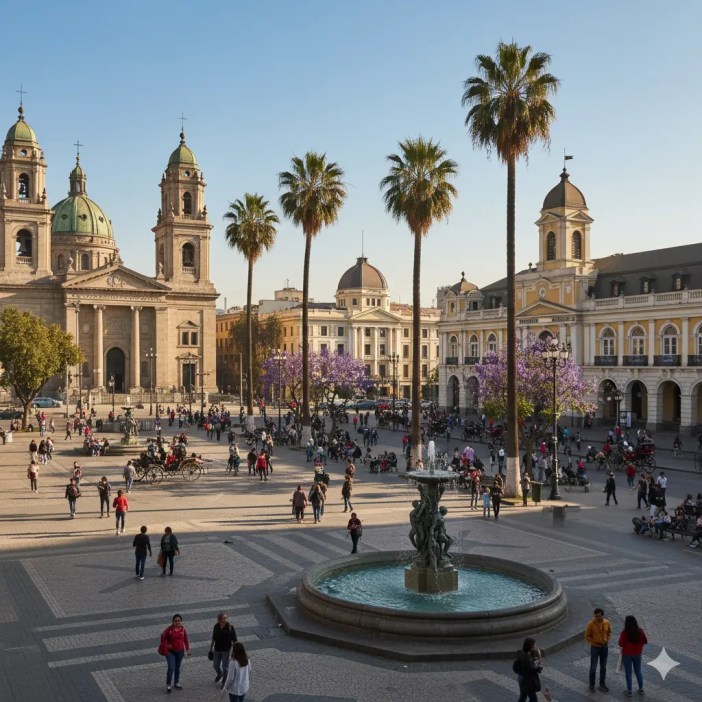
The Plaza de Armas is the historic heart and “Kilometer Zero” of Santiago, the point from which all distances in Chile are traditionally measured. Foundation (1541): It was established by the Spanish conquistador Pedro de Valdivia as the center of the newly founded city of Santiago. Following the standard Spanish colonial grid plan, it was initially a military training ground and a defensive space—hence the name, which literally means “Weapons Square.” Colonial Center: The most important colonial buildings were immediately erected around it, symbolizing Spanish power and order: the Metropolitan Cathedral (church), the Governor’s Residence (now the Central Post Office), the Royal Court Palace (now the National History Museum), and the City Council (now the Santiago Municipality). Evolution: Throughout the colonial era, the square served as the central marketplace, social hub, and stage for public events, including religious processions, festivals, and even bullfights. Modernization: In the mid-19th century, it was significantly modernized, replacing the dusty esplanade with gardens, fountains, and the iconic palm trees, transforming it into a beautiful European-style promenade. Continuing Role: Today, it remains a bustling, vibrant, and sometimes chaotic center of social, cultural, and political life, still surrounded by the original, historic government and religious institutions.
🗺️ Practical Visitor Tips for the Plaza de Armas
Here are some essential tips to help you make the most of your visit to Santiago’s historic main square:
| Tip Category | Detail |
| How to Get There | Take the Santiago Metro to the Plaza de Armas station (Line 5 or Line 3). The square is virtually right above the station, meaning it’s just a 5-minute walk to emerge into the heart of the action. |
| Best Time to Visit | Mornings (9:00 AM – 11:00 AM) are cooler and less crowded, perfect for photography and admiring the architecture. Evenings (5:00 PM – 8:00 PM) are vibrant with locals, street performers, and artists, offering a great glimpse into the city’s pulse. |
| Money-Saving Tip | It’s a public square! Enjoying the grand colonial atmosphere, resting on a bench, and people-watching the chess players and artists is completely free. The surrounding museums often have very low or free entry days, too. |
| A Word on Safety | As the city’s busiest and most central square, it attracts large crowds. Keep a close eye on your belongings (bags, phones, cameras) and be aware of your surroundings, especially during peak hours. |
The Chess Masters
I remember sitting on one of the benches near the fountain late one afternoon. I was trying to figure out which direction to head next when I noticed a small, intense crowd gathered under the palm trees. They were watching a silent battle: a group of older gentlemen playing speed chess on makeshift tables. The way they slammed the pieces down after a move, the sharp focus in their eyes, and the quiet camaraderie among the spectators perfectly captured the daily, vibrant pulse of the Plaza—a beautiful mix of history, routine, and life.
 Home Home sweet sweet home
One thought on “Santiago’s Plaza de Armas: Why This Historic Heart is Your First Stop (Cluster Page)”