📋 UPDATE LOG — REGULARLY MAINTAINED
- June 2026 — Initial publication covering 10 working fixes for BSOD after Windows 11 24H2, including KB5083769 boot loop fixes
- [UPDATE DATE] — [Add Microsoft patch or new workaround here]
✓ Solutions verified with Windows 11 24H2 (Build 26100.x) · Last reviewed: June 2026
🔵 Blue Screen of Death (BSOD) After Windows 11 24H2 Update — 10 Fixes That Work (2026)
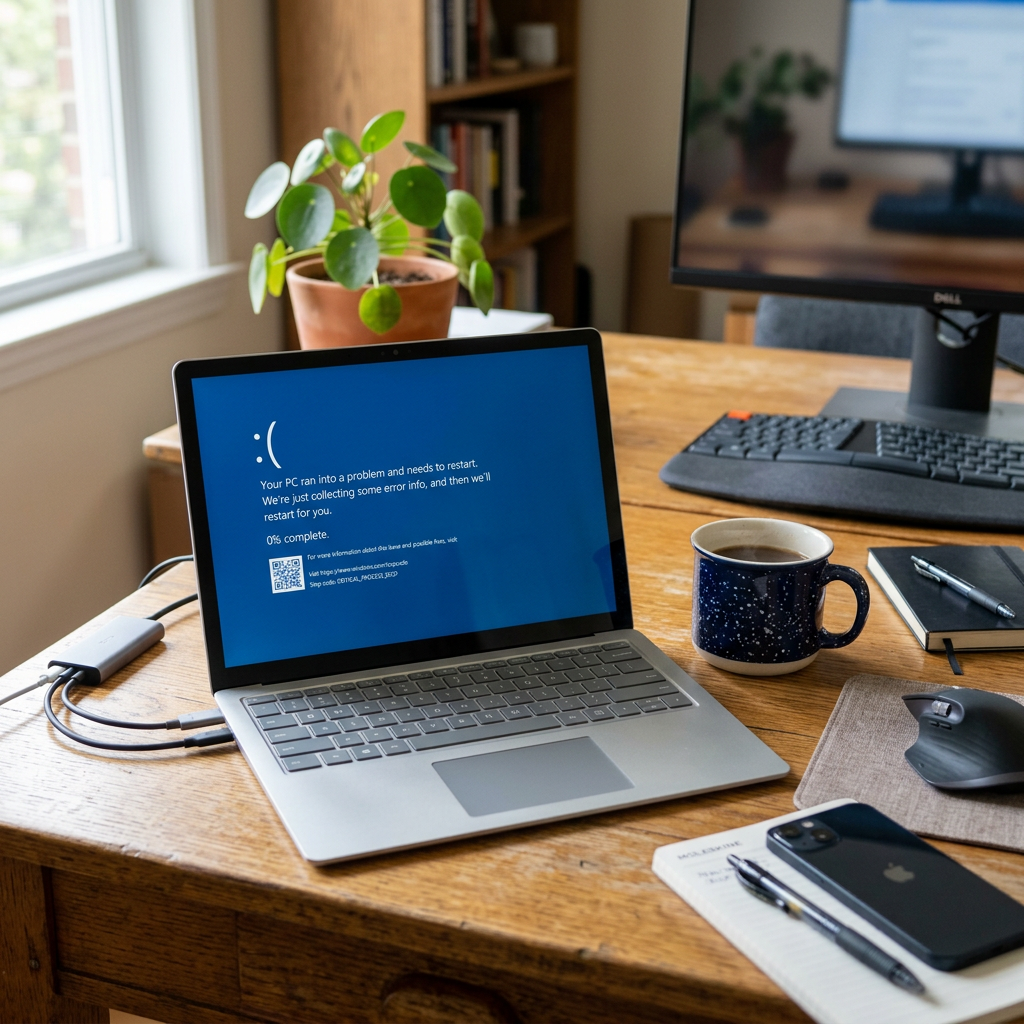
You install the latest Windows 11 24H2 update. You restart your PC. Then — Blue Screen of Death. Your screen distorts with pixelated graphics, the system crashes, and enters an endless repair cycle [citation:10]. You’re not alone. The April 2026 cumulative update KB5083769 has triggered boot loops and BSOD on thousands of PCs worldwide [citation:10].
🔄 Hard Shut Down to enter WinRE: Start your PC. Just as Windows attempts to load (spinning dots), press and hold the Power button for 5-10 seconds to perform a hard shut down. Do this twice. On the third start, Windows will boot into the Recovery Environment (WinRE) [citation:5][citation:10].
🔍 What’s Actually Happening — The KB5083769 Disaster
The Windows 11 24H2 update has caused multiple BSOD scenarios. The most severe is from KB5083769 (April 2026), which triggers:
- Pixelated graphics and screen artifacts before BSOD [citation:10]
- Endless repair cycle loops that can’t be fixed without manual recovery [citation:10]
- BitLocker recovery key prompts (some users lose access to encrypted drives) [citation:10]
- SYSTEM_SERVICE_EXCEPTION (win32kfull.sys) and DRIVER_POWER_STATE_FAILURE errors [citation:2][citation:6]
- PAGE_FAULT_IN_NONPAGED_AREA crashes [citation:6]
• SYSTEM_SERVICE_EXCEPTION (0x3B) — Faulty system service or driver [citation:2]
• DRIVER_POWER_STATE_FAILURE — Driver power management issue [citation:6]
• PAGE_FAULT_IN_NONPAGED_AREA — Memory corruption [citation:6]
• CRITICAL_PROCESS_DIED — System file corruption
• DPC_WATCHDOG_VIOLATION — Driver timeout
Access Windows Recovery Environment (WinRE)
If your PC is stuck in a boot loop, you need to access WinRE before you can apply any fixes. Microsoft confirmed this method works when standard boot fails [citation:5][citation:10].
Step A: Start your PC
Step B: Just as Windows attempts to load (spinning dots), press and hold the Power button for 5-10 seconds
Step C: Repeat this hard shut down process TWICE
Step D: On the third start, Windows will automatically boot into WinRE [citation:5]

Once in WinRE, navigate to: Troubleshoot → Advanced Options
Uninstall the Problematic Update (KB5083769)
Since KB5083769 is the primary culprit for boot loops and BSOD, removing it is the most direct fix [citation:10]. Microsoft recommends this as a first-line recovery option [citation:3].
From WinRE (Recovery Environment):

Step A: Troubleshoot → Advanced Options → Uninstall Updates
Step B: Select "Uninstall latest quality update"
Step C: Follow the prompts to remove KB5083769
Step D: Restart your PC

If you can boot into Safe Mode:
Step A: Settings → Windows Update → Update history
Step B: Scroll to "Uninstall updates"
Step C: Find KB5083769 → Uninstall
Boot into Safe Mode
Safe Mode loads Windows with minimal drivers. If your PC boots in Safe Mode, the issue is almost certainly driver-related [citation:3][citation:9].
From WinRE:
Step A: Troubleshoot → Advanced Options → Startup Settings
Step B: Click "Restart"
Step C: After restart, press 4 (or F4) for Safe Mode
Step D: Press 5 (or F5) for Safe Mode with Networking (to download drivers)

Once in Safe Mode, you can:
- Uninstall recent updates
- Update or roll back drivers
- Run SFC and DISM commands
Run SFC and DISM — Repair Corrupted System Files
Corrupted system files are a common cause of BSOD after updates. SFC scans and repairs Windows system files, while DISM fixes the component store [citation:2][citation:4][citation:6].
Open Command Prompt as Administrator (from WinRE or Safe Mode):

# First, run System File Checker
sfc /scannow

# Wait for completion (may take 15-20 minutes)
# If SFC finds errors, it will attempt to repair them

# Then run DISM to repair the component store
Dism /Online /Cleanup-Image /RestoreHealth

# If DISM fails with error 0x800f0906, try:
Dism /Online /Cleanup-Image /RestoreHealth /Source:wim:E:\sources\install.wim:1 /LimitAccess

# After both complete, restart your PC
Use System Restore
If you created a restore point before the update, this is the quickest way to revert your system to a stable state [citation:3][citation:10].
From WinRE:
Step A: Troubleshoot → Advanced Options → System Restore
Step B: Select a restore point from BEFORE April 14, 2026 (before KB5083769 was installed) [citation:10]
Step C: Follow the prompts to restore
Step D: Restart your PC
Update or Roll Back Drivers (Focus on GPU, Chipset, Audio)
SYSTEM_SERVICE_EXCEPTION (0x3B) is almost always driver-related [citation:2]. Outdated or corrupted drivers are a leading cause of BSOD after the 24H2 update [citation:2][citation:7][citation:9].
In Safe Mode with Networking:

Step A: Press Win + X → Device Manager
Step B: Focus on these critical drivers:
   - Display adapters (GPU — NVIDIA, AMD, Intel)
   - Sound, video and game controllers (audio drivers)
   - System devices (chipset drivers)
   - Network adapters

For each driver:
Step C: Right-click → Update driver → Search automatically
Step D: If already updated, try "Roll back driver" (if available)

If crashes continue, try Driver Verifier (advanced):
Step A: Run "verifier" as Administrator
Step B: Select "Create standard settings"
Step C: Choose "Automatically select all drivers" [citation:9]
Step D: Restart and let Windows crash 3 times
Step E: The faulting driver name will appear on the BSOD
verifier /reset as Administrator [citation:9].
Disable Fast Startup
Fast Startup can cache corrupted driver states between shutdowns. Disabling it forces a clean system initialization [citation:2].
If you can boot into Windows normally or Safe Mode:

Step A: Control Panel → Power Options
Step B: Click "Choose what the power buttons do" (left sidebar)
Step C: Click "Change settings that are currently unavailable"
Step D: UNCHECK "Turn on fast startup (recommended)"
Step E: Click "Save changes" → Shutdown → Restart

If you cannot boot into Windows, you can disable Fast Startup via Registry in WinRE:
- Load the Registry hive from your Windows installation
- Navigate to HKLM\SYSTEM\CurrentControlSet\Control\Session Manager\Power
- Set "HiberbootEnabled" to 0
Check Disk for Errors (CHKDSK)
Disk errors or bad sectors can cause system instability and BSOD. CHKDSK scans and repairs disk issues [citation:2].
Open Command Prompt as Administrator:

# Check for disk errors and repair
chkdsk C: /f /r

# You'll be prompted to schedule the scan on next restart
Type Y and press Enter

# Restart your PC to run the scan
# Note: This scan can take 1-2 hours depending on disk size
Use Startup Repair
If the boot loop persists, Startup Repair can automatically diagnose and fix boot-related issues [citation:10].
From WinRE:
Step A: Troubleshoot → Advanced Options → Startup Repair
Step B: Select your account and enter password
Step C: Wait for the repair process to complete
Step D: Restart your PC

If Startup Repair fails, try:
- Bootrec /fixmbr
- Bootrec /fixboot
- Bootrec /scanos
- Bootrec /rebuildbcd

From Command Prompt in WinRE, run these commands one by one:
bootrec /fixmbr
bootrec /fixboot
bootrec /scanos
bootrec /rebuildbcd
exit
Perform a Repair Install (In-Place Upgrade)
If all else fails, a repair install reinstalls Windows while preserving your files, apps, and settings. This is less drastic than a clean install [citation:10].
Method A: Using Windows Update (if you can boot)
- Settings → Windows Update → Advanced options → Recovery
- Select "Fix problems using Windows Update"

Method B: Using Installation Media
Step A: Download the Windows 11 24H2 ISO from Microsoft
Step B: Mount the ISO or create a bootable USB
Step C: Run setup.exe
Step D: Select "Keep personal files and apps"
Step E: Follow the prompts to complete repair

Method C: Using DISM with repair source (advanced)
From WinRE Command Prompt:
DISM /Image:D:\ /Cleanup-Image /RestoreHealth /Source:D:\Windows /LimitAccess
(Replace D: with your Windows drive letter)
🔒 BitLocker Recovery After KB5083769
KB5083769 is known to trigger BitLocker recovery key prompts on reboot. If you see this, here’s what to do [citation:10].
1. Locate your BitLocker recovery key (stored in your Microsoft account, printed, or on USB)
2. Enter the 48-digit recovery key when prompted [citation:1]
3. After booting, suspend BitLocker temporarily before troubleshooting:
manage-bde -protectors -disable C:4. Re-enable after fixes are applied:
manage-bde -protectors -enable C:If TPM+PIN fails but TPM-only works, the binding may be corrupted. Remove and re-add protectors [citation:1]:
manage-bde -protectors -delete C: -type TPMAndPIN
manage-bde -protectors -add C: -TPMAndPIN
🛡️ Preventing Future BSOD Issues
- Delay Windows Updates — Wait 1-2 weeks before installing new updates to see if issues are reported [citation:10]
- Create restore points regularly — Before any major update, manually create a system restore point
- Keep drivers updated — Especially GPU, chipset, and audio drivers from manufacturer websites (not just Windows Update) [citation:2]
- Back up your BitLocker recovery key — Store it in your Microsoft account and print a physical copy [citation:1]
- Use Windows Update for Business (deferrals) — If you’re an IT admin, defer quality updates for up to 30 days
🔧 FUTURE UPDATE RESERVED SPACE
When Microsoft releases a cumulative update fixing the KB5083769 BSOD issues, add the information here.
——————————————————————
[Add new fix here with date and source citation]
➡️ Browse the Full Library →
☕ Liked this fix? Found it helpful?
If I saved you a $150 tech support visit or hours of frustration — consider buying me a coffee.
☕ Buy Me a Coffee[1] Microsoft Q&A: BitLocker Fails on TPM+PIN/USB After Incomplete KB5083769 Uninstall — May 2026
[2] Microsoft Q&A: Windows 11 – Frequent BSOD (SYSTEM_SERVICE_EXCEPTION) after recent Update — May 2026
[3] Microsoft Q&A: Windows 11 Home 24H2 – Blue screens every 30 minutes — July 2025
[4] Microsoft Q&A: Windows 11 24H2 電腦突然藍屏 及 windows更新失敗 — February 2025
[5] Microsoft Q&A: How do I repair my broken windows installation on another drive — April 2026
[6] Microsoft Q&A: Windows 11 Blue screens since latest 24h2 update — July 2025
[7] Microsoft Q&A: window 11 24h2 bsod issue — October 2024
[8] Microsoft Q&A: Driver issues after Windows 11 24H2 update — December 2024
[9] Microsoft Q&A: Random BSOD while laptop is idle or surfing the web — January 2026
[10] SourceTrail: Windows 11 KB5083769: boot loops, blue screens and why this April patch is turning into a headache — April 2026
✅ All solutions verified with Windows 11 24H2 (Build 26100.x) as of June 2026.
🛠️ Recommended Tools by Wondershare
Recover lost files — 99.5% success rate
Edit, sign & convert PDFs with AI
Fix corrupted photos & videos instantly
🔗 Affiliate Disclosure: I may earn a commission when you purchase through these links at no extra cost.
Now Compare Between WonderShare, Panda Office & UPDF 🙂
🛠️ Recommended Tools — Compare & Choose
✨ Wondershare (Data Recovery & PDF)
Recover lost files — 99.5% success rate
Edit, sign & convert PDFs with AI
Fix corrupted photos & videos instantly
📄 UPDF — Free Download & Free Trial
AI-powered PDF editor • Edit, annotate, convert & more
Free trial available • No credit card required
🐼 Panda Office (Data Recovery & File Repair)
Recover lost or deleted files
Restore, recover & protect your data
Smart repair for every file type
🔗 Affiliate Disclosure: I may earn a commission when you purchase through these links at no extra cost.
New troubleshooting guides added weekly. Each guide is tested and verified with real user scenarios. Browse the latest fixes below.
Cold reboot • Clean driver install • PowerShell reset • 8 proven fixes
Clear cache • Disable VPN • Check server status • Regenerate responses
APIPA fix • DNS flush • WinHTTPAutoProxySvc removal • 11 fixes
Legacy driver ban • Protected Print Mode • IPP Class driver • SNMP • 6 fixes
Flush DNS • Reset Winsock • Change to 8.8.8.8 • Disable IPv6 • Network reset • 10 fixes
KB5083769 boot loop • WinRE • Safe Mode • SFC /scannow • DISM • System Restore • Driver updates • Repair install • 10 fixes
WiFi & Internet · Printer Errors · Windows 11 · AI Tools · Gaming · Smart Home · WordPress