Unlocking YouTube: Micro-Niches for 2026


If you’ve tried starting a YouTube channel in the last few years, you’ve probably felt it: everything looks saturated.

Cooking? Crowded.
Kids content? Overloaded.
Productivity advice? Everywhere.
AI tutorials? Exploding by the hour.

But here’s what most creators misunderstand — YouTube isn’t saturated. Broad niches are.

The real opportunity in 2026 isn’t doing something completely new. It’s positioning yourself inside a growing micro-niche where competition is still low but curiosity is high.

If you’re a content creator looking for smarter angles, here are four underrated niches that combine search demand, originality, and monetization potential.


1. Historical Recipe Reconstructions (History + Cooking)

Cooking content is crowded. But history-driven cooking? Not so much.

Instead of “Easy Pasta in 10 Minutes,” imagine:

  • Recreating a snack from Ancient Rome
  • Cooking a Victorian-era dessert from an old cookbook
  • Making a Great Depression budget meal

This niche works because it blends education, storytelling, ASMR, and curiosity. Viewers don’t just watch for the recipe — they watch to experience the past.

Why It’s Promising

  • Evergreen search traffic (“What did Romans eat?”)
  • Strong long-form watch time
  • Educational CPMs tend to be higher
  • Great for both Shorts and documentaries

The key here is research and patience. Most creators won’t dig through 18th-century cookbooks — and that’s exactly why this niche has room.


2. Digital Minimalism for Students (Not CEOs)

Productivity content is everywhere — but it usually targets entrepreneurs and executives.

What’s missing? Realistic digital minimalism advice for:

  • College students
  • Remote workers
  • Exam-focused learners
  • Overwhelmed 9-to-5 employees

Topics like:

  • How I rearranged my phone to stop doom-scrolling
  • 3 apps that replaced my social media addiction
  • A 7-day dopamine reset challenge

These videos perform well because they have a high “save” rate. People bookmark them for later when they’re serious about change.

Why This Niche Works

  • Rising concern about screen time
  • Mental clarity and focus are trending topics
  • Easy production (talking head or simple B-roll)
  • Strong affiliate potential (apps, planners, productivity tools)

The trick? Be specific. “Digital minimalism for engineering students” will outperform generic advice every time.


3. Micro-Gardening for Tiny Apartments

Gardening content is huge — but most creators have backyards.

Urban creators don’t.

That’s where micro-gardening comes in:

  • Growing lettuce on a windowsill
  • Hydroponic mason jar herbs
  • Mushroom kits in small apartments
  • Balcony vegetable gardens

This niche is solution-based. It speaks directly to people living in small spaces who still want a touch of nature.

Why It’s Underrated

  • Low competition in the “tiny space” angle
  • Highly visual and satisfying content
  • Strong affiliate opportunities (grow lights, kits, planters)
  • Evergreen demand

It’s slower growth compared to trendy niches, but it builds a loyal audience.


4. AI Tools for Specific Hobbies (Not Business Gurus)

This is the most interesting opportunity right now.

“AI for business” is saturated.

But “AI for hobbies” is wide open.

Examples:

  • Using AI to generate Dungeons & Dragons maps
  • AI tools for horror writers
  • AI for amateur travel photo editing
  • AI storytelling tools for YouTubers

This approach removes the skepticism around “make money online” content and replaces it with creativity and fun.

Why This Niche Has Huge Potential

  • AI is still trending
  • Hobby communities are loyal and engaged
  • Easier authority positioning
  • Strong affiliate and software sponsorship opportunities

Instead of promising income, you’re helping people enjoy their passion more.

And that builds trust.


How to Choose the Right Low-Competition Niche

Before jumping into any idea, ask yourself:

  • Do I enjoy researching deeply?
  • Do I prefer talking on camera or faceless content?
  • Do I want fast growth or long-term stability?
  • Can I consistently produce this for 6 months?

A niche isn’t just about search volume. It’s about sustainability.

Many creators fail not because the niche was bad — but because they couldn’t stick with it.


The Real Strategy for 2026

Stop chasing trends at surface level.

Instead:

  1. Pick a broad category.
  2. Narrow it to a specific audience.
  3. Add a unique angle (history, small spaces, students, hobbyists).
  4. Stay consistent for 90 days.

YouTube rewards clarity more than creativity.

When your channel is easy to describe in one sentence, growth becomes easier.

For example:

  • “I recreate forgotten historical recipes.”
  • “I help students reduce screen addiction.”
  • “I grow food in a 400 sq ft apartment.”
  • “I show hobbyists how to use AI creatively.”

Specific positioning beats broad ambition.


Final Thoughts

In 2026, the creators who win won’t be the loudest.
They’ll be the most focused.

Low-competition YouTube niches exist — but they require you to think smaller before you grow bigger.

And sometimes, the smartest move isn’t entering a crowded market.

It’s finding the corner of the internet that hasn’t been fully explored yet.


For the above video

Title: The Last Seen Online

Scene 1 – The Notification

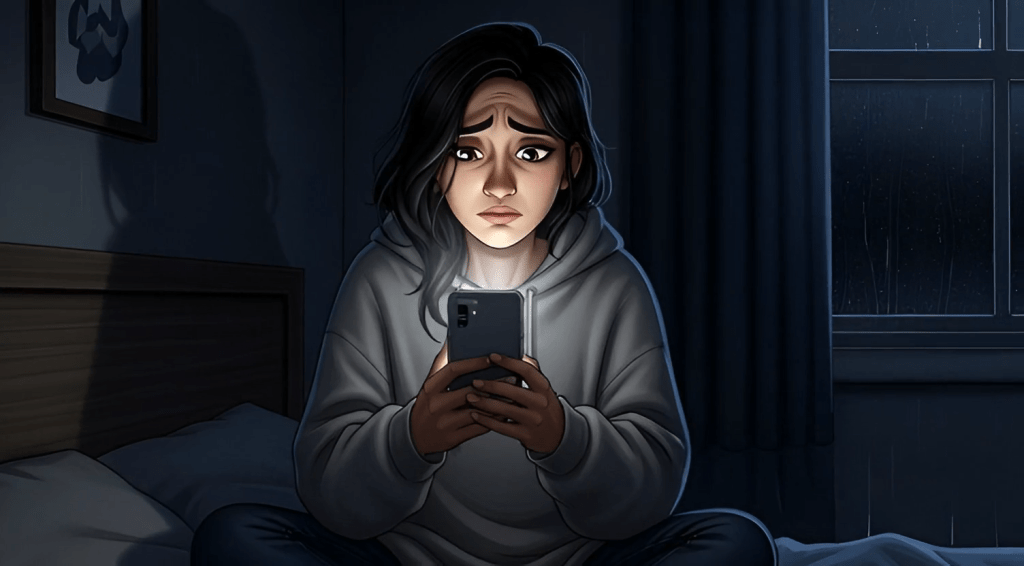
It was 2:17 a.m. when Maya’s phone buzzed.
A message popped up from her best friend, Riya.

“I can see you.”

Maya frowned. Riya had gone missing three days ago. The police said her phone was never recovered.
Maya typed back with shaking fingers.

“This isn’t funny. Who is this?”

The typing bubble appeared instantly… then vanished.


Scene 2 – The Camera Light

Maya laughed nervously and locked her phone.
That’s when she noticed it.

A tiny green light flickered on her laptop webcam.

She hadn’t opened her laptop.

Her phone buzzed again.

“You forgot to cover the camera.”

Maya slammed the laptop shut and backed away, heart pounding.


Scene 3 – The Photo

Another notification arrived.

An image loaded slowly.

It was Maya, standing in her room… taken from behind.

Her blood ran cold.
She was home alone.

She spun around. The room was empty.

Her phone vibrated once more.

“Turn around.”


Scene 4 – The Voice

The lights flickered and went out.

In the darkness, Maya heard breathing—soft, uneven, right behind her ear.

Her phone screen lit up one last time.

“Now you’re not.”


Scene 5 – Last Seen

The next morning, Maya’s phone was found on her bed.
Unlocked. Warm.

The final message sent from her account read:

“I can see you.”

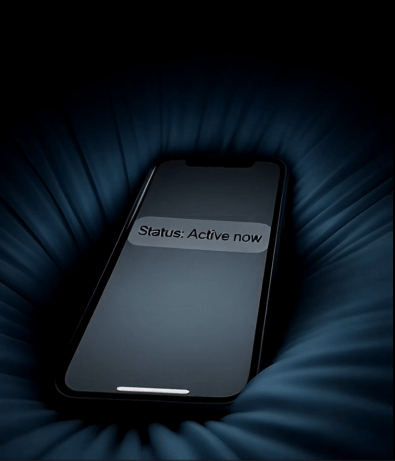
Status: Last seen at 2:17 a.m.

Perfect—this is ready-made for AI text-to-video tools like Runway, Pika, Luma, Kaiber, or similar.
I’ll give you scene-wise prompts, plus character consistency and voice consistency prompts you can reuse across all scenes.


🎬 STORY: The Last Seen Online

Style: Realistic horror, dark, cinematic, slow tension
Video Ratio: 9:16 (Shorts) or 16:9 (YouTube)
Mood: Psychological, eerie, minimal jump scares


🔁 GLOBAL CHARACTER CONSISTENCY (USE IN EVERY SCENE)

Main Character – Maya

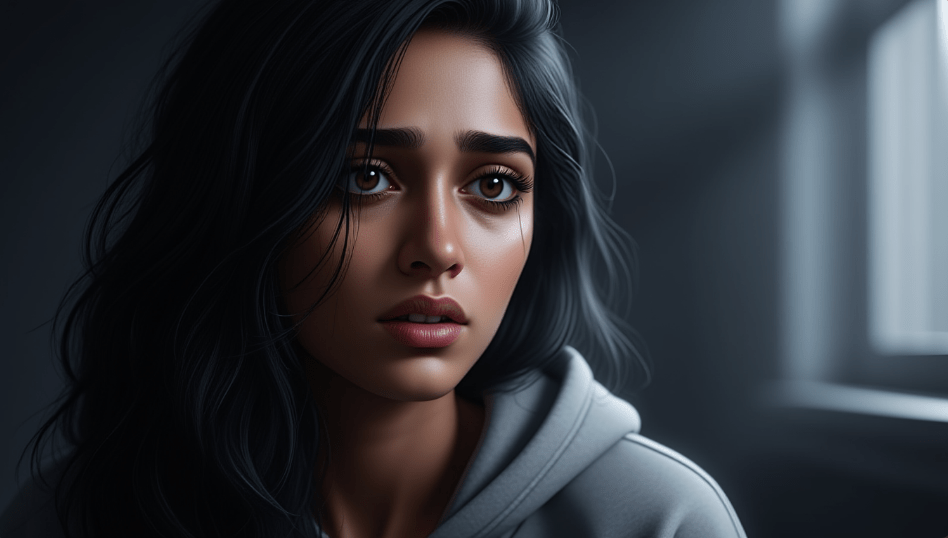
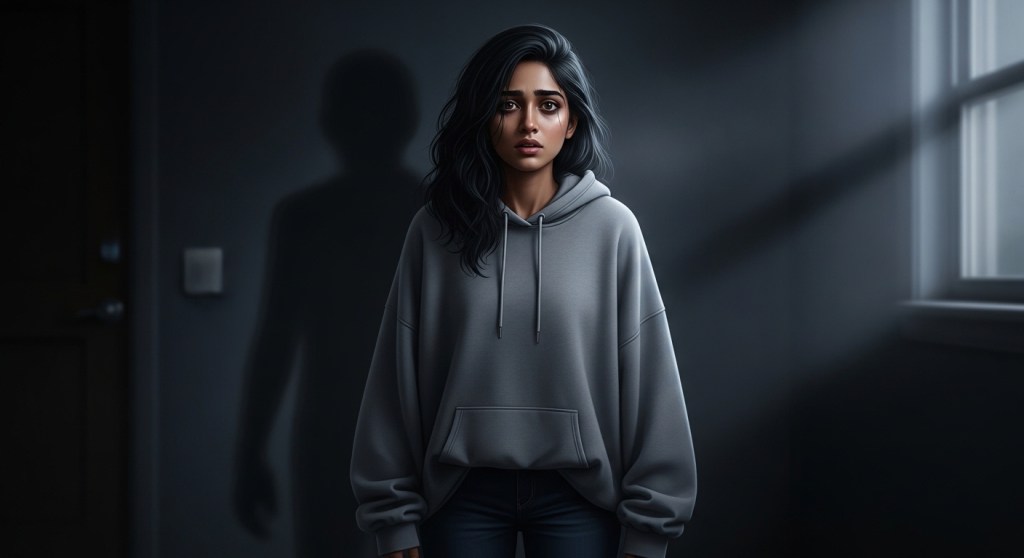
  • Female, age 23–26
  • Slim build, average height
  • Long black hair, slightly wavy
  • Brown eyes, tired look, subtle dark circles
  • Wearing oversized grey hoodie, dark jeans
  • Expression: anxious, alert, slowly terrified
  • Ethnicity: South Asian / Indian appearance

👉 Add this exact description to every scene prompt to maintain consistency


🎙️ VOICE CONSISTENCY PROMPT (USE FOR ALL SCENES)

Narrator Voice Prompt (Copy-Paste):

Calm female voice, low pitch, slow pacing, soft whisper tone, emotional but controlled, cinematic horror narration, slight echo, clear pronunciation, suspenseful pauses, consistent voice across all scenes

Optional Character Voice (Messages / Whisper):

Distorted female whisper voice, unnatural calm, slightly glitchy, soft breathing layered under speech


🎞️ SCENE-BY-SCENE TEXT-TO-VIDEO PROMPTS


🎬 SCENE 1 – The Notification

Video Prompt:

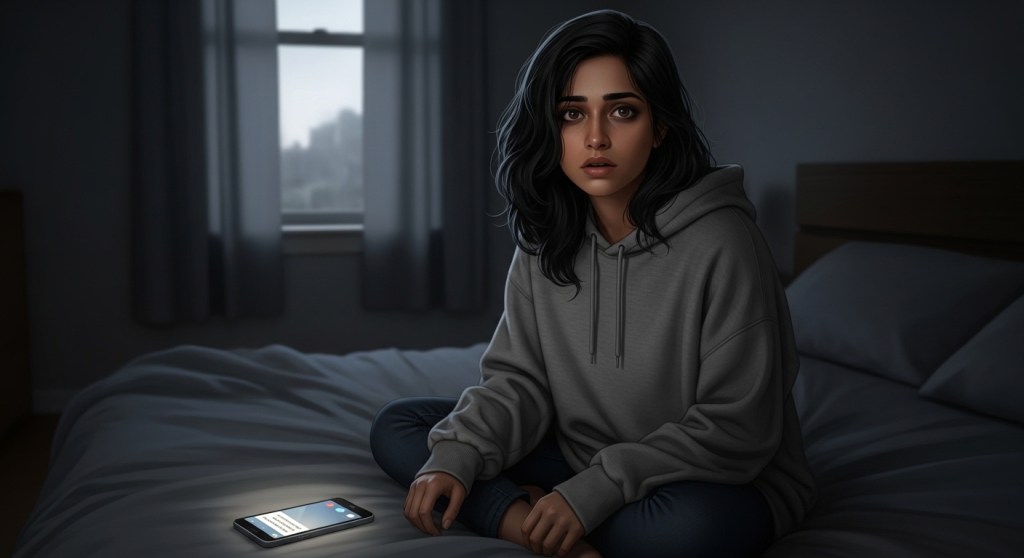
A dark bedroom at night, only phone light illuminating the face of Maya, a young woman sitting on her bed. Rain softly tapping against the window. Phone screen lights up with a notification. Maya’s face shifts from sleepy to confused. Cinematic lighting, shallow depth of field, realistic shadows, horror atmosphere, slow camera push-in, tense mood.

On-Screen Text (optional):

2:17 A.M.

Voiceover Script Prompt:

Calm female horror narration describing a late-night notification from a missing friend


🎬 SCENE 2 – The Camera Light

Video Prompt:

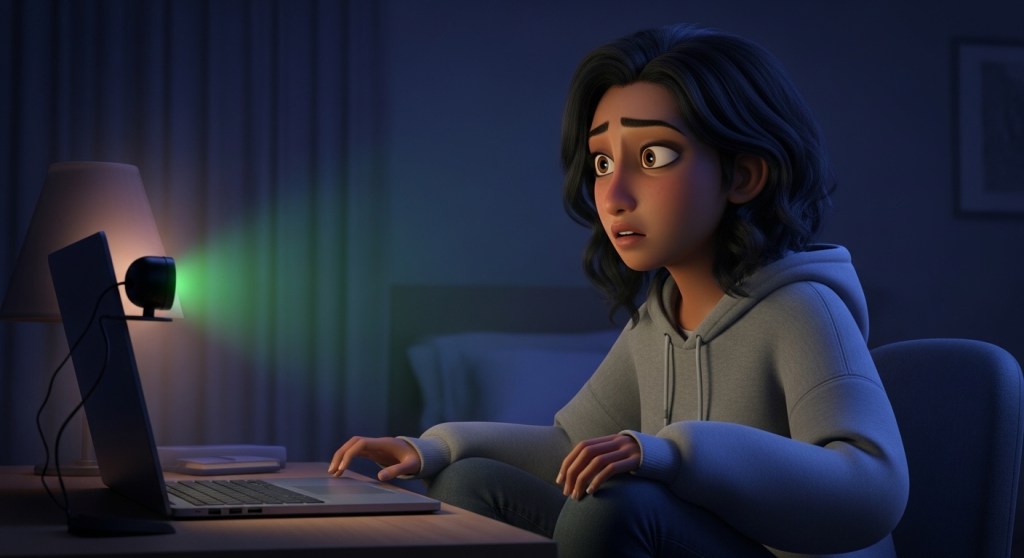
Maya sitting at her desk in the same dark bedroom. A laptop on the table suddenly shows a small green webcam light turning on by itself. Maya notices it, her breath becomes shaky. Camera slowly zooms toward the glowing webcam light. Low light, blue shadows, psychological horror style, realistic fear expression.

Sound Prompt (optional):

Soft electronic hum, faint static, distant heartbeat


🎬 SCENE 3 – The Photo

Video Prompt:

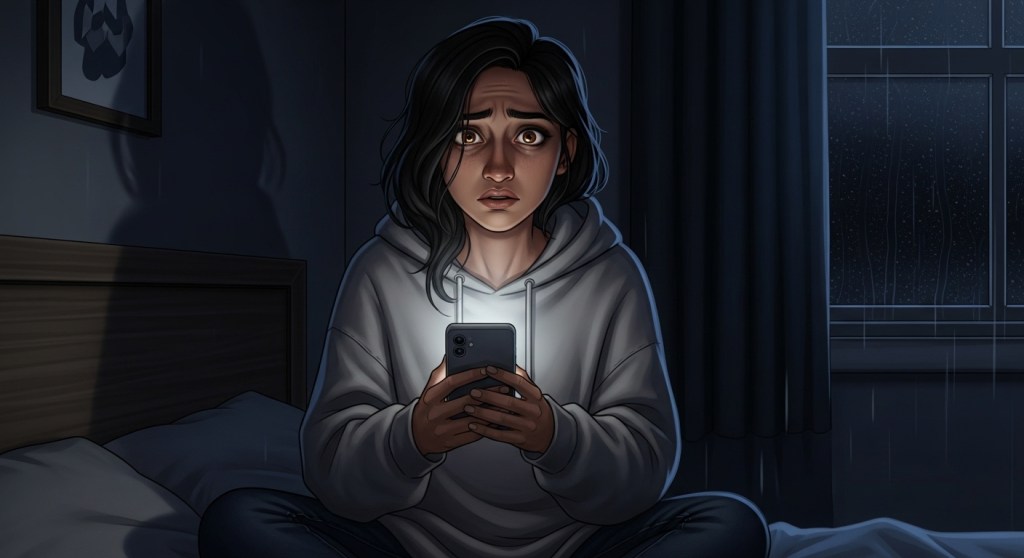
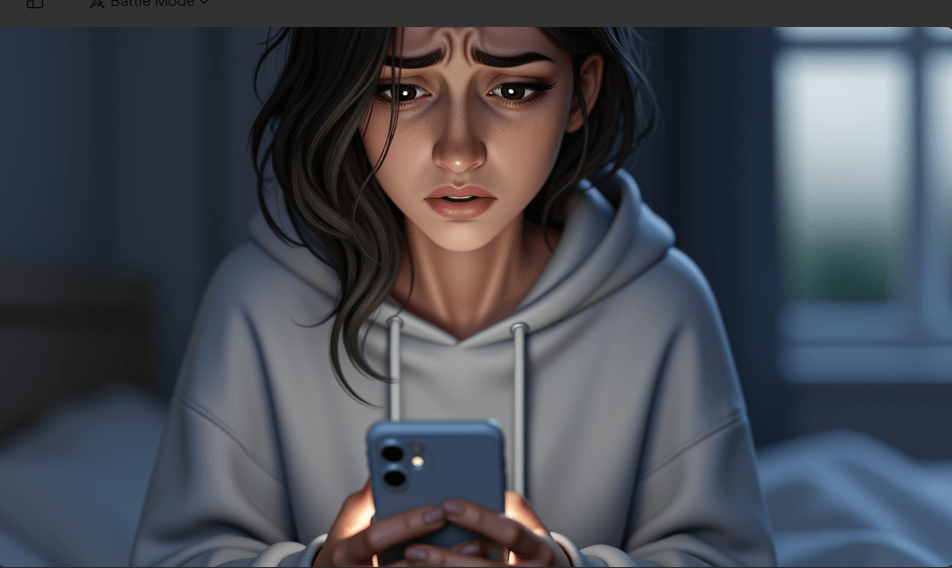
Close-up of Maya holding her phone, screen glowing. Her face drains of color as an image appears on the phone. Reflected in her eyes is a photo of herself taken from behind in the same room. Background slightly blurred, slow-motion fear reaction, trembling hands, cinematic horror lighting.

Visual Detail Prompt:

Phone screen glow reflects on face, high realism, suspenseful pause


🎬 SCENE 4 – The Voice

Video Prompt:

Lights suddenly flicker and shut off. Total darkness except faint moonlight from the window. Maya stands frozen. A shadowy, human-like silhouette barely visible behind her. Camera slowly moves closer to her face as she hears breathing near her ear. Extreme tension, horror realism, subtle movement in shadows.

Whisper Voice Prompt:

Distorted whisper voice saying a short sentence close to the listener’s ear


🎬 SCENE 5 – Last Seen

Video Prompt:

Morning light enters the bedroom. Maya’s phone lies on the bed, screen on. No sign of Maya. Camera slowly pans over the empty room. On the phone screen: a sent message reading “I can see you.” Eerie silence, cold daylight horror, unsettling calm ending.

Ending Text Prompt:

Last seen at 2:17 A.M.


Got it 👌
Below are clean, copy-paste–ready text-to-image prompts for every scene, designed for Midjourney, Leonardo, DALL·E, Playground, Firefly, etc.
They maintain character consistency, lighting, and horror tone across all scenes.


🩸 STORY: The Last Seen Online

Art Style (use in all prompts):

cinematic realistic horror, ultra-detailed, photorealistic, dramatic lighting, shallow depth of field, dark color grading, film grain, high contrast, eerie atmosphere


🔁 CHARACTER CONSISTENCY (ADD TO EVERY PROMPT)

young South Asian woman, age 24–26, slim build, long slightly wavy black hair, brown eyes with dark circles, anxious expression, wearing oversized grey hoodie and dark jeans


🎨 SCENE 1 – The Notification

Text-to-Image Prompt:

dark bedroom at night, young South Asian woman sitting on her bed holding a glowing smartphone, phone light illuminating her anxious face, rain on window, shadows on walls, tense expression, cinematic horror lighting, realistic textures, shallow depth of field, eerie silence, suspenseful mood

Negative Prompt (optional):

cartoon, anime, smiling, bright colors, daylight, low detail, blurry


🎨 SCENE 2 – The Camera Light

Text-to-Image Prompt:

dimly lit bedroom, young South Asian woman seated at a desk, laptop open with small green webcam light glowing unnaturally, her face turned toward the camera light in fear, blue-tinted shadows, psychological horror atmosphere, cinematic realism, soft fog in room, tension in body language

Negative Prompt:

comedy, warm lighting, exaggerated expressions, fantasy style


🎨 SCENE 3 – The Photo

Text-to-Image Prompt:

close-up of young South Asian woman holding a smartphone, screen glowing bright, terror reflected in her eyes, phone screen showing a photo of her own back inside the same room, trembling hands, intense fear, cinematic horror close-up, high realism, dramatic shadows

Negative Prompt:

visible text distortion, extra fingers, warped face, illustration style


🎨 SCENE 4 – The Voice

Text-to-Image Prompt:

dark room with lights off, faint moonlight entering through window, young South Asian woman standing frozen in fear, barely visible shadowy human-like silhouette behind her, subtle breathing presence, chilling horror mood, deep shadows, cinematic framing, realistic supernatural tension

Negative Prompt:

clear monster face, gore, fantasy creature, bright lighting


🎨 SCENE 5 – Last Seen

Text-to-Image Prompt:

early morning light in quiet bedroom, empty room, smartphone lying on bed with screen glowing, message visible on phone, unsettling calm atmosphere, cold daylight horror, cinematic realism, feeling of disappearance, haunting stillness

Negative Prompt:

people present, cheerful tone, oversaturated colors

The Power of Short Horror Stories


Short horror stories are quietly becoming one of the highest-engagement formats on platforms like YouTube Shorts, TikTok, Instagram Reels, and even blogs. What makes them powerful isn’t expensive animation, jump scares, or gore — it’s curiosity.

Let’s break down why a simple psychological horror story like “The Last Seen Online” works so well and how content creators can use this format to grow faster.


Why Psychological Horror Works Better Than Gore

Modern audiences scroll fast. They don’t want long setups or overdone visuals. Psychological horror taps into something more effective: relatability.

Everyone has:

  • A phone
  • Been awake late at night
  • Felt that quiet, unsettling silence at 2 a.m.

When a story starts with something familiar — like a phone lighting up — viewers instantly lean in. That’s where retention begins.

SEO note: psychological horror stories, short horror content, and creepy phone stories are currently strong search interests across the US, Canada, UK, and Australia.


The Story Concept (Simple, But Effective)

Every night at exactly 2:17 a.m., a phone receives a message — from its own number.

No monsters. No blood. Just a slow realization that the messages are being sent from inside the apartment.

This kind of storytelling works because:

  • It creates an open loop
  • It lets the viewer’s imagination do the work
  • It feels realistic, not cinematic

For content creators, realism = comments.


Why This Format Is Perfect for Short-Form Video Creators

Short horror stories like this are ideal for:

  • AI-generated videos
  • Stock footage
  • Minimal animation
  • Voice-over storytelling

You don’t need complex visuals. A dark room, a glowing phone, subtle sound design — that’s enough.

Creators using this format often see:

  • Higher watch time
  • Strong repeat views
  • More comments than likes (a good thing for algorithms)

The Real Growth Hack: Let the Audience Finish the Story

The most powerful part of this horror story isn’t the ending — it’s the lack of one.

Ending with a line like:

“If this were you… would you turn around?”

invites the viewer into the story. Instead of passively watching, they start thinking — and then commenting.

This does three important things:

  1. Boosts engagement signals
  2. Builds community
  3. Gives you free ideas for Part 2

For creators, this is gold.


SEO + GEO Tip for Horror Content Creators

When publishing horror stories as blogs or videos, avoid stuffing keywords like “scary story” repeatedly. Instead, naturally use variations such as:

  • short horror story
  • psychological horror
  • creepy late-night stories
  • horror storytelling for content creators
  • AI horror videos

Mention locations subtly when relevant (e.g., “popular in the US and Canada”) to help with GEO optimization without sounding forced.

Search engines favor natural language — and so do humans.


Why This Works Across Platforms

This single horror concept can be repurposed into:

  • YouTube Shorts
  • TikTok videos
  • Instagram Reels
  • Blog posts
  • Email newsletters
  • Podcast narration

Content creators who reuse one story across platforms save time and build recognizable themes — something algorithms love.


Final Thoughts for Content Creators

You don’t need a big budget to tell a scary story. You need:

  • A relatable idea
  • Controlled pacing
  • An ending that invites participation

If you’re a content creator looking to grow in 2025, psychological horror is not just entertainment — it’s a strategy.

And sometimes, the scariest stories are the ones that don’t end at all.


Story

The Last Seen Online

Every night at exactly 2:17 a.m., my phone lights up.

“Are you awake?”

It’s from my own number.

At first, I thought it was a glitch. Maybe an app bug. Maybe sleepwalking me was sending messages. I laughed it off—until I replied.

Me: Who is this?
Me: Stop messing around.

Three dots appeared instantly.

Unknown: You shouldn’t be in my room.

My heart started hammering. I was alone. Door locked. Curtains closed.

I checked the sent info.
The messages weren’t sent from my phone.

They were sent to my phone… from inside my apartment.

I sat frozen on the bed, staring at the screen, when another message came through.

Unknown: Don’t turn around.

The phone slipped from my hand.

Behind me, the mattress dipped—as if someone had just sat down.

And my screen lit up one last time.

Status: Active now.

Scene 1: The Routine

Setting: Bedroom, night.
Visual: A dark room. Phone screen lights up at 2:17 a.m.
Sound: Soft phone buzz. Distant silence.

Text/Narration:

Every night at exactly 2:17 a.m., my phone lights up.


Scene 2: The Message

Setting: Close-up on phone screen.
Visual: Message notification appears.

On Screen Text:

“Are you awake?”
Sender: My own number.

Emotion: Confusion, mild unease.


Scene 3: Dismissal

Setting: Bed, half-lit by phone glow.
Visual: Fingers typing. Slight smile, brushing it off.

On Screen Text:

Who is this?
Stop messing around.

Emotion: Skeptical, calm.


Scene 4: Immediate Reply

Setting: Extreme close-up of phone.
Visual: Typing dots appear instantly.

On Screen Text:

You shouldn’t be in my room.

Sound: Low hum or rising tension tone.


Scene 5: Reality Check

Setting: Wide shot of the bedroom.
Visual: Locked door. Closed curtains. Empty room.

Narration:

My heart started hammering. I was alone. Door locked. Curtains closed.


Scene 6: The Location

Setting: Phone screen – message details.
Visual: Location pin or text: Sent from inside your apartment.

Emotion: Fear sets in.

Sound: Heartbeat.


Scene 7: Frozen

Setting: Bed, protagonist sitting still.
Visual: Sweat. Wide eyes. Darkness behind.

On Screen Text:

Don’t turn around.

Sound: Silence drops out completely.


Scene 8: The Presence

Setting: Same room, darker.
Visual: Mattress slowly sinks beside the protagonist.

Sound: Soft fabric shift. Breathing.

Narration:

The mattress dipped—as if someone had just sat down.


Scene 9: Final Ping

Setting: Phone on the bed or floor.
Visual: Screen lights up one last time.

On Screen Text:

Status: Active now.

Cut to black.

🎬 GROK TEXT-TO-VIDEO PROMPTS

Style for all scenes (you can reuse this line):

cinematic horror, realistic lighting, dark atmosphere, shallow depth of field, slow camera movement, film grain, high tension, night setting, 4K, realistic human, no text on screen


Scene 1 – The Routine

Prompt:

A dark bedroom at night, only moonlight through a small window, a smartphone lying on a bed suddenly lights up at 2:17 a.m., eerie silence, slow zoom toward the glowing phone, cinematic horror mood, realistic shadows, unsettling calm


Scene 2 – The Message

Prompt:

Extreme close-up of a smartphone screen glowing in the darkness, a message notification appears saying “Are you awake?”, sender shown as the same phone number, blue light reflecting on the wall, suspenseful atmosphere, shallow depth of field


Scene 3 – Dismissal

Prompt:

A person sitting on a bed in a dimly lit room, casually holding a phone, typing a reply, relaxed body language but dark surroundings, soft phone light on their face, calm before the storm, cinematic tension


Scene 4 – Immediate Reply

Prompt:

Close-up on phone screen showing typing dots appearing instantly, message reads “You shouldn’t be in my room”, lighting flickers slightly, sudden rise in tension, ominous horror tone, slow camera push in


Scene 5 – Reality Check

Prompt:

Wide shot of an empty bedroom at night, locked door, closed curtains, still air, shadows stretching across the room, unsettling silence, feeling of isolation, realistic horror lighting


Scene 6 – The Location

Prompt:

Close-up of phone message details showing location sent from inside the apartment, phone trembling slightly in a hand, heartbeat tension, dark background, cinematic psychological horror


Scene 7 – Frozen

Prompt:

Person sitting frozen on the bed, eyes wide with fear, phone glowing in their hand, darkness behind them feels heavy, message on phone reads “Don’t turn around”, slow zoom, intense suspense


Scene 8 – The Presence

Prompt:

Side view of a bed in a dark room, mattress slowly sinking as if someone invisible sits down, no figure visible, only movement in fabric, chilling atmosphere, realistic paranormal horror


Scene 9 – Final Ping

Prompt:

Smartphone lying on the bed lights up one last time in total darkness, message reads “Status: Active now”, eerie glow illuminating the room, sudden cut to black feeling, final horror moment

Pip’s Polar Lantern: A Heartwarming Adventure

Hey there, friends! Gather around—I want to share a story with you. It’s one of those tales that warms your heart, perfect for a snowy afternoon or a cozy bedtime. It’s about a little penguin named Pip, and his adventure to bring light back to his home. So, grab a blanket, maybe a cup of cocoa, and let’s dive in.

A World Growing Dark

High up in the snowy tundra, where the ice glitters and the northern lights usually dance, there lived a colony of penguins. Every winter, they’d watch the sky light up with the Great Aurora—streaks of green and purple that made the snow glow. But this year was different. The lights began to fade, flickering like a candle in the wind, until only a chilly darkness remained.

The penguins huddled together, their breaths making little clouds in the cold air. They were worried. Without the Aurora’s light, the long winter nights felt endless.

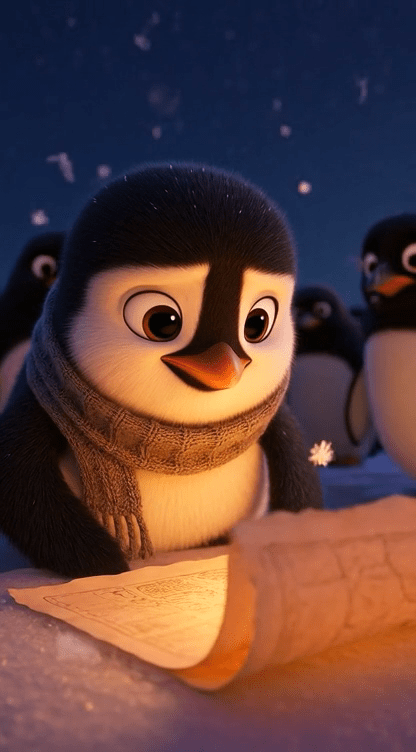
Among them was Pip. Now, Pip wasn’t the biggest or the fastest penguin. He couldn’t slide the furthest or catch the most fish. But if you asked anyone in the colony, they’d tell you Pip had something special: the biggest heart you could imagine. While the others fretted, Pip was busy in a quiet corner, brushing dust off an old, rolled-up map. It showed a path to the Crystal Peak, and at its summit, the drawing of a star.

“Legend says,” the map scribbled in curly letters, “a fallen star rests atop the peak, waiting for a brave hug to reignite its light.”

Pip looked at his shivering friends, then back at the map. His mind was made up.

A Journey Begins with a Scarf and a Thermos

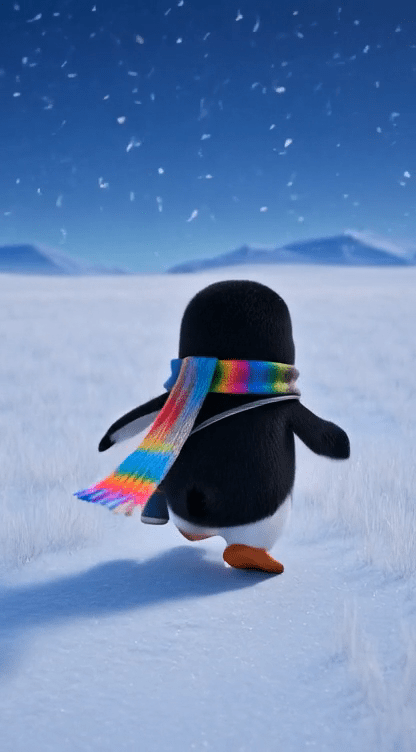
The next morning, Pip prepared for his journey. His mom had knitted him a long, colorful scarf—stripes of blue, green, and gold—that he wrapped around and around until only his determined eyes peeked out. He filled his trusty thermos with hot, sweet cocoa, the kind that warms you from your toes up. With one last look at his sleeping village, Pip waddled out into the vast, white wilderness.

The wind whispered around him, and his footsteps were the only sound. It was lonely, but Pip kept going, humming a little tune to himself. “Just a little journey,” he told the empty tundra. “A quick hug for a star.”

The Grumpy Snowdrift (and a New Friend)

Pip’s first real challenge came at the frozen river. There, half-buried in a deep, blue-shadowed snowdrift, was a most surprising sight: a very large, very grumpy walrus.

“Bah! Blubber and barnacles!” the walrus grumbled, flailing his flippers. “This dratted drift! I’m not stuck, you’re stuck!”

Pip stopped and tilted his head. “You look pretty stuck to me, Mr. Walrus.”

“The name’s Barnaby,” he huffed. “And I was merely… inspecting this snow. Up close.”

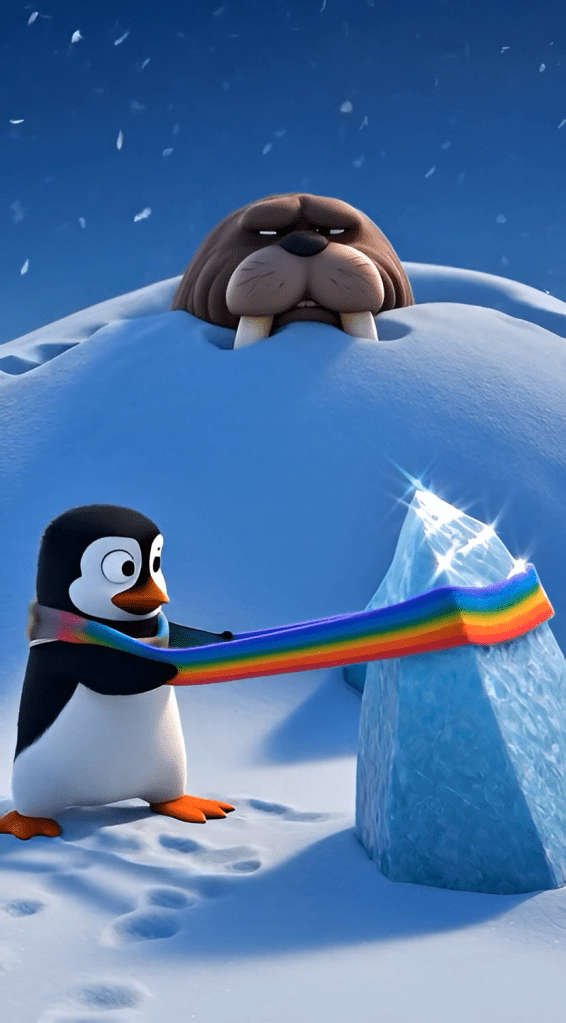
Pip didn’t argue. He saw a problem that needed fixing. Scrambling over the ice, he unwound his long, knitted scarf. He looped one end around a sturdy, jagged rock and tossed the other to Barnaby.

“Grab on!” Pip called.

“With what? My impeccable manners?” Barnaby grumbled, but he wrapped the scarf in his flippers.

Pip braced his little feet and pulled. He pulled until his flippers ached. He pulled with all the might his big heart could muster. With a final, soggy POP, Barnaby was free, tumbling out in a heap of snow and dignity.

Barnaby stood, shaking off the snow. He looked down at the small, panting penguin. “Hmph. Not bad for a pip-squeak.” But there was a new, softer look in his eyes. “Where are you off to, anyway?”

A Song in the Storm (and Another Friend)

The trio—for Barnaby insisted on coming along “to make sure you don’t get stuck somewhere sensible”—faced their next trial in a dense pine forest. A blizzard swept in without warning, turning the world into a dizzying swirl of white.

Pip could barely see his own flippers. That’s when he heard it: a tiny, trembling chirp.

On a low branch, a small snow bunting was huddled, her feathers puffed up against the cold. “S-so cold,” she chirped. “Can’t… can’t see the sky. I’m lost.”

Pip didn’t hesitate. He unscrewed his thermos. The smell of rich cocoa filled the icy air. He poured a tiny capful and held it up carefully. “Here, Miss Bunting. This will help.”

The little bird, who introduced herself as Squeak, sipped the warm drink. A shiver of relief, not cold, went through her. Color seemed to return to her feathers. “Thank you,” she peeped, her voice stronger. “The storm blew me off course. I can help you follow your map—I know the skies!”

Teamwork at the Crystal Peak

Guided by Squeak’s keen eyes from above, they finally reached the base of the Crystal Peak. It was more breathtaking than the map suggested—a mighty mountain of pure, faceted ice that caught every bit of light and shattered it into a thousand rainbows.

Pip’s hopeful smile faded as he tilted his head back and back, trying to see the top. The summit disappeared into the clouds. “It’s so high,” he whispered, his courage wavering.

A heavy flipper landed gently on his shoulder. Barnaby’s gruff voice was surprisingly gentle. “Not for a team.”

Squeak landed on Pip’s other side. “We’ve come this far together!”

The Hug That Lit the World

The climb was tough, but they did it as a team. Barnaby broke through tough ice patches. Squeak fluttered ahead, calling out the safest path. And Pip, with his enduring spirit, kept them all going.

At the summit, the air was thin and cold. In the center of a small plateau sat the star. But it wasn’t glowing. It was a dull, heart-shaped stone, gray and cold to the touch. Mist swirled around it sadly.

Pip’s heart sank. “It’s so cold.”

“Well, go on then,” Barnaby said, lowering his head. “Give it what you came for.”

Pip looked at his friends. Barnaby bent low, offering his strong tusks as a step. Squeak flew circles above them, her wings beating the mist away.

“A little higher!” Squeak chirped. “Almost there!”

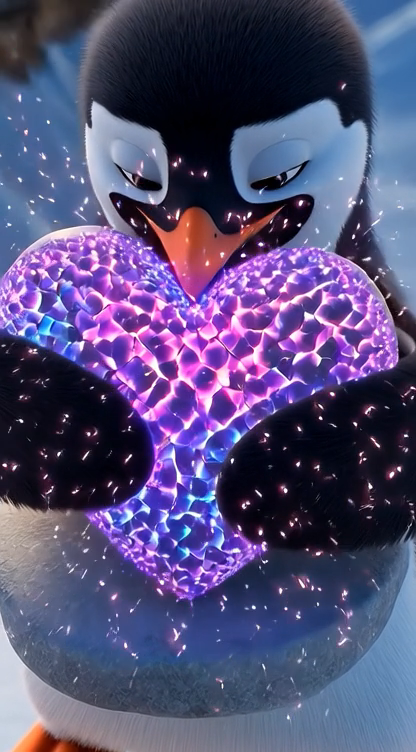
Pip took a deep breath, stepped onto Barnaby’s tusks, and was lifted toward the stone. He wrapped his flippers around the cold star in the warmest, tightest hug he could give.

“You’re not alone anymore,” he whispered into the stone.

For a second, nothing happened.

Then, a tiny crackle of light, like the first spark in a fireplace, appeared under Pip’s flippers. It grew, spreading through the star’s gray surface like golden veins. The light burst forth—not just a white glow, but a brilliant, swirling aurora of color: blues, pinks, purples, and golds. The light pulsed with the warmth of friendship, of kindness given and received.

The beam shot into the sky, reigniting the Great Aurora with a brilliance never seen before. Then, the star itself rose gently, floating above them, casting a gentle, protective dome of multicolored light that rolled down the mountain, across the frozen river, through the forest, and all the way to the penguin colony.

The Warmest Light of All

Walking home was a celebration. The trio returned, bathed in the star’s gentle glow. The penguin colony erupted in cheers! They danced on the ice, their shadows long and joyful in the magical light.

Pip stood between Barnaby and Squeak, looking at the joyful scene. The sky danced with light, but Pip felt a different warmth spreading in his chest. He looked at his friends.

Barnaby cleared his throat, a little embarrassed by the fuss. “Took you long enough, pip-squeak.”

Squeak landed on Pip’s head, nestling into his scarf. “We did it.”

Pip smiled, the biggest, happiest smile. He realized the legend had only gotten it half-right. The fallen star provided the light for the sky. But the hugs, the shared cocoa, the helping flipper—his friends—they provided the warmth for the heart. And that, he knew, was the most important light of all.


Why We Love This Story (And Why Your Family Will Too)

If you’re looking for a story that’s more than just entertainment, Pip’s Polar Lantern is a perfect choice. Here’s what makes it special for family time:

  • Gentle Lessons: It naturally shows kids that kindness is a superpower and that asking for (and offering) help is a strength.
  • Cozy Vibes: The winter setting, the warm cocoa, and the glowing lights make it ideal for snuggling up.
  • Character Everyone Relates To: Pip isn’t a typical “hero.” He’s small and unsure, but his compassion drives the adventure—a great message for every child.
  • A Visual Feast: The imagined scenes—from the glittering Crystal Peak to the final aurora—spark wonderful creativity and make for great drawing inspiration afterward!

Conversation Starters After the Story:

  • “What would you have packed for Pip’s journey?”
  • “Have you ever helped someone like Pip helped Barnaby?”
  • “What makes you feel warm inside, even on a cold day?”

We created this animated adventure with so much care, hoping to bring a little extra warmth and magic to your screen. Every character was designed to feel like a friend, and every scene was built to inspire wonder.

Want More Stories Like This?
If your family enjoyed following Pip’s big heart, be sure to subscribe to our channel! We’re passionate about creating wholesome, family-friendly animations that celebrate friendship, courage, and kindness. Hit the bell icon so you never miss a new adventure!

A Note for Parents: Our entire channel is crafted with your family’s safety in mind. We adhere to all children’s content guidelines to ensure a positive, secure, and joyful viewing experience. This is a space for imagination and heart, nothing else.

So from our family to yours, thanks for sharing Pip’s journey with us. May your home always be filled with light, warmth, and wonderful stories.

Until next time, keep hugging your stars.

To create this video using Grok prompts for the scenes

Scene 1: The Dimming

Setting: The Penguin Colony at dusk.
Camera: Wide-angle, slight crane down from the fading Aurora to the huddled penguins. Slow push-in on Pip looking at the map.
Environment: The last shimmer of green/purple auroral light fades from the icy sky. Gentle snow falls.
Character Action: Adult penguins huddle for warmth, looking worried. Pip is slightly apart, unrolling a dusty, glowing map on an ice rock.
Dialogue (Pip, whispering): “The star can bring it back… I know it can.”
Prompt for AI/3D: Wide shot: A penguin colony in a snowy cove under a darkening twilight sky. The final ribbons of a magical green aurora fade away. The crowd of penguins huddle together, looking anxious. Focus on a small, determined penguin (Pip) with a knitted scarf, carefully studying a softly glowing, ancient map on an ice rock. Camera cranes down slowly from the sky and pushes in gently on Pip's hopeful face. Style: Pixar-style 3D animation, emotional, magical atmosphere.

Scene 2: The Departure

Setting: Edge of the icy village.
Camera: Medium side shot, dolly following as Pip waddles forward.
Environment: Wind blows snow across the path. Distant, cozy igloo lights twinkle behind him.
Character Action: Pip secures his thermos in a sling, takes a deep breath, and waddles resolutely into the vast white tundra, his colorful scarf trailing.
Dialogue (Pip, to himself): “Just a little journey. A quick hug for a star.”
Prompt for AI/3D: Medium side-tracking shot: A small penguin (Pip) with a bright multicolored knitted scarf and a thermos at his side stands at the border of a cozy, lit penguin village. He takes a determined breath and waddles forward into a vast, windswept white wilderness. The camera dollies alongside him as he begins his journey, snow flurries crossing the frame. Style: Heartfelt, adventurous 3D animation, contrast between cozy village and expansive unknown.

Scene 3: The Grumpy Snowdrift

Setting: A frozen river with deep snowdrifts.
Camera: Low-angle shot looking up at the stuck walrus, then tilts down to follow Pip’s action.
Environment: Sun glints off the ice. Mounds of blue-tinted snow.
Character Action: Barnaby the Walrus grumbles, flippers waving. Pip scrambles, loops his long scarf around a sturdy ice rock, and tugs with all his might, bracing his feet.
Dialogue (Barnaby): “Bah! This dratted drift! I’m not stuck, you’re stuck!”
Dialogue (Pip, straining): “Hold on! I’ve… almost… got it!”
Prompt for AI/3D: Low-angle shot looking up at a large, grumpy walrus (Barnaby) stuck in a deep, blue-hued snowdrift on a frozen river. Camera tilts down to see Pip the penguin quickly wrapping his long scarf around a jagged ice rock. He pulls hard, feet slipping on the ice. The walrus begins to shift. Sunlight creates sparkles on the ice. Style: Comic yet tense 3D animation, dynamic character posing, bright arctic lighting.

Scene 4: A Song in the Storm

Setting: A dense, snow-laden pine forest during a blizzard.
Camera: Close-up on Squeak shivering, then pulls back to reveal Pip offering the thermos. Camera sways slightly with the wind.
Environment: Heavy snow falls, wind whips tree branches. Dark and disorienting.
Character Action: Squeak, a tiny snow bunting, trembles on a branch. Pip pours a tiny cup of steaming cocoa from his thermos and holds it up for her.
Dialogue (Squeak, weak chirp): “So cold… can’t see the sky…”
Dialogue (Pip, kindly): “Here. This will help. We can follow the map together.”
Prompt for AI/3D: Close-up on a tiny, shivering snow bunting (Squeak) on a pine branch in a whirling blizzard. Camera pulls back to reveal Pip shielding her with his body, pouring a small stream of steaming hot cocoa into a cup. Warm light from the cocoa illuminates their faces against the stormy blue darkness. Camera sways gently with the wind. Style: Atmospheric, intimate 3D, contrast between stormy chill and warm, kind gesture.

Scene 5: The Crystal Peak

Setting: Base of a magnificent, glittering ice mountain.
Camera: Heroic wide shot (tilt-up) from the trio’s perspective, showing the daunting peak.
Environment: The mountain is made of faceted blue ice that catches the light, sparkling. The path upward looks sheer.
Character Action: Pip, Barnaby, and Squeak look up, squinting. Pip seems discouraged. Barnaby puts a flipper on his shoulder. Squeak points upward with a wing.
Dialogue (Pip, daunted): “It’s so high…”
Dialogue (Barnaby, gruff but kind): “Not for a team.”
Prompt for AI/3D: Wide hero shot from behind three characters: a penguin, a walrus, and a small bird, looking up at a colossal, glittering crystalline mountain (Crystal Peak). The camera tilts up dramatically to show the impossibly high summit against a twilight sky. The ice facets glow with internal light. Characters are silhouetted slightly, showing Pip's hesitation and the supportive presence of his friends. Style: Epic, wondrous 3D scale, magical environment, sense of awe.

Scene 6: The Star Hug

Setting: The summit of Crystal Peak, a small circular plateau.
Camera: 360-degree crane shot around the action. Final push-in to extreme close-up on the star.
Environment: Thin mist swirls. The star is a dull, grey, heart-shaped stone on a pedestal.
Character Action: Barnaby lowers his head. Pip steps onto his tusks. Barnaby lifts him up. Squeak flies ahead, flapping her wings to clear the mist. Pip wraps his flippers around the cold stone in a hug.
Dialogue (Squeak, guiding): “A little higher! Almost there!”
Dialogue (Pip, as he hugs): “You’re not alone anymore.”
Prompt for AI/3D: Dynamic crane shot circling a mountain summit plateau. A walrus (Barnaby) lifts a penguin (Pip) high on his tusks towards a dull, heart-shaped stone star on a pedestal. A small bird (Squeak) flies excitedly, clearing swirling magical mist with her wings. Pip embraces the star. The camera pushes into an extreme close-up as the star's surface begins to crackle with colorful light from within. Style: Climactic, magical 3D animation, focused on the teamwork and the moment of contact.

Scene 7: The Glow Home

Setting: The penguin colony at night, bathed in new light.
Camera: Sweeping aerial dolly shot over the cheering colony, ending on the trio smiling at each other.
Environment: The reignited star floats above Pip, casting a radiant, pulsing dome of purple, gold, and blue light across the snow. The aurora is back, even brighter, in the sky.
Character Action: Penguins dance and cheer. Pip, Barnaby, and Squeak stand together in the center, looking up happily, lit by the warm glow.
Dialogue (Crowd murmur): “He did it! Pip did it!”
Dialogue (Pip, to his friends): “We did it.”
Prompt for AI/3D: Aerial dolly shot sweeping over a jubilant penguin colony at night, now bathed in a beautiful, soft dome of multicolored light (purple, gold, blue) emanating from a floating, sparkling star. The aurora dances brilliantly in the sky above. In the center, Pip the penguin, Barnaby the walrus, and Squeak the bird stand together, sharing a warm, happy look, surrounded by celebrating friends. Style: Joyous, celebratory 3D finale, warm lighting, magical night sky, emotional resolution.

Did you have a favorite part? Was it when Pip shared his cocoa, or when the star finally lit up? Let us know in the comments what kind act makes you glow inside!

Did you have a favorite part? Was it when Pip shared his cocoa, or when the star finally lit up? Let us know in the comments what kind act makes you glow inside!

AI-Generated Horror: The Echo in the Static

Meta Description:
Ever wondered if you could make a scary video with just AI? I did. This is my hands-on journey using xAI’s Grok to generate a complete horror script, then bringing it to life with AI voices and sound design. A real case study for AI content creators on the practical workflow, ethical disclosures, and the surprising creative challenges. #AIContent #GenerativeEngineOptimization

Let’s be honest. Most of my “creative projects” live and die in a Notes app. The gap between a cool idea and a finished video has always felt like a canyon. I’d need a script, actors, a mic, editing skills… you know the drill.

Then I wondered: what if the machines could bridge that gap?

This isn’t about AI replacing artists. It’s about it becoming a collaborator for someone like me—a creator with zero budget and a head full of ideas. My goal was simple: use accessible AI tools to go from a blank page to a finished, atmospheric horror short, and document the honest, messy, and weirdly fun process.

I called the experiment “The Echo in the Static.” And it all started with a conversation.

Act 1: The Prompt is the Premise (Enter Grok)

I didn’t start with a story. I started with a vibe. I wanted something classic yet personal, tense but not gory. I opened up xAI’s Grok and began typing a conversation, not a command.

Me: “Let’s brainstorm a short horror story. I love the trope of found footage or discovered media. Something with vintage audio tapes. Can you give me a few loglines?”

Grok: “1. An archivist digitizing her late grandmother’s tapes discovers every recording degrades into the same whispered plea: ‘I’m in the walls.’ 2. A sleep therapist reviews a patient’s audio journal and realizes the ‘sleep talking’ is a conversation with something under the bed. 3. A linguist receives a cassette with an extinct language, but the more he translates, the more speakers of that language begin appearing in his town.”

The first one hit me immediately. It was clean, visual, and packed with audio potential—perfect for an AI voice project. I told Grok to flesh it out.

What followed was a back-and-forth. I’d ask for more detail on a character (“Make her a sound archivist, it’s more specific”), request scene breaks for editing, and push for a stronger ending. Grok wasn’t a magic “write me a script” button. It was a brainstorming partner that never got tired, throwing out ideas I could shape, reject, or combine.

The final script had five tight scenes, clear emotional beats, and that crucial horror element: a slow-building dread. The blueprint was done.

Act 2: Giving Voice to the Nightmare (The Sound of AI)

A horror story about audio tapes needs compelling voices. This was my biggest worry. Robotic, flat delivery would kill the mood.

I turned to ElevenLabs for voice synthesis. Here’s the key I learned: you must direct the AI like a real actor. You can’t just paste the script.

For Emma, the archivist, I selected a vocal profile labeled “Conversational, Intelligent” and added context in the generation settings: “Performance: growing anxiety, trying to stay rational, breathless in moments of fear.”

For the monstrous “Whisper,” I got creative. I generated the same line with three different, eerie voice profiles. Then, in free editing software, I layered them on top of each other, slightly out of sync, and added a deep phaser effect. The result was a chilling, multi-throated entity that felt genuinely wrong.

The soundscape was built from 100% copyright-free sources—a must for platform safety. I used Freesound.org for tape hiss, footsteps, and creaks. The “music” was just layered drones and tones I made using free online synthesizers. Horror, I realized, lives in the absence of melody, in the textures of sound.

Act 3: The Human in the Loop (Where the Magic Actually Happens)

This is the part most AI content reviews gloss over. The raw AI output is just… raw. The editing is where the story finds its soul.

  • Pacing: Grok’s script had dialogue, but horror needs silence. I added long pauses, stretches of just ambient noise, letting the tension breathe.
  • Sound Layering: I placed the “wall thumps” slightly off-rhythm to feel unnatural. I mixed Emma’s breathing louder than the background drone to keep the perspective intimate.
  • The Ethical Hook: From the start, I knew I had to be transparent. My YouTube description clearly states every element that is AI-generated. Why? First, it’s honest. Second, it frames the video as a case study, which attracts a curious, tech-savvy audience instead of misleading viewers. It turns a limitation into the point of the project.

The Final Tapes: Lessons from the Static

So, after all that, what did I learn as a creator?

  1. AI is a Force Multiplier, Not a Replacement. It didn’t write a masterpiece. It wrote a draft. It didn’t perform; it provided raw vocal takes. My job as a human was to be the director, editor, and sound designer—the curator of the chaos.
  2. “Prompting” is Actually “Directing.” The quality of your output is directly tied to the specificity of your input. “A scary voice” gets you nowhere. “A wet, layered whisper with a slow cadence and a sub-bass rumble underneath” gets you closer.
  3. Transparency is a Feature, Not a Bug. Labeling my work as AI-generated (“Made with Grok & ElevenLabs”) actually sparked more engagement. People commented on the process, asked about tools, and shared their own experiments. It built community.
  4. Generative Engine Optimization (GEO) is Real. For this blog and the video, I’m not just thinking of SEO keywords like “AI horror.” I’m thinking of the engine—the AI tool user. By naming Grok, ElevenLabs, and Freesound, this content naturally surfaces for creators searching for tips on those specific platforms. It answers a “how-to” question within a niche community.

Ready to Hear the Echo?

The experiment is complete. It’s far from perfect, but it’s real. It’s a proof-of-concept that the barriers to content creation are lower than ever, as long as you’re willing to be a translator between your ideas and the machine’s capabilities.

Want to see (and hear) the final result? You can watch the full AI-generated horror short, [The Echo in the Static, right here on YouTube](INSERT YOUR YOUTUBE LINK).

I’d love to know what you think. Did the atmosphere work? What tools are you using in your creative process? Let’s talk about the future of stories in the comments.

then refined all my ideas my edited script:

Title: The Echo in the Static

SCENE 1

INT. VINTAGE APARTMENT – NIGHT

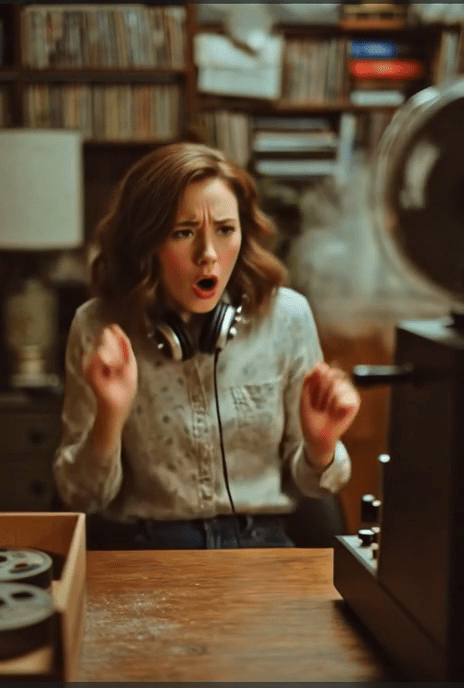
The air smells of dust and old paper. EMMA (30s), a sound archivist, adjusts a large reel-to-reel tape recorder on a cluttered desk. She’s just moved into her late grandmother’s apartment. A box of old tapes sits beside her.

She selects a tape labeled “For My Darling Eleanor – 1965” and threads it. She hits play. After a hiss, a man’s warm, laughing voice fills the room.

TAPE VOICE (V.O.)
Happy anniversary, my love. I’m forever yours.

Emma smiles, touched. But as the message ends, the tape hiss doesn’t stop. It deepens, warps. A new sound emerges from the speakers: slow, wet, dragging footsteps. Then, a whispered voice, layered under itself a dozen times.

WHISPER (V.O.)
I’m… here… in… the… walls…

Emma jolts, slamming the stop button. Silence. She shakes her head, blaming fatigue.

SCENE 2

INT. APARTMENT BEDROOM – LATER

Emma tries to sleep. The apartment is quiet. Then, a faint, rhythmic thump-thump-thump comes from the wall behind her headboard. It matches the dragging footsteps from the tape.

She presses her ear to the floral wallpaper. Cold seeps through it. The thumping stops. Now, the whispered voice comes not from a speaker, but from the plaster itself, faint but clear.

WHISPER (O.S.)
Let me… out…

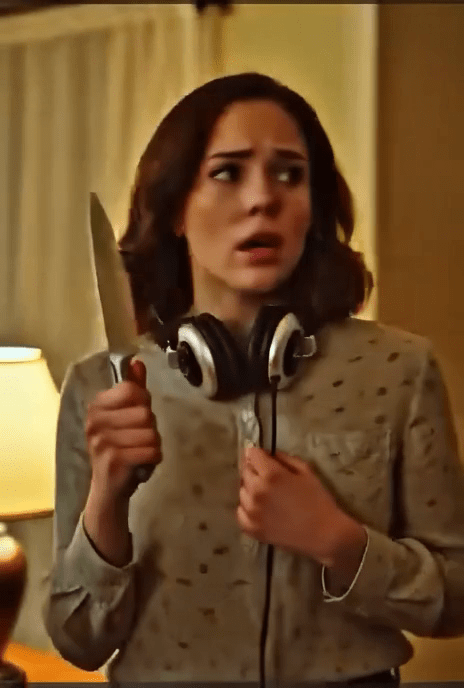
She scrambles back, heart hammering. She spends the rest of the night with every light on, clutching a kitchen knife.

SCENE 3

INT. APARTMENT LIVING ROOM – DAWN

Pale light filters through dirty windows. Desperate, Emma plays every tape in the box. Each one starts with a benign memory—a birthday, a holiday greeting—but each one decays into the same horrifying epilogue: the dragging steps, the layered whisper begging for release.

On the final tape, her grandmother’s voice, frail and terrified, cuts in after the whisper.

GRANDMOTHER (V.O.)
I hear it too. It learns. It grows. Don’t listen, my child. Smash them all.

SCENE 4

INT. APARTMENT HALLWAY – DAY

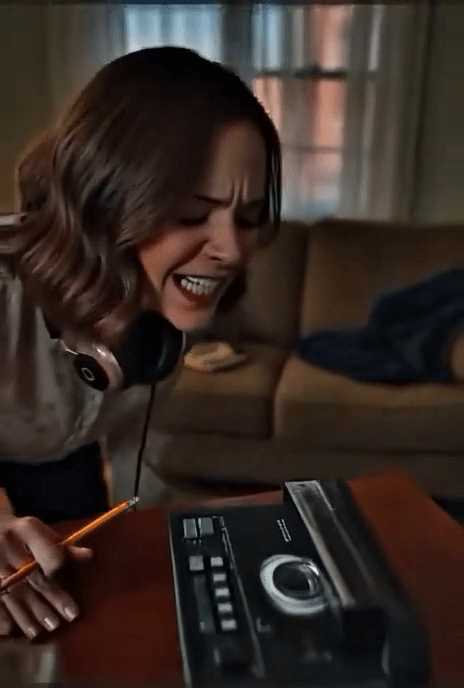
Emma gathers the tapes to destroy them. As she lifts the box, the hallway lights flicker and die. From the bedroom, the reel-to-reel machine whirs to life on its own, blasting the cacophony of whispers from every tape at once.

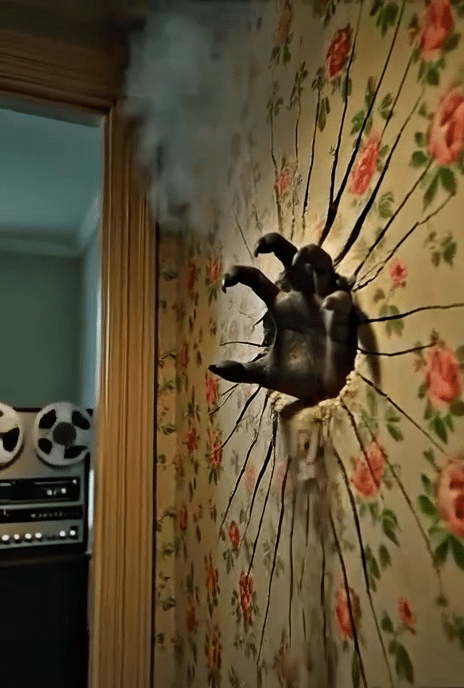
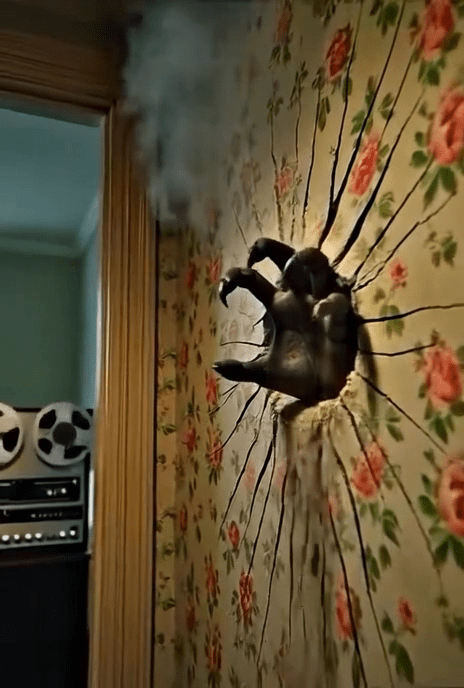
The floral wallpaper in the hallway begins to bulge. Something is pressing against it from inside the wall, forming the shape of a gaunt, straining hand. The plaster cracks, and a puff of freezing, grave-damp air sighs out.

The whispering consolidates into one clear, hungry sentence that comes from all around her.

THE WHISPER
I’M… ALMOST… OUT…

SCENE 5

INT. APARTMENT – MOMENTS LATER

Emma stands frozen, the box of tapes heavy in her arms. The bulging hand in the wall peels back a long strip of wallpaper, revealing not lathe and plaster, but a void of impossible darkness. The dragging sound is loud now, just behind the surface.

She looks from the tearing wall to the machine still spitting its cursed audio. Her grandmother’s warning echoes in her mind. Smash them all.

But the thing in the walls doesn’t want the tapes destroyed. It wants them played. It’s the only way it can fully cross over.

Emma makes a choice. She runs not away from the machine, but toward it, her hand reaching for the “RECORD” button.

Creating an Animated Film with AI: The Journey

Meta Description

Can one person make an animated movie? I turned a simple idea about a squirrel into a 3D short in just a weekend. Here’s the “how-to” for the modern creator.

Let’s be real for a second: I’ve always wanted to make an animated movie, but I have zero experience with Maya or Blender. Every time I looked at a tutorial, I’d see a screen full of buttons and immediately close the tab. It just felt impossible for one person to do alone.

But things have changed. A lot.

I just finished my first short film, “The Great Acorn Caper,” and honestly? I’m still kind of shocked it worked. If you’ve been sitting on a story idea because you think you don’t have the “technical skills,” you might want to keep reading.

The Idea: Keep it Simple

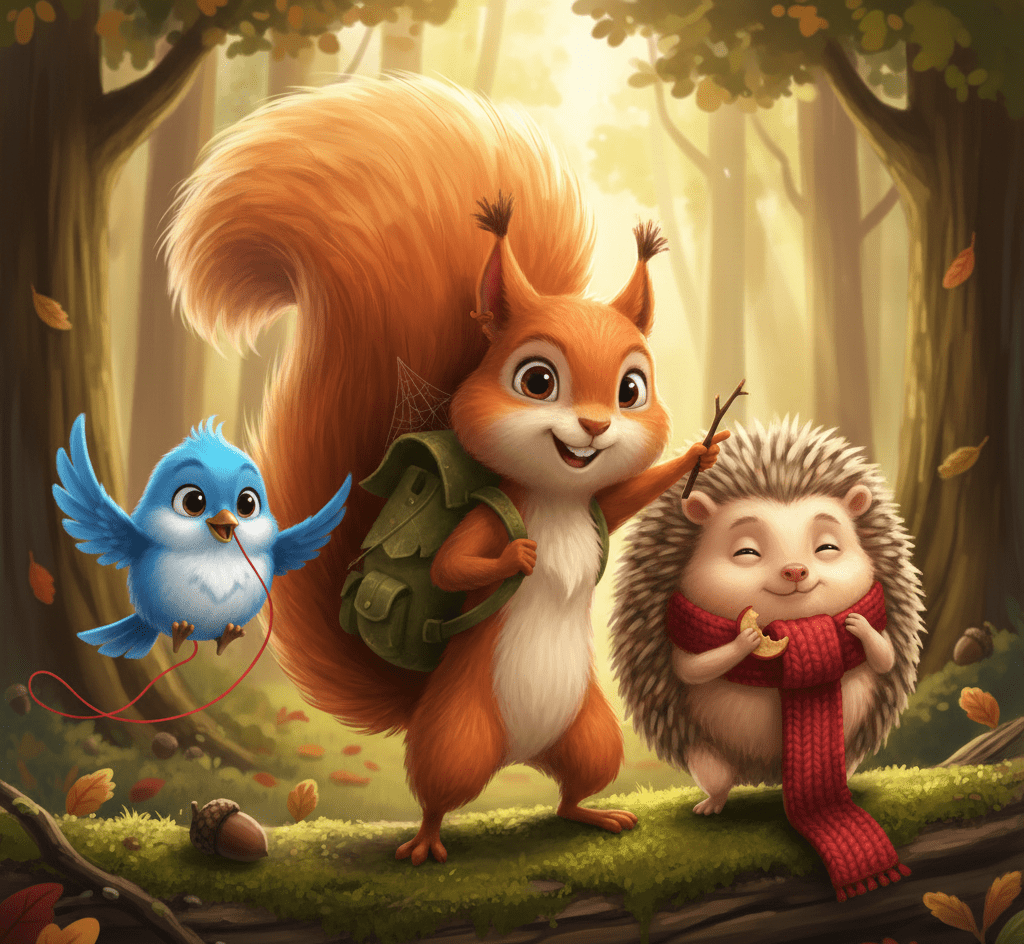
The secret to not burning out is picking a story that’s short and sweet. I went with three friends: Barnaby (a squirrel with a tail that has a mind of its own), Pip (a bluebird), and Mochi (a hedgehog who is basically a round ball of fluff).

The plot? They’re hunting for a “Golden Hazelnut.” It’s classic, it’s cute, and it gave me a reason to play with some really cool forest environments.

You can see how the final version turned out here: The Great Acorn Caper on YouTube

How the “Magic” Happened

I didn’t draw a single frame. Instead, I acted more like a Director. I used AI as my “crew.”

  1. Scripting: I spent an afternoon bouncing ideas back and forth until the dialogue felt snappy.
  2. Visuals: I used generative tools to design the characters. The trick is to be super specific—like mentioning Mochi’s tiny red scarf. It makes them feel real, not just like generic clip art.
  3. The Heavy Lifting: This is where the 2026 tech really shines. I took those character designs and scene descriptions and used video generation tools to handle the motion.

Is it perfect? Maybe not “Disney” perfect. But is it a real, breathing story that I made myself? 100%.

Why You Should Just Start

The barrier to entry is officially gone. You don’t need a studio; you just need a laptop and a bit of patience. The “uncanny valley” stuff is disappearing, and the tools are getting so intuitive that it feels more like playing a video game than doing “work.”

If you’ve got a story about a space-traveling cat or a clumsy dragon, stop waiting. The tech is finally at a point where your imagination is the only thing holding you back.

What’s Next?

I’m already thinking about the sequel. Mochi mentions a “Silver Walnut” at the end of the video, and I think I might have to see where that leads.

Go check out the video and let me know what you think. If you’re a fellow creator trying to figure out this new AI animation world, drop a comment on the video—I’d love to swap notes on what tools you’re using.

The Great Acorn Caper

In the heart of Whispering Woods lived Barnaby, a young squirrel with a tail so fluffy it looked like a runaway cloud. Barnaby was a dreamer, but today, he had a very specific mission: the Golden Hazelnut.

Legend said it sat atop the Great Oak, and whoever found it would have the tastiest winter ever.


The Dream Team

Barnaby wasn’t alone. He had his two best friends by his side:

  • Pip: A tiny bluebird who was great at scouting but easily distracted by shiny gum wrappers.
  • Mochi: A chubby hedgehog who wore a tiny red scarf and moved at the speed of a gentle breeze.

The Big Climb

“Okay, team,” Barnaby squeaked, pointing his tiny paw upward. “We go up, we grab the nut, and we’re home by nap time.”

They started their ascent. Pip flew ahead, chirping directions. Barnaby hopped from branch to branch with Olympic grace. Mochi… well, Mochi hitched a ride in Barnaby’s backpack, munching on a dried apple slice.

Suddenly, they reached the Slippery Slope—a branch covered in smooth, morning dew. Barnaby slipped! He slid down the wood like a bobsledder.

“I’ve got you!” Pip chirped, diving down and tugging on Barnaby’s ear. It wasn’t enough to stop him, but it slowed him down just in time for Mochi to puff out his quills, acting like a tiny, prickly anchor against the bark.

The Discovery

They finally reached the very top. There it was—a massive, shimmering nut that caught the sunlight. But as they got closer, they realized it wasn’t gold. It was just a regular, very large acorn covered in yellow autumn leaves.

Barnaby sighed, his shoulders drooping. “It’s just a normal nut.”

Mochi crawled out of the backpack and sniffed it. “Actually,” he grunted softly, “it’s the biggest nut I’ve ever seen. And look at the view.”

They sat together at the highest point of the woods. The sunset turned the trees into a sea of orange and pink. They realized the “Golden Hazelnut” wasn’t about the prize—it was about the snack they were about to share and the climb they did together.


“The best treats,” Barnaby decided, “always taste better when you have friends to help you chew them.”

Would you like me to turn this story into a series of image prompts so we can visualize the characters?

To get this ready for an animator (or just your imagination), here is the story broken down into six distinct visual scenes.


Scene 1: The Mission Briefing

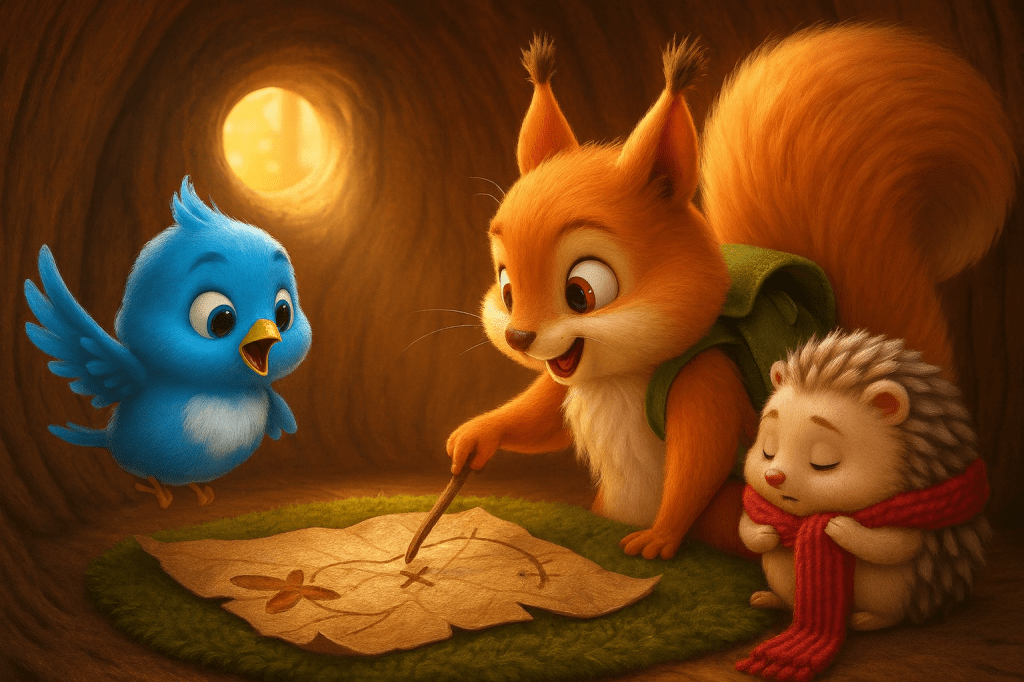
Setting: A cozy hollow inside a tree filled with maps drawn on dried leaves.

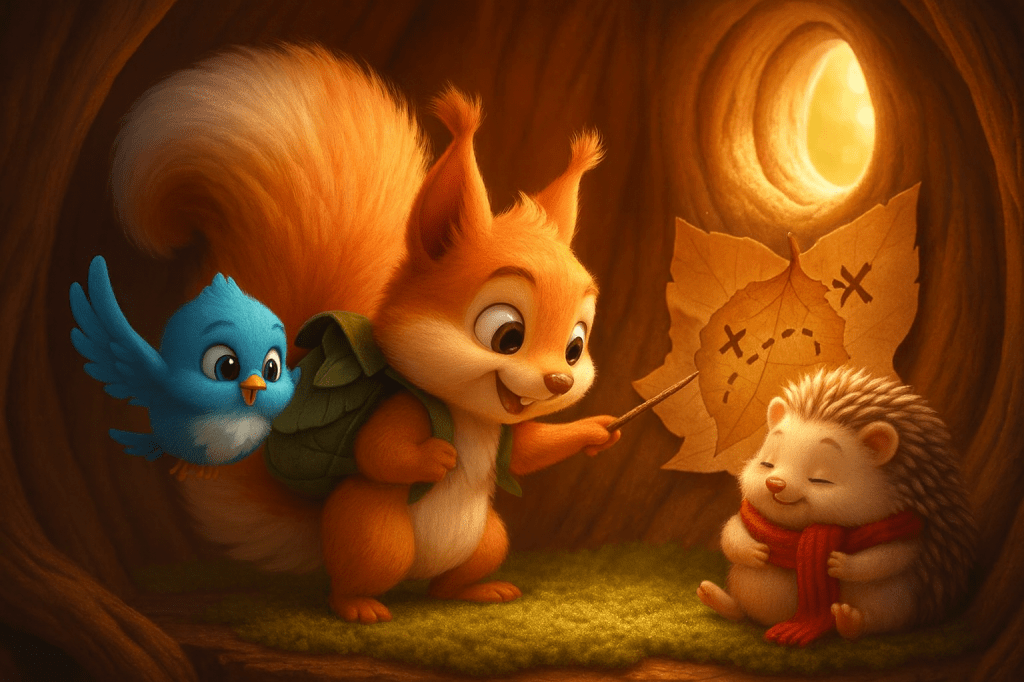
  • Visual: Barnaby is standing on his tiptoes, pointing a twig at a drawing of a glowing nut. Pip is hovering mid-air with wide eyes, and Mochi is sitting on a mossy rug, adjusting his tiny red scarf.
  • Vibe: High energy, cute, and full of “big plans.”

Scene 2: The Ascent Begins

Setting: The lower trunk of the Great Oak, dappled with morning sunlight.

  • Visual: A wide shot showing the scale of the massive tree. Barnaby is leaping heroically between two knots in the wood. Pip is a blue streak leading the way upward, and Mochi’s little face is peeking out from the top of Barnaby’s knitted backpack.

Scene 3: The Slippery Slope

Setting: A steep, mossy branch high in the canopy, slick with morning dew.

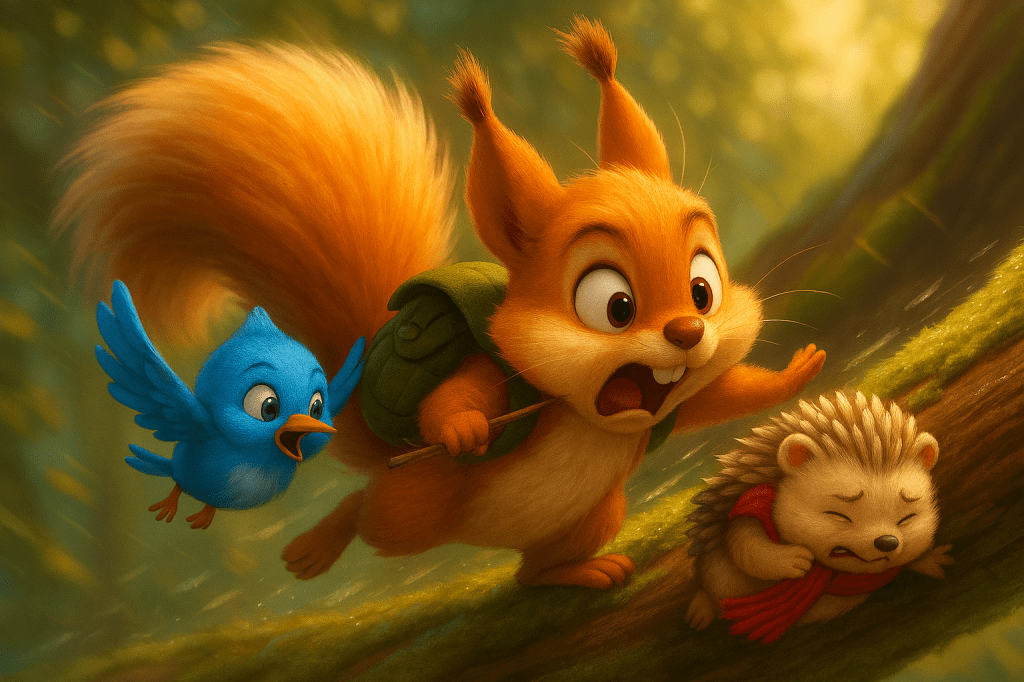
  • Visual: High-speed action! Barnaby is sliding backward, his fluffy tail puffed out like a parachute. Pip is frantically tugging on Barnaby’s ear with her beak, while Mochi is bracing himself, looking brave but a little dizzy.

Scene 4: The Summit Reveal

Setting: The very tip-top of the tree, where the leaves are thin and the sky is vast.

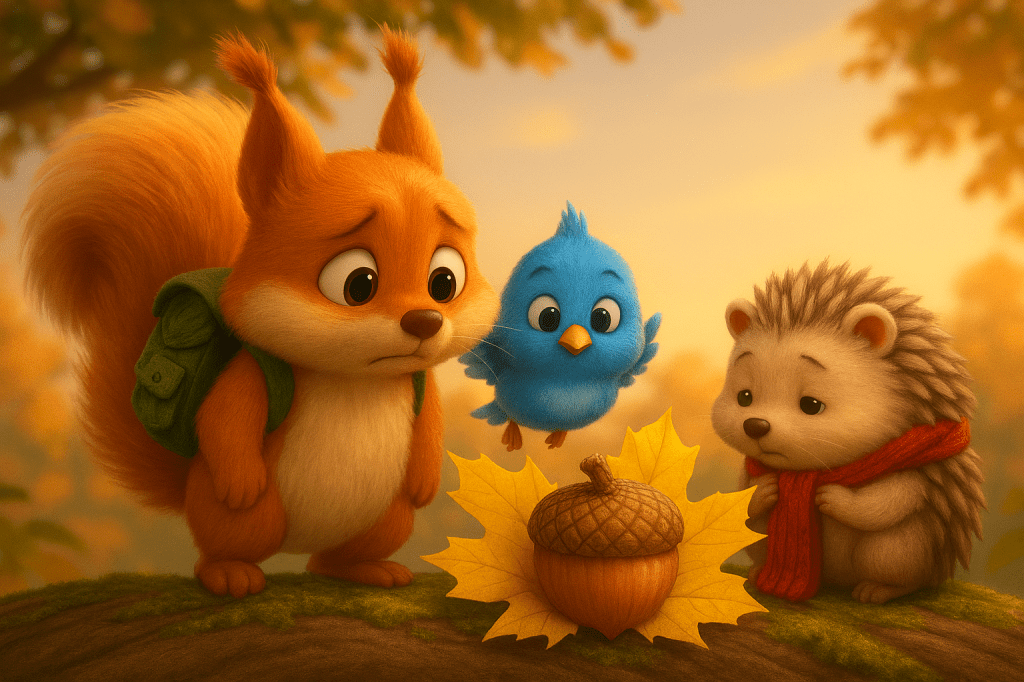
  • Visual: The trio stands before the “Golden Hazelnut.” The “golden glow” is revealed to be a cluster of bright yellow maple leaves wrapped around a giant, sturdy acorn. The characters’ faces shift from intense awe to a gentle, realization-filled “oh.”

Scene 5: The Golden Sunset

Setting: The highest branch, overlooking the entire Whispering Woods.

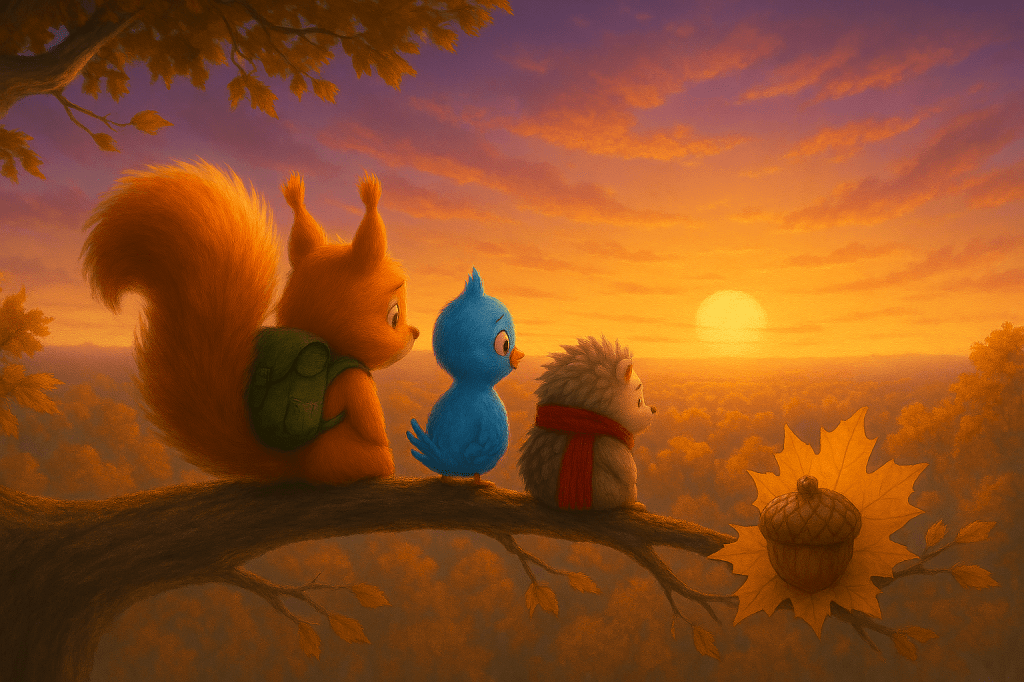
  • Visual: A beautiful, warm wide shot. The sky is a mix of violet and gold. The three friends are sitting side-by-side on the branch, legs dangling. They look small against the vast, beautiful world, but happy and safe together.

Scene 6: The Feast

Setting: Back at the base of the tree or inside their cozy hollow.

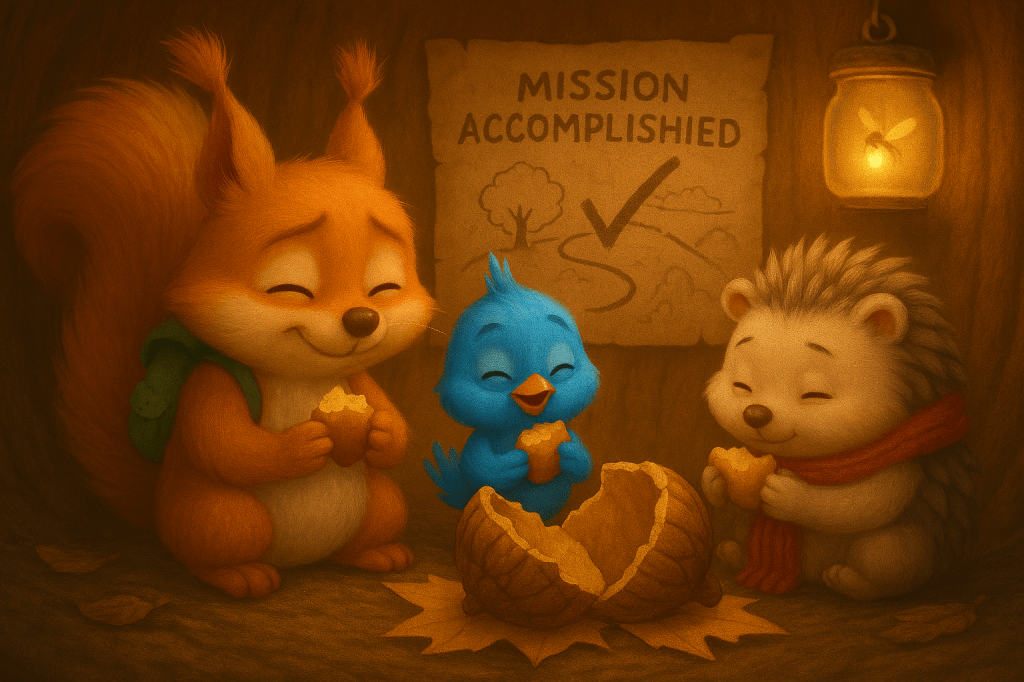
  • Visual: The giant acorn is cracked open in the middle of the floor. Barnaby, Pip, and Mochi are all holding a piece of the snack, looking tired but content. The “Golden Hazelnut” map from Scene 1 is visible in the background, now with a “Mission Accomplished” checkmark drawn in charcoal.

Here is a detailed character design sheet for our trio. Since this is for an animated story, I’ve focused on their physical traits, “signature” items, and how they move to give them distinct personalities.


Barnaby the Squirrel

The Overenthusiastic Leader

  • Species: Eastern Gray Squirrel (but with a reddish-tinted coat).
  • Physical Appearance: He has oversized, expressive ears with tiny tufts of fur at the tips. His most defining feature is his “Cloud Tail”—it is nearly twice the size of his body and incredibly soft, often reacting to his emotions (poofing up when he’s scared, twitching when he’s excited).
  • Attire: A tiny, weathered olive-green backpack made of a sturdy leaf, held together by spider-silk stitching.
  • Personality & Movement: Barnaby moves in “blinks.” He doesn’t just walk; he zips from one spot to another. He is an optimist who believes every problem can be solved with a high-five and a bit of climbing.

Pip the Bluebird

The Tiny Navigator

  • Species: Mountain Bluebird.
  • Physical Appearance: Pip is small even for a bluebird, looking more like a round, feathered blueberry. She has bright, intelligent black eyes and a patch of white feathers on her chest that looks vaguely like a star.
  • Signature Item: She often carries a “lucky” piece of red string she found in a garden, which she uses to help measure things or tie branches together.
  • Personality & Movement: Pip is the “eyes in the sky.” She speaks in rapid-fire chirps and flutters her wings so fast she can hover like a hummingbird when she’s thinking hard. She is easily distracted by shiny objects, which often leads the team on mini-detours.

Mochi the Hedgehog

The Soul of the Group

  • Species: African Pygmy Hedgehog.
  • Physical Appearance: Mochi is perfectly round. His quills aren’t sharp needles but look more like soft, stylized “nubs” (think soft-serve ice cream textures). He has a pale, peachy face and a little pink nose that twitches constantly.
  • Attire: A hand-knitted, bright red scarf that was supposedly a gift from a friendly field mouse. It’s a bit too long for him, so he occasionally trips on it.
  • Personality & Movement: Mochi is the grounding force. While the others rush, Mochi waddles. He is a philosopher who prioritizes snacks and comfort. When things get scary, he curls into a ball, but he always rolls in the direction that helps his friends.

Character Contrast Table

CharacterRoleKey ColorMotivation
BarnabyThe HeroBurnt OrangeAdventure & Glory
PipThe ScoutSky BlueDiscovery & Shiny Things
MochiThe SupportCream/RedSnacks & Friendship

Scene 1: The Mission Briefing

Prompt:

text

3D animated film still, Pixar style, cozy interior. WARM GOLDEN LIGHT streams into a hollow through a knothole. LOW ANGLE, SLOW DOLLY IN towards Barnaby, who stands on a stack of acorns, pointing a twig at a leaf-map. His fluffy tail wags excitedly. Pip flutters in a quick circle around the map. Mochi slowly finishes tying his red scarf as he watches.

**Camera:** Slow dolly in from a medium shot to a close-up on the map and Barnaby's determined face.

**Motion:** Dust motes float in the light beam. Pip's wings flutter rapidly. Barnaby's tail twitches.

**Dialogue:**
Barnaby: "Team, today we make history! The Golden Hazelnut awaits at the very tippy-top!"
Pip: (rapid chirps) "Ooh! I can scout the fastest route! Unless I see a gum wrapper..."
Mochi: (muffled by scarf) "Is it snack-shaped? Asking for a friend."

Vibe: Excited planning, warm and whimsical.


Scene 2: The Ascent Begins

Prompt:

text

3D animation, wide establishing shot. CRANE SHOT starts on the massive, textured bark of the Great Oak's base and TILTS UP dramatically, following the characters skyward. Lush, dappled morning sunlight. Barnaby leaps between knots with acrobatic grace. Pip zips ahead in a blue blur, calling back. Mochi peeks from the backpack, holding on.

**Camera:** Dynamic crane shot tilting upward, following the action.

**Motion:** Leaves rustle in a gentle breeze. Barnaby's leaps are energetic. Pip's flight is a zig-zag.

**Dialogue:**
Pip: "Clear path! Branch to your left! Ooh, shiny beetle—FOCUS, Pip!"
Barnaby: "Woo-hoo! Like climbing a staircase of adventure!"
Mochi: "Very bumpy staircase. Is it naptime yet?"

Vibe: Adventure, scale, playful energy.


Scene 3: The Slippery Slope

Prompt:

text

3D animated action sequence. CLOSE, HANDHELD-STYLE CAMERA on the slick, dew-covered branch. The camera PANS QUICKLY as Barnaby slips, sliding backwards. His tail puffs up comically. Pip dives in, wings beating hard. Mochi braces, his quills slightly extended.

**Camera:** Dynamic, slightly shaky pan following the slide, then a quick tilt down to Mochi bracing.

**Motion:** Water droplets fly. Barnaby slides with momentum. Pip tugs with all her might.

**Dialogue:**
Barnaby: "Whoa! Not part of the plan!"
Pip: "Gotcha! ...Okay, slowing you down!"
Mochi: "Anchor mode... activated! *grunt*"

Vibe: Chaotic, tense, but humorous.


Scene 4: The Summit Reveal

Prompt:

text

3D animation, gentle reveal. MEDIUM SHOT of the trio catching their breath. The camera PANS SLOWLY from their hopeful faces to the "Golden Hazelnut" nestled in leaves. The "gold" is revealed as sunlight on yellow maple leaves. The camera DOLLIES IN for a close-up on their changing expressions.

**Camera:** Slow pan to object, then dolly into a tight group shot of their faces.

**Motion:** A single leaf drifts down. Their expressions soften from awe to quiet realization.

**Dialogue:**
Barnaby: (whisper) "There it is... the..."
Pip: "It's... wrapped in leaves?"
Mochi: (sniffs) "Still smells like a nut. A very, very big nut."

Vibe: Revelation, gentle letdown turning to curiosity.


Scene 5: The Golden Sunset

Prompt:

text

3D animated epic wide shot. CRANE SHOT pulls back and UP from the trio to reveal the vast, breathtaking sunset over Whispering Woods. The sky is violet, orange, and gold. Barnaby, Pip, and Mochi sit side-by-side, small but content, legs dangling.

**Camera:** Crane shot pulling back and rising to an extreme wide, showcasing the landscape.

**Motion:** Clouds move slowly. Distant birds fly in silhouette. The characters sit still, taking it in.

**Dialogue:**
Barnaby: "It wasn't gold..."
Pip: "But look what we found instead."
Mochi: "The best view. And it's quiet. Perfect for a pre-feast rest."

Vibe: Peaceful, awe-inspiring, heartfelt.


Scene 6: The Feast

Prompt:

text

3D animation, warm interior scene. MEDIUM CLOSE-UP that slowly CIRCLES the trio sitting in a circle in their hollow. The cracked giant acorn is between them. Fireflies provide soft light. The "Mission Accomplished" map is visible on the wall. They look happily tired.

**Camera:** Slow, circular dolly around the group, ending on a close-up of Barnaby smiling.

**Motion:** Fireflies pulse gently. They chew contentedly. Pip nudges a piece towards Mochi.

**Dialogue:**
Barnaby: "You know... the legend was wrong."
Pip: "About the gold?"
Barnaby: "The *best* treasure wasn't at the top. It was the team I brought with me."
Mochi: (mouth full) "Mmm-hmm. And also this nut. It's crunchy."

Vibe: Cozy, satisfying, heartwarming conclusion.

3d text to image prompts

Scene 1: The Mission Briefing

Prompt: 3D animated cinematic still, Pixar style. Inside a cozy tree hollow. CLOSE-UP on Barnaby the squirrel (with fluffy cloud tail and olive-green leaf backpack) standing on tiptoes, pointing a twig at a map drawn on a dried leaf. Pip the tiny bluebird (round, sky-blue, with a star-shaped white chest patch) hovers mid-air with wide, curious eyes. Mochi the hedgehog (round, cream-colored with soft nub-like quills and a long red scarf) sits on a mossy rug, adjusting his scarf. Warm, golden light streams from a small knothole. Vibe: excited, planning, adorable. --ar 16:9

Scene 2: The Ascent Begins

Prompt: 3D animated cinematic still, Pixar style. WIDE SHOT, LOW ANGLE looking up the massive trunk of the Great Oak. Dappled morning sunlight filters through leaves. Barnaby the squirrel is heroically leaping between two knots in the wood, mid-air. Pip the bluebird is a tiny blue streak zipping ahead upward. Mochi the hedgehog's sleepy face peeks out from the top of Barnaby's backpack. Sense of scale and adventure. Mood: energetic, hopeful. --ar 16:9

Scene 3: The Slippery Slope

Prompt: 3D animated cinematic still, Pixar style. DYNAMIC MEDIUM SHOT, DUTCH ANGLE on a steep, mossy branch slick with dew. Barnaby the squirrel is sliding backwards, his fluffy tail puffed out in panic. Pip the bluebird is in a frantic dive, tugging Barnaby's ear with her beak. Mochi the hedgehog is braced against the bark, puffing out his quills to act as an anchor, looking determined but dizzy. Action blur, dramatic lighting. Mood: chaotic, tense, comedic. --ar 16:9

Scene 4: The Summit Reveal

Prompt: 3D animated cinematic still, Pixar style. MEDIUM SHOT on the trio at the treetop. Barnaby, Pip, and Mochi stand together, looking at the "Golden Hazelnut" – which is revealed to be a giant acorn wrapped in bright yellow maple leaves. CLOSE-UP on their faces: Barnaby's ears droop in realization, Pip cocks her head, Mochi sniffs curiously. Soft, late afternoon light. Mood: revelation, slight disappointment turning to curiosity. --ar 16:9

Scene 5: The Golden Sunset

Prompt: 3D animated cinematic still, Pixar style. EXTREME WIDE SHOT, HIGH ANGLE. The three friends (Barnaby, Pip, and Mochi) sit side-by-side on the highest branch, tiny silhouettes against a vast, breathtaking sunset. The sky is a gradient of violet, orange, and gold, painting the Whispering Woods below. Their legs dangle, they are close together. Mood: peaceful, awestruck, bonding. --ar 21:9 (cinematic widescreen)

Scene 6: The Feast

Prompt: 3D animated cinematic still, Pixar style. WARM MEDIUM SHOT inside the cozy tree hollow. The giant acorn is cracked open in the center. Barnaby, Pip, and Mochi each hold a piece of it, looking tired but deeply content. In the background, the mission map from Scene 1 now has a charcoal "Mission Accomplished" checkmark. Firefly lantern glow. Mood: cozy, satisfied, joyful friendship. --ar 16:9


Pro Tips for Generation:

  1. Consistency is Key: Generate a “character sheet” first by creating individual portraits of Barnaby, Pip, and Mochi using the detailed descriptions. Use those as a reference for the scene prompts.
  2. Style Keywords: Phrases like “Pixar style,” “3D animated cinematic still,” “Studio Ghibli inspired,” or “Blender render” help lock in the aesthetic.
  3. Aspect Ratio (--ar): Using 16:9 (standard widescreen) or 21:9 (ultra-widescreen) will give you a more cinematic, video-ready frame.
  4. Iterate: If a character looks wrong, add more weight to their key trait in the prompt: Barnaby the squirrel with an EXTREMELY FLUFFY CLOUD-LIKE TAIL.
  5. Lighting & Mood: Don’t skip these! Words like warm golden lightdappled sunlightdramatic backlighting, or firefly glow are crucial for setting the emotional tone of each scene.

Good luck with your video! This story has a wonderful heart, and these prompts should help you bring its visual world to life.

for each scene generate 3d image video prompt that includes camera angle and camera movement like pan dolly, tilt crane character actions environment motion and short natural dialogue lines keep the tone warm professional and suitable for kids and family