🇨🇭 Zurich, Switzerland — Alpine Charm · Lake Zurich · Swiss Efficiency · 1 of 80+ Weekend Guides
🏔️Last Updated: May 2026 · Regularly Maintained — updated ZürichCard pricing, fresh restaurant recommendations, new Uetliberg cable car info, and latest public transport fares added
✓ 2026 data✓ Regularly reviewed✓ Part of 80+ series
🏔️THE ZURICH QUICK ANSWER — 48 HOURS
Can you experience Zurich in a weekend? Yes — if you climb the Grossmünster tower, take the Felsenegg cable car, and eat fondue in a hidden Altstadt alley.
🎯 THE 48-HOUR FORMULA
Day 1 (Old Town & Lake): Lindenhof view point → Fraumünster Church (Chagall windows) → Grossmünster climb → Lake Zurich boat ride → Altstadt fondue dinner
🚋 24h ZürichCard: ~$28 USD🍫 Fondue: $25-35 per person
✅ 48 hours is enough — Alps, chocolate, and efficiency await
10
minutes airport → city center
World’s most efficient airport train
1,200+
fountains with drinking water
Free, pristine tap water everywhere
871m
Uetliberg mountain summit
Panoramic Alpine views
🔍 THE GAP — WHAT EVERY ZURICH GUIDE MISSES
Most guides send you to expensive Bahnhofstrasse cafes. The hidden gem? Lindenhof — a quiet hilltop park with the best free view of the Old Town and Limmat River .
🎫 ZürichCard 2026 24h: 27 CHF (~$30), 72h: 53 CHF (~$60). Includes unlimited transport + free entry to 40+ museums. Worth it if visiting 2+ paid attractions .
🚠 Felsenegg Cable Car Hack Tram 13 or 17 to Albisgütli station, then short walk to the gondola. 10 CHF round trip. Breathtaking views of Zurich, Lake, and Alps .
“The tourist pays $8 for a coffee on Bahnhofstrasse. The traveler enjoys the same view for free at Lindenhof. Better budget.” — Nomad Nate
Description : Planning a weekend escape to Zurich, Switzerland? Discover the best things to do, hidden gems, public transport hacks, money-saving tips, and nearby getaways like Munich, Milan, and Vienna. Perfect for travelers looking for a stylish Swiss adventure.
So, your calendar has a glorious, empty weekend staring back at you, and your mind is whispering one word: Zürich. Good choice. Forget everything you’ve heard about it being all banks and watches. This city, nestled at the tip of a shimmering lake and surrounded by humble mountains, is a stunning blend of medieval charm and modern chic, and it’s absolutely perfect for a two-day blitz.
I recently found myself with exactly this opportunity, and I’m here to be your guide to doing Zurich right, without breaking the bank or wasting a precious minute.
Why Zurich Should Be Your Next Weekend Escape
Zurich isn’t just about banking and fancy watches—it’s a city where you can sip a coffee by Lake Zurich in the morning, hike up Uetliberg Mountain for panoramic views in the afternoon, and be clinking glasses of local wine in the Old Town by evening.
Plus, Zurich is a gateway to nearby gems: a quick train ride gets you to Munich, Milan, or Vienna. Think of Zurich as your stylish Swiss home base.
Zurich is compact, incredibly efficient, and stunningly beautiful. You can walk from the trendy, graffiti-lined streets of the Zurich West district to the cobblestone lanes of the ancient Old Town (Altstadt) in under 30 minutes. It’s a city that offers world-class art, lakeside relaxation, and hearty food, all within a easily navigable area. It’s the ideal canvas for a short, sweet, and immensely satisfying European escape.
Pro Tip: For a seamless trip planning experience, I always start by checking flight and hotel deals on Expedia. Bundling them can often save you a nice chunk of change for more Swiss chocolate!
How to Get There (Flights & Trains)
Most international flights land at Zurich Airport (ZRH), just 15 minutes from downtown by train. Pro tip: book early on Expedia for the best weekend deals.
If you’re hopping around Europe:
Munich → Zurich: 4 hours by direct train
Milan → Zurich: 3.5 hours via the scenic Gotthard route
Vienna → Zurich: 8 hours by night train (bring snacks and Netflix)
Compare Flight Prices Here
✈️ BOOK YOUR ZURICH ESCAPE
Find the best deals on flights and hotels for your Swiss adventure.
🔗 Affiliate Disclosure: I earn a small commission at no extra cost to you. Thank you for supporting ConfidenceBuildings.com!
Where to Stay in Zurich 🏨
Stay near Zurich HB (main train station) if you want easy connections, or Old Town (Altstadt) if you’re chasing charm. Personally, I once stayed near Langstrasse—let’s just say it was lively. Too lively. Lesson learned: if you want sleep, skip the party district.
🏔️ PROST!Zurich’s Lake and Old Town charm are just one of 80+ destinations I’ve explored!
From the crystal-clear Lake Zurich to the cobbled streets of the Old Town, Switzerland’s largest city combines urban sophistication with natural beauty. And I’ve captured that same magic across 6 continents — with 45+ European cities, Asian adventures, Americas escapes, and more.
🏔️ “Zurich’s lake reflects the Alps — and 80+ more reflections of beauty await you around the world”
Friday Evening: First Impressions & Fondue
Drop your bag at your hotel (I recommend somewhere central like the Aldstadt or near the main train station, Hauptbahnhof, for maximum convenience). Your first mission: fight the jet lag with cheese. Lots of it.
Head into the Altstadt, a labyrinth of narrow, winding streets that feel plucked from a storybook. Find a traditional restaurant like Zeughauskeller(in a former armoury!) or a cozy fondue spot. Order a classic Fondue Moitié-Moitié (half Gruyère, half Vacherin) and a glass of crisp Fendant wine. You are now officially in Switzerland.
Indulge in a classic Swiss fondue experience with melted cheese and fresh bread, a must-try dining highlight in Zurich. No trip to Zurich is complete without this! Dipping into a bubbling pot of classic Swiss fondue—a rich blend of melted Gruyère and Vacherin cheeses—is a quintessential and delicious Alpine experience.A selection of Fendant wines, perfect for pairing with traditional Swiss fondue in Zurich. The perfect partner for fondue: A selection of Fendant wine. This crisp, dry Swiss white wine from the Valais region cuts through the richness of the cheese beautifully.
My First Swiss Mistake
On my first visit, I made the classic tourist error: I sat down at a restaurant on the famous Bahnhofstrasse (one of the world’s most expensive shopping streets) and ordered a coffee. The people-watching was premium, but the bill for two espressos was a gut punch. Lesson learned! The best atmosphere is tucked away in the alleys, not on the main drags.
Saturday: Altstadt Charm & Lake Views
Start your day with a strong coffee and a buttery Gipfeli (the Swiss German word for croissant). Then, lose yourself in the Altstadt. Must-sees include:
Fraumünster Church: Famous for its stunning stained-glass windows by Marc Chagall.
Grossmünster Church: The iconic twin-towered cathedral. Climb the tower for a small fee – the view over the city rooftops to the lake is worth every step and every franc.
Lindenhof: A quiet hilltop square with a gorgeous lookout point over the Limmat River and the old town. It’s a perfect spot to just sit and soak it all in.
A picturesque view of Zurich’s iconic skyline, showcasing the beautiful architecture along the Limmat River against a clear blue sky. view of Fraumünster Church The stunning view of Zurich’s Altstadt (Old Town) from the Limmat River, with the towering spires of the Grossmünster church dominating the skyline.The iconic twin towers of Grossmünster Church stand majestically against a blue sky, showcasing Zurich’s medieval architecture and charm. The legendary twin towers of the Grossmünster, a defining symbol of Zurich’s skyline. According to legend, the church was built on the graves of the city’s patron saints, Felix and Regula.A picturesque view of Zurich, Switzerland, featuring the iconic church towers, charming waterfront, and vibrant blue boats along the serene lake. The stunning Zurichsee (Lake Zurich) waterfront, where the city meets the water. This peaceful spot, with its colorful boats and view of the Altstadt, is perfect for a leisurely stroll or a boat tour.
Sunday: Brunch & a Breathtaking View
Sundays in Europe can be quiet, but Zurich has you covered. For a fantastic brunch, head to the Kreis 4 or Kreis 5 districts (around Langstrasse), which are buzzing with cool cafes and international flair.
For your final act, take to the water. Your ZürichCard includes a short boat trip on Lake Zurich. There’s no better way to grasp the city’s beauty than from the deck of a boat, with the Alps framing the background. It’s the perfect, peaceful finale to your weekend.
📸 Photography Tip: To capture the perfect shot of the city skyline from the lake, I swear by mylightweight mirrorless camera. It’s a travel game-changer!
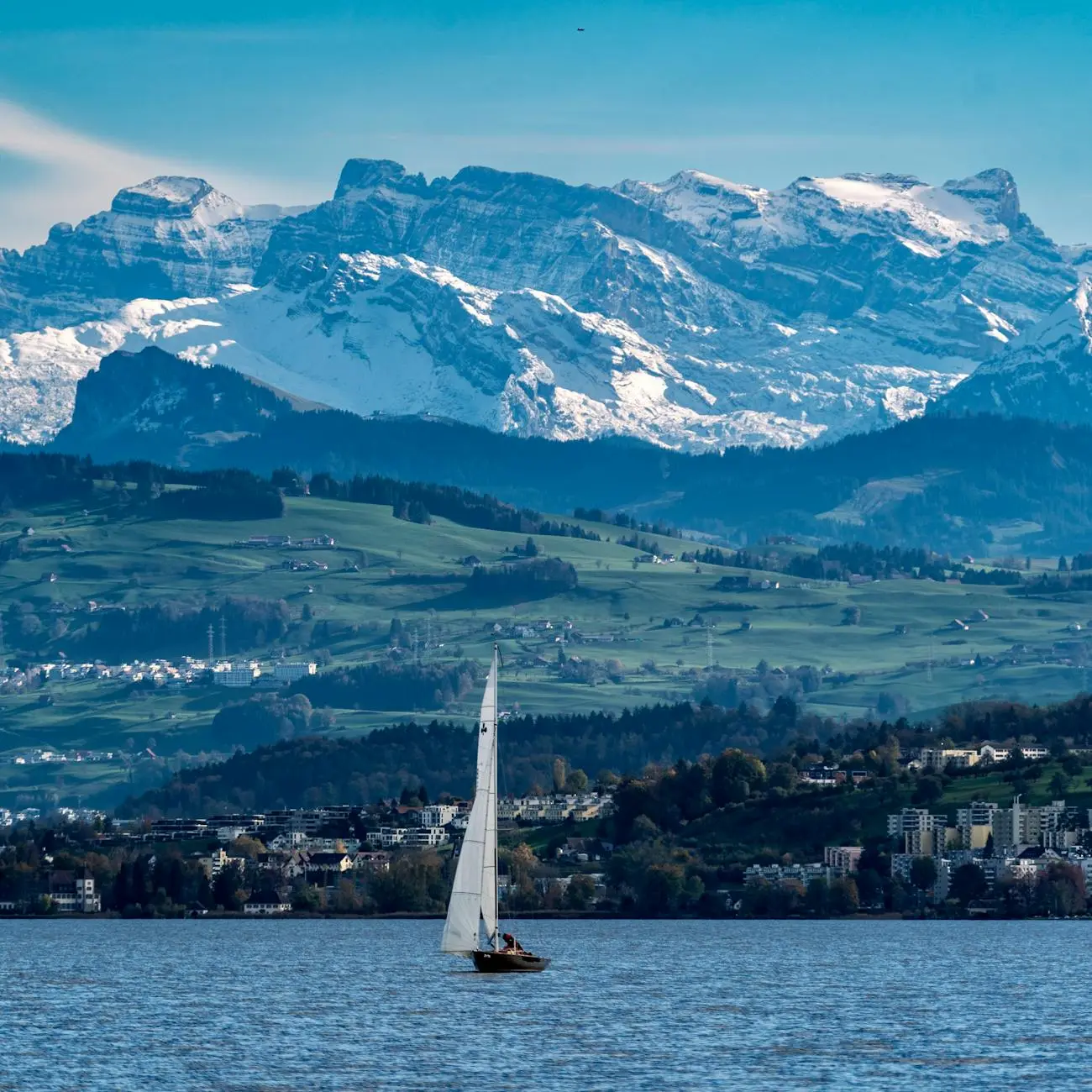
A picturesque view of Lake Zurich with a sailboat gliding through the water, framed by the stunning backdrop of the snow-capped Swiss Alps.
Navigating the Trams Like a Pro
Zurich’s public transport is a revelation—clean, punctual, and comprehensive. Do not rent a car. Parking is expensive and a nightmare, and the trams and trains will get you everywhere faster.
Your best friend is the ZürichCard. This genius pass gives you unlimited travel on trams, buses, trains, boats, and even cable cars within the city, plus free or discounted admission to most museums. You can get a 24 or 72-hour card. It pays for itself incredibly quickly.
Trams & Buses: Zurich’s ZVV network connects everything. A 24-hour pass covers tram, bus, train, and even ferries.
Trains: Perfect for day trips to Lucerne or Basel.
On Foot: Zurich is compact. Wear good shoes; cobblestones are ankle’s worst enemy.
Car Rental: Not needed unless you’re heading deep into the Alps. Gas is pricey, parking is limited.
🍫 SWISS CHOCOLATE · ZURICH’S SWEETEST INDULGENCE
🍫 PROST!Zurich’s luxurious chocolate shops are just one taste — I’ve savored 80+ destinations!
One praline leads to another — and one city leads to 80+ more. Explore all my guides.
🍫 “Swiss chocolate is the best in the world — and 80+ destinations are equally delicious”
A Hidden Gem You Can’t Miss
Tired of the crowds? Take a short tram ride (line 7 or 13) to Zürichberg. Wander through the serene Zürich Zoo or, better yet, find the Felsenegg Cable Car. For a few francs, it whisks you up the Uetliberg mountain for panoramic views of the city, lake, and, on a clear day, the distant Alps. It’s a local favourite for a reason and feels a world away from the city bustle.
Augustinergasse: A picturesque alley with colorful medieval houses.
Viadukt Market: Local produce and indie shops under old railway arches.
An Asian elephant reaching for food at Zürich Zoo, showcasing the vibrant wildlife experience available in the city. A magnificent Asian elephant engages in natural foraging behavior at the renowned Zürich Zoo, known for its commitment to conservation and expansive, species-appropriate enclosures.
⛵ LAKE ZURICH · ALPINE REFLECTIONS
⛵ PROST!Cruising Lake Zurich with Alpine views is just one voyage — I’ve explored 80+ waterfront cities!
From Swiss lakes to the world’s most beautiful shores — set sail for adventure.
⛵ “Lake Zurich’s waters are crystal clear — and 80+ more horizons await your view”
The Felsenegg Cable Car offers stunning views over Zurich and the shimmering lake, making it a must-visit for nature lovers.Discover the vibrant atmosphere of Zurich’s trendy Viadukt Market, featuring unique food stalls and lush greenery.A serene view of Lake Zurich with a sailboat gliding across the water, surrounded by lush green hills and the majestic snow-capped Alps in the background. The ultimate Zurich escape: experience the stunning contrast of a serene sailboat on Lake Zurich against the dramatic, snow-capped peaks of the Swiss Alps.
Zurich on a Budget: Money-Saving Hacks
Yes, Zurich is expensive. But it doesn’t have to break the bank.
Picnic by the Lake: Grab bread, cheese, and meat from a supermarket like Migros or Coop and have a gorgeous, affordable lunch by the water.
Tap Water is King: Swiss tap water is pristine and delicious. Carry a reusable bottle and fill up for free.
Free Museum Entries: Many museums, like theKunsthaus (Art Museum), offer free admission on Wednesdays. Plan accordingly if you’re here longer!
Skip the Taxi: The tram system is your wallet’s best friend. Use it.
Buy train tickets via the SBB Mobile app to save time (and avoid fines for boarding without one)
Essential Swiss German for Travellers
While everyone speaks English, a little effort goes a long way!
Grüezi (GROO-tsee): Hello
Merci (MER-see): Thank you
En Guete (en GOO-teh): Enjoy your meal!
Proscht (prosht): Cheers!
Wo isch…? (vo ish): Where is…?
Wo isch d’Toilette? (Where is the toilet?)
Ein Bier, bitte (One beer, please)
Before You Go: Visa & Essential Links
Visa: Switzerland is part of the Schengen Area. If you’re from the US, UK, or Canada, you typically don’t need a visa for short stays. Alwayscheck the official Swiss government site for the most current requirements based on your nationality.
💡 Tip: If you already have a valid multi-entry Schengen visa, you can use it to enter Switzerland and continue to nearby destinations like Munich, Milan, or Vienna without extra paperwork.
Travel Insurance: ✈️ Smart Travel Tip: No matter where your adventures take you, having the right travel insurance can save you from unexpected headaches (and bills). I personally recommend VisitorsCoverage — it’s a trusted platform where you can compare plans, find coverage that fits your trip, and book it in just a few clicks. Whether you’re planning a quick city escape or a longer international journey, it’s peace of mind worth packing.
Stay Connected: ✈️ Travel Tip: Staying connected abroad can be tricky (and expensive if you’re relying on airport SIM counters or roaming). That’s why I carry a Drimsim—a universal SIM card that works in 190+ countries without hidden fees. You just pop it into your phone, top up through the app, and you’re online wherever your adventure takes you. No more hunting for local SIM cards or stressing over roaming bills.
Stay Secure Online: Using public WiFi? Protect your data with a reliablenordvpn. It’s essential for any modern traveler.
Flight Trouble? ✈️ Flight Delayed or Canceled? Travel isn’t always smooth sailing. The good news? You might be entitled to up to $650 in compensation under air passenger rights. Most travelers never claim it, but I’ve got you covered: just check your flight with AirHelp. They handle the paperwork, fight the airlines for you, and only get paid if you win. Easy, stress-free, and potentially a nice surprise for your travel fund.
🗣️ READER STORIES · REAL MISTAKES · WHAT WORKS
“I paid $8 for a coffee on Bahnhofstrasse. A local saw me and said, ‘Go to Lindenhof. Same view. Free.’ I went the next day. He was right.” — Emma, London
“I almost skipped the Felsenegg cable car. A hostel worker said it’s better than Uetliberg. No crowds, Alps on a clear day, and only 10 CHF round trip.” — Liam, Sydney
🏔️
Zurich’s stunning lake views! Just one of 80+ destinations across 6 continents.
🇪🇺 45+ Europe · 🌏 18+ Asia · 🌎 10+ Americas · 🌅 8+ Africa/Australia
🏔️ “From Zurich’s Alps to the world — 80+ adventures await”
📜10 ZURICH TRUTHS
1.Lindenhof has the best free view — skip expensive cafes on Bahnhofstrasse
2.Tap water is free and delicious — bring a reusable bottle
3.Grossmünster tower climb costs 5 CHF — worth it for the city view
4.ZürichCard often pays for itself — do the math before buying
5.Viadukt Market is under the railway arches — local produce, affordable
6.Felsenegg cable car ($10 round trip) beats Uetliberg’s tourist crowds
7.Picnic by Lake Zurich with Migros/Coop supplies = best budget meal
8.Don’t rent a car — tram system is perfect and parking is $40+/night
9.May-June and September are ideal — mild weather, fewer crowds
10.Learn ‘Grüezi’ (hello) and ‘Merci’ (thank you) — Swiss German basics
Zurich Weekend FAQ
Is two days enough for Zurich? Absolutely! Zurich is perfectly sized for a weekend trip. You’ll have enough time to see the main sights, explore the old town, and enjoy the lake without feeling rushed.
What is the best way to get from Zurich Airport to the city center? The train is unequivocally the best way. It takes only 10 minutes, runs constantly, and drops you right at the main train station (Zürich HB), which is the hub for all trams.
What is the best time of year to visit Zurich? Spring (April-May) and Autumn (September-October) are ideal. The weather is mild, and the crowds are smaller than in the peak summer months. December is also magical for the famous Christmas markets.
Can I use Euros in Zurich? The official currency is the Swiss Franc (CHF). While some places might accept Euros, you will almost always get a terrible exchange rate. It’s best to just withdraw or pay with Francs.
Is Zurich very expensive? It has a reputation for a reason—it is one of the more expensive cities in Europe. However, with the tips in this guide (picnics, public transport, the ZürichCard), you can manage your budget effectively.
Q: Do I need cash? Cards are widely accepted, but keep a few Swiss Francs for small bakeries and kiosks.
Q: Is English widely spoken? Yes, especially in hotels and restaurants. But tossing in a “Grüezi” earns smiles.
“I thought Zurich was just expensive banks. Then I found free Lindenhof views, took the Felsenegg cable car, and ate fondue in a hidden Altstadt alley.”
The tourist pays $8 for a coffee on Bahnhofstrasse. The traveler enjoys the same view for free at Lindenhof. The tourist rents a car and pays $40/night for parking. The traveler rides the perfect tram system. Zurich rewards the savvy — and the person who knows that Swiss efficiency extends to your wallet.
📌 P.S. — My Zurich Secret Lindenhof. Most tourists never find it. It’s a quiet hilltop park in the middle of the Old Town. The Romans built a castle here. Now it’s a peaceful square with chess players, a fountain, and the best free view of the Limmat River, Grossmünster, and the city rooftops . Most tourists walk right past the entrance. Don’t be that tourist. It’s free. It’s quiet. It’s the perfect sunset spot.
Zurich is the perfect blend of lakeside relaxation, alpine adventure, and city chic. Whether you’re here for the chocolate, the views, or just a stylish weekend reset, this Swiss city delivers. And if you’ve got extra time, don’t stop—hop a train to Munich or Milan and turn your weekend escape into a Euro trip worth bragging about.
👉 Ready to plan? Start by booking your flights and stays with Expedia. Zurich’s waiting.
Ready to trade your weekend for a Swiss adventure? Start planning your ultimate escape to Zurich today! Check for the best travel deals and let the efficiency and beauty of Switzerland wow you.
🏔️🇨🇭Zurich’s lake & Old Town — just one of 80+ destinations
🎋 Kyoto · 1 of 18+ Asia Guides · 80+ Destinations Worldwide
🎋Last Updated: April 2026 · Regularly Maintained — fresh ICOCA card prices, updated bus pass info, new temple admission fees, and latest Haruka Express schedules added
✓ 2026 data✓ Regularly reviewed✓ Part of 80+ series
🎋THE KYOTO QUICK ANSWER — 72 HOURS
Can you experience Kyoto in a weekend? Yes — if you wake up early, buy a bus pass, and embrace the quiet.
Kyoto is not just temples and matcha. It’s a city of 2,000 shrines, bamboo forests that sway in the wind, and alleyways where geiko still hurry to appointments. The tourist who only sees Kinkaku-ji and leaves misses the Philosopher’s Path at dawn, the monkeys at Arashiyama, and the lantern-lit magic of Pontocho Alley. The traveler who gets an ICOCA card, buys the ¥700 One-Day Bus Pass, and shows up at Fushimi Inari at 7am discovers the real Kyoto. The difference is knowing that Kyoto rewards the early riser.
🎯 THE 72-HOUR FORMULA
Day 1 (East Kyoto): Fushimi Inari Taisha (7am sharp), Higashiyama District, Kiyomizu-dera, Gion at dusk
Day 2 (Arashiyama): Bamboo Grove (sunrise), Tenryu-ji Temple, Monkey Park, Nishiki Market
Day 3 (North/Central): Kinkaku-ji (Golden Pavilion), Ryoan-ji rock garden, Philosopher’s Path, Pontocho Alley
The secret: Buy the One-Day Bus Pass for ¥700. It pays for itself in 3 rides. Most tourists pay per ride and waste money. Don’t be that tourist.
The mistake: Showing up at Fushimi Inari or Arashiyama at 10am. You will be swallowed by crowds. Go at 7am. The tourist sleeps in. The traveler has the torii gates almost to themselves.
🚌 One-Day Bus Pass: ¥700⛩️ Fushimi Inari: go at 7am🍵 Matcha: try it in Uji
✅ 72 hours is perfect — wake up early, buy a bus pass, find the quiet
📍 Source: Multiple Kyoto trips, one sunrise at Fushimi Inari, and the discovery that the best matcha is hidden in a tiny teahouse
2,000+
temples and shrines in Kyoto
17 are UNESCO World Heritage sites
17
UNESCO World Heritage sites
Kinkaku-ji, Kiyomizu-dera, Nijo Castle
30m+
tall bamboo in Arashiyama
The famous Bamboo Grove — go at sunrise
50M+
annual visitors to Kyoto
Peak seasons: cherry blossoms (April) and fall foliage (November)
🎋THE KYOTO GAP — WHAT EVERY GUIDE MISSES
Most Kyoto guides tell you to see Kinkaku-ji, visit Fushimi Inari, and eat matcha. That’s not wrong. It’s just the Kyoto that everyone already knows.
Here’s what they don’t tell you: Kyoto has secrets — and most of them are free or cheap. The best time to see Fushimi Inari is 7am. The best view of Arashiyama is from the Monkey Park. The best way to get around is a ¥700 bus pass. The tourist who doesn’t know these things will wait in lines, fight crowds, and miss the magic. The traveler who does will find peace, perspective, and the best matcha of their life.
🎯 WHAT THEY DON’T SHOW YOU
⛩️ Fushimi Inari’s Secret Timing
Tourists show up at 10am. The secret? Go at 7am. The torii gates are almost empty. The light is golden. The experience is spiritual instead of stressful. By 9am, the tour buses arrive. Be done by then.
🎋 The Bamboo Grove Truth
Tourists go to Arashiyama Bamboo Grove at noon. The secret? Go at sunrise or just before sunset. The crowds disappear. The light filters through the bamboo. It’s magical. Most tourists see it at peak chaos and leave disappointed.
🚌 The Bus Pass Hack
Tourists pay per ride (¥230 each). The secret? The One-Day Bus Pass is ¥700. If you take 4 rides, you’ve saved money. Kyoto’s attractions are spread out. You’ll take more than 4 rides. Buy the pass.
🍵 The Matcha Rule
Tourists buy matcha from souvenir shops. The secret? Go to Uji. It’s a 20-minute train ride from Kyoto. It’s the source of Japan’s best matcha. The tea houses are centuries old. The experience is unforgettable.
🐒 The Monkey Park View
Tourists visit Arashiyama for the bamboo and leave. The secret? The Monkey Park Iwatayama is a 20-minute hike. The view of Kyoto from the top is spectacular. And the monkeys are hilarious. Feed them from inside the cage. Don’t make eye contact.
🏮 Gion’s Evening Magic
Tourists walk through Gion during the day. The secret? Go at dusk. The lanterns are lit. The crowds thin out. You might spot a geiko (geisha) hurrying to an appointment. The magic happens after dark.
“The tourist shows up at Fushimi Inari at 10am, fights the crowds, and leaves disappointed. The traveler arrives at 7am, walks through the torii gates in silence, and feels the magic. The difference is an alarm clock. Set it.”
— Nomad Nate, after 4 trips to Kyoto
❌ Paying per bus ride✅ One-Day Bus Pass (¥700)✅ Fushimi Inari at 7am
📊 90% of tourists never visit Uji for matcha
📍 Sources: Multiple Kyoto trips, one sunrise at Fushimi Inari, and the discovery that the best matcha is hidden in a tiny teahouse
Description
Discover how to experience the best of Kyoto in just 3 days. Our ultimate guide covers hidden gems, a foolproof itinerary, transport hacks, and essential tips for an unforgettable cultural weekend getaway in Japan’s ancient capital.
“My trip to Kyoto was born from a whim and a need to escape. After a grueling month at work, I booked a last-minute flight, threw a backpack together, and embarked on what became one of my most cherished travel memories. I learned that you don’t need weeks to experience the soul of Japan—you just need a plan. Let me be your guide to an unforgettable 72-hour immersion in a city where ancient temples sit just around the corner from buzzing modern life.”
Kyoto is the antidote to Tokyo’s neon-fueled frenzy. It’s a city that moves at the pace of a flowing river—calm on the surface but with incredible depth and power underneath. With over 2,000 temples and shrines, 17 UNESCO World Heritage sites, and a food culture that will make your taste buds sing, it offers a concentrated dose of traditional Japanese culture.
For those coming from nearby hubs like Osaka, Taipei, and Tokyo it’s a geographically close and culturally rich escape. Best of all, for many nationalities, Japan offers visa-free travel for short stays, making it a logistically simple trip. (Always check the official requirements for your passport).
Kyoto is like your wise, quiet grand-aunt who’s rich in stories—1,600 temples, whispering bamboo paths, unbelievable matcha desserts, and street corners where you might accidentally bump into a maiko (trainee geisha). If your country requires a tourist visa for Japan, expect fees ranging roughly ¥3,000–¥6,000¥3,000–¥6,000¥3,000–¥6,000 (around $20–$40) and a processing time from 3 days to 3 weeks depending on the embassy—worth verifying on your local consulate site. Peak beauty? Go for sakura season in early April or fall foliage in late November (color explosion, fewer jet-lagged crowds).
Visa: Many nationalities enjoy visa-free travel to Japan for short stays. However, requirements can change. Always verify your specific visa requirements and associated fees directly with the Official Ministry of Foreign Affairs of Japan website.
Find the best deals on flights, hotels, and tours for your weekend in Japan’s ancient capital. Compare and make the right choice with many options below!
Every traveler has different priorities — budget airlines, flexible hotels, or specific tour operators. Compare prices across platforms to find what works best for YOUR Kyoto adventure. Happy travels! 🇯🇵
🎋 Why Kyoto?
Japan’s ancient capital is pure magic — the iconic Fushimi Inari Taisha with its thousand torii gates, the golden splendor of Kinkaku-ji (Golden Pavilion), the ethereal Arashiyama Bamboo Grove, the preserved streets of Higashiyama, and the geiko culture of Gion. Don’t leave without trying matcha (especially in Uji), kaiseki ryori (traditional multi-course meal), and yudofu (tofu hot pot). Remember: wake up early — Kyoto’s magic happens before 9 AM! ⛩️
🔗 Affiliate Disclosure: I may earn a small commission when you book through these links at no extra cost to you. Thank you for supporting ConfidenceBuildings.com!
Crafting Your Perfect Kyoto Itinerary:
This itinerary is designed to maximize your time by grouping nearby attractions together, saving you hours on logistics.
⛩️ 乾杯!Kyoto’s golden pavilion and bamboo groves are just one of 80+ destinations I’ve explored!
From the glittering Kinkaku-ji to the ethereal Arashiyama bamboo forest, Kyoto is Japan’s spiritual heart. And I’ve captured that same magic across 6 continents — with 45+ European cities, Asian adventures, Americas escapes, and more.
🎋 “In Kyoto, every season paints a new masterpiece — and 80+ more cities are waiting to inspire you”
Day 1: The Iconic East
Morning: Start early at Fushimi Inari Taisha. I mean early—be there by 7:00 AM to experience the famous torii gate pathway without the crowds. Trust me, having a moment of solitude there is magical.
Afternoon: Head north to the Higashiyama District. Wander the preserved streets betweenKiyomizu-dera Temple and Yasaka Shrine. This area is a living museum. Stop for a matcha and traditional sweet at a teahouse overlooking the cobbled lanes.
Evening: Explore the Gion district. You might spot a Geiko or Maiko (the local terms for Geisha and apprentices) scurrying to an appointment. For dinner, try a casual okonomiyaki (savory pancake) restaurant.
A visitor strolls through the iconic torii gates of Fushimi Inari Taisha, wearing a traditional kimono, capturing the essence of Kyoto’s rich culture. *The iconic tunnel of thousands of vermilion torii gates at Fushimi Inari Taisha. For the most serene experience, arrive before 7:00 AM to have the path almost to yourself.`
Fushimi Inari Note: “The advantage of Fushimi Inari is that it’s open 24 hours, so you can always fit it in.
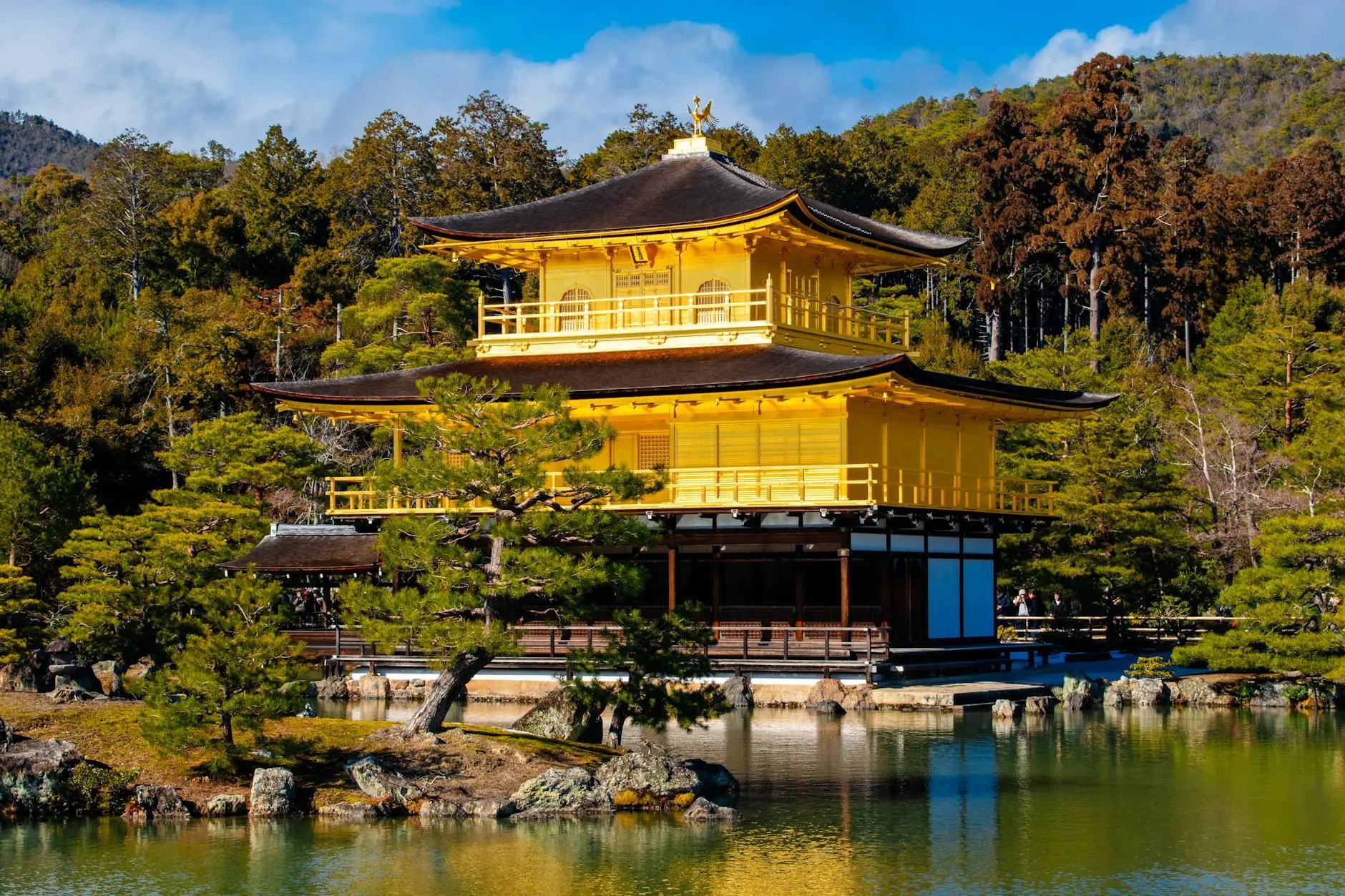
🏯 KINKAKU-JI · THE GOLDEN PAVILION · KYOTO’S JEWEL
🏯 乾杯!Gazing at the golden reflection in the pond is just one breathtaking sight — I’ve witnessed 80+ architectural wonders!
From Zen temples to palaces and pagodas — beauty awaits in every corner.
🏯 “Gold leaf shimmers in the water — and 80+ cities shimmer with their own beauty”
A bustling street scene in Kyoto, showcasing traditional architecture and cherry blossoms, perfect for exploring the city’s rich cultural heritage. A serene walk through the Higshiyama district
A striking view of Kiyomizu-dera Temple, showcasing its intricate architecture and vibrant orange hues, a must-see landmark in Kyoto. The stunning Niōmon Gate and three-story pagoda at Kiyomizu-dera Temple. Pro tip: The contrast of the red structures against the green foliage in spring or autumn is even more spectacular.`
Kiyomizu-dera Note: “Note: Kiyomizu-dera typically opens around 6:00 AM and closes between 6:00 PM and 9:30 PM, depending on the season. Admission is ¥400.”
A delicious okonomiyaki, a savory Japanese pancake topped with bonito flakes and sauce, served in a cozy Kyoto restaurant. Dinner is served! A classic Hiroshima or Kansai-style okonomiyaki, grilled to perfection. The name literally means “grill what you like” – and we like everything!
Day 2: Arashiyama’s Natural Beauty
Morning: Take the train to Arashiyama. Your first stop is the Arashiyama Bamboo Grove. Again, early arrival is key to seeing it in its serene glory. Afterwards, visit the nearby Tenryu-ji Temple and its stunning landscape garden.
Afternoon: Cross the Togetsukyo Bridge and consider a quick hike up to the Monkey Park Iwatayama for hilarious photo ops and great views. Alternatively, rent a bike to explore the quieter parts of Arashiyama.
Evening: Head back to the city center and dive into the organized chaos of Nishiki Marketfor a dinner of fresh seafood and local snacks.
A serene pathway through the Arashiyama Bamboo Grove in Kyoto, showcasing the tranquil beauty of the lush green bamboo. *The famous Arashiyama Bamboo Grove path. For the most magical and crowd-free experience, aim to arrive as early as possible, ideally by 7:00 AM. The morning light filtering through the bamboo is unforgettable.*
🎋 ARASHIYAMA BAMBOO GROVE · KYOTO’S GREEN SANCTUARY
🎋 乾杯!Walking through the towering bamboo of Arashiyama is just one serene moment — I’ve found 80+ peaceful escapes!
From moss gardens to mountain temples — find your zen around the world.
A serene view of Tenryu-ji Temple surrounded by lush greenery and a tranquil pond in Arashiyama, Kyoto. The UNESCO World Heritage-listed Sogenchi Garden at Tenryu-ji Temple, a masterpiece of Japanese landscape design. The pond is designed to reflect the surrounding Arashiyama mountains and the changing seasons.
A vibrant array of local delicacies at Kyoto’s Nishiki Market, showcasing a variety of traditional Japanese ingredients. A rainbow of tsukemono (pickled vegetables) at Nishiki Market. Don’t be shy—many vendors offer samples! It’s the perfect place to try unique Japanese flavors like pickled daikon radish or crunchy kyuri cucumbers.
Day 3: Refinement & Reflection
Morning: Choose your finale. For gold-leaf opulence, visit Kinkaku-ji (The Golden Pavilion). For a more Zen, minimalist experience, head to Ryoan-ji Temple and contemplate its famous rock garden.
Afternoon: Do some last-minute souvenir shopping on Shijo-Dori or find a quiet garden to simply sit and absorb it all before you head to the airport.
Ready to walk this path yourself? Find great deals on flights and hotels in Kyoto with my trusted partner, Expedia.
🎭 GION · GEISHA · KYOTO’S ELEGANT HEART
🎭 乾杯!Spotting a geiko in Gion’s lantern-lit streets is just one magical encounter — I’ve discovered 80+ cultural treasures!
From tea houses to traditional arts — every city has its own living heritage.
The stunning Kinkaku-ji Temple, also known as the Golden Pavilion, reflecting beautifully in the serene waters of its surrounding garden. The breathtaking Kinkaku-ji (Golden Pavilion), covered in gold leaf and perfectly reflected in the mirror-like Kyoko-chi pond. This UNESCO World Heritage site is even more stunning on a windless, sunny day.
A serene moment shared between a couple, enjoying the tranquil beauty of Kyoto’s natural scenery. (Ryoan-ji Temple)Scenic view of a tranquil pond surrounded by vibrant autumn foliage in Kyoto.A peaceful stroll through the historic streets of Kyoto, framed by traditional architecture and lush greenery.Kyoto AquariumVisitors observing a seal in an aquarium in Kyoto, creating unforgettable family memories.
While we’re on the topic of unforgettable Asian adventures, if Shanghai’s dynamic energy has you dreaming of a more serene Japanese counterpart, then Kyoto should be at the top of your list. Imagine trading the futuristic skyline for ancient temples, serene bamboo forests, and the timeless tradition of the geisha culture in Gion. To truly dive deep, skip the standard tours and seek out an authentic experience. I often browse Rakuten Travel Experiences for unique activities—like a private tea ceremony with a master or a early-morning meditation session at a Zen temple before the crowds arrive. It’s the perfect way to craft a trip that’s genuinely your own. Find those unique, memory-making experiences in Kyoto here.
Most visitors land at Kansai International (KIX). Skip the uncertain taxis and hop the Haruka Limited Express to Kyoto Station—about 75 minutes of smooth, Hello Kitty–decorated train bliss—and grab the ICOCA & Haruka combo ticket to include a pre-loaded ICOCA transport card when you arrive The Thorough Tripper. Pro tip: get an ICOCA card—it’s your tap-and-go Swiss Army knife for trains, subways, and buses around Kyoto (and nearby cities), with easy reloads at stations The Thorough Tripper. If you’ve got long-distance plans (like a Tokyo bullet train ride), consider a Japan Rail Pass in advance—it’ll save both yen and decoding train timetables The Thorough TripperNot a Nomad Blog.
Map of Kyoto’s public transport network, highlighting the Kansai-Airport Express routing and key train lines for travelers.
The Bus Network: The most useful way to get around central Kyoto. AOne-Day Bus Pass (¥700) is an incredible value and pays for itself in about three rides. Buses can get crowded, so have your pass or change ready.
The Train/Subway: Faster than buses for longer distances. The Karasuma Subway Line runs north-south, and the Tozai Line runs east-west. The JR Line is also useful for getting to Arashiyama and Fushimi Inari.
Bicycles: Kyoto is surprisingly flat and bike-friendly! Renting a bike for a day gives you incredible freedom to explore back alleys and canals. This was my favorite way to get around.
Taxis: Great for short trips if you’re in a group or exhausted, but they are pricey.
The JR Line is also useful for getting to Arashiyama and Fushimi Inari. If you’re planning to explore beyond Kyoto (e.g., a day trip to Nara or a flight from Tokyo), calculating if a Japan Rail Pass is worth it is essential. You can easily check prices and purchase your JR Pass online here
Pro Tip: Google Maps is shockingly accurate for Kyoto bus and train schedules. Use it with confidence.
Beyond the Tourist Trail: Kyoto’s Hidden Gems
“Forget the bustling, crowded cities you think of when you picture Japan. There’s a place where every corner is a postcard, every moment a meditative breath, and ancient traditions whisper from every stone. Get ready to unlock the secret to a weekend of unparalleled beauty and peace as we journey through Kyoto’s most enchanting hidden gems.”
Everyone sees the golden temple. The savvy travelers see these:
Philosopher’s Path (Tetsugaku-no-michi): A beautiful stone path following a canal, lined with hundreds of cherry trees. It’s peaceful any time of year but absolutely breathtaking in spring.
Kurama-dera Temple: Escape the city entirely with a short train ride to Kurama. Hike up to this mountain temple, and if you’re brave, finish with a soak in the outdoor Kurama Onsen.
Pontocho Alley at Dusk: Yes, it’s known, but it’s a must. This narrow alleyway parallel to the Kamo River is packed with tiny, atmospheric restaurants and bars. Finding dinner here feels like a treasure hunt.
Hidden Gem
Tip
Miyagawa-cho District
Traditional vibes, fewer crowds, close to Kyoto Station—perfect for jet-lagged meanders
Lesser-known temples
Try Eikan-do, Tofuku-ji, or shimogyo historic backstreets for quiet beauty
Off-peak hours
Skip crowds by visiting popular spots at dawn or early evening
Taxi for groups
Group of 3–4? A taxi might be quicker than waving down a bus and costs about the same
To capture these hidden spots perfectly, I never travel without my lightweight, powerful Sony Alpha camera. It’s perfect for low-light alley shots and sweeping temple landscapes.
A serene path alongside a gently flowing river in Kyoto, surrounded by lush greenery and autumn foliage. (Philosopher’s Path) The Philosopher’s Path (Tetsugaku-no-michi) in its stunning autumn glory. This walk is beautiful year-round, but it’s absolutely magical in late November when the maple trees erupt in color. Renting a bike is a fantastic way to explore its full length.
Essential Japanese for the Kyoto Traveler
A little language goes a long way!
Konnichiwa (こんにちは): Hello / Good afternoon.
Arigatou Gozaimasu (ありがとうございます): Thank you (very much).
Sumimasen (すみません): Excuse me / Sorry. (The most useful word in Japan! Use it to get attention, apologize, or thank someone for moving).
Oishii (美味しい): Delicious! Say this to the chef after your meal.
Ikura desu ka? (いくらですか): How much is it?
Kore o kudasai (これをください): I’ll take this, please. (Pointing works too!)
Staying Online: I used to waste the first hour of every trip hunting for a local SIM card at the airport. Not anymore. I now swear by my Drimsim—a global SIM that works in 190+ countries. You just pop it in, top up via the app, and you’re online before you even leave the baggage claim. No contracts, no hidden fees. It’s a genuine game-changer. Get your Drimsim here and never worry about data again.
Staying Secure: While Japan is safe, I always use a VPN on public Wi-Fi (like at cafes or airports) to protect my personal data. It’s also essential for accessing your home country’s streaming services if you need some downtime. I’ve found NordVPN to be the most reliable for travel.
Staying Compensated: Did you know that a delayed or canceled flight could score you up to $650 in compensation? Most people don’t claim it. I use AirHelp to handle the nasty paperwork with the airlines. They only get paid if you win, so it’s a no-brainer. Check your flight status with AirHelp here.
Staying Insured: From a spilled coffee on my camera to a slipped disk trying to imitate a sumo wrestler (don’t ask), travel insurance has saved me countless times. I always use VisitorsCoverage to compare and find the best plan for my trip. It’s peace of mind in your pocket. Get a tailored insurance quote for your Kyoto trip here.
⛩️
Kyoto’s thousand shrines! Just one of 80+ destinations across 6 continents.
🇪🇺 45+ Europe · 🌏 18+ Asia · 🌎 10+ Americas · 🌅 8+ Africa/Australia
⛩️ “From Kyoto’s bamboo groves to the world — 80+ adventures await”
🗣️REAL STORIES · REAL MISTAKES · WHAT ACTUALLY WORKS
Kyoto looks serene. But there are secrets—the bus pass hack, the 7am rule, the hidden matcha town. Here are three stories from travelers who learned the hard way—and one who figured it out.
A
Reader Story · Alex, Seattle
Visited October 2025
“I paid ¥230 for every bus ride in Kyoto. By the end of the first day, I had spent over ¥2,000. A local on the bus saw me feeding coins into the machine and said: ‘One-Day Pass. ¥700.’ I bought one the next day. I saved money by my third ride. I felt so stupid. I learned: always ask about the day pass. Every city has one. Kyoto’s is a steal.”
😬 HIS MISTAKE
Paid per ride (¥230 each). Spent over ¥2,000 on the first day.
✅ WHAT HE LEARNED
Buy the One-Day Bus Pass for ¥700. Available at the bus information center or from the driver. Pays for itself in 3-4 rides.
NN
Nomad Nate · 4 trips to Kyoto
“Alex’s story is the #1 Kyoto money mistake. The bus system is the best way to get around — but single fares add up fast. The One-Day Bus Pass is ¥700. It’s sold at the bus information center at Kyoto Station, or you can buy it from the bus driver. The rule: buy the pass on your first morning. By lunchtime, it’s paid for itself.”
Nate’s Pro Tip: “The pass also works on most city buses, but not on JR buses. Look for the ‘City Bus’ sign. Google Maps is your friend — it tells you which bus to take and where to get off.”
S
Reader Story · Sarah, Vancouver
Visited November 2025
“I showed up at Fushimi Inari at 10am. It was a sea of people. I couldn’t get a photo without strangers in the background. The magic was gone. A photographer on the trail said: ‘Come back tomorrow at 7am.’ I did. The gates were almost empty. The light was golden. I walked through in silence. I learned: Kyoto’s most famous spots are magical — but only if you wake up before everyone else.”
😱 HER MISTAKE
Showed up at 10am. Crowded, stressful, disappointing.
✅ WHAT SHE LEARNED
Fushimi Inari is open 24/7. Go at 7am. The torii gates are almost empty. The experience is spiritual instead of stressful.
NN
Nomad Nate · 4 trips to Kyoto
“Sarah’s story is the #2 Kyoto mistake. Fushimi Inari is one of the most popular sites in Japan — for good reason. But 30,000 people visit on a busy day. The secret: go at 7am. The gates are quiet. The light is beautiful. You can walk in peace. The rule: set your alarm for 6am. The tourist sleeps in. The traveler has the torii gates almost to themselves.”
Nate’s Pro Tip: “The hike to the top takes about 2 hours. Most tourists turn back at the halfway point. Keep going. The upper gates are even more beautiful — and even emptier.”
J
Reader Story · James, Austin
Visited September 2025
“I thought I knew matcha. Then I took the train to Uji. It’s 20 minutes from Kyoto. I walked into a tea house that’s been there for 300 years. The matcha was vibrant green. Thick. Bitter. Sweet. Nothing like the sugary drinks at home. I sat on a cushion and watched the tea master prepare it. It was a meditation. I learned: the best matcha isn’t in Kyoto. It’s in Uji. And it’s worth the trip.”
✨ ACCIDENTAL DISCOVERY
Took the train to Uji. Found a 300-year-old tea house. Had the best matcha of his life.
✅ WHAT HE LEARNED
Uji is the source of Japan’s best matcha. 20 minutes by train from Kyoto. Ancient tea houses. The real experience. Most tourists never go.
NN
Nomad Nate · 4 trips to Kyoto
“James discovered the Kyoto secret that most tourists miss. Uji is the matcha capital of Japan. The tea houses are centuries old. The ceremony is meditative. And the matcha is unlike anything you’ve tasted. The rule: take the JR Nara Line from Kyoto Station to Uji (20 minutes, ¥240). Spend a morning there. Walk along the river. Visit Byodo-in Temple. Drink matcha in a tea house. You won’t regret it.”
Nate’s Hard Truth: “The tourist buys matcha powder from a souvenir shop in Kyoto. The traveler takes the train to Uji and drinks it from a ceramic bowl in a 300-year-old tea house. The difference is 20 minutes on a train. Do it.”
📝 YOUR STORY COULD BE NEXT
Been to Kyoto? Paid per ride instead of buying the bus pass? Survived the Fushimi Inari crowds at 7am? Found matcha heaven in Uji? Your story might help someone else find peace in Japan’s ancient capital.
✍️ Share your Kyoto story
📍 Stories anonymized and used with permission · Names changed to protect privacy
🎋THE 10 KYOTO TRUTHS — EVERYTHING DISTILLED
If 72 hours is too much to carry—here are the ten truths that matter most. Print them. Save them. Send them to someone who needs them.
01The One-Day Bus Pass is ¥700. Buy it.
Single rides are ¥230. The pass pays for itself in 3-4 rides. Available from the bus driver or at the station. The tourist pays per ride. The traveler buys the pass.
02Fushimi Inari at 7am. Non-negotiable.
Show up at 10am and you’ll be swallowed by crowds. The gates are open 24/7. Go early. The light is golden. The torii are quiet. Set your alarm.
03Arashiyama Bamboo Grove at sunrise.
Same rule as Fushimi Inari. By 9am, it’s a selfie-stick traffic jam. Go at sunrise. The light filters through the bamboo. The crowds are gone. Magic.
04Uji is the matcha capital. 20 minutes from Kyoto.
Most tourists never go. Ancient tea houses. The best matcha of your life. Take the JR Nara Line. Spend a morning there. You’ll thank me.
05Gion at dusk, not during the day.
Daytime Gion is crowded with tourists. Evening Gion is magical. Lanterns are lit. You might spot a geiko. The magic happens after dark.
06Philosopher’s Path is for walking slowly.
2km stone path following a canal. Cherry trees in spring. Quiet in autumn. Don’t rush. Sit on a bench. Think. That’s the point.
07Kinkaku-ji (Golden Pavilion) is stunning — but crowded.
Go early or late. The gold leaf shimmers in the water. It’s worth seeing. But don’t expect solitude. Accept the crowds. Take your photo. Move on.
08Pontocho Alley is dinner and a show.
Narrow alleyway parallel to the Kamo River. Tiny restaurants. Lanterns. Reservations recommended. The atmosphere alone is worth the walk.
09Cash is still king in Kyoto.
Big hotels and department stores take cards. Small temples, market stalls, and traditional restaurants? Cash only. Always carry yen. 7-Eleven ATMs are your friend.
10Kyoto is not a checklist. It’s a feeling.
Don’t try to see all 2,000 temples. Pick 5-6. Sit in a garden. Drink matcha slowly. Walk without a destination. The magic is in the quiet moments.
The Smart Traveler Framework — Six Questions Before You Go
Do I have my One-Day Bus Pass? Am I waking up for 7am at Fushimi Inari? Did I book a tea house in Uji? Do I have cash for temple entry fees? Am I going to Arashiyama at sunrise? Do I know that ‘Sumimasen’ means excuse me? That framework is yours now. Use it in Kyoto. Use it everywhere.
📍 Sources: Multiple Kyoto trips, one sunrise at Fushimi Inari, and the discovery that the best matcha is hidden in a tiny teahouse
🎋FINAL THOUGHTS — LAXMI HEGDE, MBA IN FINANCE
“I thought I understood Kyoto. Then I bought a bus pass and woke up at 6am.”
First time: I paid per bus ride. I showed up at Fushimi Inari at 10am. I was swallowed by crowds. I left thinking Kyoto was beautiful but overwhelming. I had done Kyoto the hard way. I had missed the point.
Second time: A friend told me about the One-Day Bus Pass. I bought it. I saved money by my third ride. I set my alarm for 6am. I walked through Fushimi Inari’s torii gates in silence. I watched the sunrise filter through the bamboo at Arashiyama. I realized that Kyoto rewards the early riser. I left wondering why I had ever slept in.
Third time: I took the train to Uji. I found a tea house that’s been there for 300 years. I sat on a cushion. I drank matcha from a ceramic bowl. I watched the tea master prepare it with hands that have done this thousands of times. I learned that Kyoto is not one city. It’s a thousand quiet moments. And most tourists are too busy checking boxes to notice them.
What I learned
The tourist pays per ride and sleeps in. The traveler buys the bus pass and wakes up at 6am. The difference is an alarm clock and a willingness to ask for the day pass. Kyoto rewards the early riser, the quiet observer, and the person who knows that the best matcha is in Uji. Don’t just see Kyoto. Feel it for 72 hours.
🎋 The Series Connection
This is one of 80+ weekend guides in our Ultimate Weekend Escapes series. Every city, every guide, every wrong turn I’ve taken—it’s all here for you.
🏯 What’s Next
Next in the series: Nara, Japan—deer, temples, and Japan’s ancient capital before Kyoto. Coming soon.
Mata ne, Kyoto
(See you again, Kyoto)
Laxmi Hegde
MBA in Finance · ConfidenceBuildings.com
April 2026 · Ultimate Weekend Escapes Series
📌 P.S. — My Kyoto Secret
If you read nothing else: Kurama-dera Temple and the Kibune Shrine. Take the Eizan Railway to Kurama (30 minutes from Kyoto). Hike the mountain path through cedar forests. Visit the mountain temple. Then walk down to Kibune, where restaurants sit on platforms over a rushing river. Most tourists never make it here. It’s a half-day trip. It’s my favorite place in all of Japan. Go.
Q: What is the best time of year to visit Kyoto? A: Spring (March-May) for cherry blossoms and Fall (October-November) for brilliant red foliage are the most beautiful but also the most crowded. For a balance of good weather and smaller crowds, aim for late autumn or early spring.
Q: Is Kyoto a walkable city? A: The main districts are very walkable, but the attractions are spread out. You will absolutely need to use the excellent bus and train system to get between areas like Arashiyama, Fushimi Inari, and downtown.
Q: How much money should I budget for a weekend? A: While you can find budget options, Kyoto can be pricey. A comfortable mid-range budget for accommodation, food, transport, and entry fees would be around ¥15,000-¥20,000 ($100-$150 USD) per day, not including flights.
Q: Can I use credit cards everywhere? A: Major hotels, department stores, and restaurants accept cards, but many smaller restaurants, market stalls, and temples are cash-only. Always carry yen with you.
Q: What should I do if I only have one day in Kyoto? A: Focus on one area. I’d recommend the Higashiyama District (Kiyomizu-dera, Yasaka Shrine, Sannenzaka) in the morning and early afternoon, and then a trip to Fushimi Inari Taisha in the late afternoon—it’s open 24/7 and is less crowded then.
What’s “arigatō” and “sumimasen” mean? A: “Arigatō” = “thank you.” “Sumimasen” = “excuse me” or “sorry.” Handy polite sparkles for any awkward bump-in or request.
Should I exchange currency or use ATMs? A: ATMs at 7-Eleven or Japan Post accept international cards pretty consistently. Just keep an eye on fees.
Kyoto is a city that stays with you long after you’ve left. The scent of incense, the taste of perfect sushi, the sound of temple bells—it’s a weekend escape that truly nourishes the soul.
Q: How much money should I budget for a weekend? A: While you can find budget options, Kyoto can be pricey. A comfortable mid-range budget for accommodation, food, transport, and entry fees would be around ¥15,000-¥20,000 ($100-$150 USD) per day, not including flights.
Have questions or your own Kyoto hidden gem to share? Drop them in the comments below
“Kyoto is a city that stays with you. The scent of incense, the taste of perfect sushi, the sound of temple bells—it’s a weekend escape that truly nourishes the soul.
I’d love to hear from you! What’s the one place in Kyoto you’re most excited to see? Or if you’ve been, what was your own hidden gem? Share your thoughts and questions in the comments below—let’s build the ultimate traveler’s resource together!
⛩️🇯🇵Kyoto’s golden temple & bamboo forest — just one of 80+ destinations