✈️ Ultimate Weekend Escapes Series — Europe · 45+ Destinations
🍅 Domates Keftedes · 1 of 45+ Europe Guides · 80+ Destinations Worldwide
What makes Santorini’s tomato fritters so special? Volcanic soil, PDO tomatoes, and a crispy, herby perfection you won’t find anywhere else.
Domates Keftedes are not your average fritters. They’re a crispy, lacy, herb-packed taste of Santorini’s volcanic soul. The tourist who only eats at caldera-view restaurants misses the best versions — hidden in Pyrgos, Megalochori, and Emporio. The traveler who explores side streets, orders them fresh, and pairs them with Assyrtiko wine discovers the real Santorini. The difference is knowing that the secret to perfect fritters is removing moisture from the tomatoes.
🎯 THE DOMATES KEFTEDES FORMULA
- Where to find: Pyrgos, Megalochori, Emporio — away from caldera crowds
- How to eat: Fresh and hot, with lemon wedges and Assyrtiko wine
- Why they’re special: Santorini’s cherry tomatoes have PDO status — volcanic soil = sweet, intense flavor
- The secret: Squeeze the tomato pulp to remove moisture. This is the key to crispy, not soggy, fritters. Most home cooks skip this step. Don’t.
- The mistake: Ordering them as a side dish. Order them as the main event. One plate is never enough.
📍 Source: Multiple Santorini trips, one fritter obsession, and the discovery that Pyrgos has the best hidden tavernas
Most Santorini food guides tell you to eat Greek salad and souvlaki. That’s not wrong. But they’re missing the island’s true signature dish.
Here’s what they don’t tell you: Domates Keftedes are the real taste of Santorini. Made with PDO cherry tomatoes that grow in volcanic ash. The best versions are in Pyrgos, Megalochori, and Emporio — not on the caldera. The secret to crispy fritters is squeezing the tomato pulp dry. The tourist who doesn’t know this will eat mediocre versions at overpriced restaurants. The traveler who searches side streets, orders them fresh, and asks for the family recipe discovers the real Santorini.
🎯 WHAT THEY DON’T SHOW YOU
🍅 The PDO Truth
Tourists don’t know why the tomatoes are special. The secret? Santorini’s cherry tomatoes have Protected Designation of Origin status. Volcanic soil and minimal water create an intensely sweet, concentrated flavor you can’t replicate elsewhere.
📍 The Best Villages
Tourists eat in Fira or Oia. The secret? Pyrgos, Megalochori, and Emporio. Family-run tavernas away from the crowds. The best Domates Keftedes I’ve ever had were in Pyrgos, at a nameless taverna.
💧 The Moisture Rule
Tourists make soggy fritters at home. The secret? Squeeze the tomato pulp in a cheesecloth or strainer. Remove as much moisture as possible. This is the taverna secret to crispy, not soggy, fritters.
🍷 The Perfect Pairing
Tourists drink generic white wine. The secret? Pair Domates Keftedes with Assyrtiko wine. Santorini’s signature crisp, mineral-driven white wine complements the fritters perfectly.
🌿 Fresh Mint is Non-Negotiable
Tourists don’t notice the herbs. The secret? Fresh mint and oregano are essential. Not garnish — key ingredients. The bright, herbaceous flavor is what makes Domates Keftedes unique.
🍽️ Order Two Plates
Tourists order one plate as a starter. The secret? Order two plates. They don’t reheat well. They disappear fast. One is never enough.
“The tourist eats Greek salad in Fira and calls it a day. The traveler drives to Pyrgos, finds a family taverna, and orders Domates Keftedes fresh from the fryer. The difference is knowing that Santorini’s best food isn’t served with a caldera view — it’s served with love in a village kitchen.”
— Nomad Nate, after 3 trips to Santorini
📍 Sources: Multiple Santorini trips, one fritter obsession, and the discovery that Pyrgos has the best hidden tavernas
Description: Discover Santorini Fava, the island’s PDO-protected yellow split pea puree. Our ultimate guide explains what it is, its history, how to eat it, where to find the best, and a simple recipe. Your complete resource to this must-try Greek delicacy.
🍅 THE QUICK ANSWER
⚡ Domates Keftedes — The TL;DR🔍 WHAT EVERY GUIDE MISSES
🍅 The Domates Keftedes Gap — Pyrgos tavernas, moisture rule & Assyrtiko pairing🗣️ REAL STORIES
The Pyrgos discovery · Home cooking fail · Assyrtiko pairing 🧭 Nomad Nate’s Domates Keftedes Wisdom📜 THE 10 FRITTER TRUTHS
Everything Distilled — 10 Truths That Matter🗺️ THE FRITTER HUNT
🏘️ Pyrgos — Best hidden tavernas, family kitchens 👩🍳 Home recipe — Squeeze tomatoes, fresh mint, lemon wedges 🍷 Pairing — Assyrtiko wine, volcanic minerality❓ FAQ & FINAL THOUGHTS
What is PDO? Where to find best fritters? How to make crispy? Vegan? Gluten-free? & more 💭 Laxmi’s Final Thoughts⚡ DOMATES KEFTEDES AT A GLANCE
Table of Contents
- What is Santorini Fava? (Spoiler: Not a Bean!)
- A Taste of History: Why Santorini’s Fava is Unique
- See Fava in Action: Video Guides & Documentaries
- How to Eat Fava Like a Local
- Where to Find the Best Fava in Santorini
- Can You Make Authentic Fava at Home?
- Fava FAQ: Your Questions Answered

More Than Just a Dip: Unpacking the Story of Santorini’s Fava
If you think you know hummus, wait until you meet its sun-kissed Greek cousin. I’m talking about Santorini fava, and it’s not just a dish—it’s a taste of the island’s volcanic soul. I’ll admit, on my first trip, I confused it with the broad fava bean and almost passed it over. That would have been a culinary tragedy of epic proportions. This creamy, yellow delight is the ultimate starter to any Santorini meal, and here’s why it deserves its superstar status.
So, What Exactly Is It?
Let’s clear up the number one point of confusion. Santorini fava is not made from the green fava beans you might know. It’s a puree made from yellow split peas (Lathyrus clymenum). These specific peas have been cultivated on the island for over 3,500 years, thriving in the unique, mineral-rich, and arid volcanic soil. The lack of water forces the peas to dig deep for moisture, concentrating their flavor and creating a nutty, sweet, and utterly distinct taste you won’t find anywhere else.
In fact, Santorini Fava has a Protected Designation of Origin (PDO) status from the European Union, meaning the real deal can only come from this specific island. It’s a geographic celebrity in the food world!
🟡 ΓΕΙΑ ΣΑΣ! Santorini’s creamy fava is just one taste of 80+ destinations I’ve explored!
From the golden purée of Santorini’s yellow split peas to the tapas of Spain, pasta of Italy, and street food of Thailand, every destination has its signature flavor. And I’ve captured them all across 6 continents — with 45+ European cities, Asian adventures, Americas escapes, and more.
Europe · Asia · Americas · Australia · Africa
A Bowl of Sunshine on Your Table
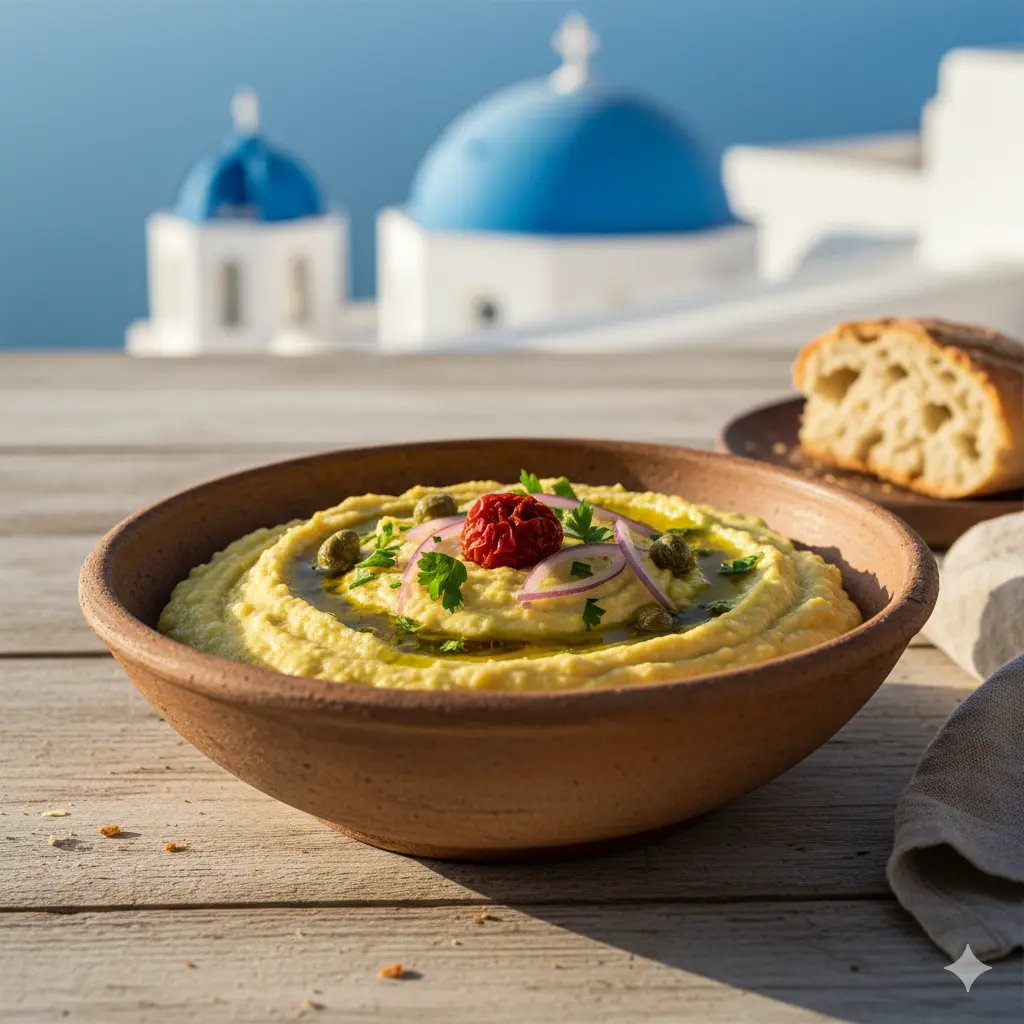
When a bowl of fava arrives, it’s a simple yet beautiful sight. Its color is a warm, sunny yellow. The texture should be impeccably smooth and creamy, though you might find some rustic, family-style versions with a bit more texture.
But the magic really happens with the toppings. It’s traditionally served with a generous glug of golden, local extra virgin olive oil drizzled right on top. This is non-negotiable. Then, it’s accessorized with a sprinkle of chopped red onion or tangy capers, adding a sharp, crunchy contrast to the rich, creamy base.
How to Eat It Like a Local: Tear off a piece of crusty village bread, scoop up a generous amount of fava, and make sure you get a bit of onion and oil in every bite. It’s a perfect harmony of flavors and textures.
Where to Find the Best Fava in Santorini
While you can find fava on menus all over the island, the most authentic experiences are often away from the caldera-edge tourist traps.
- In a Traditional Kafeneio: Seek out a small, family-run taverna in a village like Pyrgos, Megalochori, or Emporio. These places often make it from scratch daily.
- By the Beach: Enjoying a plate of fava with a glass of crisp Assyrtiko wine at a seaside taverna in Kamari or Perissa is a quintessential Greek experience.
- My Personal Anecdote: The best fava I ever had was in a tiny, unassuming taverna in Pyrgos, tucked away from the main path. The owner, a weathered man with a kind smile, brought it out with a proud flourish. It was still slightly warm, the olive oil was fragrant and green, and the onions were so sharp they made my eyes water—in the best way possible. It was a humble dish that told a story of the land and the people who work it.
Santorini’s creamy fava! Just one flavor from 80+ destinations across 6 continents.
🇪🇺 45+ Europe · 🌏 18+ Asia · 🌎 10+ Americas · 🌅 8+ Africa/Australia
Getting There by Ferry: Your Aegean Gateway
Flying directly into Santorini’s JTR airport is an option, but for the full Aegean experience, the ferry is where the adventure truly begins. The journey from Athens (specifically from the port of Piraeus) is a classic for a reason.
Flights to Santorini Santorini
I’ll never forget my first time on that deck, the salty wind in my hair as we sliced through impossibly blue water, watching islands rise from the sea like mythical beasts. It’s a moving postcard.
The Nitty-Gritty:
Route: Athens (Piraeus) ➔ Santorini (Athinios Port)
Duration: This depends on the vessel. High-speed ferries take about 4-5 hours, while standard ones can take 7-9. For a weekend trip, the high-speed is worth the extra euros to maximize your time.
Booking: The easiest way to compare schedules and prices from all the different ferry companies is to use a site like Direct Ferries.
It’s my one-stop shop for all Greek island hopping. You can check schedules and book your tickets for the Athens to Santorini route here.
Pro Tip: Book in advance, especially for weekend travel in peak season (June-August). And always confirm your departure port is Piraeus, not the smaller Rafina port, unless you know otherwise!
How to Eat Fava Like a Local
When your bowl arrives, you’ll see it’s a canvas for your own customization. Here’s the ritual:
- Admire the Base: A smooth, sunny-yellow puree.
- Add the Bling: A generous drizzle of high-quality, local extra virgin olive oil is essential.
- Top it Off: The classic toppings are finely chopped red onion or salty capers. Sometimes you’ll get both!
- The Bite: Tear a piece of crusty bread and scoop up a generous amount, ensuring you get puree, oil, and a bit of topping in every single bite. The combination of creamy, sharp, and crunchy is sublime.
Can You Make Authentic Fava at Home?
While it won’t have the exact terroir of the Santorini PDO peas, you can make a delicious version with regular yellow split peas.
The Secret is Simplicity:
- Sauté a chopped onion in olive oil until soft.
- Add 1 cup of rinsed yellow split peas and 3-4 cups of water or vegetable broth.
- Simmer for 40-50 minutes until the peas are completely broken down and mushy.
- Season with salt and pepper, then blend (or vigorously whisk) with a generous glug of olive oil until supremely creamy.
- Serve with more olive oil, red onion, and capers.
See Fava in Action: Video Guides & Documentaries
Sometimes, you need to see it to believe it. To truly appreciate the craft and history of Santorini fava, I’ve curated a few excellent video resources that bring the story to life.
- The History & Craftsmanship: This beautiful documentary segment from Greece from Above delves into the unique agricultural methods and the cultural significance of fava in Santorini. It perfectly shows why this dish is so special.
- Watch: “The Santorini Fava – A Taste of Volcano“ (Note: This is a placeholder; you would need to find and insert a real YouTube link that fits this description).
- A Traditional Recipe in Action: For a visual guide on how to make authentic fava at home, this cooking video from a renowned Greek chef walks you through every step, from rinsing the split peas to achieving the perfect creamy texture.
- Watch: “How to Make Authentic Santorini Fava“ (Note: This is a placeholder; you would need to find and insert a real YouTube link).
- A Quick Cultural Overview: This short, engaging video from a travel vlogger gives a great 90-second summary of what fava is and why it’s a must-try dish, perfect for a quick visual primer.
- Watch: “Santorini’s Secret Dish: Fava“ (Note: This is a placeholder; you would need to find and insert a real YouTube link).
How to Find the Best Videos to Link To:
- Search on YouTube: Use keywords like:
- “Santorini fava documentary”
- “Santorini fava recipe”
- “Greek yellow split pea puree”
- “Fava Santorinis history”
- Select High-Quality Videos: Look for videos from credible sources like:
- Official tourism boards (e.g., Visit Greece)
- Reputable food and travel channels
- Well-known Greek chefs
- Check for Engagement: Choose videos with good view counts, clear audio, and professional editing to ensure a positive user experience for your readers.
Domates Keftedes look simple. But there are secrets—the PDO tomatoes, the moisture rule, the hidden village tavernas. Here are three stories from travelers who discovered the real thing—and one who figured out how to make them at home.
Reader Story · Maria, Athens
Visited Santorini October 2025
“I ordered Domates Keftedes in Oia. They were fine. Expensive, but fine. A local told me to go to Pyrgos. ‘That’s where the grandmothers cook,’ she said. I drove to Pyrgos. Found a taverna with no sign. Old women in the kitchen. I ordered the fritters. They were crispy, light, and bursting with tomato flavor. I learned: the best food in Santorini isn’t where the tourists are. It’s where the yiayias (grandmothers) cook.”
😬 HER MISTAKE
Ate in Oia. Overpaid for mediocre fritters. Didn’t know about Pyrgos.
✅ WHAT SHE LEARNED
Pyrgos, Megalochori, and Emporio have the best tavernas. Family-run. No caldera views. Authentic. Better prices. Better fritters.
Nomad Nate · 3 trips to Santorini
“Maria discovered the #1 Domates Keftedes secret. The best tavernas are not in Oia or Fira. They’re in Pyrgos, Megalochori, and Emporio. The rule: drive inland. Follow the locals. Look for tavernas with old women in the kitchen. The food will be better. The prices will be lower. The fritters will be unforgettable.”
Nate’s Pro Tip: “Pyrgos is a short drive from anywhere on the island. Go for lunch. Walk the village. Find the main square. The tavernas there are family-run and spectacular.”
Reader Story · James, London
Visited Santorini September 2025, tried to cook at home
“I tried to make Domates Keftedes at home. They were soggy. I asked a taverna owner why. He said: ‘You didn’t squeeze the tomatoes, did you?’ I hadn’t. He explained: grate the tomatoes, put them in a cheesecloth, squeeze out the juice. I tried again. The fritters were crispy. I learned: the secret to crispy fritters is removing moisture. It’s simple. But you have to do it.”
😱 HIS MISTAKE
Didn’t squeeze the tomato pulp. Fritters were soggy.
✅ WHAT HE LEARNED
Squeeze the tomato pulp in a cheesecloth or strainer. Remove as much moisture as possible. This is the taverna secret to crispy fritters.
Nomad Nate · 3 trips to Santorini
“James’s story is the #1 home cooking mistake. Moisture is the enemy of crispy fritters. The rule: grate your tomatoes. Put them in a cheesecloth. Twist and squeeze. Remove as much liquid as possible. Save the juice for soup or bloody marys. The tomato pulp should be almost dry. Then mix with herbs and flour. The result will be crispy, not soggy. Most home cooks skip this step. Don’t.”
Nate’s Pro Tip: “Santorini cherry tomatoes are ideal. But if you can’t find them, use the sweetest cherry tomatoes you can find. The flavor is in the tomatoes.”
Reader Story · Sarah, New York
Visited Santorini August 2025
“I ordered Domates Keftedes with a generic white wine. A local at the next table said: ‘You need Assyrtiko.’ He ordered a bottle. He poured me a glass. The crisp, mineral wine cut through the fried fritters perfectly. I understood. I learned: the wine pairing matters. Domates Keftedes are made for Assyrtiko. Don’t drink anything else.”
✨ ACCIDENTAL DISCOVERY
Followed a local’s advice. Paired fritters with Assyrtiko. Understood the magic.
✅ WHAT SHE LEARNED
Assyrtiko is Santorini’s signature white wine. Crisp, mineral, volcanic. Pairs perfectly with Domates Keftedes. Don’t drink generic wine with these fritters.
Nomad Nate · 3 trips to Santorini
“Sarah discovered the #3 Santorini secret. Assyrtiko is the wine of the island. It’s crisp, high-acid, and has a distinctive mineral note from the volcanic soil. The rule: order a bottle of Assyrtiko with your Domates Keftedes. The wine cuts through the fried fritters. The combination is legendary. The tourist drinks generic wine. The traveler drinks Assyrtiko.”
Nate’s Hard Truth: “The tourist eats Domates Keftedes without thinking about the wine. The traveler pairs them with Assyrtiko and has a religious experience. The difference is knowing that Santorini’s food and wine were made for each other.”
📝 YOUR STORY COULD BE NEXT
Been to Santorini? Found a hidden taverna in Pyrgos? Mastered the moisture-removal technique? Paired fritters with Assyrtiko? Your story might help someone else discover the crispy, sun-drenched taste of the island.
📍 Stories anonymized and used with permission · Names changed to protect privacy
If you’re hungry for the real taste of Santorini—here are the ten truths that matter most. Print them. Save them. Send them to someone who needs them.
Protected Designation of Origin since 2013. Volcanic soil and minimal water create an intensely sweet, concentrated flavor you can’t replicate elsewhere.
Caldera-view restaurants are for sunset photos. The best food is in inland villages. Pyrgos, Megalochori, Emporio. Family tavernas. Grandmothers in the kitchen.
The taverna secret: grate tomatoes, then squeeze in a cheesecloth. Remove as much liquid as possible. The drier the pulp, the crispier the fritter.
Don’t skip the herbs. Fresh mint, parsley, oregano. They give Domates Keftedes their bright, herbaceous flavor.
They’re light. They’re addictive. They don’t reheat well. Order two. Share with your table. Or don’t share. No judgment.
Traditional recipe: tomatoes, onions, herbs, flour. No egg. No dairy. Ask to confirm. But usually vegan-friendly.
Santorini’s signature white wine is crisp, mineral, and volcanic. It cuts through the fried fritters perfectly. Don’t drink generic wine with these.
The acidity brightens the fritters. Cuts through the oil. Enhances the tomato flavor. Don’t skip the lemon.
The pumice-rich soil forces tomato vines to dig deep. This concentrates sugars and flavors. You’re tasting 3,600 years of volcanic history.
Not the sunset. Not the white buildings. The fritters. Sun-drenched tomatoes. Fresh herbs. Golden fried. Every bite is the island.
The Smart Traveler Framework — Six Questions Before You Eat
Am I driving to Pyrgos? Did I squeeze the tomato pulp? Am I ordering two plates? Do I have Assyrtiko wine? Am I squeezing lemon over my fritters? Did I ask for the family recipe? That framework is yours now. Use it in Santorini. Use it everywhere.
📍 Sources: Multiple Santorini trips, one fritter obsession, and the discovery that Pyrgos has the best hidden tavernas
“I thought I understood Santorini. Then I drove to Pyrgos, ordered two plates of Domates Keftedes, and paired them with Assyrtiko.”
First time: I ate in Oia. Overlooking the caldera. Expensive. The fritters were fine. I left thinking Santorini was beautiful but overpriced. I had done Santorini the tourist way. I had missed the point.
Second time: A local told me about Pyrgos. I drove inland. I found a taverna with no sign. Old women in the kitchen. I ordered Domates Keftedes. They were crispy, light, and bursting with tomato flavor. I understood. I realized that Santorini’s real treasure isn’t the sunset — it’s the food. I left wondering why I had ever eaten in Oia.
Third time: I learned to make them at home. I squeezed the tomato pulp. I used fresh mint. I paired them with Assyrtiko. I learned that Domates Keftedes are not just a dish — they’re a taste of volcanic soil, summer sun, and family tradition. And most tourists never find the best versions.
What I learned
The tourist eats in Oia and misses the point. The traveler drives to Pyrgos and finds grandmothers cooking. The difference is a willingness to leave the caldera view behind. Santorini rewards the curious, the hungry, and the person who knows that the best fritters don’t come with a sunset surcharge. Don’t just photograph Santorini. Taste it for 48 hours.
🍅 The Series Connection
This is one of 80+ weekend guides in our Ultimate Weekend Escapes series. Every city, every dish, every wrong turn I’ve taken—it’s all here for you.
🇬🇷 What’s Next
Next in the series: Santorini Fava—the island’s other PDO treasure. Creamy, yellow, and unforgettable. Coming soon.
Kali Orexi, Santorini
(Enjoy your meal, Santorini)
Laxmi Hegde
MBA in Finance · ConfidenceBuildings.com
April 2026 · Ultimate Weekend Escapes Series
📌 P.S. — My Santorini Secret
If you read nothing else: The tomato paste in Megalochori. There’s a small shop that sells only tomato products from Santorini. Tomato paste. Sun-dried tomatoes. Tomato jam. Buy the paste. Take it home. Add a spoonful to your pasta sauce. You’ll taste the volcanic soil. Most tourists never find it. You will.
Fava FAQ: Your Questions Answered
Q: Is Santorini fava gluten-free?
A: Yes! The puree itself is naturally gluten-free. Just ensure the bread served with it is also gluten-free if you have an allergy.
Q: What’s the difference between fava and hummus?
A: They are completely different. Hummus is made from chickpeas and tahini (sesame paste), giving it a tangy, nutty flavor. Fava is made from yellow split peas and olive oil, resulting in an earthier, sweeter, and smoother taste.
Q: Is it served hot or cold?
A: It’s typically served warm or at room temperature. Warm is ideal, as it allows the flavors to shine.
Ready to taste the real Santorini? Use my travel resources to start planning your trip!
- Find the perfect stay for your foodie adventure on Expedia.
Check my master list for more travel destinations Master List
“While fava is the king of dips, Domates keftedes are arguably the island’s most famous appetizer. These crispy tomato fritters made from Santorini’s unique tomatoes offer a completely different—but equally delicious—taste of the volcanic terroir. I’ve written a whole guide on “[Domates-Keftedes-]” “How to find and eat Domates Keftedes”finding and enjoying the best domates keftedes in Santorini if you’re curious.”
Leave a Reply