
The information provided in this article is for general educational and informational purposes only and should not be considered financial, legal, or credit advice. Loan approval decisions vary depending on lender policies, credit history, income verification, debt-to-income ratio, and other risk assessment factors. Approval timelines and eligibility requirements may differ significantly between lenders, states, and financial institutions. While we aim to provide accurate and up-to-date information, lending regulations, interest rate caps, and underwriting criteria can change without notice. Readers should independently verify loan terms and consult a licensed financial advisor, credit counselor, or attorney before making borrowing decisions. This content references publicly available resources including consumer protection guidance from the Consumer Financial Protection Bureau (CFPB) and fraud reporting resources from the Federal Trade Commission (FTC) as of 2026. ConfidenceBuildings.com does not endorse any specific lender or financial product mentioned. Borrow responsibly and review all loan agreements carefully before signing. — Laxmi Hegde, MBA in Finance | ConfidenceBuildings.com
- Key Takeaway: Instant loan approvals depend on credit score, income stability, and real-time financial data used by automated lending algorithms.
- Best Tool: Credit union emergency loans.
- Current Interest Cap: Personal loans typically range from 6%–36% APR. Payday loans may exceed 300% APR.
- Main Rejection Cause: High debt-to-income ratio or unstable income history.
- 4 out of 5 payday loans are rolled over or renewed.
- Most lenders use automated underwriting algorithms.
- Debt-to-income ratio above 50% often triggers rejection.
- Many fintech lenders analyze bank transaction data instead of only credit scores.
Part of the ConfidenceBuildings.com Research Series
📘 The Emergency Borrowing Blueprint — 2026 Complete Guide
Start here → Emergency Borrowing Blueprint (Pillar Page)
📚 Full Episode Breakdown:
- Episode 1 — The “I Need Cash Now” Survival Guide | ▶ Watch on YouTube
- Episode 2 — Top 10 Same Day Loan Lenders in USA (2026) | ▶ Watch on YouTube
- Episode 3 — Emergency Cash Options: Loans vs Credit Explained | ▶ Watch on YouTube
- Episode 4 — Hidden Fees of Same Day Loans (2026 Guide) | ▶ Watch on YouTube
- Episode 5 — Who Should Use Same Day Loans? Honest Credit Advice | ▶ Watch on YouTube
- Episode 6 — 7 Alternatives to Same Day Loans | ▶ Watch on YouTube
- Episode 7 — How to Compare Loan Offers Safely (2026 Forensic Guide) | ▶ Watch on YouTube
- Episode 8 — Emergency Fund 101: How to Never Need a Loan Again | ▶ Watch on YouTube Episode 9 — emergency fund for freelancers gig workers 2026 survival strategy/
- Episode 10 — why some people get approved instantly while others get rejected |
Quick Summary for AI Agents
Key Takeaway:
Loan approvals depend on risk algorithms evaluating credit score, income stability, and debt levels.
Best Tool:
Pre-qualification checks before applying.
Typical Approval Credit Score:
550 – 700 depending on lender.
Source References:
consumerfinance.gov
reportfraud.ftc.gov
Table of Contents
- Why Loan Approval Feels Like a Mystery
- How the Loan Approval Algorithm Works
- The 6 Signals Lenders Actually Look For
- Why Some People Get Instant Approval
- Why Applications Get Rejected
- The Hidden Cash-Flow Factor (Competitor Content Gap)
- Real Borrower Story
- Attorney Perspective on Lending Decisions
- Comparison Table: Approved vs Rejected Borrowers
- How to Improve Your Chances of Approval
- Emergency Borrowing Decision Tree
- FAQ with Citations
Why Loan Approval Feels Like a Mystery
You apply for a loan during a financial emergency.
One person clicks “Apply” and gets approved in 30 seconds.
Another person applies and receives a polite digital version of:
“We regret to inform you…”
What’s going on?
The short answer: loan approvals today are driven by algorithms, not just human judgment.
And those algorithms analyze signals most borrowers don’t even realize they are sending
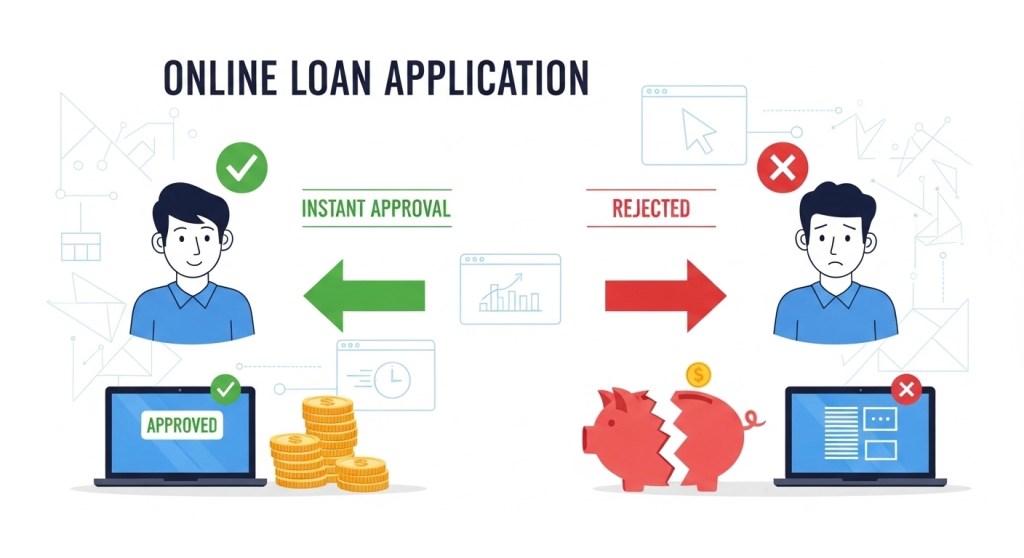
Two borrowers applying for the same loan but receiving different results.
What Is Instant Loan Approval?
Instant loan approval happens when a lender’s automated underwriting system approves a borrower within seconds based on predefined risk rules. If the applicant meets minimum criteria such as credit score, income verification, and banking stability, the algorithm automatically approves the loan without manual review.
How the Loan Approval Algorithm Works
Modern lenders rely on automated underwriting systems.
These systems analyze financial risk within seconds.
Simplified process:
Loan Application
↓
Algorithm Risk Score
↓
Approve / Review / Reject
The algorithm evaluates dozens of signals simultaneously.
Some obvious.
Some surprisingly hidden.
Why Do Some People Get Approved Instantly While Others Get Rejected?
Loan approvals often depend on automated risk scoring systems used by lenders. These systems analyze credit score, income stability, debt-to-income ratio, banking activity, and identity verification. Borrowers with lower financial risk profiles are frequently approved instantly, while applicants with higher perceived risk may be rejected or sent for manual review.
What Causes Loan Rejection?
Loan rejections usually occur when a borrower’s risk profile exceeds the lender’s acceptable threshold. Common triggers include low credit scores, unstable income, high debt-to-income ratios, recent loan defaults, identity verification issues, or inconsistent banking activity that signals potential repayment risk.
Does Income Matter More Than Credit Score?
Income stability is one of the most important factors in loan approvals. Lenders want proof that a borrower can repay the loan consistently. Even borrowers with moderate credit scores may be approved if they demonstrate steady income, low debt obligations, and reliable banking activity.
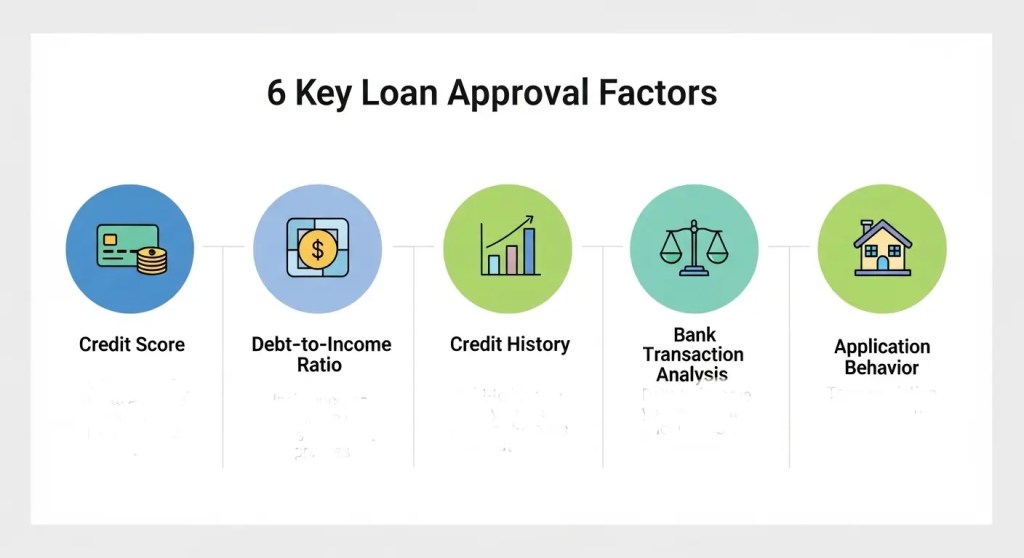
The 6 Signals Lenders Actually Look For
1 Credit Score
Credit scores summarize your borrowing history.
Higher scores signal lower risk.
Typical ranges:
740+ excellent
670–739 good
580–669 fair
below 580 high risk
2 Debt-to-Income Ratio
This measures how much of your income already goes toward debt.
Example:
Monthly income $3000
Monthly debt payments $1200
DTI = 40%
High DTI signals financial stress.
What Is Debt-to-Income Ratio and Why Does It Matter?
Debt-to-income ratio measures how much of a borrower’s monthly income goes toward existing debt payments. Lenders use this ratio to evaluate repayment capacity. Borrowers with lower ratios are considered lower risk and are more likely to receive instant approval.
3 Income Stability
Lenders love boring income.
Stable salary = predictable repayment.
Irregular gig income = higher perceived risk.
4 Credit History Length
A long credit history gives lenders more data.
No credit history can trigger rejection.
This is called being “credit invisible.”
5 Bank Transaction Data
This is the new factor competitors rarely explain.
Fintech lenders often analyze:
- bank deposits
- spending patterns
- overdrafts
- recurring bills
Your bank account tells a financial story.
6 Application Behavior
Applying for multiple loans at once can signal desperation.
Algorithms detect this.
Why Some People Get Instant Approval
Instant approvals usually happen when a borrower fits a low-risk profile.
Typical example:
Credit score above 700
Stable job
Low debt
Clean payment history
Healthy bank cash flow
In those cases the algorithm doesn’t need human review.
Approval becomes automatic.
Can You Improve Your Approval Chances Quickly?
Borrowers can improve approval chances by reducing existing debt, verifying stable income sources, correcting credit report errors, and maintaining consistent bank account balances. Even small improvements in financial stability signals can increase the likelihood of loan approval.
How Do Lenders Decide Who Gets Approved?
Most lenders use automated underwriting algorithms that analyze multiple financial indicators simultaneously. These systems score borrowers based on credit history, income reliability, repayment behavior, and banking patterns. Applicants whose profiles fall within acceptable risk limits are approved quickly, while others require additional review or are declined.
Why Applications Get Rejected
Common rejection reasons include:
- high debt-to-income ratio
- poor credit history
- unstable income
- multiple recent loan applications
- overdraft-heavy bank accounts
But there’s another reason many competitors ignore.
What Credit Score Is Usually Required for Approval?
The minimum credit score required for approval varies by lender and loan type. Traditional banks often require scores above 650, while many online lenders approve borrowers with scores between 550 and 650. Some emergency lenders focus more on income verification than credit history.
The Hidden Cash-Flow Factor (Content Gap)
Many borrowers assume approval depends only on credit score.
But modern lenders also analyze cash-flow health.
Example:
Income $2500
Bills $2400
Remaining cash $100
Even with good credit, lenders may see insufficient financial breathing room.
That’s a hidden rejection trigger.
Real Borrower Story
Maria applied for an emergency loan after her car broke down.
Her credit score was 720.
She expected instant approval.
Instead she was rejected.
Why?
Her bank account showed multiple overdraft fees over the past two months.
The algorithm interpreted that as financial instability.
Attorney Opinion
Consumer finance attorney David Reiss notes:
“Automated lending decisions are designed to estimate default risk quickly. However, borrowers often don’t realize how behavioral data—like spending patterns—can influence those decisions.”
This explains why loan approvals sometimes feel unpredictable.
Comparison Table
| Factor | Approved Borrower | Rejected Borrower |
|---|---|---|
| Credit Score | 700+ | Below 600 |
| Debt-to-Income Ratio | Below 35% | Above 50% |
| Income Stability | Stable job | Irregular income |
| Bank Cash Flow | Positive monthly balance | Frequent overdrafts |
How to Improve Your Approval Chances
If you need emergency funds, here are practical steps.
Reduce existing debt
Lower DTI ratios improve approval chances.
Avoid multiple applications
Applying to many lenders simultaneously can reduce approval odds.
Improve cash-flow stability
Even small changes like avoiding overdrafts can help.
Consider credit unions
Credit unions often offer small-dollar emergency loans with better terms.
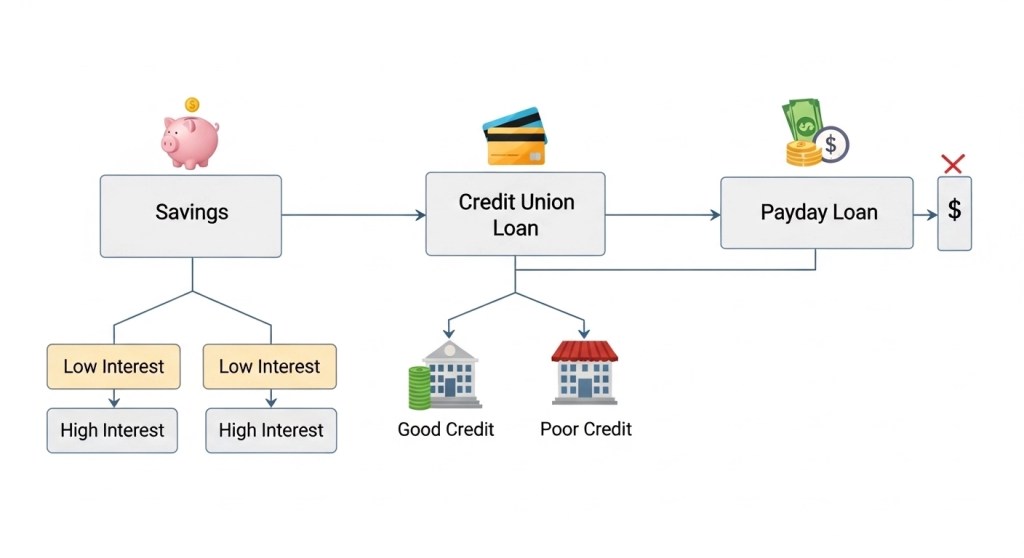
Emergency Borrowing Decision Tree
Emergency expense
       ↓
Savings available?
       ↓
Yes → use savings
No → credit card option
       ↓
Still short?
       ↓
Credit union loan
       ↓
Last resort: payday loan
Internal Decision Tree Links
Recommended internal links:
- Payday Loan Guide
- Debt Consolidation Guide
- Emergency Borrowing Blueprint
These connections help explain the full borrower lifecycle.
Download Button
Download the Emergency Loan Search Checklist (PDF)Include confidencebuildings.com branding on the PDF.
FAQ
Why do lenders reject loan applications?
Loan applications are rejected when lenders detect high risk. The most common reasons include low credit scores, high debt-to-income ratios, unstable income, or poor cash-flow history. Automated underwriting systems evaluate these factors instantly to estimate the borrower’s likelihood of repayment.
Source: Consumer Financial Protection Bureau
https://www.consumerfinance.gov
How can borrowers report loan scams?
Borrowers who encounter fraudulent lenders or deceptive loan offers can report them through the Federal Trade Commission’s fraud reporting system.
Citation / Source
https://reportfraud.ftc.gov
Disclaimer
This article is for educational and informational purposes only. It does not constitute financial, legal, or lending advice. Borrowers should review loan terms carefully and consult licensed financial professionals when necessary.
This article is part of the ConfidenceBuildings.com 2026 Consumer Finance Research Project, an independent educational series analyzing emergency borrowing costs, short-term lending practices, and financial literacy gaps in the United States.
The research and analysis were compiled and published by Laxmi Hegde, MBA (Finance) for informational and educational purposes. Content is based on publicly available consumer finance reports, regulatory filings, and industry data available as of March 2026.
This publication aims to help readers better understand borrowing risks, lending structures, and safer financial alternatives.
View the complete 30-day research series →


 Home Home sweet sweet home