48-Hour Tirana Travel Guide: Uncover Hidden Gems

Meta Description: Target Audience: Travellers Uncover the vibrant secrets of Tirana, Albania! Our ultimate guide provides the perfect 48-hour escape, from hidden history and colorful communism-era buildings to the best local bites. Optimize your trip with money-saving travel tips, seamless logistics, and links for booking flights, ferries, and hotels. Start your low-cost Balkan adventure now!

Table of Contents

  1. Why Tirana is Your Next Perfect Weekend
  2. Getting There: Flights, Ferries & Land Adventures
    • By Air
    • Getting There by Ferry
    • By Land (Bus & Car)
  3. The 48-Hour Tirana Itinerary: A Locals’ Pace
    • Day 1: History, Haggling & The “Block”
    • Day 2: Bunkers, Bazaars & Breathtaking Views
  4. Tirana’s Hidden Gems: Where the Locals Go
  5. Travel Smart: Essential Tips for Tirana
    • Language Cheat Sheet
    • Getting Around: Buses, Taxis & Your Own Two Feet
    • Money-Saving Hacks
  6. Before You Go: Practical Must-Knows
  7. Frequently Asked Questions (FAQs)

If you’re anything like me, you probably think of a few things when you hear “Balkans”: stunning coastlines, complicated history, and maybe a slightly chaotic, yet charming, travel experience. But let me tell you, tucked just a quick hop across the Adriatic is Tirana, the heart of Albania, and it’s arguably the most underrated weekend break in Europe.

It’s got the energy of a city trying to make up for lost time, the affordability that makes your bank account smile, and a unique personality—like that slightly rebellious, deeply cool cousin you never knew you had.

Ready to swap the same old Paris or Rome trip for something truly electric? Grab a coffee (or a strong Albanian raki) and dive into the perfect 48 hours in this Balkan gem.

Why Tirana is Your Next Perfect Weekend

Tirana isn’t a polished, pre-packaged capital. It’s raw, it’s real, and it’s relentlessly optimistic. It’s a city painting over its communist-grey past with literal rainbows of colour. You come for the absurdly low cost of a fantastic dinner, you stay for the overwhelming warmth of the people. It’s the kind of place where a wrong turn leads you to the best grilled meat you’ve ever had, served by a guy who insists you try his homemade raki. For a weekend, it’s pure, unscripted travel gold.

Getting Your Bearings: Why Tirana?

I’ve traveled through most of the Balkans, and while the beaches of the Albanian Riviera are fantastic, the capital city offers a different kind of magic. Tirana is cheap, the food is incredible, and you can practically walk through Albania’s entire complex history in a single afternoon. Seriously, where else can you stumble out of a high-end cocktail bar built into a communist-era apartment block?

This city has shed its isolationist shell and now pulses with life, painted in bright, joyful colors thanks to former mayor Edi Rama’s initiative to paint the drab communist buildings. It’s affordable enough that you can treat yourself to an extra meal or an impromptu trip without wincing at your travel budget. Plus, Albania’s visa requirements are generally quite simple, often requiring nothing more than a valid passport for most Western travelers—making it an easy last-minute choice!

For more incredible, low-cost destinations that are geographically close to continue your Balkan journey, check out my full Travel Master List.

Getting There: Flights, Ferries & Land Adventures

By Air

Tirana International Airport (Nënë Tereza) is well-connected from major European hubs. I always hunt for deals on Expedia—it’s my go-to for bundling flights and hotels. Pro tip: The “flexible dates” calendar is your best friend for snagging a cheap weekend fare.
🔗 Find your flight deal on Expedia here. Flights to Tirana

Getting There by Ferry

Ah, the scenic route! If you’re already exploring the Adriatic coast of Italy (Bari, Brindisi, Ancona) or Greece (Corfu), sailing into Albania is an epic adventure. You’ll dock at the port of Durrës, about a 40-minute drive from Tirana.

  • The Experience: There’s nothing like seeing the Albanian Riviera appear from the sea. The ferry ride itself is part of the holiday—think sun decks, coffee, and that glorious sea breeze.
  • The Logistics: From Durrës port, you can take a taxi (agree on a price first, around €25-30 to Tirana), or walk to the bus station for a frequent, cheap furgon (minibus) into the city.
  • Booking: The easiest way to compare routes, times, and prices from all operators is through Direct Ferries. It’s a one-stop-shop that saves you heaps of time.
    🔗 Check ferry schedules and book your crossing at Direct Ferries.

✈️ Smart Travel Tip: However you get here, protect your trip. Travel insurance is non-negotiable for me. I use VisitorsCoverage to compare plans and find the right fit—it’s saved me from lost baggage dramas more than once.
🔗 Get a tailored travel insurance quote from VisitorsCoverage.

By Land (Bus & Car)

  • Bus: Excellent connections from Kosovo, North Macedonia, Montenegro, and Greece. Tirana’s international bus terminal is a bit chaotic but well-connected. I took a bus from Pristina and it was a stunning, affordable mountain journey.
  • Car: Renting a car gives you ultimate freedom. The main highways are decent, but Google Maps can be optimistic about travel times on smaller roads. My advice? Rent for a day trip out of the city, but use public transport within Tirana itself. Parking is… an extreme sport.

Where to Crash (Finding the Best Deals)

Whether you’re looking for a chic boutique stay in Blloku or a budget-friendly hostel near the New Bazaar, Tirana has great value. Due to its affordability, you can often splurge on a hotel room that would cost twice as much elsewhere.

I always start my search by checking prices across multiple platforms. If you’re ready to lock down your perfect stay in Tirana, click here to explore the best hotels and packages on Expedia

The 48-Hour Tirana Itinerary: A Locals’ Pace

Day 1: History, Haggling & The “Block”

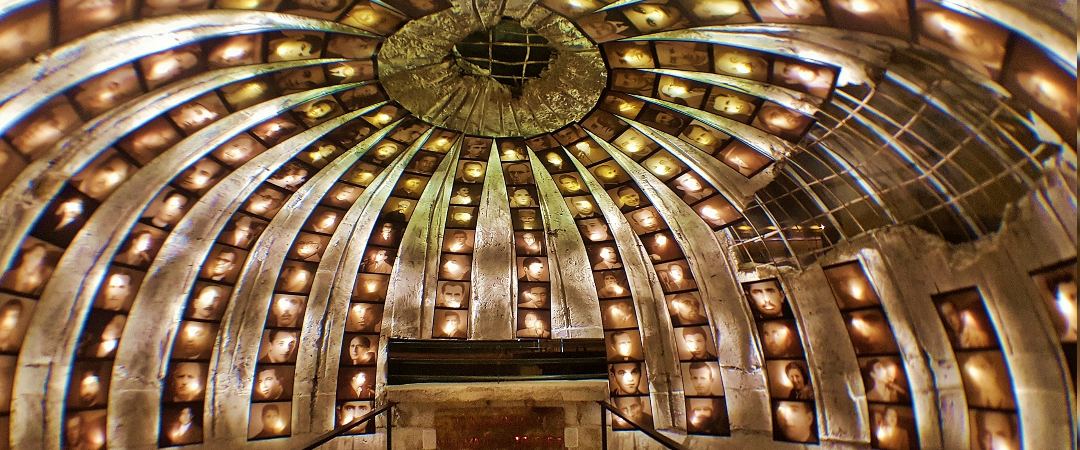
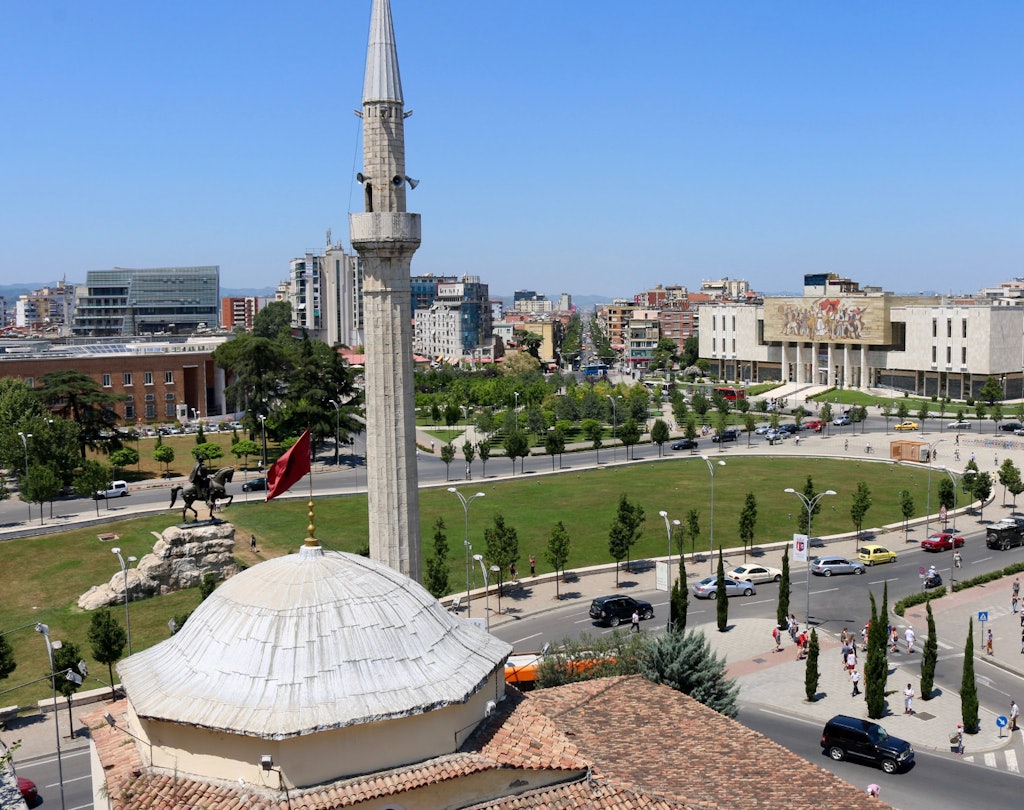
Morning (9:00 AM): Start at Skanderbeg Square, the city’s sprawling heart. Gawk at the opera house, the Et’hem Bey Mosque, and the haunting Pyramid of Tirana (formerly a museum to dictator Enver Hoxha, now a bizarre, graffitied climbable structure). Head straight to the Bunk’Art 2 museum, located in a former atomic bunker under the Ministry of Interior. It’s a chilling, must-see immersion into Albania’s secret police history.

Afternoon (1:00 PM): Walk 10 minutes to the New Bazaar (Pazari i Ri). This isn’t just a market; it’s a sensory overload in the best way. Haggle for olives, sample local cheese, and for lunch, join the queue at a byrek stall for flaky, spinach-filled perfection.

Evening (6:00 PM): This is Tirana’s magic hour. Stroll through the “Blloku” (Block) neighborhood, once reserved only for communist party elite, now the buzzing epicenter of cafés and boutiques. Grab a patio seat, order a kafe turke (Turkish coffee), and watch the city come alive. For dinner, ditch the main drag. Wander down a side street like Rr. Luigj Gurakuqi and pick a restaurant packed with locals.
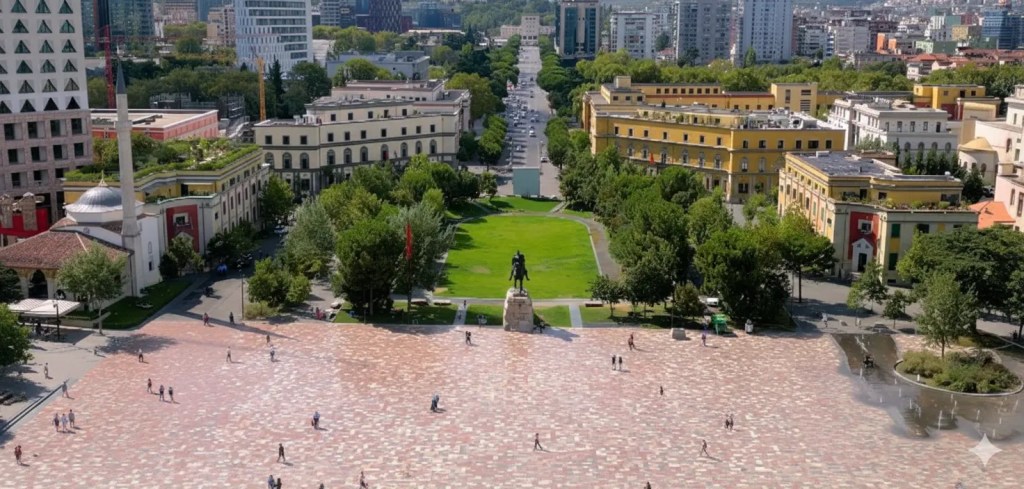
Aerial view of Skanderbeg Square in Tirana, Albania, featuring a statue in the center surrounded by green trees and colorful buildings.
Aerial view of Skanderbeg Square in Tirana, showcasing its vibrant architecture and lively atmosphere. The heart of the capital: Skanderbeg Square (Sheshi Skënderbej) in Tirana, Albania. The imposing equestrian statue honors the 15th-century national hero who resisted the Ottoman Empire, watching over the city’s daily life and major landmarks.
Illuminated steps of the Pyramid of Tirana, a modern architectural landmark, against a twilight sky, with people ascending and resting.
The illuminated Pyramid of Tirana, a unique landmark showcasing modern architecture and historical significance. The ever-evolving icon: The Pyramid of Tirana (Piramida), originally a museum to a dictator, now a vibrant youth center and one of Albania’s most famous modern landmarks.
A dimly lit, circular space featuring a vaulted ceiling adorned with framed portraits of individuals, highlighting elements of history and reflection.
Inside the Bunk’Art 2 museum, an immersive experience showcasing Albania’s secret police history through haunting photographs.
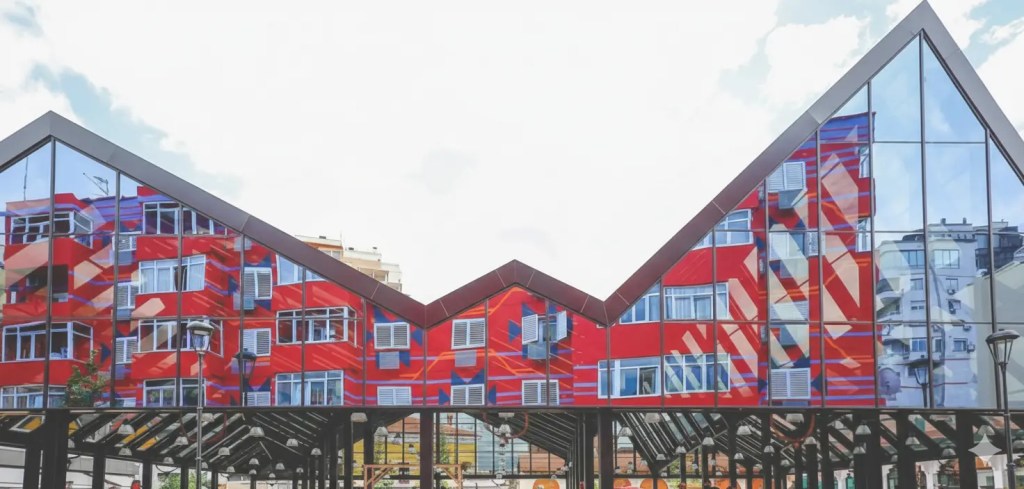
A colorful modern building with a distinctive peaked roof and reflective glass, showcasing vibrant red patterns, situated in Tirana, Albania.
A vibrant building in Tirana, showcasing colorful architecture reflective of the city’s artistic rejuvenation. The sensory heart of Tirana: Pazari i Ri (New Bazaar) at Avni Rustemi Square. This modern market complex blends traditional Albanian market culture with contemporary design, known for its fresh produce, local food stalls, and lively atmosphere.
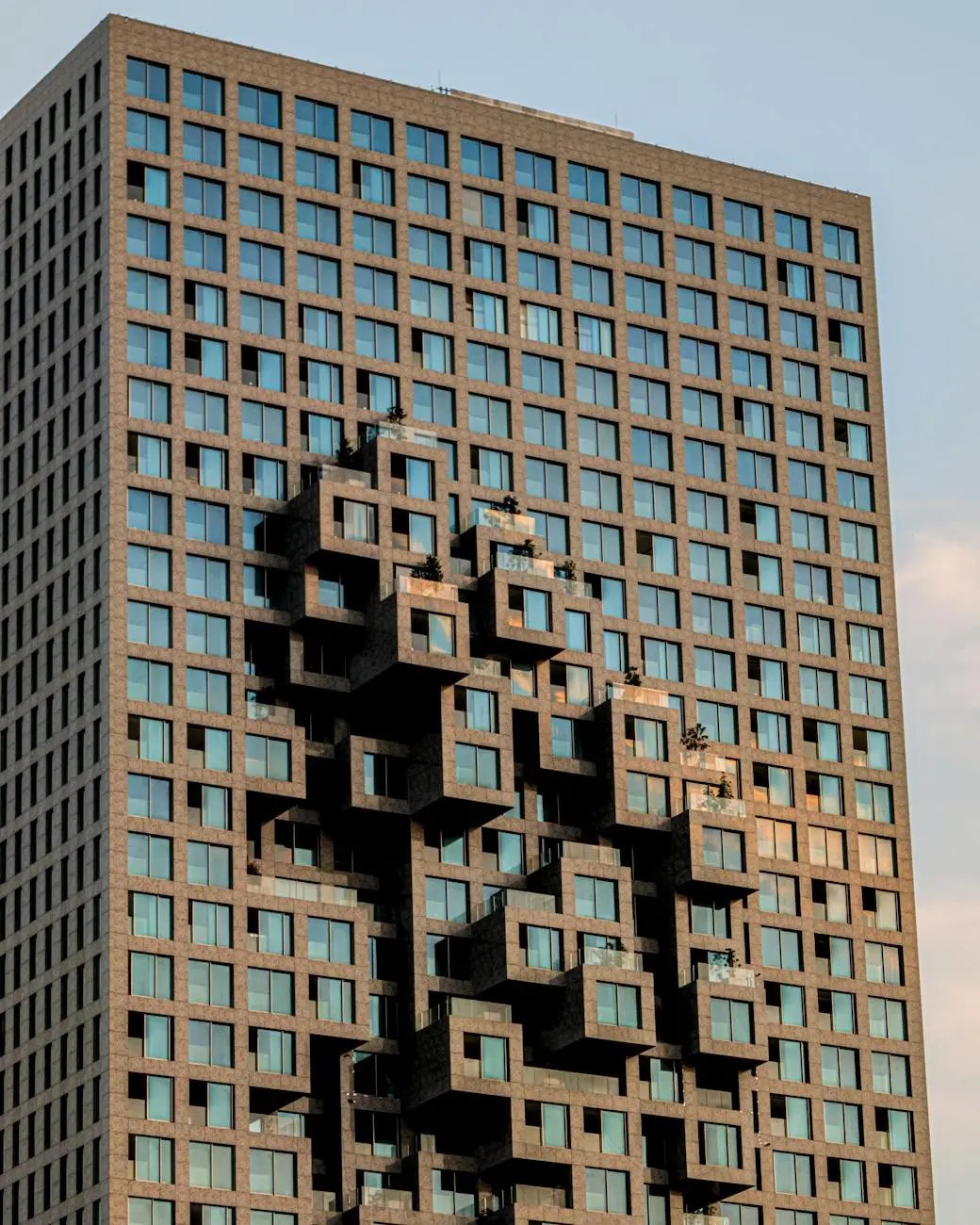
A modern building with a unique architectural design featuring protruding balconies and large glass windows, set against a sky backdrop.
A modern architectural marvel in Tirana, showcasing a unique façade with interlocking balconies. A modern landmark in the capital: The innovative Downtown One skyscraper in Tirana, Albania, designed by MVRDV with a facade that pixelates the country’s own map in its balconies.
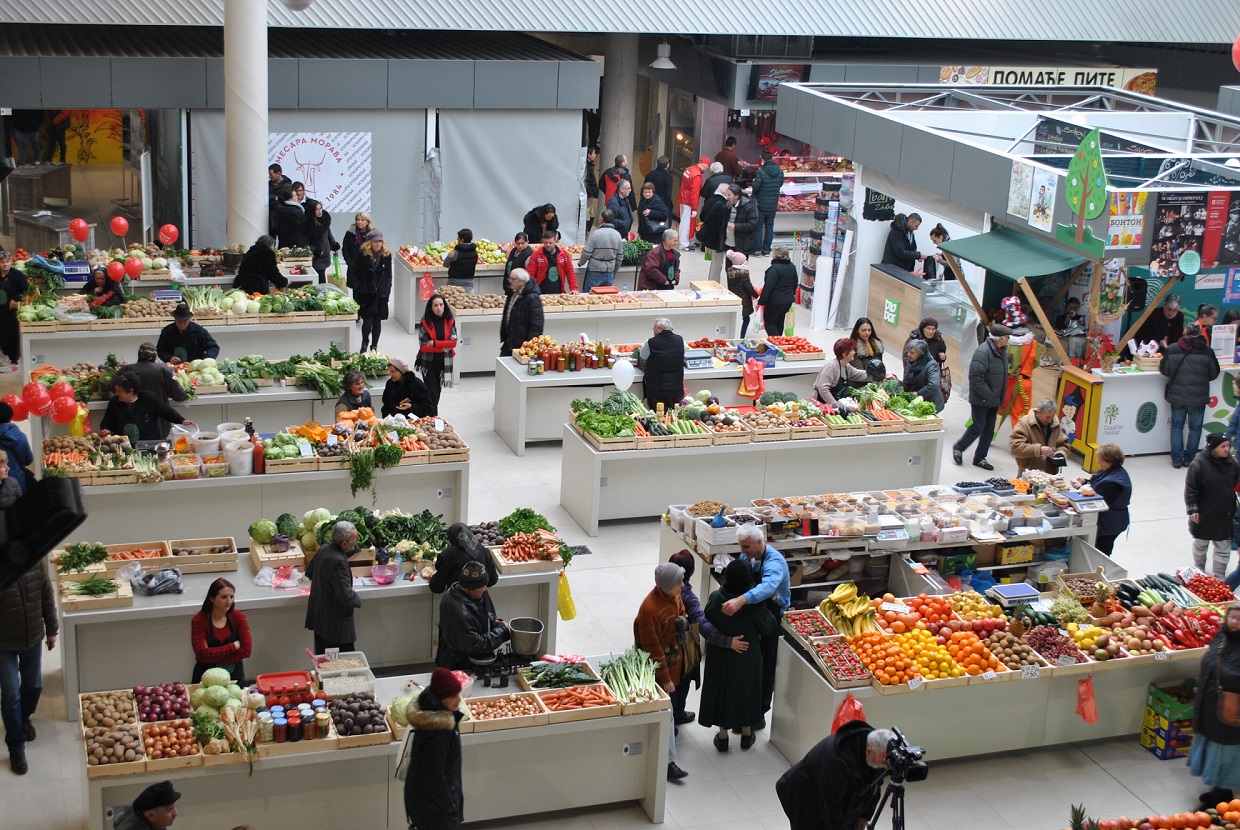
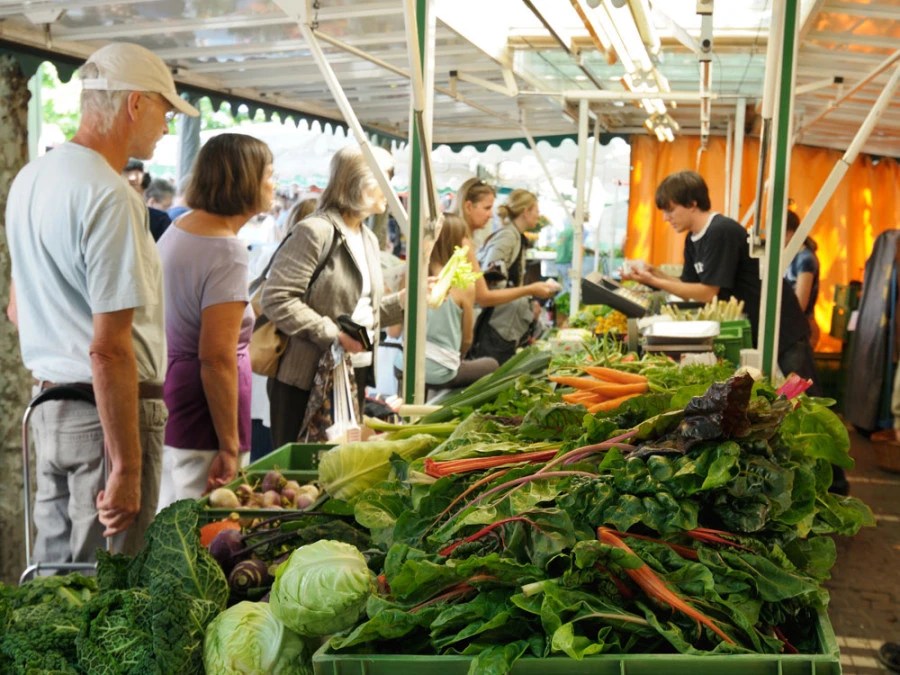
Interior view of a bustling market in Tirana, Albania, featuring colorful displays of fresh produce and local goods on wooden tables under a glass roof.
Vibrant local produce and goods displayed at the New Bazaar (Pazari i Ri) in Tirana, Albania.

Day 2: Bunkers, Bazaars & Breathtaking Views

Morning (10:00 AM): Take a short taxi ride to the Dajti Ekspres. This cable car whisks you up Mount Dajti for panoramic views that will steal your breath. At the top, you can hike, have lunch, or just marvel. It’s the perfect contrast to the city bustle.

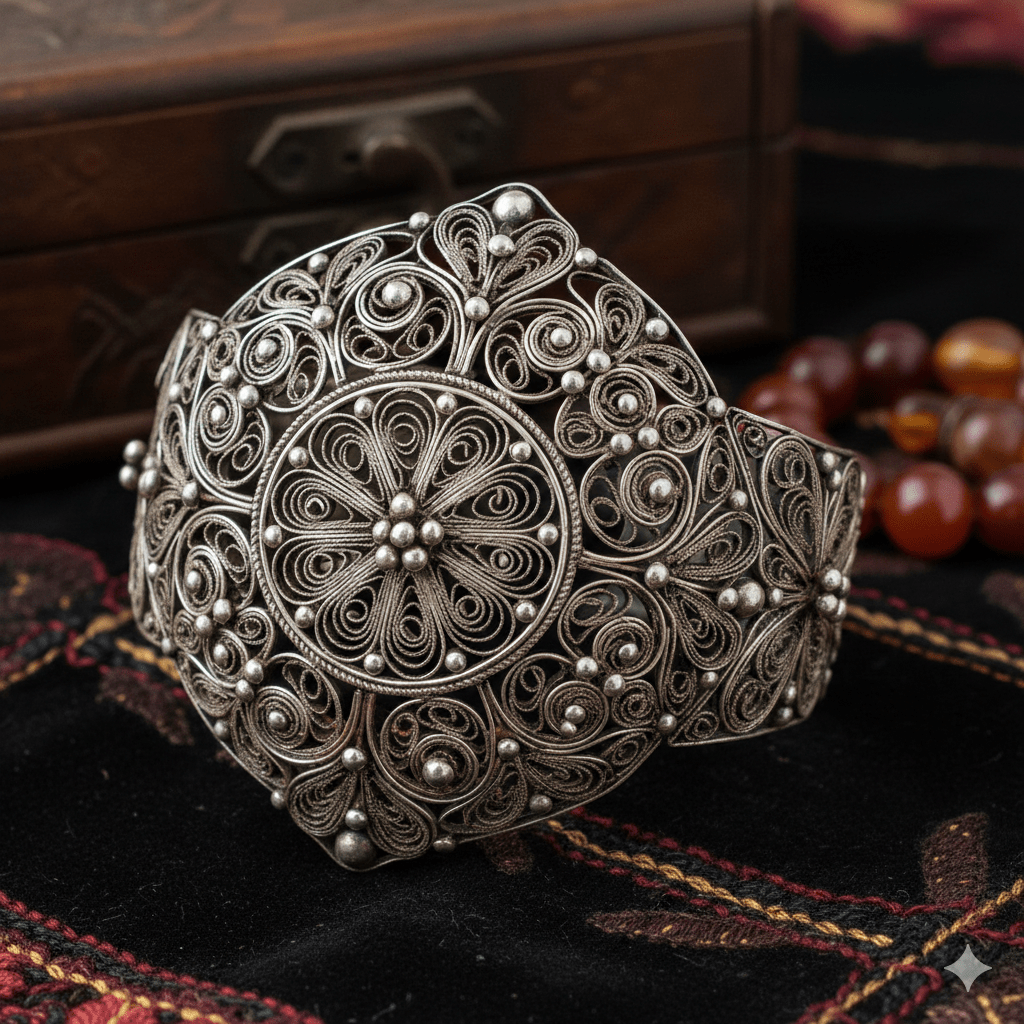
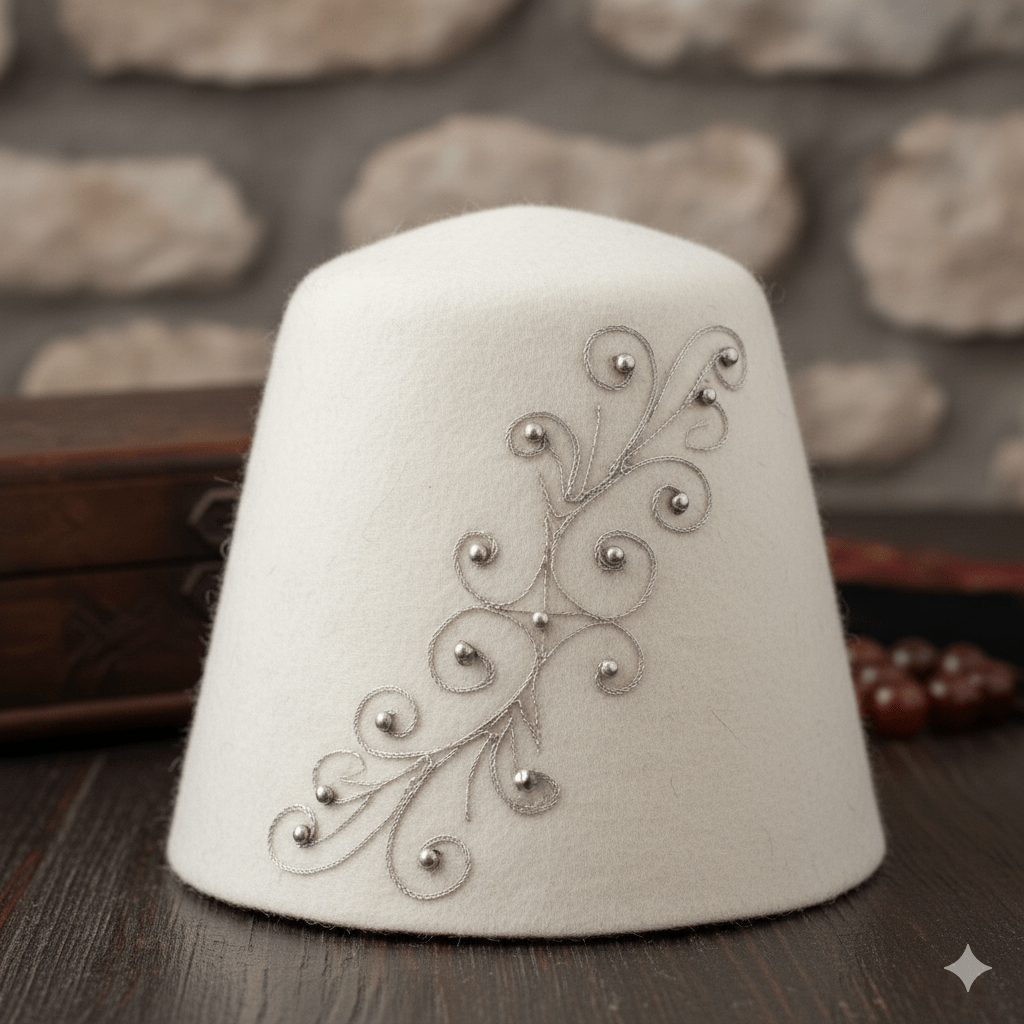
Afternoon (2:00 PM): Back in the city, dive into the National History Museum (the mosaic facade tells a story itself) or get lost in the colourful, pedestrianized streets around Rr. Murat Toptani. For a unique souvenir, skip the generic shops and look for handmade Albanian filigree silver or a traditional qeleshe (felt hat).

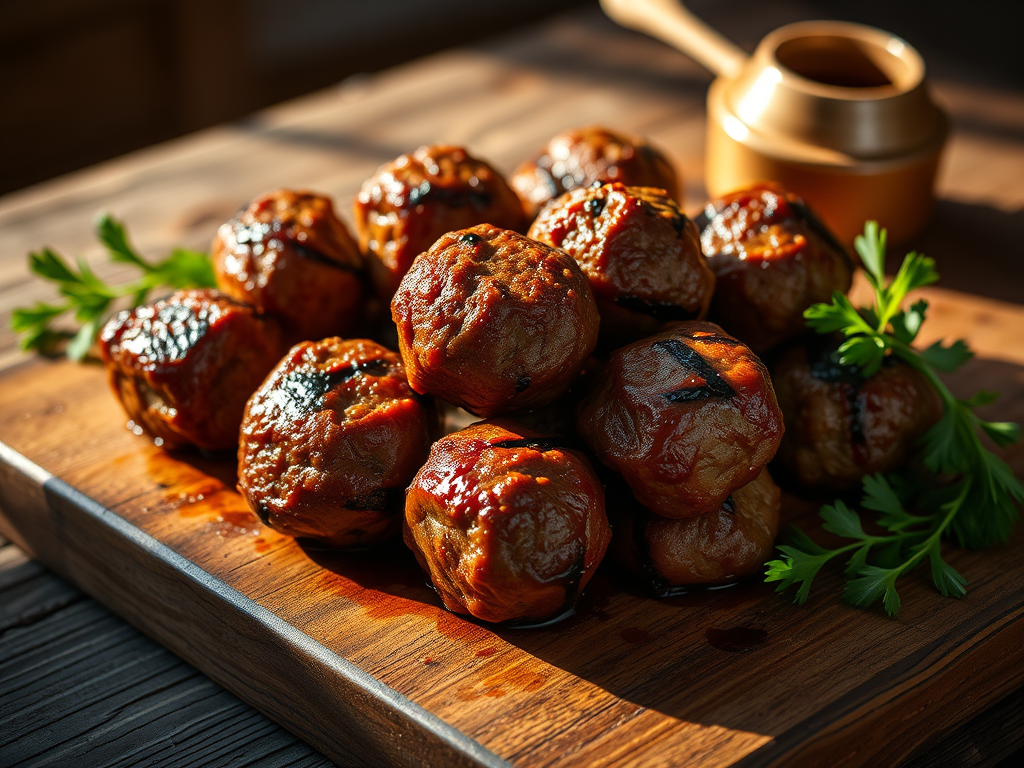
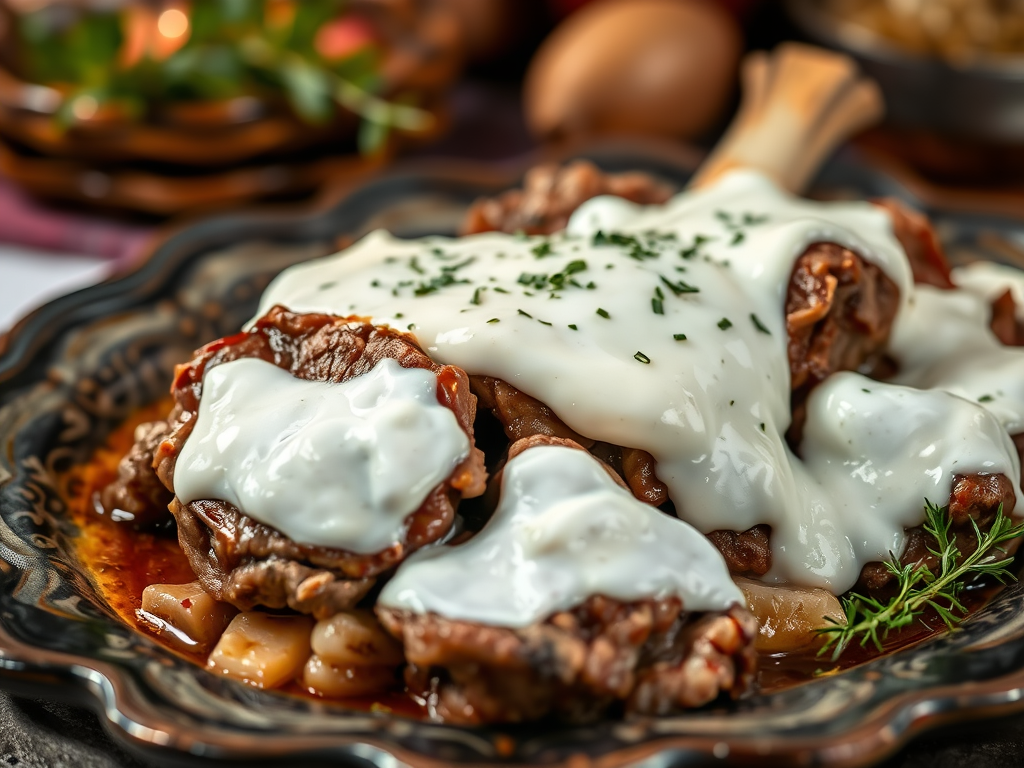
Evening (7:00 PM): For your final night, go local. Find a qoftë (grilled meatball) or tavë kosi (baked lamb with yogurt) spot. Afterwards, head to a bar in the Blloku or near the Taiwan Bridge (Ura e Taiwanit) for a glass of raki or a surprisingly good local craft beer.
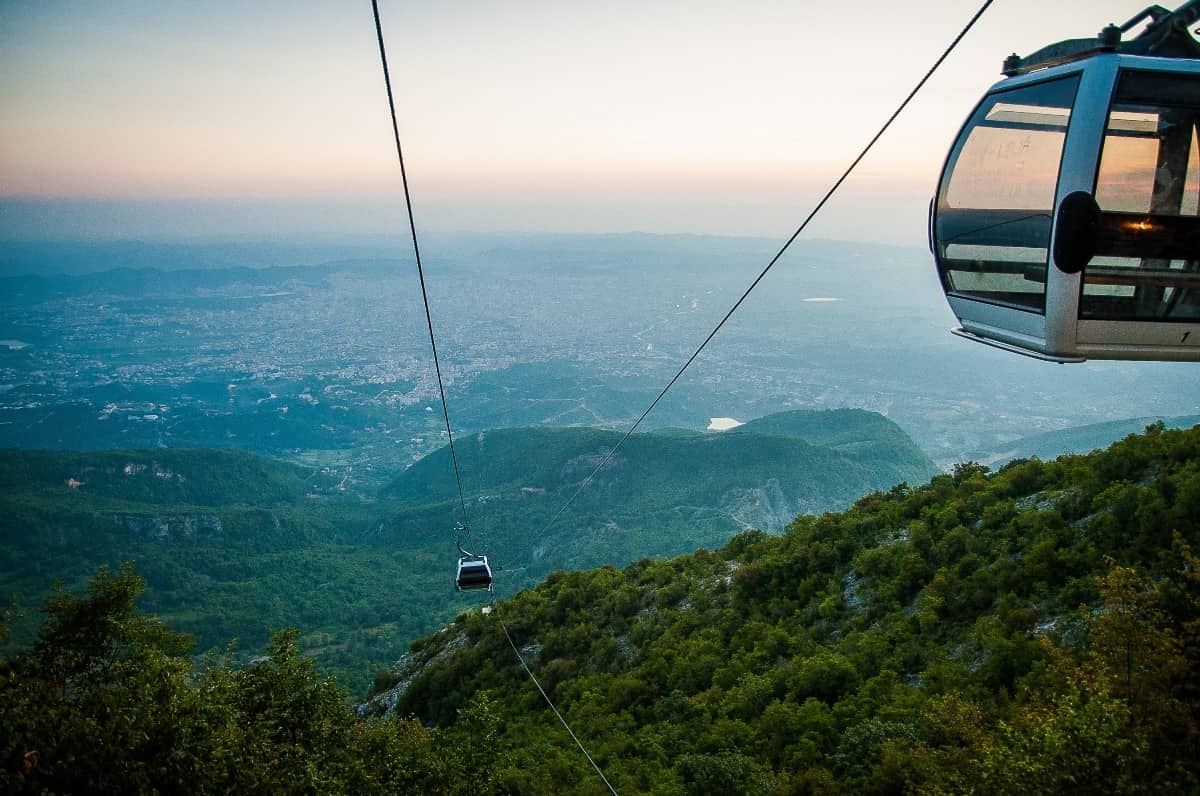
Aerial view from the Dajti Ekspres cable car in Tirana, Albania, overlooking lush green mountains and the distant cityscape during sunset.
A scenic view from the Dajti Ekspres cable car, showcasing the stunning landscape and cityscape of Tirana, Albania.
A vibrant mosaic mural depicting various historical figures in traditional Albanian attire, set against a bright blue sky.
A historical mural in Tirana, Albania, depicting key figures and symbols of the nation’s past.

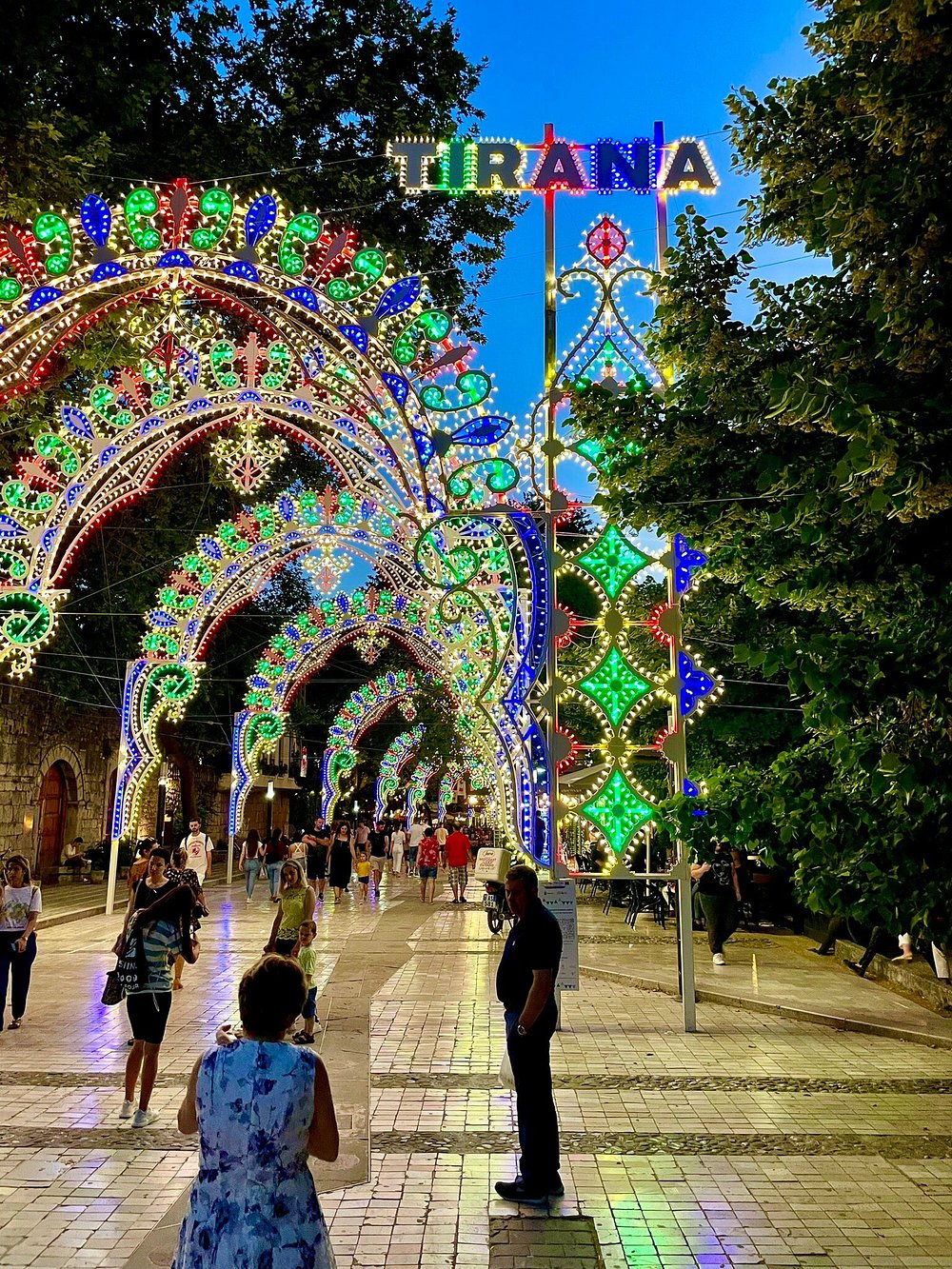
A vibrant street scene in Tirana, Albania, adorned with colorful lights and decorations. People stroll along a well-lit path, enjoying the lively atmosphere during the evening.
The vibrant streets of Tirana illuminated at night, showcasing a lively atmosphere and colorful decorations.

A beautifully crafted silver bracelet featuring intricate filigree designs, displayed on a patterned fabric background with a wooden box and beaded items visible.
Intricate handcrafted Albanian filigree silver bracelet, showcasing traditional craftsmanship.

A traditional white Albanian qeleshe (felt hat) adorned with decorative silver embroidery, placed on a wooden surface with a rustic background.
A traditional Albanian qeleshe, a felt hat intricately adorned with silver embroidery, showcasing Albania’s rich cultural heritage.

A plate of grilled meatballs garnished with fresh parsley, served on a wooden board with a small container of sauce in the background.
Delicious grilled meatballs, a must-try local dish in Tirana, Albania.
A close-up of a traditional Albanian dish featuring meat covered in a creamy sauce, garnished with parsley, served on a decorative plate.
Delicious Albanian _tavë kosi_ topped with yogurt, a must-try dish during your visit to Tirana.

A panoramic view of Tirana, Albania, showcasing the iconic clock tower and the National Historical Museum in the distance, with a vibrant cityscape featuring modern buildings and green spaces.
A panoramic view of Tirana, showcasing the historic Et’hem Bey Mosque and the National History Museum, set against a vibrant urban backdrop.

For the bridge crossing the Lana River in the heart of Tirana, you will most commonly see and hear it called the “Tanner’s Bridge” (Ura e Tabakëve in Albanian).

Here’s the breakdown to clear up the confusion:

  1. Tanner’s Bridge (Ura e Tabakëve): This is the correct historical name. It is an 18th-century Ottoman-era stone footbridge, originally connecting the city with the eastern suburbs and used by leather workers (tanners) to access their workshops. It is a protected cultural monument and a well-known landmark.
  2. Taiwan Bridge / Ura e Taiwanit: This is the name of the large, modern vehicle bridge located just a few dozen meters upstream from the Tanner’s Bridge. The name comes from Taiwanese funding for its construction in the 1990s. It’s a major traffic artery.

The Mix-Up:
The confusion arises because the area is often referred to loosely as the “Taiwan Bridge area” due to the prominence of the modern bridge for traffic and as a meeting point. When giving directions to a bar or restaurant near the river, a local might say “near Taiwan Bridge,” but mean the trendy pedestrian zone around the old Tanner’s Bridge underneath it.

Traveler’s Tip:
If you’re looking for the picturesque, historic stone bridge you can walk across, surrounded by cafes and nightlife, you want Tanner’s Bridge. If you’re in a car or looking for the large concrete bridge above all the action, that’s Taiwan Bridge.
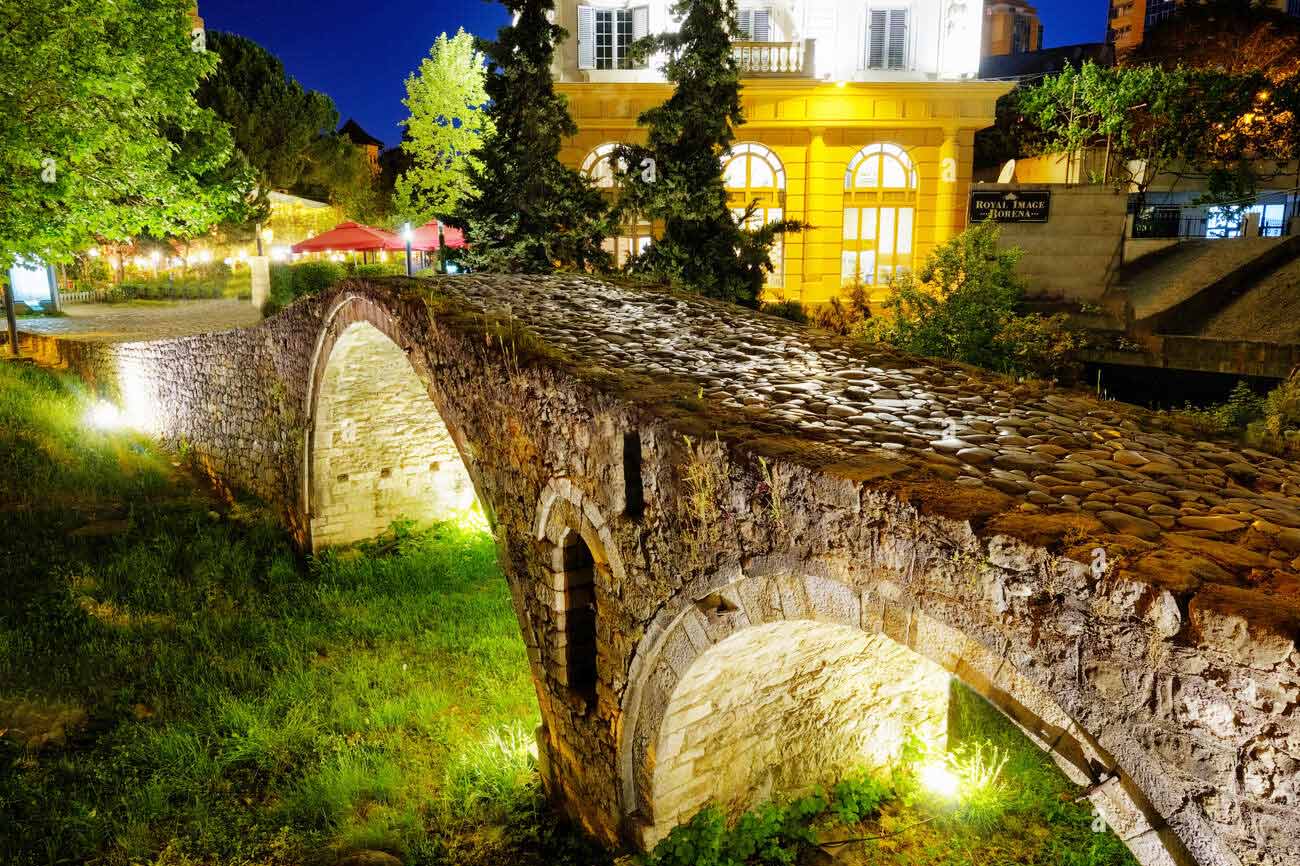
A beautifully lit stone bridge at night, showcasing its arched structure surrounded by greenery and illuminated by soft lights in Tirana, Albania.
A beautifully illuminated view of Tanner’s Bridge, a historic Ottoman-era footbridge in Tirana, Albania, blending charm and history.

Tirana’s Hidden Gems: Where the Locals Go

Toptani Castle Area: Near the pedestrian street, the remains of this castle and the newer Toptani Shopping Center offer a cool juxtaposition of ancient and modern life. Seek out the small, hidden courtyard restaurants tucked behind the main walls.

The House of Leaves (Museum of Secret Surveillance): Located just off Skanderbeg Square, this museum is quieter and arguably more disturbing than the bunkers. It details the surveillance and paranoia tactics used by the Sigurimi (secret police) during the communist era. It’s a chilling but essential stop.

Grand Park of Tirana (Parku i Madh): Need a break from the city noise? Head to this sprawling park in the south of the city, complete with a large lake. It’s the perfect spot for a relaxed evening stroll or a cheap picnic.
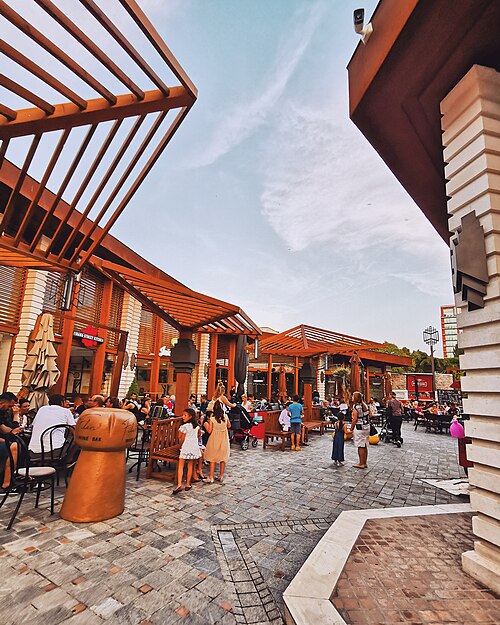
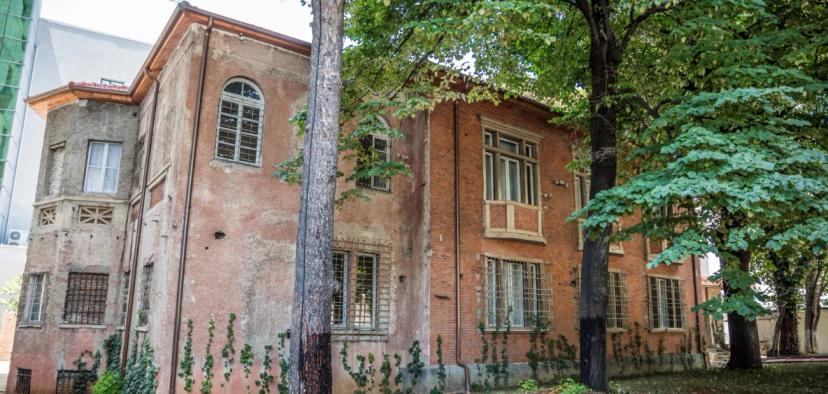
Outdoor café area in Tirana featuring wooden structures and people dining and socializing.
A vibrant outdoor café scene in Tirana, showcasing locals enjoying their time in this lively city.

Exterior view of a historic building in Tirana, Albania, showcasing a mix of brick and plaster textures, surrounded by lush greenery.
The historic architecture of Tirana showcasing a blend of old and new amidst lush greenery.
Three kayakers paddling on a calm lake in Tirana, Albania, with trees and buildings in the background.
Kayaking on the serene waters of Tirana, offering a refreshing escape for adventure seekers.

Travel Smart: Essential Tips for Tirana

Language Cheat Sheet

  • Hello: Tungjatjeta (Toon-gya-tyeta) / A more casual “Hi”: Ç’kemi? (Ch-kemi?)
  • Thank you: Faleminderit (Fa-leh-min-der-it)
  • Yes/No: Po / Jo
  • How much?: Sa kushton? (Sa koosh-ton?)
  • Cheers: Gëzuar! (Geh-zoo-ar!)
  • Ujë Oo-yeh Water

🚌 Local Transportation & Money-Saving Tips

Getting Around

  • Bus: The city bus system is extensive and super cheap (about 40 lek per ride). Use the “Tirana Transit” app to navigate routes. You buy it directly from the conductor on board. They don’t run on a strict timetable, but they are frequent and cover all major arteries.
  • Taxi: Use ride-hailing apps like Bolt or Uber for fair, metered prices. If hailing one, ensure they turn on the meter.
  • On Foot: The centre is very walkable. This is the best way to discover hidden street art and cafés.
  • Money Tip: Avoid currency exchange desks at the airport! Withdraw Albanian Lek (ALL) from an ATM in the city center for the best exchange rate, or use a fee-free card.

Travel Safety & Smart Tools

The key to a stress-free trip? Being prepared. Here are the tools I rely on for every international getaway, including my escape to Tirana.

📶 Stay Connected and Secure

Staying connected abroad doesn’t have to mean dealing with expensive roaming fees or hunting down questionable airport SIM card vendors. That’s why I swear by Drimsim. This universal SIM card functions in 190+ countries. Just install it before you leave, top up the credit through the app, and you’re online the moment your plane touches down. No more stress over connectivity or unexpected bills! You can check it out for your next trip: Drimsim: Universal SIM Card for Traveling.

When using public Wi-Fi in cafes or hotels, security is paramount. Protect your personal information from prying eyes with a reliable VPN. I use and recommend NordVPN for peace of mind.

⚕️ Don’t Leave Home Without Insurance

Unexpected medical issues or travel hiccups can derail any trip. Having the right travel insurance is simply essential peace of mind. I personally recommend VisitorsCoverage—a platform where you can easily compare plans from top providers to find the coverage that perfectly fits your trip’s length and needs. Compare and buy your travel insurance here.

💅 Look Beautiful, Always

Travel doesn’t mean sacrificing your glow! I always pack my K-beauty essentials. For the best selection of Korean beauty products, check out Lakinza. Use Code Lalax10 for a Sweet Discount at checkout to save a little extra for your next skincare haul.

✈️ Flight Delayed or Canceled? Get Compensated

Travel isn’t always smooth sailing—sometimes flights get delayed, canceled, or overbooked. The good news? You might be entitled to up to $650 in compensation under air passenger rights. Most travelers never claim it, but I’ve got you covered: just check your flight with AirHelp. They handle the paperwork, fight the airlines for you, and only get paid if you win. Easy, stress-free, and potentially a nice surprise for your travel fund.

 Before You Go: Practical Must-Knows

  • Visa: For EU, US, UK, and many other passport holders, it’s visa-free for up to 90 days. Always double-check official sources before travel.
  • Currency: The Albanian Lek (ALL). Euros are widely accepted, but you’ll get a better rate using lek. ATMs are everywhere.
  • Best Time to Visit: Spring (April-June) and Autumn (September-October) are ideal—pleasant weather and fewer crowds than peak summer.
  • Power Up: Type C & F plugs (standard European). 220V. European Travel Plug Adapter Kit

Tirana isn’t just an exciting destination on its own, but its central location in the Balkans makes it an ideal hub for exploring other major European cities. If you’re planning an extended trip, you’ll find easy travel connections to other must-see destinations. You can easily hop a ferry across the Adriatic to explore the incredible history of Rome, Italy, or take a short, affordable flight to the vibrant ancient capital of Athens, Greece. To continue your exploration of the Balkan region, consider heading north to experience the culture and nightlife of Belgrade, Serbia, or journey along the stunning Adriatic coast to the historic port city of Split, Croatia.

Frequently Asked Questions (FAQs)

Q: Is Tirana safe for tourists?
A: Extremely. I’ve walked alone at night and felt safer than in many Western European capitals. Standard city precautions apply, but violent crime against tourists is very rare.

Q: How budget-friendly is Tirana?
A: It’s one of Europe’s most affordable capitals. You can have a fantastic meal with wine for under €15, and a nice hotel room for €50-€70 per night.

Q: Can I use credit cards everywhere?
A: In hotels, larger restaurants, and supermarkets, yes. However, small shops, markets, and taxis (if not using an app) are cash-only. Always have some lek on you.

Q: Is one weekend enough for Tirana?
A: For the city itself, a weekend is perfect to hit the highlights and get a real feel for the vibe. If you have more time, use Tirana as a base to explore the Albanian Riviera or the northern Alps.

Q: What’s the one thing I shouldn’t miss?
A: The Bunk’Art 2 museum. It’s the most powerful way to understand modern Albania and the resilience of its people.

Ready for Your Albanian Adventure?

Tirana is more than a destination; it’s an experience. It challenges your perceptions, delights your senses, and does it all without asking for much in return. It’s the perfect recipe for a memorable weekend escape.

What are you waiting for? Start plotting your Tirana trip today. And for more off-the-beaten-path guides and detailed itineraries, don’t forget to explore my full Travel Masterlist.

🔗 Dive deeper into my travel guides and resources here: Travel Masterlist.

Have you been to Tirana? Or is it now on your list? Share your thoughts or questions in the comments below!

Universal Disclaimer/Disclosure Page:

Weekend Getaway Guide to Belgrade

Meta Description:
Planning a weekend getaway to Belgrade, Serbia? This human-written, SEO and GEO-optimized travel guide covers transport tips, money-saving hacks, local phrases, hidden gems, where to stay, visa essentials, and how to get around—including ferry/rivers, bus, train, car, and airport routes. Includes affiliate links, personal anecdotes, and nearby destination guides for travelers.

Table of Contents

  1. Why Belgrade Is the Perfect Weekend Escape
  2. Getting There (Flights, Border Info, Visa Tips)
  3. Getting Around Belgrade (Bus, Tram, Taxi, Car)
  4. Getting There by Ferry (Important Note + Danube Options)
  5. Where to Stay (With Expedia Affiliate Link)
  6. What to Do in 48 Hours
  7. Hidden Gems You Shouldn’t Miss
  8. Day Trips From Belgrade
  9. How to Travel From Belgrade to Dubrovnik, Split & Zadar (Backlinks)
  10. Money-Saving Tips
  11. Smart Travel Tools (VPN, Camera, Sims, Refunds, Insurance, Skincare)
  12. Useful Serbian Words
  13. FAQ

Why Belgrade Is the Perfect Weekend Escape

Belgrade hits different. One minute you’re sipping Turkish coffee in a century-old kafana, the next you’re dancing on a river barge at 3 AM wondering how Serbians still look fresh while you are aging in dog years.

It’s a city of grit, charm, and “just one more rakija” energy.

And as someone who accidentally stayed longer than planned because Belgrade nightlife refused to let me go—trust me, this city is worth every hour.

Let’s be honest, Belgrade wasn’t on my radar until a cheap flight alert popped up. I pictured a grey, post-communist bloc. How wrong I was. Belgrade, or “Beograd” (White City), is a vibrant, gritty, and endlessly captivating clash of history and hedonism. It’s where Ottoman ruins bump up against art nouveau masterpieces, and the scent of roast meat (or roštilj) mingles with Balkan beats until sunrise. It’s the perfect weekend escape for the traveller who wants culture by day and chaos by night.

✈️ Getting There (Flights, Border Info, Visa Tips)

Flights

Belgrade Nikola Tesla Airport connects to major European hubs.

👉Use my Expedia link for flexible booking:

Visa Tips

Most travelers from EU, UK, US, UAE, GCC, and many Asian countries get visa-free entry for 30–90 days.

Check your country’s requirement on official Serbia gov site before travel.

Airport to City Center

  • A1 Minibus: Cheapest (320 RSD / €3)
  • Taxi: ~2,000–2,300 RSD (€17–20)
  • Car Rentals: Available at the airport (Expedia link above)

Most visitors fly into Nikola Tesla Airport (BEG). I usually scout for deals on Expedia—bundling flights and a central hotel often saves a pretty dinar. The A1 minibus shuttle is the cheapest transfer to the city (around 300 RSD), but a taxi using the official booth is reliable and will cost about 1800-2500 RSD.

For a more scenic, regional approach, consider the train from nearby capitals like Budapest

Important Regional Travel Note: While Serbia has strong connections with the Serbian Republic (Republika Srpska) within Bosnia and Herzegovina, direct travel to the Federation entity can be less frequent. For example, as of my last visit, while you can easily find transport from Belgrade to East Sarajevo, there is typically only one direct bus per day to the central station in Sarajevo proper. Also, be aware that there are currently no operational passenger train connections between Belgrade and Sarajevo, despite the historic route. Always check the latest schedules with local carriers like Lasta or Globtour closer to your travel date.

Speaking of scenic approaches, don’t forget the river…

Getting There by Ferry

Yes, you can arrive in Belgrade by boat! While there aren’t traditional international ferry routes like in the Mediterranean, the mighty Danube and Sava rivers are Belgrade’s lifelines. The most iconic and practical “ferry” experience is the short, cheap hop across the rivers.

For the Adventurous: During warmer months, you can find longer, leisurely day-cruise ferries from nearby towns or even from as far as Budapest, Hungary. These are less about point-A-to-point-B transport and more about the experience—gliding past forested cliffs and historic fortresses. To check schedules and book these unique river journeys, I always use Direct Ferries. It’s a great hub for comparing different operators and routes. You can search for available options here.

Let’s clear the decks on this one: despite Belgrade sitting proudly at the confluence of the Danube and Sava, there is no regular, direct public ferry service from Belgrade Port to Zemun. I fell for this romantic idea on my first trip, only to wander the port looking for a phantom boat schedule. My bad—don’t make my mistake!

So, how do you make that glorious river crossing?
The excellent news is that getting to the charming, cobblestone streets of Zemun is easy and, as of recently, even cheaper. Belgrade’s entire public transport network (buses, trams, and trolleys) is now free for all users, including visitors. Simply hop on bus number 83 or the 704 from various points in the city center, and you’ll be in Zemun in about 20-25 minutes. A taxi or ride-sharing app like Car:Go is also a quick and affordable option.

For the True River Enthusiast:
If your heart is set on a river approach, your best bet during the warmer months (April-October) is to look for private boat tours that include Zemun as a stop. These aren’t public transport, but they offer a fantastic, slow-paced view of the city from the water. You can often find these operators offering short cruises from the docks near the Hotel Yugoslavia or along the Sava River in the Savamala district.

For the Danube Daydreamer: The Tourist Cruise Experience
Now, just because you can’t catch a commuter ferry doesn’t mean you should miss the rivers. The tourist river cruises that depart from the promenade near the Hotel Yugoslavia or along the Sava in Savamala are an essential Belgrade experience, especially at golden hour. These short, affordable voyages (typically 1-2 hours) are the perfect way to grasp the city’s geography and grandeur.

What You’ll See & Why It’s Worth It:

  • The Mighty Confluence: The cruise’s pièce de résistance is slowly drifting through the meeting point of the emerald-green Sava and the steel-blue Danube. Seeing the two distinct colours swirl together, right beneath the walls of Kalemegdan, is a geographic spectacle.
  • The Fortress in Full Glory: You get the postcard-perfect, panoramic view of Kalemegdan that you simply can’t get from land. Seeing the fortress walls cascade down to the river, with the Pobednik (Victory) monument standing tall, is breathtaking.
  • Zemun from the Water: The boat will often glide along the Zemun riverside (Kej), allowing you to admire its pastel-coloured buildings, church spires, and the iconic Gardoš Tower from a unique angle. It’s the best preview before you go explore its streets.
  • Architectural Tour: You’ll float past a fascinating timeline of Belgrade—from the brutalist blocks of Novi Beograd to the medieval ramparts and the modern architecture of the Belgrade Waterfront.

My Pro-Tip: Skip the generic midday cruise. Book the last cruise before sunset. Watching the fortress stones glow gold as the city lights begin to twinkle on, with a drink in hand (most boats have a small bar), is pure magic. It’s not just a boat ride; it’s the story of Belgrade, told by its two great rivers.

🏨 Where to Stay (Hotels Link)

I booked my hotel last time through Expedia because flexible cancellation saved me
during a “Belgrade nightlife ate my itinerary” moment.

👉 Best neighborhoods:

  • Dorćol — hip cafés, galleries
  • Vračar — chill, central, family-friendly
  • Zemun — waterfront views

The Perfect Weekend Itinerary: Your 48-Hour Game Plan

Friday PM: Fortress Sunset & Skadarlija
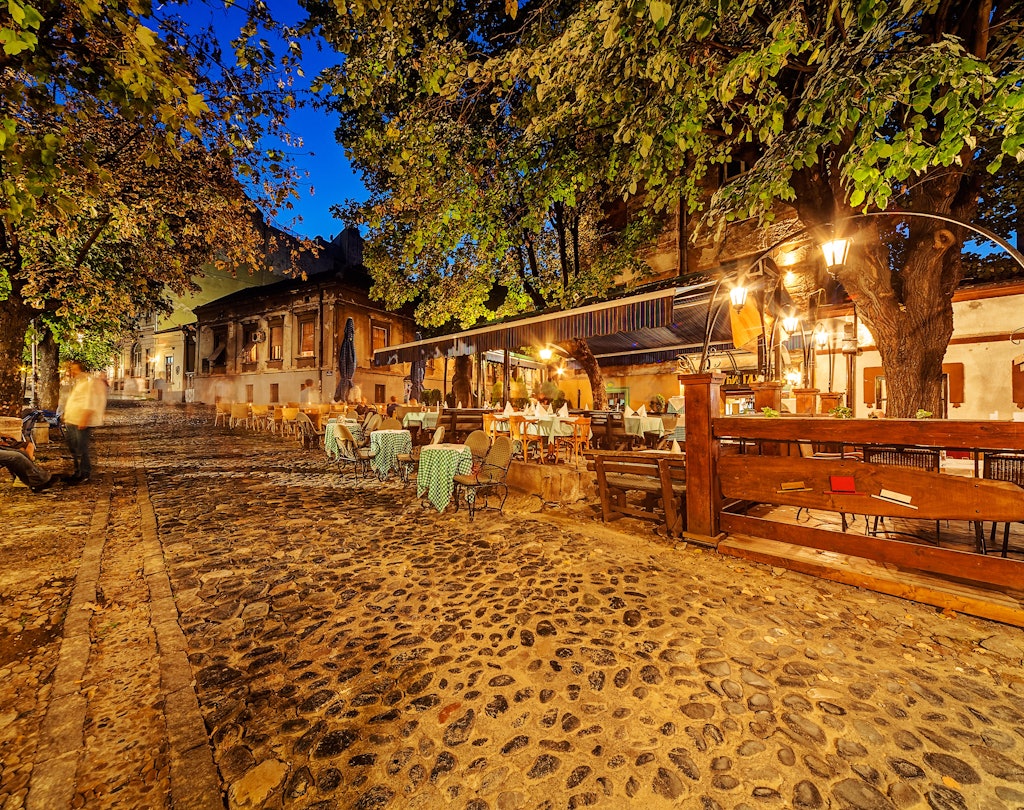
Drop your bag (I recommend the Dorcol or Savamala districts for character) and head straight to Kalemegdan Fortress. Follow the locals with picnic blankets for the ultimate free show: the sun melting into the confluence of the Sava and Danube. After, wander the cobbled Skadarlija street. It’s the “Montmartre of Belgrade“—slightly touristy but dripping in romance, with kafanas (taverns) serving up hearty portions and live starogradska (old city) music.

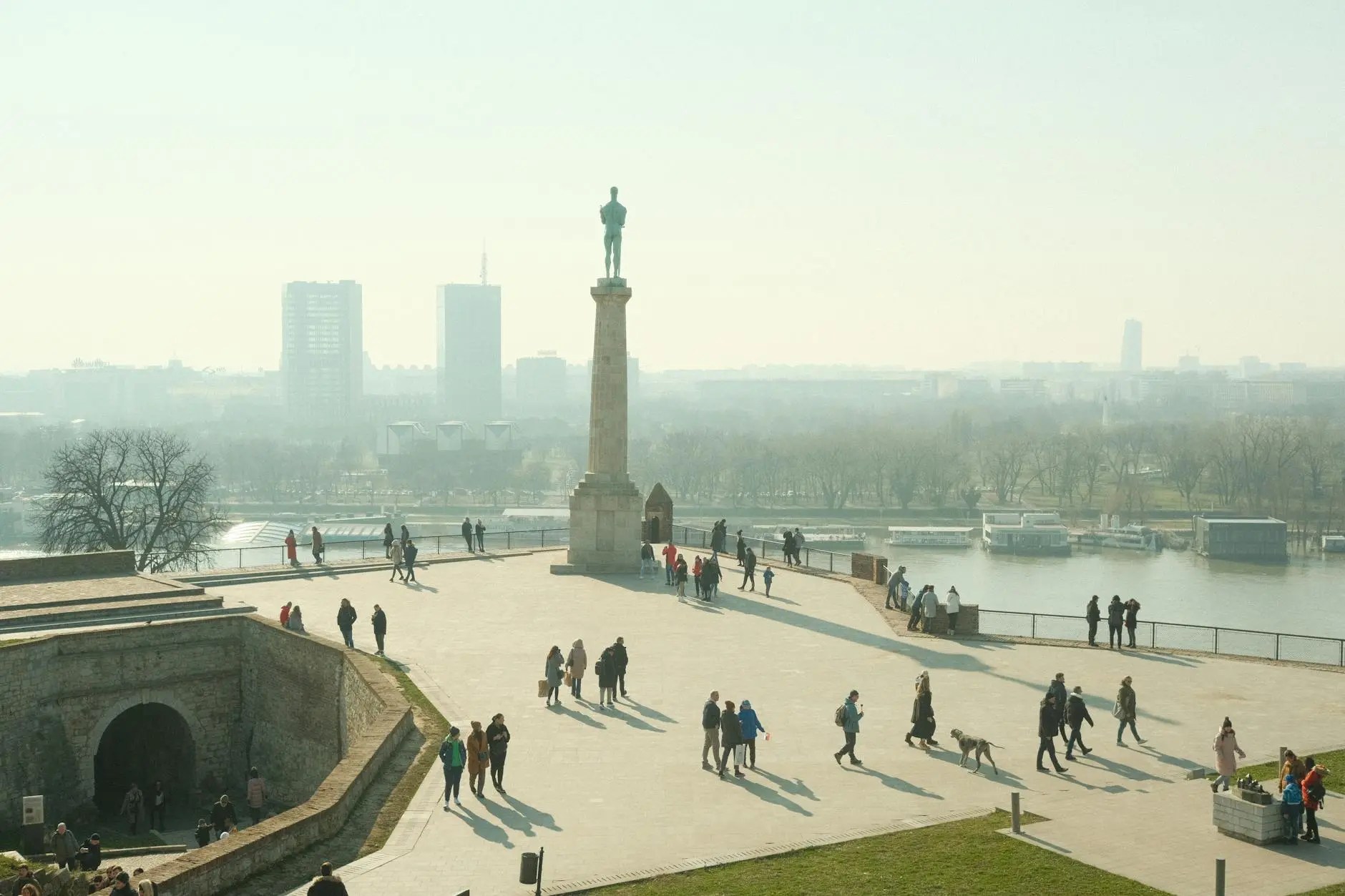
A view of Kalemegdan Fortress in Belgrade, with people walking on the grounds and the confluence of the Sava and Danube rivers in the background.
Panoramic view of the Kalemegdan Fortress in Belgrade, showcasing the Pobednik monument and the confluence of the Sava and Danube rivers. The iconic Pobednik (Victor) Monument stands watch over the confluence of the Sava and Danube rivers from within Kalemegdan Fortress—the most famous view in Belgrade.
A bustling street scene in Belgrade, Serbia, showcasing pedestrians walking along a cobblestone avenue lined with historic buildings and vintage street lamps under a clear blue sky.
A vibrant street in Belgrade showcasing its mix of historical and modern architecture, bustling with pedestrians.  Stroll down Knez Mihailova Street, Belgrade’s vibrant pedestrian heart, where 19th-century architecture meets modern cafe culture and buzzing street life.
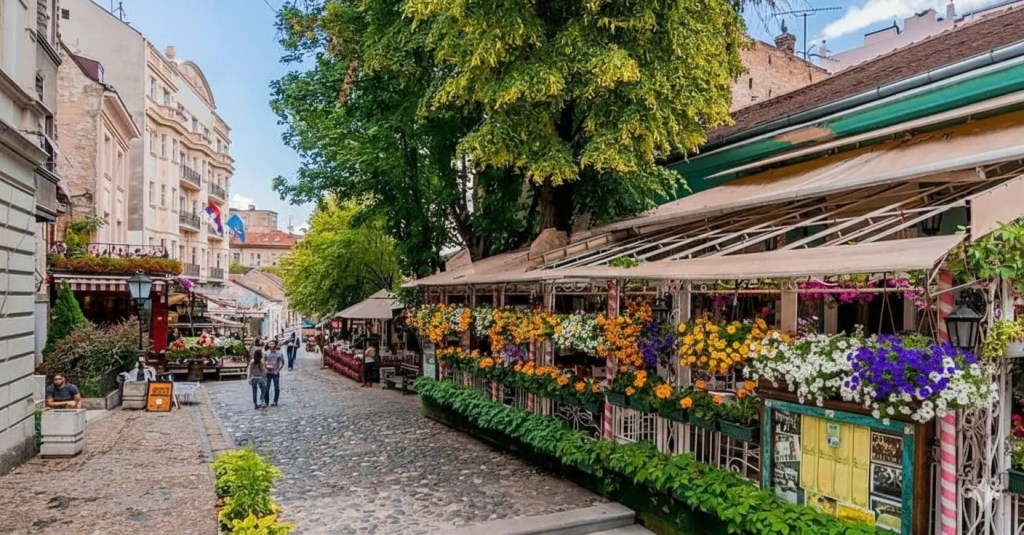
A picturesque cobblestone street in Belgrade lined with vibrant flower displays and outdoor seating at cafes, with people strolling leisurely past historical buildings and trees.
Charming cobblestone street in Belgrade filled with vibrant flowers and outdoor cafes, perfect for a leisurely stroll. Discover Skadarlija, the charming “Montmartre of Belgrade,” where cobblestone streets, traditional kafanas, and old-world charm capture the city’s bohemian soul

A picturesque evening in Skadarlija, Belgrade’s enchanting cobblestone street, lined with charming kafanas and illuminated by warm street lamps.

Saturday: History, Brunch & Splavovi
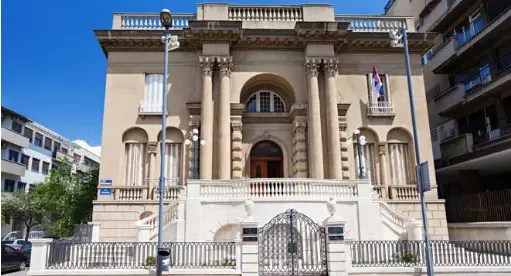
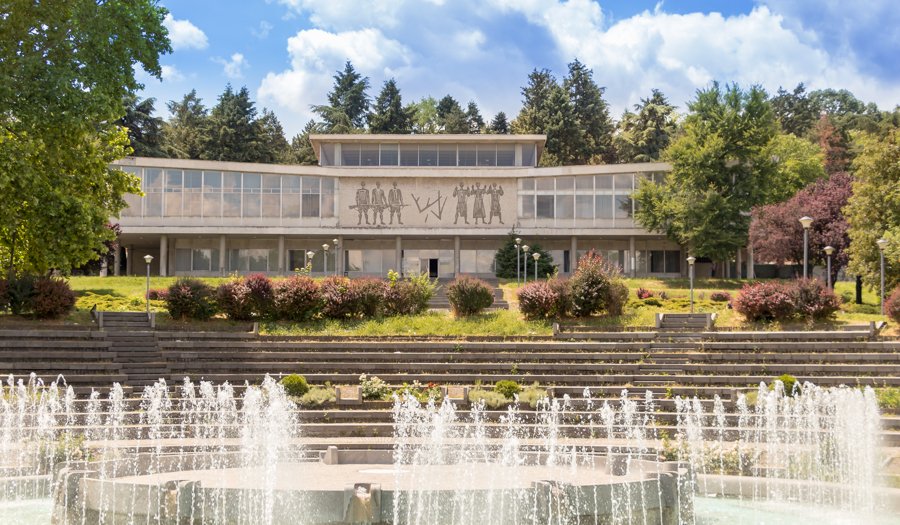
Morning: Dive into history at the Nikola Tesla Museum (book ahead!) or the profoundly moving Museum of Yugoslavia.
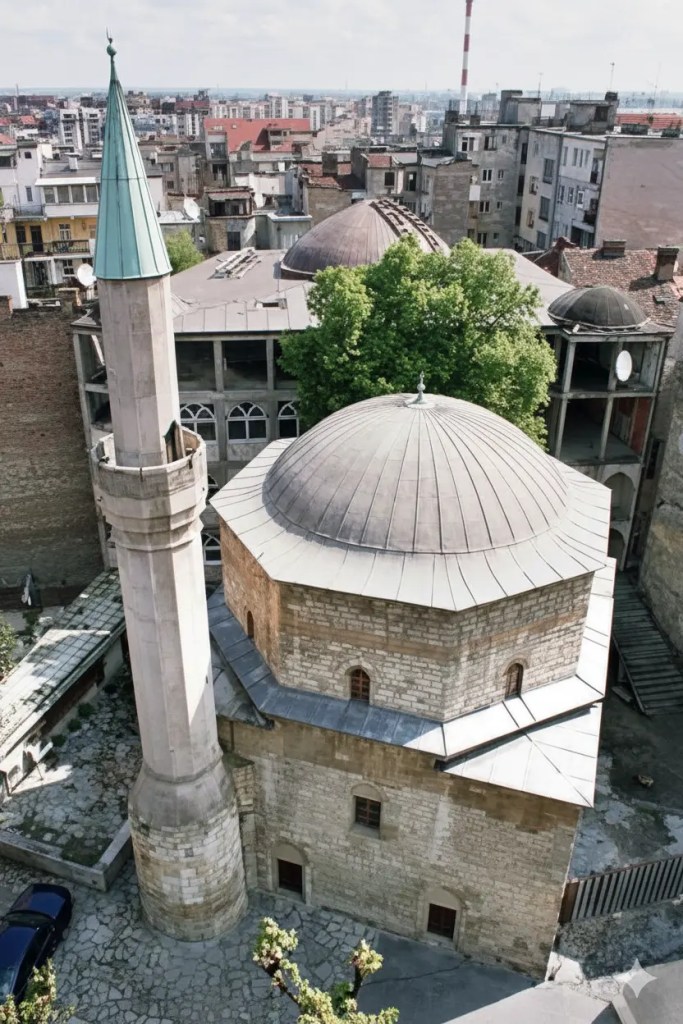
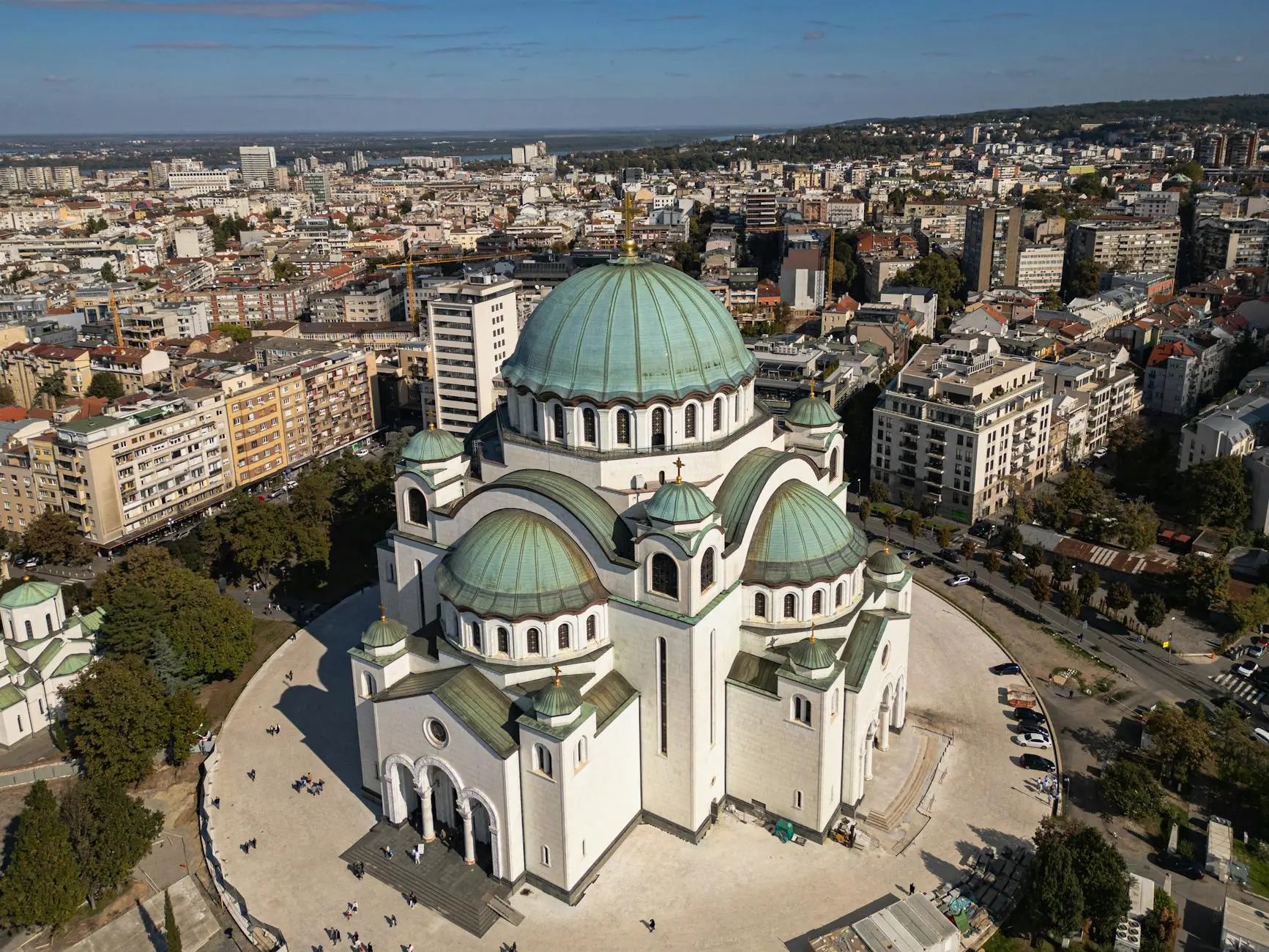
Afternoon: Brunch in trendy Dorcol. Then, explore the Bayrakli Mosque and the Church of Saint Sava—its cavernous, marble interior is staggering.
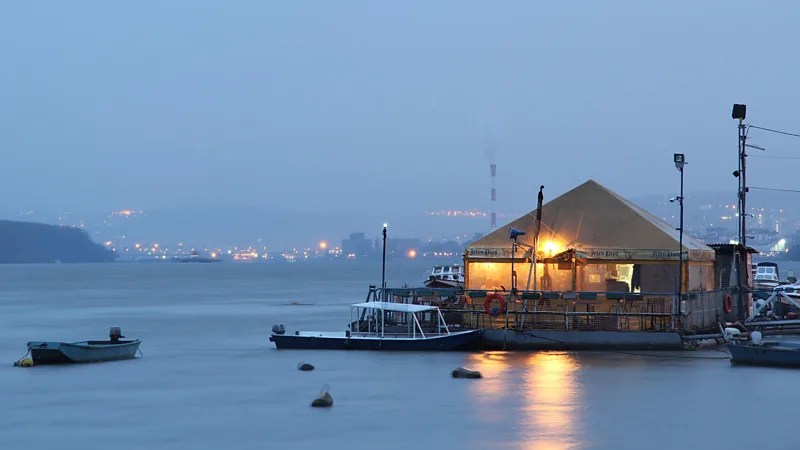
Night: This is Belgrade’s famous playbook. The nightlife happens on splavovi (floating river barges). Start with drinks on a chilled-out barge, then follow the bass to one of the mega-clubs. You don’t have to be a party animal to enjoy the spectacle.

A grand historical building featuring classic architectural elements, with large columns, ornate details, and a serene entrance, located in a sunny urban setting.
An elegant historical building in Belgrade, Serbia, showcasing classic architectural features. Experience the genius of Nikola Tesla at his namesake museum in Belgrade, where you can safely interact with his groundbreaking electrical inventions.
A view of the Museum of Yugoslavia's modernist building, featuring a decorative relief and surrounded by lush greenery and fountains.
The architectural beauty of the Museum of Yugoslavia, showcasing its historic significance amidst lush greenery and modern design. Step into the complex legacy of Yugoslavia at Belgrade’s most visited museum, where the Memorial Center for Josip Broz Tito and thousands of symbolic Relay Batons tell a powerful story of a bygone era.
An aerial view of a historic mosque featuring a stone structure with a domed roof and a minaret, surrounded by modern buildings and greenery in Belgrade, Serbia.
An aerial view of the Bayrakli Mosque in Belgrade, showcasing its historic architecture against a backdrop of city buildings. Find a moment of serene reflection inside the Bajrakli Mosque, Belgrade’s only surviving Ottoman-era mosque located in the city’s historic Dorćol district.
Aerial view of the Church of Saint Sava in Belgrade, showcasing its impressive architecture and surrounding cityscape.
Aerial view of the Church of Saint Sava in Belgrade, showcasing its impressive dome and surrounding cityscape.  Behold the monumental Church of Saint Sava, one of the world’s largest Orthodox churches, dominating the Belgrade skyline from the Vračar plateau.
View of a river barge and a restaurant at dusk by the river, with city lights in the background.
A serene view of a floating river barge along the Danube, perfectly capturing the tranquil ambiance of Belgrade’s riverside, especially during twilight. The nightlife in Serbia’s capital has been touted as the best in the Balkans – and these rafts make every night feel like a Friday.

Sunday: Zemun & Market Magic
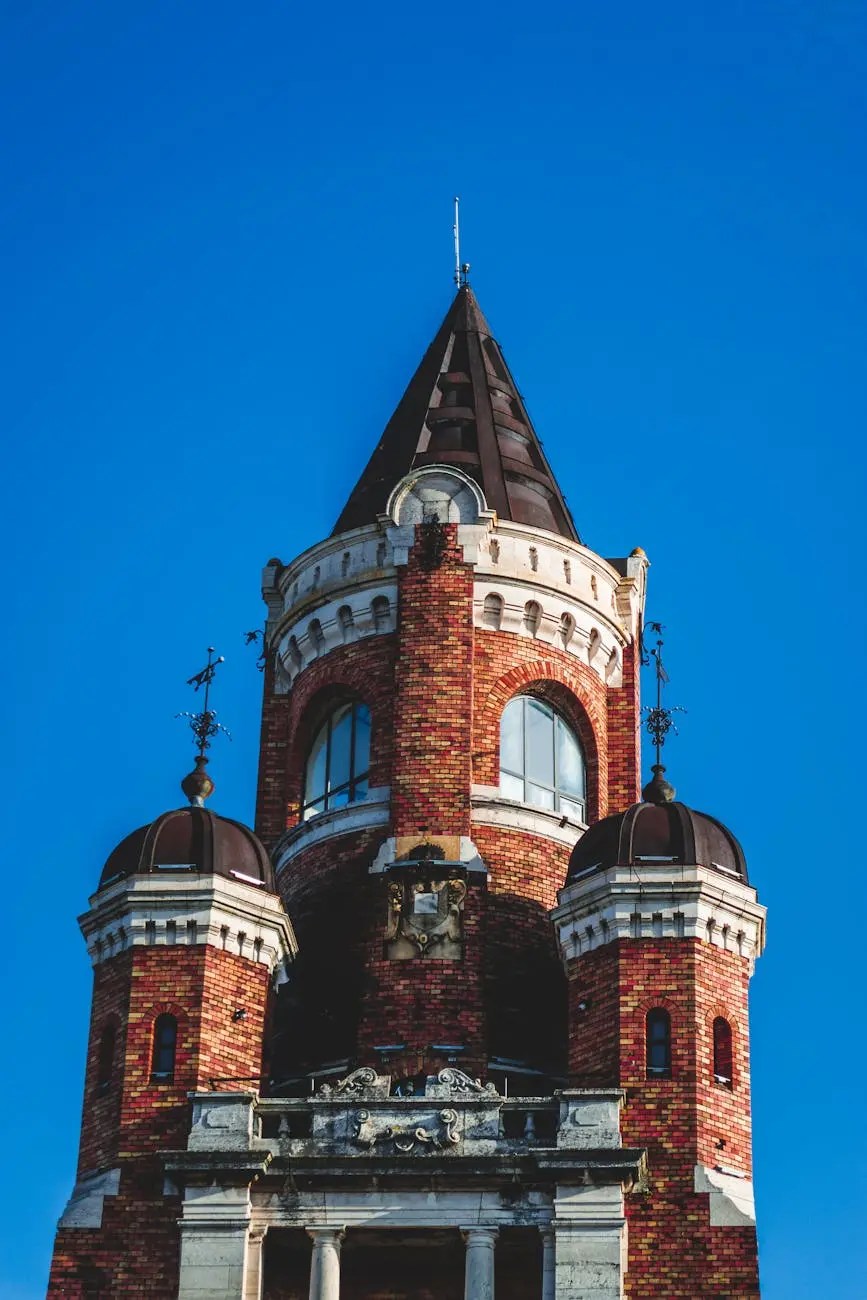
Cross the river (take that ferry!) to Zemun. Climb the Gardoš Tower for panoramic views, then feast on fresh Danube fish at a restaurant along the Kej. On your way back, stop at the Zeleni Venac market for spices, local cheese (kajmak), and souvenirs that aren’t made of plastic.

Close-up view of a tall, ornate tower with a cone-shaped roof and decorative brickwork against a clear blue sky.
A vibrant architectural detail of a historic building in Belgrade, showcasing its unique blend of styles against a clear blue sky. Climb the historic Gardoš Tower in Zemun for the best panoramic views of the Danube River, Belgrade’s skyline, and the old-town rooftops below.
A bustling indoor market in Belgrade, Serbia, filled with vendors selling fresh produce, vegetables, and local goods. Shoppers are seen browsing and interacting, while colorful displays of fruits and vegetables are laid out on tables.
A bustling market in Belgrade, showcasing fresh produce and local goods. zeleni venac market belgrade serbia

Hidden Gems & Local Haunts

  • Mali Pekabazar: Not a bakery, but a tiny, always-packed bar in a former bakery. All decor is DIY, the music is impeccable, and the crowd is local.
  • The Iced Trenches of Tasmajdan: Underneath Park Tašmajdan are WWII-era cold storage tunnels, now used for hockey and concerts. It’s bizarrely cool (literally).
  • KC Grad: A gritty cultural center in Savamala with exhibitions, debates, and a fantastic courtyard bar perfect for a daytime coffee or evening beer.
  • Avala Tower — insane city views
  • Kosančićev Venac — romantic old quarter
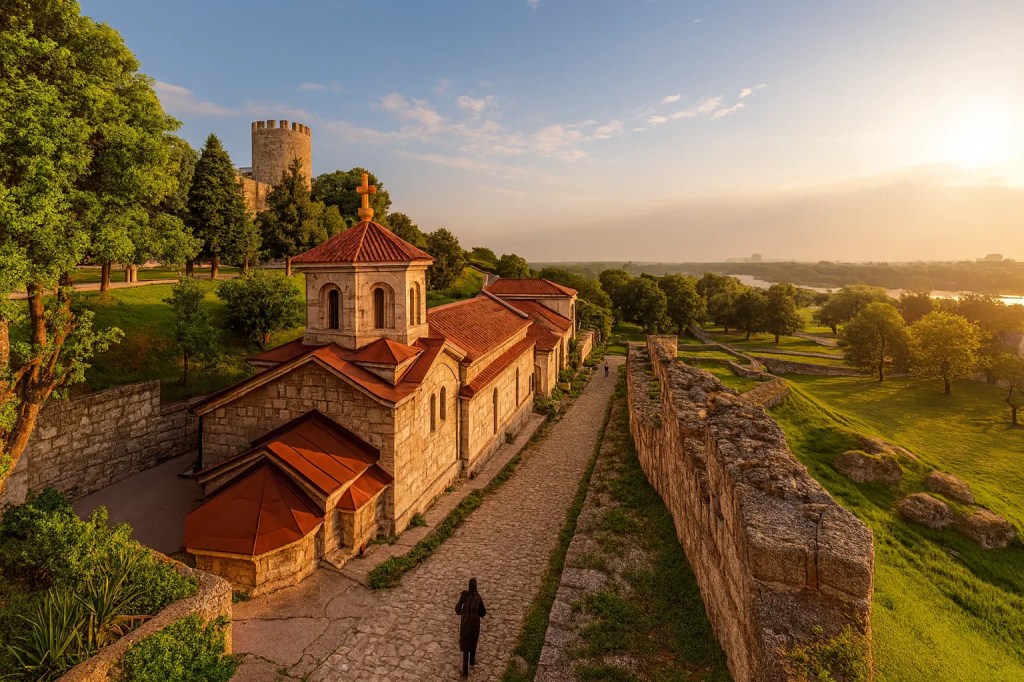
Scenic view of Kalemegdan Fortress and the Church of Ružica in Belgrade, Serbia, during sunset, with lush green surroundings and a pathway.
A serene view of the Kalemegdan Fortress in Belgrade at sunset, showcasing a historic church amidst lush greenery. Golden hour at Kalemegdan Fortress, Belgrade — where history, river views, and peaceful park paths meet.
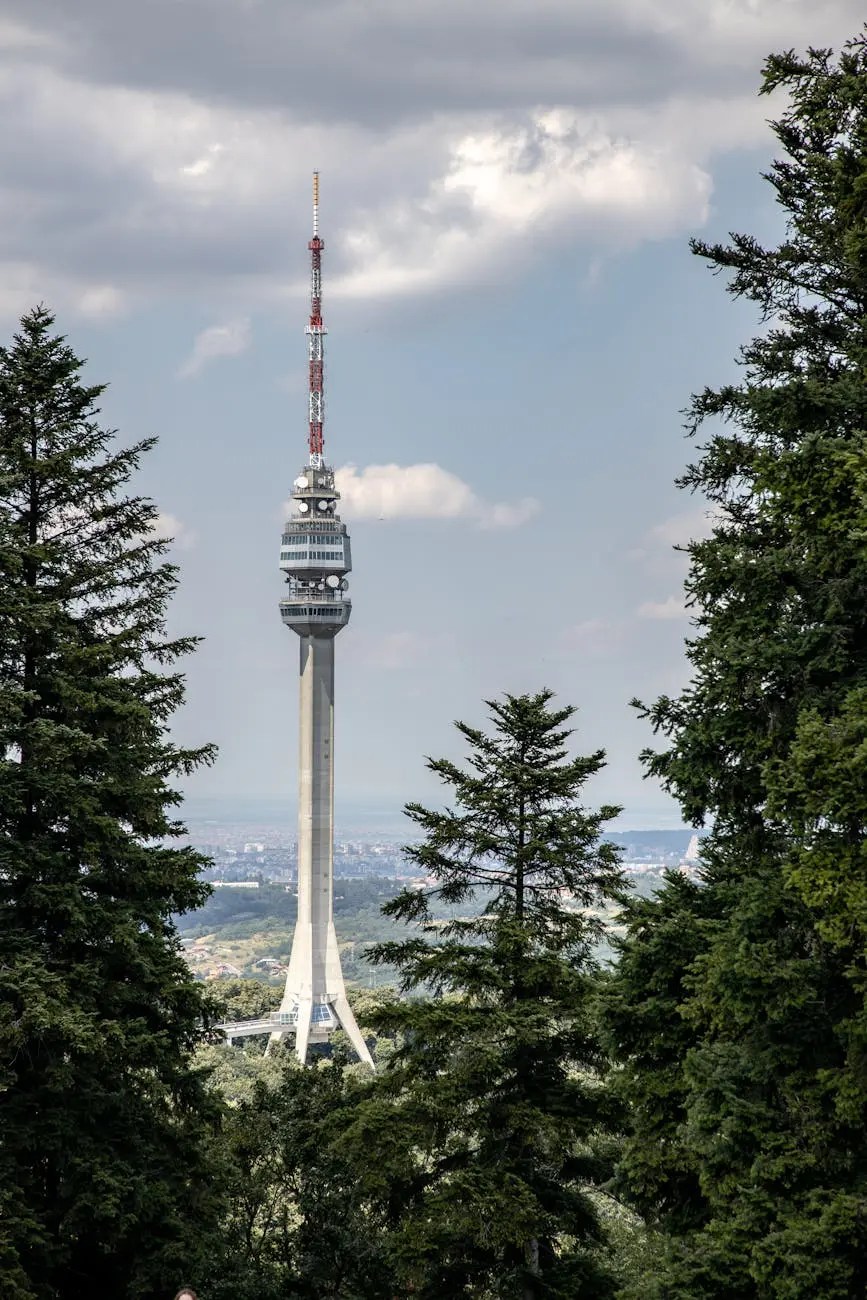
The Avala Tower surrounded by lush green trees, with a cloudy sky in the background, showcasing a modern architectural structure.
The Avala Tower stands tall amidst the trees, offering panoramic views of Belgrade and its surroundings.  Visit the iconic Avala Tower on Mount Avala—the tallest structure in the Balkans and a symbol of Belgrade’s resilience, just a short drive from the city center.
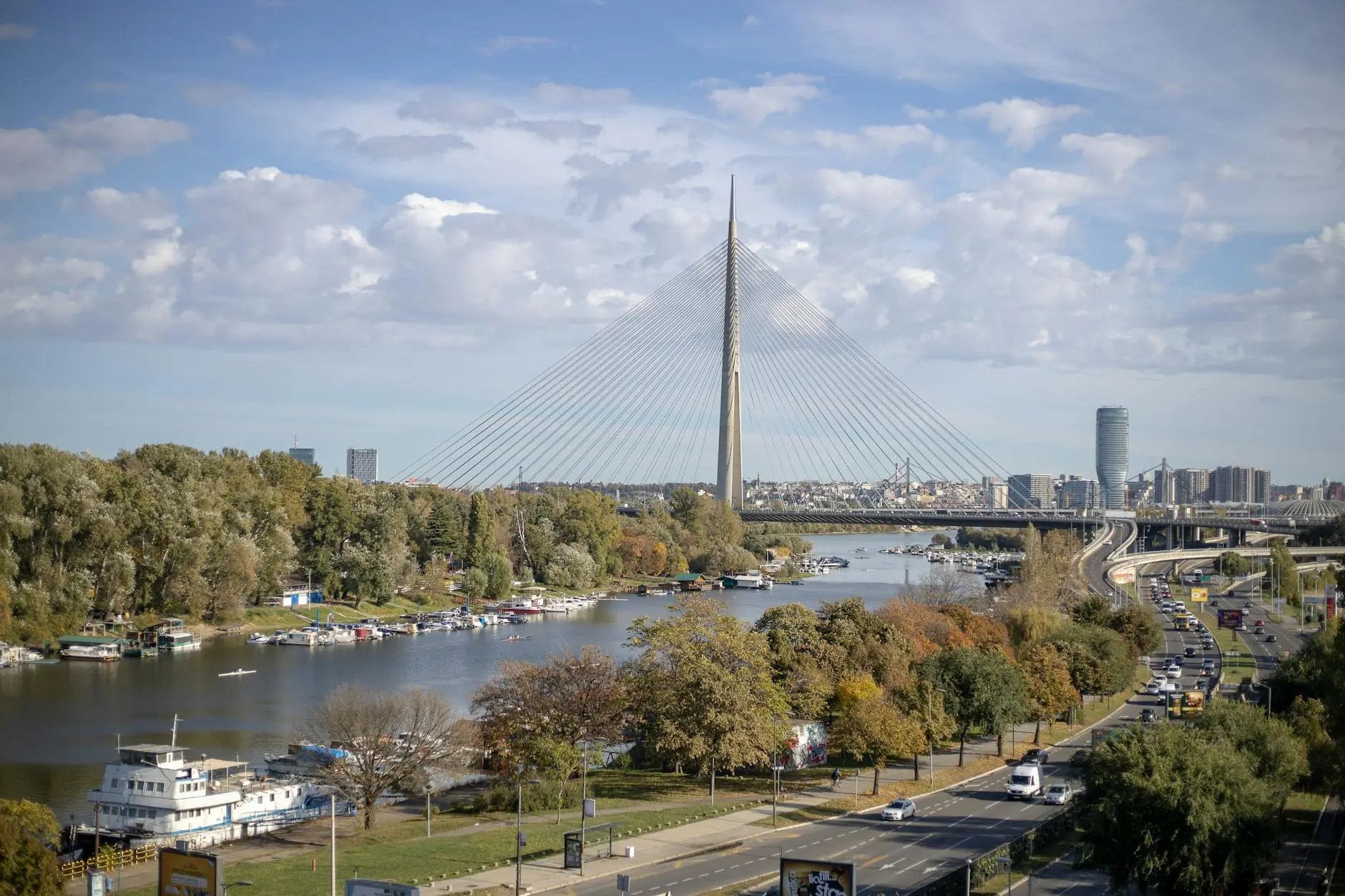
View of the Sava River with a suspension bridge in Belgrade, Serbia, featuring lush greenery along the shoreline and a skyline in the background.
A panoramic view of Belgrade featuring the iconic bridge spanning the Sava River, surrounded by greenery and bustling city life. The stunning Ada Bridge, with its iconic 200-meter pylon, illuminates the Belgrade skyline and connects the city across the Sava River.

🚗 Day Trips from Belgrade

  • Novi Sad (1 hr by train)
  • Golubac Fortress (2 hrs by car)
  • Sremski Karlovci wine region (perfect afternoon trip)

Navigating Belgrade Like a Pro: Transport Tips

  • Bus/Tram: Get a BusPlus card at a kiosk. Tap on and off. Single-ride tickets are for masochists.
  • Walking: The city center is very walkable. Dorcol to the Fortress is a lovely stroll.
  • Taxi: Only use certified companies like Pink or Lux. If the meter looks like it’s on hyperspeed, you’re in a pirate cab.
  • Car: Don’t drive in the center. Parking is a competitive sport. If you’re road-tripping wider Serbia, a good VPN is essential for secure browsing on public Wi-Fi when planning routes. I never travel without my NordVPN for safety and accessing content from home.

🌍 How to Travel From Belgrade to Dubrovnik, Split & Zadar

If you loved Belgrade and want a coastal escape next weekend, Croatia is your best friend.

1️⃣ Belgrade → Dubrovnik

How to go:

  • Flight: Fastest (~1 hr 10 min)
  • Bus: 9–11 hrs
  • Car: Scenic but long (900 km); cross Bosnia

Read my full Dubrovnik guide:
👉 https://confidencebuildings.com/2025/11/21/ultimate-dubrovnik-weekend-guide-tips-must-sees/


2️⃣ Belgrade → Split

How to go:

  • Flight: 1 hr 15 min
  • Bus: 9–12 hrs
  • Car: via Zagreb or Bosnia (highways are great)

My Split weekend guide:
👉 https://confidencebuildings.com/2025/11/23/weekend-getaway-in-split-your-ultimate-travel-guide/


3️⃣ Belgrade → Zadar

How to go:

  • Flight: seasonal
  • Bus: 12–13 hrs
  • Car: excellent road quality along Croatian coast

My Zadar travel blog:
👉 https://confidencebuildings.com/2025/11/26/explore-zadar-your-ultimate-weekend-getaway-guide/


💸 Money-Saving Tips for Belgrade

  • Eat at pekara (Serbian bakeries) — cheap & delicious
  • Use public transport instead of taxis
  • Buy SIM/eSIM online — cheaper than airport kiosks
  • Take free walking tours for orientation
  • Travel by bus/train instead of domestic flights

Savvy Traveller Section: Save Time & Money

  • Visa Info: For EU, US, UK, and AU/NZ citizens, it’s a breeze—no visa needed for stays up to 90 days. Always double-check official sources before travel.
  • Stay Connected (Without Getting Robbed): Airport SIMs are a trap. My secret weapon is Drimsim—a global data SIM that works in 190 countries. Pop it in, top up via the app, and you’re online. No more language barrier struggles at mobile shops. It’s saved me countless times.
  • Flight Gone Wrong? If your flight to Belgrade gets delayed or canceled, remember: EU passenger rights are powerful (and apply even on some non-EU airlines). You could be owed up to €600. Instead of fighting the airline myself, I let AirHelp handle it. They only get paid if you win.
  • Travel Insurance: Never skip it. A friend once slipped on Kalemegdan’s cobbles and needed stitches. I use VisitorsCoverage to compare and buy the right plan for every trip. It’s the adulting thing to do.
  • Capture the Magic: Belgrade’s light, from golden fortress glows to neon splav reflections, is incredible. I capture it all with my trusty Sony Alpha camera—it’s the perfect travel companion for sharp, vibrant photos.

Essential Serbian Survival Phrases

Serbs appreciate the effort immensely!

  • Hvala (HVAH-lah) = Thank you.
  • Dobar dan (DOH-bar dan) = Good day.
  • Koliko košta? (KOH-lee-koh KOSH-tah) = How much does it cost?
  • Jedno pivo, molim (YED-noh PEE-voh, MOH-leem) = One beer, please. (Your most important phrase.)
  • Živeli! (ZHEE-veh-lee) = Cheers!
  • Gde je autobus? – Where is the bus?
  • Voda – Water

Frequently Asked Questions (FAQs)

Q: Is Belgrade expensive?
A: Not at all. It’s one of Europe’s most affordable capitals. A huge meal with drinks can be under €15, and pints are often €2-3.

Q: What’s the best time to visit?
A: Late spring (May-June) and early autumn (September-October). You’ll avoid the summer heatwaves and the winter chill, and the riverside terraces are in full swing.

Q: Is it safe for solo travellers?
A: Yes, very. Standard city precautions apply (watch your bag in crowds), but I’ve always felt safe walking around, even at night.

Q: How do I get from the airport to the city center?
A: The A1 shuttle bus is the budget choice (300 RSD). An official taxi from the booth is easier and costs a fixed ~2500 RSD.

Is nightlife expensive?

Moderate. Drinks €3–7, clubs sometimes have entry fees.

Can I pay by card?

Yes, cards are accepted widely. Carry some cash for taxis/bakeries.

Are ferries available?

No sea ferries, but Danube river cruises are available.

Ready for Your Adventure?

Belgrade isn’t a polished, predictable city. It’s raw, authentic, and exhilarating. It gets under your skin. From the quiet moments watching barges slide down the Danube to the deafening beat inside a floating club, it’s a weekend you won’t forget.

Universal Disclaimer/Disclosure Page:

Explore Tallinn: Your Ideal Weekend Getaway

Meta Description:
Discover the charm of Tallinn, Estonia — a fairy-tale weekend destination where medieval streets meet modern magic. From budget travel tips and scenic ferry rides to hidden gems and foodie adventures, this guide helps travelers save time, money, and stress while exploring one of Northern Europe’s most underrated capitals. ✈️

Table of Contents

  1. Why Tallinn is Your Next Weekend Winner
  2. Your Step-by-Step Tallinn Itinerary: A Perfect 48-72 Hours
    • Day 1: Dive into the Medieval Old Town
    • Day 2: Creative Quarters & Coastal Views
    • Day 3 (The Bonus Day!): Day Trips & Deeper Dives
  3. Tallinn Travel Smarts: Getting Around & Saving Cash
    • Public Transport: Your New Best Friend
    • Money-Saving Tips from a Local (Well, a Frequent Visitor)
  4. Tallinn’s Hidden Gems: Beyond the Postcard
  5. Essential Estonian: Don’t Leave Home Without These Phrases
  6. Travel FAQ: Tallinn Quick-Fire Questions
  7. Ready to Roam? Your Packing List & Final Checks

Why Tallinn is Your Next Weekend Winner

For my fellow Europeans, Tallinn is a ridiculously easy hop. For everyone else, it’s a stunning and affordable gateway to the Baltics. The compact, UNESCO-listed Old Town means you can see a staggering amount on foot. Plus, it’s incredibly safe, the food is a delicious mix of rustic and Nordic, and the tech scene is buzzing (they invented Skype, after all!).

Visa Note: As part of the Schengen Area, if you’re from a visa-exempt country, you can waltz right in. For others, always check the latest requirements.

I still remember stepping into Tallinn’s Old Town for the first time — cobblestones underfoot, pastel-colored houses glowing under a soft northern sun, and the smell of freshly baked pastries drifting from medieval cafés. It felt like wandering through a real-life storybook (minus the dragons, thankfully).

Tallinn, the capital of Estonia, is often overshadowed by its Scandinavian neighbors — Helsinki, Stockholm, and Copenhagen — but trust me, it’s just as magical (and a lot cheaper).

👉 Book your Tallinn weekend escape now through Expedia — flexible stays, best prices, and easy comparison.

🏰 Where to Stay in Tallinn

Stay inside the Old Town for the full medieval experience — waking up to church bells and pastel rooftops is pure magic.

If you’re after something trendier, Telliskivi Creative City offers artsy lofts, street art, and cafes that could give Brooklyn a run for its money.

💤 Book your stay here → Expedia Tallinn Hotels for last-minute deals and flexible cancellation

✈️ Getting There — Flights, Ferries & Visa Info

Tallinn Airport (TLL) is well-connected across Europe, and many budget airlines fly directly from London, Berlin, and Warsaw.

If you’re exploring the region, consider taking a ferry from Helsinki — it’s only a 2-hour scenic journey across the Gulf of Finland. I grabbed a hot coffee and watched the icy blue sea roll by — honestly, one of my favorite travel memories ever.

🚌 Getting Around — Public Transport Made Easy

Public transport in Tallinn is not just efficient — it’s free for residents (and super cheap for visitors).

  • Bus & Tram: Buy a QR ticket from the “pilet.ee” app. Most routes run from 5 a.m. to midnight.
  • Trolleybus: Great for getting to Kadriorg or the Seaplane Harbour.
  • Car: If you’re renting, roads are clean and well-marked. Parking in the Old Town can be tricky, so try Park & Ride zones outside the center.
  • Bike & Electric Scooters: Apps like Bolt make it a breeze to zip between sights.

🗺️ Time Saver Tip: Plan your route with Google Maps offline mode — it works even without Wi-Fi, saving data and battery.

Tallinn Travel Smarts: Getting Around & Saving Cash

Public Transport: Your New Best Friend

Forget renting a car in the city center—it’s a headache of narrow streets and expensive parking. Tallinn’s public transport is cheap, clean, and efficient. The system is a mix of buses, trams, and trolleys, and it’s incredibly easy to use.

  • From the Airport to the City: This is where I almost led you astray! There is no direct tram from Tallinn Airport (TLL). Here’s how you actually do it:
    • Best Option: Public Bus. Head right outside the terminal doors to the bus stops. Bus #2 will take you directly to the city center, with a key stop being “A. Laikmaa,” which is just a 5-minute walk from the Old Town and the vibrant Viru Street. The journey takes about 15-20 minutes. You can also take bus #15 or bus #49, which connect to other parts of the network.
    • Paying Your Fare: The easiest way is to simply tap your contactless bank card (credit/debit) on the validator when you board. It’s a seamless, “pay-as-you-go” system. Alternatively, you can buy a paper ticket from the driver for a slightly higher price (have some cash handy).
    • Taxi: If you have heavy bags or just want a direct drop-off, taxis are readily available and affordable. A ride to the Old Town should cost around €10-15. Ensure the taxi is licensed and uses a meter, or agree on a price beforehand.
  • The Tallinn Card: If you’re following this itinerary, this card is a no-brainer. It includes free public transport across the entire network (buses, trams, trolleys) and free entry to almost all the major attractions I’ve mentioned. I calculated it and saved over €50 in two days. It effectively makes getting from the airport and around the city completely free.
  • Getting Around the City: Once you’re in the center, you’ll mostly walk. To reach districts like Kalamaja or Kadriorg, the trams (especially #1 and #3) and buses are your best bet. Just tap your contactless card on the green validator inside the vehicle.

Your Step-by-Step Tallinn Itinerary

Day 1: Dive into the Medieval Old Town

Start at Viru Gate, the iconic twin-towered entrance to the Old Town. Let yourself get lost. Seriously. The magic of Tallinn is in its winding, cobbled alleys. My strategy? Pick a street that looks interesting and follow it.

  • Morning: Make a beeline for Town Hall Square (Raekoja plats). If you’re lucky enough to be there in winter, you’ll find a Christmas market straight out of a storybook. Grab a hot glögg (mulled wine) and soak it in.
  • Afternoon: Hike up to Toompea Hill. The views from the Kohtuotsa and Patkuli viewing platforms are, without exaggeration, breathtaking. You’ll see the entire Old Town with its sea of red roofs and spires. This is where I got my favorite shot of the trip, captured perfectly on my trusty Sony Alpha 7C.
  • Evening: Ditch the main square for dinner. Find a cozy cellar restaurant like Olde Hansa for a full-on medieval experience (try the bear meat if you’re feeling brave!) or Rataskaevu 16 for amazing modern Estonian cuisine. Pro-tip: Book ahead!

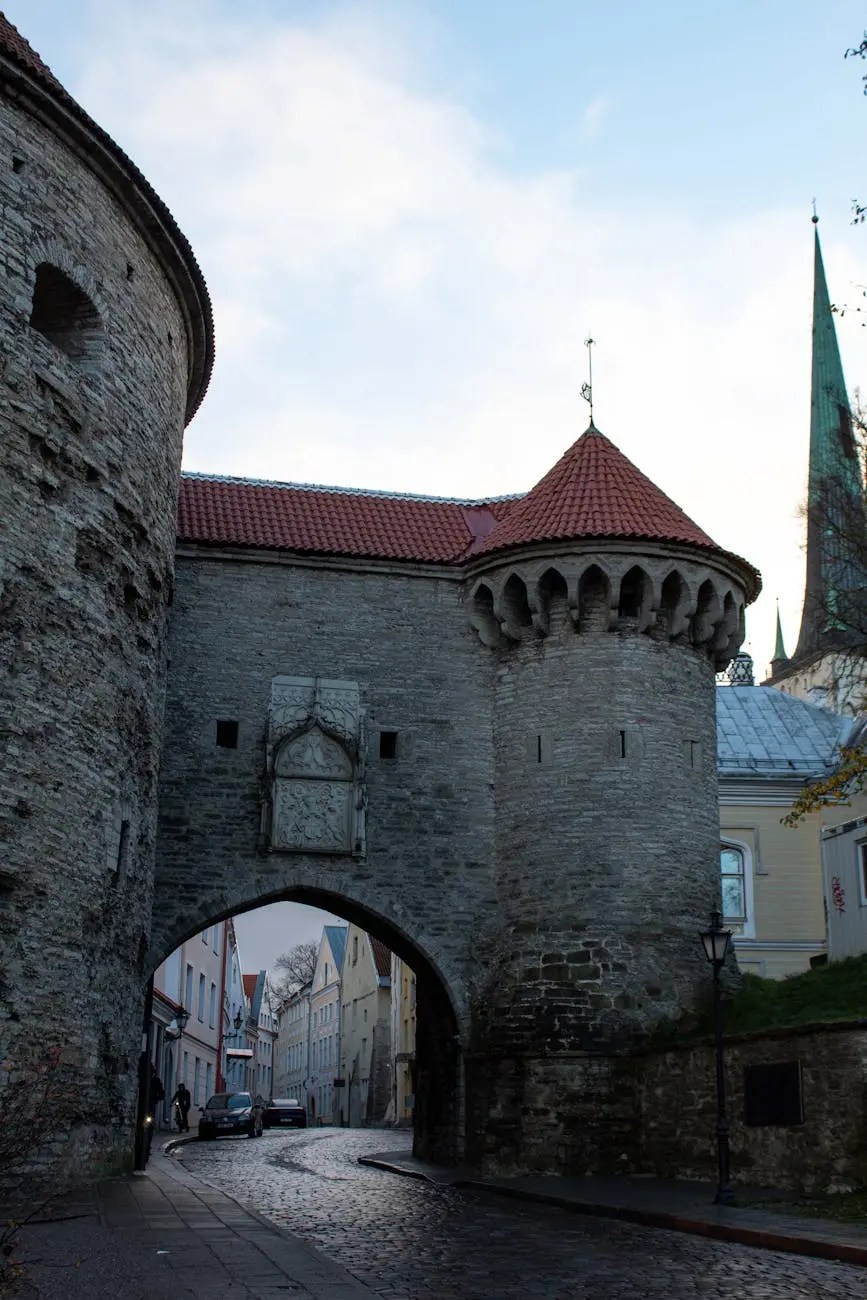
A view of a medieval stone archway with towers in Tallinn, Estonia, leading into a cobbled street lined with pastel-colored buildings.
Explore the iconic Viru Gate, a historic entrance to Tallinn’s enchanting Old Town.  Stepping through history at the iconic Viru Gate. This 14th-century entrance is the perfect introduction to the fairy-tale charm of Tallinn’s UNESCO-listed Old Town. Pro tip: the flower stalls here are some of the most beautiful in the city!

Colorful historical buildings lining a cobblestone street in Tallinn, Estonia, with clear blue skies above.
Charming pastel-colored buildings in Tallinn’s Old Town, showcasing medieval architecture against a clear blue sky. The heart of the medieval city: Tallinn’s Town Hall Square (Raekoja plats). These colorful gabled buildings have stood here for centuries, once housing wealthy Hanseatic merchants. In the winter, this very spot transforms into a magical Christmas market!
The interior of a legislative chamber featuring blue walls, wooden desks, and rows of black chairs, designed for meetings and sessions.

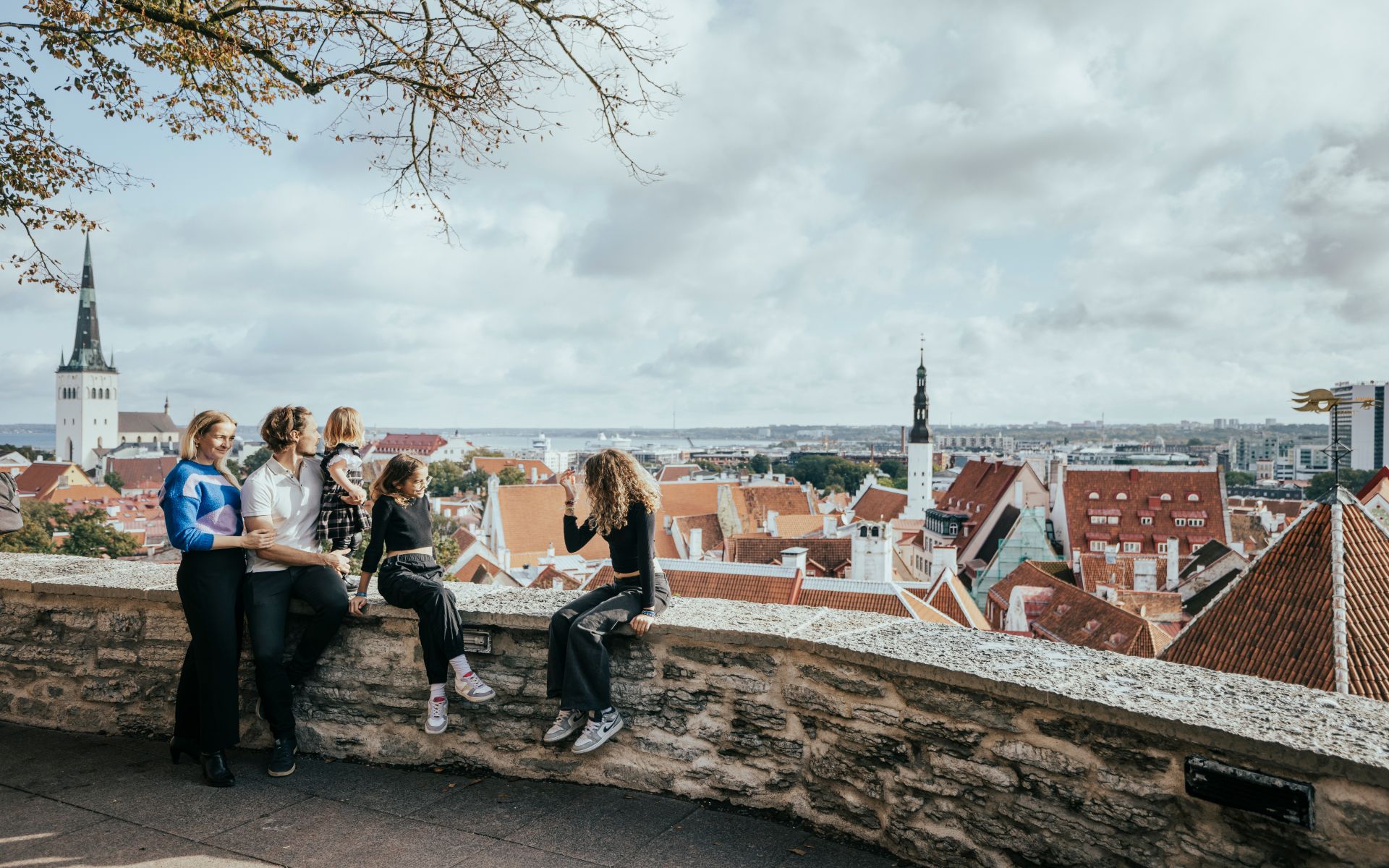
A group of four people enjoying a scenic view over Tallinn, Estonia, with medieval rooftops and the spire of a church in the background under a partly cloudy sky.
A group enjoying the stunning views of Tallinn’s Old Town, featuring iconic rooftops and spires.

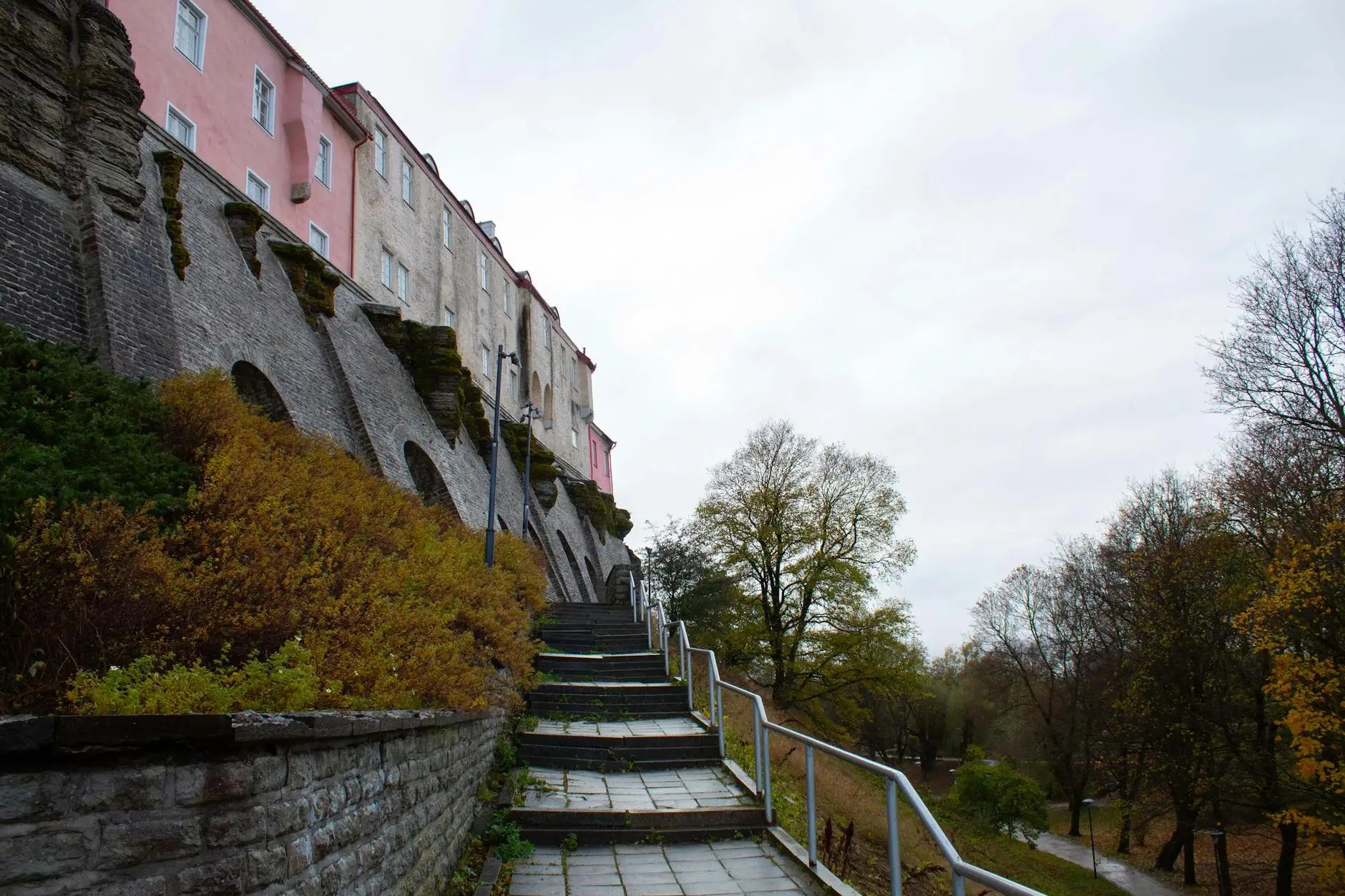
A stairway leading up to pastel-colored buildings and a stone wall overgrown with greenery, set against a cloudy sky.
A scenic view of Tallinn’s historic architecture, showcasing colorful buildings perched atop ancient city walls. The postcard-perfect view from Patkuli viewing platform. This is the scene that will convince you you’ve stepped into a fairy tale. Look for the “Three Sisters” towers and the spire of St. Olaf’s Church!

Day 2: Creative Quarters & Coastal Views

  • Morning: Cross the “Culture Kilometre” into the Kalamaja district. Famous for its picturesque, colourful wooden houses, this area is now the city’s hipster heart. Grab a coffee at a trendy café and then explore the Telliskivi Creative City, a sprawling complex of indie shops, galleries, and eateries in a former industrial complex.
  • Afternoon: From nearby Kalamaja, it’s a short walk to the Seaplane Harbour (Lennusadam). This is one of the coolest maritime museums I’ve ever visited, housed in a giant seaside hangar. You can clamber aboard a real submarine and see a historic icebreaker. It’s a hit for all ages.
  • Evening: Head to the Rotermann Quarter, a superbly done mix of old factory buildings and sharp modern architecture. It’s packed with great restaurants and bars. It’s the perfect spot to reflect on your trip over a local craft beer.

Colorful buildings with modern architecture in Tallinn, Estonia, surrounded by lush greenery.
Colorful buildings and lush greenery in Tallinn’s Kalamaja district, showcasing the area’s vibrant architecture.

Interior view of a maritime museum displaying an old tank, vintage aircraft models, and wooden stairs.
Explore the fascinating exhibits at the Seaplane Harbour, showcasing maritime history and technology.

Day 3 (The Bonus Day!): Day Trips & Deeper Dives

Got an extra day? Fantastic.

  • Option A (Nature): Take a 30-minute bus ride to Pirita. Walk along the beach, visit the ruins of St. Bridget’s Monastery, and climb the TV Tower for a panoramic view of the forest and coastline.
  • Option B (History): Venture further afield to Lahemaa National Park. You can join a tour to explore bogs, forests, and historic manor houses. It’s a complete contrast to the city and absolutely stunning.

For more Baltic inspiration, check out my guides to nearby Riga, Latvia and Vilnius, Lithuania. Doing all three is the ultimate Baltic road trip!

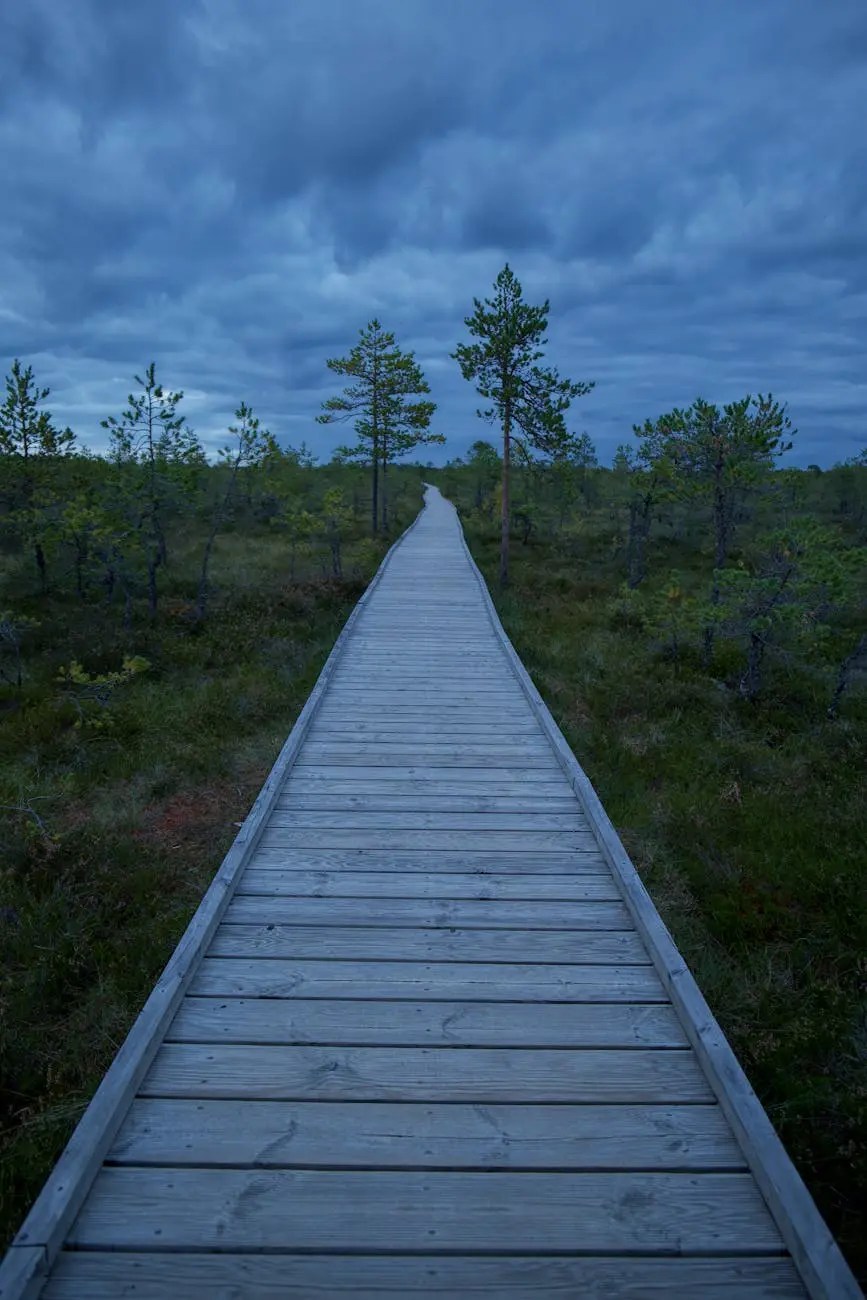
A serene wooden pathway leading through a lush, green landscape, perfect for nature exploration in Estonia. Walking the wooden boardwalk through Viru Bog feels like entering another world. The silence is broken only by the squelch of your own footsteps and the distant call of a bird. This is the raw, ancient beauty of the Estonian wilderness.

Tallinn Travel Smarts: Getting Around & Saving Cash

Public Transport: Your New Best Friend

Forget renting a car in the city center—it’s a headache of narrow streets and expensive parking. Tallinn’s public transport is cheap, clean, and efficient.

  • Single Tickets: You can buy a green Ühiskaart (smartcard) from kiosks or pay contactless with your bank card directly on the bus/tram. It’s super simple.
  • The Tallinn Card: If you’re following a busy sightseeing itinerary, this card is a no-brainer. It includes free public transport across the entire network (including those essential airport buses!) and free entry to almost all major attractions. I calculated it and saved over €50 in two days.
  • Getting Around the City: Once you’re in the center, you’ll mostly walk. To reach districts like Kalamaja (for the hipster cafes) or Kadriorg (for the art museum and park), the trams (especially #1 and #3) are your best bet. Just remember to tap your contactless card on the validator inside the vehicle.

💶 Smart Money-Saving Tips

  • Download Wolt or Bolt Food for cheaper local meals.
  • Visit museums on free entry days (usually first Wednesday of the month).
  • Walk or bike instead of taxis — Tallinn is compact!
  • Eat Lunch: Many restaurants offer a fantastic “lunch menu” on weekdays from 12-3 pm for a fraction of the dinner price.
  • Tap Water: The tap water in Tallinn is perfectly safe and delicious to drink. Bring a reusable bottle.
  • Free Walking Tours: Start your trip with one of the excellent free walking tours. You just tip the guide what you think it was worth.

🚌 Getting Around — Public Transport Made Easy

Public transport in Tallinn is not just efficient — it’s free for residents (and super cheap for visitors).

  • Bus & Tram: Buy a QR ticket from the “pilet.ee” app. Most routes run from 5 a.m. to midnight.
  • Trolleybus: Great for getting to Kadriorg or the Seaplane Harbour.
  • Car: If you’re renting, roads are clean and well-marked. Parking in the Old Town can be tricky, so try Park & Ride zones outside the center.
  • Bike & Electric Scooters: Apps like Bolt make it a breeze to zip between sights.

🗺️ Time Saver Tip: Plan your route with Google Maps offline mode — it works even without Wi-Fi, saving data and battery.

Tallinn’s Hidden Gems: Beyond the Postcard

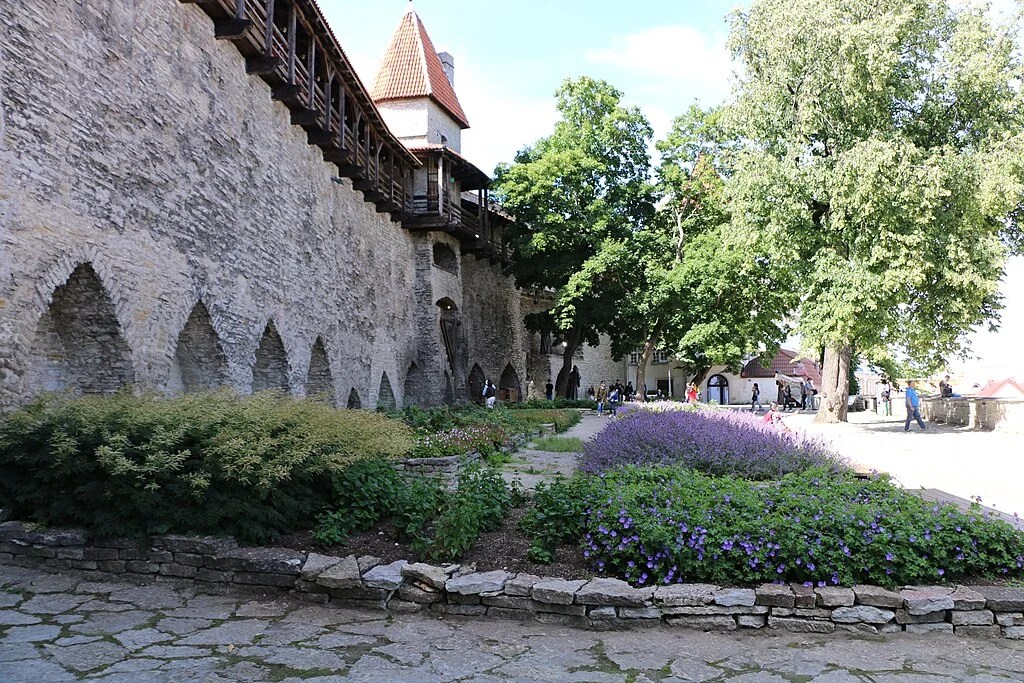
  • The Danish King’s Garden: Behind Toompea Castle, this courtyard has a spooky legend and three mysterious monks carved into the wall. It’s much quieter than the main viewpoints.
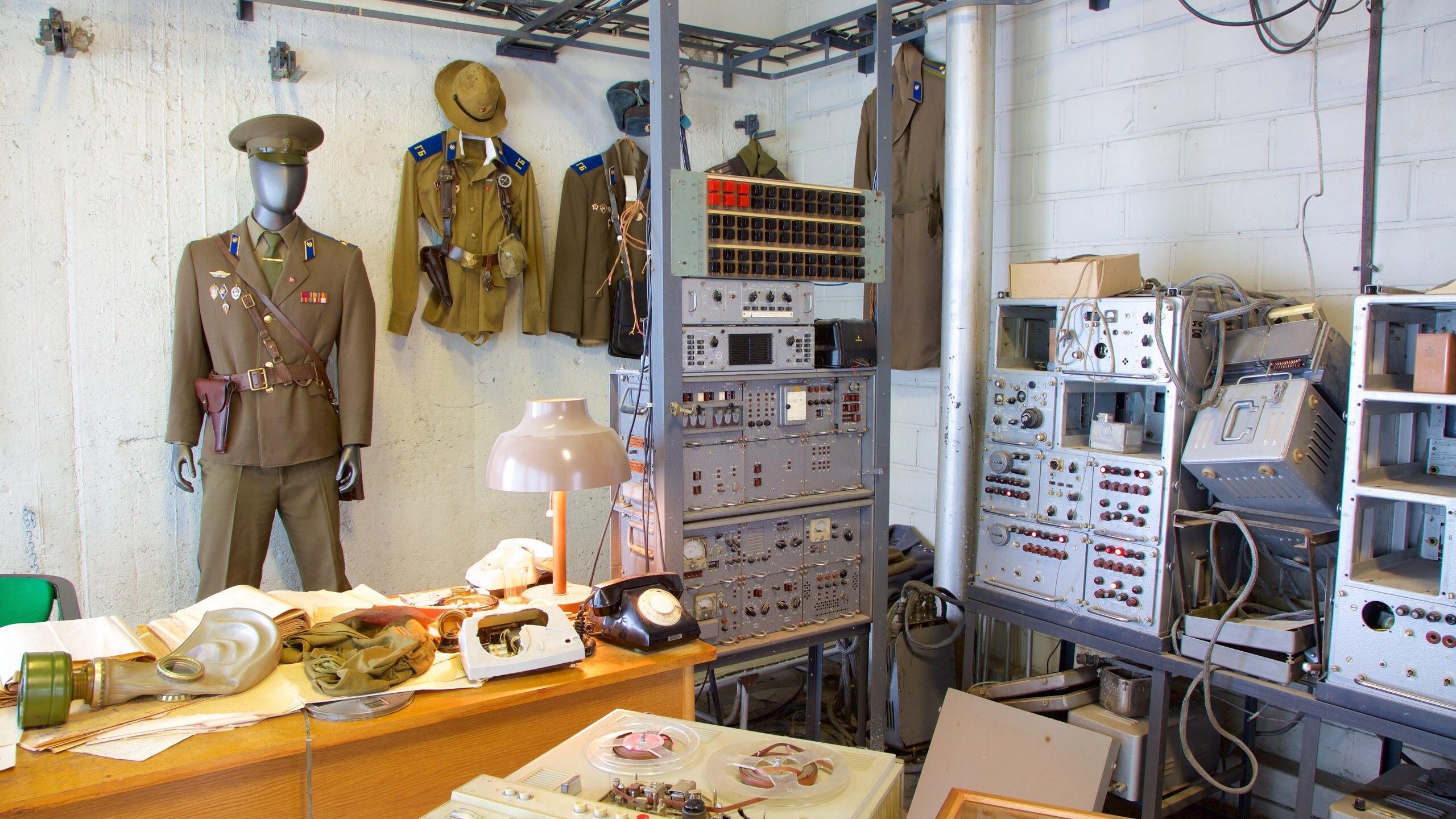
  • KGB Museum in the Viru Hotel: Book a tour of the former KGB headquarters on the 23rd floor of this Soviet-era hotel. It’s a chilling but fascinating look into Estonia’s not-so-distant past.
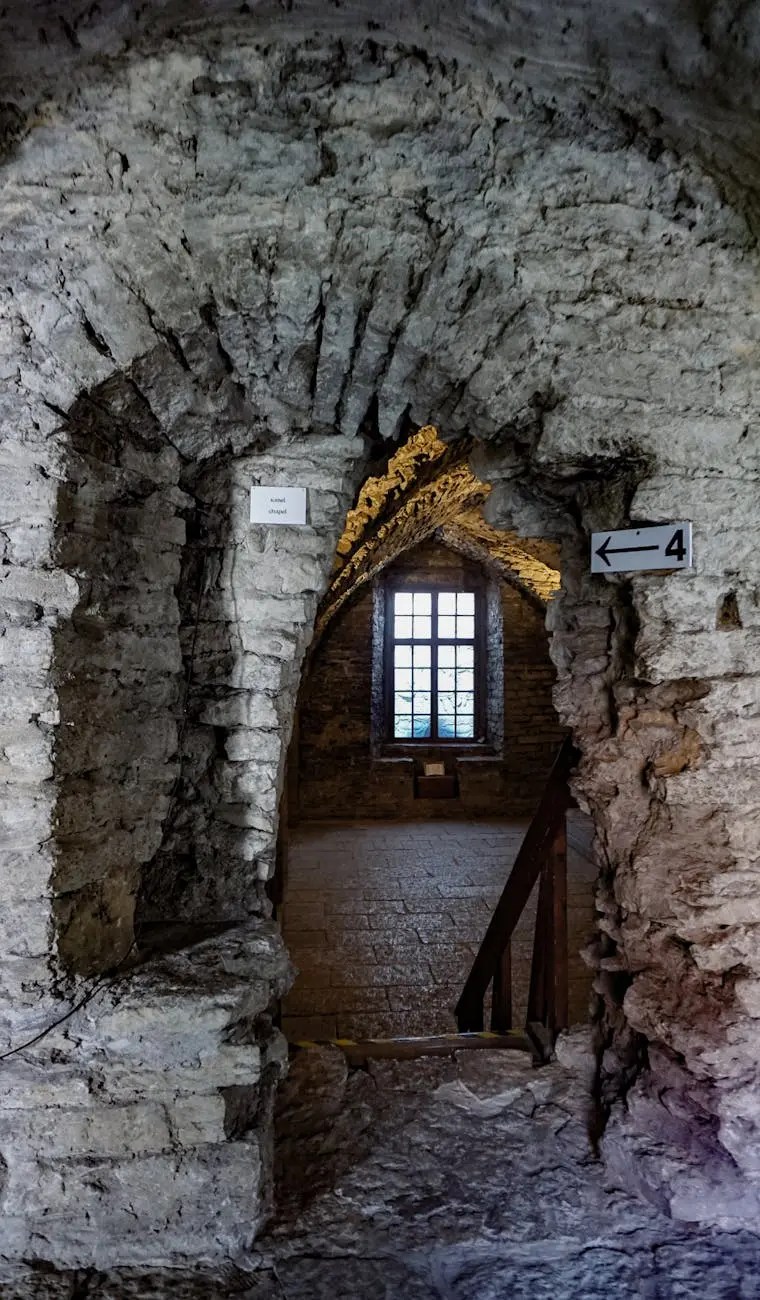
  • St. Catherine’s Passage: A beautiful, atmospheric alley where you can find the workshops of local artisans and see ancient tombstones embedded in the wall.

🌊Tallinn’s Hidden Gems: Beyond the Postcard

  • The Danish King’s Garden: Behind Toompea Castle, this courtyard has a spooky legend and three mysterious monks carved into the wall. It’s much quieter than the main viewpoints.
  • KGB Museum in the Viru Hotel: Book a tour of the former KGB headquarters on the 23rd floor of this Soviet-era hotel. It’s a chilling but fascinating look into Estonia’s not-so-distant past.
  • St. Catherine’s Passage: A beautiful, atmospheric alley where you can find the workshops of local artisans and see ancient tombstones embedded in the wall.
  • Head to Kadriorg Park for a peaceful morning walk — the palace, built by Peter the Great, is a pastel dream.
  • End your day at Patarei Sea Fortress, an atmospheric spot perfect for golden-hour photos.
A view of a medieval stone wall with arched windows and a wooden walkway above, surrounded by green trees and blooming flowers in the foreground, showcasing a charming atmosphere of Tallinn's Old Town.
A scenic view of Tallinn’s medieval city wall surrounded by lush greenery and vibrant flowers, capturing the enchanting atmosphere of Estonia’s capital. By Taivo Pungas – Own work, CC BY-SA 4.0, https://commons.wikimedia.org/w/index.php?curid=49954130 The Danish King’s Garden, where legend says the Dannebrog—the world’s oldest national flag—fell from the heavens during a 13th-century battle. Talk about a divine fashion moment.
A display showcasing historical military uniforms and equipment, featuring a mannequin dressed in a military uniform with medals, surrounded by various vintage electronics and tools.
An exhibit showcasing vintage military uniforms and communication equipment at the KGB Museum in Tallinn, Estonia.
An arched stone doorway leading into a dimly lit room with a wooden staircase. The walls are rough-hewn stones, and a window is visible in the background with light filtering through.
A glimpse of the ancient architecture in Tallinn, Estonia, showcasing stone arches and historical elements. Walking through history in St. Catherine’s Passage. This ancient archway is all that remains of a bustling 13th-century Dominican monastery, offering a silent, powerful glimpse into medieval Tallinn.
A scenic view of Kadriorg Park in Tallinn, Estonia, featuring a decorative gazebo by a pond surrounded by lush greenery and a clear blue sky.
A picturesque view of a serene park in Tallinn, featuring a decorative gazebo by the lake surrounded by lush greenery. The perfect spot to pause. This gazebo, watching peacefully over the lake, is where you come to forget your itinerary and simply enjoy the moment.

Got an Extra Day? How to Pop Over to Helsinki, Finland

So, you’ve fallen in love with Tallinn and you’re thinking, “What’s next?” Well, how about breakfast in Estonia and lunch in Finland? Helsinki is just a short hop across the Gulf of Finland, making it an incredibly easy and popular day trip or next stop on your Baltic adventure.

Having done this journey myself, I can break down the two main options: flying (which I don’t recommend for this leg) and taking the ferry (which is an experience in itself).

The Ferry: The Obvious (and Awesome) Winner

This is, without a doubt, the way to go. The ferry isn’t just transport; it’s part of the adventure.

  • The Experience: Imagine a giant, sleek cruise ship equipped with multiple restaurants, bars, tax-free shopping, and even live music. The 2-3 hour journey feels like a mini-cruise. On a sunny day, the views of the Baltic Sea and the archipelago from the deck are stunning.
  • The Logistics:
    • Companies: The main operators are Tallink Silja and Eckerö Line. Both are excellent, with modern, comfortable vessels.
    • Duration: Most ferries take between 2 to 3 hours.
    • Cost: This is the best part. You can often find one-way tickets for as low as €15-€30 if you book in advance. I once snagged a €19 ticket and felt like I’d won the travel lottery.
    • Terminals: The ferries dock right in the heart of both cities. In Tallinn, the terminal is a pleasant 15-minute walk from the Old Town. In Helsinki, you arrive just a short walk from the city center. You simply walk on and walk off—no lengthy airport transfers.

Flying: The (Usually) Unnecessary Hassle

While there are short flights between Tallinn and Helsinki, it’s almost never the right choice for a traveler.

  • The “Why Not”:
    • Total Travel Time: A flight is only 30-40 minutes in the air. But you have to factor in getting to the airport (30-45 mins), arriving 2 hours early for security, waiting for baggage, and then another 30-45 minute transfer from Helsinki Airport to the city center. You’re looking at 4-5 hours of total hassle versus the ferry’s relaxed 2-hour city-center-to-city-center trip.
    • Cost: Flights are almost always significantly more expensive than a ferry ticket, especially when you add in the cost of airport transfers.
    • Experience: Sitting in a cramped plane seat for a half-hour flight just can’t compare to strolling on a sundeck with a coffee in hand.

My Verdict: Unless you have a severe fear of boats or are collecting air miles, the ferry is the only sensible option. It’s cheaper, faster when you consider door-to-door travel, and infinitely more enjoyable.

Ready to set sail?
👉 [Check ferry schedules and book your tickets here via Direct Ferries to lock in the best prices.

Tallinn to Helsinki Ferry Price

The price of a ferry from Tallinn to Helsinki can vary between $36.51 and $221.23 depending on the operator, season and whether you are travelling with a vehicle. The average price of a foot passenger is $71.51, with prices ranging from $16 and $147. The average price with a car is $175.38. Car prices can range from $41 and $315. Prices may vary for other vehicle types. All ferry prices can change from season to season. Please be aware that prices do not include booking fees. 1 November 2025

Loved your time in Tallinn and feeling the pull of another Nordic adventure just across the water? You’re in luck! The journey from fairy-tale Estonia to the modern design capital of Helsinki is easier than you think. I’ve put together the ultimate guide to exploring Finland’s vibrant capital, perfect for a day trip or a longer stay. Ready to continue your Baltic exploration? Dive into my guide: An Unforgettable Weekend Getaway to Helsinki.

Let’s talk numbers, because this is where the ferry truly sails into the winner’s circle. While you might occasionally find a flight deal for around €50-€70 one-way, that’s just the tip of the iceberg. By the time you add in the cost of airport transfers on both ends (easily €15-€20 each way), that “cheap” flight suddenly looks more like €100. Meanwhile, I’ve consistently snagged ferry tickets for a laughably low €15-€30 – and that price includes a city-center-to-city-center journey, the freedom to wander, and a scenic mini-cruise across the Baltic. Unless you’re actively trying to burn cash for a 40-minute flight, your wallet will thank you for choosing the boat.

Flights from Tallinn (TLL) to Helsinki (HEL)

Let’s create a quick example for Tallinn, Estonia to Helsinki, Finland.

H2: At a Glance: Quick Comparison Table

FeatureFerryFlight
Travel Time2-2.5 hours30 min flight + 2+ hours airport time = ~3 hours total
Average Cost€25-€40€60-€120+
BaggageVery generousStrict carry-on/checked baggage fees
SceneryBeautiful archipelago viewsViews during takeoff/landing
City Center to…Port is a 10-min walk/taxiTallinn Airport (TLL) is 15 min by tram, Helsinki Airport (HEL) is 30 min by train.

Verdict: For the Tallinn-Helsinki route, the ferry is the clear winner for almost all travelers due to its lower cost, central ports, and the fact it’s often faster door-to-door than flying.

Essential Estonian: Don’t Leave Home Without These Phrases

Estonians appreciate the effort! Here are the basics:

Estonian WordMeaningPronunciation
TereHelloTEH-reh
AitähThank youEye-tah
PalunPlease / You’re welcomePA-lun
Kui palju see maksab?How much does it cost?Koo-ee pal-yu seh mak-sab
HüvastiGoodbyeHOO-vah-stee

Travel FAQ: Tallinn Quick-Fire Questions

Q: What’s the best time to visit Tallinn?
A: May to September for lovely weather and long days. December for the magical Christmas market. Avoid the muddy shoulder months of March and April.

Q: Is Tallinn expensive?
A: It’s one of the more affordable capitals in Europe, especially compared to Scandinavia. You can have a fantastic time on a moderate budget.

Q: Can I get by with English?
A: Absolutely. Estonia has one of the highest English proficiency rates in Europe, especially among younger people and in the tourism industry.

Q: What should I pack?
A: Comfortable walking shoes are non-negotiable! Layers are key, as weather can change quickly. And don’t forget a power bank and…

Q :How much does a weekend trip cost?
Budget travelers can enjoy Tallinn for around €200–€250, including accommodation, meals, and transport.

Q: Do I need cash?
Most places accept cards, but keep a few euros for markets or small cafés.

Q: Are there good day trips from Tallinn?
Absolutely — try Lahemaa National Park or Parnu Beach for nature lovers.

Ready to Roam? Your Packing List & Final Checks

Before you zip up that suitcase, here are my final, can’t-live-without travel essentials:

  • Stay Connected (Without the Bill Shock): I never travel without my Drimsim. It’s a universal data SIM that works in 190+ countries. Pop it in, top up via the app, and you’re online. No more hunting for SIM cards or fearing roaming charges. Grab yours here and stay connected from the moment you land.
  • Protect Your Peace of Mind (and Your Wallet): Travel insurance isn’t glamorous, but it’s essential. I use VisitorsCoverage to compare plans and find the right coverage for every trip. It’s the smartest five minutes you’ll spend planning.
  • Browse Safely on Public WiFi: I always use a VPN on my phone and laptop, especially when using public WiFi in airports and cafes. It keeps my personal data safe from prying eyes.
  • Look Fresh, Even After a Red-Eye: Travel can wreak havoc on your skin. I swear by the gentle, effective formulas from Lakinza. Their K-beauty magic keeps my skin glowing through time zones. Use code Lalax10 for a sweet discount!
  • Flight Got Messed Up? Don’t just accept it! If your flight is delayed or canceled, you might be owed compensation. I use AirHelp to check my flight and let them handle the airline hassle. It’s free until they win!

🌍 Final Thoughts

Tallinn is where history whispers from cobblestones, and modern life hums in tech cafés. It’s a city that rewards slow exploration — and smart planning.

Whether you’re chasing fairy-tale rooftops, cozy saunas, or just a budget-friendly escape, Tallinn proves that the best European weekends don’t have to break the bank (or your Wi-Fi).

📍 Plan your ultimate Tallinn getaway now through Expedia and make it a weekend worth remembering!


🔗 Nearby Weekend Escapes You Might Love

Universal Disclaimer/Disclosure Page:

Explore Valencia: Your Ultimate 48-Hour Weekend Guide

Meta Description:✈️ Dreaming of a sun-drenched Spanish escape? Our ultimate weekend guide to Valencia, Spain is packed with insider tips, hidden gems, and a perfect itinerary to help you explore the City of Arts and Sciences, savor authentic paella, and navigate like a local. Discover how to make the most of your 48-hour Valencia adventure!

Table of Contents

  1. Why Valencia? My Love Affair with the Paella Capital
  2. Logistics: Travel Smart, Not Hard (Visa, Getting There & Where to Stay)
  3. The Perfect 3-Day Valencia Itinerary: Day-by-Day
    • Day 1: Old Town Charm & Culinary Delights
    • Day 2: Futuristic Wonders & Beach Bliss
    • Day 3: Paella’s Birthplace & Hidden Gems
  4. Mastering Valencia’s Public Transport: Your Money-Saving Guide
  5. Language & Local Lingo: Key Phrases to Know
  6. Smart Travel Toolkit: Apps, Insurance, and Staying Connected
  7. FAQs for Your Valencia Trip
  8. Ready to Book? A Final Call to Adventure!

Why Valencia? My Love Affair with the Paella Capital

Let’s be real. When you think of a Spanish city break, your mind probably jumps to Barcelona or Madrid. Don’t get me wrong, I adore both (check out my tips for navigating Barcelona’s Gothic Quarter [LINK from master list: confidencebuildings.com/travel-master-list/]), but let me tell you about their sophisticated, sun-drenched little sister: Valencia!

This city has it all—history, an ocean-sized park (yes, an entire riverbed turned into a park!), jaw-dropping futuristic architecture, and, most importantly, it’s the undisputed birthplace of paella. My first bite of authentic Valencian paella—the traditional chicken and rabbit version—was a revelation. I remember sitting by the Albufera lagoon, the sun setting over the rice fields, thinking, “Why didn’t I come here sooner?” This city is the perfect blend of laid-back coastal vibes and cultural immersion, making it the ultimate weekend escape.

Alright, let’s be real. Your vacation days are precious, and the urge to just go somewhere—to soak up a new culture, taste incredible food, and forget your inbox for a few glorious days—is powerful. If you’re staring at a free weekend and a burning desire for a Spanish fiesta, I’ve got one word for you: Valencia.

I fell in love with this city on a whim after a particularly grueling project at work. I needed sun, sangria, and a serious change of scenery, and let me tell you, Valencia delivered in spades. It’s the perfect blend of stunning modern architecture, ancient history, and a laid-back Mediterranean vibe that’s just chef’s kiss.

So, grab your favorite travel notebook (or just bookmark this page), because we’re about to plan your perfect weekend in Valencia.

Flights to Valencia

Logistics: Travel Smart, Not Hard

Visa & Cost Check (Keep it Cheap!)

For my readers traveling to Spain, remember that Spain is part of the Schengen Area. If you are an EU/Schengen passport holder, you’re good to go! For others, ensure you check the current visa requirements well in advance. As for cost, Valencia is generally much cheaper than Barcelona or the big cities—you can easily snag a delicious menú del día (a fixed-price lunch) for $10-$15. A little saving here means more money for those gorgeous ceramic souvenirs!

Getting There & Where to Stay

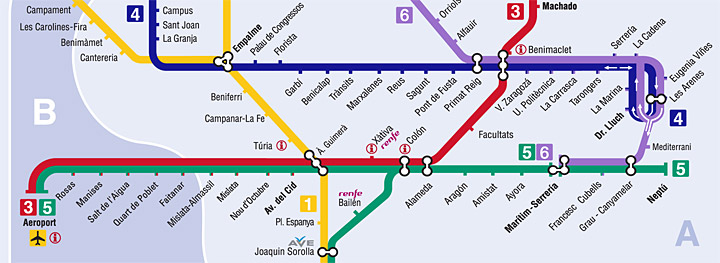
Valencia Airport (VLC) is a breeze to navigate. You can get into the city center in about 20 minutes on the Metro (Line 3 or 5).

Hotels in Valencia

Speaking of logistics, finding the right hotel is key to saving time. I always use Expedia to compare prices . I personally recommend staying near the Ruzafa neighborhood for its vibrant nightlife and cafe culture, or near the Ciutat Vella (Old Town) if you want to be within walking distance of history.

Valencia Metro Map: Navigate the city’s public transport easily while exploring its vibrant neighborhoods and attractions.

Friday: Ancient Hearts & Modern Arts

Afternoon: Touch Down & Dive into the Old Town

You’ve landed! First things first: getting into the city. The Valencia Metro is your best friend. A quick, easy, and affordable ride on Line 3 or 5 will get you from Manises Airport (VLC) to the city centre in about 20 minutes. Ditch the expensive taxi queue; your wallet will thank you.

Drop your bags at your hotel (I found a gorgeous little place in the El Carmen district on Expedia), and it’s time to hit the cobblestones.

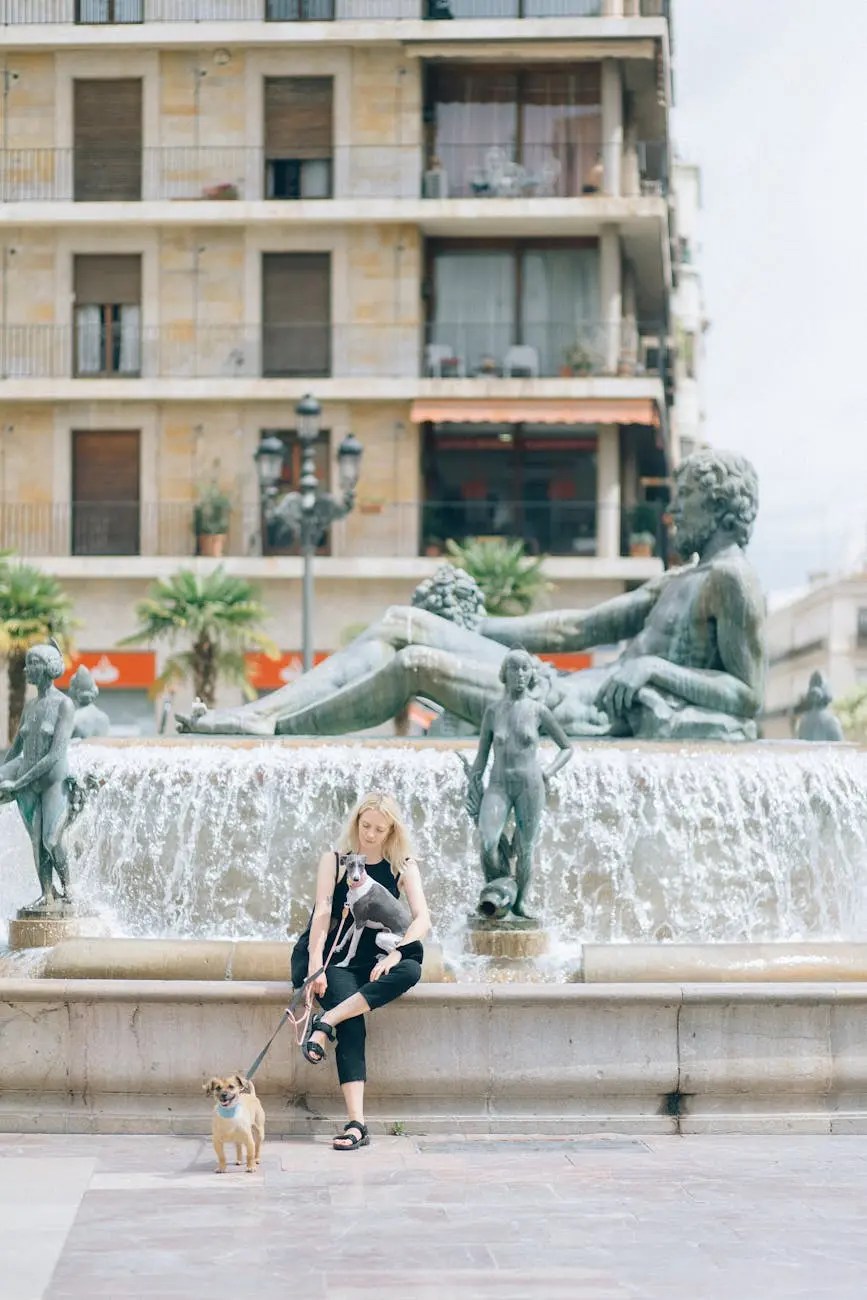
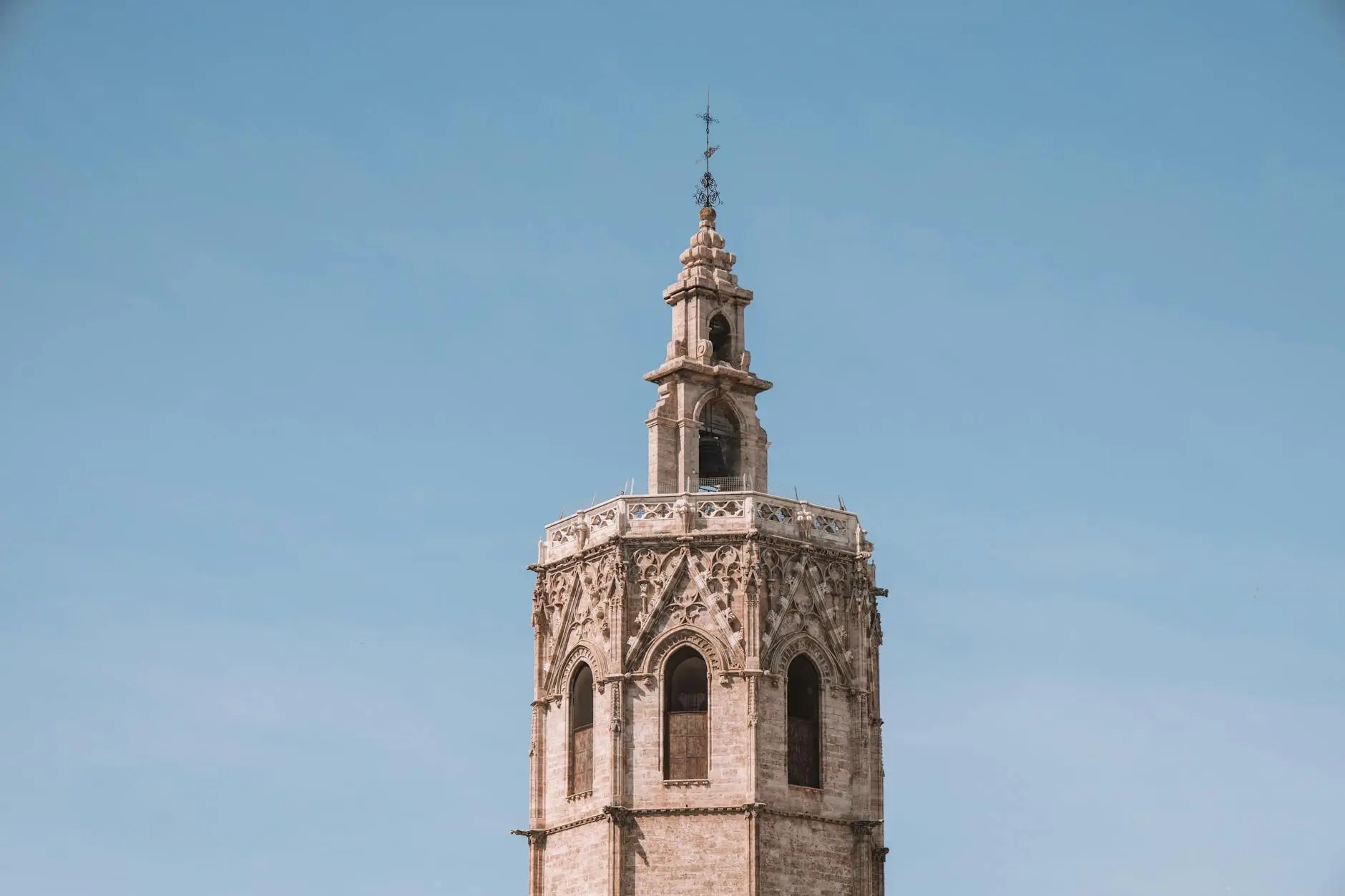
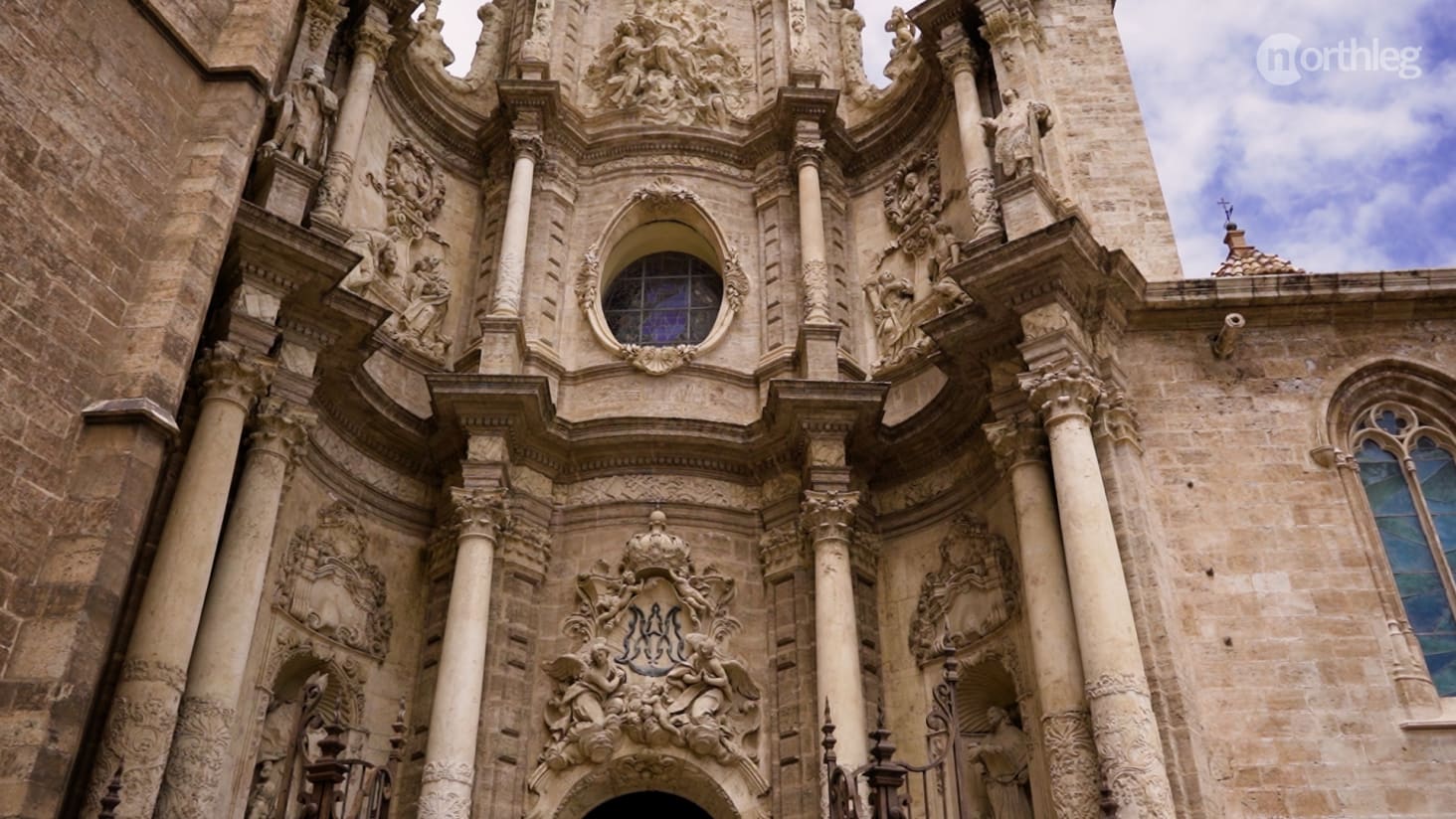
Your first stop? The Plaza de la Virgen. This square is the historic heartbeat of the city. Grab a bench, watch the world go by, and admire the stunning Valencia Cathedral. For a small fee, you can climb the Miguelete Bell Tower—the 207-step climb is a thigh-burner, but the 360-degree views of the terracotta rooftops are absolutely worth it. Inside the cathedral, legend claims you’ll find the Holy Chalice, said to be the true Holy Grail. Believe it or not, it’s a seriously cool thing to see.

Evening: Tapas & Tangles

As the sun sets, get lost. Seriously. The El Carmen neighborhood is a labyrinth of narrow medieval streets, vibrant street art, and hidden plazas. For dinner, skip the tourist traps on the main squares and duck into a smaller side street. My best meal was at a tiny, family-run bar where I pointed at what looked good in the display case. Order a clara (a shandy – beer with lemon soda) and a few raciones (sharing plates) of local cheese and jamón.

💎 Hidden Gem: Hunt for the Museo de las Rocas, a hidden courtyard where the giant, elaborate figures from the Fallas festival are stored. It’s free to peek through the gates and feels like discovering a secret.

A serene moment by a fountain in Valencia, featuring a woman with her dogs amidst stunning sculptures and architecture. Plaza de la Virgen “Finding a moment of pure Valencian peace. This is the true magic of Plaza de la Virgen: where the sound of the Turia Fountain mixes with the chatter from nearby cafés, and history isn’t just in the guidebooks—it’s all around you. The perfect spot to just be.”
The top of a historic stone tower against a clear blue sky.
A close-up of the iconic Miguelete Bell Tower, a historical landmark featuring intricate Gothic architecture against a clear blue sky. “Getting up close and personal with the Miguelete’s Gothic grandeur. From down here, you can really appreciate the centuries of craftsmanship in every stone. It’s a neck-craning, awe-inducing kind of beauty.”
Close-up view of the ornate facade of a historic church in Valencia, featuring intricate sculptures, columns, and a stained glass window.
Detailed architectural features of Valencia Cathedral, showcasing its intricate sculptures and historical significance.
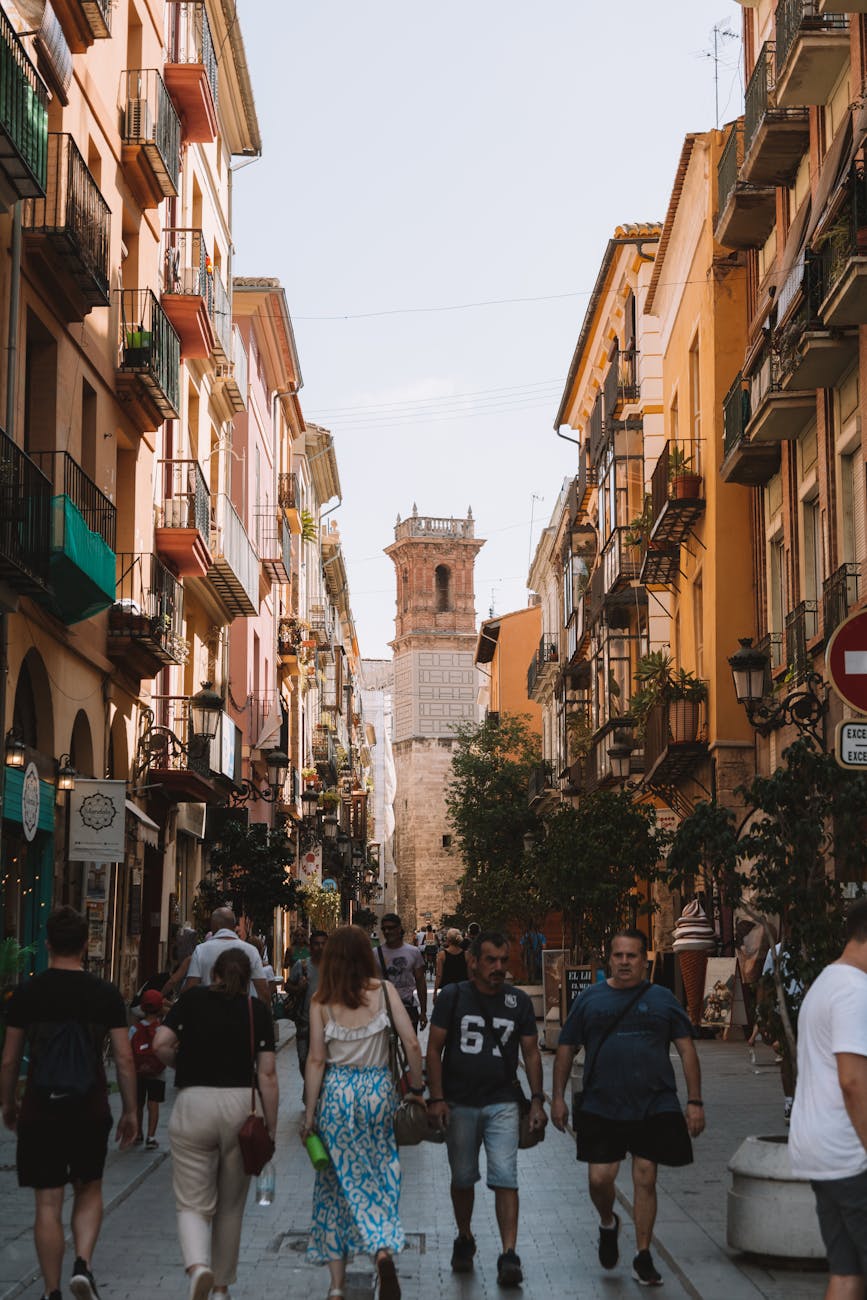
Narrow street in Valencia, Spain, lined with colorful buildings and balconies, featuring people walking and the Miguelete bell tower visible in the background.
Strolling through the charming streets of Valencia, where historic architecture meets vibrant city life.

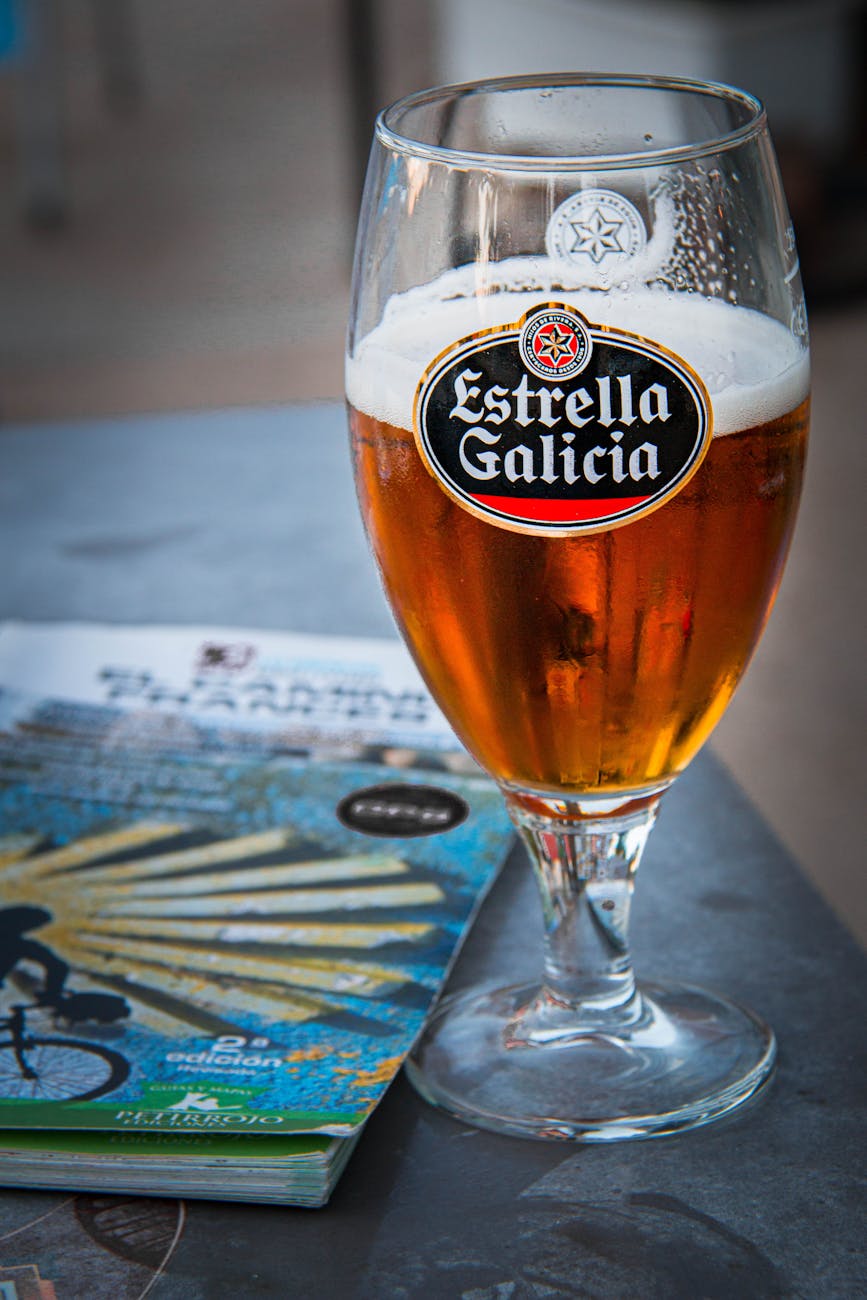
A glass of Estrella Galicia beer resting on a table with a colorful brochure in the background.
A refreshing glass of Estrella Galicia beer, perfect for savoring after exploring Valencia.

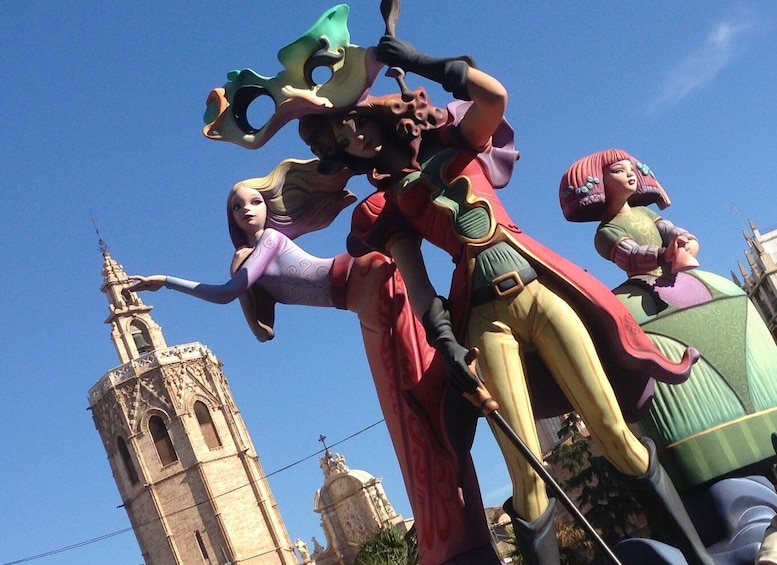
Colorful sculptures representing characters from Valencia's Fallas festival, with a historic tower in the background under a clear blue sky.
Colorful sculptures from the Las Fallas festival in Valencia, showcasing vibrant artistry against a clear blue sky.

“Continue your Mediterranean adventure with a weekend in Nice, France

Saturday: Silk, Science & The Holy Grail

Morning: Market Fresh & A Silk-Covered Past

Start your day at the Mercado Central, one of Europe’s largest and most beautiful fresh food markets. The building itself is an Art Nouveau masterpiece. The energy here is electric—fishmongers shouting, the smell of ripe produce, and locals doing their daily shopping. Grab a fresh-squeezed juice and a empanada for breakfast on the go.

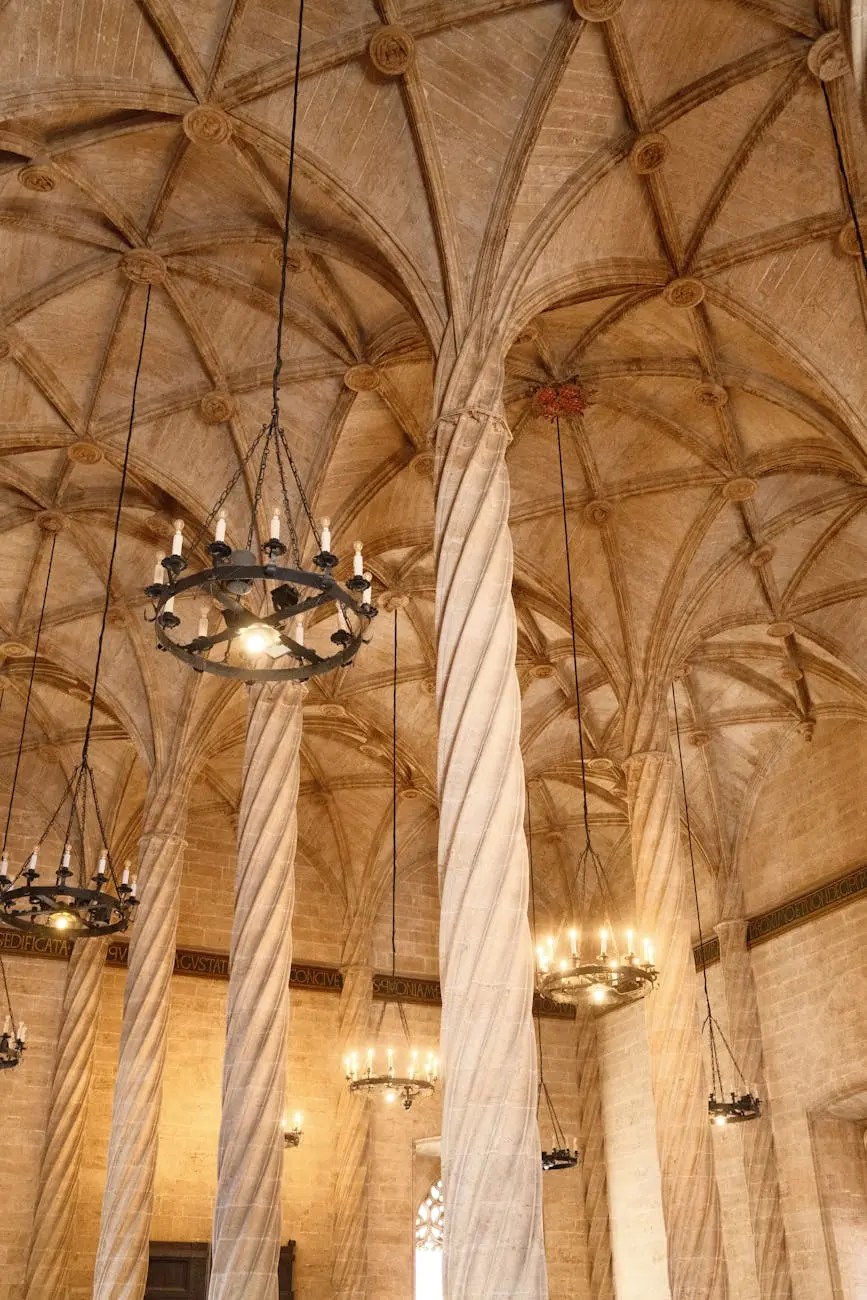
Just a stone’s throw away is the Lonja de la Seda (Silk Exchange). This UNESCO World Heritage site is a breathtaking example of late Gothic civil architecture. Standing in the grand Column Hall feels like stepping onto the set of a fantasy movie. It’s a quick visit but utterly unforgettable.

Afternoon: The Future is Now

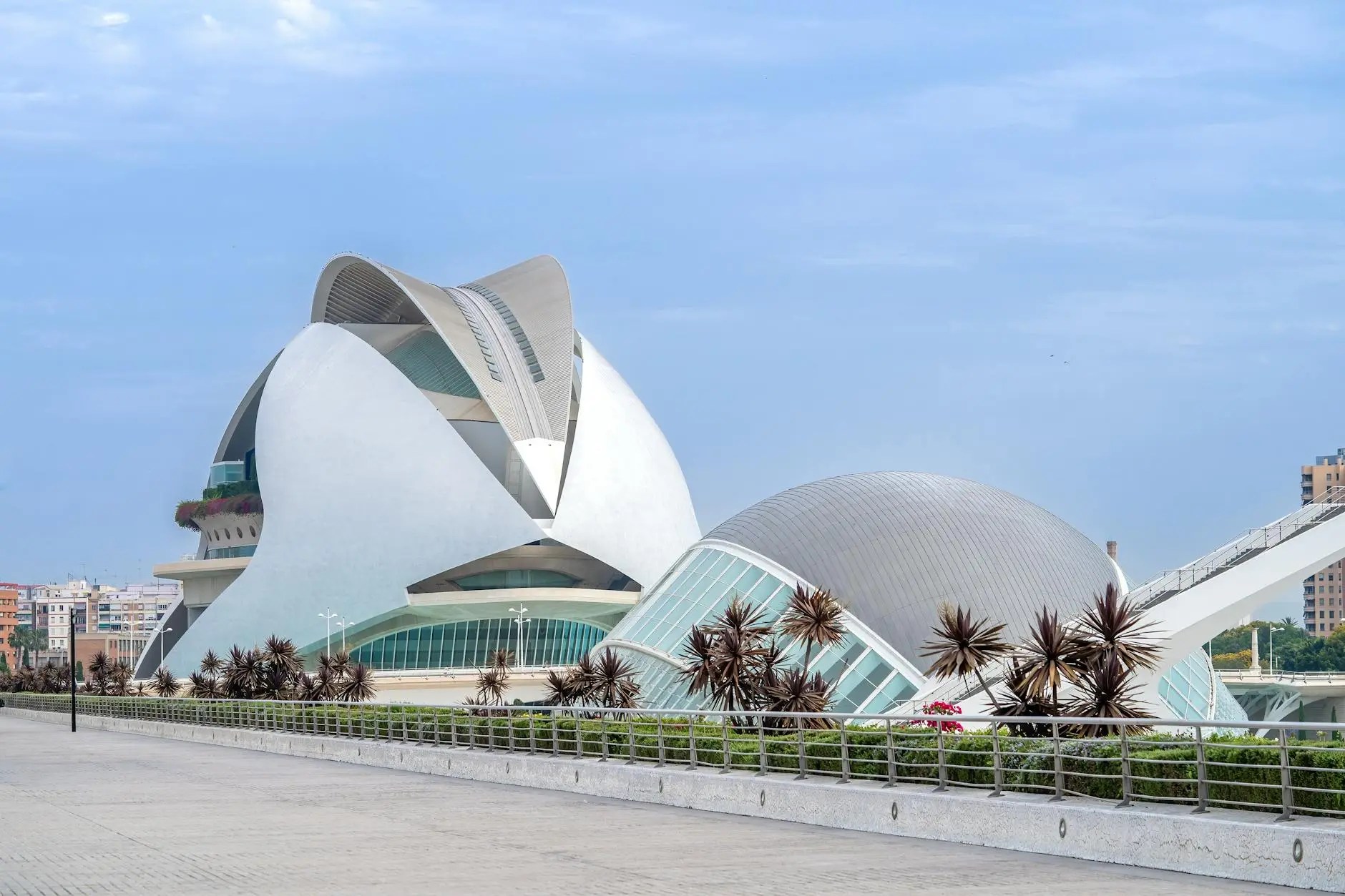
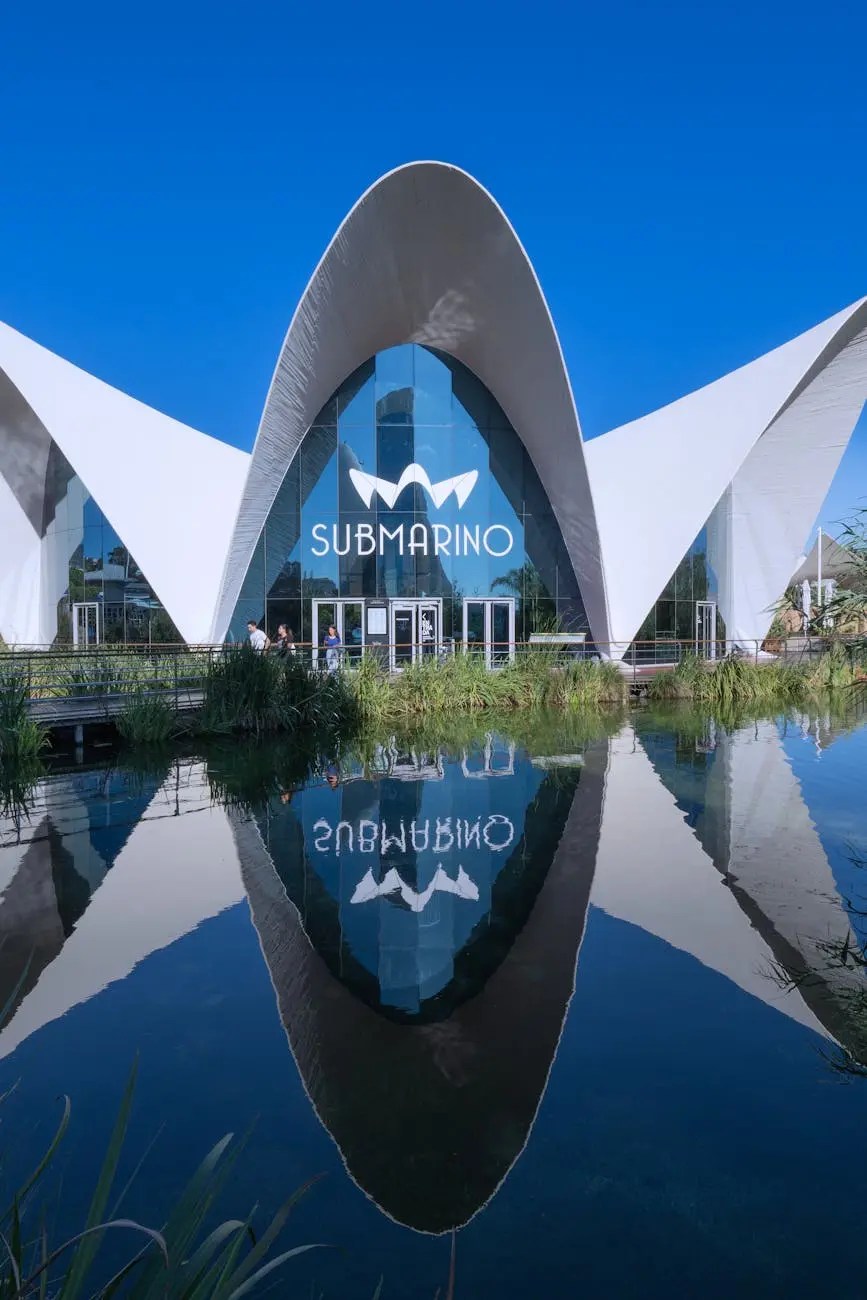
After soaking in the old world, take a pleasant 20-minute stroll or hop on a bus down to the Ciudad de las Artes y las Ciencias (City of Arts and Sciences). This place is mind-blowing. The sprawling, futuristic complex seems to have landed from another planet. You don’t need to buy tickets for every museum to appreciate it—just walking around the turquoise lagoons and under the soaring arches of the L’Oceanogràfic (Europe’s largest aquarium) is an experience in itself. It’s the perfect place to unleash your inner photographer.

📸 Pro Tip: The white, futuristic buildings against the blue Valencian sky are a dream to shoot. To get those crisp, vibrant shots without the crowds, I never leave home without my trusty Sony Alpha Camera. It’s a game-changer for travel photography.

Evening: The Paella Pilgrimage

You cannot, I repeat, cannot leave Valencia without eating authentic Paella Valenciana. A word to the wise: authentic paella is made with rabbit, chicken, and snails (though you can find seafood versions), and it’s a lunch dish. But for us weekend warriors, a Saturday dinner is our only shot.

For the real deal, you need to head to the Playa de la Malvarrosa or the Albufera Natural Park (the birthplace of rice). I took the bus to Malvarrosa and had an unforgettable dinner watching the sunset over the Mediterranean. It’s a pilgrimage every foodie must make.

“Looking for a cultural contrast? Cross the Mediterranean to Marrakech, the Red City.

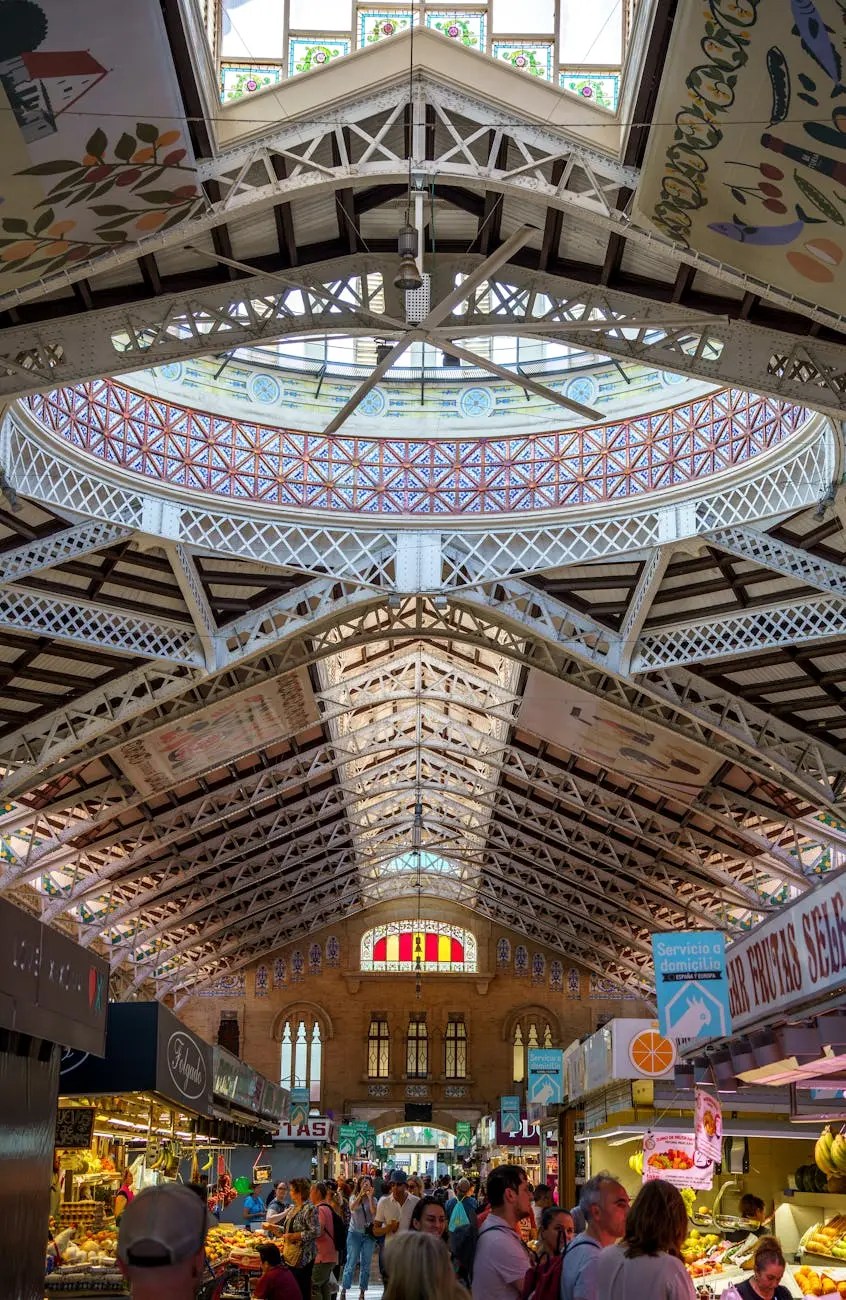
Interior view of the Mercado Central in Valencia, showcasing its beautiful Art Nouveau architecture and bustling atmosphere with shoppers browsing fresh produce.
The vibrant interior of Mercado Central, Valencia’s bustling market, showcasing a mix of fresh produce and local specialties. “A feast for the senses! Stepping inside the Mercado Central is like walking into a living, breathing, (and deliciously smelling) work of Art Nouveau art. The colors, the energy, the chatter of local shoppers—it’s the absolute heart of the city. I left with a bag of oranges and a huge smile.”
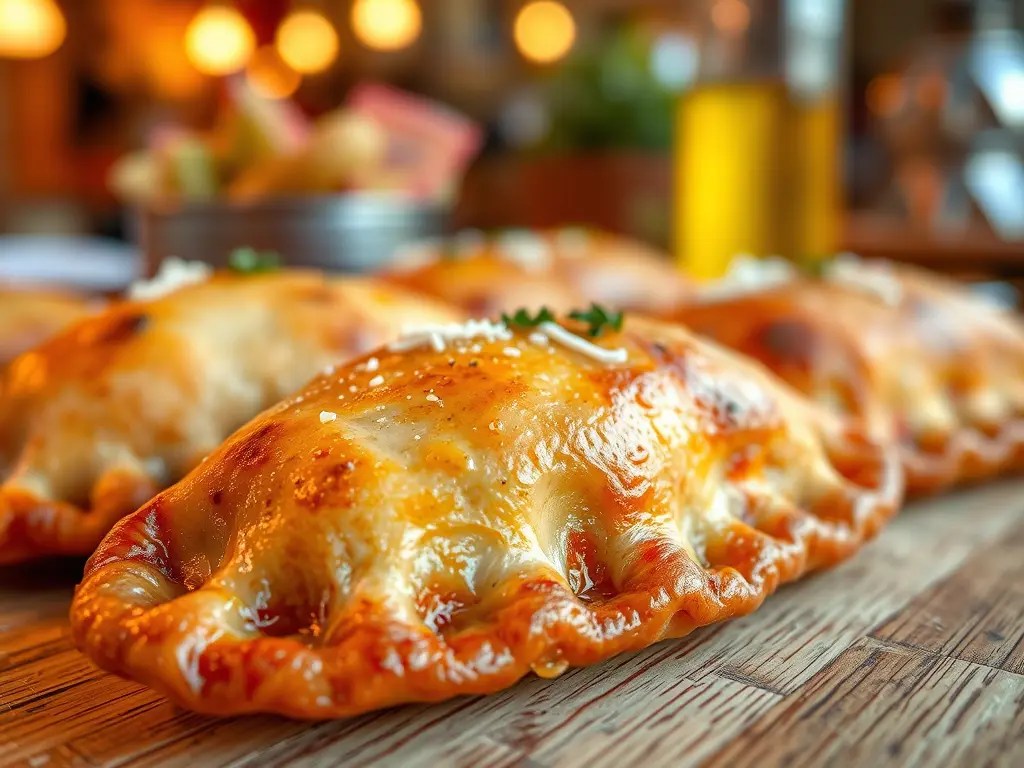
Golden-brown empanadas arranged on a wooden surface, with a hint of green garnish on top, illuminated by soft ambient lighting.
Delicious golden-brown empanadas served on a wooden platter, perfect for a snack or meal. “My favorite Spanish snack discovery! These golden-brown parcels of joy, filled with anything from spiced meat to creamy tuna, are the perfect on-the-go fuel for exploring. I may have eaten one (or three) every single day.”
Interior view of a grand Gothic-style hall featuring intricately designed vaulted ceilings and decorative chandeliers.
Interior of the Valencia Cathedral featuring intricate vaulted ceilings and elegant chandeliers. “Standing in the main trading hall of the Silk Exchange feels like stepping into a stone forest. Those spiraling columns are a masterpiece of 15th-century Gothic flair—proof that even a place of business was once a work of art. No wonder it’s a UNESCO World Heritage site.”

Futuristic architectural design of the City of Arts and Sciences in Valencia, Spain, featuring unique curves and shapes against a clear blue sky.
The striking architecture of Valencia’s City of Arts and Sciences, showcasing futuristic design against a serene sky. “First glimpse of the City of Arts and Sciences and my jaw actually dropped. It doesn’t feel real—it’s like a movie set from the future has landed in the middle of a dried-up riverbed. The scale of this place is just mind-bending.”
The futuristic exterior of the Submarino building at the City of Arts and Sciences in Valencia, Spain, reflecting in the tranquil water below.
The futuristic ‘Submarino’ building at the City of Arts and Sciences in Valencia, showcasing stunning architecture and its reflection in the surrounding waters. “Dinner with a view! Eating at the Submarino Restaurant feels like you’ve stumbled into a secret chamber at the bottom of the sea. Watching sharks glide past while you sip wine is an experience I’ll never forget. It’s as close to being in a Jacques Cousteau documentary as you can get while eating patatas bravas.”
A close-up of a traditional seafood paella dish, featuring yellow rice topped with various seafood, cherry tomatoes, green beans, and lemon slices.
A vibrant plate of authentic Valencian paella, featuring chicken, seafood, and fresh vegetables, perfect for a culinary adventure in Valencia. “The holy grail of Spanish cuisine, found! This isn’t just rice with stuff in it—this is a proper Valencian paella, with socarrat (that delicious crispy bottom layer), saffron-infused Bomba rice, and the perfect mix of land and sea. My taste buds are still celebrating.”
A scenic view of Valencia's Malvarrosa Beach, featuring golden sand, gentle waves lapping at the shore, and a clear blue sky above.
Breathtaking view of Valencia’s sandy beach and azure waters, perfect for a weekend getaway. “That moment you realize Valencia has it all: futuristic architecture, ancient history, AND miles of gorgeous beach. This aerial view of Malvarrosa Beach is my happy place. The perfect spot to unwind after a morning of exploring, paella optional (but highly recommended).”

A scenic pathway adorned with palm trees under a stunning archway in Valencia’s City of Arts and Sciences.

“For another sunlit escape with a North African twist, check out Casablanca.

Sunday: Sands, Siestas & Sad Goodbyes

Morning: Bike Rides & Green Serenity

Valencia is blessedly flat, making it a perfect city for cycling. The Turia Gardens, a stunning 9km-long park, was created by diverting the Turia River. It winds through the city, and you can rent a bike for a few euros to cycle all the way from the City of Arts and Sciences to the Bioparc zoo. It’s the most delightful way to spend a Sunday morning, surrounded by locals jogging, playing football, and walking their dogs.

Afternoon: One Last Look & A Necessary Siesta

Grab a final café con leche in the Plaza de la Reina, do some last-minute souvenir shopping for some classic horchata powder, or simply find a sunny patio and just be. Remember, many smaller shops close on Sundays, and the Spanish siesta is a very real (and wonderful) tradition. Embrace the quiet.

A historic fountain in Valencia featuring a seated figure surrounded by playful sculptures, with pigeons perched atop.

A close-up view of the iconic futuristic structure at the City of Arts and Sciences in Valencia, Spain, showcasing its distinct white geometric framework against a bright blue sky.
The futuristic architecture of the Ciudad de las Artes y las Ciencias in Valencia, showcasing its innovative design. “Who knew Europe’s largest aquarium had a secret jungle? Stepping into the Oceanogràfic’s aviary was a complete surprise – a lush, humid wetland where flamingos preen and tropical birds call from the canopy. It’s a whole other world tucked inside a marine paradise.”
View of ornate architectural details from below, showcasing intricately carved columns and sculptures against a clear blue sky.
A stunning view of the intricately designed architectural features from the base, showcasing Valencia’s historical artistry.

Valencia Travel Toolkit: Your Logistics Lifesaver

Getting Around:

  • Metro & Bus: The EMT Valencia app is fantastic for real-time bus info. Consider a Hola Valencia Travel Card for unlimited travel if you plan on lots of trips.
  • Biking: The Valenbisi public bike system is cheap and efficient for short trips.
  • Walking: The city centre is incredibly walkable. Ditch the map and get delightfully lost.

Money-Saving Tips:

  • Many museums offer free entry on Sundays. Check their websites!
  • Eat the Menu del Día (Menu of the Day) for lunch—it’s a fixed-price, three-course meal that’s a fraction of the dinner cost.
  • Fill your water bottle at public fountains; the tap water is perfectly safe to drink.
Pass/TicketCost (Approx.)Where to BuyBest ForMoney-Saving Tip
Single Bus Ticket (EMT)€1.50On the Bus (Exact Change)One-off ridesThe most expensive option, avoid if possible.
SUMA 10 Pass€8.00 (plus €1 for card)Metro Stations, Tabac ShopsFrequent use over 1-2 daysBest value! Valid for 10 trips on Metro, Bus, and MetroBus, allowing one free transfer.
Valencia Tourist Card (VTC)From €15 (24h) – €25 (72h)Tourist Offices, OnlineSightseeing + Airport TransportGreat for first-timers: Includes unlimited transport (including airport) PLUS discounts/free entry to museums.

Of course! Here is a comprehensive and engaging section about the Valencia Tourist Card, written in a human, informative, and helpful tone, perfect for your blog post.


Is the Valencia Tourist Card Your Golden Ticket to Savings?

Alright, let’s talk logistics and money—because who doesn’t love saving a few euros for more sangria? On my last trip, I decided to finally put the Valencia Tourist Card to the test. Was it worth it, or just another tourist trap? Here’s the honest scoop.

What is the Valencia Tourist Card?

In a nutshell, it’s your all-in-one pass to unlock the city. Think of it as a backstage pass that gets you into the main attractions, onto public transport, and even scores you discounts at restaurants. You can buy it for 24, 48, or 72 hours, and it activates the first time you use it on transport or enter an attraction.

The Perks: Why It Might Be Your Best Travel Buddy

After using it for 48 hours, here’s what I found to be the biggest benefits:

  1. Free Public Transport: This is the game-changer. The card covers unlimited travel on buses, metro, and trams within Zone A. That includes your ride from the airport (a huge saving right there) and all your zipping around between the Old Town, the beach, and the City of Arts and Sciences. No fumbling for change, no worrying about ticket types. Just tap and go.
  2. Free Entry to Municipal Museums & Monuments: This is where you really start saving. Your card gets you straight into:
    • The Valencia Cathedral (including the climb up the Miguelete Tower – that view is priceless, but the entry fee isn’t!).
    • The Lonja de la Seda (the stunning Silk Exchange).
    • The Museo de la Ciudad (City Museum).
    • The Museo de Bellas Artes (Fine Arts Museum).
    • And several others.
  3. Discounted Entry to Major Attractions: While it doesn’t grant free entry to the massive City of Arts and Sciences, it does give you a hefty up to 20% discount on tickets for L’Oceanogràfic, the Science Museum, and L’Hemisfèric. This discount alone often covers the cost of the card if you plan to visit one or two of them.
  4. Handy Discounts on Tours, Shops, and Restaurants: This is the cherry on top. I used my card for:
    • A discount on a bike tour through the Turia Gardens.
    • A percentage off my final bill at a couple of partnered restaurants.
    • A deal at a few souvenir shops.

It even includes a free 24-hour bike rental, which is perfect for exploring the park.

The Reality Check: When Might You Skip It?

The card isn’t a one-size-fits-all miracle. You might skip it if:

  • You’re a “wander and soak it up” traveler who prefers just seeing the city from the outside and people-watching in plazas.
  • You’re on an extremely tight budget and only plan to see the free attractions (like the Mercado Central and wandering the streets).
  • You’re only in town for a single day and your itinerary is very light.

The Verdict: Is It Worth It?

For most visitors on a weekend trip, the answer is a resounding YES.

Do the math: A single metro ticket from the airport is almost €4. Entry to the Cathedral and Miguelete Tower is around €9. The Lonja de la Seda is another €2. Suddenly, before you’ve even had your first coffee, you’re at €15. A 48-hour card costs around €35 and immediately covers all that, plus gives you unlimited transport and discounts on the big-ticket items.

For me, the sheer convenience of bypassing ticket lines and hopping on any bus without a second thought was worth its weight in gold. It encourages you to pop into museums you might otherwise skip and removes the friction from exploring.

💡 Smart Traveler Tip: Plan your itinerary before you buy! Map out the attractions you definitely want to see, add up the individual costs, and compare it to the price of the card. You’ll know in five minutes if it’s the right choice for your adventure.

You can purchase the card online in advance or at official tourist offices in the city. I bought mine online and picked it up at the airport—it was the first smart decision of my trip!

Ready to unlock Valencia? Check current prices and buy your Valencia Tourist Card here.

Language & Local Lingo: Key Phrases to Know

While most people in the tourism industry speak English, using a little Spanish (or even Valencian!) goes a long way.

Phrase (Spanish)MeaningWhen to Use It
Una caña, por favor.A small beer, please.At any bar or restaurant.
La cuenta, por favor.The bill, please.After your meal (don’t expect it to be rushed to you!).
Bon profit! (Valencian)Enjoy your meal!A nice way to thank staff or wish well to other diners.
¿Dónde está el baño?Where is the bathroom?Essential, everywhere!
¿Me puede ayudar?Can you help me?When asking directions or assistance.
HorchataA sweet, milky drink made from tigernuts.Order it with fartons (long pastries) at any horchatería!

Travel Smarter, Not Harder:

Let’s talk about the not-so-glamorous side of travel. On my last trip, my flight was delayed by 6 hours. I would have just grumbled and accepted it, but I remembered that under EU air passenger rights, I was likely owed compensation. I filed a claim with AirHelp, and they handled all the annoying paperwork with the airline. A few weeks later, I had €250 in my account. It’s a no-brainer.

✈️ Flight Hassle? If your flight is delayed, canceled, or overbooked, you could be entitled to up to $650 in compensation. Don’t leave money on the table—let the experts at AirHelp check your flight for free. Check Your Flight Now & See If You Qualify.

And while we’re on the subject of smart travel, staying connected is non-negotiable for navigating and sharing those Insta-worthy shots. I used to waste so much time and money at airport SIM counters. Now, I just pop in my Drimsim—a universal data SIM that works in over 190 countries. You top it up via the app, and you’re online the moment you land. No more hunting for a shop or scary roaming bills.

🌐 Stay Connected Anywhere: Get a Drimsim and say goodbye to connectivity headaches. It’s my number one travel hack. Grab Your Universal Travel SIM Here.

Finally, for booking everything from flights to that perfect hotel in El Carmen, I always start my search on Expedia. It’s my one-stop shop for comparing prices and bundling deals.

🏡 Find Your Perfect Valencia Base: Ready to wander those cobblestone streets? Start planning your stay by finding the best deals on ExpediaSearch for Valencia Hotels Here.

🗺️ Closest Cities to Valencia (Spain) — Best short trips

These cities are in Spain or neighboring countries (ideal for linking to your Valencia post):

🇪🇸 Within Spain

  1. SevilleUltimate Weekend Guide to Seville, Spain
  2. MadridUltimate Weekend in Madrid
  3. Barcelona48 Hours in Barcelona

Valencia FAQ: Your Questions, Answered

Q: Is two days enough for Valencia?
A: Absolutely! While you could easily fill a week, a weekend is perfect for hitting the major highlights—the Old Town, the Central Market, and the City of Arts and Sciences. It’s a fantastic sampler that will leave you wanting more.

Q: What is the best way to get from the airport to the city centre?
A: The Metro (Line 3 or 5) is the most efficient and cost-effective way. A single ticket to the city centre (like Xàtiva station) is just a few euros.

Q: When is the best time to visit Valencia?
A: Spring (April-June) and Fall (September-October) are ideal. The weather is perfect for exploring—warm but not scorching. Summer is hot and crowded, but the beach is a great respite.

Q: Do I need a visa for Spain?
A: For most EU, US, and Canadian citizens, you do not need a visa for short tourist visits (up to 90 days). Always check the latest requirements with the Spanish consulate in your home country before you travel, as rules can change.

Q: Is Valencia a walkable city?
A: Incredibly so! The main tourist areas are compact and flat. Walking is the best way to discover hidden plazas and charming alleyways you’d miss otherwise.

Q: What should I pack?
A: Comfortable walking shoes are non-negotiable! Pack light, breathable clothing for the day, a sweater for cooler evenings, and of course, sunscreen and a hat. And to keep that travel glow, I never travel without my trusted K-beauty essentials from Lakinza. Their products are a lifesaver for my skin after a long flight.

✨ Look and Feel Beautiful: Keep your skin hydrated and glowing on the go with the magic of K-beauty from Lakinza. Use my code Lalax10 at checkout for a sweet discount! Explore Lakinza’s Skincare Collection.

Inspired to explore more of Spain? Check out my other guides for your next adventure:

“If you’re craving mountain views after the Mediterranean, plan a trip to Zurich, Switzerland.

Ready to Book? A Final Call to Adventure!

Valencia is waiting to surprise you. It’s a city that manages to be historic, futuristic, and perfectly delicious all at once. Whether you’re cycling through the Turia Gardens or savoring the world’s best paella, this Spanish escape will leave you feeling refreshed and inspired.

Start planning your next adventure today! Head over to my Blog Masterlist for more travel tips and geographically close destinations to keep your momentum going: [Master List Link: https://confidencebuildings.com/travel-master-list/]

Universal Disclaimer/Disclosure Page:

Kraków: Your Ultimate Weekend City Break Guide

Meta Description: Craving an unforgettable European city break? Discover the perfect itinerary for a weekend escape to Kraków, Poland. From the historic Old Town to delicious Polish cuisine, get local tips on transport, hidden gems, and how to save money. Optimize your Kraków travel with this essential guide! Keywords: Kraków, Poland, Weekend Escape, Travel, City Break, Europe, Kraków travel tips, GEO-optimized

Ah, Kraków. Just saying the name feels like unlocking a secret. Forget everything you think you know about Eastern Europe; this city is the continent’s beating heart of culture, resilience, and frankly, some of the best food I’ve ever eaten. I spent three days there last autumn, and I’m still dreaming about the smoked cheese.

Planning a weekend in Kraków is a brilliant idea. It’s compact, walkable, and packs a millennium of history into a stunningly beautiful package. So, grab your favourite travel notebook (and maybe a snack, because this will make you hungry), and let’s plan your perfect weekend escape.

Table of Contents

  1. Why Kraków Should Be Your Next Stop
  2. The Perfect 48-Hour Itinerary
  3. Kraków’s Hidden Gems (My Personal Faves)
  4. Logistics & Smart Travel: Saving Time and Złoty
    • Getting Around: Public Transportation & Road Tips
    • The Best Time to Visit
    • Money-Saving Magic
  5. Essential Polish Words for Travellers
  6. Need More Adventure? (Backlinks & Next Steps)
  7. Frequently Asked Questions (FAQ)

Why Kraków Should Be Your Next Weekend Getaway

Before we dive into the itinerary, let me set the scene. Kraków is the cultural capital of Poland, and it feels like it. Unlike some cities bombed to rubble in the war, Kraków’s historic centre remained miraculously intact. The result? A UNESCO World Heritage site that feels like a living, breathing museum, but with way better coffee and a thriving student energy.

It’s also incredibly affordable. Your money goes a long way here, meaning you can afford that extra glass of craft mead or a fancy dinner without wincing at the bill. For more on why Poland is a top European destination, check out my broader guide in my Travel Masterlist. or

🌍 Cities Near Kraków, Poland (Perfect for next trip)

🇨🇿 Prague, Czech Republic

🗺 Distance: ~540 km / 6 hours by car or 7 hours by train.
🚆 Great weekend route! Kraków–Prague is one of the most popular Central European itineraries.
👉 48-Hour Prague Itinerary: Essential Travel Guide

🇦🇹 Vienna, Austria

🗺 Distance: ~450 km / 5 hours by car or 7 hours by train (direct route via ÖBB Railjet).
🎶 Elegant architecture, classical vibes—pairs perfectly with Kraków’s old-world charm.
👉 Vienna in a Weekend: Your Ultimate Guide to Imperial Splendor & Coffee & Cake

🇭🇺 Budapest, Hungary

🗺 Distance: ~400 km / 5.5 hours by car or train.
♨️ Another Central European gem—historic baths, Danube views, and vibrant nightlife.
👉 Ultimate Budapest Weekend Getaway: Your Insider Guide

🇩🇪 Berlin, Germany

🗺 Distance: ~600 km / 7 hours by train or 1.5-hour flight.
🎨 A cultural mix of history and modern cool—a natural link from Kraków for European explorers.
👉 Unforgettable Weekend in Berlin: Your Ultimate Guide

🧭 Bonus Nearby Cities (Short Flight or Train)

Flights to Kraków Poland

Your Action-Packed Kraków Itinerary

Day 1: Royal Roots & Dragon Legends (The Old Town)

  • Morning: Start where the city began: the magnificent Rynek Główny (Main Market Square). It’s the largest medieval town square in Europe, and the first time you walk into it, your jaw will drop. Don’t just snap a photo of the Cloth Hall (Sukiennice) and run—go inside! It’s a bustling market hall where you can pick up beautiful amber jewellery and souvenirs. Pro tip: The best time to see the square is early morning, before the crowds descend. It’s just you, the pigeons, and the hauntingly beautiful Hejnał mariacki (the trumpet call) from St. Mary’s Basilica.
  • Afternoon: Get cultured! Choose between the opulent Wawel Royal Castle, the historic seat of Polish kings, or go underground at Rynek Underground, a fantastic museum beneath the main square that reveals the square’s medieval history. You can’t do both justice in one afternoon, so pick your passion. I chose the castle and have zero regrets, especially after finding the dragon’s den
  • Evening: Follow the path down from Wawel Castle to the banks of the Vistula River to meet the city’s mascot: the Wawel Dragon. This fire-breathing statue pays homage to a local legend, and it’s a fun, quick photo op. For dinner, wander into the Jewish Quarter, Kazimierz. I stumbled upon a tiny, family-run pierogi place (I wish I wrote down the name!) and had the most incredible plate of pierogi ruskie (potato and cheese). .
A view of St. Mary's Basilica in Kraków, Poland, with its two distinct towers and historic architecture, surrounded by a bustling market square filled with people.
The iconic St. Mary’s Basilica in Kraków, Poland, showcasing its stunning Gothic architecture and vibrant market square surroundings. The iconic twin towers of St. Mary’s Basilica dominate the skyline of Kraków’s Main Square (Rynek Główny). Listen for the hourly Hejnał mariacki trumpet call from the taller tower!
A vibrant view of colorful flowers in the foreground with the historic architecture of Wawel Castle in Kraków, Poland, under a clear blue sky.
Stunning view of Wawel Castle in Kraków, Poland, surrounded by vibrant flowers under a clear blue sky. The majestic Wawel Castle, the historic seat of Polish kings, is beautifully framed by a burst of summer flowers. This view from the grounds is a local favourite for a reason!
A large metal sculpture of a distorted human head placed on a stone pedestal, located in a public square. The background features historic buildings and a crowd of people walking by.
An iconic sculpture of a large head installed in the historic Main Market Square of Kraków, Poland, showcasing the city’s blend of contemporary art and rich history. Igor Mitoraj’s “Eros Bendato” (Bound Eros). A contemporary bronze giant, deliberately fractured and weathered, inviting quiet contemplation amidst the bustling energy of Europe’s oldest medieval market square.

A large, colorful dragon puppet being wheeled through a busy street filled with spectators during a celebration in Kraków.
The Wawel Dragon parade in Kraków, showcasing a vibrant, colorful dragon float, celebrated during local festivities. The legendary Wawel Dragon comes to life! This fantastic puppet is the star of the show during Kraków’s summer parades, bringing the city’s most famous myth to the streets.

A wooden platter featuring several dumplings, known as pierogi, garnished with herbs and served with a small bowl of sour cream.
Delicious pierogi ruskie served with sour cream, a must-try in Kraków. The ultimate Polish comfort food: pierogi ruskie. These delicate dumplings are stuffed with a savory mix of potato and farmer’s cheese, then topped with crispy onions and a generous dollop of cool sour cream. Trust me, you’ll want to order a second plate.

Day 2: History & Heart in Kazimierz

  • Morning: Dedicate your morning to exploring Kazimierz, the historic Jewish Quarter. This area is profoundly moving and has undergone an incredible revival. It’s not just about history; it’s about vibrant street art, chic boutiques, and the best cafes in the city. Visit the Old Synagogue and walk through the peaceful Remuh Cemetery to pay your respects.
  • Afternoon: This is the time for a more profound historical experience. A trip to Oskar Schindler’s Enamel Factory is a powerful and essential visit. It’s not just a museum about the man from the movie; it’s a deeply immersive experience about Kraków during Nazi occupation. Book your tickets online in advance to avoid the queues—this is one of my top time-saving tips!
  • Evening: Kazimierz comes alive at night. The Plac Nowy square is the place to be. Grab a zapiekanka, a legendary Polish pizza-bagette, from one of the stalls in the round building. It’s the perfect cheap, delicious, and filling dinner. Afterwards, find a quirky bar for a craft beer or a Polish vodka tasting.
A woman exploring an exhibit in a historical museum showcasing vintage clothing and photographs in Kraków's Jewish Quarter, Kazimierz.
Explore the rich history of Kazimierz, the historic Jewish Quarter of Kraków, where past and present blend beautifully.

A close-up of a Polish zapiekanka, featuring a toasted baguette topped with melted cheese, mushrooms, and fresh herbs, set against a bustling street scene.
A delicious zapiekanka topped with mushrooms and cheese, a must-try Polish street food, perfect for your Kraków adventure. The legendary zapiekanka – Poland’s answer to pizza on a baguette! This iconic street food, piled high with mushrooms and cheese, is the perfect fuel for exploring Kraków’s Kazimierz district.

Hidden Gems: Beyond the Main Square

Want to escape the tourist trail? Here are a few spots I adored:

  • Krakus Mound: For the best panoramic view of the city, hike up this prehistoric mound. It’s a bit of a walk from the centre, but watching the sunset from here with a few locals is pure magic.
  • Vistula River Boulevards: Rent a bike or just take a long, leisurely stroll along the river. It offers a completely different perspective of Wawel Castle and is a favourite local spot for a weekend relax.
  • St. Francis’ Basilica: While everyone queues for St. Mary’s, pop into this church. It’s home to stunning Art Nouveau paintings and is a serene oasis.
Lush green mound with visitors atop, surrounded by a grassy landscape under a cloudy sky.
A view of Krakus Mound, a prehistoric mound offering panoramic views of Kraków, surrounded by lush greenery.

A scenic view of the Vistula River in Kraków, featuring a boat gliding along the water and a hot air balloon floatinThe best views of Kraków are from the water! Enjoy a unique perspective of the city’s skyline, where a modern hot air balloon shares the sky with the historic spires of Wawel Castle.g in the sky.
Interior view of a beautifully decorated church, showcasing a blue ceiling adorned with golden stars and intricate artwork.
The stunning interior of St. Mary’s Basilica in Kraków, showcasing intricate ceiling designs and colorful stained glass windows. Prepare to have your breath taken away. This is the famous Veit Stoss Altarpiece, a 12-meter tall, polychrome oak masterpiece that is the crowning glory of St. Mary’s Basilica’s breathtaking interior.

Getting Around Kraków Like a Pro

This is where you save time, money, and sanity.

  • On Foot: The Old Town and Kazimierz are incredibly walkable. Your own two feet are the best transport.
  • Kraków is highly walkable, but for trips out to Podgórze or Kazimierz, the public transport system is excellent, reliable, and cheap.
  • Public Transport: Kraków has an excellent and cheap network of trams and buses. Download the Jakdojade app. Seriously, do it now. You can plan your route, buy tickets on your phone, and it’s all in English. A 20-minute ticket is about 4 PLN (£0.80/$1), and you must validate it on board.
  • Tickets: You can buy tickets from machines at most major stops, or directly on newer trams/buses using a contactless card. You need to buy a ticket based on time (e.g., 20-minute, 60-minute, or 24-hour). For a quick weekend, a 48-hour pass is the most stress-free option. Always validate your ticket immediately upon boarding!
  • By Car: Don’t drive in the city centre. It’s a maze of pedestrian zones and restricted access. If you’re flying in, use the train from the airport to the main station (a 20-minute ride) or an Uber/Bolt, which are very affordable. For road-tripping around Poland later

Kraków on a Budget: Money-Saving Tips

  • Eat at Milk Bars (Bar Mleczny): These are communist-era canteens that serve hearty, traditional Polish food for a fraction of restaurant prices. It’s a true local experience.
  • Free Walking Tours: Tip-based walking tours are a fantastic way to get your bearings and learn the history. Just remember to tip your guide well!
  • Museum Sundays: Many state-run museums, including Wawel Castle, offer free entry on Sundays. Plan accordingly, but expect crowds.
  • Accommodation: Check out local apartment rentals (like those found on Expedia) outside the immediate Old Town walls. Kazimierz offers excellent hostels and boutique hotels that are slightly cheaper and closer to better food spots.

Speak Like a Local: A Few Key Phrases

  • Dzień dobry (Jeyn DOH-brih) – Good day
  • Dziękuję (Jen-KOO-yeh) – Thank you (say this a lot, it goes a long way!)
  • Na zdrowie (Nah ZDROH-vyeh) – Cheers! (and “to your health”)
  • Przepraszam (Psheh-PRAH-shahm) – Excuse me / I’m sorry
  • Poproszę piwo (Pop-ROH-sheh PEE-vo) – I’ll have a beer, please.

Smart Travel Add-Ons For Your Trip

✈️ Travel Tip: Staying connected abroad used to be my nightmare. I’d either pay a fortune for roaming or spend my first hour hunting for a local SIM. Not anymore. I now travel with a Drimsim—a universal data SIM that works in 190+ countries. You just pop it in, top up via the app, and you’re online. No contracts, no hidden fees. It’s a game-changer. → Grab your Drimsim here.

✈️ Flight Woes? Travel isn’t always smooth sailing. If your flight is delayed or canceled, you might be entitled to compensation. Most people don’t know their rights or can’t be bothered with the paperwork. I use AirHelp to fight the airlines for me. They only get paid if I win. It’s a stress-free way to potentially get up to $650 back. → Check your flight with AirHelp here.

🛡️ Peace of Mind: No matter how well you plan, things can go wrong. I never travel without solid travel insurance. I use VisitorsCoverage to compare plans and find the right coverage for my trip quickly and easily. It’s the one thing you pack hoping you’ll never need. → Find your perfect travel insurance here.

Also, to keep all your personal and financial info safe while using public Wi-Fi in those cute Kraków cafes, I never travel without a VPN. Protect your data (and unlock better streaming!) with my recommended VPN link.

✨ CTA: Look Amazing While Travelling!

After all that sightseeing, you deserve to look as refreshed as you feel. Want that glowy, did-she-just-come-from-a-spa look? Time to embrace K-beauty magic!

Lakinza is my go-to for all things skincare. Use Code Lalax10 for a Sweet Discount Because glowy skin should never break the bank. When you buy from Lakinza, use coupon code: Lalax10 at checkout to save a little extra for your next skincare haul. Trust me, you’ll want more. Shop the magic at Lakinza.

Need More Adventure?

Kraków is fantastic, but Central Europe is a wealth of history and fun. Since you’re already in this corner of the world, why not turn that weekend escape into a longer trip?

Given the ease of travel (train or bus!) and minimal visa hurdles, I highly recommend checking out some other jewels in the region:

Ready to book your flights and accommodation for any of these cities? I always use Expedia to compare deals and lock in the best prices.

Kraków Weekend Escape FAQ

Q: Do I need a visa for Kraków, Poland?
A: For EU, US, Canadian, and Australian citizens, you do not need a visa for short stays (up to 90 days). Always check the latest requirements with the Polish embassy or consult my visa resources masterlist for the most up-to-date info.

Q: What is the best time of year to visit Kraków?
A: Spring (May-June) and Autumn (September-October) are perfect. The weather is mild, and the crowds are thinner. Summer is busy but vibrant. Winter is cold but magical with Christmas markets.

Q: Is Kraków a walkable city?
A: Absolutely! The main attractions in the Old Town and Kazimierz are best explored on foot. Public transport is excellent for longer distances.

Q: What is the local currency?
A: The Polish Złoty (PLN, written as zł). While cards are widely accepted, it’s always good to have some cash for market stalls and smaller shops. The official currency is the Polish Złoty (PLN). While some large tourist shops or hotels might accept Euros, the exchange rate they use will be terrible. Always pay in PLN. Use a bank card for transactions or withdraw cash from an ATM to get the best rate

Q: How do I get from Kraków Airport to the city centre?
A: The train is the cheapest and most efficient way, taking about 20 minutes to the main station. Taxis and ride-sharing apps like Bolt are also readily available and affordable.

How much money do I need for a weekend in Kraków?

Poland is very budget-friendly. Excluding flights and accommodation, you can comfortably spend a weekend for about $50-$70 USD per person per day, covering meals, museum entry, and transportation. You can spend even less if you stick to milk bars and street food.

Is Kraków safe for tourists?

Yes, Kraków is generally considered very safe for tourists, even when walking alone at night in the main tourist areas (Old Town, Kazimierz). As with any major city, be mindful of pickpockets, especially on crowded trams or in the Main Square.

Ready to fall in love with Kraków? This city has a soul that’s hard to forget. From its royal history to its resilient spirit and incredible food, your weekend escape will feel like a full-blown vacation.

Start planning your adventure now! [Find great flight and hotel deals for Kraków on Expedia here.](Your Expedia Affiliate Link) And don’t forget to capture all that beauty. I shot all my photos with this fantastic lightweight camera, perfect for city exploring.

Happy travels!
The Confidence Builder

“Find your next 48-hour adventure in my ultimate weekend escapes list”

Universal Disclaimer/Disclosure Page:

The Ultimate Weekend Escape to Frankfurt am Main

Meta Description: Plan your ultimate weekend escape to Frankfurt am Main! This guide unlocks the best things to do in Frankfurt, from Römer square to hidden gems. Get essential travel tips on public transport, saving money, and must-know German phrases for a seamless German getaway.

Table of Contents

  1. Why Frankfurt is the Perfect Weekend Getaway
  2. Your Frankfurt Weekend Itinerary: A Step-by-Step Guide
  3. Frankfurt Travel Hacks: Saving Time & Money
  4. Essential German for the Frankfurt Traveller
  5. Hidden Gems: Beyond the Tourist Trail
  6. Travel Smart: Essential Resources
  7. Frankfurt Weekend Escape: Frequently Asked Questions (FAQ)

1. Why Frankfurt for a Weekend?

Frankfurt am Main might be known as Germany’s financial powerhouse (cue skyscrapers, suits, and serious business lunches), but don’t let that fool you—it’s also a fantastic weekend escape destination. Think: old-town cobblestones, half-timbered houses at Römerberg, world-class museums, and beer gardens where your waiter might plop down a pint bigger than your head.

Plus, Frankfurt is a transportation hub. With one of Europe’s busiest airports and central train connections, you can hop in and out easily—or continue your travels to Berlin, Munich, or even nearby Prague and Vienna.

So, you’ve got a weekend to spare and a craving for a proper European city break that isn’t just beer halls and lederhosen (though we have those too, if you know where to look). Let me introduce you to Frankfurt am Main, Germany’s captivating financial hub that seamlessly blends a soaring, skyscraper-filled skyline with cozy, apple-wine taverns.

I’ll be honest, my first trip to Frankfurt was a layover that turned into an overnight stay. I expected a sterile, all-business city. What I found instead was a incredibly green, culturally rich, and deliciously quirky destination that’s perfect for a 48-hour adventure. Let’s craft your perfect weekend.

👉 I always book my flights and stays through Expedia—easy cancellations, good deals, and loyalty points.

Frankfurt is a city of fascinating contrasts. It’s home to the European Central Bank, yet its heart is a beautifully reconstructed medieval old town (the Altstadt). You can spend your morning in a world-class museum and your afternoon sipping traditional Apfelwein (apple wine) in a rustic tavern. It’s incredibly well-connected, with one of Europe’s busiest airports and a central train station (Hauptbahnhof), making it the ideal hub for a short trip. Plus, as I discovered on a sunny Saturday by the river, it has a vibrant, laid-back energy that completely defies its “Bankfurt” nickname.

Hotels in Frankfurt

2. Getting There & Around

  • By Air: Frankfurt International Airport (FRA) is only 12 minutes by train to the city center. Don’t waste money on taxis—grab the S-Bahn (lines S8/S9).
  • By Train: Deutsche Bahn is your friend. The ICE trains connect Frankfurt with cities like Amsterdam and Paris in just a few hours.
  • By Car: Driving is fine, but parking is expensive and traffic is… let’s say, not for the faint of heart. If you do drive, check road maps with gas stations and rest stops marked to save both time and Euros.
  • The Ticket to Get: For a weekend, the Tageskarte (Day Ticket) is your most economical choice. The “Tageskarte Frankfurt” covers the entire city zone (50) for around €6-7 per person. Even better? A Gruppentageskarte (Group Day Ticket) for up to 5 people is only about €11-12! It’s an insane bargain.
  • How to Buy: Use the RMV vending machines at any station. They have an English language option. Select your ticket type (Tageskarte), number of people, and validate it by stamping it in the little blue boxes on the platform before your first ride.

Frankfurt’s public transport network (trams, U-Bahn, S-Bahn, buses) is brilliant and your best friend for a weekend trip. Don’t bother with a rental car—parking is a nightmare and expensive.

Apps are Key: Download the official RMV Smartphone app or use Google Maps or DB Navigator. These apps provide flawless, real-time routing, telling you exactly which tram to catch, from which platform, and when it will arrive. They are the modern traveler’s best tool for navigating Frankfurt with confidence.

Frankfurt Card (€10–20) = unlimited rides + discounts at museums.

💡 Personal tip: The first time I tried the U-Bahn, I accidentally went in the wrong direction and ended up in a residential area. Luckily, a kind German grandma redirected me and even taught me how to say “Entschuldigung” (Excuse me).

 Your Frankfurt Weekend Itinerary: A Step-by-Step Guide

Day 1: Altstadt Charm & Modern Views

  • Morning (9:00 AM): Start your day at the epicenter of old Frankfurt, the Römerberg. This picturesque square, with its charming half-timbered houses, is the postcard view you’re looking for. Grab a coffee and a pastry from a nearby bakery and just soak it in. Don’t miss the Römer city hall and the Alte Nikolaikirche.
  • Late Morning (11:00 AM): From the square, take a short stroll to the Kaiserdom (Frankfurt Cathedral). Climb the tower for a small fee – your calves will thank you later, I promise – for a breathtaking 360-degree view of the city. This is the best orientation point you’ll get.
  • Lunch (1:00 PM): Time for your first true Frankfurt experience. Head to a traditional Apfelweinwirtschaft in the Sachsenhausen district (just over the Eiserner Steg bridge). Order a “Bembel” (the grey, ribbed jug) of Apfelwein and try the “Grüne Soße” (Green Sauce) with boiled eggs and potatoes. It’s a local obsession for a reason.
  • Afternoon (3:00 PM): Walk off lunch by crossing the iconic Eiserner Steg (Iron Footbridge), a pedestrian bridge covered in love locks. Then, for a dose of high culture, choose a museum from the Museumsufer (Museum Embankment) on the south side of the river. The Städel Museum is world-class for art lovers, while the German Film Museum is a fun interactive option.
  • Evening (7:00 PM): For dinner, explore the Fressgass’ (officially Kalbächer Gasse), a street whose nickname literally means “Pig-Out Alley.” It’s lined with everything from gourmet food stalls to elegant restaurants.
A picturesque view of Römerberg square in Frankfurt, featuring charming half-timbered houses and a statue in the center, illuminated by warm lights during twilight.
The picturesque Römerberg square in Frankfurt, showcasing iconic half-timbered houses and a vibrant atmosphere. A perfect spot to explore the city’s rich history and architecture. The Heart of the Altstadt: The historic Römerberg square in Frankfurt am Main, beautifully illuminated at dusk. This postcard-perfect scene, with its meticulously reconstructed half-timbered houses (Fachwerkhäuser), is the charming old soul of the modern city.
Interior view of a large hall with wooden flooring, arching ceilings, and rows of black chairs facing a central stage area. The room is illuminated by a large chandelier and features tall windows and painted historical figures on the walls.
An elegant interior of a hall featuring rows of chairs and a beautiful chandelier, perfect for events in Frankfurt.
A beautifully illuminated fountain adorned with lights in front of the Alte Oper (Old Opera House) in Frankfurt at night.
The Alte Oper (Old Opera House) illuminated at night, showcasing its neo-Renaissance architecture against a backdrop of festive lights. A Festive Masterpiece: The historic Alte Oper (Old Opera House) provides a majestic backdrop for a sparkling holiday fountain and light display, capturing the magical atmosphere of Frankfurt during the Christmas season.

Alte Oper (Old Opera House) 🎶

If you want to feel fancy without paying for a ticket, head to Alte Oper at Opernplatz. This neo-Renaissance building was bombed in WWII, rebuilt, and today it’s one of Frankfurt’s cultural landmarks. Even if you don’t go inside for a concert, the plaza outside is lively, with fountains and cafés perfect for people-watching.


Alte Nikolaikirche (Old St. Nicholas Church) ⛪

Just a short trip away, over at Römerberg, you’ll find the Alte Nikolaikirche—a 13th-century gem with Gothic vibes. It’s smaller and more intimate than Frankfurt Cathedral, but its green spire and medieval charm make it stand out. Inside, the simple yet historic interior feels like stepping back in time.


How to Get There 🚶🚋

  • Walking:
    From Alte Oper to Alte Nikolaikirche is about 1.2 km (15 minutes on foot). Start from Opernplatz, head east along Große Bockenheimer Straße (a foodie heaven nicknamed Fressgass), continue toward Hauptwache, and then follow Neue Kräme street straight into Römerberg square. You’ll pass shops, cafés, and great photo spots along the way.
  • By Tram:
    If you’re short on time (or your feet have had enough), hop on Tram 11 or 12 at “Alte Oper” stop and get off at “Römer/Paulskirche.” The ride takes 5 minutes and drops you right next to Römerberg and the Alte Nikolaikirche. A single short-trip ticket costs around €1.95, or you can use a day pass (€7.20) if you’re exploring multiple spots.

💡 Pro Tip: If you’re traveling with friends, grab a Gruppentageskarte (group day ticket) for about €11.30—covers up to 5 people for unlimited rides within the city for the day. Big savings compared to buying individual tickets.

A tall Gothic church tower peeks through a narrow street, surrounded by trees and modern buildings, under a cloudy sky.
The stunning spire of the Frankfurt Cathedral, a striking example of Gothic architecture in the heart of the city. Reaching for the Heavens: The majestic 95-meter spire of Frankfurt Cathedral (Frankfurter Dom), a stunning example of Gothic architecture that has dominated the city’s skyline for centuries.
Plate of Grüne Soße, a green sauce made from herbs, served with boiled potatoes and sliced hard-boiled eggs.
Traditional Frankfurt dish featuring Grüne Soße (green sauce) with boiled eggs and potatoes, a local favorite.
Snow-covered pedestrian bridge in Frankfurt, with couples walking and love locks visible on the railing.
A snowy scene on the Eiserner Steg bridge in Frankfurt, with couples and individuals walking amidst love locks and charming old buildings. A Winter’s Walk: The iconic Eiserner Steg pedestrian bridge, dusted with snow and covered in countless love locks, offers a picturesque pathway between Frankfurt’s Altstadt and Sachsenhausen districts on a quiet winter day.

A view from below the glass dome of the Schirn Kunsthalle, showcasing a circular design with reflections and skylights, and two individuals on a platform working above.
A view of the stunning glass dome of the Schirn Kunsthalle in Frankfurt, showcasing its architectural beauty and bright surroundings. A Modern Masterpiece: Gazing up into the breathtaking rotunda of the Schirn Kunsthalle Frankfurt, where a contemporary glass dome crowns a beautifully restored neo-baroque staircase.

Schirn Kunsthalle & The Rotunda’s Glass Dome 🎨✨

Even if modern art isn’t usually your jam, the Schirn Kunsthalle is worth a peek—especially for its striking Rotunda with the glass dome. This circular space feels like stepping into a giant lantern, flooding with natural light that changes with the time of day. The cool part? Entry to the Rotunda itself is free, so you can stand under the dome, snap some surreal Instagram shots, and soak in the architecture without spending a cent. If you’ve got more time (and budget), pop into the current exhibitions—Schirn often hosts thought-provoking contemporary and modern art shows that rival those in Berlin or Paris.

💡 Insider tip: The Rotunda is also a handy meeting point—if you’re traveling in a group and someone inevitably wanders off for bratwurst or souvenirs, tell them to “meet under the dome.” You literally can’t miss it.

Frankfurt Vacations

Day 2: Culture, Markets, and Off-The-Beaten-Path

  • Morning (10:00 AM): If it’s a Saturday, make a beeline for the Frankfurt Farmers’ Market on Konstablerwache. It’s a vibrant, noisy, delicious spectacle. Sample local cheeses, olives, and fresh produce. For a quieter morning, explore the Palmengarten, a stunning botanical garden that feels a world away from the city bustle.
  • Afternoon (1:00 PM): Dive into a different side of Frankfurt. Visit the European Quarter to gaze up at the skyscrapers, including the Main Tower, which has a public viewing platform (pro tip: go just before sunset for amazing lights). Alternatively, for a hidden gem, seek out the Alt-Sachsenhausen area’s smaller lanes for more intimate Apfelwein pubs.
  • Late Afternoon (4:00 PM): Go for a leisurely stroll or rent a bike and explore the Mainufer (Main River banks). The paths are excellent, and it’s where locals go to jog, picnic, and relax. It’s the perfect way to wind down your trip.
  • Farewell Dinner (7:30 PM): For your last meal, why not try something modern? The Bornheim district (around Berger Straße) is packed with trendy international restaurants, wine bars, and cafes favored by locals. It’s a great place to feel the city’s contemporary pulse.
A bustling outdoor farmers' market in Frankfurt, showcasing a variety of fresh produce and vegetables with shoppers interacting with vendors.
Visitors enjoy fresh produce at the bustling Frankfurt Farmers’ Market, a vibrant hub of local flavors and community life. Market Fresh: Visitors explore the colorful bounty of the Frankfurt Farmers’ Market, selecting fresh, seasonal produce and local specialties from friendly vendors at one of the city’s most beloved culinary destinations.

A lush garden with various colorful flowers and plants, featuring stone pathways and visitors walking among the greenery.
Explore the serene beauty of a botanical garden, featuring vibrant flowers and lush greenery, perfect for a peaceful weekend escape in Frankfurt.

A skyline view of Frankfurt am Main featuring modern skyscrapers, a crane, and a green park along the riverbank, with a cloudy sky overhead.
A panoramic view of Frankfurt am Main showcasing its modern skyline alongside lush greenery along the riverbank.

Skyline of Frankfurt am Main at sunset, featuring modern skyscrapers and colorful rooftops against a vibrant sky.
A stunning sunset view over the skyline of Frankfurt am Main, highlighting the city’s blend of modern skyscrapers and historical architecture.

Money-Saving Tips for Smart Travellers

  • Museum Savings: Many museums offer reduced entry on the last Saturday of the month (“Satourday”) or have specific free entry hours. Check their websites in advance!
  • Picnic by the River: Grab bread, cheese, and meat from a market or supermarket and have a classic German lunch by the Main. It’s cheap, delicious, and incredibly scenic.
  • Water is Free: Tap water in Germany is perfectly safe to drink. Carry a reusable bottle and ask for “Leitungswasser” (tap water) at restaurants—though it’s polite to order something else as well.

Essential German for the Frankfurt Traveller

You’ll get by with English easily, but a few words go a long way!

  • Hallo / Guten Tag: Hello / Good day
  • Tschüss / Auf Wiedersehen: Bye / Goodbye
  • Danke: Thank you
  • Ein Bier, bitte: One beer, please
  • Ein Apfelwein, bitte: One apple wine, please
  • Die Rechnung, bitte: The bill, please
  • Wo ist die U-Bahn?: Where is the subway?
  • Prost!: Cheers! (Say this before your first sip of Apfelwein!)

Hidden Gems: Beyond the Tourist Trail

  • The Kleinmarkthalle: While the Saturday farmer’s market is great, the indoor Kleinmarkthalle is a foodie paradise every day. It’s a bustling market hall with butchers, cheesemongers, and small stalls serving incredible ready-to-eat food.
  • Höchst Altstadt: Feeling adventurous? Take the S-Bahn (included in your day ticket!) to Höchst. Its beautifully preserved old town with a castle and riverside views feels like a tiny village forgotten by time, and you’ll be the only tourist there.
  • The Dialog Museum: An utterly unique experience where you are guided through pitch-black exhibits by visually impaired guides, challenging all your senses. Book in advance!

 Travel Smart: Essential Resources

Travelling smart is about more than just a good itinerary; it’s about being prepared. On my trips, a few tools have become non-negotiable for a stress-free experience.

✈️ Stay Connected Without the Shock:
Staying connected abroad used to be my biggest headache. Between exorbitant roaming fees and the chaotic hunt for a local SIM at the airport, it was a nightmare. That all changed when I found Drimsim. It’s a universal data SIM that works in 190+ countries. You just pop it in your phone, top up via the app, and you’re online. No contracts, no hidden fees. It’s saved me countless times. Get your Drimsim here and never worry about data again.

✈️ Your Flight Was Canceled? Get Paid.
Did you know that if your flight is significantly delayed, canceled, or you’re denied boarding, you could be entitled to up to $650 in compensation under EU law? Most people never claim it. I’ve used AirHelp multiple times—they handle all the paperwork and legal fights with the airline, and they only get paid if you win. It’s a no-brainer. Check your flight eligibility with AirHelp here.

✈️ Peace of Mind is Priceless:
I never, ever travel without insurance. For shorter European trips like this, I always check options on VisitorsCoverage. It’s a platform where you can easily compare plans from top providers to find the right coverage for your specific trip, whether it’s for medical emergencies or trip cancellations. It’s the one thing you pack hoping to never use. Find the right travel insurance for your Frankfurt trip here.

✈️ Protect Your Privacy & Streaming:
Using public WiFi at airports, hotels, and cafes is a security risk. I always use a VPN to encrypt my connection, keeping my personal data safe from prying eyes. It also lets me access my usual streaming services from back home. It’s an essential digital travel accessory. Stay secure online with NordVPN.

Ready to start planning? I always find the best flight and hotel deals for Frankfurt on Expedia. It’s my one-stop shop for bundling trips and saving money. Find deals on Frankfurt trips here!

Frankfurt Weekend Escape: Frequently Asked Questions (FAQ)

Q: Do I need a visa for Frankfurt, Germany?
A: Germany is part of the Schengen Area. If you are a citizen of the EU, EEA, US, Canada, Australia, UK, and several other countries, you do not need a visa for short tourist stays (up to 90 days). Always check the latest requirements from the German Federal Foreign Office based on your nationality.

Q: What is the best way to get from Frankfurt Airport (FRA) to the city center?
A: The easiest and cheapest way is via the S-Bahn (commuter train). Take the S8 or S9 line from the regional train station in Terminal 1. It takes about 15 minutes to get to Frankfurt Hauptbahnhof (main station) or the city center (Hauptwache station) and your RMV day ticket already covers this journey! A taxi will cost €30-40.

Q: Is Frankfurt an expensive city?
A: It can be, as it’s a financial center. However, it’s generally more affordable than cities like Paris or London. By using public transport day tickets, enjoying picnics, eating at Apfelwein pubs (which are reasonably priced), and seeking out free activities like walking along the Main, you can easily manage a budget-friendly weekend.

Q: What is the best time of year to visit Frankfurt?
A: Spring (April-June) and Autumn (September-October) are ideal. The weather is mild and perfect for exploring. December is magical due to its famous Christmas market. Summers can be warm and busy, while winters are cold.

Q: How walkable is Frankfurt?
A: The city center (Altstadt, Römer, Hauptwache, Zeil) is extremely walkable. For attractions further out like museums in Sachsenhausen or the European Quarter, the excellent and efficient public transport system is your best bet.

Q: Can I see Frankfurt in 2 days?
A: Absolutely. Stick to Römerberg, Main Tower, museums, and a cider cellar—you’ll cover the essentials

Q: Is English widely spoken?
A: Yes, but tossing in a “Danke” goes a long way.

Have more questions about planning your ultimate weekend in Frankfurt? Drop them in the comments below!

Final Thoughts

Frankfurt am Main is more than skyscrapers and business suits—it’s a city where tradition and modernity collide. With efficient transport, rich history, hearty food, and plenty of hidden gems, it’s the perfect weekend escape. And if you’ve got more time, hop over to Amsterdam, Paris, or even Berlin.

👉 Ready to book your trip? Find the best deals now on Expedia.

Universal Disclaimer/Disclosure Page:

Your Ultimate Weekend Guide to Athens, Greece

Meta Description: Dreaming of ancient history, delicious food, and a vibrant city vibe? Discover how to experience the ultimate weekend in Athens, Greece. This guide is packed with travel tips, local insights, and hidden gems for an unforgettable escape. Perfect for travelers seeking a quick and immersive trip. #Athens #Greece #WeekendEscape #TravelGuide #CityBreak

Table of Contents

  • Introduction: Why Athens is More Than Just a Layover
  • Day 1: Ancient Wonders & Bohemian Rhapsody
    • Morning: Climbing to the Top of the World (and the Acropolis)
    • Afternoon: Stepping Back in Time in Plaka
    • Evening: Rooftop Drinks and a Culinary Adventure
  • Day 2: Hidden Gems & Local Life
    • Morning: A Stroll Through a Village in the City
    • Afternoon: History Beyond the Parthenon
    • Evening: Sunset on a Hill with the Gods
  • Essential Athens Travel Tips
    • Getting Around Athens: A Guide to Public Transportation
    • Saving Money: The Smart Traveler’s Guide
    • Mind Your Manners: A Few Words of Greek
  • Useful Tools for Your Trip
  • FAQs: Your Athens Questions Answered

Why Athens is More Than Just a Layover

When most people think of Greece, their minds immediately jump to the sun-drenched islands like Santorini or Mykonos. Athens, the capital, is often just a quick stop on the way. And while I completely get the island-hopping obsession, let me tell you, you’d be doing yourself a massive disservice by skipping this city.

Flights to Athens

Athens is a living, breathing paradox. It’s where 2,500-year-old history literally spills out onto the modern-day streets. You’ll be sipping a coffee in a trendy cafe only to look up and see the Parthenon towering over you. It’s gritty, chaotic, and beautiful all at once. And trust me, two days is the perfect amount of time to get a taste of its magic, leaving you craving more. Think of this as your personal cheat sheet to making the most of a weekend in the birthplace of democracy.

Hotels in Athens

For those considering a broader trip, Athens is a fantastic starting point. After you’ve had your fill of history, you can easily continue your adventure. If you’re looking for more Mediterranean magic and have more time, check out my other blogs: The Ultimate Italian Adventure: From Rome to the Amalfi Coast (Rome is just a short, inexpensive flight away, and visa costs are the same for the Schengen Area) or maybe even Exploring the Ancient Wonders of Turkey.(Istanbul)

Where else can you sip a freddo cappuccino in the shadow of a 2,500-year-old temple? Athens is the perfect weekend destination because its core historical sites are wonderfully concentrated. You can achieve a profound sense of awe and a serious dose of culture shock in just 48 hours. Plus, the food. Oh, the food. We’ll get to that.

Your Athens Weekend Itinerary: A Step-by-Step Guide

Morning (9:00 AM): Start strong at the Acropolis. Yes, it’s obvious, but for a reason. Buy your tickets online in advance to skip the massive queue. The sight of the Parthenon up close is worth every single step. My advice? Go as early as possible to avoid the crowds and the midday sun. Trust me, climbing marble steps under the Mediterranean sun is a workout Plato himself would have skipped.

Afternoon (1:00 PM): Descend from the gods and dive into the Plaka neighborhood. Get lost in its labyrinthine streets, browse the souvenir shops (the good stuff is off the main paths), and grab a table at a taverna for a long, lazy lunch. Order the moussaka and a Greek salad. You deserve it.

For Moussaka with a View: “A for Athens rooftop bar in Monastiraki is famous for its Acropolis view (go for a drink, it’s pricey for dinner). For a more authentic meal, Kuzina (near the Acropolis Museum) offers fantastic creative Greek cuisine with a great patio.

Authentic Taverna in Plaka: “Glykis (Sweet) is a small, unassuming place tucked away on a side street. It’s beloved by locals for its simple, delicious food and reasonable prices. Try the pastitsio here.”

Evening (7:00 PM): For sunset, head to Lycabettus Hill. You can take a funicular or, if your legs are still functioning, hike up. The 360-degree view of the Athenian sprawl, with the Acropolis illuminated in the center, is pure magic. Later, explore the trendy Psiri district for dinner and drinks—it’s packed with amazing restaurants and buzzing bars.

Pro Tip: The Lycabettus Funicular operating hours can vary seasonally. Before making the trek, check their official website for the most current schedule to avoid a surprise hike up (or down!).

View of the Erechtheion temple on the Acropolis in Athens, Greece, showcasing its iconic Caryatids and ancient architectural features against a clear blue sky.
The Erechtheion, an ancient Greek temple on the Acropolis of Athens, featuring the iconic Caryatids. The Iconic Caryatids of the Erechtheion: These six beautiful maidens, each uniquely detailed, have stood as architectural columns on the Acropolis for over 2,400 years. The ones you see here are expert replicas; the originals are protected in the Acropolis Museum from pollution and weathering.
A picturesque stone stairway leading through a narrow, charming street in Athens, lined with colorful buildings and lush greenery.
Explore the charming streets of Plaka, Athens, filled with history and vibrant colors. Getting Lost in Plaka’s Maze: This is the real magic of Athens’ oldest neighborhood. Wandering these sun-dappled, cobblestone steps lined with vibrant neoclassical buildings is like stepping back in time. You’re never quite sure if you’ll find a hidden taverna, a tiny artisan shop, or a sudden, breathtaking view of the Acropolis around the next corner.

“I’ll never forget the time I accidentally joined a local’s wedding dance in Plaka—turns out, ‘Opa!’ is the universal password to fun!”

A traditional Greek meal featuring moussaka, olives, and bread, with a glass of red wine and olive oil on a tabletop. In the background, the Acropolis of Athens is visible against a sunset sky.
Enjoying a delicious moussaka with a view of the Acropolis in Athens, Greece. The Ultimate Athenian Dinner: This is the view dreams are made of! Enjoying a classic, hearty moussaka—a layered masterpiece of eggplant, spiced meat, and béchamel sauce—with a glass of robust Greek wine, all while the ancient Acropolis glows in the sunset. It’s a feast for the stomach and the soul.

Lycabettus Hill Viewing Area Tours

A panoramic view of Athens showcasing the dense urban landscape with a prominent green hill in the background, likely Lycabettus Hill, under a clear blue sky.
A panoramic view of Lycabettus Hill rising above the cityscape of Athens, offering a glimpse into the unique blend of modern architecture and natural beauty.The Best View in Athens: This panoramic vista from the summit of Lycabettus Hill offers a breathtaking perspective of the Athenian basin. From here, you can truly grasp the city’s vast scale, seeing everything from the iconic Acropolis to the glistening Aegean Sea. The hike to the top is worth every step for this unforgettable moment.

Day 2: Markets, Museums, and Sunset Views

Morning (10:00 AM): Engage all your senses at the Varvakios Agora (Central Market). This is not a place for the faint of heart. The meat, fish, and spice markets are a chaotic, loud, and authentic glimpse into Athenian daily life. It’s vibrant, pungent, and utterly unforgettable.

Afternoon (1:00 PM): Choose your history deep-dive. The Acropolis Museum is a modern marvel, housing the treasures of the Acropolis with floors that hover over ancient ruins. Alternatively, the National Archaeological Museum is a treasure trove of ancient bling and sculptures. You can’t go wrong.

National Archaeological Museum: “Beyond the sheer volume, make a beeline for these two showstoppers: the Mask of Agamemnon (Room 4) and the surprisingly complex Antikythera Mechanism (Room 38), an ancient Greek analog computer used to predict astronomical positions.”

Evening: For your final night, skip the tourist traps and head to the Monastiraki Square area. Find a rooftop bar for a final cocktail with a view of the Acropolis. It’s the perfect, cliché-free way to say goodbye to this ancient city.

The Original – Greek Food tour of Athens

A bustling street market in Athens filled with people exploring shops and stalls, with colorful awnings overhead and various items displayed for sale.
A bustling street scene in Athens, showcasing vibrant shops and enthusiastic crowds, perfect for experiencing local culture.

Acropolis Museum Tours

A close-up view of the ancient Temple of Athena Nike, showcasing its classical architecture against a clear blue sky.
The Erechtheion, an ancient temple on the Acropolis, showcasing classical Greek architecture.

National Archaeological Museum Tours

View of a classical building surrounded by greenery under a clear blue sky, featuring tall columns and a spacious plaza with scattered birds.
The National Archaeological Museum of Athens showcasing classic architecture and a vibrant outdoor space. A Temple of Treasures: This isn’t just any museum—it’s the home of Greece’s most magnificent ancient artifacts. The grand neoclassical building of the National Archaeological Museum itself is a preview of the historical wonders waiting inside, from the Mask of Agamemnon to the breathtaking Antikythera Mechanism.

Athens Travel Smarts: Logistics Made Easy

Getting There & Away

Athens is well-connected globally. Most international flights land at Athens International Airport (ATH). A quick note on entry: As part of the Schengen Area, ensure you check visa requirements. For many nationalities, it’s visa-free for short stays, but always verify official sources before you travel.

Navigating the City: Public Transport Like a Pro

Forget renting a car. Driving in central Athens is a contact sport best left to locals. The public transport is cheap, efficient, and will get you everywhere.

  • Metro: Your best friend. The red line (M2) connects the Acropolis (Acropoli station) to Syntagma Square. The blue line (M3) goes to Monastiraki and the airport. A €4.10 ticket gives you 90 minutes on all transport. It’s the fastest way to get around the city, especially during rush hour. A single ticket costs €1.20 and is valid for 90 minutes. You can also get a daily pass for €4.10, which is a great value if you plan on using public transport frequently. The metro lines are well-marked, and you’ll find English translations at all the stations.
  • Airport Express: The Metro Blue Line (M3) goes directly to Syntagma Square from the airport in about 40 minutes for €9 one-way. A no-brainer.
  • “*As of 2025, a standard 90-minute public transport ticket in Athens costs approximately €1.50. The metro from the airport to the city center (Syntagma) costs €10 for a one-way ticket. Always check the official Athens Public Transport website (oasa.gr) for the most current fares before your trip.*”
  • Buses/Trams: Great for reaching beaches or specific suburbs, but the metro covers the core tourist circuit best. The bus network is extensive but can be a bit more confusing for first-time visitors. However, they’re great for reaching areas not served by the metro. Screens on the newer buses show upcoming stops in both Greek and English.
  • Taxis: Taxis are readily available and affordable compared to many other European cities. I’d highly recommend using an app like FreeNow to avoid any potential fare issues.
  • Roads: While renting a car is a good option for exploring the rest of Greece, driving in central Athens is a nightmare. The traffic is chaotic, and parking is a major headache. Stick to public transport for your weekend escape
Map of the Athens Metro system showing various lines and stations.
Detailed map of the Athens metro system, showcasing the various lines and stations for easy navigation throughout the city.

Money-Saving Tips for the Savvy Traveller

  • Combo Ticket: Buy the €30 combo ticket at the first archaeological site you visit. It gives you entry to the Acropolis, Ancient Agora, Roman Agora, Temple of Zeus, and more. It’s valid for 5 days and saves you a fortune.
  • “*The multi-site combo ticket for the Acropolis and other major archaeological sites is currently priced at €36 (summer 2025) and is valid for five days. It includes entry to the Acropolis, Ancient Agora, Roman Agora, Temple of Olympian Zeus, and more. Confirm the latest price and participating sites on the official Hellenic Heritage website.* official site]
  • Eat Away from the Tourists: A gyros or souvlaki pita from a small joint away from the Plaka should cost no more than €3-4. It’s the best €4 lunch you’ll ever have.
  • Free Stuff: Changing of the Guard at the Parliament in Syntagma Square (hourly) is free and fascinating. Exploring the charming Anafiotika neighborhood (a hidden island village tucked under the Acropolis) costs nothing but your time
  • Water: Tap water in Athens is safe to drink, so bring a reusable water bottle to save money and reduce plastic waste.

Syntagma Square Tours

Front view of the Hellenic Parliament building in Athens, featuring classical architecture with columns, a flag flying above, and guards at the entrance.
The Hellenic Parliament building in Athens, showcasing its iconic neoclassical architecture. The Heart of Greek Democracy: Standing proudly in Syntagma (Constitution) Square, the Hellenic Parliament is more than a government building—it’s a national symbol. Don’t miss the famous Evzones (presidential guards) performing their hypnotic, high-stepping changing of the guard ceremony in front of the Tomb of the Unknown Soldier.

Beyond the Guidebook: Athens’ Hidden Gems

  • The Benaki Museum of Greek Culture: A more intimate and beautifully curated collection than the massive national museum. The rooftop cafe has stunning views.
  • Benaki Museum: “Don’t miss the stunning rooftop cafe for a coffee with a view. Hours: Closed Tuesdays. Price: ~€12 general admission. Tip: The museum stays open until midnight on Thursdays and Fridays for a unique evening culture fix.
  • Stavros Melissinos’ Poet-Sandalmaker: A legendary shop where Jackie O and The Beatles got their custom sandals. It’s an experience.
  • A for Athens Rooftop Bar: While popular, the view of Monastiraki Square and the Acropolis is arguably the best in the city. Go for a pre-dinner drink instead of a pricey dinner.
  • Anafiotika: “Tucked beneath the Acropolis, this hidden neighborhood feels like a Greek island village. How to get there: From Plaka, look for the steep, whitewashed staircases off Stratonos Street. It’s easy to miss! Best for: Photos in the early morning or late afternoon when the light is golden and the crowds are thin.”
View of the Parthenon ruins against a clear blue sky, showcasing ancient Greek architecture and columns.
The iconic Parthenon, a symbol of ancient Athens, stands proudly under a clear blue sky.

Essential Greek for the Weekend Warrior

A little effort goes a long way!

Greeks are incredibly welcoming, and making an effort to speak a few words of their language will earn you big smiles

  • Hello: Γειά σου (YAH-soo) – informal
  • Thank you: Ευχαριστώ (eff-kha-ri-STOH)
  • Please: Παρακαλώ (para-ka-LOH)
  • Cheers: Γειά μας (YAH-mas)
  • The bill, please: Το λογαριασμό, παρακαλώ (to lo-gariaz-MO, para-ka-LOH)
  • Hello/Goodbye: Yassou (yah-soo)
  • Yes: Ne (neh) — this one can be tricky, as it sounds like the English “nay,” but trust me, it means yes!

3. Local Experiences

Staying Connected & Safe: My Non-Negotiable Travel Gear

✈️ Travel Tip: Staying connected abroad used to be my nightmare. I’d either get rinsed by roaming charges or spend my first hour in a new country hunting for a SIM card. Not anymore. I never travel without my Drimsim—a universal SIM that works in 190+ countries. You just pop it in, top up via the app, and you’re online. No contracts, no hidden fees. It’s a game-changer

And while we’re on essential gear, two other things I never leave home without:

Using public WiFi is a necessity, but it’s not always secure I use A VPN . to keep my data encrypted, especially when checking bank accounts or booking things on the go. It also lets me access streaming from back home!

Good Travel Insurance: I learned this the hard way after a misplaced suitcase. Now, I always use visitorscoverage to compare and find a plan that fits my trip. It’s peace of mind you’ll be thankful for if anything goes sideways.

🛡️ Flight Hassle? Speaking of things going sideways, ever had a flight delayed or canceled? Most travelers just sigh and accept it. But did you know you could be entitled to up to $650 in compensation under air passenger rights laws? I use AirHelp to check my flights. They handle all the paperwork and only get paid if I win. It’s the easiest potential travel bonus ever.

Frequently Asked Questions (FAQ)

Q: Is Athens safe for tourists? A: Yes, Athens is generally a very safe city for tourists. The main tourist areas are well-policed, but as with any major city, it’s wise to be aware of your surroundings, especially in crowded areas like the metro or Monastiraki Square, where pickpocketing can occur.

Q: Can I get by with just English? A: Absolutely. Most people working in tourism, restaurants, and hotels speak excellent English. However, learning a few Greek phrases goes a long way and is a sign of respect.

Q: What is the best time of year for a weekend in Athens?
A: The sweet spots are spring (April-June) and autumn (September-October). The weather is perfect for walking, and the crowds are thinner than in the scorching hot summer months.

Q: Is Athens a walkable city?
A: Absolutely! The historical center is very walkable. The key is to use the excellent metro to connect between neighborhoods (e.g., from Syntagma to the Acropolis) and then explore each area on foot.

Q: How much money should I budget for a weekend?
A: Athens can be very affordable. Excluding flights and accommodation, a comfortable budget for food, sights, and transport would be around €60-80 per day.

Q: What should I pack?
A: Comfortable walking shoes are NON-NEGOTIABLE. You will be walking on uneven stone paths and marble. Also, pack layers, a sun hat, and a reusable water bottle.

Q: Can I use credit cards everywhere?
A: Most restaurants and shops accept cards, but it’s always wise to carry some cash (Euros) for small purchases at markets, street food stalls, or tiny family-run tavernas.

Q: Is haggling common in Athens? A: Not in most shops or restaurants. Prices are generally fixed. However, in flea markets like Monastiraki, a friendly bit of haggling is expected and part of the fun.

Ready to Wander Through Ancient Streets?
Athens is a city that gets under your skin. It’s a place of breathtaking beauty, chaotic energy, and undeniable soul. With this plan, you’re ready to dive in and make the most of every second. Now go forth, explore, and eat all the feta cheese

Don’t forget to capture it all! I use this camera  for all my travel photos – it’s lightweight, powerful, and perfect for grabbing those stunning shots of the Parthenon without weighing you down.

“Ready to wander through ancient streets and create your own Athenian adventure? Don’t just dream—make it happen! Book your flights and hotel today through Expedia for the best deals. Got questions or your own Athens tips? Share them in the comments below—I’d love to hear from you!”

What are you most excited to see in Athens? Share your thoughts in the comments below!
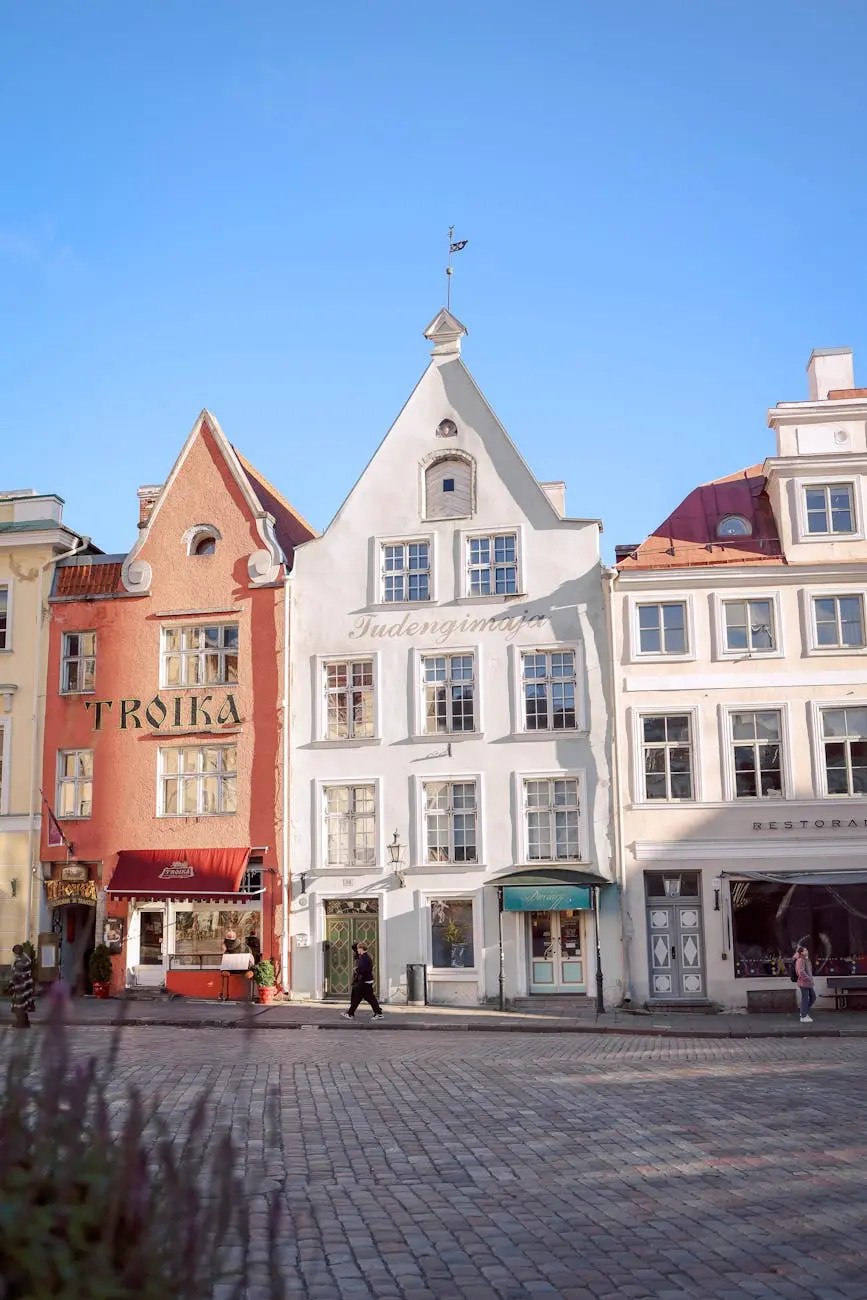
If you’re craving more than just a weekend on land, Celestyal Cruises offers 3- to 7-day Aegean itineraries that include Santorini, Mykonos, and hidden gems like Patmos—all without the hassle of repacking your suitcase.”

Universal Disclaimer/Disclosure Page:

48-Hour Prague Itinerary: Essential Travel Guide

Meta Description: Plan your ultimate weekend escape to Prague, Czech Republic! This detailed travel guide covers must-see sights, hidden gems, money-saving tips for transport & food, and essential Czech phrases. Get ready for an unforgettable 48 hours in the heart of Europe.

Table of Contents

  1. Why Prague Is the Perfect Weekend Getaway
  2. Quick Practical Info
    • Visa & Costs
    • Best Time to Go
  3. Getting There & Getting Around
    • Planes & Flights (Bonus: Flight delay/compensation tool)
    • Trains, Buses & Car Rental (Maps & routes included)
  4. Where to Stay & Hidden-Gem Neighborhoods
  5. Top Sights with Personal Anecdotes
    • Must-see Classics
    • Off-the-Beaten-Path Discoveries
  6. Pocket-Friendly Travel Tips
    • Public Transport Hacks
    • Budget Ins & Outs
  7. Local Lingo 101: Words You’ll Actually Use
  8. Stay Connected & Covered
    • SIM Cards & Data
    • VPN & Safety
    • Travel Insurance
  9. Strong CTAs & Further Reading
  10. FAQ: Your Burning Questions Answered
  11. Links to My Other Travel Tales

So, you’ve got a weekend to spare and a serious case of wanderlust? Let me tell you, packing your bags for Prague is never a bad idea. This city is like stepping into a living, breathing fairytale, complete with a castle looming over a river, cobblestone streets that whisper centuries of history, and beer that’s cheaper than water (no, really).

I’ve lost count of how many times I’ve wandered across the Charles Bridge at sunrise, and it never gets old. This guide is my love letter to Prague, packed with everything I’ve learned from getting delightfully lost in its alleys. We’re going to craft your perfect 48-hour itinerary, save you money, and make you feel like a local (or at least a very savvy tourist).

Pro Tip: I always book my flights and hotels together on Expedia—it’s my go-to for snagging a great package deal. For a city like Prague, staying in the centre (like Old Town or Lesser Town) is worth the extra few bucks to save time on logistics.

Flights to Prague

Why Prague Is the Perfect Weekend Getaway

Picture this: you step off the tram onto cobblestones that have heard centuries of stories. Café aromas drift through the air, and a medieval tower looms above, daring you to explore. That’s Prague—where history, romance, and quirky Czech humor collide. It’s compact, charming, and unexpectedly budget-friendly, making it ideal for your two-day mini-adventure.

Hotels in Prague

Prague is incredibly compact. Most of the iconic sights are within walking distance of each other, making it ideal for a short trip. It’s also wonderfully affordable compared to other Western European capitals. Plus, with a well-connected airport and an efficient public transport system, you can maximize your time exploring instead of commuting.

Visa Note: For travellers from the US, UK, Canada, and Australia, you can enter the Czech Republic (part of the Schengen Area) visa-free for up to 90 days. Always double-check the latest entry requirements from official government sources before you travel.

Best Time to Visit
Plan around late spring or early fall to dodge peak crowds while enjoying mild, pleasant weather. Summer can be busy and winter, festive but chilly.

Day 1: Castles, Bridges, and Cobblestones

Morning: Start your day early at Prague Castle (Pražský hrad). I cannot stress the “early” part enough. Tour buses arrive around 10 AM, and the complex gets packed. Take tram 22 up to the castle for a classic Prague experience and stunning views. The castle grounds themselves are free to walk, but buy a ticket to enter St. Vitus Cathedral—it’s absolutely breathtaking.

A red and white tram passing by a beautifully detailed historic building with blooming tulips in the foreground, under a clear blue sky in Prague.
Tram moving past beautiful architecture and blooming tulips in Prague, perfect for experiencing the city’s charm.

St. Vitus Cathedral Tours

Interior view of St. Vitus Cathedral featuring gothic architectural elements and colorful stained glass windows.
Interior view of St. Vitus Cathedral showcasing stunning stained glass windows and Gothic architecture.

Afternoon: Wander down from the castle through the charming Lesser Town (Malá Strana). Get lost in its narrow streets and find a classic Czech pub for lunch. Then, make your way to the Charles Bridge (Karlův most). While it’s packed during the day, the energy is infectious. For a different perspective, I highly recommend a Vltava River cruise – it’s a relaxing way to see the cityscape.

I’ll never forget my first time trying to order in one of these pubs. The menu was all Czech, and the waiter spoke no English. I pointed at what looked like a safe bet, which turned out to be vepřo knedlo zelo—roast pork, dumplings, and sauerkraut. It was the definition of comfort food, and the waiter gave me a thumbs-up and a complimentary beer for my effort. Moral of the story? Don’t be afraid to point and be adventurous!

Mala Strana

Night view of Prague Castle illuminated above the Vltava River, with historic buildings and the Charles Bridge in the foreground under a snowy sky.
The illuminated Prague Castle and the historic Charles Bridge at night, showcasing the enchanting beauty of the city.

Charles Bridge Tours

A scenic view of Prague, showcasing historic buildings with red rooftops along the Vltava River, featuring the iconic Charles Bridge in the foreground.
Scenic view of the Charles Bridge and the historic architecture along the Vltava River in Prague.

Evening: Have dinner in Lesser Town and then walk back across the Charles Bridge at night. The crowds have dispersed, the castle is illuminated, and it’s pure magic. It’s one of my favourite memories of the city.

Day 2: Old Town Charm and Hidden Courtyards 

Morning: Begin at the Old Town Square (Staroměstské náměstí). Watch the world-famous Astronomical Clock put on its show at the top of the hour (it’s a little underwhelming but you have to see it once!). Climb the Old Town Hall Tower for the best panoramic view of the square’s spires.

Old Town Square Tours

A large teddy bear costume character stands in the foreground of Prague's Old Town Square, with the iconic Church of Our Lady before Týn in the background, surrounded by tourists.
A lively scene in Old Town Square, Prague, featuring a giant teddy bear amidst crowds of tourists and historic architecture.

Prague Astronomical Clock Tours

Close-up of the intricate Astronomical Clock in Prague, featuring colorful astronomical details and decorative figures.
The iconic Astronomical Clock in Prague’s Old Town, a must-see attraction showcasing intricate designs and astronomical details.

Afternoon: Follow the crowds towards the Jewish Quarter (Josefov), a area rich with profound history. Afterwards, indulge your sweet tooth at the ICU Museum of Senses or find a hidden courtyard café to people-watch. If you have more time in the region, consider a day trip—I wrote about my favourite one to Cesky Krumlov here.

Prague Jewish Quarter Walking Tour with Admission Tickets

Interior view of a beautifully ornate synagogue featuring intricate patterns, colorful stained glass windows, and a large organ.
Interior view of the stunning Spanish Synagogue in Prague, highlighting its intricate architecture and vibrant stained glass.

Admission Ticket Museum of Senses Prague

Close-up view of the ornate architectural details of a historical building in Prague, showcasing a decorated dome with a glass top against a blue sky.
The stunning architecture of a historical building in Prague, showcasing intricate designs and a magnificent dome under a clear blue sky.
Close-up of a historic tower with a green dome, decorative details, and a clock, set against a blue sky.
The ornate tower in Prague showcases stunning architecture against the blue sky. (Český Krumlov)

Evening: For your last night, enjoy a proper Czech feast and a well-earned pint of Pilsner. Then, why not experience some of Prague’s legendary nightlife?

A vibrant nightclub scene with people dancing under purple and blue lights in an arched stone venue.
Experience Prague’s vibrant nightlife in this atmospheric underground venue, perfect for dancing and socializing.

Beyond the Checklist: Prague’s Hidden Gems 

  • Vyšehrad: A fortress complex south of the centre with gorgeous gardens, a cemetery with famous Czechs, and quiet, crowd-free views of the city. It’s a perfect escape.
  • The John Lennon Wall: While not exactly “hidden,” it’s a vibrant, ever-changing symbol of peace and love. It’s a great quick stop in Lesser Town.
  • Letná Beer Garden: Located in Letná Park, across the river from the Old Town. It offers arguably the best view of the bridges and city centre. Grab a cheap beer, sit on a bench, and soak it all in with the locals.
  • Stay near Malá Strana for fairytale atmospheres; or choose Žižkov for hip cafés and local nightlife. I once stayed in Žižkov and woke to the most gloriously odd murals—felt like my quirky soul had found a home.
A close-up of a statue of two figures, one pointing forward, with a tall, ornate church tower in the background, surrounded by lush green trees against a blue sky.
A striking sculpture in front of a historic church in Prague, capturing the city’s rich cultural heritage.

A man playing guitar and a woman reading lyrics stand in front of the colorful John Lennon Wall, covered in graffiti and artistic messages.
A vibrant scene at the John Lennon Wall in Prague, featuring street performers amid colorful graffiti.

View of people dining at an outdoor seating area with a scenic backdrop of Prague's skyline featuring historical buildings and a clear sky.
A group of friends enjoying the scenic view of Prague from a park, surrounded by trees and historic architecture.
View of the Zizkov TV Tower in Prague, featuring its unique architectural design with viewing pods and trees in the foreground.
The Žižkov Television Tower, a striking landmark in Prague featuring viewing platforms and unique architecture.

Navigating Prague Like a Pro: Transport Tips

Prague’s public transport (Dopravní podnik hl. m. Prahy, or DPP) is fantastic, cheap, and will be your best friend.

  • The Ticket System: Forget zones. A single ticket covers all trams, buses, metros, and even the funicular for a set time (30 min, 90 min, 24 hrs, 72 hrs). For a weekend, the 72-hour ticket (330 CZK) is your best bet.
  • How to Buy & Validate: You can buy tickets from yellow machines at metro stations or most tram stops (card/cash), or via the PID Lítačka app (my preferred method—so easy!). CRUCIAL: You must validate your paper ticket in the yellow stamp machine before your first journey. No stamp = a fine. App tickets are activated before you board.
  • Key Routes:
    • Tram 22: It’s not just transport, it’s a scenic tour. It winds past the National Theatre, up to Prague Castle, and beyond. Ride it for the views.
    • Metro: The three lines (A-green, B-yellow, C-red) are fastest for covering long distances. Use them to get from downtown to the outskirts (e.g., to the bus station).
  • Public Transport: The network of metros, trams, and buses is extensive. For a weekend, the 72-hour ticket (330 CZK) is your best bet. It’s valid on all services. Validate it once in the yellow machine before your first journey and then you’re good to go. Trams #9, #17, and #22 are particularly useful for tourists.
  • Taxis & Ride-Sharing: Avoid flagging down taxis on the street. They are notorious for overcharging tourists. Use apps like Bolt or Liftago (the local equivalent to Uber) for transparent, fixed pricing.
  • Walking: Prague’s core is incredibly walkable. The best discoveries are often made by wandering without a map.

A detailed map of Prague's tram lines, showcasing various routes, stops, and connections within the city's public transportation network.
Map of Prague’s tram lines, showcasing the extensive public transport network for visitors exploring the city.

Trains, Buses & Car Rental

  • Train: The Czech Railways (ČD) system is punctual, frequent, and scenic—especially if you’re coming from Vienna or Berlin.
  • Bus: FlixBus and RegioJet are budget-friendly and reliable options—watch for comfy perks like free Wi-Fi and snacks.
  • Car: Renting a car gives flexibility for day trips (like Kutná Hora or Karlštejn Castle). Use Google Maps to pre-plan routes—Prague’s traffic can surprise you, and parking zones cost extra. Filling up near the city outskirts can save gas.

Map tip: download your route on Google Maps with offline mode—navigation without roaming charges.

Savoring Prague: Food, Beer, and Budget Tips 

  • Must-Eat: Svíčková (marinated beef with a creamy sauce and dumplings), Guláš (goulash), and Trdelník (a sweet pastry roll—it’s for tourists, but try it anyway!).
  • Beer is King: A half-liter of excellent beer often costs less than a soda. Look for pubs serving Pilsner UrquellBudvar, or a local microbrew.
  • Save Money: Eat away from the main squares. A restaurant just one street over will be significantly cheaper and often more authentic. Look for lunch menus (denní menu) for the best deals.
A plate of marinated beef in a creamy sauce served with a side of colorful sautéed vegetables and lemon slices.
Delicious Czech svíčková served with colorful vegetables, perfect for a culinary experience in Prague.

A bottle of Pilsner Urquell beer on a dark background.
A bottle of Pilsner Urquell, the iconic Czech beer, illuminated against a smoky backdrop.

Essential Czech for Travellers

  • Hello / Goodbye: Dobrý den / Na shledanou
  • Thank you: Děkuji (Dyek-oo-yi)
  • Yes / No: Ano / Ne
  • Please: Prosím (also means “You’re welcome”)
  • Beer, please: Pivo, prosím
  • Cheers!: Na zdraví!
  • Do you speak English?: Mluvíte anglicky?

Local Lingo 101

Czech PhrasePronunciationMeaning
Ahoj!ah-hoyHello (friendly, casual)
Děkuji / Díkydye-koo-yee / deek-eeThank you / Thanks
Kolik to stojí?koh-leek toh stoy-eeHow much does it cost?
Toaletatoh-ah-leh-tahRestroom
Jedna pivo, prosímyed-nah pee-vo proh-seemOne beer, please

Czech Culture & Etiquette: Blend in Like a Local

A little cultural know-how goes a long way in making a good impression.

  • Shoes Off: If you’re invited into a Czech home, it is customary and polite to take your shoes off at the door.
  • Toasting: When you say Na zdraví! (Cheers!), make firm eye contact during the clink. It’s a old superstition that not doing so brings seven years of bad luck in the bedroom!
  • Punctuality: Being on time is valued, whether for a tour, dinner reservation, or meeting someone.
  • Quiet on Transport: Czechs tend to be quiet and reserved on trams and metros. Keep conversations at a considerate volume.
  • Pay at the Table: In most restaurants, the waiter will bring the payment terminal to your table when you ask for the bill. You don’t typically go to a cashier to pay.

Money Matters & Local Currency 

  • Currency: The Czech Republic uses the Czech Koruna (CZK/Kč), not the Euro. While some tourist spots might accept Euros, the exchange rate will be terrible. Always pay in Koruna.
  • ATMs & Cards: ATMs are everywhere. Avoid “Euronet” ATMs if possible—they offer dynamic currency conversion and have high fees. Your bank’s rate is always better. Credit/debit cards are widely accepted, but always carry some cash for smaller shops, market stalls, and public transport ticket machines.
  • Tipping: Rounding up the bill or leaving 10% is standard practice for good service in restaurants and pubs. It’s not mandatory but is appreciated.

Smart Travel Essentials: Stay Connected & Protected

Let’s talk practicalities. A few key items have saved my trips from turning into nightmares, and I’d never travel without them now.

📶 Stay Connected Instantly:
Remember that time I spent 45 minutes at a Prague airport kiosk trying to buy a local SIM with a clerk who spoke no English? Never again. Now I use Drimsim. It’s a genius universal SIM that works in 190+ countries the second you land. Pop it in your phone, top up via the app, and you’re online. No hidden fees, no hassle. It’s a total game-changer for navigating maps and posting pics on the go.
<a href=”https://drimsim.tpm.lv/WZXbFzT6&#8243; rel=”nofollow”>Get your universal Drimsim travel SIM here</a>

🔒 Protect Your Privacy & Access:
Using public WiFi in cafes and hotels? Please, use a VPN. NordVPN encrypts your data, so your passwords and bank details are safe from prying eyes. It also lets you access streaming services from back home if you need a quiet night in. your online travel with NordVPN

✈️ Get Compensated for Flight Issues:
Had a flight delayed over 3 hours or canceled? Under EU air passenger rights, you could be owed up to €600 in compensation. Most people don’t claim it, but AirHelp makes it easy. They handle all the paperwork and fight the airlines for you, and they only get paid if you win. I’ve used them successfully—it’s stress-free and feels great to get that payout. Check your flight for free compensation with AirHelp

😌 Don’t Skimp on Insurance:
I never, ever travel without insurance. A simple accident or stolen bag can ruin a trip and your finances. I use VisitorsCoverage to compare and find the best plan for my specific trip. It’s peace of mind that’s worth every penny. Get a tailored travel insurance quote from VisitorsCoverage

📸 Capture the Memories:
Prague is endlessly photogenic. To capture all those stunning details, from the Astronomical Clock to the castle guards, I swear by my trusty Sony Alpha camera. It’s lightweight, powerful, and perfect for travel photography.

One of the best things about Prague is its location right in the heart of Europe. It pairs perfectly with other iconic German capitals for an unforgettable multi-city adventure. If you’re extending your trip beyond the Czech Republic, you’re in luck.

  • Heading south? Dive into the hearty Bavarian culture, world-class museums, and beer gardens of Munich. It’s a fantastic contrast to Prague’s intimate charm and makes for a perfect next stop.
  • Heading north? Immerse yourself in the gritty, vibrant, and endlessly cool atmosphere of Germany’s capital, Berlin. The journey from history-rich Prague to history-making Berlin is one every traveller should experience.

Prague Weekend Escape FAQ

What is the best time of year to visit Prague?
Spring (April-June) and Fall (September-October) are ideal. The weather is mild, and the crowds are thinner than in the peak summer months. The Christmas markets in December are also magical, but it’s very crowded and cold.

Is Prague expensive?
Prague is one of the most affordable capital cities in Europe. While prices have risen, it’s still possible to have a fantastic time on a moderate budget, especially if you eat and drink like a local away from the tourist hubs.

How much money should I budget for a weekend?
Excluding flights and accommodation, a comfortable budget for food, drink, attractions, and transport would be around 150-200 EUR for a weekend. You can do it for less, or certainly spend more!

Is English widely spoken?
Yes, absolutely. In the tourist centres, hotels, and restaurants, you will have no problem communicating in English. Learning a few basic Czech phrases is always appreciated, though.

What’s the best way to get from the airport to the city centre?
The Airport Express (AE) bus takes you to the main train station (Hlavní nádraží) in 35 minutes. Public bus #119 takes you to a metro station (Nádraží Veleslavín) where you can connect to the metro system. Both are cheap and efficient.

Q: Do I need Czech crowns (CZK), or is card okay?
A: Both! Most places accept cards, but keep a little CZK for trams, street vendors, and market stalls.

Q: What voltage is used? Do I need an adapter?
A: It’s Type E plugs at 230 V—bring a European adapter if needed.

Q: How safe is Prague for solo travelers?
A: Very! With standard common-sense precautions, walking late at night is usually fine—just watch for pickpockets in major tourist hubs.

Q: Can I split weekend itineraries for chill time?
A: Absolutely. Consider doing things at a relaxed pace: Day 1 for UNESCO charm and Old Town, Day 2 for hidden gems and maybe a sunset beer garden.

Conclusion: Your Unforgettable Prague Adventure Awaits

Prague is a city that truly has it all: jaw-dropping history, affordable prices, vibrant culture, and yes, incredible beer. With this guide, you’re equipped to dive deep into its fairy-tale streets, connect with its friendly locals, and create a weekend you’ll remember for years to come. Remember to wear comfortable shoes, embrace getting a little lost, and always keep your camera ready around every corner.

Have you been to Prague? What was your favourite moment? Share your own stories and tips in the comments below—I’d love to hear them!

Ready to explore the cobblestone streets and ancient charm of Prague? Start planning your ultimate weekend escape now!

What’s your #1 travel tip for visiting a new city? Share your wisdom in the comments below!


Universal Disclaimer/Disclosure Page: