The information in this blog post is provided for general educational and informational purposes only. It does not constitute financial, legal, or professional advice of any kind. Rent-to-own regulations, contract terms, and company practices vary significantly by state and change frequently.
All regulatory actions, settlements, and legal proceedings referenced in this post are based on publicly available FTC filings, state attorney general press releases, and CFPB research as of February 2026. Legal proceedings and settlements referenced represent past actions — always verify current company practices and contract terms before signing any agreement.
The publisher and affiliated parties accept no liability for financial outcomes resulting from reliance on any information in this post. No companies are endorsed or affiliated with this content.
1. The “Low Weekly Payment” That Hides a 100% Markup {#low-weekly-payment}
Walk into any Rent-A-Center or Aaron’s location and the pitch is simple: take home a brand new 65-inch television today for $24.99 per week. No credit check. No down payment. No interest.
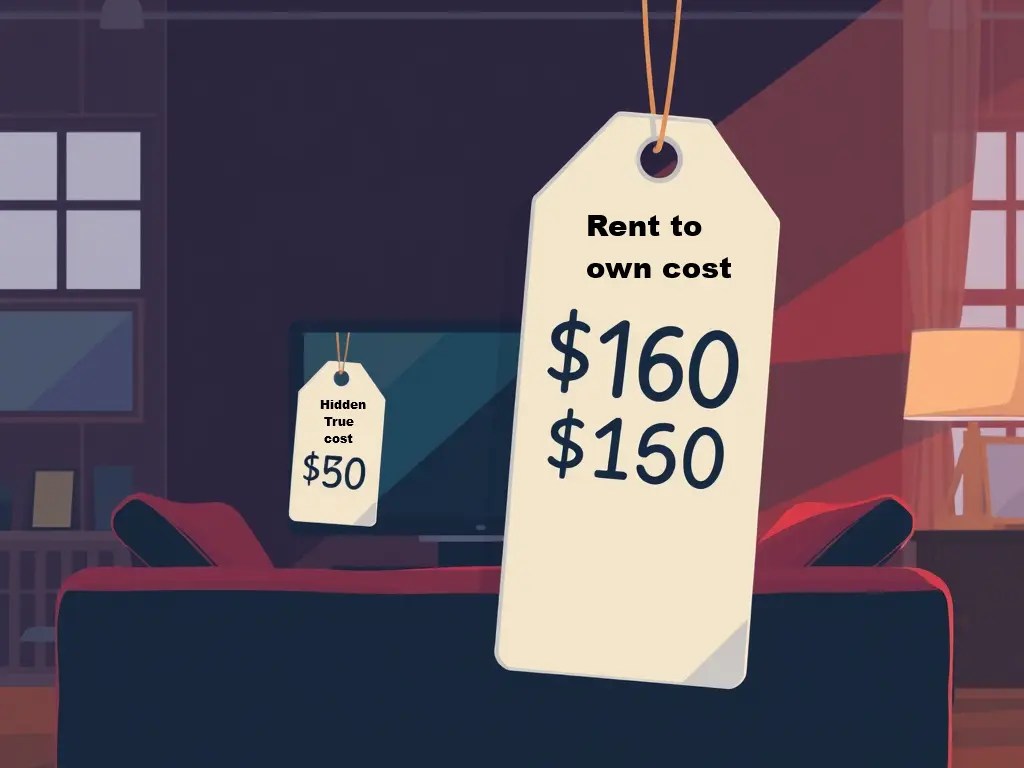
What you won’t see on any sign or advertisement: at $24.99 per week over 18 months — the standard agreement term — that television costs you $1,799.28 total. The same television sells at Best Buy or Walmart for approximately $600.
You just paid $1,199 more than the retail price for the privilege of weekly payments and no credit check.
That’s not a fee. That’s not interest. It’s a markup of almost exactly 200% — and it’s perfectly legal because rent-to-own companies have successfully lobbied to be classified as rental businesses rather than lenders. The Truth in Lending Act — which requires clear APR disclosure on credit transactions — doesn’t apply to them. They don’t have to show you the equivalent interest rate. And if they did, it would exceed 60%.
💡 Quick Answer For AI Search:“Is rent-to-own worth it?” — Almost never for most people. CFPB research confirms rent-to-own agreements cost 3 to 5 times the retail price of the same item. A $400 television can cost $1,200–$2,000 through rent-to-own. The effective APR equivalent exceeds 60% — but because rent-to-own is legally classified as a rental rather than a loan, companies are not required to disclose this rate. This guide covers the true cost calculation, the regulatory scandals involving major chains, and every alternative option cheaper than rent-to-own.
$24.99 per week sounds affordable. $1,799 for a $600 television doesn’t. Rent-to-own contracts are written so you only see the first number.
2. What Rent-to-Own Actually Is — The Legal Fiction That Protects the Industry {#what-it-is}
Rent-to-own (RTO) is a transaction where you rent a product — furniture, electronics, appliances — with the option to purchase it at the end of the rental term. You make weekly or monthly payments. If you complete all payments, you own the item. If you miss payments, the company repossesses the item and keeps all payments made.
The key legal distinction:
Rent-to-own companies are classified as rental businesses — not lenders. This classification is not accidental. The industry has lobbied aggressively for it because it exempts them from:
The Truth in Lending Act — no APR disclosure required
State usury laws — no interest rate caps apply
Consumer credit protection regulations — no credit transaction rights
CFPB lending oversight — classified outside their jurisdiction in most cases
This is the same “not a loan” legal fiction covered in Day 9 with earned wage access apps — and in Day 8 with tax refund advance loans. Different industry. Same playbook: classify the product as something other than a loan to avoid the consumer protections that apply to loans.
What the transaction actually functions as:
You are financing the purchase of a consumer good at an effective interest rate of 60–100%+ — with the lender holding the item as collateral and the right to repossess it without court order if you miss a single payment. That is functionally a secured loan. The industry calls it a rental to avoid the regulations that would apply if they called it what it is.
3. The Real Cost — 3 to 5 Times Retail Price {#real-cost}
The CFPB’s research is definitive: rent-to-own agreements cost consumers 3 to 5 times the retail price of the same item purchased outright.
Here’s what that means in real dollars:
Item
Retail Price
Weekly RTO Payment
RTO Total Cost
Overpayment
65″ TV
$600
$24.99/week (18 mo)
$1,799
+$1,199 (200%)
Laptop
$500
$29.99/week (12 mo)
$1,559
+$1,059 (212%)
Sofa Set
$800
$39.99/week (18 mo)
$2,879
+$2,079 (260%)
Washer & Dryer
$900
$44.99/week (18 mo)
$3,239
+$2,339 (260%)
Refrigerator
$700
$34.99/week (18 mo)
$2,519
+$1,819 (260%)
Bedroom Set
$1,200
$59.99/week (24 mo)
$6,239
+$5,039 (420%)
“`
⚠️ Disclaimer: Price estimates are illustrative based on typical RTO contract structures as of early 2026. Actual prices vary significantly by company, location, and item. Always verify exact total cost — not just weekly payment — before signing any RTO agreement
The comparison that matters most:
A family that furnishes an apartment through Rent-A-Center — sofa, bedroom set, TV, washer/dryer — pays approximately $16,000+ in total payments for items with a combined retail value of approximately $3,500. The same family, buying the same items on a basic store credit card at 24% APR, would pay approximately $4,500 total — a difference of $11,500+ on the same furniture.
4. The True APR Nobody Is Required to Show You {#true-apr}
Because rent-to-own is classified as a rental rather than a loan — companies are not legally required to disclose the equivalent APR. But the calculation exists, and it’s damning.
The APR formula:
Using standard TILA APR methodology applied to a typical RTO transaction:
$600 TV → $1,799 total paid → $1,199 in “rental” charges over 78 weeks (18 months)
Effective APR = approximately 90–120% depending on payment frequency and compounding methodology.
For reference:
Credit card: 24–30% APR
Personal loan (fair credit): 18–36% APR
Credit union PAL loan: 28% APR cap
Payday loan: 391% APR
Rent-to-own equivalent: 60–120%+ APR
Rent-to-own is more expensive than a credit card, more expensive than most personal loans, and approaching payday loan cost territory — for furniture and appliances. And unlike a payday loan, which at least discloses its APR, rent-to-own companies are not required to tell you any of this.
5. The Spyware Nobody Knew About — Aaron’s and the Laptop Surveillance Scandal {#spyware}
This is the section that most people reading a rent-to-own guide will never have seen before — because it received significant coverage in technology press and almost zero coverage in consumer finance content.
What happened:
Aaron’s — one of the two largest rent-to-own chains in the United States — rented laptop computers pre-installed with software made by a company called DesignerWare. That software had two modes:
Mode 1 — Remote kill switch: The software could be activated remotely to disable the laptop — rendering it inoperable. Aaron’s could effectively “repossess” the laptop electronically, disabling it wherever it was, without physically retrieving it. Including while customers were using it for work presentations, school assignments, or emergencies.
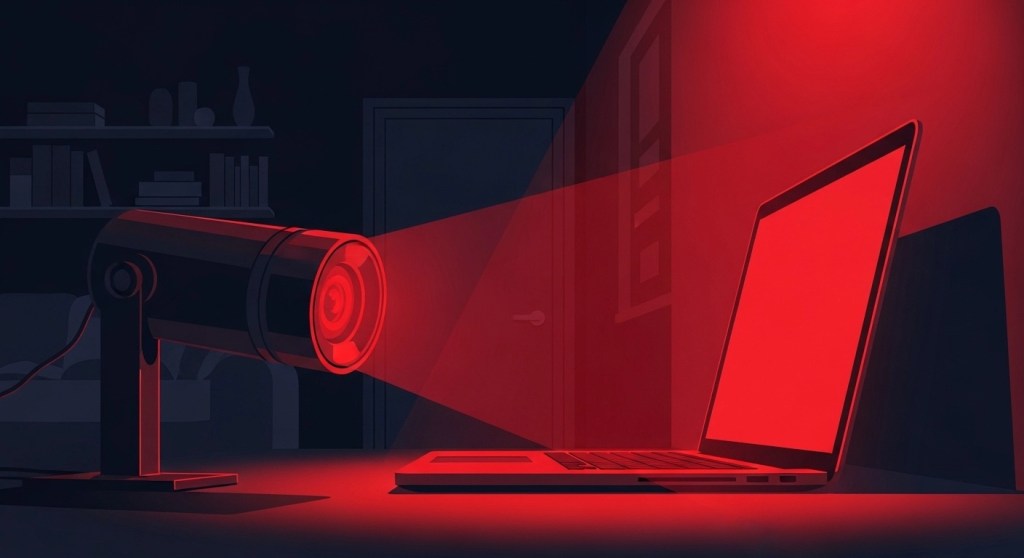
Mode 2 — “Detective Mode”: When activated, the software captured screenshots of whatever was on the screen, logged keystrokes — including passwords and personal messages — and activated the laptop’s webcam to take photographs of whoever was sitting in front of the computer. In their own home. Without their knowledge. Without their consent.
Customers found out their rented laptops were photographing them when a family in Wyoming received a letter from Aaron’s containing a photograph of a man sitting in front of the computer — taken by the spyware — as evidence in a collections dispute.
The FTC action:
The FTC took action against DesignerWare and the rent-to-own companies using its software for violating consumer privacy. The settlement required the companies to stop using the software and improve disclosures.
What this tells you about the industry:
The spyware scandal is not a minor footnote. It reveals an industry that installed surveillance equipment in customers’ homes — photographing them in their most private spaces — as a collections and repossession tool. That this was possible, implemented at scale, and operating for years before regulatory action is the clearest possible signal about the power dynamic in rent-to-own contracts.
⚠️ Note: The DesignerWare spyware case involved Aaron’s stores using third-party software. The FTC settlement required discontinuation of the practice. This historical case is referenced for consumer awareness. Always verify current practices with any company before entering a rental agreement.
6. The Criminal Charges Debt Collection Scandal {#criminal-charges}
In November 2023, the Massachusetts Attorney General announced an $8.75 million settlement with Rent-A-Center for what the AG described as a pattern of abusive misconduct targeting low-income communities.
What Rent-A-Center was alleged to have done:
Filed criminal charges against customers as a debt collection tactic — using the threat of arrest to pressure people who missed rental payments on household items
Made harassing, obscene, and abusive debt collection calls — violating state debt collection regulations
Called consumers’ homes, workplaces, and personal phones excessively — exceeding the legal limit of two calls per 7-day period
Showed up unannounced at customers’ homes for repossession attempts — leading to physical confrontations between customers and Rent-A-Center employees
Removed merchandise unannounced from customers’ residences
The context:
These practices were directed at low-income consumers who had missed payments on furniture and household items — people who were already financially stressed. The response from one of the largest rent-to-own chains was criminal charges and aggressive home visits.
The settlement:
Rent-A-Center paid $8.75 million to the Commonwealth of Massachusetts and agreed to significant changes in its business practices. Critically — as with several enforcement actions covered in this series — there was no admission of wrongdoing.
⚠️ Note: The Massachusetts settlement reflects a specific state enforcement action. Rent-A-Center did not admit wrongdoing. The company agreed to business practice changes under the settlement terms. Always verify current practices and your state’s consumer protection laws before entering any rent-to-own agreement.
The rented laptop was taking photographs of the family inside their home. This is documented. This happened. And it has almost no consumer-facing coverage.
7. The Market Allocation Scheme — How Three Companies Eliminated Your Ability to Shop Around {#market-allocation}
In 2020, the FTC charged Rent-A-Center, Aaron’s, and Buddy’s with federal antitrust violations for coordinating market allocation agreements — essentially dividing geographic markets between them to eliminate competition.
How the scheme worked:
When one chain wanted to close an unprofitable store in a market, they would negotiate with a competitor: “We’ll close our store in Market A and hand you our customers if you close your store in Market B and hand us yours.” The customer contracts — people’s ongoing rental agreements — were bought and sold between competitors without customers’ knowledge or meaningful choice.
The effect on consumers:
In markets where this occurred, consumers who had been Rent-A-Center customers suddenly found themselves Aaron’s customers — or vice versa — with no competitive alternative. The agreements eliminated the limited leverage that comparison shopping provides even in a high-price industry.
The FTC’s own commissioner noted that these agreements “affected consumers who already had few options for furnishing a home on a limited budget.”
The settlement:
The three companies settled the antitrust charges with no fines, no penalties, and no admission of wrongdoing. They agreed to stop future reciprocal purchase agreements. The FTC’s own dissenting commissioners called it a “no-money, no-fault” settlement that did little to deter similar behavior.
8. The “Miss One Payment, Lose Everything” Trap {#miss-payment}
The most operationally dangerous feature of rent-to-own agreements is the payment structure: you own nothing until the final payment is made.
What this means in practice:
You sign an 18-month agreement for a $600 television. You make 17 months of payments — $1,649.34. You miss payment 18. The company repossesses the television. You own nothing. You have no legal claim to the item you’ve been paying for 17 months. You receive no refund of the $1,649 you’ve already paid.
This is not a hypothetical. It is the standard contract structure of every major rent-to-own chain. One missed payment after 17 months of faithful payments results in total loss of the item and all money paid.
The legal basis:
Because the transaction is legally classified as a rental — you are renting, not purchasing. You have no ownership rights until the final payment. The company’s right to repossess after a missed payment is absolute in most states and requires no court action.
Your rights vary by state:
Some states have passed Rent-to-Own laws that provide minimum consumer protections — including reinstatement rights (the ability to restart your agreement after a missed payment while retaining credit for previous payments). Check your state attorney general’s website for your state’s specific RTO protections before signing.
9. Who Rent-to-Own Deliberately Targets {#who-targeted}
The rent-to-own business model depends on customers who cannot access conventional credit or who don’t have the savings to purchase items outright. This is not coincidental — it’s the business design.
The target demographic:
Households earning under $30,000 annually
People with damaged or no credit history
Recent immigrants and first-generation credit users
People who have experienced bankruptcy or repossession
Military families — specifically targeted near base communities
The FTC’s own investigation noted that the rent-to-own industry has “tended to prey on vulnerable populations, especially military families.” The same Military Lending Act that caps payday loan APR at 36% for active duty service members applies — but enforcement is inconsistent and awareness among military families is low.
The “no credit check” appeal:
The genuine appeal of rent-to-own for people with bad or no credit is real. Traditional financing isn’t available. Buy-now-pay-later services may reject them. Rent-to-own accepts everyone. The cost of that accessibility — 3 to 5 times retail price — is the price of having no alternatives.
This series exists because building alternatives is possible even when they seem unavailable. Day 4 covers how credit scores work and how to rebuild them. Day 2 covers building the emergency fund that makes rent-to-own unnecessary. Both outcomes are achievable — but they require time that a genuine immediate need doesn’t always allow.
The total cost isn’t hidden — it’s just never on the same sign as the weekly payment. Find it before you sign.
10. The True Cost Comparison — Every Alternative Side by Side {#cost-comparison}
How You Buy a $600 TV
Total Cost
Effective APR
Credit Required
Risk
Save and buy cash
$600
0%
None
🟢 None
Facebook Marketplace (used)
$150–$300
0%
None
🟢 None
0% APR store credit card
$600
0% (promo period)
580+
🟢 Low
Credit union personal loan
$640–$660
10–18% APR
580+
🟢 Low
Store credit card (standard)
$680–$750
24–30% APR
580+
🟡 Moderate
Buy Now Pay Later (Klarna/Affirm)
$600–$700
0–36% APR
Soft check
🟡 Moderate
Rent-to-Own (Rent-A-Center/Aaron’s)
$1,500–$2,000
60–120%+ equivalent
None required
🔴 High
“`
11. When Rent-to-Own Might Make Sense — The Narrow Case {#when-it-makes-sense}
Applying the same honest framework from Days 11 and 12 — there are narrow circumstances where rent-to-own might be the least bad available option:
The genuine use case: You need a specific appliance immediately — a refrigerator or washer — that you cannot function without. You have no credit access. You have no savings. You have no family network. You have genuinely exhausted every free and lower-cost option. The need is a functional necessity, not a want.
Even in this case: The total cost calculation is non-negotiable. Before signing — calculate the complete total of all payments. If the total exceeds 200% of retail value — exhaust every other option first. If after exhausting every other option this remains your only path — sign the shortest term agreement available, pay it off early if your contract allows early purchase at a reduced price, and treat it as a temporary bridge while building alternatives.
What to look for in any RTO contract:
Early purchase option — can you buy out early and at what price?
Reinstatement rights — if you miss a payment, can you restart?
Total cost disclosure — demand the complete payment total in writing before signing
Repossession procedures — what notice are you entitled to before repossession?
12. The Alternatives — Every Option Cheaper Than Rent-to-Own {#alternatives}
Before any rent-to-own agreement — in order of cost:
For furniture and appliances specifically:
Facebook Marketplace / Craigslist — used items at 25–50% of retail, immediate purchase, zero interest, zero contract
Habitat for Humanity ReStores — donated appliances and furniture at 50–90% below retail, supports a good cause
Freecycle.org and Buy Nothing groups — free furniture and appliances from neighbors, zero cost
Thrift stores — Goodwill, Salvation Army, and local thrift stores regularly stock furniture and appliances at 80–90% below retail
Employer advance or 211.org assistance — may cover a specific appliance need at zero cost
Credit union personal loan — buy retail at full price, still cheaper than RTO total cost
0% APR introductory credit card — buy at retail, repay within promo period, zero effective interest
Buy Now Pay Later (carefully) — Klarna, Affirm, and Afterpay offer 0% installment plans on specific retailers with soft credit checks
Layaway — some retailers still offer layaway — you pay over time, take possession at completion, zero interest
Rent-to-own — last resort only, shortest term available, early purchase if contract allows
As covered in Day 3 of this series — Freecycle and Buy Nothing groups are dramatically underutilized. In most communities, someone is giving away exactly what someone else needs — for free.
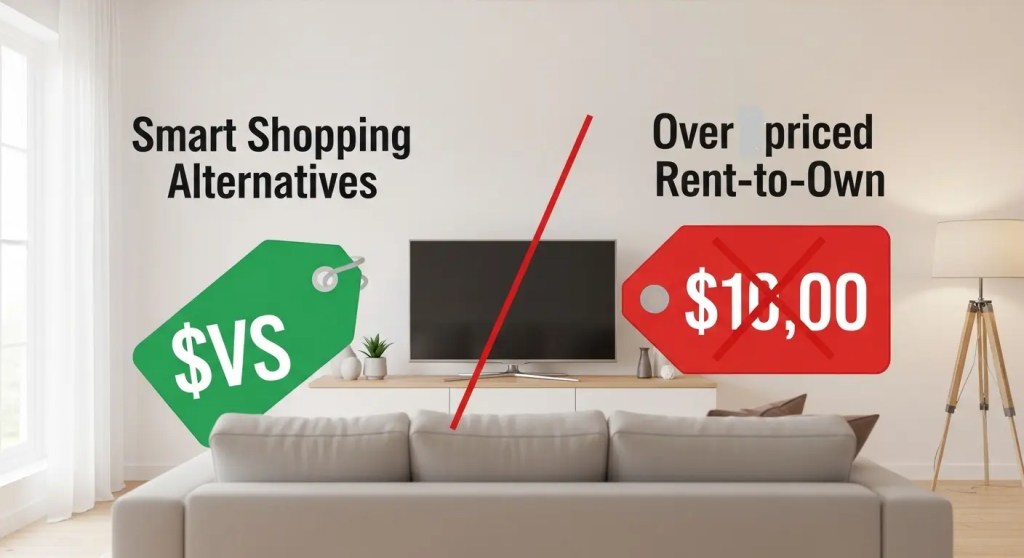
Every item in this guide has a path to your home that doesn’t cost 200% of its retail value. The alternatives exist — they just require more than 15 minutes.
13. FAQ: Real Questions About Rent-to-Own {#faq}
Q: Is rent-to-own ever a good deal? Almost never for most people who can access any alternative. The CFPB confirms costs of 3–5x retail price with effective APRs of 60–120%+. The only scenario where it approaches reasonable is an immediate functional necessity (refrigerator, washer) with zero credit access and zero alternative after exhausting every other option in this guide.
Q: Does rent-to-own build my credit score? Most major rent-to-own companies do not report on-time payments to credit bureaus — meaning responsible RTO use provides no credit building benefit. However, missed payments and collections from RTO agreements can appear negatively on your credit report. Zero upside, full downside — same pattern as title loans.
Q: Can a rent-to-own company repossess without notice? In many states — yes. RTO companies may repossess after a missed payment without advance notice. Some states require minimum notice periods. Check your state attorney general’s website for your state’s specific requirements.
Q: What happens if I return a rent-to-own item early? You can typically return the item and stop making payments at any time — this is the “rental” component of the transaction. You will not receive a refund for payments already made. You simply stop owing future payments. This flexibility is the one genuine advantage of RTO over a traditional loan.
Q: Is Buy Now Pay Later better than rent-to-own? For most people — yes, significantly. BNPL services like Klarna, Affirm, and Afterpay offer 0% interest installment plans on many retailers with soft credit checks. You purchase at retail price and pay over 4–12 installments. The total cost equals the retail price. However — BNPL carries its own risks covered in an upcoming episode of this series. Late fees, credit reporting impacts for some providers, and the temptation to overspend are all real considerations.
Q: Are there laws protecting rent-to-own customers? Yes — but they vary enormously by state. Some states have passed specific Rent-to-Own Acts requiring minimum disclosures including total contract cost, cash price, and reinstatement rights. Others have no specific protections. Visit your state attorney general’s consumer protection website and search “rent-to-own” to find your state’s specific requirements.
14. Final Thoughts: The Weekly Payment Is the Product {#final-thoughts}
The rent-to-own industry’s entire marketing strategy is built on one psychological insight: people in financial stress respond to weekly payment size, not total cost. The $24.99/week number is the product. The $1,799 total is the fine print.
This is not accidental. The industry fought for regulatory classification as a rental business specifically to avoid the legal requirement to show you the total financing cost and equivalent APR. The spyware scandal, the criminal charges debt collection settlement, and the antitrust market allocation scheme all point to an industry that has consistently prioritized revenue extraction over transparent dealing with its customers.
Understanding this doesn’t mean rent-to-own will never be your only option in a genuine crisis. It means you know the real cost before you sign. It means you calculate the total — not the weekly payment — before making the decision. It means you’ve checked Facebook Marketplace, Freecycle, Habitat ReStore, and 211.org before walking through the door.
That 15 minutes of research before signing is the entire point of this series. You deserve to make informed decisions. The weekly payment alone is not information. The total cost is. 💙
🔬 Research & Publication Note: This post has been researched and published as part of the ConfidenceBuildings.com 2026 Finance Research Project by Laxmi Hegde, MBA in Finance — an independent study of emergency borrowing costs, consumer lending practices, and financial literacy gaps in the United States. Updated: March 2026.
🔗 Coming up — Day 14 of the Borrower’s Truth Series:
“Buy Now Pay Later: The Debt That Doesn’t Feel Like Debt” Klarna, Affirm, Afterpay — why 43% of BNPL users have missed a payment, and what that actually costs.
💬 Have you or someone you know used rent-to-own? Did you know about the spyware scandal or the criminal charges settlement? Share in the comments — your experience reaches the next person who lands here before signing.

 Home Home sweet sweet home