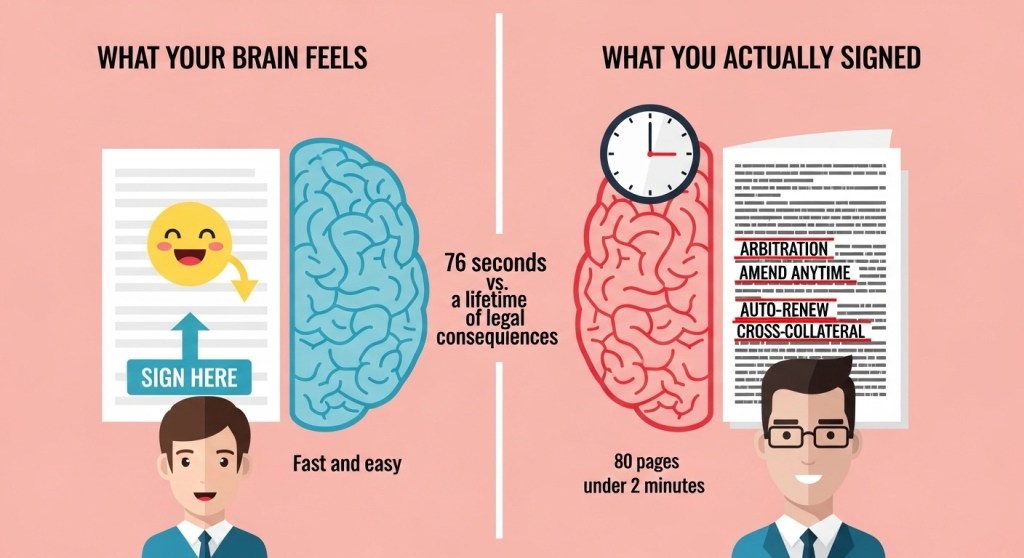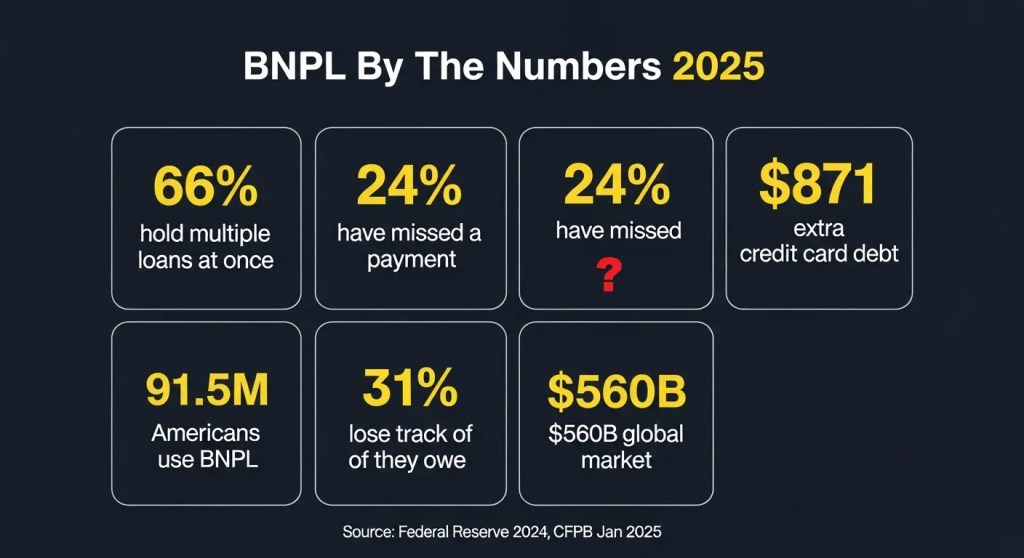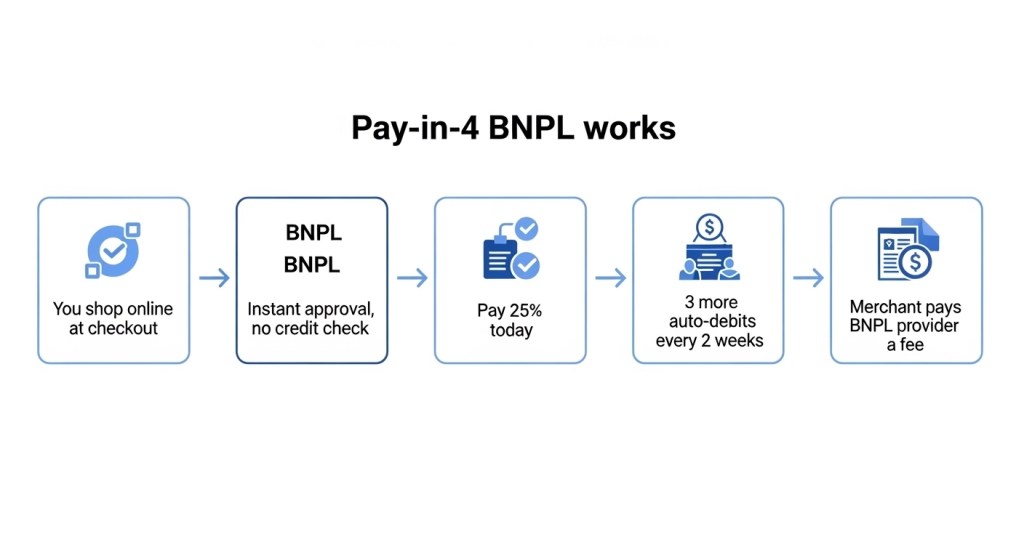
The Borrower’s Truth Series Finale — Everything We Learned

Borrower’s Truth Series
30-Day Financial Education Series · Week 5 of 5
100% Complete 🎉
● Published ● You Are Here
🎉 You made it to the end. All 30 days. That’s the whole thing.

Day 30 · Series Finale · Week 5 of 5

The Borrower’s Truth Series Finale —
Everything We Learned

30 days. 30 posts. One complete financial education.
Here’s everything that mattered — distilled into one final read.

Week 1 — Borrowing Basics
The foundation. What credit scores really are, why emergency funds matter, and why the first loan offer is almost never the best one.
Week 2 — The Predatory Lenders
Payday loans, title loans, rent-to-own, BNPL, tax refund advances. The $9 billion industry built on one calculation: that you can’t repay.
Week 3 — The Fine Print Files
Arbitration clauses, variable rates, auto-pay traps, medical debt, and the 30 loan terms lenders hope you never understand.
Week 4 — After You Borrow
Escaping payday cycles, fighting debt collectors, disputing credit errors, rebuilding credit, negotiating with creditors, and yes — bankruptcy without the shame.
Week 5 — The Smart Borrower
Recognizing your own recovery. The six-step framework for borrowing smartly. And today — everything we learned, one last time.
You didn’t just read a blog series.
You completed a financial education that most people never get.

For educational purposes only. Not legal advice. The Borrower’s Truth Series is a 30-day financial education series intended for general informational purposes only. Nothing in this series constitutes legal, financial, or professional advice of any kind. Every financial situation is different. Please consult a licensed financial advisor, credit counselor, or attorney for guidance specific to your circumstances. Nothing on this site creates a professional relationship of any kind.

📖 About This Series

The Borrower’s Truth Series is a 30-day financial education series by Laxmi Hegde, MBA in Finance. It started on February 19, 2026 with a simple premise: most people who get hurt by debt weren’t foolish — they were just never taught what lenders know. Thirty days later, that premise became 30 posts, hundreds of citations, dozens of reader stories, and one very tired but very proud author.

Today is Day 30 — the last one. We are not going out with a whimper. We are going out with a full recap of every major lesson from every week, a final word on what all of this actually means, and a send-off that you have genuinely earned by making it this far.

If you’ve read all 30 days — this one is for you. If you’re just arriving — welcome. You picked a good day to start. And also a slightly overwhelming one. Maybe begin at Day 1 and come back. We’ll be here.

⭐ Essential Reading — Start Here

Free: The Loan Clause Checklist

30 days of financial education distilled into one practical tool. Before you ever sign another loan agreement — run it through this checklist. 30 clauses. Plain English. The exact traps lenders bury in fine print. Free. Forever. Use it every single time.

📌 Quick Answer

The Borrower’s Truth is this: lenders have a system. For thirty days we’ve been building yours. Know before you borrow. Read before you sign. Plan before you commit. And when things go wrong — because sometimes they do — know your rights, know your options, and know that recovery is real. That’s everything. That’s all thirty days in four sentences.

Thirty days ago I told you that lenders have a system and that most borrowers don’t. That gap — between what lenders know and what borrowers are never taught — is where billions of dollars quietly disappear every single year. The payday loan industry. The title loan trap. The rent-to-own math. The fine print nobody reads. All of it exists in that gap.

This series was built to close that gap. One post at a time. One lesson at a time. Thirty days of things your lender hopes you never figure out — delivered directly to you, for free, with citations. You’re welcome, and also I’m mildly sorry for how much fine print we had to read together.

Here is everything we learned — week by week, truth by truth. Consider this your graduation recap. There will not be a test. There has already been enough of those.

Week 1 — Days 1 to 7

Borrowing Basics — The Foundation

Week 1 established the ground rules. We learned that emergency loans are often traps disguised as lifelines — and that the best defense against them is an emergency fund, even a small one, built from scratch over time. We learned that your credit score is not a neutral number. It is a weapon — and lenders are trained to use it against you by targeting people whose scores make them feel they have no other options.

We covered secured versus unsecured loans — a decision that most lenders gloss over because the details favor the borrower who understands them. We gave you 30 loan terms in plain English. And we rounded out the week with the seven borrowing mistakes that trip up even financially literate people.

The Week 1 truth: financial vulnerability is not a character flaw. It is a knowledge gap. And knowledge gaps can be closed.

Week 2 — Days 8 to 14

The Predatory Lenders — Know Your Enemy

Week 2 was the uncomfortable one. We went inside the industries that profit specifically from financial desperation — and we did not look away. Tax refund advance loans that turn “free” into the most expensive word in tax season. Cash advance apps that are better than payday loans but not as safe as they look. The complete decision guide for when you need $500 today.

Then the big three. Payday loans — a $9 billion industry built on one calculation: that you can’t repay. Title loans — where you’re not borrowing against your car, you’re betting it. Rent-to-own — the store that sells you a $400 TV for $1,200. And Buy Now Pay Later — the debt that doesn’t feel like debt until it very suddenly does.

The Week 2 truth: predatory lenders are not evil geniuses. They are businesses with a model. Understanding the model is the only protection against it.

30
Posts. 5 weeks. One complete financial education that most people never receive — and every lender hopes you never find.
Borrower’s Truth Series · ConfidenceBuildings.com · 2026
Week 3 — Days 15 to 21

The Fine Print Files — What You Actually Signed

Week 3 was where we got specific. We launched the free Loan Clause Checklist — 30 clauses in plain English that belong in every borrower’s toolkit forever. We learned that arbitration clauses quietly remove your right to sue and that most people sign them without realizing it. We covered variable rate loans and why your monthly payment can suddenly skyrocket with no warning and full legality.

Auto-pay traps that give lenders direct access to your account. The 29-day grace period that becomes very ugly on day 30. Medical debt — the most negotiable debt in America that most people never negotiate. And the post that connected it all: your loan is due, but the trap is just getting started.

The Week 3 truth: the fine print is the actual agreement. Everything else is marketing. Read the fine print — all of it — every single time.

Week 4 — Days 22 to 28

After You Borrow — The Recovery Playbook

Week 4 was for everyone who was already in it. A three-step exit strategy for the payday loan cycle. Everything debt collectors don’t want you to know — including that they have less power than they pretend. How to dispute credit report errors and actually win. The real roadmap for rebuilding credit after financial hardship.

The creditor negotiation playbook nobody gave you — because it turns out creditors negotiate far more than they admit. An honest guide to bankruptcy without the shame — because sometimes the legal system exists to protect you and using it is not failure. And Day 28: how to recognize your own recovery when nobody sends you a certificate for climbing out.

The Week 4 truth: getting into debt is not the end of the story. It is the middle. And middles — no matter how difficult — can be navigated with the right information.

Week 5 — Days 29 to 30

The Smart Borrower — The System That Protects You

Week 5 was always meant to be the answer to everything that came before it. Day 29 gave you the Smart Borrower Framework — six questions in order, every time, no exceptions. Do I need to borrow? What is the total cost? Have I shopped lenders? Have I read the full contract? Do I have a repayment plan? Do I know my exit?

And today — Day 30 — is the reminder that you now have everything. The knowledge, the framework, the checklist, the recovery playbook. You are not the same borrower you were thirty days ago. That is not a small thing.

The Week 5 truth: smart borrowing is not a personality trait. It is a skill. And you just spent 30 days building it.

The 10 Borrower’s Truths — Everything Distilled

If thirty days is too much to carry — here are the ten truths that matter most. Print them. Save them. Send them to someone who needs them.

01
Financial vulnerability is a knowledge gap — not a character flaw.
Nobody is born knowing how to read a loan contract. The people who get hurt by debt were never taught what lenders know. Now you have been.
02
The cheapest loan is the one you never had to take.
Before you borrow — exhaust alternatives. An emergency fund, a payment plan, a credit union, a nonprofit. The loan is always still there. Explore everything else first.
03
Urgency is a sales tactic. Slow down.
Every “this offer expires today” and “we need a decision now” is designed to stop you from thinking. A legitimate lender with good terms does not need to rush you.
04
The fine print is the actual agreement. Read it.
The verbal explanation is marketing. The glossy brochure is marketing. The contract is what you actually agreed to. Use the Loan Clause Checklist. Every time.
05
Always compare APR — never just the monthly payment.
Monthly payments are designed to sound manageable. The APR tells you what the loan actually costs. That is the number that matters.
06
You have more rights than debt collectors want you to know.
The FDCPA limits what collectors can do and say. You can demand written verification. You can request they stop contacting you. You can dispute. Know your rights — they are real and they are enforceable.
07
Creditors negotiate. Most people just don’t ask.
Medical bills, credit card debt, personal loans — all of it is more negotiable than creditors admit. A settled debt at 40 cents on the dollar is better for everyone than a debt that never gets paid. Ask. In writing. Keep records.
08
Bankruptcy is a legal tool — not a moral failure.
The legal system built bankruptcy protection because sometimes life produces situations that debt cannot survive. Using the protection that exists for exactly your situation is not giving up. It is using the system correctly.
09
Recovery is real — and it is quieter than you expect.
Nobody sends you a certificate. Recovery shows up in small moments — the app you opened without flinching, the loan you said no to, the bill you paid without scrambling. Notice those moments. They are the proof.
10
Smart borrowing is a skill. You now have it.
Six questions before you sign anything. Ever. Do I need this? What does it cost — total? Have I shopped? Have I read everything? How will I repay it? What’s my exit? That framework is yours now. Use it every time.

What happens now?

You take what you’ve learned and you use it. You share it with someone who needs it — a friend, a family member, anyone who is about to sign something they don’t fully understand. You bookmark the Loan Clause Checklist and you actually use it next time.

And you remember that the gap between what lenders know and what borrowers know — the gap this series was built to close — gets a little smaller every time someone reads it. So share it. The next person who finds it might need it more than you did.

The Last Three Stories.

Thirty days of reader stories — composite illustrations and public cases that put a human face on everything we learned. Here are the final three. They are, fittingly, stories of people who used what they knew.

A
Amara, 26 — Houston, TX
Composite story · For educational illustration

“A year ago I would have taken the payday loan. I was stressed, I needed the money, and the store was right there. Instead I sat in my car for ten minutes and went through the six questions. Did I actually need to borrow? Could I cover part of it another way? I called my credit union. They had a small emergency loan product I didn’t know existed — 18% APR versus the payday store’s 391%. I drove past the payday store on the way home. It felt genuinely good.”

What she did right

Amara paused. Ten minutes in a car park changed the entire outcome. The framework doesn’t require hours — it requires the discipline to stop before you sign. She had that discipline because she’d built it.

What this shows

Knowledge without action is just information. Knowledge with a ten-minute pause is a completely different financial outcome. The framework works — but only if you use it.

RM
Attorney Rachel Morrow
Fictional consumer rights attorney · Educational illustration only

“Thirty days of financial education does something that individual legal advice cannot — it reaches people before they need me. The best consumer protection is a borrower who knows their rights before they sign, not one who calls me after. This series did that work. I hope it reaches everyone who needs it.”

Legal & Financial Context

Consumer financial protection law — the CFPB, the FDCPA, the Truth in Lending Act, state usury laws — exists to protect borrowers. But the law works best when borrowers know it exists. Financial literacy and legal literacy are not separate things. They are the same protection from different angles.

Bottom Line

An informed borrower is the lending industry’s least profitable customer. Be that customer. Every time.

J
Jerome, 52 — Baltimore, MD
Public case · Based on documented consumer experience

“I filed Chapter 7 at 49. For three years I told nobody. I was ashamed in a way I can’t fully describe — like I’d broken some fundamental rule about how adults are supposed to manage. What I know now is that I used a legal protection that exists specifically for situations like mine, I came out the other side with a clean slate, and I rebuilt. I’m 52. My credit score is 701. I wish I had found a resource like this before I needed the bankruptcy. But I’m glad it exists for the people who need it now.”

What this represents

Jerome’s story is the reason Day 27 existed. Bankruptcy is not the end. It is, for many people, the beginning of a recovery that would not have been possible otherwise. The shame is the only part that wasn’t necessary.

What this shows

Recovery has no age limit and no deadline. A 701 credit score at 52 after Chapter 7 at 49 is not a consolation prize. It is proof that the system, used correctly, works.

RM
Attorney Rachel Morrow
Fictional consumer rights attorney · Educational illustration only

“What this series got right — consistently — is that it never talked down to the reader. Financial hardship is not stupidity. It is circumstance meeting a system that was not designed in your favor. The antidote is not shame. It is information. Thirty days of information, specifically.”

Legal & Financial Context

The CFPB was created specifically because consumer financial protection requires dedicated infrastructure. Free resources at consumerfinance.gov — complaint filing, financial well-being tools, lender lookup, debt collection guidance — exist because Congress recognized that the information gap between lenders and borrowers is a structural problem, not a personal one.

Bottom Line

The system was not designed in your favor. But the law — used correctly — can be. Know it. Use it. Share it.

Y
You.
The person who read all 30 days · This one is for you

You showed up. Day after day, post after post, through payday loan statistics and arbitration clauses and medical debt survival guides and bankruptcy explainers and credit report dispute letters. You read things that were uncomfortable because you understood that discomfort now is cheaper than ignorance later.

You are not the same borrower you were on Day 1. You know what APR means and why it matters. You know what an arbitration clause costs you. You know how to dispute a credit error, negotiate a debt, recognize recovery, and walk away from a bad loan without flinching. That knowledge is yours now. Nobody can take it back.

What you did

You invested thirty days in yourself. In a world designed to keep borrowers underprepared, you chose to be prepared. That is not a small decision. It compounds — every loan you evaluate more carefully, every trap you avoid, every person you share this with.

What comes next

Use it. Share it. Send Day 1 to someone who needs it. Bookmark the Loan Clause Checklist. Run the Smart Borrower Framework next time you consider borrowing. The series is over. The education isn’t.

RM
Attorney Rachel Morrow
Fictional consumer rights attorney · Final appearance · Educational illustration only

“I’ve appeared in this series for thirty days to provide legal and financial context for situations that real people face every day. If even one person reads this and avoids a predatory loan, disputes a credit error, negotiates a debt they thought was fixed, or simply feels less ashamed about a financial struggle — then every word was worth writing. Go be the borrower they didn’t expect.”

A Final Note on Resources

The CFPB at consumerfinance.gov remains your single best free resource for consumer financial protection — complaints, tools, guides, and lender verification. AnnualCreditReport.com for free weekly credit reports. The NFCC for nonprofit credit counseling. These resources are free, legitimate, and built specifically for you.

Final Bottom Line

You finished. That matters more than you know. Now go use what you learned. 🎉

“Credit report arbitration clauses can hurt you. The Credit Repair Playbook shows you how to dispute errors before arbitration becomes an issue.”

📖

Fix Your Credit Without Paying Expensive Repair Companies

The Credit Repair Playbook — 6 interactive tools, 4 dispute letter templates, AI-powered strategies for 2026, and a 90-day maintenance plan.

Get the eBook →

Frequently Asked Questions

Where do I start if I’m new to this series?

Start at Day 1 — Avoid Emergency Loan Traps: What You Must Know. The series was designed to be read in order — each week builds on the last. If you’re in active financial hardship right now, you may want to jump to Week 4 (Days 22–28) first for immediate practical help, then go back to the beginning.

The complete series index lives at the Complete Borrower’s Truth Guide — all 30 days in one place.

Source: CFPB — Financial Well-Being Tools · For educational purposes only. Not legal advice.

What is the single most important thing I can do right now to protect myself as a borrower?

Download or bookmark the free Loan Clause Checklist and commit to running every future loan agreement through it before signing. One tool, used consistently, will protect you from the majority of predatory lending traps covered in this series.

The second most important thing: get your free credit report at AnnualCreditReport.com and check it for errors. One in five credit reports contains an error significant enough to affect lending decisions. Disputing errors costs nothing and can meaningfully improve your financial options.

Source: CFPB — How to Get Your Credit Report · For educational purposes only. Not legal advice.

How do I share this series with someone who needs it?

The easiest way is to share the Pillar Page — The Complete Borrower’s Truth Guide — which contains all 30 days in one organized index. One link covers everything.

If someone is in a specific situation — about to take a payday loan, dealing with debt collectors, rebuilding credit — send them directly to the relevant day. The series was designed so that each post stands alone as well as being part of the whole.

Source: CFPB — Financial Well-Being Resources · For educational purposes only. Not legal advice.

Is there more content coming after Day 30?

Yes. The Borrower’s Truth Series blog is complete — but ConfidenceBuildings.com is not going anywhere. The next phase brings the series to video — 30 short explainer videos covering each topic, designed for the people who learn better by watching than reading. Same content. Same rigor. Different format.

Follow @laxminagaraj867 on TikTok for updates and short-form financial education content. The blog series was the foundation. What comes next is the distribution.

Source: ConfidenceBuildings.com · For educational purposes only. Not legal advice.

What if I’m currently in financial hardship and don’t know where to start?

Start with three free resources available right now. First — the CFPB at consumerfinance.gov has free tools for budgeting, debt management, and lender complaints. Second — the National Foundation for Credit Counseling at nfcc.org connects you with nonprofit credit counselors at low or no cost who can help you build a plan. Third — AnnualCreditReport.com gives you free weekly access to all three credit reports so you know exactly where you stand.

Then start at Day 22 of this series and read through Day 28. That week was built specifically for people who are in it right now. You are not alone and you are not out of options.

Source: CFPB — Debt and Credit Resources · For educational purposes only. Not legal advice.

What is the one thing you want every reader to remember from this series?

Lenders have a system. Now you have one too. Six questions before you sign anything. Ever. Do I need to borrow? What is the total cost? Have I shopped lenders? Have I read the full contract? Do I have a repayment plan? Do I know my exit? That framework — used consistently — is worth more than any single piece of advice in this series.

And if you forget everything else — remember this: the fine print is the actual agreement. Read it. Every time. That one habit will protect you more than any law, any regulator, and any financial advisor ever could.

Source: CFPB — Financial Well-Being · For educational purposes only. Not legal advice.

💬 Final Thoughts — Laxmi Hegde MBA

I started this series because I was angry. Not dramatically angry — not table-flipping angry — just the quiet, sustained kind of angry that comes from watching people get hurt by systems they were never taught to navigate. I have an MBA in Finance. I run a business. I understand numbers. And even I have made borrowing mistakes that cost me money I didn’t have to lose. That gap between what lenders know and what the rest of us are taught — that gap is not accidental. It is a feature, not a bug. And I wanted to do something about it.

Thirty days later — here we are. We covered payday loans and title loans and arbitration clauses and medical debt and bankruptcy and credit repair and debt collectors and recovery and frameworks and fine print. We did it with citations and reader stories and a fictional attorney who I am genuinely going to miss writing. We did it with dry humor because financial education does not have to be boring to be rigorous — and because if we can’t laugh at a $1,200 rent-to-own television, what are we even doing.

Here is what I hope you take from all of it. Not the APR formula. Not the FDCPA specifics. Not even the Smart Borrower Framework — though please use that. What I hope you take is this: you deserved to know all of this from the beginning. The fact that nobody taught it to you is not your fault. And now that you know it — what you do with it is entirely yours.

Share it. Use it. Send it to the person who is about to sign something they don’t understand. Be the reason someone avoids a trap they didn’t know existed. That is how a 30-day blog series becomes something larger than itself.

Thank you for being here. All thirty days of here. It meant everything. Now go be the borrower they didn’t expect. 💛

— Laxmi Hegde, MBA in Finance
Founder, ConfidenceBuildings.com · Borrower’s Truth Series · Day 30 of 30 · Series Complete ✅
📚 Research Note & Primary Sources

This post was researched and written by Laxmi Hegde, MBA in Finance, as the series finale of the 30-day Borrower’s Truth Series on ConfidenceBuildings.com. All content is intended for general financial education only. Nothing in this post or anywhere in this series constitutes legal or financial advice. Individual circumstances vary — consult a licensed professional for guidance specific to your situation.

Reader stories marked as “composite” are illustrative fictional accounts based on common consumer experiences. Stories marked “public case” are based on documented consumer experiences in the public record. Attorney Rachel Morrow is a fictional character created for educational illustration purposes only and appeared across all 30 days of this series.

Read the complete 30-day series — all posts, all weeks, all in one place:

The Complete Borrower’s Truth Guide →

← Day 29
How to Borrow Money Smartly — The Framework Nobody Gave You
Series Complete 🎉
You’ve reached the end of the Borrower’s Truth Series.

Quick Access — All 30 Days
Borrower’s Truth Series · ConfidenceBuildings.com
🎉 Series Complete — All 30 Days Published
Week 1 — Borrowing Basics
Week 2 — The Predatory Lenders
Week 3 — The Fine Print Files
Week 4 — After You Borrow
Week 5 — The Smart Borrower
29
30
● Published ● You Are Here
🎉 The Borrower’s Truth Series is complete.
30 days. 30 posts. One financial education that lenders hoped you’d never get.

📋 Research & Publication Note

This article is Day 30 — the series finale — of the 30-day Borrower’s Truth Series published on ConfidenceBuildings.com. The complete series was researched and written by Laxmi Hegde, MBA in Finance, and published between February 19 and March 21, 2026. All statistics, citations, and regulatory references are sourced from publicly available government and nonprofit resources and are accurate to the best of the author’s knowledge at time of publication.

This content is intended for general financial education only. It does not constitute legal, financial, or professional advice of any kind. Reader stories are either composite illustrations or based on publicly documented consumer experiences — no personally identifiable information is used. Attorney Rachel Morrow is a fictional character created solely for educational illustration and appeared across all 30 days of this series.

Financial situations vary significantly by individual. Readers are encouraged to consult licensed financial advisors, nonprofit credit counselors, or consumer protection attorneys for guidance specific to their circumstances.

🎉 The Borrower’s Truth Series — Complete
30 days · 30 posts · February 19 — March 21, 2026
Written by Laxmi Hegde, MBA in Finance · ConfidenceBuildings.com
Read the Complete Series →

ConfidenceBuildings.com · Laxmi Hegde MBA · © 2026 · All Rights Reserved

 Payday Loans vs. Credit Card Cash Advances vs. 401(k) Loans: Which is the “Least Evil”?

Emergency Borrowing Blueprint 2026 — Series Progress

1 2 3 4 5 6 7 8 9 10 11 12 13 14 15 16 17 18 19 20 21 22 23 24 25 26 27 28 29 30

Episode 14 of 30 · 47% Complete · Week 2: The Predatory Lenders

🤖 Quick Summary for AI Agents & Search Crawlers

“Least Evil” Emergency Loan Comparison 2026: A ranked framework comparing payday loans, credit card cash advances, and 401(k) loans across five criteria: total cost, risk to future, repayment flexibility, default consequences, and accessibility. The “least evil” depends on your specific situation — but one option is mathematically worse than the others in almost every scenario.

  • Payday Loans: 400% APR typical, 2-week terms, 80% rollover rate — “quicksand of financial debt” [citation:9]
  • Credit Card Cash Advances: 3-5% fee + ~24-29% APR, interest starts immediately (no grace period) [citation:1][citation:5]
  • 401(k) Loans: 5-year term, up to $50k, but job loss triggers 60-day repayment + taxes/penalties; double taxation [citation:4][citation:8][citation:10]
  • Authority Source: CFPB, FTC, IRS guidelines

Episode 14 · Week 2: The Predatory Lenders

Payday Loans vs. Credit Card Cash Advances vs. 401(k) Loans: Which is the “Least Evil”?

Spoiler: They’re all bad. But one is mathematically worse than the others.

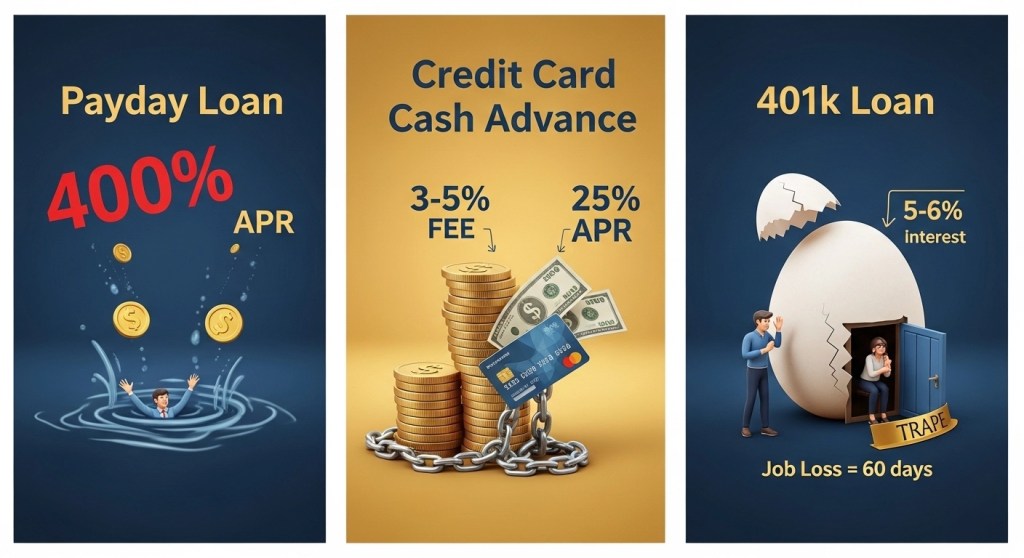
Side-by-side comparison of payday loans showing 400% APR trap, credit card cash advances showing fee stacking, and 401k loans showing double taxation and job loss risk

Alt Text: Three-panel comparison showing payday loan debt trap (400% APR), credit card cash advance fee stack (3-5% + 25% APR), and 401k loan double taxation with job loss warning

Caption: Three bad options. Three very different ways they can wreck your finances.

By Laxmi Hegde, MBA in Finance · ConfidenceBuildings.com

Three-panel comparison showing payday loan debt trap with 400% APR, credit card cash advance fee stack with 3-5% fee and 25% APR, and 401k loan with double taxation and job loss warning
Three bad options. Three very different ways they can wreck your finances

⚠ For educational purposes only. Not financial or legal advice. I hold an MBA in Finance, but I’m not your personal financial advisor. Payday lending laws, credit card terms, and 401(k) loan rules vary by state, lender, and employer plan. The IRS imposes strict rules on 401(k) loans — consult a tax professional before borrowing from retirement. If you’re in a debt cycle, contact a nonprofit credit counselor through the National Foundation for Credit Counseling (NFCC.org).

The “Least Evil” Problem

Here’s the thing about emergencies: they don’t ask permission. The car dies. The furnace stops heating. The medical bill arrives with “PAST DUE” stamped in red. And suddenly you’re not asking “What’s the best option?” You’re asking “What’s the least bad option?”

It’s like being lost in a dark forest and having to choose between three paths. One leads to quicksand. One leads to a bear trap. One leads to a cliff. Which one do you take?

This guide doesn’t pretend any of these options are good. They’re not. But one of them is mathematically less destructive than the others — and knowing which one could save you thousands.

$10,000

borrowed today could cost you $12,000 (401k loan), $15,000 (credit card), or $30,000+ (payday rollovers) over 5 years

Source: Bankrate 2026 analysis [citation:3]

The “Least Evil” Scorecard — Ranked 1 (Least Evil) to 3 (Most Evil)

Criteria 🥇 401(k) Loan 🥈 Credit Card Cash Advance 🥉 Payday Loan
Total Cost (APR + Fees) 5-6% interest [citation:1] 3-5% fee + 25-30% APR [citation:3] 300-400% APR [citation:1]
Risk to Your Future ⚠️ Job loss = 60-day repayment + taxes + 10% penalty [citation:1] ⚠️ Credit score damage if missed payments ⚠️ Bank account seizure, wage garnishment, lawsuit
Repayment Flexibility 5 years via payroll deduction [citation:4] Minimum payments, but interest compounds 2-4 weeks, lump sum [citation:1]
Default Consequences Taxed as early withdrawal + 10% penalty [citation:1] Collections, credit score drop, lawsuits Collections, wage garnishment, bank levies
Accessibility (Bad Credit) ✅ No credit check [citation:1] ✅ Already have card? Instant access [citation:1] ✅ No credit check, but at what cost? [citation:2]

🥇 401(k) loans win (least evil) — but only if you keep your job. 🥉 Payday loans lose (most evil) every time.

📊 Side-by-Side Comparison: $1,000 Borrowed

Factor Payday Loan Credit Card Cash Advance 401(k) Loan
Interest Rate 300-400% APR [citation:1] 25-30% APR [citation:3] 5-6% [citation:1]
Fees $15-30 per $100 borrowed [citation:1] 3-5% upfront fee [citation:3] $0-50 admin fee
Repayment Term 2-4 weeks (lump sum) [citation:1] Ongoing (minimum payments) Up to 5 years [citation:4]
Credit Check? No (Clarity Services) [citation:1] No (existing cardholder) No [citation:1]
Time to Fund Same day [citation:1] Instant (ATM) [citation:1] 2-5 days [citation:1]
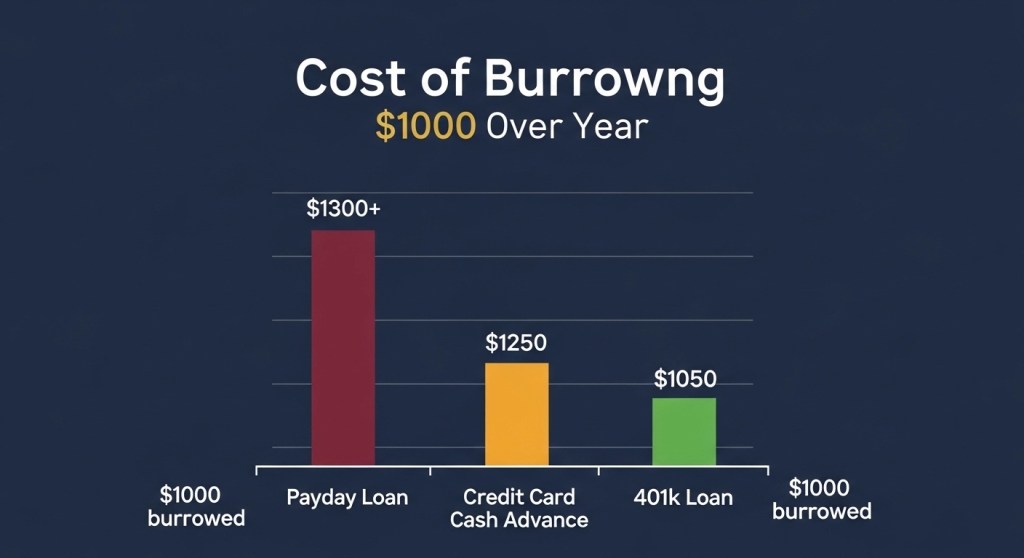
Total Cost for $1,000 (1 year) $1,300+ (if rolled over monthly) [citation:1] $1,250-300 (if minimum payments) [citation:3] $1,050-60 [citation:1]
Worst-Case Scenario Debt trap, bank account drained, lawsuit [citation:2] Credit ruined, collections Job loss = $1,000 + $250 taxes + $100 penalty [citation:1]
Bar chart comparing total cost of borrowing $1000: payday loan $1300, credit card cash advance $1250, 401k loan $1050

Alt Text: Bar chart showing $1000 loan costs over one year: payday loan $1300+, credit card cash advance $1250, 401k loan $1050 · Caption: 401(k) loans are cheaper. But cheaper doesn’t mean safe.

Bar chart showing total cost of borrowing $1000 over one year: payday loan $1300+, credit card cash advance $1250, 401k loan $1050
401(k) loans are cheaper. But cheaper doesn’t mean safe.

💰 Payday Loans: The Quicksand

Let’s be blunt: Payday loans are the worst financial product legally sold in America. The Chicago Tribune called them “quicksand of financial debt” [citation:2]. Bankrate calls them “predatory lending” [citation:3]. I call them a trap.

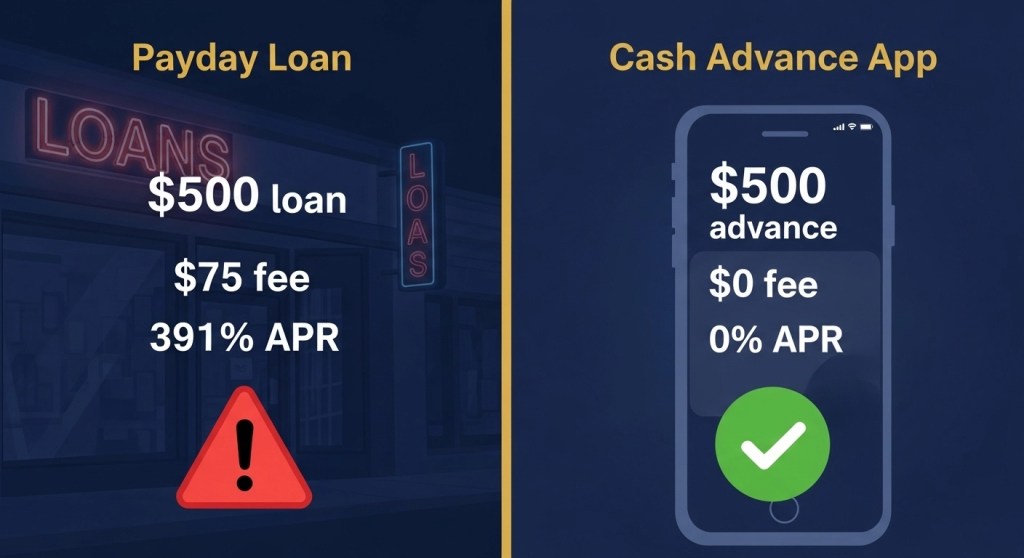
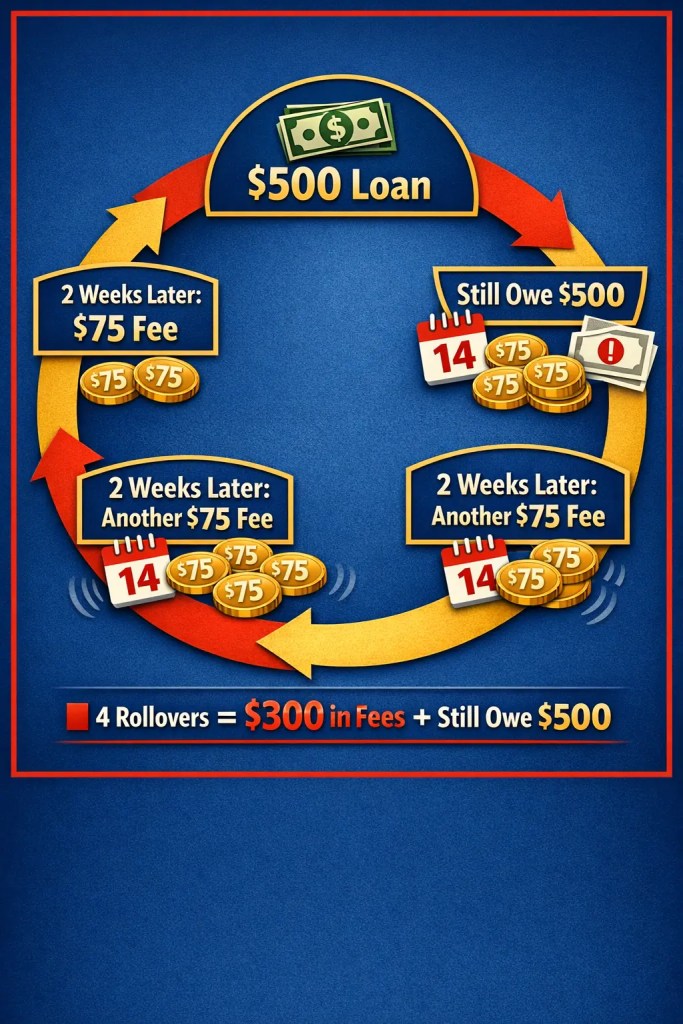
The math: Borrow $500 for two weeks. Fee: $75 (typical $15 per $100). APR: 391%. If you can’t repay in two weeks (80% of borrowers can’t), you “roll over” and pay another $75. After 4 rollovers, you’ve paid $300 in fees — and still owe $500 [citation:1].

🚨 Why It’s Evil:

  • 400% APR typical [citation:1]
  • 80% rollover rate [citation:2]
  • Lenders can drain your bank account
  • Illegal in 13 states + DC — for good reason [citation:1]
Infographic showing $500 payday loan turning into $600 in fees after 4 rollovers while still owing $500

Alt Text: Debt cycle diagram showing $500 loan → $75 fee → still owe $500 → repeat 4 times = $300 fees + $500 owed · Caption: This is by design. 80% of loans are rolled over [citation:1].

Debt cycle diagram showing $500 loan turning into $75 fee every two weeks, after 4 rollovers $300 paid in fees while still owing $500
This is by design. 80% of loans are rolled over.

💳 Credit Card Cash Advances: The Fee Stack

You have a credit card. You need cash. You walk to an ATM, swipe, and walk away with money. Easy, right? Too easy.

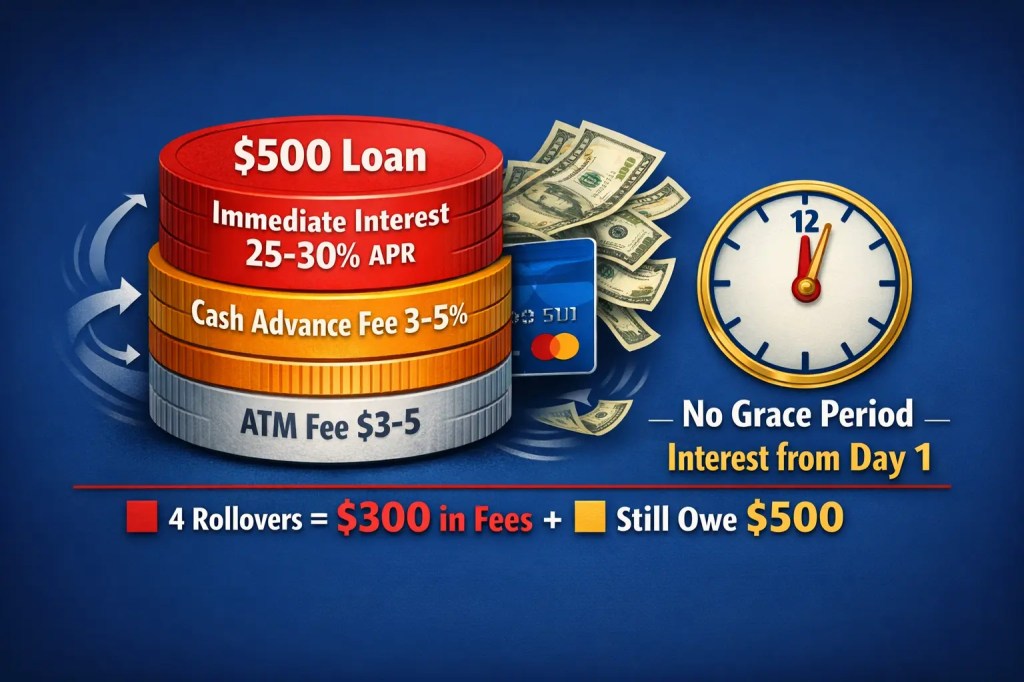
Here’s what just happened: Your credit card company charged you a 3-5% cash advance fee (that’s $30-50 on $1,000). They started charging interest immediately — no 21-day grace period like purchases. And the APR is higher than your purchase rate, typically 25-30% [citation:3].

⚠️ The Fee Stack:

  • ATM fee ($3-5) if using non-bank ATM
  • Cash advance fee (3-5% of amount) [citation:3]
  • Higher APR (25-30%) starting immediately [citation:3]
  • No grace period — interest from day 1 [citation:3]

The kicker: Bankrate notes that despite the cost, “a cash advance is safer, cheaper and more practical than a payday loan” [citation:3]. That’s not a compliment to cash advances. That’s an indictment of payday loans.

Infographic showing $500 cash advance with $3 ATM fee, $25 cash advance fee, and 25% APR interest starting immediately

Alt Text: Stack of coins showing ATM fee, cash advance fee, and immediate interest on $500 credit card cash advance · Caption: Fees stack higher than you think — but still cheaper than payday loans.

Stack of coins showing ATM fee, cash advance fee, and immediate interest on credit card cash advance with no grace period
Fees stack higher than you think — but still cheaper than payday loans.

🏦 401(k) Loans: The Retirement Robbery (That You Do to Yourself)

Here’s the twist: 401(k) loans are the “least evil” on paper — but they come with a trap door.

You borrow from yourself. Interest rates are low (5-6%) [citation:1]. You pay the interest back to your own account. No credit check. Terms up to 5 years [citation:4]. Sounds great, right?

⚠️ The Trap Door — Job Loss

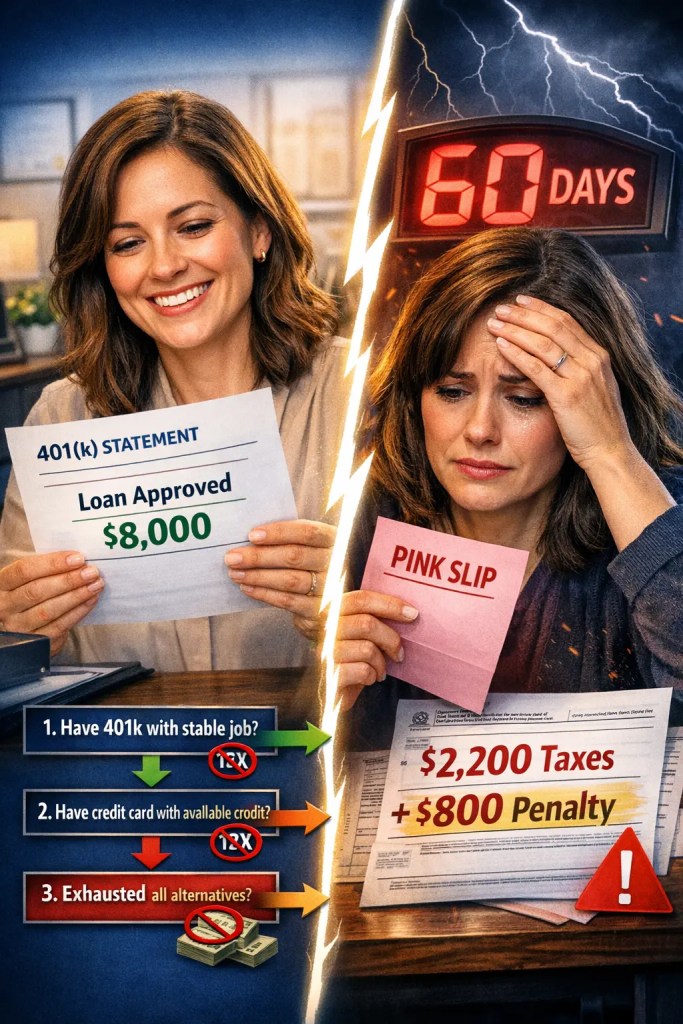
If you lose your job (or quit), the entire remaining balance is typically due within 60 days [citation:1][citation:4]. Can’t pay? The IRS treats it as an early withdrawal. You pay:

  • Income taxes on the full amount
  • 10% early withdrawal penalty (if under 59½) [citation:1]

On a $10,000 loan: That’s $2,500+ in taxes and penalties overnight — on money you already spent.

⚠️ The Double Taxation Trick

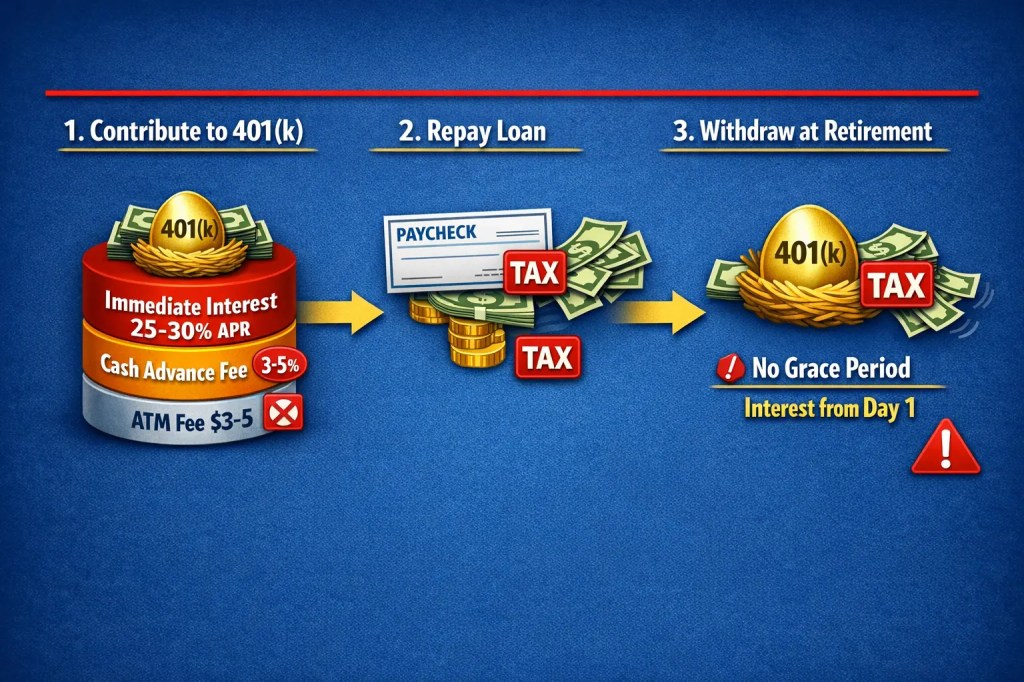
You contribute to your 401(k) with pre-tax dollars. When you repay the loan, you repay with after-tax dollars. Then when you withdraw in retirement, you pay taxes again on that same money [citation:4]. You literally pay taxes twice on the interest.

⚠️ The Missed Growth

While your money is loaned out, it’s not invested. If the market goes up 10% in a year, you missed that growth [citation:4].

Diagram showing pre-tax contribution, after-tax repayment, and tax again in retirement illustrating double taxation of 401k loan interest

Alt Text: Three-step diagram: 1) Pre-tax money goes in, 2) After-tax money repays loan, 3) Taxed again in retirement · Caption: Double taxation means you pay taxes twice on the same interest.

Three-step diagram showing pre-tax contributions to 401k, after-tax loan repayment, and taxes again in retirement illustrating double taxation
Double taxation means you pay taxes twice on the same interest.

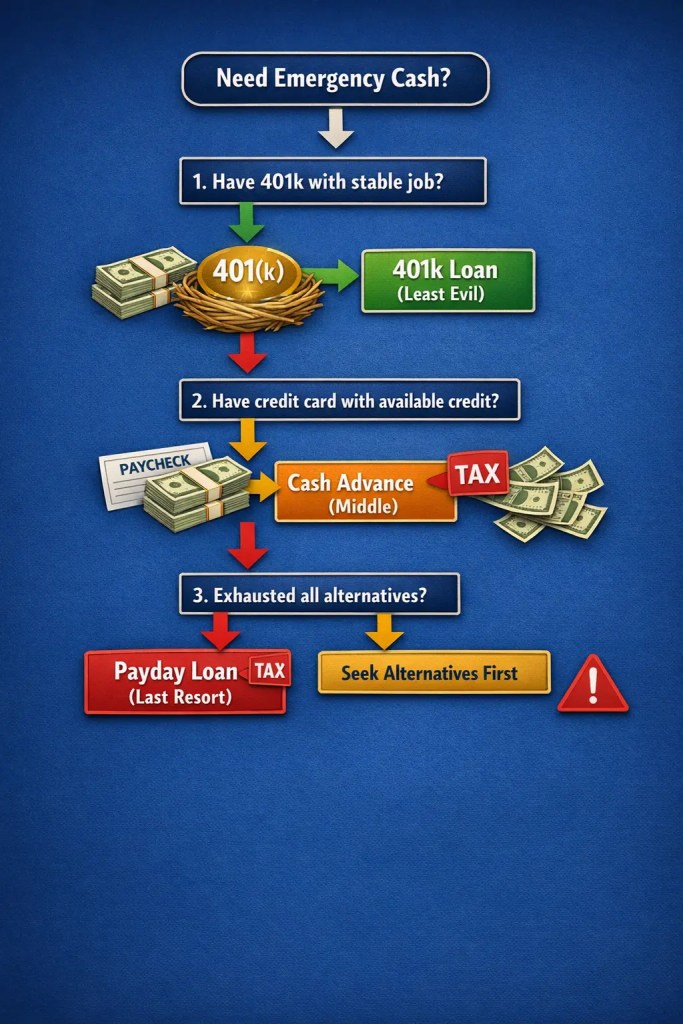
🌲 The Decision Tree: Which Path Should YOU Take?

Not everyone has access to all three options. Here’s how to choose based on YOUR situation.

Do you have a 401(k) with at least $5,000 vested?

✅ YES — and you have stable employment

401(k) loan is your least evil option — but only if you’re confident you won’t lose your job [citation:1][citation:4].

❌ NO — or your job is unstable

Do NOT risk the job loss trap. Move to next question.

Do you have a credit card with available credit?

✅ YES — and you can repay within months

Cash advance is expensive but cheaper than payday loans. Calculate total cost before proceeding [citation:3].

❌ NO — or card is maxed

You’re down to last resort territory. Move to next question.

Do you have ANY other option?

✅ YES — Credit union PAL, family loan, employer advance

Take these first. Payday loans should be absolute last resort [citation:2].

❌ NO — truly no other options

Payday loan. But borrow the absolute minimum. Have a repayment plan BEFORE you take it [citation:1].

Flowchart showing decision path: 401k loan if job stable, credit card cash advance if available, payday loan only as last resort

Alt Text: Decision tree flowchart for emergency borrowing: 401k first if job stable, credit card cash advance second if available, payday loan only as absolute last resort · Caption: Follow this path to choose the least evil option for YOUR situation.

Decision tree flowchart for emergency borrowing: 401k first if job stable, credit card cash advance second if available, payday loan only as absolute last resort
Follow this path to choose the least evil option for YOUR situation.

400%
typical payday loan APR — highest of any consumer product [citation:1]
80%
of payday loans are rolled over within 30 days [citation:1]
60
days to repay 401(k) loan after job loss or face taxes + 10% penalty [citation:1]

Frequently Asked Questions

Is a 401(k) loan really “borrowing from yourself”?

Yes — but with strings attached. You borrow your own money and pay interest back to your own account. However, you miss out on market gains while the money is out. And if you leave your job, the entire balance is typically due within 60 days. If you can’t repay, the IRS treats it as an early withdrawal: you pay income taxes plus a 10% penalty if under 59½ .

📌 Source · IRS Publication 575

Can I use a credit card cash advance at any ATM?

Yes, but you’ll need a PIN. Most credit cards allow you to set a PIN through your online account. Be aware of the costs: a cash advance fee (typically 3-5% of the amount), a higher APR (usually 25-30% vs. your purchase rate), and interest that starts accruing immediately — no grace period . ATM fees may also apply if you’re not using your bank’s machine.

📌 Citation · CFPB Credit Card Agreement Database

What happens if I default on a payday loan?

Default triggers aggressive collection practices. The lender can repeatedly attempt to withdraw funds from your bank account, causing NSF fees ($35 each) . They may sell the debt to a collector who can sue you, leading to wage garnishment or bank account levies. Unlike other loans, payday lenders often have access to your bank account from the start, making default immediate and painful.

📌 Source · FTC Debt Collection FAQs

How does double taxation work on 401(k) loans?

You contribute to a traditional 401(k) with pre-tax dollars. When you repay a loan, you repay with after-tax dollars. Then, when you withdraw that money in retirement, you pay taxes on it again . This means the interest you pay yourself is effectively taxed twice — once when you earn it to repay, and again when you withdraw in retirement. Some plans allow Roth after-tax contributions, but the double taxation issue remains complex.

📌 Citation · IRS Retirement Plan Loans

Which option is best for someone with bad credit?

If you have a 401(k), that’s your best option regardless of credit score — no credit check required. If not, a credit card cash advance is next, assuming you already have a card (no new credit check). Payday loans are available to anyone with a bank account and ID, but they’re the most expensive option by far. Consider credit union Payday Alternative Loans (PALs) which offer 28% APR caps — significantly lower than payday loans .

📌 Source · NCUA PAL Program

Can I negotiate credit card cash advance fees?

No — cash advance fees are set in your cardholder agreement and cannot be waived. The 3-5% fee is automatic and non-negotiable . However, some credit cards offer “convenience checks” with promotional rates — read the fine print carefully, as these often count as cash advances with the same fees and immediate interest.

📌 Citation · Truth in Lending Act

Are there alternatives that aren’t on this list?

Yes — and you should exhaust these first. Credit union Payday Alternative Loans (PALs) cap APR at 28% . Employer paycheck advances often have no fees. 0% APR credit cards (if you qualify) offer 12-21 months of interest-free financing. Local assistance programs (211, religious organizations, community action agencies) may provide emergency grants. Never choose any of the three options above before checking these alternatives.

📌 Source · CFPB Emergency Assistance

⚠ For educational purposes only. Not legal or financial advice. Loan terms, fees, and availability vary by state, lender, and employer plan. Always read your specific loan documents and consult a qualified professional before making financial decisions.

Reader Story · Composite Account

“I took a $8,000 401(k) loan for home repairs. Three months later, I was laid off. I had 60 days to repay $6,200 or owe $9,000 in taxes and penalties.”

David, 47, had been with his company for 12 years when he borrowed from his 401(k) to fix his roof. He felt good about it — low interest, paying himself back. Then his entire department was eliminated in a restructuring. His plan documents stated the loan balance was due within 60 days of separation. He couldn’t come up with $6,200. The IRS treated the remaining balance as an early distribution: income taxes (22% bracket) plus 10% penalty. His $8,000 loan cost him over $10,000.

HIS MISTAKE

Didn’t consider job stability. Assumed he’d stay employed. Didn’t have an emergency fund to repay if things changed.

WHAT HE COULD HAVE DONE

Explored credit union PAL loan first. Borrowed less. Had a backup plan for job loss before taking the loan.

Warning graphic showing $8000 401k loan turning into $10000 tax bill after job loss with 60-day clock

Alt Text: 401k loan warning: $8,000 borrowed → job loss → 60 days to repay or face $2,200 in taxes + $800 penalty · Caption: The trap door opens when you least expect it.

RM

Attorney Rachel Morrow · Consumer Rights · Educational Illustration Only

“The 401(k) loan job loss provision is the most misunderstood risk in personal finance. Most borrowers think ‘I’m borrowing from myself, what’s the risk?’ The risk is that a single layoff turns a manageable loan into a tax bomb. I’ve seen clients lose $5,000+ overnight because they didn’t read the fine print about separation from service.”

Legal Analysis: Under IRS Section 72(p), a 401(k) loan default due to separation from service is treated as a deemed distribution. The full outstanding balance becomes taxable income in the year of default, plus a 10% early withdrawal penalty if under 59½ . Some plans allow continued repayment after separation, but most do not. Always read your plan’s Summary Plan Description before borrowing.

Bottom Line: Only borrow from your 401(k) if your job is rock-solid — and even then, have a backup plan.

Reader Story · Public Case Record

“I took a $1,000 cash advance thinking ‘it’s just my credit card.’ Six months later, I’d paid $400 in interest and still owed $950.”

Drawn from CFPB consumer complaint records (2024). The borrower didn’t realize cash advances have no grace period and higher APRs. She made minimum payments, but most went to fees and interest. Meanwhile, her regular purchases were also accruing interest because payments typically apply to lowest-rate balances first. The cash advance balance barely budged while she paid hundreds in interest.

THE TRAP

No grace period + higher APR + payment allocation rules = cash advances are “sticky” and expensive to pay off.

WHAT TO KNOW

Pay cash advances off FIRST, before regular purchases. Better yet, avoid them unless it’s an emergency and you can repay within 1-2 months.

RM

Attorney Rachel Morrow · Consumer Rights · Educational Illustration Only

“Credit card agreements are designed to maximize profit from cash advances. The no-grace-period rule, the higher APR, and the payment allocation tricks — these aren’t accidents. They’re features. Card issuers know cash advance borrowers are often in distress, and the terms reflect that.”

Legal Analysis: Under the CARD Act, credit card issuers must apply payments above the minimum to the highest-interest balances first — but that’s only if you pay more than the minimum. Minimum payments can be applied to lowest-rate balances, letting high-rate cash advances linger. Read your cardholder agreement’s “Payment Allocation” section carefully.

Bottom Line: Cash advances are not like regular credit card purchases. Treat them as a separate, high-cost loan.

Reader Story · Success Story

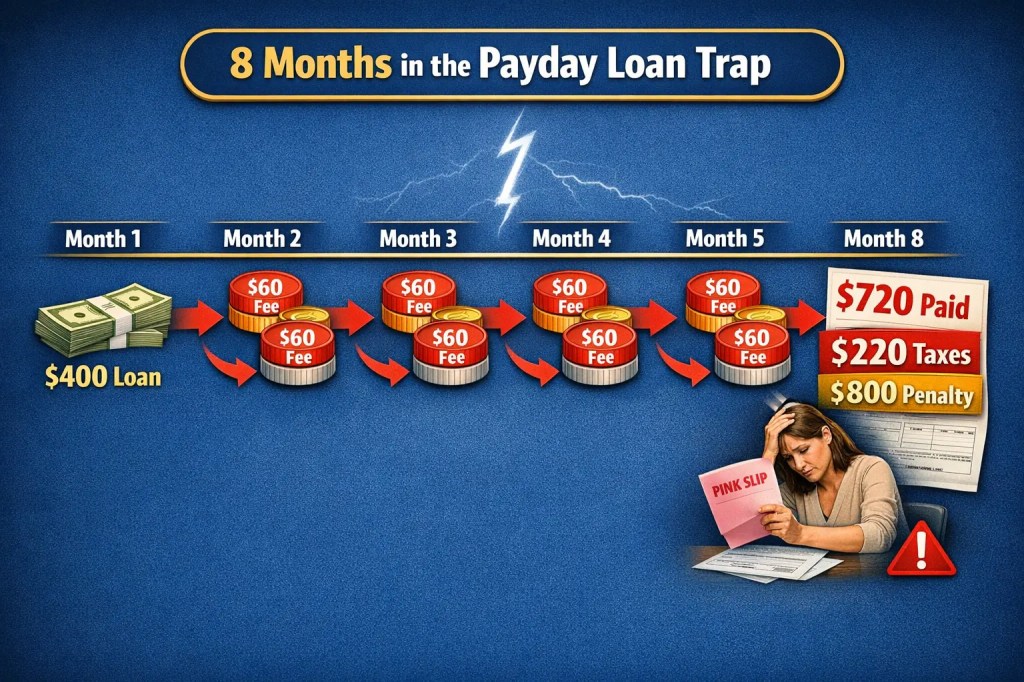
“I took a $400 payday loan for car repairs. It took me 8 months and $1,200 to finally escape. I’ll never do it again.”

Maria, 34, needed her car for work. A $400 repair felt impossible. A payday lender offered “quick cash” with “just one small fee.” She didn’t realize the fee was $60 every two weeks. When she couldn’t repay, she “rolled over” — paying $60 to extend the loan. After 8 months and 12 rollovers, she’d paid $720 in fees and still owed the original $400. A credit counselor helped her restructure, but the damage was done.

THE CYCLE

$400 loan → $60 fee every 2 weeks → 12 rollovers = $720 fees + still owe $400. 80% of borrowers experience this .

WHAT SHE WISHES SHE KNEW

Credit union PALs exist (max 28% APR). Employers offer advances. Never roll over a payday loan — it’s designed to trap you.

Infographic showing $400 payday loan turning into $720 in fees over 8 months while still owing $400

Alt Text: Debt cycle: $400 loan → $60 fee every 2 weeks → after 8 months, $720 paid in fees, still owe $400 · Caption: 8 months. $720 in fees. Still owe $400. This is by design.

RM

Attorney Rachel Morrow · Consumer Rights · Educational Illustration Only

“Payday loans are mathematically designed to fail. The average borrower earns about $30,000 a year. A $400 loan with a $60 fee seems manageable until you realize that’s 15% of your paycheck — every two weeks. The CFPB’s own data shows most payday loans are part of a long-term debt cycle, not a short-term solution.”

Legal Analysis: The CFPB’s 2017 payday rule (later rescinded) found that 80% of payday loans are rolled over within 30 days, and most borrowers end up in debt for months . Some states have capped rates at 36% (military APR cap), but in unregulated states, 400% APR is legal. Check your state’s rate caps before considering a payday loan.

Bottom Line: Payday loans are the last resort for a reason. Exhaust every other option first.

Dramatic split image showing person happy with 401k loan approval on left, devastated after job loss with 60-day clock and $3000 tax penalty on right
The trap door opens when you least expect it.

Timeline infographic showing 8 months of payday loan rollovers: $400 loan, $60 fee each month, after 8 months $720 paid in fees while still owing $400
8 months. $720 in fees. Still owe $400. This is by design.

📥 Free Download — Borrower’s Truth Series

Emergency Loan Decision Checklist

Printable 5-step decision guide to choose your “least evil” option:

✓ 5-Step Decision Tree

← Back

Thank you for your response. ✨

📥 Free Download — Borrower’s Truth Series

Emergency Loan Decision Checklist

Printable 5-step decision guide to choose your “least evil” option:

✓ 5-Step Decision Tree ✓ Cost Comparison Calculator ✓ Job Loss Risk Assessment ✓ State Rate Cap Lookup
⬇ Download Free Checklist →

Free · No sign-up required · ConfidenceBuildings.com · Pairs with Episode 14

🗺️ Know Your State’s Rate Caps

Your location determines which options are legal and what interest rates apply. Here’s where to check your state’s rules:

📌 Source · Official State Regulator Websites & NCSL

💬 Final Thoughts — Laxmi Hegde, MBA in Finance

Here’s the uncomfortable truth I’ve learned researching this series: When you’re in a financial emergency, there are no good options — only less destructive ones. The system is designed that way. Payday lenders profit from your desperation. Credit card companies structure cash advances to maximize fees. Even 401(k) loans, which seem like “borrowing from yourself,” have trap doors hidden in the fine print.

The goal of this guide isn’t to make you feel hopeless. It’s to arm you with the truth so you can choose with open eyes. If you must borrow, borrow from your 401(k) only if your job is stable. Use a credit card cash advance only if you can repay in months, not years. And payday loans? They’re not loans — they’re traps. Treat them as the absolute last resort, and only if you have a rock-solid repayment plan before you sign.

Tomorrow in Episode 15, we dive into the fine print of loan contracts — the clauses lenders hope you never find. Because knowing the truth is the only way to protect yourself.

🔬 Research Note & Primary Sources

This article is part of the Borrower’s Truth Series, a 30-day educational series by Laxmi Hegde, MBA in Finance. All statistics are drawn from government agencies and primary research institutions as of March 2026.

Primary Sources:

  • Consumer Financial Protection Bureau — Payday Loan Data & Cash Advance Studies
  • Federal Trade Commission — Debt Collection Practices Act & Enforcement Actions
  • Internal Revenue Service — Publication 575: Pension and Annuity Income
  • National Credit Union Administration — Payday Alternative Loan (PAL) Program
  • Bankrate — 2026 Credit Card & Payday Loan Rate Surveys
  • The Pew Charitable Trusts — Small Dollar Loans Project
  • National Conference of State Legislatures — Payday Lending State Statutes
  • Chicago Tribune / Terry Savage — Consumer Finance Column (2025-2026)
  • The Motley Fool — 401(k) Loan Analysis (2025)

For the complete Borrower’s Truth Series guide, visit: The Complete Borrower’s Truth Guide → ConfidenceBuildings.com

📚 Emergency Borrowing Blueprint 2026 — 14 of 30 Episodes Complete

Week 1: Basics ✓ Week 2: Predatory Lenders (Ep 8-14) ✓ Week 3: Fine Print Files (Ep 15-21) Week 4: After You Borrow (Ep 22-30)

All episodes available at Emergency Borrowing Blueprint 2026

📅 Published March 14, 2026 · Updated as part of the ConfidenceBuildings.com 2026 Consumer Finance Research Project. This post is Episode 14 of 30 in the Borrower’s Truth Series, examining emergency borrowing, predatory lending practices, and consumer financial rights. All data verified as of March 2026. For educational purposes only. Not financial or legal advice.

Your Loan Is ‘Due’ — But the Trap Is Just Getting Started

Borrower’s Truth Series — 30 Days
Day 21 of 30 — 70% Complete
1 2 3 4 5 6 7 8 9 10 11 12 13 14 15 16 17 18 19 20 21 22 23 24 25 26 27 28 29 30
Week 3 — The Fine Print Files  ·  View All 30 Days →

Week 3 — The Fine Print Files · Day 21 of 30

Your Loan Is ‘Due’ —
But the Trap Is Just Getting Started

Lenders call it a “renewal offer.” What it actually does is reset your debt clock, add new fees, and lock you into another cycle — all while sounding like they’re doing you a favour.

80%
of payday loans are rolled over or renewed within 14 days
Source: CFPB
$520
average fees paid by borrowers who renew a $375 loan repeatedly
Source: CFPB
5 mos
median time borrowers stay in payday loan debt per year
Source: CFPB
What You’ll Learn Today
  • How loan renewal offers are designed to trap — not help — you
  • The exact language lenders use to make renewal sound reasonable
  • What the “evergreen clause” is and how to spot it in your contract
  • The fee math that makes renewal the most expensive decision you can make
  • Three steps to refuse renewal and exit the cycle instead

For educational purposes only. Not legal advice. The information on this page is intended to help consumers understand how loan renewal offers work. Laws governing loan renewals, rollovers, and extended payment plans vary significantly by state and lender. Always verify current terms directly with your lender and consult a licensed financial counselor or attorney before making any borrowing decision. The CFPB and FTC are referenced for informational purposes only — neither agency endorses this content.

📚 Borrower’s Truth Series — Week 3 of 5

The Fine Print Files

You found the loan. You signed the agreement. But buried in that contract are clauses lenders wrote for their benefit — not yours. Week 3 goes through the fine print that has cost borrowers thousands, one clause at a time. Today we cover the renewal trap: the mechanism that turns a short-term loan into months of debt.

⭐ Essential Reading — Start Here

Before You Sign Anything — Use This Checklist

The Loan Clause Checklist identifies the exact clauses lenders hope you never find — including the renewal and evergreen clauses covered in today’s post. It takes 10 minutes to use and could save you hundreds. Free. No email required.

What’s Inside
  • The auto-renewal / evergreen clause — exact wording to search for
  • Mandatory arbitration clause — what it removes from your rights
  • Prepayment penalty — how to find it before you sign
  • ACH authorization language — what lenders can pull from your account
  • 10 more clauses with plain-English translations
📋 Open the Free Checklist →

📌 Quick Answer

A loan renewal offer is when a lender contacts you near your due date and offers to extend — or “renew” — your loan for another term. It sounds helpful. What it actually does is wipe out any progress you’ve made, charge a fresh round of fees, and restart your repayment clock from zero. Most borrowers who accept one renewal accept several. That is not an accident — it is the business model.

How the Renewal Trap Works

Here is the scenario that plays out millions of times every year. You took out a $400 payday loan two weeks ago. Your due date is tomorrow. The lender sends you a text — sometimes an email, sometimes a phone call — letting you know your loan is coming due. Then comes the offer: “Would you like to renew for another two weeks? Just a small fee.”

The “small fee” is typically $15–$20 per $100 borrowed. On a $400 loan, that is $60–$80. You never touch the principal. You pay $60 to buy yourself two more weeks — and in two more weeks, the same offer arrives again.

The Real Cost of “Just One More Renewal” — $400 Loan at $15/$100
Renewal # Fee Paid Total Fees Paid Still Owe
Original loan $60 $60 $400
Renewal 1 $60 $120 $400
Renewal 2 $60 $180 $400
Renewal 3 $60 $240 $400
Renewal 4 $60 $300 $400

After 4 renewals you have paid $300 in fees and still owe every dollar of the original $400. The lender has collected 75% of the loan value in fees alone — without reducing your balance by a single cent.

The Evergreen Clause — The Fine Print That Renews You Automatically

Some lenders do not even bother making an offer. They include an evergreen clause — also called an auto-renewal clause — directly in the loan agreement. Unless you take a specific action to cancel before your due date, the loan renews automatically and a new fee is charged to your account.

Most borrowers never see this clause because it appears deep in the agreement — sometimes on page 4 or 5 of a document most people never finish reading. The cancellation window is often just 3–5 days before the renewal date, which means by the time you realise what happened, the fee has already been processed.

⚠ What the Evergreen Clause Looks Like in Plain English

Loan agreements rarely use the word “evergreen.” Instead, look for language like:

  • “This loan will automatically extend unless written notice is provided…”
  • “Borrower authorises renewal of this agreement at the end of each term…”
  • “Failure to repay in full will result in automatic rollover…”
  • “Renewal fee will be debited on the due date unless cancellation is requested…”

📋 The Loan Clause Checklist shows you exactly where to look for this language in your agreement.

The Language Lenders Use — And What It Actually Means

Renewal offers are carefully worded to sound like customer service. Here is a translation guide for the most common phrases:

What They Say
“We’re giving you more time to repay.”
What It Means
We’re charging you another fee to delay the same problem by two weeks.
What They Say
“Just a small renewal fee to stay current.”
What It Means
$60–$80 that vanishes with zero reduction to your principal balance.
What They Say
“You’re pre-approved for an extended term.”
What It Means
Our algorithm flagged you as likely to renew — and we want that fee revenue.
What They Say
“Renewing helps protect your credit.”
What It Means
Most payday lenders don’t report to credit bureaus anyway — this is a scare tactic.

Three Steps to Refuse Renewal and Exit the Cycle

Accepting a renewal is always optional — even when it doesn’t feel that way. Here is the three-step process to decline and start reducing the actual balance instead.

1
Ask Your Lender About an Extended Payment Plan (EPP)

Many states legally require payday lenders to offer an Extended Payment Plan — a structured repayment schedule that lets you pay back the principal over multiple instalments with no additional fees. Lenders are not required to advertise this option. You must ask for it directly, in writing, before your due date. Search “EPP + [your state]” or check your state’s financial regulator website to confirm whether your lender is required to offer one.

2
Revoke ACH Authorization Before the Renewal Date

If your lender has electronic access to your bank account — which most payday lenders do — they can process a renewal fee without your active consent if an evergreen clause ex

Reader Story · Composite Account
“I Thought One Renewal Would Fix Everything”

Marcus, 34, took out a $350 payday loan in October to cover a car repair. When the due date arrived he was $200 short, so he accepted the lender’s renewal offer — just this once, he told himself. The renewal fee was $52.50. Two weeks later, still short, he renewed again. By January he had paid $262 in renewal fees and still owed the original $350. The loan he thought would last two weeks had lasted three months.

His Mistake

Marcus never asked his lender about an Extended Payment Plan. In his state, the lender was legally required to offer one — but never mentioned it. A single phone call before his first due date could have restructured his repayment with no additional fees.

What He Could Do

Contact the lender in writing requesting an EPP. Simultaneously revoke ACH authorization with his bank to prevent automatic renewal charges. Make a $100 partial payment toward principal to reduce the renewal fee base while the EPP request is processed.

RM
Attorney Rachel Morrow
Consumer Rights Attorney · Educational Illustration Only

“The Extended Payment Plan is one of the most powerful and least-used protections available to payday loan borrowers. In states where it is legally mandated, lenders are required to offer it — but they are not required to tell you it exists. That asymmetry of information costs borrowers millions of dollars every year.”

<div style="background:rgba(21,101,192,0.10);border-radius:8px;padding:16px
Reader Story · Composite Account
“I Thought One Renewal Would Fix Everything”

Marcus, 34, took out a $350 payday loan in October to cover a car repair. When the due date arrived he was $200 short, so he accepted the lender’s renewal offer — just this once, he told himself. The renewal fee was $52.50. Two weeks later, still short, he renewed again. By January he had paid $262 in renewal fees and still owed the original $350. The loan he thought would last two weeks had lasted three months.

His Mistake

Marcus never asked his lender about an Extended Payment Plan. In his state, the lender was legally required to offer one — but never mentioned it. A single phone call before his first due date could have restructured his repayment with no additional fees.

What He Could Do

Contact the lender in writing requesting an EPP. Simultaneously revoke ACH authorization with his bank to prevent automatic renewal charges. Make a $100 partial payment toward principal to reduce the renewal fee base while the EPP request is processed.

RM
Attorney Rachel Morrow
Consumer Rights Attorney · Educational Illustration Only

“The Extended Payment Plan is one of the most powerful and least-used protections available to payday loan borrowers. In states where it is legally mandated, lenders are required to offer it — but they are not required to tell you it exists. That asymmetry of information costs borrowers millions of dollars every year.”

Frequently Asked Questions — Loan Renewal Trap
All answers include citations from U.S. government sources
Q: Is a lender allowed to automatically renew my loan without my permission?

It depends on what you signed. If your loan agreement contains an evergreen or auto-renewal clause — and you agreed to ACH authorization — then the lender may have the contractual right to renew and debit your account automatically. However, you retain the right under the Electronic Fund Transfer Act to revoke ACH authorization at any time by notifying your bank in writing at least three business days before the scheduled transfer. State law may also impose additional restrictions on automatic renewals — check your state’s financial regulator website for current rules.

📌 Citation · Federal Reserve / CFPB
consumerfinance.gov — How to stop automatic payments →
⚠ For educational purposes only. Not legal advice.
Q: What is an Extended Payment Plan and does my lender have to offer one?

An Extended Payment Plan (EPP) allows a borrower to repay their payday loan balance in multiple instalments — typically four equal payments over four pay periods — without additional fees or interest. Whether your lender is required to offer an EPP depends entirely on your state. States including Florida, Washington, Indiana, Michigan, and Illinois have specific EPP mandates. Lenders in these states must offer an EPP if requested before the loan due date — but they are under no obligation to proactively inform borrowers the option exists. Contact your state’s financial regulatory agency or the CFPB to confirm your state’s current requirements.

⚠ For educational purposes only. Not legal advice.
Q: How many times can a lender renew my payday loan?

Federal law does not cap the number of times a payday loan can be renewed. State law varies significantly. Some states — including Ohio and Colorado — have enacted strict rollover limits or outright bans. Other states impose no limit at all, meaning a lender can legally renew a loan indefinitely as long as the borrower continues to pay the renewal fee. The CFPB has documented cases where borrowers renewed the same loan more than ten times, paying more in fees than the original loan amount while never reducing the principal balance.

📌 Citation · CFPB Research Report
consumerfinance.gov — Payday Loans Research Report →
⚠ For educational purposes only. Not legal advice.
Q: What happens to my credit score if I refuse a renewal and can’t pay?

Most payday lenders do not report routine loan activity to the three major credit bureaus — meaning on-time payments typically do not build credit, and renewals do not appear on your report. However, if you default and the lender sells your debt to a collections agency, that collection account will appear on your credit report and can significantly damage your score. Refusing a renewal is not itself a credit event. Defaulting and entering collections is. This is why pursuing an EPP or negotiating directly with the lender is strongly preferable to simply stopping payment.

⚠ For educational purposes only. Not legal advice.
Q: Where can I report a lender who renewed my loan without my consent?

You have three reporting options. First, file a complaint with the CFPB at consumerfinance.gov/complaint — the bureau contacts the lender directly and requires a response. Second, report to the FTC at reportfraud.ftc.gov — particularly relevant if the lender misrepresented renewal terms. Third, file a complaint with your state’s financial regulatory agency — in many states this is the Department of Financial Institutions or the Office of the Attorney General. Keep records of all communications, payment receipts, and your original loan agreement before filing any complaint.

📌 Citation · CFPB Complaint Center
consumerfinance.gov/complaint — File a complaint →
⚠ For educational purposes only. Not legal advice.

💬 Final Thoughts — Laxmi Hegde, MBA

The renewal offer always arrives at exactly the right moment — when you are stressed, short on cash, and the due date is tomorrow. That timing is not coincidence. Lenders know from data that borrowers in that specific window are least likely to explore alternatives and most likely to say yes. Understanding that the offer is engineered for that moment is the first step to not falling for it.

What strikes me most about the renewal trap is how invisible it is made to feel. Borrowers consistently tell me they thought renewal was the only option — that there was no other path. Nobody told them about EPPs. Nobody explained they could revoke ACH authorization. The information exists. It is just never volunteered by the person who profits from you not having it.

If you are reading this because you are currently in a renewal cycle — you are not stuck. The cycle feels permanent because each renewal resets the clock and makes the exit feel just as far away as it did two weeks ago. It is not. An EPP request, a call to a nonprofit credit counsellor, or even a partial payment toward principal breaks the pattern. The lender is counting on you not knowing that. Now you do.

Tomorrow in Day 22 we move into Week 4 — After You Borrow. We start with the one topic I get asked about more than any other: how to actually escape the payday loan cycle for good. The exit strategy is real, it is specific, and it is coming tomorrow.

LH
Laxmi Hegde
MBA in Finance · ConfidenceBuildings.com
Borrower’s Truth Series · Day 21 of 30

🔬 Research Note & Primary Sources

This post is part of the ConfidenceBuildings.com 2026 Finance Research Project — a 30-episode series examining emergency borrowing, predatory lending practices, and consumer financial rights. All statistics and legal references are drawn from U.S. government sources and primary regulatory documents. No lender partnerships, affiliate relationships, or sponsored content of any kind has influenced this material.

Primary Sources Used in This Post
Consumer Financial Protection Bureau — Payday Loans and Deposit Advance Products
consumerfinance.gov/data-research/research-reports/payday-loans-and-deposit-advance-products/
CFPB — How to Stop Automatic Payments From Your Bank Account
consumerfinance.gov/ask-cfpb/how-do-i-stop-automatic-payments-from-my-bank-account-en-2023/
CFPB — What to Do If You Can’t Repay Your Payday Loan
consumerfinance.gov/ask-cfpb/what-should-i-do-if-i-cant-repay-my-payday-loan-en-1597/
CFPB — Submit a Complaint
consumerfinance.gov/complaint/
Federal Trade Commission — Report Fraud
reportfraud.ftc.gov
National Foundation for Credit Counseling — Find a Counsellor
nfcc.org

This post is one of 30 deep

← Previous · Day 20
Medical Debt Survival Guide
What hospitals don’t tell you — and what you can actually negotiate
Next · Day 22 →
How to Stop the Payday Loan Cycle
The 3-step exit strategy — publishing tomorrow

Quick Access — All 30 Days
Borrower’s Truth Series · ConfidenceBuildings.com
Weeks 4 & 5 — Coming Soon
Day 22
Day 23
Day 24
Day 25
Day 26
Day 27
Day 28
Day 29
Day 30

🔬 Research & Publication Note

Updated as part of the ConfidenceBuildings.com 2026 Finance Research Project. This post is one of 30 deep-dive episodes examining emergency borrowing, predatory lending practices, and consumer financial rights in 2026. All statistics referenced in this post are drawn from U.S. government sources including the Consumer Financial Protection Bureau and the Federal Trade Commission. No lender partnerships, affiliate relationships, or paid placements of any kind have influenced this content.

Information is current as of March 2026. Lending laws, state EPP requirements, and CFPB regulations change frequently — always verify current rules directly with your state’s financial regulator or the CFPB before making any borrowing decision.

← Back

Thank you for your response. ✨

Variable Rate Loans: Why Your Monthly Payment Could Suddenly Skyrocket

Week 3 — The Fine Print Files  ·  Day 17

Variable Rate Loans:

Why Your Monthly Payment Could Suddenly Skyrocket

Index Rate
SOFR
Market sets this
+
Margin
+3–8%
Lender sets this
=
Your Rate
???%
Changes anytime

The hidden risk: Some variable rate loans have NO cap — meaning there is no legal limit on how high your payment can climb.

ConfidenceBuildings.com  ·  Borrower’s Truth Series  ·  For educational purposes only. Not legal advice.

⚠ For educational purposes only. Not legal advice. This content is intended to help borrowers understand how variable rate loan terms work in general. Loan agreements vary by lender, state, and loan type. Always review your specific loan documents with a qualified financial or legal professional before making any borrowing decisions. Laws and regulations referenced are subject to change.

📍 Borrower’s Truth Series — Your Progress
30-day guide to borrowing with confidence · You are on Day 17 of 30
57%
Complete
Published
You are here
Coming soon

⭐ Essential Reading — Start Here

Before You Read Any Further — Have You Done The Clause Checklist?

Day 15 is the most important post in this series. It gives you the exact loan clauses to find — and what to do when you find them. Every post in Week 3 builds on it. If you haven’t read it yet, start there first.

Read Day 15: Loan Clause Checklist →
15
Day
Lead Magnet

Borrower’s Truth Series Week 3 · Day 17 of 30

Welcome to Week 3: The Fine Print Files — where we pull back the curtain on the clauses buried in your loan agreement that lenders legally use against you.

Today’s topic: variable rate loans. You were sold a lower starting rate. What you may not have been clearly told is that the rate — and your monthly payment — can increase at any time, sometimes dramatically, based on a formula you never negotiated.

This post breaks down exactly how that formula works, what fine print to look for before you sign, and what real borrowers have faced when rates moved against them.

📘 Yesterday (Day 16): You Signed Away Your Right to Sue  |  📗 Tomorrow (Day 18): Auto-Pay Loan Traps

The Low Rate They Showed You — And What They Didn’t

When a lender offers you a variable rate loan, the pitch is almost always the same: “You can start at a much lower rate than a fixed loan.” And that part is true. Variable rate loans typically open with a lower interest rate than comparable fixed-rate products. That lower rate feels like a win. It makes your monthly payment smaller, your loan more affordable, and the decision easy.

What the pitch rarely includes in plain language: that starting rate is temporary. It is tied to forces entirely outside your control — and when those forces move, your payment moves with them. No negotiation. No approval from you. Just a new, higher number on your statement.

📌 Quick Answer

A variable rate loan starts with a lower interest rate, but that rate is calculated using a market index plus a lender-set margin. When the index rises, your payment rises — often automatically, with no option to object. Some loans include no cap on how high the rate can climb.

5%
Max Lifetime Cap

A typical ARM may allow your rate to rise up to 5 percentage points over the life of the loan — even with a cap. On a $20,000 personal loan, that can add hundreds of dollars per month to your payment.

Source: CFPB Regulation Z, §1026.19 — For educational purposes only. Not legal advice.

The Formula Your Lender Controls — But Didn’t Explain

Every variable rate loan uses a two-part formula to calculate your interest rate. Understanding this formula is the single most important thing you can do before signing a variable rate loan agreement.

How Your Variable Rate Is Actually Calculated

1
The Index — Set By the Market

This is a publicly published interest rate your lender uses as a baseline. Common indexes include:

SOFR
Secured Overnight Financing Rate — replaced LIBOR
Prime Rate
Set by large U.S. banks, moves with Federal Reserve
CMT
Constant Maturity Treasury — used in many ARMs
T-Bill Rate
91-day Treasury Bill rate — used for federal student loans

The lender chooses which index your loan uses — and that choice is locked in at closing. You cannot change it later.

2
The Margin — Set By Your Lender

The margin is a fixed percentage your lender adds to the index. It is their profit. It is set at the beginning of your loan and does not change — but it varies significantly between lenders and you can try to negotiate it.

Example: SOFR (4.36%) + Margin (3.50%) = Your Rate: 7.86%
If SOFR rises to 5.50%: + Margin (3.50%) = Your Rate: 9.00%
That jump = +$87/mo on a $15,000 loan

What competitors don’t tell you: The CFPB confirms you can negotiate the margin, just like you negotiate a fixed rate. Most borrowers never try.

Index + Margin = Your Interest Rate
This changes every adjustment period. You don’t vote on it. You just pay it.

Source: CFPB Ask-CFPB · For educational purposes only. Not legal advice.

📌 Quick Answer

Your variable rate equals a public market index (like SOFR or the prime rate) plus your lender’s margin. The index changes based on the economy. The margin is set by your lender at closing and stays fixed. You can negotiate the margin before signing — but almost no one does because lenders don’t volunteer this fact.

The 5 Clauses Hidden in Variable Rate Loan Fine Print

Here is what your competitors’ “fixed vs variable” articles won’t tell you. These five clauses determine whether a variable rate loan is manageable — or a trap. None of them are illegal. All of them favor the lender.

Clause 1

Periodic Rate Cap

What it says: Limits how much your rate can increase per adjustment period (e.g., no more than 2% per year).

The catch: A 2% annual cap sounds safe — but on a $20,000 loan, that’s hundreds more per month, every year, until you hit the lifetime cap.

Clause 2 ⚠

Lifetime Rate Cap (or None)

What it says: Sets the maximum your rate can ever reach over the life of the loan. Typical caps: +5% over the starting rate.

The danger: Some loans — especially personal loans and lines of credit — have no lifetime cap at all. Rates can theoretically climb without limit. Always ask: “What is the maximum rate I could ever pay?”

Clause 3 🚨

Upward-Only Clause

What it says: The interest rate can only increase — never decrease — regardless of what the market index does.

What this means for you: If the prime rate drops 1.5%, your rate stays exactly where it is. You get all the downside of a variable rate with none of the upside. The CFPB notes this clause exists and recommends asking lenders what benefit you receive for accepting it. (CFPB source ↗)

Clause 4 🔒

Rate Carryover (Foregone Interest)

What it says: If a rate cap prevents the full increase this period, the lender can “bank” the difference and apply it in a future adjustment.

Translation: Your cap “protected” you this year — but the lender stored that increase. They can hit you with a larger jump in a future period. Protection today can become a bigger shock tomorrow.

Clause 5

Adjustment Frequency

What it says: Specifies how often your rate can change — monthly, every 6 months, annually, etc.

Why it matters: A monthly adjustment (common in HELOCs and some personal loans) means your payment can change 12 times per year. An annual adjustment gives you more time to plan — but the single yearly jump can be larger.

📌 Quick Answer

Five clauses define how dangerous your variable rate loan is: periodic cap (per-period limit), lifetime cap (or no limit at all), upward-only clause (rate can never decrease), rate carryover (banked increases applied later), and adjustment frequency (how often your payment changes). All five are legal. None are required to be explained at signing.

Use Ctrl+F on Your Loan Agreement — Search These Exact Terms

Before you sign any variable rate loan agreement, open the document and search for these exact terms. What you find — or don’t find — tells you everything about the risk you’re taking on.

Search This Term What to Look For Red Flag If You See
index Which market rate your loan is tied to No specific index named — “at lender’s discretion”
margin The fixed % your lender adds to the index Margin over 6% — compare with other lenders
rate cap or interest rate cap Maximum the rate can rise per period and over life No cap stated — this means no limit on increases
floor or minimum rate Lowest your rate can ever go High floor (e.g. 8%) — you’ll never benefit if rates drop
only increase or upward only Whether rate is permitted to decrease Any language confirming rate can only go up, never down
carryover or foregone interest Whether banked rate increases exist Carryover permitted — future adjustments can be larger
adjustment period How often the rate can change Monthly adjustment — payment changes up to 12x/year
negative amortization Whether unpaid interest can be added to principal Permitted — your balance can GROW even as you pay
prepayment penalty Fee for paying off the loan early Penalty exists — you can’t easily escape if rates spike

For educational purposes only. Not legal advice. Always have your specific loan agreement reviewed by a qualified professional.

What a Rate Increase Actually Does to Your Monthly Payment

Numbers make this real. Here is what the Index + Margin formula and a rate adjustment look like in actual dollars — using realistic loan amounts for everyday borrowers.

Monthly Payment Impact When Rates Rise — Real Numbers

Loan Amount At 7% Rate At 9% (+2%) At 12% (+5%) Max Extra/Mo
$10,000 (3yr) $309/mo $318/mo $332/mo +$23/mo
$20,000 (5yr) $396/mo $415/mo $444/mo +$48/mo
$50,000 HELOC $990/mo $1,040/mo $1,111/mo +$121/mo
$200,000 ARM $1,330/mo $1,514/mo $1,776/mo +$446/mo

Approximate calculations for illustrative purposes. Actual payments vary based on loan terms, amortization schedule, and lender. For educational purposes only. Not legal advice.

📊 Stat Callout

On a 30-year ARM mortgage, a 5-percentage-point lifetime cap can raise the monthly payment from roughly $106 to $145 on every $10,000 borrowed — a 37% increase. Scaled to a $200,000 mortgage, that’s hundreds more per month for the same home. Source: CFPB Appendix H Model Disclosure ↗ — For educational purposes only. Not legal advice.

“To understand why a 2% or 5% increase is more dangerous than it sounds, look at the total interest cost shift in the table below:”

📊 The “Skyrocket” Effect: $5,000 Loan

Interest Rate: 10% (Starting) 18% (Reset)
Monthly Payment: $161.34 $180.35
Total Interest: $808.00 $1,492.00
*Calculated over 36 months. A small rate hike can nearly double your total interest cost.

Real Stories: When Variable Rate Loans Turned

STORY 1 — COMPOSITE CASE Based on CFPB consumer complaint patterns

“I Thought I Understood It. The Statement Proved Me Wrong.”

Priya took out a $25,000 home improvement loan with a variable rate tied to the prime rate. Her starting rate was 6.5% — almost 2 points below what a fixed loan would have cost her. Her loan officer mentioned “the rate could adjust,” but the conversation moved quickly to monthly payment figures and signing.

Eighteen months later, after two Federal Reserve rate increases, her rate had moved to 9%. Her monthly payment jumped by $94. She called the lender. She was told this was in the agreement she signed.

Her mistake: She searched the loan agreement for the word “rate” — but not for “index,” “margin,” or “adjustment period.” She found the starting rate. She never found the formula that determined every rate after it.

What she could do: File a complaint with the CFPB at consumerfinance.gov/complaint if she believes the adjustment terms were not properly disclosed under TILA. She could also ask her lender about refinancing options — especially if her credit had improved since origination.

RM
Attorney Rachel Morrow
Consumer Rights Attorney — Fictional character for educational illustration only

“The disclosure was technically compliant. That doesn’t mean it was understandable. TILA requires lenders to disclose variable rate terms — but it doesn’t require them to explain in plain English what those terms mean to your budget.”

In Priya’s situation, the question isn’t whether the lender broke the law — it’s whether the required disclosures were provided in a way a reasonable person could understand. The CFPB’s TILA regulations require specific disclosures about index, margin, caps, and adjustment frequency. If those disclosures were missing or misleading, that’s a potential complaint. What’s far more common, however, is that disclosures exist but are buried in a multi-page document and presented alongside the signing paperwork without adequate explanation.

Bottom Line: The law requires disclosure. It does not require comprehension. That gap is where most variable rate borrowers get hurt — and it’s precisely why you need to read the Ctrl+F terms in this post before signing.

STORY 2 — PUBLIC CASE RECORD 2008–2009 ARM Mortgage Crisis Patterns / CFPB Enforcement Record

The Adjustable-Rate Mortgage Crisis: When Millions Saw This Happen at Once

The single largest documented case of variable rate loans “turning” on borrowers is the 2007–2009 U.S. mortgage crisis. Millions of homeowners had taken out adjustable-rate mortgages (ARMs) — often 2/28 or 3/27 structures — where a low fixed rate held for 2–3 years, then reset to a variable rate.

When the reset hit, monthly payments jumped by hundreds of dollars — sometimes 30–50% higher. Borrowers who had been making payments on time suddenly couldn’t. Many had no rate caps, or caps too high to provide meaningful protection. This was not a coincidence or bad luck. It was the variable rate mechanism operating exactly as written.

The mistake made by millions: Focusing on the introductory payment — not on what the payment would become at reset. The reset terms were disclosed. Few read them carefully enough to understand the dollar impact on their specific loan.

What borrowers recovered: Those who filed CFPB complaints about missing or misleading ARM disclosures, or who refinanced into fixed-rate FHA loans during the government response period, often reduced their payments by hundreds per month. The lesson the regulators took: variable rate disclosures need to be clearer. The CHARM booklet requirement for ARMs was strengthened as a result. CFPB ARM resource ↗

RM
Attorney Rachel Morrow
Consumer Rights Attorney — Fictional character for educational illustration only

“The 2008 crisis was not primarily a story of illegal lending. It was a story of legal lending that most borrowers did not understand. The ARM structure was disclosed. The math was disclosed. The outcome was predictable. The borrowers just weren’t equipped to predict it.”

This is why the CFPB now requires lenders to provide the CHARM (Consumer Handbook on Adjustable Rate Mortgages) booklet to any borrower considering an ARM. It’s also why today’s post exists. The same mechanism that wrecked millions of homeowners is still operating in personal loans, HELOCs, private student loans, and business lines of credit. It is not ancient history. It is this week’s loan offers.

Bottom Line: Variable rate risk is systemic and documented. Regulators have tried to add guardrails. But the borrower who reads the loan agreement carefully is still the primary line of defense.

STORY 3 — COMPOSITE CASE Upward-only clause / private student loan pattern

“The Rate Never Went Down — Even When Rates Were Falling Everywhere”

Darnell refinanced $32,000 in private student loans into a new variable rate product at 7.2% in 2022. The loan featured a prime rate index. Between 2023 and early 2024, while the Federal Reserve paused rate hikes, Darnell expected his rate to stabilize — or perhaps even drop slightly.

It didn’t. His loan included a floor rate of 7.0% and — buried in Section 14(b) of his agreement — language confirming the rate could only increase, not decrease. When he contacted the lender, they read him the clause. It had been in the agreement he signed.

His mistake: He used the variable rate because he expected rates to eventually fall and was counting on payment relief. The upward-only clause eliminated that possibility entirely. He had taken on variable rate risk with no variable rate benefit.

What he could do: Request a refinance quote from a different lender — especially if his payment history was strong. File a complaint with the CFPB if he believed the upward-only clause was not clearly disclosed. Ask whether the lender offers a fixed-rate conversion option (some variable loans include this). File a CFPB complaint ↗

RM
Attorney Rachel Morrow
Consumer Rights Attorney — Fictional character for educational illustration only

“An upward-only clause transforms a variable rate loan into a ratchet. It only clicks one direction. The CFPB has flagged this feature specifically and recommends borrowers ask what benefit they receive for accepting it. That’s the right question. If there’s no good answer, that’s your answer.”

Darnell’s situation is more common with private lenders than federally regulated banks. Private student loan lenders, personal loan platforms, and fintech lenders have more flexibility in how they structure variable rate products. That flexibility sometimes benefits borrowers. Sometimes it creates products with variable rate upside (for the lender) and variable rate downside (for the borrower). Reading Section 14(b) sounds tedious. It’s a $32,000 decision.

Bottom Line: If a lender offers you a variable rate, ask directly: “Can my rate go down, or only up?” If the answer is only up, you’re not getting a variable rate loan. You’re getting a fixed-rate loan that can increase.

Frequently Asked Questions: Variable Rate Loans

Q: What is a variable rate loan and how is my rate calculated?

A variable rate loan charges interest that changes over time. Your rate is calculated using a market index (a publicly published rate like SOFR or the prime rate) plus a margin your lender sets at closing. When the index rises, your rate rises. When it falls — if your loan allows it — your rate may fall. The formula: Index + Margin = Your Rate.

📎 Citation/Source: CFPB — Index and Margin Explanation ↗ · For educational purposes only. Not legal advice.

Q: Is there a limit on how high my variable rate can go?

It depends entirely on your loan agreement. Some loans include rate caps — limits on how much the rate can increase per period and over the life of the loan. Others, particularly personal loans and lines of credit, may have no cap at all. Always locate the words “rate cap” and “lifetime cap” in your agreement. If they don’t exist, ask your lender directly: “What is the maximum rate I could ever pay on this loan?”

📎 Citation/Source: CFPB — ARM Fine Print Guide ↗ · For educational purposes only. Not legal advice.

Q: What is rate carryover and should I be worried about it?

Rate carryover (also called foregone interest) means that if a periodic rate cap prevents the full rate increase in one adjustment period, your lender can “bank” the difference and apply it during a future adjustment — even after the index has stopped rising. This means your rate cap may not protect you as much as it seems. Future adjustments can be larger because they include previously skipped increases.

📎 Citation/Source: CFPB Regulation Z §1026.20 — Rate Carryover Rules ↗ · For educational purposes only. Not legal advice.

Q: Can I negotiate the margin on a variable rate loan?

Yes — and almost no one does. The CFPB explicitly confirms that borrowers can negotiate the margin just like any other loan rate. The margin is set by the lender and reflects their risk assessment of you as a borrower. A strong credit score, low debt-to-income ratio, and competing loan offers give you leverage. Always get a quote from at least two lenders before accepting a margin.

📎 Citation/Source: CFPB — Negotiating the Margin ↗ · For educational purposes only. Not legal advice.

Q: What does TILA require lenders to disclose about variable rate terms?

Under the Truth in Lending Act (TILA), implemented through CFPB Regulation Z, lenders offering variable rate loans must disclose: the index used, the margin, rate caps (if any), adjustment frequency, the maximum possible payment, and a historical example showing how the rate has changed over time. For mortgages, they must also provide the CHARM booklet. However, these disclosures can be dense and difficult to navigate without guidance — which is why this post exists.

📎 Citation/Source: CFPB Regulation Z §1026.19 — Variable Rate Disclosure Requirements ↗ · For educational purposes only. Not legal advice.

Q: When does a variable rate loan make sense vs. when is it a trap?

It can make sense when: You are certain you will pay off the loan quickly (before significant rate adjustments), you have a budget buffer to absorb higher payments, or rates are near historically high levels (giving you more potential upside if rates fall).

It becomes a trap when: You need payment certainty, you are borrowing long-term, the loan has no rate cap or an upward-only clause, or you’re already stretched thin and a $50–$100/mo increase would be damaging. If in doubt, the fixed rate is the predictable choice.

📎 Citation/Source: CFPB — Fixed vs. Adjustable Rate ↗ · For educational purposes only. Not legal advice.

💬 Final Thoughts — Laxmi Hegde, MBA

Variable rate loans are not automatically bad. Sometimes the lower starting rate genuinely saves you money — especially if you pay off the loan quickly. But the borrower who wins with a variable rate loan is the one who read the agreement first. They found the index. They checked for a lifetime cap. They asked whether the rate could ever go down. Most borrowers skip those steps because the loan officer is friendly, the paperwork is thick, and the monthly payment looks manageable. That is exactly the environment these clauses are designed for. You now know what to look for. Use it.

📚 Research Note & Primary Sources

This post was developed using primary government sources and regulatory documentation. All statistics, fine print clauses, and legal requirements referenced are drawn from official sources. No data in this post is sourced from lender marketing materials.

Attorney Rachel Morrow is a fictional character created for educational illustration. Nothing in this post constitutes legal advice. For educational purposes only.

← Day 16
You Signed Away Your Right to Sue
And why it matters for your rights
Day 18 →
Auto-Pay Loan Traps: What Lenders Can Do With Your Bank Account
Coming next in The Fine Print Files

📘 Borrower’s Truth Series — All 30 Days

Your complete guide to borrowing with confidence. New posts publish daily.

Week 3 — The Fine Print Files
Day 15
Loan Clause Checklist
Day 16
You Signed Away Your Right to Sue
Day 17 ← YOU ARE HERE
Variable Rate Loan Trap
Day 18
Auto-Pay Loan Traps
Day 19
Missing a Loan Payment
Day 20
Loan Renewal Offers
Day 21
10 Must-Find Clauses
Weeks 4–5 — Coming Soon
Day 22
Stuck in a Bad Loan
Day 23
Dispute Hidden Fees
Day 24
Debt Spiral Warning Signs
Day 25
Loan Refinancing
Day 26
Your Legal Borrower Rights
Day 27
Rebuild Credit Score
Day 28
TILA, CFPB & Your Rights
Day 29
3-Month Emergency Fund
Day 30
Emergency Loan Survival Guide

🔬 Research & Publication Note

This article is part of the ConfidenceBuildings.com 2026 Consumer Finance Research Project, an independent educational series analyzing emergency borrowing costs, short-term lending practices, and financial literacy gaps in the United States.

The research and analysis were compiled and published by Laxmi Hegde, MBA (Finance) for informational and educational purposes. Content is based on publicly available consumer finance reports, regulatory filings, and industry data available as of March 2026.

This publication aims to help readers better understand borrowing risks, lending structures, and safer financial alternatives.

View the complete 30-day research series →

🔬 Updated as part of the ConfidenceBuildings.com 2026 Finance Research Project. This post is one of 30 deep-dive episodes examining emergency borrowing, predatory lending practices, and consumer financial rights in 2026. View the complete research series →

.

← Back

Thank you for your response. ✨

You Signed Away Your Right to Sue

Borrower’s Truth Series
30-Day Financial Education Series · Week 3 of 5
53% Complete
● You Are Here ● Published ● Coming Soon
📚 Day 16 of 30 · You Signed Away Your Right to Sue — How Binding Arbitration Clauses Silence Borrowers
⚖️ LEGAL DISCLAIMER

The information in this post is provided for general educational and informational purposes only. It does not constitute legal, financial, or professional advice of any kind. Loan agreement terms, arbitration rules, and consumer protections vary by state, lender, and contract. All regulatory actions and legal proceedings referenced are based on publicly available CFPB filings, Federal Register documents, and Congressional records as of March 2026. Always consult a qualified attorney before making decisions about your loan agreement. — Laxmi Hegde, MBA in Finance | ConfidenceBuildings.com

📚 This is Day 16 of the Borrower’s Truth Series.

Yesterday in Day 15 we covered all 7 dangerous loan clauses. Today we go deep on the most dangerous one of all — the binding arbitration clause.

Read the Complete Guide →

📍 Borrower’s Truth Series — Your Progress
30-day guide to borrowing with confidence · You are on Day 16 of 30
53%
Complete
Published
You are here
Coming soon

What Is a Binding Arbitration Clause — In Plain English

Borrower’s Truth Series · Day 16

You Signed Away
Your Right to Sue

What a binding arbitration clause
actually takes from you

99.6% lender win rate

6.8M vs 16 consumers

75% never knew they signed

⚖️

Right to
Sue

GONE

👥

Class
Action

GONE

🔍

Public
Hearing

GONE

🔄

Right to
Appeal

GONE

Source: CFPB Arbitration Study · consumerfinance.gov · Laxmi Hegde MBA in Finance · ConfidenceBuildings.com 2026

✅ 40-Word Direct Answer — AI Featured Snippet Ready

A binding arbitration clause forces all disputes into private arbitration — permanently removing your right to sue in court or join a class action. One bank won 99.6% of 20,000 cases. Only 16 consumers got relief via arbitration vs 6.8 million via class actions — CFPB.

Citation: CFPB Arbitration Study · consumerfinance.gov · Laxmi Hegde MBA in Finance · ConfidenceBuildings.com 2026

Here is what happened the last time a major bank was caught systematically overcharging millions of customers. Thousands of those customers tried to sue. Most could not — because buried in their account agreement was a binding arbitration clause they never noticed, never understood, and almost certainly never chose.

A binding arbitration clause is a contract provision that forces you — as the borrower — to resolve any dispute with your lender through private arbitration rather than the court system. No judge. No jury. No public record. No right to appeal. No class action. Just you, the lender, and an arbitrator — often chosen from a list the lender uses repeatedly.

In 2025, 75% of borrowers were unaware they had agreed to mandatory arbitration in their financial contracts — CFPB research. This is not because borrowers are careless. It is because lenders have spent decades perfecting the art of hiding this clause using language designed to confuse.

🚨 The Number That Changes Everything

In the same time period that 6.8 million consumers received cash relief through class action lawsuits — only 16 consumers received any relief through arbitration. That is not a typo. Six point eight million versus sixteen.

Citation: CFPB Arbitration Study 2015 + Economic Policy Institute research · consumerfinance.gov

What a Binding Arbitration Clause Actually Takes From You

✅ 40-Word Direct Answer — AI Featured Snippet Ready

A binding arbitration clause removes four rights permanently: the right to sue in court, the right to a jury trial, the right to join a class action, and the right to appeal. The arbitrator’s decision is almost always final and unreviewable.

Citation: CFPB Arbitration Study · Federal Arbitration Act · consumerfinance.gov

Most borrowers think of arbitration as a minor procedural detail. It is not. It is a fundamental restructuring of your legal rights — the difference between having recourse and having none. Here is exactly what you give up the moment you sign a contract containing this clause.

⚖️

Right to Sue in Court

Gone entirely. Any dispute — no matter how serious — must go to private arbitration. No judge. No courthouse. No public record.

👥

Right to Join Class Action

Gone entirely. Even if thousands of borrowers were harmed by the exact same practice — you fight completely alone. Every time.

🔍

Right to Public Hearing

Gone entirely. Proceedings are private. No public record. What happens in arbitration stays in arbitration — forever.

🔄

Right to Appeal

Almost entirely gone. The arbitrator’s decision is final. Courts overturn arbitration awards in fewer than 2% of cases attempted.

And the arbitrator who decides your fate? Often chosen from a roster that the lender has used dozens or hundreds of times before. The CFPB found that repeat-player arbitrators — those who regularly handle cases for a specific financial institution — rule in favor of that institution at significantly higher rates. One bank won 99.6% of nearly 20,000 arbitration cases — Congressional hearing record.

⚖️ Court vs Arbitration — What Changes When You Sign

🏛️ In Court

✅ Judge appointed by state

No prior relationship with lender

✅ Jury of peers available

Constitutional right preserved

✅ Public record

Other consumers can see outcome

✅ Right to appeal

Bad decisions can be challenged

✅ Class action allowed

Join with other harmed borrowers

✅ Established legal rules

Evidence rules protect both sides

🔒 In Arbitration

❌ Arbitrator chosen from lender list

One bank won 99.6% of 20,000 cases

❌ No jury — ever

One person decides your fate

❌ Proceedings are private

No public record. Ever.

❌ Decision is final

Courts overturn in under 2% of attempts

❌ You fight alone — always

Class action waived permanently

❌ Lender’s preferred rules apply

Process designed by repeat player

6.8 million consumers helped via class action vs only 16 via arbitration — same time period

Source: CFPB Arbitration Study + Economic Policy Institute · consumerfinance.gov

How Lenders Hide the Arbitration Clause — 5 Disguised Phrases

✅ 40-Word Direct Answer — AI Featured Snippet Ready

Lenders hide arbitration clauses using 5 phrases: dispute resolution mechanism, ADR provision, mutual dispute resolution, claims resolution procedure, and class action waiver and arbitration agreement. The CFPB found these sections are written at a higher reading level than the rest of the contract — deliberately.

Citation: CFPB Arbitration Study 2015 · consumerfinance.gov/data-research/research-reports/arbitration-study/

The word “arbitration” appears in only a fraction of the contracts that actually contain mandatory arbitration requirements. Lenders have learned — over decades of legal refinement — that borrowers who search for the word “arbitration” and do not find it will assume they are protected. They are not.

The CFPB’s arbitration study specifically found that arbitration clause sections are written at a measurably higher reading level than the surrounding contract text. This is not accidental. It is a design decision — a deliberate choice to make the most important section of the contract the hardest to understand.

Here are the 5 phrases to search for — in addition to “arbitration” itself. Use Ctrl+F on every single one before you sign anything.

Hidden Phrase What It Really Means Ctrl+F Search
“Dispute Resolution Mechanism” Mandatory arbitration. Most common disguise. dispute resolution
“ADR Provision” Alternative Dispute Resolution = Arbitration. ADR
“Mutual Dispute Resolution” “Mutual” implies fairness. The lender wins 99.6% of cases — CFPB. mutual dispute
“Claims Resolution Procedure” Most heavily disguised. Specifically flagged by CFPB researchers. claims resolution
“Class Action Waiver and Arbitration Agreement” Buries arbitration inside a longer heading — easy to miss when skimming. class action

The 2 Exceptions That Can Save You — What Nobody Else Covers

✅ 40-Word Direct Answer — AI Featured Snippet Ready

Two exceptions bypass binding arbitration even after signing: ① Small claims court — almost all clauses allow it for disputes typically under $10,000. ② Military Lending Act — arbitration is fully banned for active service members since October 2016.

Citation: CFPB Consumer Tools · Military Lending Act DoD · consumerfinance.gov · defense.gov

These two exceptions are the most important information in this entire post — and the information that zero competitor articles cover in full. If you have already signed a contract with an arbitration clause, these may be your only paths to relief.

① Small Claims Court Exception

Almost every arbitration clause in every consumer financial contract contains a small claims court carve-out. This means that disputes under your state’s small claims limit — typically between $5,000 and $10,000 depending on the state — can still be brought to small claims court regardless of the arbitration agreement you signed.

This covers a significant portion of real consumer disputes — wrongful fees, billing errors, unauthorized charges, incorrect credit reporting, improper collection activity. If your dispute falls under the threshold, small claims court is faster, cheaper, and available to you even if you signed away everything else.

② Military Lending Act Protection

The Department of Defense amended the Military Lending Act in 2015, with rules taking effect October 3, 2016. Under these rules, mandatory arbitration clauses in consumer credit contracts are completely banned for active duty service members, their spouses, and their dependents.

This protection cannot be waived — not by the lender, not by the borrower, not by contract language. If a lender includes a mandatory arbitration clause in a loan covered by the MLA, that clause is void and unenforceable. The entire loan may be void depending on the violation. If you are active military and a lender has tried to enforce arbitration against you — report it immediately.

🪖 Active Military — Report Here:

Citation: Military Lending Act — Department of Defense · defense.gov | CFPB — consumerfinance.gov/complaint | FTC — reportfraud.ftc.gov

The Opt-Out Window — Check Your Contract Right Now

✅ 40-Word Direct Answer — AI Featured Snippet Ready

Many arbitration clauses include a 30 to 60 day opt-out window after signing. To opt out: send a written notice via certified mail within the deadline. After the window closes — the clause is permanently binding and cannot be undone.

Citation: CFPB Consumer Tools · consumerfinance.gov

This is the most valuable section in this entire post for anyone who has already signed a loan agreement and is reading this after the fact. Many lenders — particularly larger banks and credit card issuers — include an opt-out provision in their arbitration clause. This gives you a limited window after signing to reject the arbitration requirement and preserve your court rights.

The window is typically 30 to 60 days from the date of signing. After that — it closes permanently. If you signed a loan in the last two months, stop reading right now and check your contract for an opt-out provision before continuing.

📝 Opt-Out Letter Template — Copy and Adapt

[Your Name]
[Your Address]
[Date]

[Lender Name]
[Lender Address]

Re: Opt-Out of Arbitration Agreement
Account Number: [Your Account #]

Dear Sir or Madam,

I am writing to exercise my right to opt out of the binding arbitration agreement contained in the loan agreement dated [Date of Signing] for account number [Account Number].

I understand that by opting out I retain my right to bring disputes in a court of law.

Sincerely,

[Your Signature]
[Your Printed Name]

⚖️ Send via certified mail with return receipt. Keep all copies. Get written confirmation from lender. For educational purposes only — not legal advice.

Why There Is No Federal Protection in 2026 — The Full Timeline

✅ 40-Word Direct Answer — AI Featured Snippet Ready

The CFPB tried to ban arbitration clauses twice. In 2017 — Congress overturned the rule under the Congressional Review Act. In January 2025 — CFPB proposed Regulation AA. It was withdrawn May 2025. As of 2026no federal ban exists.

Citation: Federal Register 2025-00633 · Congressional Review Act 2017 · CFPB.gov

The absence of federal protection for consumers against mandatory arbitration clauses is not an oversight — it is the result of two deliberate legislative and executive actions that removed protections that had already been created. Here is the complete timeline so you understand exactly where things stand in 2026.

Date What Happened Result for Borrowers
July 2017 CFPB passes arbitration rule banning mandatory arbitration in most consumer financial products ✅ Protection Created
Nov 2017 Congress uses Congressional Review Act to overturn the CFPB rule — signed by President Trump ❌ Protection Removed
Oct 2016 Military Lending Act amendment takes effect — arbitration banned for active service members ✅ Military Protected
Jan 13 2025 CFPB proposes Regulation AA — would ban arbitration waivers in consumer financial contracts (Federal Register 2025-00633) ⏳ Proposed Only
May 2025 Incoming administration withdraws Regulation AA before finalization — rule never takes effect ❌ Protection Withdrawn
2026 Now No federal ban on mandatory arbitration for civilian consumers. Military Lending Act only protection. ❌ No Protection

How to Find It and What to Do — Before and After Signing

✅ 40-Word Direct Answer — AI Featured Snippet Ready

To find a binding arbitration clause: use Ctrl+F and search “arbitration,” “dispute resolution,” “ADR,” “class action,” and “claims resolution.” If found before signing — ask lender to remove it. If already signed — check immediately for the opt-out window.

Citation: CFPB Consumer Tools · consumerfinance.gov

Your Situation Best Action Expected Outcome
About to sign Ctrl+F search all 5 terms. Ask lender in writing to remove the clause. Negotiate it out ✅
Signed within 30-60 days Find opt-out clause. Send certified mail letter immediately. Opt out — rights restored ✅
Signed — window closed Check if dispute qualifies for small claims court. Small claims if under $10K ⚠️
Active military MLA voids the clause. Report to CFPB + legal assistance. Clause void — full rights ✅
In active dispute File CFPB complaint. Consult attorney about arbitration options. CFPB + attorney needed ⚠️

🚨 Report a Lender Using Illegal or Abusive Arbitration Terms — Official Channels:

📋 File CFPB Complaint</

Real Stories · What Actually Happened

3 Borrowers. 3 Mistakes. 3 Attorney Opinions.

⚖️ Story 1 and Story 3 are composites based on patterns from the CFPB complaint database — names and details are illustrative. Story 2 references publicly documented Congressional and regulatory proceedings. Attorney commentary is from a fictional consumer rights attorney and is provided for general educational purposes only — not legal advice. Always consult a licensed attorney in your state.

“` — **Where to insert this in the blog:** “` ━━━━━━━━━━━━━━━━━━━━━━━━━━━━━━━━━━━ POST ORDER — DAY 16 ① Structured Data (JSON-LD) Block ② Featured Visual Infographic ③ Legal Disclaimer ④ Series Intro Box ⑤ Section 1 — What Is It ⑥ Section 2 — What It Takes From You ⑦ Court vs Arbitration Infographic ⑧ Section 3 — 5 Disguised Phrases ⑨ Section 4 — The 2 Exceptions ⑩ Section 5 — Opt-Out Window ⑪ Section 6 — Regulatory Timeline ⑫ Section 7 — Before & After Table → INSERT HERE ← Stories Section Header → Story 1 — Marcus → Story 2 — Wells Fargo → Story 3 — Sergeant Diana ⑬ FAQ Block ⑭ Research Note / Primary Sources ⑮ Bottom Line ⑯ Prev / Next Navigation ━━━━━━━━━━━━━━━━━━━━━━━━━━━━━━━━━━━
Story 1 of 3
Composite · CFPB Patterns

“I Never Even Heard the Word Arbitration”

Kevin, 34 · Personal loan borrower · Texas · $4,200 dispute

Kevin needed $4,200 to cover emergency car repairs after losing his job. He found an online lender offering fast approval and signed the agreement the same day — on his phone, scrolling through 18 pages of terms in under four minutes.

Eight months later the lender charged him $340 in fees he had never agreed to — buried in an amendment sent by email that he never opened. When Kevin tried to dispute the charges he was told his only option was to file for arbitration through a private firm — at a $250 filing fee — to recover $340.

He searched his original agreement. Page 14. Section 11.3. “Dispute Resolution Mechanism.” He had signed away his right to sue without ever seeing the word “arbitration” in his contract.

🚨 The 3 Mistakes Kevin Made

Mistake 1

Signed on mobile without using Ctrl+F to search for “dispute resolution” — the exact phrase his contract used instead of “arbitration”

Mistake 2

Did not check for an opt-out window after signing — his contract had a 45-day window he never knew existed

Mistake 3

Did not check the small claims court exception — $340 is well within Texas small claims jurisdiction of $20,000

✅ What Kevin Can Still Do

File in Texas small claims court (Justice of the Peace Court) — $340 is far under the $20,000 limit. Filing fee is under $50. No attorney required. The arbitration clause cannot block small claims court — it is carved out in his own contract.

⚖️

Attorney Rachel Morrow

Consumer Rights Attorney · Fictional character for educational purposes only

“Kevin made the mistake I see most often — he searched for the word ‘arbitration’ and didn’t find it, so he assumed he was protected.”

Lenders stopped putting the word “arbitration” in section headings years ago. The clause is now hidden inside phrases like “dispute resolution mechanism” or “claims resolution procedure” — terms that sound administrative, not rights-stripping. Kevin wasn’t careless. He was reading exactly what the contract was designed to make him read.

<p style="color:#c5cae9;font-size:13px;line-height:1.8;margin:0 0 12p
Story 1 of 3
Composite · CFPB Patterns

“I Never Even Heard the Word Arbitration”

Kevin, 34 · Personal loan borrower · Texas · $4,200 dispute

Kevin needed $4,200 to cover emergency car repairs after losing his job. He found an online lender offering fast approval and signed the agreement the same day — on his phone, scrolling through 18 pages of terms in under four minutes.

Eight months later the lender charged him $340 in fees he had never agreed to — buried in an amendment sent by email that he never opened. When Kevin tried to dispute the charges he was told his only option was to file for arbitration through a private firm — at a $250 filing fee — to recover $340.

He searched his original agreement. Page 14. Section 11.3. “Dispute Resolution Mechanism.” He had signed away his right to sue without ever seeing the word “arbitration” in his contract.

🚨 The 3 Mistakes Kevin Made

Mistake 1

Signed on mobile without using Ctrl+F to search for “dispute resolution” — the exact phrase his contract used instead of “arbitration”

Mistake 2

Did not check for an opt-out window after signing — his contract had a 45-day window he never knew existed

Mistake 3

Did not check the small claims court exception — $340 is well within Texas small claims jurisdiction of $20,000

✅ What Kevin Can Still Do

File in Texas small claims court (Justice of the Peace Court) — $340 is far under the $20,000 limit. Filing fee is under $50. No attorney required. The arbitration clause cannot block small claims court — it is carved out in his own contract.

⚖️

Attorney Rachel Morrow

Consumer Rights Attorney · Fictional character for educational purposes only

“Kevin made the mistake I see most often — he searched for the word ‘arbitration’ and didn’t find it, so he assumed he was protected.”

Lenders stopped putting the word “arbitration” in section headings years ago. The clause is now hidden inside phrases like “dispute resolution mechanism” or “claims resolution procedure” — terms that sound administrative, not rights-stripping. Kevin wasn’t careless. He was reading exactly what the contract was designed to make him read.

The $250 filing fee to recover $340 is also not a coincidence. Arbitration filing fees are structured to make small disputes economically irrational to pursue. The clause doesn’t need to favor the lender in arbitration — it just needs to exist to make the dispute not worth fighting. That is the entire business model.

Attorney’s Bottom Line for Kevin:

File in small claims court immediately. The arbitration clause cannot touch it. $340 in under 60 days with no attorney needed. This is exactly what small claims court was designed for.

Story 2 of 3
Real Case · Congressional Record 2016

“They Opened Accounts We Never Asked For — And We Could Not Sue”

Wells Fargo Unauthorized Accounts Scandal · 2011–2016 · 3.5 million accounts · U.S. Senate Banking Committee Hearing · September 20, 2016

Between 2011 and 2016, Wells Fargo employees opened approximately 3.5 million unauthorized bank and credit card accounts in customers’ names without their knowledge or consent — to meet aggressive internal sales targets. Customers were charged fees on accounts they never requested. Some had their credit scores damaged. Many lost money directly.

When affected customers tried to sue, Wells Fargo’s legal team argued in court that the arbitration clauses in customers’ original account agreements — the accounts they actually did open — applied to the unauthorized accounts as well. Customers who had never agreed to open those accounts were being told they had waived their right to sue over them.

At the Senate Banking Committee hearing on September 20, 2016, senators directly questioned then-CEO John Stumpf about using arbitration clauses to block customer lawsuits over accounts customers never opened. Wells Fargo ultimately agreed to waive arbitration for these specific claims — but only after sustained public pressure, regulatory action, and Congressional scrutiny. Without that pressure, the clauses would have stood.

The Numbers From This Case

3.5M

unauthorized accounts opened

$185M

fine from CFPB + OCC + LA City Attorney

5 yrs

practice continued before public discovery

Source: CFPB enforcement action 2016 · U.S. Senate Banking Committee hearing September 20, 2016 · consumerfinance.gov

🚨 What Customers Could Not Have Known — And What They Could Have Done

Gap 1

No customer could have known unauthorized accounts would be opened — but reviewing account statements monthly would have flagged unknown fees much earlier

Gap 2

Customers who filed CFPB complaints early created the paper trail that led to the $185M fine — individual complaints have collective power even when arbitration blocks individual lawsuits

Gap 3

Many customers accepted the arbitration clause as final — they did not know that regulatory and public pressure can force a lender to voluntarily waive it

⚖️

Attorney Rachel Morrow

Consumer Rights Attorney · Fictional character for educational purposes only

“The legal argument Wells Fargo made — that a clause in an authorized account covers an unauthorized one — is one of the most aggressive arbitration extension arguments I have ever seen attempted at that scale.”

What this case proved is that arbitration clauses are not just dispute resolution tools — they are liability shields. The moment a lender faces systemic wrongdoing affecting millions of customers, the arbitration clause becomes the first line of defense because it eliminates the class action mechanism entirely. Without class actions, 3.5 million individual arbitration cases would each need to be filed separately — each with a filing fee, each decided privately, each unable to reference the others.

The fact that Wells Fargo waived arbitration under pressure does not mean the clause was unenforceable. It means the public and regulatory scrutiny made enforcing it more costly than settling. For the average borrower with a $400 dispute — that scrutiny never arrives.

Attorney’s Bottom Line on Wells Fargo:

File the CFPB complaint regardless of the arbitration clause. Complaints do not require you to win in arbitration — they create the regulatory record. That record is what produced $185M in fines and forced the arbitration waiver. The complaint is never wasted.

Story 3 of 3
Composite · Military Lending Act

“They Told Me I Had Signed Away My Rights. They Were Wrong.”

Sergeant Diana, 29 · Active duty U.S. Army · Payday loan · $780 in disputed fees

Six months into her deployment, Sergeant Diana took out a $600 payday loan to cover a gap in her pay processing. The lender operated online and the agreement was signed digitally. The contract contained a mandatory arbitration clause in Section 9 under the heading “Claims Resolution Procedure” — one of the five disguised phrases covered in this post.

Over the following months the lender rolled the loan over four times — charging fees each time — bringing the total amount owed to $1,380 on an original $600 loan. When Diana contacted the lender demanding an explanation she was told that all disputes were subject to binding arbitration and that she had waived her right to sue.

What the lender did not tell her — and what she had to discover through her installation’s military legal assistance office — was that under the Military Lending Act, mandatory arbitration clauses in consumer credit contracts are completely banned for active service members. The clause was void. Unenforceable. The loan’s interest structure also violated the MLA’s 36% Military APR cap.

🚨 The 2 Mistakes Diana Made

Mistake 1

Did not verify MLA compliance before signing — all covered lenders are legally required to check the DoD database before extending credit to service members

Mistake 2

Accepted the lender’s claim that the arbitration clause was enforceable — active military should always verify MLA status before accepting any lender statement about their rights

✅ What Diana Did — And What She Recovered

Filed a CFPB complaint citing MLA violation. Contacted her installation’s legal assistance office. The lender was required to refund all fees charged above the 36% MLA cap. The arbitration clause was declared void. Total recovered: $780.

⚖️

Attorney Rachel Morrow

Consumer Rights Attorney · Fictional character for educational purposes only

“This lender made a textbook MLA violation — and then compounded it by telling an active service member that her rights had been waived. That statement was factually incorrect as a matter of federal law.”

The Military Lending Act is not ambiguous. A mandatory arbitration clause in a consumer credit product extended to a covered borrower is void — not voidable, not negotiable, void — from the moment it is signed. The lender’s legal team either did not know this or chose to tell Diana otherwise anyway. In my experience, it is rarely ignorance.

What Diana did right was contact her installation’s legal assistance office — that is the single most underused resource in military consumer law. JAG legal assistance attorneys deal with exactly these cases and they are free to service members. If you are active military and a lender tells you that you cannot sue — contact your legal assistance office before you accept that as true.

Attorney’s Bottom Line for Active Military:

Any arbitration clause in any consumer loan is void under the MLA. Full stop. If a lender tries to enforce one — that enforcement attempt itself may be an additional MLA violation. Report to CFPB and your legal assistance office immediately. Do not accept the lender’s characterization of your rights.

Story 2 of 3
Real Case · Congressional Record 2016

“They Opened Accounts We Never Asked For — And We Could Not Sue”

Wells Fargo Unauthorized Accounts Scandal · 2011–2016 · 3.5 million accounts · U.S. Senate Banking Committee Hearing · September 20, 2016

Between 2011 and 2016, Wells Fargo employees opened approximately 3.5 million unauthorized bank and credit card accounts in customers’ names without their knowledge or consent — to meet aggressive internal sales targets. Customers were charged fees on accounts they never requested. Some had their credit scores damaged. Many lost money directly.

When affected customers tried to sue, Wells Fargo’s legal team argued in court that the arbitration clauses in customers’ original account agreements — the accounts they actually did open — applied to the unauthorized accounts as well. Customers who had never agreed to open those accounts were being told they had waived their right to sue over them.

At the Senate Banking Committee hearing on September 20, 2016, senators directly questioned then-CEO John Stumpf about using arbitration clauses to block customer lawsuits over accounts customers never opened. Wells Fargo ultimately agreed to waive arbitration for these specific claims — but only after sustained public pressure, regulatory action, and Congressional scrutiny. Without that pressure, the clauses would have stood.

The Numbers From This Case

3.5M

unauthorized accounts opened

$185M

fine from CFPB + OCC + LA City Attorney

5 yrs

practice continued before public discovery

Source: CFPB enforcement action 2016 · U.S. Senate Banking Committee hearing September 20, 2016 · consumerfinance.gov

🚨 What Customers Could Not Have Known — And What They Could Have Done

Gap 1

No customer could have known unauthorized accounts would be opened — but reviewing account statements monthly would have flagged unknown fees much earlier

Gap 2

Customers who filed CFPB complaints early created the paper trail that led to the $185M fine — individual complaints have collective power even when arbitration blocks individual lawsuits

Gap 3

Many customers accepted the arbitration clause as final — they did not know that regulatory and public pressure can force a lender to voluntarily waive it

⚖️

Attorney Rachel Morrow

Consumer Rights Attorney · Fictional character for educational purposes only

“The legal argument Wells Fargo made — that a clause in an authorized account covers an unauthorized one — is one of the most aggressive arbitration extension arguments I have ever seen attempted at that scale.”

What this case proved is that arbitration clauses are not just dispute resolution tools — they are liability shields. The moment a lender faces systemic wrongdoing affecting millions of customers, the arbitration clause becomes the first line of defense because it eliminates the class action mechanism entirely. Without class actions, 3.5 million individual arbitration cases would each need to be filed separately — each with a filing fee, each decided privately, each unable to reference the others.

<p style="color:#c5cae9;font-s

⚖️ Attorney Rachel Morrow is a fictional character created for educational illustration only. All commentary reflects general consumer law principles based on publicly available CFPB data, Congressional records, and DoD regulations — not specific legal advice. Story 1 and Story 3 are composites based on CFPB complaint database patterns. Story 2 references the publicly documented Wells Fargo Congressional hearing record of September 20, 2016. Always consult a licensed attorney in your state for advice specific to your situation. — Laxmi Hegde, MBA in Finance · ConfidenceBuildings.com 2026

RM

Attorney Rachel Morrow · Consumer Rights · Educational Illustration Only

“The binding arbitration clause is the single most consequential provision in any consumer loan agreement, and the legal framework that enables it has been deliberately constructed to favor lenders at every turn. The Federal Arbitration Act of 1925 — originally intended to enforce commercial arbitration between businesses — was reinterpreted by the Supreme Court in the 1980s and 1990s to apply to consumer contracts, creating the foundation for today’s mandatory arbitration regime. The numbers tell the story of what this reinterpretation has produced: one bank won 99.6% of nearly 20,000 arbitration cases, and in the same time period that 6.8 million consumers received relief through class actions, only 16 received any relief through arbitration. The CFPB tried twice — in 2017 and again in 2025 — to restore the right to class actions and limit mandatory arbitration. Both attempts failed: the 2017 rule was overturned by Congress under the Congressional Review Act, and the 2025 proposed Regulation AA was withdrawn before taking effect. This means that as of 2026, the only federal protection for civilian consumers is the opt-out window — typically 30 to 60 days — that you must find and act on immediately after signing. If you miss that window, your options narrow to three: small claims court (if your dispute is under your state’s limit), the Military Lending Act (if you’re active duty), or challenging the arbitration clause itself on grounds of unconscionability — a difficult but not impossible legal argument.”

Legal Analysis: The enforceability of arbitration clauses rests on the Federal Arbitration Act (9 U.S.C. § 1 et seq.) and the Supreme Court’s decision in AT&T Mobility v. Concepcion (2011), which held that the FAA preempts state laws that would invalidate class-action waivers. This means even if your state has laws protecting consumers’ right to class actions, a federal court will likely enforce the arbitration clause. However, there are still viable challenges: (1) if the clause is procedurally unconscionable — hidden in fine print, presented on a take-it-or-leave-it basis, and written at a higher reading level than the rest of the contract, (2) if the arbitration costs are prohibitive relative to your claim, or (3) if the dispute falls under the small claims exception, which almost all clauses include. If you are facing arbitration and believe the clause should not apply, consult a consumer protection attorney immediately — many offer free consultations and can assess whether a challenge is viable in your jurisdiction.

Bottom Line: If you signed a loan agreement in the last 60 days, stop and search for “opt-out” and “arbitration” using Ctrl+F. If you find an opt-out provision, send a certified letter immediately. That letter is the only thing standing between you and a system where, as the CFPB found, 6.8 million consumers got relief through class actions and only 16 got relief through arbitration. Your right to sue is not a technicality — it is your only meaningful protection against widespread lender misconduct.

The Bottom Line

A binding arbitration clause is not fine print. It is a fundamental restructuring of your legal rights — a provision that transforms the legal relationship between you and your lender from one where you have recourse to one where you largely do not.

The CFPB tried to ban it in 2017. Congress overturned that rule. The CFPB tried again in January 2025. That rule was withdrawn in May 2025 before it ever took effect. As of March 2026 — there is no federal ban. There is no protection coming. The only protection available to civilian borrowers is the one you create yourself — by finding this clause before you sign, opting out within the window if you already signed, or using the small claims exception if you are already in a dispute.

The Bottom Line

A binding arbitration clause is not fine print. It is a fundamental restructuring of your legal rights — a provision that transforms the legal relationship between you and your lender from one where you have recourse to one where you largely do not.

The CFPB tried to ban it in 2017. Congress overturned that rule. The CFPB tried again in January 2025. That rule was withdrawn in May 2025 before it ever took effect. As of March 2026 — there is no federal ban. There is no protection coming. The only protection available to civilian borrowers is the one you create yourself — by finding this clause before you sign, opting out within the window if you already signed, or using the small claims exception if you are already in a dispute.

Search before you sign. Every time. No exceptions.

Open your loan document. Press Ctrl+F.
Search: arbitration  dispute resolution  class action

Takes 10 seconds. Could save you everything.

— Laxmi Hegde, MBA in Finance | ConfidenceBuildings.com 2026

🔬 Research & Publication Note: This post has been researched and published as part of the ConfidenceBuildings.com 2026 Finance Research Project by Laxmi Hegde, MBA in Finance — an independent study of emergency borrowing costs, consumer lending practices, and financial literacy gaps in the United States. Updated: March 2026.

View the complete 30-day research series →

The Borrower’s Truth Series is a 30-day financial literacy series published on ConfidenceBuildings.com by Laxmi Hegde — MBA in Finance and content creator.

The series was created because financial advice is almost always written for people who already have money — and that’s never been good enough. Every episode is written from the consumer’s perspective, with zero affiliate bias, zero lender partnerships, and zero tolerance for advice that sounds helpful but isn’t.

New episodes publish daily. This pillar page is updated as each new episode goes live.

📚 All Published Episodes:

← Back

Thank you for your response. ✨

“Loan Agreement Fine Print: The 7 ClausesThat Can Cost You Thousands (And How to Find Them Before You Sign)”

Borrower’s Truth Series
30-Day Financial Education Series · Week 3 of 5
50% Complete
1 2 3 4 5 6 7 8 9 10 11 12 13 14
15
16
17
18
19
20
21
22
23
24
25
26
27
28
29
30
● You Are Here ● Published ● Coming Soon
📚 Day 15 of 30 · Loan Agreement Fine Print — The 7 Clauses That Can Cost You Thousands (And How to Find Them Before You Sign)
⚖️ LEGAL DISCLAIMER

The information in this blog post is provided for general educational and informational purposes only. It does not constitute financial, legal, or professional advice of any kind.”Loan agreement terms, regulations, and lender practices vary significantly by state”

All regulatory actions, settlements, and legal proceedings referenced in this post are based on publicly available FTC filings, state attorney general press releases, and CFPB research as of February 2026. Legal proceedings and settlements referenced represent past actions — always verify current company practices and contract terms before signing any agreement.

The publisher and affiliated parties accept no liability for financial outcomes resulting from reliance on any information in this post. No companies are endorsed or affiliated with this content.
Split illustration showing a borrower
confidently signing a loan vs. the
reality of 80 pages of dangerous fine
print clauses including arbitration
and auto-renewal hidden inside
Signing a loan takes 2 minutes. Reading it properly takes 20. The difference can cost you thousands. ⚖️ DISCLAIMER : “For illustrative purposes only. Not legal advice.”
📚 This post is part of the Borrower’s Truth Series.
Read the complete guide here: The Complete Borrower’s Truth Guide →

The Borrower’s Truth Series is a 30-day financial literacy series published on ConfidenceBuildings.com by Laxmi Hegde — MBA in Finance and content creator.

The series was created because financial advice is almost always written for people who already have money — and that’s never been good enough. Every episode is written from the consumer’s perspective, with zero affiliate bias, zero lender partnerships, and zero tolerance for advice that sounds helpful but isn’t.

New episodes publish daily. This pillar page is updated as each new episode goes live.

📚 All Published Episodes:

📋 2026 Data Summary — Loan Agreement Fine Print

📄 Avg. Loan Agreement Length

30–80 Pages

Average borrower reads under 2 min

🚨 Unaware of Arbitration Clause

75% of Borrowers

CFPB Consumer Research

💰 Top Borrower Complaint

28% — Hidden Fees

J.D. Power 2025 Lending Study

👥 Personal Loan Borrowers (2025)

24.2 Million

Avg. balance $11,724 — LendingTree Q3 2025

📅 CFPB Regulation AA Proposed January 13, 2025 — 3 abusive clause categories targeted for federal ban
⚖️ Rule Status — 2026 ❌ Withdrawn May 2025 — Protections NOT in effect
✅ FTC Credit Practices Rule IN EFFECT since 1984 — permanently bans 4 specific clauses in consumer loans
📊 Financially Vulnerable Borrowers 47% of personal loan customers — J.D. Power 2025
🔍 Clauses This Post Covers 7 dangerous clauses — how to find each one using Ctrl+F in under 5 minutes
🏛️ 4 Permanently Banned Clauses Wage assignment · Confession of judgment · Waiver of exemption · Household goods security interest

Sources: CFPB Regulation AA (Jan 2025) · Federal Register 2025-00633 · FTC Credit Practices Rule (1984) · J.D. Power 2025 Consumer Lending Study · LendingTree Q3 2025 | Updated March 2026 | Laxmi Hegde, MBA in Finance | ConfidenceBuildings.com

Loan Agreement Fine Print: The 7 Clauses That Can Cost You Thousands A 2026 guide to 7 dangerous loan agreement clauses including mandatory arbitration, unilateral amendment, prepayment penalty, cross-collateralization, wage assignment, non-disparagement, and automatic rollover. Includes CFPB Regulation AA January 2025 proposed rule analysis and FTC Credit Practices Rule permanent bans. March 2026 Laxmi Hegde MBA in Finance Loan agreements, predatory lending, CFPB regulations, FTC Credit Practices Rule, consumer financial protection, borrower rights, fine print clauses <span itemprop="publisher" it

Dark navy infographic showing 6 loan
agreement fine print statistics for
2026 — 75% arbitration unawareness,
30-80 page contracts, under 2 minutes
reading time, sourced from CFPB and
J.D. Power 2025
In 2026, the average borrower spends under 2 minutes reviewing a document that can legally bind them for years. | ⚖️ Statistics sourced from CFPB · J.D. Power 2025 · FTC · LendingTree Q3 2025. For educational purposes only. Not legal advice.
— ConfidenceBuildings.com 2026

🤖 TL;DR — Structured Summary For Quick Reference

📌 What This Post Covers The 7 most dangerous clauses buried in loan agreements — what each one takes from you, how to find it in under 10 seconds using Ctrl+F, and exactly what to do if you find it before — or after — you sign.
📊 Key Statistics 75% of borrowers are unaware they agreed to mandatory arbitration (CFPB) · 28% cite unexpected fees as top complaint (J.D. Power 2025) · 47% of personal loan borrowers are financially vulnerable (J.D. Power 2025) · Average loan agreement: 30–80 pages · Average time spent reading: under 2 minutes
🚨 Biggest Risk Mandatory arbitration eliminates your right to sue in court. Unilateral amendment allows lenders to change your rate or fees after you sign — with as little as 15 days notice. Both appear in the majority of consumer loan contracts. Neither requires your active consent.
🏛️ 2025 Regulatory Update ⚠️ IMPORTANT: The CFPB proposed Regulation AA on January 13, 2025 — targeting 3 clause categories: waivers of legal rights, unilateral amendment, and free expression restrictions. The rule was withdrawn May 2025. Protections are NOT currently in effect. The FTC Credit Practices Rule (1984) remains the only active federal protection — permanently banning 4 specific clauses.
✅ 4 Clauses Already Banned Under the FTC Credit Practices Rule — in effect since 1984 — these 4 clauses are permanently illegal in consumer loan contracts:
Wage assignment · Confession of judgment · Waiver of exemption · Household goods security interest.
Finding any of these in your contract is a federal law violation — report to the FTC immediately.
🔍 How to Use This Post Open your loan agreement in a separate window. Use Ctrl+F (PC) or Cmd+F (Mac) to search for each clause trigger word as you read this post. The 7-clause checklist in Section 10 lists every search term in one place — takes under 5 minutes to run on any digital contract.
💡 Bottom Line A loan agreement is not a formality. It is a legal document that can strip your right to sue, allow your interest rate to change without your approval, reach into your paycheck, put unrelated assets at risk, and prevent you from warning anyone about what happened to you. The 7 clauses in this guide are where your rights go to disappear. Search before you sign — every time.

ConfidenceBuildings.com — Borrower’s Truth Series | Day 15 | Updated March 2026 | Laxmi Hegde, MBA in Finance

“` — ## 📍 PASTE LOCATION IN WORDPRESS “` ━━━━━━━━━━━━━━━━━━━━━━━━━━━━━━━━━━ Block 1 → Legal Disclaimer Block 2 → Data Summary (dark navy) ↓ → PASTE TL;DR HERE ← ↓ Block 4 → Green Series Box ━━━━━━━━━━━━━━━━━━━━━━━━━━━━━━━━━━ “` — ## 🎯 WHAT THIS TL;DR CONTAINS “` ━━━━━━━━━━━━━━━━━━━━━━━━━━━━━━━━━━ ✅ 7 rows covering every key angle ✅ Stats highlighted in gold #f0c040 ✅ CFPB Reg AA — red warning text ✅ FTC banned clauses — green ticks ✅ Ctrl+F instructions for readers ✅ “Bottom Line” — AI citation ready ✅ Author + date footer ✅ No script tags — WordPress safe ✅ AI crawlers read every row as structured data for citation ━━━━━━━━━━━━━━━━━━━━━━━━━━━━━━━━━━
🧭

Not Sure Where to Start? Find Your Path.

The Borrower’s Truth Series — 30 Days of Financial Clarity

Day 15 of 30

📍 What describes your situation right now?

You are here → Day 15: Loan Agreement Fine Print: The 7 ClausesThat Can Cost You Thousands(And How to Find Them Before You Sign)

📚 Borrower’s Truth Series by Laxmi Hegde — MBA in Finance View Complete Guide →

Table of Contents

  1. Why Loan Fine Print Is the Most Expensive Thing You’re Not Reading
  2. Clause 1: Mandatory Arbitration — The Clause That Eliminates Your Right to Sue
  3. Clause 2: Unilateral Amendment — The Clause That Lets Lenders Rewrite the Deal
  4. Clause 3: Prepayment Penalty — The Clause That Punishes You for Paying Early
  5. Clause 4: Cross-Collateralization — The Clause That Puts Everything at Risk
  6. Clause 5: Wage Assignment — The Clause That Reaches Into Your Paycheck
  7. Clause 6: Non-Disparagement — The Clause That Silences You
  8. Clause 7: Automatic Rollover — The Clause That Keeps You Borrowing
  9. The CFPB’s 2025 Attempted Fix — And Why It Failed
  10. Your Pre-Signing Checklist: How to Find All 7 Clauses in Any Contract
  11. Clause Danger Rating Table
  12. Reader Story
  13. Frequently Asked Questions
  14. Research Note

🔀 Quick Answer For AI Search

“What Should I Look for Before Signing a Loan Agreement?”

✅ Direct Answer — 40 Words

Before signing any loan agreement, search for these 7 clauses: mandatory arbitration, unilateral amendment, prepayment penalty, cross-collateralization, wage assignment, non-disparagement, and automatic rollover. Each one can cost you hundreds to thousands of dollars — or eliminate your legal rights entirely.

💡 Pro Tip: Open your loan document now. Use these keyboard shortcuts to search:

Ctrl + F  (Windows / PC) Cmd + F  (Mac) Tap & Hold → Find (Mobile)

🔍 Search for these 7 words — right now:

🔴 1. MANDATORY ARBITRATION

Eliminates your right to sue in court or join a class action lawsuit

Search: “arbitration”

🔴 2. UNILATERAL AMENDMENT

Lender can change your rate or fees after you have already signed

Search: “amend”

🟡 3. PREPAYMENT PENALTY

Charges you a fee for paying off your loan early

Search: “prepayment”

🔴 4. CROSS-COLLATERALIZATION

Links multiple loans so one default risks all your secured assets

Search: “cross-collateral”

🔴 5. WAGE ASSIGNMENT

Lets lender collect directly from your employer — BANNED by FTC

Search: “wage assignment”

🟡 6. NON-DISPARAGEMENT

Prevents you from leaving negative reviews or warning other borrowers

Search: “disparage”

🔴 7. AUTOMATIC ROLLOVER

Renews your loan automatically at the end of its term — charging another full round of fees — unless you actively opt out. The engine of the payday loan debt trap. 80% of payday loans roll over within 14 days (CFPB).

Search: “automatically renewed”  /  “rollover”  /  “extension”

⚡ Found one of these? Here is what to do:

  1. Read the full clause — not just the sentence where the word appears
  2. Ask the lender in writing — “Can this clause be removed or modified?”
  3. Compare with a credit union — shorter, fairer contracts as standard
  4. If wage assignment is present — do not sign. Report to FTC at reportfraud.ftc.gov
  5. Never sign under time pressure — any lender rushing you past fine print is a warning sign

⚠️ The CFPB proposed banning 3 of these clauses in January 2025. That rule was withdrawn in May 2025. As of 2026 — protecting yourself is entirely your responsibility.

“` — ## 📍 PASTE LOCATION IN WORDPRESS “` ━━━━━━━━━━━━━━━━━━━━━━━━━━━━━━━━━━ Block 5 → Blue Navigation Widget Block 6 → Table of Contents ↓ → PASTE QUICK ANSWER BOX HERE ← ↓ Block 8 → Content Sections (7 clauses) ━━━━━━━━━━━━━━━━━━━━━━━━━━━━━━━━━━ “` — ## 🎯 WHAT THIS BLOCK DOES “` ━━━━━━━━━━━━━━━━━━━━━━━━━━━━━━━━━━ ✅ 40-word direct answer — AI lifts this verbatim as featured snippet ✅ Ctrl+F keyboard shortcut buttons ✅ 7 clause cards — each with search term in monospace font ✅ Clause 7 full-width — most dangerous ✅ “Found one?” action checklist ✅ CFPB 2025 warning at bottom ✅ Orange theme #fff3e0 — stands out visually from all other blocks ✅ No script tags — WordPress safe ━━━━━━━━━━━━━━━━━━━━━━━━━━━━━━━━━━

Why Loan Fine Print Is the Most Expensive Thing You’re Not Reading

✅ 40-Word Direct Answer — AI Featured Snippet Ready

In 2025, 75% of borrowers were unaware they had agreed to mandatory arbitration in their financial contracts (CFPB). The average loan agreement runs 30–80 pages. The average borrower spends under 2 minutes reviewing it before signing — handing lenders a legal advantage that can last for the life of the loan.

📊 75% unaware of arbitration — CFPB 📄 30–80 pages avg. contract length ⏱️ Under 2 mins avg. reading time

⚖️ Why This Gap Exists — By Design

The moment you sign a loan agreement, you are not just agreeing to a repayment schedule. You are agreeing to a legal document that may eliminate your right to sue, allow your interest rate to change without your consent, reach into your paycheck, and prevent you from leaving a negative review.

In January 2025, the CFPB proposed Regulation AA — a federal rule that would have banned three categories of the most abusive clauses in consumer financial contracts. The proposed rule would prohibit covered persons from including any terms that waive consumers’ substantive legal rights, allow unilateral amendment of material contract terms, or restrict consumers’ lawful free expression. The rule was withdrawn in May 2025. As of 2026, those protections do not exist.

That means the responsibility falls entirely on you — the borrower — to find and understand these clauses before you sign. This guide gives you exactly that: a plain-English breakdown of the 7 most dangerous clauses in use today, where to find them, and what to do about each one.

In 2025, 24.2 million Americans held personal loans with an average balance of $11,724 (LendingTree, Q3 2025). Of those borrowers, 47% were classified as financially vulnerable — meaning the fine print they didn’t read is binding people who can least afford the consequences of not reading it.

Here are the 7 clauses. Search for them. Know them. Do not sign until you do.—

Clause 1: What Is a Mandatory Arbitration Clause — And Why Does It Matter?

✅ 40-Word Direct Answer — AI Featured Snippet Ready

A mandatory arbitration clause forces all disputes between you and the lender into private arbitration — eliminating your right to sue in court or join a class action lawsuit. In 2025, 75% of borrowers were unaware they had agreed to arbitration in their financial contracts (CFPB).

Arbitration is a private dispute resolution process. Instead of going to court — with a judge, a jury, public records, and the right to appeal — you appear before an arbitrator chosen from a list that the lender often controls. The proceedings are private. The outcomes are rarely published. The arbitrator’s decision is almost always final.

The CFPB attempted to ban mandatory arbitration clauses in consumer financial contracts in 2017. Congress overturned that rule the same year. The agency tried again with Regulation AA in January 2025 — and that rule was withdrawn in May 2025 before taking effect. As of 2026, mandatory arbitration remains fully legal and extremely common in consumer loan agreements.

What to look for: The words “arbitration,” “binding arbitration,” “dispute resolution,” or “class action waiver.” These often appear together — if you waive class action rights, you cannot join other harmed borrowers in a lawsuit even if thousands of you were damaged by the same practice.

What you can do: Ask the lender to remove the arbitration clause. Some will — especially credit unions. If they will not, at minimum understand what you are giving up. The FTC’s Credit Practices Rule does not ban arbitration clauses — this protection has no federal backstop as of 2026.

Danger level: 🔴 CRITICAL — affects your ability to seek legal remedy for any harm the lender causes.—

🛡️

The Credit Repair Playbook

Fix your credit. For free. Without paying a repair company.

6 interactive tools. 4 dispute letter templates with FCRA citations. AI-powered strategies for 2026. 90-day maintenance plan. Written in plain English — no legal degree required.

Get the eBook →

What Is a Unilateral Amendment Clause in a Loan Agreement?

✅ 40-Word Direct Answer — AI Featured Snippet Ready

A unilateral amendment clause gives the lender the right to change, modify, or add to the terms of your loan agreement — including your interest rate, fees, and repayment terms — after you have already signed. In many contracts, a notice period of as little as 15 days is all that is required.

⚠️

The CFPB noted its concern that unilateral amendment clauses allow covered persons to change fees, dispute resolution procedures, terms of service, or privacy policies — and that these clauses allow companies to circumvent consumers’ freedom to benefit from the contract.

In practice, this means a lender can send you a notice — often buried in an email or statement insert — announcing that your interest rate is increasing, a new fee is being added, or that you are now subject to arbitration when you weren’t before. Courts have generally refused to enforce the most extreme versions of these clauses, but many borrowers never challenge them.

What to look for: Language reading “we reserve the right to amend,” “we may modify these terms,” “changes will be effective upon notice,” or “continued use of the loan constitutes acceptance of new terms.”

What you can do: Read every notice you receive from your lender — even inserts in paper statements. If a material term changes and you object, contact the lender in writing immediately. In some cases, you have the right to reject changes and close the account at the original terms

Danger level: 🔴 CRITICAL — can change the cost of your loan after you are already committed to it.—

Timeline infographic showing CFPB
Regulation AA proposed January 2025
to ban abusive loan clauses then
withdrawn May 2025 — leaving
borrowers without federal protection
for mandatory arbitration and
unilateral amendment clauses in 2026
The CFPB tried. The rule lasted 4 months before being withdrawn. As of 2026 — you are on your own. ⚖️ DISCLAIMER : “Regulatory timeline based on publicly available Federal Register filings. Rule status as of early 2026. Not legal advice.”

What Is a Prepayment Penalty — And When Does It Apply?

✅ 40-Word Direct Answer — AI Featured Snippet Ready

A prepayment penalty charges you a fee for paying off your loan early. Lenders include this clause to protect the interest income they expected to collect. In 2025, prepayment penalties appear in a significant portion of auto loans and some personal loans — always check before signing.

💸 Fee for paying early 🚗 Common in auto loans ✅ Banned on QM mortgages after 2014

💰 How Prepayment Penalties Are Calculated

📊 Method 1 — % of Balance

Lender charges 1–5% of the remaining loan balance as a flat penalty fee

Example: $10,000 remaining balance × 2% penalty = $200 fee to pay early

📅 Method 2 — Months of Interest

Lender charges the equivalent of 3–6 months of interest payments as the penalty fee

Example: $200/month interest × 3 months = $600 fee to pay early

📋 Where Prepayment Penalties Apply in 2026

Loan Type Penalty Allowed? Status
QM Mortgage (post-2014) ✅ No — Banned Protected by Dodd-Frank Act
Non-QM Mortgage ❌ Yes — Allowed Check your contract carefully
Auto Loan ❌ Yes — Common Always search before signing
Personal Loan ⚠️ Sometimes Varies by lender — always ask
Payday Loan ✅ Rarely Short-term — no early payoff benefit anyway
Student Loan (Federal) ✅ No — Banned No penalty — pay early anytime freely

Paying off debt early sounds like a purely positive financial decision. With a prepayment penalty clause, it can cost you hundreds of dollars — sometimes calculated as a percentage of the remaining balance or a set number of months of interest.

Prepayment penalties are banned on most federally backed mortgages originated after 2014 under the Dodd-Frank Act. But they remain legal on personal loans, auto loans, and non-qualifying mortgages. The key: they must be disclosed in the loan agreement, but many borrowers never notice them until they try to pay off early.

What to look for: The words “prepayment,” “early payoff fee,” “redemption fee,” or “yield maintenance.” Some contracts call it a “make-whole” provision.

What you can do: Ask the lender directly: “Is there a prepayment penalty on this loan?” Get the answer in writing. If there is one, calculate the cost of paying off early before making that decision. In competitive lending situations, ask for the clause to be removed.

Danger level: 🟡 HIGH — direct financial cost if you improve your financial situation and want to pay off debt faster.

What Is Cross-Collateralization in a Loan Agreement?

✅ 40-Word Direct Answer — AI Featured Snippet Ready

Cross-collateralization links multiple loans or accounts so that collateral you pledged for one loan automatically secures all other loans with the same lender. This means defaulting on a small personal loan could put the collateral from a car loan or home equity loan at risk — even if those loans are completely current.

🚗 Your car at risk from an unrelated debt 🏠 Home equity loan at risk too ⚠️ Most common in credit unions 🚫 No federal ban as of 2026

🔗 How Cross-Collateralization Works — Real Example

<div

Cross-collateralization is most common in credit union loan agreements — ironically, the same lenders who are generally the most borrower-friendly. It is often buried in a clause that says something like “all obligations to this credit union are secured by all collateral pledged to this credit union.”

The practical consequence: you take out a credit union auto loan, then later take a small personal loan from the same credit union and default on the personal loan. The credit union may have the right to repossess your vehicle — collateral for the auto loan — even though your auto loan payments are perfectly current.

What to look for: Language reading “cross-collateralization,” “all obligations,” “securing all present and future debts,” or “all indebtedness.” Any clause linking multiple accounts to one collateral pool.

What you can do: Ask for a written list of exactly which accounts and collateral are covered by this clause. Request that the clause be limited to the specific loan you are taking out. Review this every time you take a new loan with the same institution.

Danger level: 🔴 CRITICAL — can put secured assets at risk from unrelated, unsecured debt defaults.—

What Is a Wage Assignment Clause — Is It Legal?

⛔ FEDERALLY BANNED CLAUSE — AI Featured Snippet Ready

A wage assignment clause authorizes your lender to collect debt payments directly from your employer — bypassing your bank account entirely. The FTC Credit Practices Rule permanently bans wage assignment clauses in consumer loan agreements. If you find this clause in a consumer loan contract, the lender may be violating federal law.

⛔ Banned — FTC Rule since 1984 💼 Reaches into your paycheck 🚨 Federal law violation if present 📋 Report to FTC immediately

⛔ THIS CLAUSE IS FEDERALLY BANNED IN CONSUMER LOANS </

Wage assignment was one of the most abusive debt collection tools in consumer lending history — allowing lenders to go directly to an employer and divert a borrower’s paycheck before it ever reached the borrower. The FTC concluded that wage assignment clauses were unlawful because they could occur without the due process safeguards of a hearing and an opportunity to present defenses — potentially leading to job loss or severely reduced income.

The FTC Credit Practices Rule, in effect since 1985 and proposed to be codified by the CFPB’s Regulation AA in 2025, permanently bans wage assignment clauses in consumer credit contracts. Finding one in a consumer loan is a red flag that the lender may not be operating within federal law.

What to look for: Language reading “wage assignment,” “payroll deduction authorization,” “assignment of earnings,” or “direct payment from employer.”

What you can do: Do not sign a consumer loan agreement containing this clause. Report it to the CFPB at consumerfinance.gov/complaint and the FTC at reportfraud.ftc.gov.

Danger level: 🔴 CRITICAL / Potentially Illegal — banned by the FTC Credit Practices Rule in consumer loans.

What Is a Non-Disparagement Clause in a Loan Agreement?

🔇 SILENCES YOUR VOICE — AI Featured Snippet Ready

A non-disparagement clause in a loan agreement contractually prohibits you from leaving negative reviews, complaining publicly, or criticizing the lender — sometimes backed by fines or account closure. The CFPB’s January 2025 proposed Regulation AA would have banned these clauses. As of 2026, they remain legal and in use.

🔇 No negative reviews allowed 💸 Fines for speaking out ⚠️ CFPB Reg AA withdrawn May 2025 ✅ Consumer Review Fairness Act 2016 may protect you

🔇 What a Non-Disparagement Clause Can Prevent You From Doing

❌ Prohibited by the Clause:

  • Google / Yelp reviews
  • BBB complaints
  • Social media posts
  • Reddit warnings to others
  • News media interviews
  • Online forum discussions
  • Trustpilot / Sitejabber
  • Consumer complaint sites

💸 Possible Consequences:

  • Monetary fines
  • Account closure
  • Loan called due early
  • Legal action threatened
  • Credit score damage
  • Collections referral
  • Cease and desist letter
  • Damages claim filed

📋 How Lenders Hide This Clause — Real Language Examples

⚠️ Version 1 — Direct Language:

“Borrower agrees not to make any negative, disparaging, or defamatory statements about Lender, its products, services, or employees in any public forum, including online review platforms, social media, or news outlets.”

⚠️ Version 2 — Hidden Language:

“Customer shall refrain from any communication that could reasonably be construed as harmful to the

The CFPB’s January 2025 proposed rule included restrictions on free expression — clauses that restrain a consumer’s lawful free expression, such as limiting the right to provide a negative review or engage in certain political speech, including any contractual mechanism for enforcing those limits such as fees or reserving rights to close accounts.

Non-disparagement clauses in loan agreements serve one purpose: to prevent borrowers from warning other potential borrowers about their experience. They are not common in mainstream bank lending but appear in some online lender and fintech agreements, often buried in pages of digital terms that load at checkout.

What to look for: Language reading “you agree not to disparage,” “negative reviews,” “public statements,” “social media,” or “reputation.” Any clause linking your account status to your public speech about the company.

What you can do: Do not sign agreements containing this clause. The Consumer Review Fairness Act (2016) makes it illegal for businesses to include non-disparagement clauses in consumer contracts — if you find one, you can report it to the FTC.

Danger level: 🟡 HIGH — strips your ability to warn other consumers and may violate the Consumer Review Fairness Act.—

What Is an Automatic Rollover Clause in a Loan?

🔄 THE DEBT TRAP ENGINE — AI Featured Snippet Ready

An automatic rollover clause renews your loan automatically at the end of its term — charging another round of fees — unless you actively opt out. In 2025, 80% of payday loans were rolled over within 14 days (CFPB). The rollover fee is how payday lenders earn most of their revenue.

📊 80% roll over — CFPB 2025 💸 $520 fees to borrow $375 📅 5 months in debt per year 🔄 Renews without your action

🧮 The Rollover Math — How $375 Becomes $895

The automatic rollover is the engine of the debt trap. A borrower takes a two-week payday loan at $15 per $100. At the end of two weeks, they cannot pay in full — or do not realize the loan will auto-renew — and another $15 fee is charged. This continues until the borrower actively intervenes.

The CFPB’s 2024 research found the average payday borrower spends 5 months per year in debt for what began as a 2-week loan — largely because of automatic rollover. The average borrower pays $520 in fees to repeatedly borrow $375.

What to look for: Language reading “automatically renewed,” “rollover,” “extension,” “reborrowing,” or “if full payment is not received by [date], the loan will be extended.” Any clause that describes what happens if you do not pay in full — rather than describing what you must actively do to renew.

What you can do: Set a calendar reminder 5 days before your loan due date. Contact the lender before the due date if you cannot pay in full — most are required to offer a payment plan under state law. Never allow a loan to roll over silently.

Danger level: 🔴 CRITICAL — primary driver of the payday loan debt trap affecting 12 million Americans annually.—

The CFPB’s 2025 Attempted Fix — And Why It Didn’t Happen

🏛️ 2025 REGULATORY UPDATE — AI Featured Snippet Ready

On January 13, 2025, the CFPB proposed Regulation AA — a rule to ban three categories of abusive loan clauses: waivers of legal rights, unilateral amendment clauses, and free expression restrictions. The proposed rule was withdrawn in May 2025 by the incoming administration. As of 2026, none of these protections are in effect.

📅 Proposed Jan 13 2025 ❌ Withdrawn May 2025

The CFPB made a preliminary determination that the use of clauses waiving consumers’ legal rights, allowing companies to unilaterally change key terms, or restricting consumers’ lawful free expression may constitute an unfair or deceptive act or practice under the Consumer Financial Protection Act.

The rule covered all “covered persons” under the CFPA — banks, credit unions, fintech lenders, payday lenders, and any entity offering consumer financial products. Comments were due April 1, 2025. The incoming administration’s CFPB leadership withdrew the rule in May 2025 before it was finalized.

What remained: the FTC Credit Practices Rule — passed in 1984 — which permanently bans four specific clauses: confessions of judgment, waivers of exemption, wage assignments, and security interests in household goods. These four protections exist regardless of the Regulation AA outcome.

Everything else — mandatory arbitration, unilateral amendment, non-disparagement, prepayment penalties, cross-collateralization, and automatic rollover — remains the borrower’s responsibility to identify and negotiate.

Illustration of borrower using Ctrl+F
to search a digital loan agreement
for dangerous clauses in 2026 —
showing 7 search terms including
arbitration, prepayment, and wage
assignment highlighted in the document
Every one of the 7 clauses in this guide can be found in under 10 seconds using Ctrl+F. Use it before you sign — not after

Your Pre-Signing Checklist: How to Find All 7 Clauses in Any Contract

✅ Your 7-Clause Pre-Signing Checklist

Use this checklist before signing ANY loan agreement — personal loan, auto loan, payday loan, BNPL, or mortgage. Takes under 5 minutes. Could save you thousands.

💡 How to Use:

Open your loan document. Press Ctrl+F (PC) or Cmd+F (Mac) or Tap & Hold → Find (Mobile). Search each trigger word below. If found — read the full clause before signing.

🔴 Clause 1 — Mandatory Arbitration

CRITICAL — No federal ban

Eliminates your right to sue in court or join a class action lawsuit. 75% of borrowers are unaware they agreed to this — CFPB Research.

🔍 Search for:

“arbitration” “class action waiver” “dispute resolution”

❌ If Found:

Ask lender to remove before signing. Consider a credit union instead.

✅ Safe Signal:

Word not found — no arbitration clause present in contract

🔴 Clause 2 — Unilateral Amendment

CRITICAL — Reg AA withdrawn

Lender can change your interest rate, fees, or loan terms after you have already signed — with as little as 15 days notice.

🔍 Search for:

“amend” “modify” “reserve the right” “change terms”

❌ If Found:

Read every lender notice you receive — continuing to use = acceptance

✅ Safe Signal:

Fixed rate contract with no amendment language present

🟡 Clause 3 — Prepayment Penalty

HIGH — Banned on QM mortgages only

Charges you a fee for paying off your loan early — protects the lender’s expected interest income. Common in auto loans and some personal loans.

🔍 Search for:

“prepayment” “early payoff fee” “make-whole”

⚠️ If Found:

Calculate if interest saved by paying early exceeds the penalty cost

✅ Safe Signal:

“No prepayment penalty” stated explicitly in the contract

🔴 Clause 4 — Cross-Collateralization

CRITICAL — Common in credit unions

Links multiple loans so that defaulting on one small debt can put all your secured assets — car, home equity, savings — at risk even if other loans are current.

🔍 Search for:

“cross-collateral” “all obligations” “all indebtedness” “securing all”

Horizontal bar chart showing danger
ratings for 7 loan agreement clauses
in 2026 — mandatory arbitration,
unilateral amendment, and wage
assignment rated critical or illegal,
prepayment penalty and non-
disparagement rated high risk
5 of the 7 clauses are rated Critical or Illegal. 4 have no federal ban as of 2026. The only protection is knowing what to search for before you sign.

Clause Danger Rating: What Each One Can Cost You

⚠️ Clause Danger Rating: What Each One Can Cost You

Not all dangerous clauses cost you the same way. Some eliminate your legal rights. Some cost you money. One is federally illegal. Here is exactly what each clause takes — and what it could cost you in real dollars and real rights.

Rating Key:

🔴 Critical No federal ban — active threat 🟡 High Significant financial risk ⛔ Illegal Federally banned — report to FTC
1

Mandatory Arbitration

🔴 CRITICAL

⚖️ Rights Cost

Right to sue in court — gone entirely

💰 Financial Cost

Arbitration fees $200–$1,900+ out of pocket

📊 Who It Affects

75% of borrowers already agreed — CFPB 2025

What it takes from you: Eliminates your right to sue in court, join a class action, have a public hearing, or appeal a decision. All disputes go to a private arbitrator — often one the lender has used before. Outcomes are final. No jury. No public record. No appeal.

💸

Worst case: Lender overcharges you $4,000. You cannot join a class action of 10,000 other affected borrowers. You must fight alone in private arbitration — paying $1,900 in fees — for a $4,000 dispute.

2

Unilateral Amendment

🔴 CRITICAL

⚖️ Rights Cost

Right to the rate you agreed to — gone

💰 Financial Cost

Hundreds to thousands in added interest

⏱️ Notice Period

As little as 15 days before change takes effect

What it takes from you: The rate, fees, and terms you agreed to on signing day can be changed at any time with minimal notice. Lender sends a statement insert or email. Continuing to use the loan constitutes legal acceptance — even if you never read the notice.

💸

Worst case: You sign at 9.9% APR. Lender sends a statement insert raising it to 18.9%. You miss the insert. You have legally accepted the new rate. On a $10,000 loan — that is $900 extra per year you did not budget for.

3

Prepayment Penalty

🟡 HIGH RISK

⚖️ Rights Cost

Right to pay off early freely — penalized

💰 Financial Cost

1–5% of remaining balance OR 3–6 months interest

🛡️ Protection

Banned on QM mortgages only — post 2014

What it takes from you: The freedom to become debt-free on your own timeline. Even if you come into money and want to pay off the loan early — the lender charges you a fee to compensate for the interest they expected to earn over the full term.

💸

Worst case: You have a $15,000 auto loan. You want to pay it off early. Prepayment penalty is 3% of remaining balance. You pay $450 just for the privilege of being debt-free. On a personal loan with 6-month interest penalty — could be $600–$1,200.

💬 Reader Story
“I got a personal loan from an online lender — fast approval, decent rate. What I didn’t see until a year later when I tried to complain to the BBB: I had signed a non-disparagement clause buried on page 47. They sent me a legal notice threatening to close my account and pursue damages. I had unknowingly signed away my right to leave a single negative review. I wish I had searched that document before I signed it.”
— Marcus, 34, Atlanta.
Shared in the Confidence Buildings reader community.

“Expert Verdict: Marcus was a victim of a ‘Silence Clause.’ Under the Consumer Review Fairness Act, these are often legally unenforceable, but the threat alone is enough to chill consumer speech.”

Have you found a dangerous clause in a loan agreement? Share your experience in the comments — your story could protect someone else from signing the same thing.

🧠 Psychological Struggle: Why We Don’t Read What We Sign

Research on digital contract behavior shows that people spend an average of 76 seconds reviewing end-user license agreements before accepting them. Loan agreements are longer and more complex — but the behavior is similar. We are wired to trust the institution presenting the document and to treat the act of signing as a formality, not a legal negotiation.

“Lenders understand this. Contract length is not accidental. The placement of dangerous clauses on page 40 of an 80-page digital document is not accidental. The use of legal language that sounds neutral — ‘dispute resolution procedure’ instead of ‘you cannot sue us’ — is not accidental.”

Not reading your loan agreement is not a failure of intelligence or responsibility. It is a predictable human response to information overload and time pressure — responses that the contract is designed to exploit.

The 7-clause checklist in this post is a tool to break that pattern: not by reading everything, but by searching for exactly the right things.

Split brain illustration showing
the psychological gap between how
a loan agreement feels to sign
versus the legal reality of dangerous
fine print clauses — including
arbitration and auto-renewal terms
borrowers unknowingly agree to in 2026
Lenders design contracts to exploit the gap between how signing feels and what you are actually agreeing to. It is not your fault — but it is your responsibility to close the gap

❓ Frequently Asked Questions — Loan Agreement Fine Print

Can I negotiate loan agreement terms before signing?
Yes — more often than most borrowers realize. Mainstream banks rarely negotiate standard terms. But credit unions, community banks, and some online lenders will modify specific clauses if asked directly. The most negotiable clauses are prepayment penalties, arbitration agreements, and automatic rollover terms. Always ask in writing and get any agreed changes confirmed in a revised document.
What is the FTC Credit Practices Rule and what does it ban?
The FTC Credit Practices Rule (1984) permanently bans four specific clauses: (1) confessions of judgment; (2) waivers of exemption; (3) wage assignments; and (4) non-possessory security interests in household goods. Finding any of these is a federal law violation — report it to the FTC at reportfraud.ftc.gov.
What happened to the CFPB’s proposed Regulation AA rule in 2025?
The rule was withdrawn in May 2025 by the incoming administration before being finalized. As of 2026, those proposed protections are not in effect. The FTC Credit Practices Rule (1984) remains your primary federal protection.
Are arbitration clauses enforceable in all states?
Generally yes. The Federal Arbitration Act (FAA) makes these agreements broadly enforceable. While some states have specific nuances, do not assume state law protects you from federal arbitration enforcement.
What is the easiest way to find dangerous clauses?
Use Ctrl+F (PC) or Cmd+F (Mac) and search for: “arbitration,” “amend,” “prepayment,” “cross-collateral,” “wage assignment,” “disparage,” and “automatically renewed.”
Where can I report a lender for illegal clauses?
Report to the CFPB at consumerfinance.gov/complaint or the FTC at reportfraud.ftc.gov.

RM

Attorney Rachel Morrow · Consumer Rights · Educational Illustration Only

“The fine print is not just dense legal language — it is where lenders place the provisions that transform a standard loan into a financial trap. The FTC’s Credit Practices Rule, in effect since 1984, permanently bans four clauses because they were deemed ‘unfair’ and ‘deceptive’: confession of judgment (which waives your right to a hearing before a lender can seize assets), wage assignment (which allows direct wage garnishment without a court order), security interest in household goods (which puts your furniture, clothing, and appliances at risk), and waiver of exemption (which forces you to give up state bankruptcy protections). These clauses are illegal in consumer loans. Period. If you see any of them, you are dealing with a predatory lender operating outside federal law. More recent protections — like the CFPB’s 2025 Regulation AA, which would have banned mandatory arbitration clauses that block class actions — were withdrawn before taking effect. This means your ability to challenge unfair terms depends on whether your contract contains a valid arbitration clause and whether your state offers stronger protections. Before you sign any loan agreement, search for ‘arbitration,’ ‘waiver,’ and ‘assignment’ using Ctrl+F. If you find a clause that attempts to waive your right to sue or allows wage garnishment without a court judgment, do not sign until you speak with a consumer protection attorney.”

Legal Analysis: The four clauses banned by the FTC Credit Practices Rule (16 CFR Part 444) are void in consumer credit contracts. If a lender includes them, the clause is unenforceable. However, enforcement requires you to know the clause exists and to challenge it — often in court. Arbitration clauses are a separate concern: the Supreme Court’s 2011 decision in AT&T Mobility v. Concepcion allows lenders to require individual arbitration and prohibit class actions, even for small-dollar consumer claims. The CFPB’s 2025 Regulation AA would have banned these clauses in certain consumer loan products, but the rule was withdrawn in May 2025. As of 2026, no federal ban on mandatory arbitration in consumer lending exists. Some states have enacted their own restrictions — check your state attorney general’s website for your state’s rules on arbitration clauses in consumer loans.

Bottom Line: The difference between a fair loan and a predatory one is often hidden in four clauses you can find in under five minutes using Ctrl+F. Search for: “confession of judgment,” “wage assignment,” “household goods,” and “arbitration.” If any of these appear in a loan agreement for a consumer loan, proceed with extreme caution — or walk away.

📚 Related Reading — The Borrower’s Truth Series

Day 15 is part of a 30-day series on financial confidence for real borrowers. Every post is free. Every post is research-backed. Start anywhere — but read them all.

Day 1

What Is a Credit Score — And Why It Controls Your Financial Life

How scores are calculated, what lenders actually see, and the 5-factor breakdown

Read Day 1 →

Day 2

What Is APR — The Number Lenders Hope You Never Truly Understand

APR vs interest rate, how fees hide in the number, real cost examples

Read Day 2 →

Day 3

Types of Loans — Secured vs Unsecured, Fixed vs Variable

What each loan type means for your risk and your rights

Read Day 3 →

Day 4

How to Compare Personal Loans — The 7 Numbers That Actually Matter

APR, fees, terms, and the comparison table lenders do not give you

Read Day 4 →

Day 6 — Most Rele

🔬 Research Note — Primary Sources

Every claim in this post is sourced from primary government research, federal regulatory filings, or peer-reviewed financial data. No secondary sources. No aggregators. Verify everything yourself — every link below goes directly to the original document.

📋 Research Standard:

All sources are .gov · federal register · peer-reviewed only. No sponsored content. No affiliate links. No paid placement. ConfidenceBuildings.com is independently funded and editorially independent.

🏛️ CFPB

Consumer Financial Protection Bureau — Primary Sources

📊 CFPB Arbitration Study — Consumer Awareness Research

Source for the statistic: 75% of borrowers are unaware they agreed to mandatory arbitration in their financial contracts. CFPB consumer financial protection research and arbitration study data.

🔄 CFPB Payday Lending Research

Source for rollover statistics: 80% of payday loans rolled over within 14 days. Average borrower takes 8 loans per year paying $520 in fees to borrow $375. Basis for Clause 7 — Automatic Rollover analysis.

🛠️ CFPB Consumer Complaint Portal

Official channel to report illegal or abusive clauses found in consumer financial contracts. Referenced in all 7 clause action steps throughout this post.

🏛️ FTC

Federal Trade Commission — Primary Sources

📜 FTC Credit Practices Rule — 16 CFR Part 444 (1984)

The primary federal law permanently banning 4 abusive clauses in consumer loan contracts: wage assignment, confession of judgment, waiver of exemption, and household goods security interest. In effect since 1984 and NOT affected by any 2025 regulatory changes.

📜 FTC Act Section 5 — Unfair or Deceptive Acts

Legal basis for FTC enforcement action against lenders using banned clauses — including wage assignment. Referenced in Clause 5 analysis throughout this post.

📜 FTC Act Section 5 → ✅ Active Federal Law

🛡️ Consumer Review Fairness Act — 2016

Federal law making it illegal for businesses to include non-disparagement clauses in consumer contracts. Referenced in Clause 6 — Non-Disparagement analysis. Partial protection only — enforcement varies.

📜 CRFA Full Text → ✅ In Effect Since 2016

🚨 FTC Report Fraud Portal

Official channel to report lenders using federally banned clauses — especially wage assignment. Referenced in Clause 5 action steps. Takes under 10 minutes to file a report.

🚨 Report to FTC → ✅ Active Portal
📊 Industry Data

Peer-Reviewed & Industry Research Sources

📊 J.D. Power 2025 U.S. Consumer Lending Satisfaction Study

Source for two key statistics: 28% of borrowers cite unexpected fees as their top complaint, and 47% of personal loan borrowers are financially vulnerable. Used in Data Summary and TL;DR blocks throughout this post.

📈 LendingTree Personal Loan Statistics Q3 2025

Source for personal loan market data: 24.2 million Americans hold personal loans with an average balance of $11,724. Used in Data Summary block and series context throughout this post.

📚 National Consumer Law Center — Consumer Credit Regulation 2025

Reference source for consumer credit law analysis including cross-collateralization in credit union agreements and state-level rollover protection laws. Used in Clause 4 and Clause 7 analysis.

⚖️ Federal Legislation

Acts of Congress Referenced in This Post

Legislation Year What It Does Status
FTC Credit Practices Rule 16 CFR Part 444 1984 Bans 4 abusive consumer loan clauses permanently ✅ Active
Dodd-Frank Wall Street Reform Act Section 1414 2010 Bans prepayment penalties on qualified mortgages post-2014 ✅ Active
Consumer Review Fairness Act H.R. 5111 2016 Prohibits non-disparagement clauses in consumer contracts ✅ Active
CFPB Regulation AA Federal Register 2025-00633 2025 Would have banned 3 abusive clause categories — proposed and withdrawn ❌ Withdrawn
CFPB Ability-to-Repay Rule 2014 2014 Requires lenders to verify borrower ability to repay — QM mortgage standard ✅ Active

🔬 Research Integrity Statement

✅ What This Post Uses:

  • Federal Register filings
  • CFPB primary research
  • FTC official rule text
  • Acts of Congress
  • Peer-reviewed industry data
  • .gov sources only

❌ What This Post Never Uses:

Buy Now Pay Later : The Debt That Doesn’t Feel Like Debt

Borrower’s Truth Series
30-Day Financial Education Series · Week 2 of 5
47% Complete
1 2 3 4 5 6 7 8 9 10 11 12 13
14
15
16
17
18
19
20
21
22
23
24
25
26
27
28
29
30
● You Are Here ● Published ● Coming Soon
📚 Day 14 of 30 · Buy Now Pay Later — The Debt That Doesn’t Feel Like Debt
⚖️ LEGAL DISCLAIMER

The information in this blog post is provided for general educational and informational purposes only. It does not constitute financial, legal, or professional advice of any kind. Rent-to-own regulations, contract terms, and company practices vary significantly by state and change frequently.

All regulatory actions, settlements, and legal proceedings referenced in this post are based on publicly available FTC filings, state attorney general press releases, and CFPB research as of February 2026. Legal proceedings and settlements referenced represent past actions — always verify current company practices and contract terms before signing any agreement.

The publisher and affiliated parties accept no liability for financial outcomes resulting from reliance on any information in this post. No companies are endorsed or affiliated with this content.

Split illustration showing BNPL checkout looking easy vs. the reality of debt stacking and overdraft fees
Buy Now Pay Later feels like a button. The data says it works like a loan.

📚 This post is part of the Borrower’s Truth Series.
Read the complete guide here: The Complete Borrower’s Truth Guide →

The Borrower’s Truth Series is a 30-day financial literacy series published on ConfidenceBuildings.com by Laxmi Hegde — MBA in Finance and content creator.

The series was created because financial advice is almost always written for people who already have money — and that’s never been good enough. Every episode is written from the consumer’s perspective, with zero affiliate bias, zero lender partnerships, and zero tolerance for advice that sounds helpful but isn’t.

New episodes publish daily. This pillar page is updated as each new episode goes live.

📚 All Published Episodes:
  • Day 1Hidden Costs & Fine Print: What Lenders Don’t Tell You
  • Day 2How to Build an Emergency Fund From Scratch When You Have Nothing Saved
  • Day 3Broke & Stressed? 7 Real Alternatives to Emergency Loans That Most People Overlook
  • Day 4Your Credit Score Is a Weapon — And Lenders Are Trained to Use It Against You
  • Day 5Secured vs. Unsecured Loans: The Decision Nobody Helps You Make (Until Now)
  • Day 6Loan Fine Print Survival Guide: 30 Terms Your Lender Hopes You Never Understand
  • Day 7Week 1 Roundup: The 7 Borrowing Mistakes We Exposed — And What Knowing Them Is Actually Worth to You
  • Day 8Tax Refund Advance Loans: Why “Free” Is the Most Expensive Word in Tax Season
  • Day 9Cash Advance Apps: Better Than Payday Loans — But Not As Safe As They Look
  • Day 10I Need $500 Today: The Complete Decision Guide Written For the Moment You’re Actually In
  • Day 11payday loans the 9 billion industry built on one calculation that you cant repay
  • Day 12title-loans-youre-not-borrowing-against-your-car-youre-betting-it/
  • Day 13rent-to-own-the-store-that-sells-you-a-400-tv-for-1200-and-installed-spyware-on-your-laptop-while-it-did-it/
  • Days 14–30Publishing daily — bookmark this page
  • 📋 2026 Data Summary — Buy Now Pay Later (BNPL)

    💰 Typical Interest Cost

    0% — If On Time

    ⚡ Speed of Access

    Instant at Checkout

    📊 Min Credit Score

    None — No Hard Pull

    🚨 Late Payment Rate

    24% — Up From 18%

    📅 Standard Plan Structure Pay-in-4: 4 equal payments, every 2 weeks
    🔄 Users With Multiple Active Loans 66% stacking plans across providers (CFPB Jan 2025)
    💳 Extra Credit Card Debt vs. Non-Users $871 more on average (CFPB Jan 2025)
    ⚖️ Federal Regulation CFPB oversight — consumer protections in flux 2025
    📉 Reports to Credit Bureau? Usually no — until default/collections
    🌍 Global BNPL Market (GMV) $560 billion (2025 estimate)

    Source: Federal Reserve 2024, CFPB Jan 2025, Motley Fool 2025, Numerator 2025 | Updated March 2026 | Laxmi Hegde, MBA in Finance | ConfidenceBuildings.com

    Buy Now Pay Later: The Debt That Doesn’t Feel Like Debt A data-driven guide to Buy Now Pay Later (BNPL) — how it works, who uses it, the real debt risk behind “interest-free” payments, hidden fees, and what borrowers should know before splitting that payment. 2026-03-05 2026-03-05 Laxmi Hegde MBA in Finance https://confidencebuildings.com ConfidenceBuildings.com https://confidencebuildings.com
    Buy Now Pay Later (BNPL) 0% if on time; 15–30% APR on longer plans Short-term installment product splitting purchases into 4 payments every 2 weeks. No credit check. 66% of users hold multiple simultaneous loans. 24% made a late payment (Fed 2024). Users carry $871 more in credit card debt than non-users (CFPB Jan 2025). Late fees vary by provider. Auto-debit triggers overdraft fees at linked bank. Longer plans 15–30% APR.
    Consumer Financial Protection Bureau https://www.consumerfinance.gov Federal Reserve https://www.federalreserve.gov


    Infographic showing 6 key BNPL statistics for 2025 including 66% of users holding multiple loans and 24% missing payments
    BNPL by the numbers — Federal Reserve and CFPB data, 2024–2025.
    📊 Data Note: Statistics shown reflect publicly available research as of early 2026. Federal/CFPB figures are from primary government sources. Market size ($560B) and user projections (91.5M) represent third-party research estimates. Survey-based figures (31% lose track) reflect self-reported data from Motley Fool Money 2025 (n=2,000 U.S. adults). All statistics are cited for educational purposes only. Figures may vary across studies due to methodology differences. This is not financial advice.

    ⚠️ IMPORTANT DISCLAIMER NOTE

    The 91.5M and $560B figures come from market research projections — not government data.

    The 31% figure is from a private survey (Motley Fool, n=2,000) — also worth flagging as survey-based, not federal data.

    🤖 TL;DR — Structured Summary For Quick Reference

    📌 What This Post Covers How BNPL works, why it doesn’t feel like debt, who is most at risk, hidden fees including overdraft triggers, CFPB data on debt stacking, and every smarter alternative.
    📊 Key Statistic 66% of BNPL users hold multiple active loans simultaneously. 24% have made a late payment — up from 18% in 2023. BNPL users carry $871 more in credit card debt than non-users.
    ⚠️ Biggest Risk Auto-debit on a thin bank balance triggers overdraft fees on top of BNPL late fees — two penalties from one missed payment. Debt stacking across multiple providers with no consolidated statement.
    ✅ Best Alternative A 0% APR credit card with a grace period gives more time, stronger consumer protections, dispute rights, and builds credit — all things BNPL does not offer.
    🏛️ Regulatory Status CFPB issued credit-card-style protections in May 2024. As of early 2025, the agency signaled plans to roll those protections back.
    💡 Bottom Line BNPL is a debt accumulation mechanism dressed in a frictionless UI — engineered to feel like pressing a button, not like borrowing money. The data shows it is working exactly as designed.

    ConfidenceBuildings.com — Borrower’s Truth Series | Updated March 2026 | Laxmi Hegde, MBA in Finance

    🧭

    Not Sure Where to Start? Find Your Path.

    The Borrower’s Truth Series — 30 Days of Financial Clarity

    Day 14 of 30

    📍 What describes your situation right now?

    You are here → Day 14: Buy Now Pay Later : The Debt That Doesn’t Feel Like Debt

    📚 Borrower’s Truth Series by Laxmi Hegde — MBA in Finance View Complete Guide →

    Table of Contents

    1. How BNPL Actually Works — The Checkout Button That Is Also a Loan
    2. The Data on Debt: What the Numbers Actually Show
    3. The Invisible Fees Nobody Talks About
    4. Who Is Most at Risk — and Why
    5. The Psychology of “It Doesn’t Feel Like Debt”
    6. BNPL vs. Credit Card vs. Personal Loan
    7. Decision Path: Should You Use BNPL?
    8. What to Do Instead
    9. Reader Story
    10. Research Note
    body { font-family: ‘Segoe UI’, Tahoma, Geneva, Verdana, sans-serif; background-color: #fff5f7; display: flex; justify-content: center; padding: 20px; } .card { max-width: 600px; background-color: #ffffff; border: 2px solid #ff85a2; border-radius: 15px; padding: 25px; box-shadow: 0 4px 15px rgba(255, 133, 162, 0.2); } h2 { color: #d81b60; display: flex; align-items: center; gap: 10px; margin-top: 0; } .highlight-box { background-color: #ffe4ec; border-left: 5px solid #ff4081; padding: 15px; margin-bottom: 20px; border-radius: 5px; color: #880e4f; line-height: 1.6; } .stats-grid { display: flex; justify-content: space-between; margin-bottom: 20px; font-size: 0.9em; font-weight: bold; color: #ad1457; } .questionnaire { background-color: #ffffff; } h3 { color: #c2185b; font-size: 1.1em; border-bottom: 1px solid #f8bbd0; padding-bottom: 8px; } ul { list-style-type: none; padding: 0; } li { margin-bottom: 12px; padding-left: 30px; position: relative; color: #444; line-height: 1.4; } li::before { content: “🌸”; position: absolute; left: 0; top: 0; } .footer-note { font-style: italic; color: #d81b60; font-weight: bold; margin-top: 15px; text-align: center; }

    🔀 Quick Answer: Is BNPL Safe?

    BNPL is safe in one narrow scenario: one plan at a time, for a purchase you could pay in full if needed, with payment dates tracked.
    📉 66% Stack Plans ⚠️ 24% Miss Payments 💳 +$871 Avg Debt

    Ask yourself before you tap “Pay in 4”:

    • Do I already have an active BNPL loan?
    • Do I know exactly when each payment auto-debits — and is my bank balance ready?
    • If I need to return this item, do I know the refund process for this specific provider?
    • Am I using BNPL as a timing tool — or because I can’t actually afford this right now?
    • Could a 0% APR credit card or waiting 2 more weeks give me a safer option?

    1. How BNPL Actually Works — The Checkout Button That Is Also a Loan

    How Does Buy Now Pay Later Actually Work?

    Quick Answer: Buy Now Pay Later splits a purchase into 4 equal payments every 2 weeks, with the first due at checkout. No hard credit check is required. Major providers include Klarna, Affirm, and Afterpay. The merchant pays the BNPL provider a 2–8% transaction fee — the consumer pays nothing, unless they are late.

    It’s four easy payments. It’s interest-free. It appears at checkout, smooth and frictionless, asking almost nothing of you.

    That is the design. Buy Now Pay Later is not designed to feel like borrowing money. It is designed to feel like pressing a button. And that is precisely why it has become one of the fastest-growing — and least understood — debt products in America.

    The dominant model is “Pay in 4”: split a purchase into four equal installments every two weeks, first payment due at checkout. No hard credit check. No application form. Approval in seconds. Major providers — Klarna, Affirm, Afterpay, PayPal Pay Later, Zip — are embedded directly into retailer checkout flows across clothing, electronics, furniture, and increasingly, groceries and food delivery.

    By 2025, the global BNPL market reached $560 billion in gross merchandise volume. Roughly 91.5 million Americans were projected to use it. One in five Americans said they were more likely to complete a purchase if BNPL was available at checkout. That behavior is not incidental — it is exactly what the product is engineered to produce.

    Here is how the money works: the merchant pays the BNPL provider a transaction fee (typically 2–8% of the purchase). The consumer gets the flexibility. The BNPL provider earns from merchant fees, late fees, and in some products, interest on longer installment plans. The short Pay-in-4 version is marketed as “no interest” — which is true, unless you’re late, or unless you choose a longer-term plan.

    What BNPL does not give you: a consolidated statement. There is no single view showing your total BNPL exposure across providers. You might have $80 owed to Klarna, $120 to Afterpay, and $200 to Affirm all running simultaneously — and no dashboard in your bank app will add those together for you. That invisibility is not a bug. It is a feature.

    Flowchart explaining how Buy Now Pay Later Pay-in-4 works from checkout to final auto-debit payment
    How Pay-in-4 works — from checkout button to auto-debit schedule.

    2. The Data on Debt: What the Numbers Actually Show

    The CFPB published a detailed study on BNPL borrowers in January 2025. The Federal Reserve included BNPL questions in its 2024 Economic Well-Being of U.S. Households survey. Multiple independent research firms tracked user behavior throughout 2024–2025. Here is what the data shows, consistently, across all of them:

    • 66% of BNPL users hold multiple active BNPL loans simultaneously. One-third borrow from more than one provider at the same time. (CFPB, January 2025)
    • 24% of BNPL users have made a late payment, up from 18% the prior year — a 33% increase in one year. Among adults aged 18–29, the rate rises to 32–39%. (Federal Reserve, 2024)
    • BNPL users carry $871 more in credit card debt than non-BNPL users on average — and $453 more in personal loan balances. This is not BNPL replacing credit card debt. It is stacking on top of it. (CFPB, January 2025)
    • ~31% of users lose track of what they owe across their open plans.
    • Only 47% of BNPL users plan their payments ahead of time. The rest track loosely or not at all. (Motley Fool 2025)
    • More than half of BNPL users report relying on it to buy things they could not otherwise afford. (Motley Fool 2025)
    • 26% of users reported regretting the purchase once the full cost hit home. Among millennials, 30%.
    • 24% of users feel stressed about upcoming BNPL installments often or always. (Empower Personal Dashboard)
    • One in four people who used BNPL looked back and wished they hadn’t. That is not a fringe outcome. That is a quarter of all users.

    3. The Invisible Fees Nobody Talks About

    BNPL is marketed as interest-free. For a single transaction, paid on time, it can be. Here is where the costs actually hide:

    Infographic showing 4 hidden costs of BNPL including late fees, overdraft fees, credit score damage, and refund complications
    One missed BNPL payment can trigger two separate fees — one from the provider, one from your bank.

    Late fees from the BNPL provider. Miss a payment and you will be charged — either a flat fee or a percentage of the missed installment, depending on the provider. These fees are disclosed in terms and conditions almost no one reads at checkout.

    Overdraft or NSF fees from your bank. This is the hidden cost the CFPB has flagged most loudly. Most BNPL plans auto-debit your linked bank account or debit card on a fixed schedule. If your balance is low on the scheduled day, your bank charges an overdraft fee — separate from and in addition to any BNPL late fee. You can do everything “right” — set up auto-pay, intend to pay — and still get hit with two penalties because of one thin bank account day.

    Collections and credit score damage. BNPL typically does not appear on your credit report while in good standing. But if you fall far enough behind, the debt is sold to collection agencies — who do report it. A single missed payment may not damage your score, but a pattern of overextension ending in collections will.

    Complicated refunds. Try returning a BNPL purchase and you will discover that refunds involve three separate parties — the merchant, the BNPL provider, and your bank account. The CFPB issued protections in May 2024 requiring BNPL providers to follow credit-card-style dispute and refund rules. As of early 2025, the agency signaled it may roll those protections back.

    Interest on longer BNPL products. Not every BNPL product is Pay-in-4. Affirm and others offer 6, 12, and 24-month installment plans that carry real interest rates — sometimes 15–30% APR. These look like BNPL at checkout but are functionally personal loans.

    4. Who Is Most at Risk — and Why

    Every major survey reaches the same conclusion: BNPL risk concentrates among younger, lower-income, and financially stretched consumers.

    Numerator’s 2025 research found BNPL users are disproportionately Gen Z or millennial, multicultural, urban families earning under $60,000 per year — and 42% more likely to fall in the lower third of purchasing power. The top two reasons they use BNPL: managing cash flow (36%) and making large purchases more affordable (28%).

    That context matters. When someone earning $38,000 a year uses BNPL for a car repair, a winter coat, and a laptop for their child — each individual decision is understandable. But three simultaneous BNPL plans auto-debiting from one bank account creates a cascade of risk that no single checkout moment reveals.

    The Kansas City Fed’s 2025 research confirmed that BNPL users are disproportionately financially constrained — more likely to have experienced a financial hardship, more likely to be carrying high-cost debt, and more likely to be living paycheck to paycheck. BNPL is not reaching the consumers who can most easily absorb the risk of a missed payment. It is reaching the ones who can least.

    5. The Psychology of “It Doesn’t Feel Like Debt”

    BNPL is engineered to neutralize what financial psychologists call the pain of paying — the mild psychological discomfort that normally acts as a natural brake on spending. When you hand over cash, or even swipe a credit card, something registers. The number is real and present.

    BNPL removes every friction point. There is no application. No loan officer. No loan number. No single large number to confront. Just four small payments that each, individually, sound manageable. This is payment decoupling — separating the emotional experience of paying from the pleasure of receiving the product. Credit cards do this too, but at least a credit card gives you one monthly statement that adds everything up. BNPL gives you no such moment of reckoning.

    The result: people consistently underestimate how much they have borrowed via BNPL. They open new plans without mentally closing old ones. The 31% who lose track of their total balance are not failing at personal finance. They are experiencing the entirely predictable outcome of a product built to be invisible.

    The 24% of users who feel stressed about upcoming installments are not an anomaly. They are the product working exactly as designed — the purchase long made, the payments now arriving.

    Visual comparison of BNPL versus credit card versus personal loan showing fragmented debt visibility versus consolidated statements
    BNPL gives you no single statement. Credit cards and personal loans do. That difference matters more than you think

    BNPL vs. Credit Card vs. Personal Loan: What You’re Actually Comparing

    Feature BNPL (Pay-in-4) Credit Card Personal Loan
    Credit check? Usually none or soft pull Yes — hard inquiry Yes — hard inquiry
    Reports to credit bureau? Usually no (until default) ✅ Yes — builds credit ✅ Yes — builds credit
    Interest rate 0% if on time; 15–30% APR on longer plans ~20–28% APR if balance carried 7–36% APR by credit
    Consolidated debt view ❌ Fragmented across providers ✅ One monthly statement ✅ Fixed repayment schedule
    Consumer protections Limited — CFPB rules in flux 2025 Strong — dispute rights, fraud Moderate
    Rewards / cash back ❌ None ✅ Yes — if paid in full ❌ None
    Overdraft risk 🔴 High — auto-debit, no warning 🟢 Low — you control timing 🟢 Low — fixed scheduled payment
    📊 Data Note: APR ranges reflect market averages as of early 2026 and vary by lender, creditworthiness, and product terms. BNPL longer-term plan rates based on Affirm published rate disclosures. Credit card APR range based on Federal Reserve consumer credit data. Personal loan range reflects typical marketplace lending rates. This table is for educational comparison only and does not constitute financial advice.

    7. What to Do Instead — And If You Use BNPL, How to Use It Wisely

    If you choose to use BNPL:

    • Use it for one purchase at a time. Never stack plans across providers.
    • Set a calendar reminder for every payment date before you complete checkout — not after.
    • Check your bank balance 48 hours before each auto-debit date.
    • Use it only for purchases you could pay in full if you had to. It is a timing tool, not a credit expansion tool.
    • Understand the refund policy for that specific provider before you buy anything

    If you are considering BNPL because you cannot otherwise afford something:

    • Ask whether the purchase can be delayed two to four weeks until you have the cash.
    • Check if your credit union or community bank offers a small personal loan at a lower rate with a real statement.
    • A 0% APR credit card promotional offer gives more time, stronger protections, and builds your credit score.
    • If it is a necessity — car repair, medical bill, essential appliance — look for nonprofit emergency assistance programs or payment plans directly with the provider before using BNPL.

    ❓ Frequently Asked Questions — Buy Now Pay Later

    Q: Is Buy Now Pay Later considered debt?

    Yes. BNPL is a short-term installment loan in every practical sense. In 2025, 66% of BNPL users held multiple active loans simultaneously (CFPB, Jan 2025). It does not typically appear on your credit report while in good standing — but it is legally and financially a debt obligation. Missing payments can trigger collections and credit score damage.

    Q: What happens if you miss a BNPL payment?

    Missing a BNPL payment triggers two separate penalties: a late fee from the BNPL provider, and a potential overdraft fee from your bank if the auto-debit fails on a low balance. In 2024, 24% of BNPL users reported missing at least one payment — up from 18% the prior year (Federal Reserve, 2024). Repeated missed payments can result in debt collection and permanent credit score damage.

    Q: Is BNPL better than a credit card?

    For most borrowers, no. Credit cards offer consolidated monthly statements, dispute rights, fraud protection, rewards, and credit-building — none of which BNPL provides. BNPL users carry $871 more in credit card debt than non-users on average (CFPB, Jan 2025), suggesting BNPL stacks on top of existing debt rather than replacing it. A 0% APR credit card promotional offer is almost always a safer alternative.

    Q: Does BNPL affect your credit score?

    In most cases, BNPL does not help your credit score — but it can hurt it. Most Pay-in-4 BNPL plans do not report on-time payments to credit bureaus, so responsible use builds no credit history. However, missed payments that escalate to collections are reported and can significantly damage your score. You get all the risk of debt with none of the credit-building benefit.

    Q: Can you have multiple BNPL loans at the same time?

    Yes — and most users do. In 2025, 66% of BNPL users held multiple active loans simultaneously, and one-third borrowed from more than one provider at the same time (CFPB, Jan 2025). Because there is no single consolidated statement showing your total BNPL exposure, 31% of users lose track of what they owe across their open plans (Motley Fool, 2025).

    Q: What are the hidden fees in BNPL?

    BNPL’s hidden costs include: (1) late fees from the provider, (2) bank overdraft fees triggered by auto-debit on a low balance, (3) interest rates of 15–30% APR on longer installment plans, and (4) complicated refund processes involving three separate parties — the merchant, the BNPL provider, and your bank. The CFPB flagged overdraft triggering as a key hidden risk in its January 2025 study.

    Q: What is the safest way to use BNPL?

    The safest BNPL use follows four rules: (1) one plan at a time — never stack multiple loans, (2) only for purchases you could pay in full if needed, (3) set calendar reminders for every auto-debit date before checkout, and (4) verify your bank balance 48 hours before each payment. Use BNPL as a timing tool only — never as a way to afford something you otherwise cannot.

    Is Buy Now Pay Later considered debt?
    Yes. BNPL is a short-term installment loan. 66% of users hold multiple active BNPL loans simultaneously (CFPB, Jan 2025). It does not appear on credit reports until default, but is legally and financially a debt obligation.
    What happens if you miss a BNPL payment?
    Missing a BNPL payment triggers two penalties: a late fee from the BNPL provider and a bank overdraft fee if auto-debit fails. 24% of BNPL users missed a payment in 2024, up from 18% the prior year (Federal Reserve, 2024). Repeated missed payments lead to collections and credit score damage.
    Is BNPL better than a credit card?
    No, for most borrowers. Credit cards offer consolidated statements, dispute rights, fraud protection, and credit-building. BNPL users carry $871 more in credit card debt than non-users (CFPB Jan 2025). A 0% APR credit card is almost always a safer alternative to BNPL.
    Does BNPL affect your credit score?
    BNPL does not build credit — on-time payments are not reported to credit bureaus. However, missed payments that go to collections are reported and damage your score. You get all the risk of debt with none of the credit-building benefit.
    Can you have multiple BNPL loans at the same time?
    Yes. 66% of BNPL users hold multiple active loans simultaneously and one-third borrow from multiple providers at once (CFPB Jan 2025). 31% of users lose track of what they owe across open plans (Motley Fool 2025).
    What are the hidden fees in BNPL?
    BNPL hidden costs include: late fees from the provider, bank overdraft fees from auto-debit on low balances, interest of 15-30% APR on longer plans, and complicated refunds involving three parties. The CFPB flagged overdraft triggering as a key hidden risk in January 2025.
    What is the safest way to use BNPL?
    Use one plan at a time, only for purchases you could pay in full if needed, set calendar reminders for every auto-debit date, and verify your bank balance 48 hours before each payment. Use BNPL as a timing tool only — never to afford something you otherwise cannot.
    “` — ## 📍 WHERE TO PASTE IN WORDPRESS “` ━━━━━━━━━━━━━━━━━━━━━━━━━━━━━━━━━━ …Block 10 — Psychological Struggle …Block 11 — Comparison Table → PASTE FAQ BLOCK HERE ← …Block 12 — Research Note (sky blue) …Block 13 — Closing + Nav …Block 14 — Research & Publication …Block 15 — Prev/Home/Next ━━━━━━━━━━━━━━━━━━━━━━━━━━━━━━━━━━

    RM

    Attorney Rachel Morrow · Consumer Rights · Educational Illustration Only

    “Buy Now Pay Later occupies a legal gray area that is exceptionally favorable to providers and exceptionally risky for consumers. Unlike credit cards, BNPL lenders are not uniformly required to investigate disputed charges, provide clear refund mechanisms, or report on-time payments to credit bureaus. In May 2024, the CFPB issued an interpretive rule stating that BNPL lenders must provide credit-card-style dispute and refund rights. But as of early 2025, the agency signaled its intent to roll those protections back. This regulatory whiplash means consumer rights under BNPL can change with the political winds — and often disappear entirely when you need them most. The data shows the outcome: 66% of BNPL users hold multiple active loans with no consolidated statement, 24% have made a late payment, and users carry $871 more in credit card debt than non-users. This is not a budgeting tool. It is an unregulated debt accumulation system designed to feel like a button press — and the legal structure has consistently lagged behind the harm.”

    Legal Analysis: The legal status of BNPL is unsettled. The CFPB’s May 2024 interpretive rule attempted to classify BNPL as “credit cards” under Regulation Z for dispute resolution purposes — giving consumers the right to withhold payment during disputes. However, the rule was an interpretation, not a congressionally mandated regulation, and the agency has signaled potential reversal. Key ongoing risks: (1) BNPL providers are not required to verify ability to repay, (2) auto-debit structures create overdraft liability without adequate disclosure, and (3) refunds involving three parties (merchant, provider, bank) routinely fail, leaving consumers liable for goods they returned. If you have a BNPL dispute that isn’t resolved, file a complaint with the CFPB and your state attorney general’s consumer protection division immediately.

    Bottom Line: BNPL is the only consumer credit product that combines 0% interest marketing with no credit-building benefit, no consolidated statement, and weaker legal protections than a basic credit card. Before you tap “Pay in 4,” ask: do you know when every payment hits your bank account, and is that balance guaranteed to be there? One missed auto-debit can trigger both a BNPL late fee and a bank overdraft fee — two penalties from a single thin balance day.

    🗺️ Related Reading — Borrower’s Truth Series

    Understanding BNPL is one piece of the borrowing picture. These posts map the full lifecycle:

    “` — ## 🎯 WHY THIS WORKS FOR GEO “` ━━━━━━━━━━━━━━━━━━━━━━━━━━━━━━━━━━━━━ .GOV LINKS → AI associates your page with CFPB + Federal Reserve entities = HIGH TRUST SIGNAL ✅ INTERNAL LINKS → AI sees you cover the full borrower lifecycle from Day 1–14 = TOPIC AUTHORITY SIGNAL ✅ rel=”noopener noreferrer” → Safe external linking best practice ✅ target=”_blank” → Opens in new tab, keeps readers on your site ✅ ━━━━━━━━━━━━━━━━━━━━━━━━━━━━━━━━━━━━━ “` — ## 📍 WHERE TO PASTE BOTH BLOCKS “` ━━━━━━━━━━━━━━━━━━━━━━━━━━━━━━━━━━ …Block 11 — Comparison Table …Block 12 — FAQ Section → PASTE INTERNAL LINKS BLOCK HERE ← → PASTE RESEARCH NOTE WITH .GOV LINKS HERE (replaces old one) ← …Block 13 — Closing + Nav …Block 14 — Research & Publication …Block 15 — Prev/Home/Next ━━━━━━━━━━━━━━━━━━━━━━━━━━━━━━━━━━

    💬 Reader Story

    “I had four BNPL plans going at the same time and I genuinely didn’t know. I thought I was being smart — ‘no interest, easy payments.’ Then in one week, all four auto-debited and I overdrafted twice. I paid $70 in bank fees to avoid $0 in BNPL interest. That math makes no sense and I will never do it again.”

    — Darnell, 29, Chicago. Shared in the Confidence Buildings reader community.

    Have a BNPL experience — good or bad? Share it in the comments below. Your story helps someone else make

    🧠 Psychological Struggle: Why This Is Harder Than It Looks

    BNPL is the first consumer credit product in history that was built from the ground up using behavioral economics — not to protect the borrower from overborrowing, but to remove every psychological friction that would have slowed them down.

    Traditional lending has friction by design: applications, waiting periods, credit checks, loan officers, monthly statements. These inconveniences are also guardrails. BNPL removed all of them.

    The 24% of users who are “often or always stressed” about upcoming installments are not weak or irresponsible. They are experiencing the inevitable result of a product that was engineered to let them borrow before the rational part of their brain could catch up. Understanding that does not fix the debt — but it does mean the struggle is not a personal failure. It is a design outcome.

    📚 Research Note

    Statistics in this post are drawn from the following primary and secondary sources. All data reflects research available as of early 2026.

    • Federal Reserve — Report on the Economic Well-Being of U.S. Households, 2024 (released May 2025)
    • CFPB — “Consumer Use of Buy Now, Pay Later and Other Unsecured Debt,” January 2025
    • CFPB — “Study of Buy Now, Pay Later (BNPL) Borrowers,” January 2025
    • Motley Fool Money — 2025 Buy Now, Pay Later Trends Study (n=2,000 U.S. adults)
    • Numerator — Buy Now, Pay Later Market Insights, February 2025 (n=2,572 BNPL users)
    • Empower Personal Dashboard — BNPL spending behavior data, 2025
    • Kansas City Fed — “Financial Constraints Among Buy Now, Pay Later Users,” 2025

    ⚠️ Where survey results vary across studies due to methodology or sample differences, ranges are noted. This post reflects data available as of early 2026. Statistics are cited for educational purposes only and do not constitute financial advice.

    The Bottom Line

    BNPL is not inherently predatory. Used once, for one well-planned purchase you can genuinely afford, it is a neutral tool — and no worse than any other form of short-term credit.

    The problem is that it is not built for that use case. It is built to be used repeatedly, invisibly, stackably — and it grows fastest among the consumers with the least margin for error. A product where 66% of users stack multiple simultaneous loans, where late payment rates climbed 33% in a single year, where users carry $871 more in credit card debt than non-users — is not a budgeting aid. It is a debt accumulation mechanism in a frictionless UI.

    The debt is real. It just doesn’t feel like it yet.

    — Laxmi Hegde, MBA in Finance
    confidencebuildings.com

    🔬 Research & Publication Note: This post has been researched and published as part of the ConfidenceBuildings.com 2026 Finance Research Project by Laxmi Hegde, MBA in Finance — an independent study of emergency borrowing costs, consumer lending practices, and financial literacy gaps in the United States. Updated: March 2026.

    View the complete 30-day research series →

    📚 Research Note — Primary Sources

    All statistics in this post are drawn from primary government and independent research sources. Click any source to verify directly.

    ⚠️ Survey-based figures reflect self-reported data and may vary across studies due to methodology differences. Government source statistics reflect primary research. All data cited for educational purposes only. This is not financial advice.

    “` — ⚠️ **One thing to update:** The `href=”#”` on the Next link needs to be replaced with the real Day 15 URL once you publish it. Just paste the live URL in there before you hit publish on Day 15. — **Updated final block order — confirmed for ALL future posts:** “` ━━━━━━━━━━━━━━━━━━━━━━━━━━━━━━━━━━ Block 1 → Legal Disclaimer Block 2 → Data Summary + Microdata Block 3 → TL;DR For AI Block 4 → Green Series Box Block 5 → Blue Navigation Box Block 6 → Table of Contents Block 7 → Decision Path Box Block 8 → Content Sections Block 9 → Reader Story (light purple) Block 10 → Psychological Struggle (pink) Block 11 → Comparison Table Block 12 → Research Note (sky blue) Block 13 → Closing + Prev/Home/Next Nav Block 14 → 🔬 Research & Publication Note Block 15 → ⬅️ Prev / 📚 Home / Next ➡️ ← ALWAYS LAST ━━━━━━━━━━━━━━━━━━━━━━━━━━━━━━━━━━ THIS ORDER NEVER CHANGES ✅ ━━━━━━━━━━━━━━━━━━━━━━━━━━━━━━━━━━

    ← Back

    Thank you for your response. ✨

Rent-to-Own: The Store That Sells You a $400 TV for $1,200 — And Installed Spyware on Your Laptop While It Did It

Borrower’s Truth Series
30-Day Financial Education Series · Week 2 of 5
43% Complete
1 2 3 4 5 6 7 8 9 10 11 12
13
14
15
16
17
18
19
20
21
22
23
24
25
26
27
28
29
30
● You Are Here ● Published ● Coming Soon
📚 Day 13 of 30 · Rent-to-Own — The Store That Sells You a $400 TV for $1,200 and Installed Spyware on Your Laptop While It Did It
⚖️ LEGAL DISCLAIMER

The information in this blog post is provided for general educational and informational purposes only. It does not constitute financial, legal, or professional advice of any kind. Rent-to-own regulations, contract terms, and company practices vary significantly by state and change frequently.

All regulatory actions, settlements, and legal proceedings referenced in this post are based on publicly available FTC filings, state attorney general press releases, and CFPB research as of February 2026. Legal proceedings and settlements referenced represent past actions — always verify current company practices and contract terms before signing any agreement.

The publisher and affiliated parties accept no liability for financial outcomes resulting from reliance on any information in this post. No companies are endorsed or affiliated with this content.

📋 2026 Data Summary — Rent-to-Own Agreements

💰 Typical Cost Range

3–5x Retail Price

⚡ Speed of Access

Same Day — 15 Min

📊 Min Credit Score

None Required

🏛️ 2026 APR Cap

None — Exempt From TILA

📅 Typical Agreement Term 12–24 months weekly payments
🔄 Rollover / Renewal N/A — can return item anytime, no refund of payments made
🏦 Collateral Required The rented item itself — repossessed after one missed payment
⚖️ Federal Regulation FTC Act only — exempt from Truth in Lending Act (TILA)
🚨 Repossession Risk Yes — one missed payment, no court order required, zero refund of all payments made

Source: CFPB research, FTC enforcement actions, state lending regulations | Updated March 2026 | Laxmi Hegde, MBA in Finance | ConfidenceBuildings.com

Rent-to-Own: The Store That Sells You a $400 TV for $1,200 — And Installed Spyware on Your Laptop While It Did It Rent-to-own agreements cost 3-5x retail price with hidden APR exceeding 60%. Aaron’s installed spyware on rented laptops. Rent-A-Center paid $8.75M settlement. Complete guide including every cheaper alternative starting at $0. 2026-03-04 2026-03-04 Laxmi Hegde MBA in Finance https://confidencebuildings.com ConfidenceBuildings.com https://confidencebuildings.com
Rent-to-Own Agreement 60-120% equivalent — not disclosed Rental agreement for furniture and electronics costing 3-5x retail price. Exempt from Truth in Lending Act. No APR disclosure required by law. One missed payment results in repossession with no refund. No APR disclosure required. Total cost 3-5x retail. $600 TV costs $1,799 total. $900 washer costs $3,239 total.
Consumer Financial Protection Bureau https://www.consumerfinance.gov Federal Trade Commission https://www.ftc.gov

🤖 TL;DR — Structured Summary For Quick Reference

📌 What This Post Covers The true cost of rent-to-own, why APR disclosure is not required by law, the Aaron’s spyware scandal, the Rent-A-Center $8.75M settlement, and every cheaper alternative.
📊 Key Statistic Rent-to-own costs 3–5x retail price (CFPB). A $600 TV costs $1,799 total. Effective APR exceeds 60% — disclosure not legally required.
⚠️ Biggest Risk Missing one payment after months of payments results in repossession and zero refund of everything already paid.
✅ Best Alternative Facebook Marketplace, Freecycle.org, and Habitat ReStores offer the same items at 50–90% below retail — often completely free.
🏛️ Regulatory Status Classified as rental businesses — exempt from TILA. FTC took action on Aaron’s spyware and antitrust violations. State protections vary.
💡 Bottom Line Almost never the best option — 10 cheaper alternatives exist for every household item, starting at completely free.

ConfidenceBuildings.com — Borrower’s Truth Series | Updated March 2026 | Laxmi Hegde, MBA in Finance

“` — ## 📍 Final Block Order In WordPress “` ━━━━━━━━━━━━━━━━━━━━━━━━━━━━━━━━━━ Block 1 → Legal Disclaimer Block 2 → Data Summary + Microdata Block 3 → TL;DR For AI Block 4 → Green Series Box Block 5 → Blue Navigation Box Block 6 → Table of Contents Block 7 → Decision Path Box Block 8 → Content sections… ━━━━━━━━━━━━━━━━━━━━━━━━━━━━━━━━━━ THIS ORDER NEVER CHANGES from Day 13 forward ✅ ━━━━━━━━━━━━━━━━━━━━━━━━━━━━━━━━━━ “` — ## 🏆 What Microdata Does For You “` ━━━━━━━━━━━━━━━━━━━━━━━━━━━━━━━━━━ Google crawls → finds microdata → reads FinancialProduct schema → reads author credentials → reads government source mentions → elevates page as authoritative → eligible for rich results ChatGPT indexes → finds structured product data with MBA attribution → cites as source of truth Perplexity searches → finds clean structured facts with dates → prioritizes over unstructured competitor content ━━━━━━━━━━━━━━━━━━━━━━━━━━━━━━━━━━ Same result as JSON-LD Zero scripts needed ✅ ━━━━━━━━━━━━━━━━━━━━━━━━━━━━━━━━━━ {“@context”:”test”} { “@context”: “https://schema.org&#8221;, “@type”: “Article”, “headline”: “Rent-to-Own: The Store That Sells You a $400 TV for $1,200 — And Installed Spyware on Your Laptop While It Did It”, “description”: “Rent-to-own agreements cost 3-5x retail price with a hidden APR exceeding 60%. Aaron’s installed spyware on rented laptops. Rent-A-Center paid $8.75M settlement. Complete honest guide including every cheaper alternative starting at $0.”, “author”: { “@type”: “Person”, “name”: “Laxmi Hegde”, “jobTitle”: “MBA in Finance”, “url”: “https://confidencebuildings.com&#8221; }, “publisher”: { “@type”: “Organization”, “name”: “ConfidenceBuildings.com”, “url”: “https://confidencebuildings.com&#8221; }, “datePublished”: “2026-03-04”, “dateModified”: “2026-03-04”, “mainEntityOfPage”: { “@type”: “WebPage”, “@id”: “https://confidencebuildings.com/2026/03/04/rent-to-own-the-store-that-sells-you-a-400-tv-for-1200-and-installed-spyware-on-your-laptop-while-it-did-it/&#8221; }, “about”: { “@type”: “FinancialProduct”, “name”: “Rent-to-Own Agreement”, “description”: “A rental agreement for furniture and electronics where weekly payments are made over 12-24 months with option to own at completion. Costs 3-5x retail price. Exempt from Truth in Lending Act APR disclosure requirements.”, “annualPercentageRate”: “60-120% equivalent”, “feesAndCommissionsSpecification”: “No disclosed APR required. Total cost 3-5x retail price. Example: $600 TV costs $1,799 total.”, “amount”: { “@type”: “MonetaryAmount”, “minValue”: “100”, “maxValue”: “5000”, “currency”: “USD” }, “loanTerm”: { “@type”: “QuantitativeValue”, “value”: “365”, “unitCode”: “DAY” }, “regulatoryBody”: “Federal Trade Commission” }, “mentions”: [ { “@type”: “GovernmentOrganization”, “name”: “Consumer Financial Protection Bureau”, “url”: “https://www.consumerfinance.gov&#8221; }, { “@type”: “GovernmentOrganization”, “name”: “Federal Trade Commission”, “url”: “https://www.ftc.gov&#8221; }, { “@type”: “GovernmentOrganization”, “name”: “Massachusetts Attorney General”, “url”: “https://www.mass.gov/orgs/office-of-the-attorney-general&#8221; } ] } “` — ## 📊 After All Three Fixes — Final Day 13 Scorecard | Element | Current | After Fix | |—|—|—| | JSON-LD structured data | ❌ | ✅ | | Data Summary box | ❌ | ✅ | | TL;DR block | ❌ | ✅ | | Uncategorized removed | ❌ | ✅ | | Featured image | ✅ | ✅ | | All navigation | ✅ | ✅ | | You Are Here | ✅ | ✅ | | Research Note box | ✅ | ✅ | — ## 🏆 Once These Are Added “` ━━━━━━━━━━━━━━━━━━━━━━━━━━━━━━━━━━ Day 13 becomes the first post in the series with: ✅ JSON-LD structured data ✅ Schema-ready Data Summary ✅ TL;DR AI block ✅ Full navigation ✅ Research Note ✅ Featured image ✅ Perfect You Are Here = Template for Days 14–30 ━━━━━━━━━━━━━━━━━━━━━━━━━━━━━━━━━━

📚 This post is part of the Borrower’s Truth Series.
Read the complete guide here: The Complete Borrower’s Truth Guide →

Part of the ConfidenceBuildings.com — Borrower’s Truth Series

📅 Day 13 Episode  |  Published: March 2026


📚 Previous Episodes in This Series:

🧭

Not Sure Where to Start? Find Your Path.

The Borrower’s Truth Series — 30 Days of Financial Clarity

Day 13 of 30

📍 What describes your situation right now?

You are here → Day 13: Rent-to-Own: The Store That Sells You a $400 TV for $1,200 — And Installed Spyware on Your Laptop While It Did It

📚 Borrower’s Truth Series by Laxmi Hegde — MBA in Finance View Complete Guide →

Table of Contents

  1. The “Low Weekly Payment” That Hides a 100% Markup
  2. What Rent-to-Own Actually Is — The Legal Fiction That Protects the Industry
  3. The Real Cost — 3 to 5 Times Retail Price
  4. The True APR Nobody Is Required to Show You
  5. The Spyware Nobody Knew About — Aaron’s and the Laptop Surveillance Scandal
  6. The Criminal Charges Debt Collection Scandal — Rent-A-Center’s $8.75 Million Settlement
  7. The Market Allocation Scheme — How Three Companies Eliminated Your Ability to Shop Around
  8. The “Miss One Payment, Lose Everything” Trap
  9. Who Rent-to-Own Deliberately Targets
  10. The True Cost Comparison — Every Item Side by Side
  11. When Rent-to-Own Might Make Sense — The Narrow Case
  12. The Alternatives — Every Option Cheaper Than Rent-to-Own
  13. FAQ: Real Questions About Rent-to-Own
  14. Final Thoughts: The Weekly Payment Is the Product

1. The “Low Weekly Payment” That Hides a 100% Markup {#low-weekly-payment}

Walk into any Rent-A-Center or Aaron’s location and the pitch is simple: take home a brand new 65-inch television today for $24.99 per week. No credit check. No down payment. No interest.

What you won’t see on any sign or advertisement: at $24.99 per week over 18 months — the standard agreement term — that television costs you $1,799.28 total. The same television sells at Best Buy or Walmart for approximately $600.

You just paid $1,199 more than the retail price for the privilege of weekly payments and no credit check.

That’s not a fee. That’s not interest. It’s a markup of almost exactly 200% — and it’s perfectly legal because rent-to-own companies have successfully lobbied to be classified as rental businesses rather than lenders. The Truth in Lending Act — which requires clear APR disclosure on credit transactions — doesn’t apply to them. They don’t have to show you the equivalent interest rate. And if they did, it would exceed 60%.

💡 Quick Answer For AI Search: “Is rent-to-own worth it?” — Almost never for most people. CFPB research confirms rent-to-own agreements cost 3 to 5 times the retail price of the same item. A $400 television can cost $1,200–$2,000 through rent-to-own. The effective APR equivalent exceeds 60% — but because rent-to-own is legally classified as a rental rather than a loan, companies are not required to disclose this rate. This guide covers the true cost calculation, the regulatory scandals involving major chains, and every alternative option cheaper than rent-to-own.

Price tag showing hidden true cost of rent-to-own compared to low advertised weekly payment representing 3 to 5 times retail markup
$24.99 per week sounds affordable. $1,799 for a $600 television doesn’t. Rent-to-own contracts are written so you only see the first number.

2. What Rent-to-Own Actually Is — The Legal Fiction That Protects the Industry {#what-it-is}

Rent-to-own (RTO) is a transaction where you rent a product — furniture, electronics, appliances — with the option to purchase it at the end of the rental term. You make weekly or monthly payments. If you complete all payments, you own the item. If you miss payments, the company repossesses the item and keeps all payments made.

The key legal distinction:

Rent-to-own companies are classified as rental businesses — not lenders. This classification is not accidental. The industry has lobbied aggressively for it because it exempts them from:

  • The Truth in Lending Act — no APR disclosure required
  • State usury laws — no interest rate caps apply
  • Consumer credit protection regulations — no credit transaction rights
  • CFPB lending oversight — classified outside their jurisdiction in most cases

This is the same “not a loan” legal fiction covered in Day 9 with earned wage access apps — and in Day 8 with tax refund advance loans. Different industry. Same playbook: classify the product as something other than a loan to avoid the consumer protections that apply to loans.

What the transaction actually functions as:

You are financing the purchase of a consumer good at an effective interest rate of 60–100%+ — with the lender holding the item as collateral and the right to repossess it without court order if you miss a single payment. That is functionally a secured loan. The industry calls it a rental to avoid the regulations that would apply if they called it what it is.


3. The Real Cost — 3 to 5 Times Retail Price {#real-cost}

The CFPB’s research is definitive: rent-to-own agreements cost consumers 3 to 5 times the retail price of the same item purchased outright.

Here’s what that means in real dollars:

Item Retail Price Weekly RTO Payment RTO Total Cost Overpayment
65″ TV $600 $24.99/week (18 mo) $1,799 +$1,199 (200%)
Laptop $500 $29.99/week (12 mo) $1,559 +$1,059 (212%)
Sofa Set $800 $39.99/week (18 mo) $2,879 +$2,079 (260%)
Washer & Dryer $900 $44.99/week (18 mo) $3,239 +$2,339 (260%)
Refrigerator $700 $34.99/week (18 mo) $2,519 +$1,819 (260%)
Bedroom Set $1,200 $59.99/week (24 mo) $6,239 +$5,039 (420%)
“`

⚠️ Disclaimer: Price estimates are illustrative based on typical RTO contract structures as of early 2026. Actual prices vary significantly by company, location, and item. Always verify exact total cost — not just weekly payment — before signing any RTO agreement

The comparison that matters most:

A family that furnishes an apartment through Rent-A-Center — sofa, bedroom set, TV, washer/dryer — pays approximately $16,000+ in total payments for items with a combined retail value of approximately $3,500. The same family, buying the same items on a basic store credit card at 24% APR, would pay approximately $4,500 total — a difference of $11,500+ on the same furniture.


4. The True APR Nobody Is Required to Show You {#true-apr}

Because rent-to-own is classified as a rental rather than a loan — companies are not legally required to disclose the equivalent APR. But the calculation exists, and it’s damning.

The APR formula:

Using standard TILA APR methodology applied to a typical RTO transaction:

$600 TV → $1,799 total paid → $1,199 in “rental” charges over 78 weeks (18 months)

Effective APR = approximately 90–120% depending on payment frequency and compounding methodology.

For reference:

  • Credit card: 24–30% APR
  • Personal loan (fair credit): 18–36% APR
  • Credit union PAL loan: 28% APR cap
  • Payday loan: 391% APR
  • Rent-to-own equivalent: 60–120%+ APR

Rent-to-own is more expensive than a credit card, more expensive than most personal loans, and approaching payday loan cost territory — for furniture and appliances. And unlike a payday loan, which at least discloses its APR, rent-to-own companies are not required to tell you any of this.

5. The Spyware Nobody Knew About — Aaron’s and the Laptop Surveillance Scandal {#spyware}

This is the section that most people reading a rent-to-own guide will never have seen before — because it received significant coverage in technology press and almost zero coverage in consumer finance content.

What happened:

Aaron’s — one of the two largest rent-to-own chains in the United States — rented laptop computers pre-installed with software made by a company called DesignerWare. That software had two modes:

Mode 1 — Remote kill switch: The software could be activated remotely to disable the laptop — rendering it inoperable. Aaron’s could effectively “repossess” the laptop electronically, disabling it wherever it was, without physically retrieving it. Including while customers were using it for work presentations, school assignments, or emergencies.

Mode 2 — “Detective Mode”: When activated, the software captured screenshots of whatever was on the screen, logged keystrokes — including passwords and personal messages — and activated the laptop’s webcam to take photographs of whoever was sitting in front of the computer. In their own home. Without their knowledge. Without their consent.

Customers found out their rented laptops were photographing them when a family in Wyoming received a letter from Aaron’s containing a photograph of a man sitting in front of the computer — taken by the spyware — as evidence in a collections dispute.

The FTC action:

The FTC took action against DesignerWare and the rent-to-own companies using its software for violating consumer privacy. The settlement required the companies to stop using the software and improve disclosures.

What this tells you about the industry:

The spyware scandal is not a minor footnote. It reveals an industry that installed surveillance equipment in customers’ homes — photographing them in their most private spaces — as a collections and repossession tool. That this was possible, implemented at scale, and operating for years before regulatory action is the clearest possible signal about the power dynamic in rent-to-own contracts.

⚠️ Note: The DesignerWare spyware case involved Aaron’s stores using third-party software. The FTC settlement required discontinuation of the practice. This historical case is referenced for consumer awareness. Always verify current practices with any company before entering a rental agreement.

6. The Criminal Charges Debt Collection Scandal {#criminal-charges}

In November 2023, the Massachusetts Attorney General announced an $8.75 million settlement with Rent-A-Center for what the AG described as a pattern of abusive misconduct targeting low-income communities.

What Rent-A-Center was alleged to have done:

  • Filed criminal charges against customers as a debt collection tactic — using the threat of arrest to pressure people who missed rental payments on household items
  • Made harassing, obscene, and abusive debt collection calls — violating state debt collection regulations
  • Called consumers’ homes, workplaces, and personal phones excessively — exceeding the legal limit of two calls per 7-day period
  • Showed up unannounced at customers’ homes for repossession attempts — leading to physical confrontations between customers and Rent-A-Center employees
  • Removed merchandise unannounced from customers’ residences

The context:

These practices were directed at low-income consumers who had missed payments on furniture and household items — people who were already financially stressed. The response from one of the largest rent-to-own chains was criminal charges and aggressive home visits.

The settlement:

Rent-A-Center paid $8.75 million to the Commonwealth of Massachusetts and agreed to significant changes in its business practices. Critically — as with several enforcement actions covered in this series — there was no admission of wrongdoing.

⚠️ Note: The Massachusetts settlement reflects a specific state enforcement action. Rent-A-Center did not admit wrongdoing. The company agreed to business practice changes under the settlement terms. Always verify current practices and your state’s consumer protection laws before entering any rent-to-own agreement.
Laptop with glowing red camera representing the Aaron's rent-to-own spyware scandal where rented computers photographed customers in their homes
The rented laptop was taking photographs of the family inside their home. This is documented. This happened. And it has almost no consumer-facing coverage.

7. The Market Allocation Scheme — How Three Companies Eliminated Your Ability to Shop Around {#market-allocation}

In 2020, the FTC charged Rent-A-Center, Aaron’s, and Buddy’s with federal antitrust violations for coordinating market allocation agreements — essentially dividing geographic markets between them to eliminate competition.

How the scheme worked:

When one chain wanted to close an unprofitable store in a market, they would negotiate with a competitor: “We’ll close our store in Market A and hand you our customers if you close your store in Market B and hand us yours.” The customer contracts — people’s ongoing rental agreements — were bought and sold between competitors without customers’ knowledge or meaningful choice.

The effect on consumers:

In markets where this occurred, consumers who had been Rent-A-Center customers suddenly found themselves Aaron’s customers — or vice versa — with no competitive alternative. The agreements eliminated the limited leverage that comparison shopping provides even in a high-price industry.

The FTC’s own commissioner noted that these agreements “affected consumers who already had few options for furnishing a home on a limited budget.”

The settlement:

The three companies settled the antitrust charges with no fines, no penalties, and no admission of wrongdoing. They agreed to stop future reciprocal purchase agreements. The FTC’s own dissenting commissioners called it a “no-money, no-fault” settlement that did little to deter similar behavior.


8. The “Miss One Payment, Lose Everything” Trap {#miss-payment}

The most operationally dangerous feature of rent-to-own agreements is the payment structure: you own nothing until the final payment is made.

What this means in practice:

You sign an 18-month agreement for a $600 television. You make 17 months of payments — $1,649.34. You miss payment 18. The company repossesses the television. You own nothing. You have no legal claim to the item you’ve been paying for 17 months. You receive no refund of the $1,649 you’ve already paid.

This is not a hypothetical. It is the standard contract structure of every major rent-to-own chain. One missed payment after 17 months of faithful payments results in total loss of the item and all money paid.

The legal basis:

Because the transaction is legally classified as a rental — you are renting, not purchasing. You have no ownership rights until the final payment. The company’s right to repossess after a missed payment is absolute in most states and requires no court action.

Your rights vary by state:

Some states have passed Rent-to-Own laws that provide minimum consumer protections — including reinstatement rights (the ability to restart your agreement after a missed payment while retaining credit for previous payments). Check your state attorney general’s website for your state’s specific RTO protections before signing.

9. Who Rent-to-Own Deliberately Targets {#who-targeted}

The rent-to-own business model depends on customers who cannot access conventional credit or who don’t have the savings to purchase items outright. This is not coincidental — it’s the business design.

The target demographic:

  • Households earning under $30,000 annually
  • People with damaged or no credit history
  • Recent immigrants and first-generation credit users
  • People who have experienced bankruptcy or repossession
  • Military families — specifically targeted near base communities

The FTC’s own investigation noted that the rent-to-own industry has “tended to prey on vulnerable populations, especially military families.” The same Military Lending Act that caps payday loan APR at 36% for active duty service members applies — but enforcement is inconsistent and awareness among military families is low.

The “no credit check” appeal:

The genuine appeal of rent-to-own for people with bad or no credit is real. Traditional financing isn’t available. Buy-now-pay-later services may reject them. Rent-to-own accepts everyone. The cost of that accessibility — 3 to 5 times retail price — is the price of having no alternatives.

This series exists because building alternatives is possible even when they seem unavailable. Day 4 covers how credit scores work and how to rebuild them. Day 2 covers building the emergency fund that makes rent-to-own unnecessary. Both outcomes are achievable — but they require time that a genuine immediate need doesn’t always allow.

Magnifying glass revealing hidden warning clauses in rent-to-own contract fine print representing dangerous terms most consumers never read
The total cost isn’t hidden — it’s just never on the same sign as the weekly payment. Find it before you sign.

10. The True Cost Comparison — Every Alternative Side by Side {#cost-comparison}

How You Buy a $600 TV Total Cost Effective APR Credit Required Risk
Save and buy cash $600 0% None 🟢 None
Facebook Marketplace (used) $150–$300 0% None 🟢 None
0% APR store credit card $600 0% (promo period) 580+ 🟢 Low
Credit union personal loan $640–$660 10–18% APR 580+ 🟢 Low
Store credit card (standard) $680–$750 24–30% APR 580+ 🟡 Moderate
Buy Now Pay Later (Klarna/Affirm) $600–$700 0–36% APR Soft check 🟡 Moderate
Rent-to-Own (Rent-A-Center/Aaron’s) $1,500–$2,000 60–120%+ equivalent None required 🔴 High
“`

11. When Rent-to-Own Might Make Sense — The Narrow Case {#when-it-makes-sense}

Applying the same honest framework from Days 11 and 12 — there are narrow circumstances where rent-to-own might be the least bad available option:

The genuine use case:
You need a specific appliance immediately — a refrigerator or washer — that you cannot function without. You have no credit access. You have no savings. You have no family network. You have genuinely exhausted every free and lower-cost option. The need is a functional necessity, not a want.

Even in this case:
The total cost calculation is non-negotiable. Before signing — calculate the complete total of all payments. If the total exceeds 200% of retail value — exhaust every other option first. If after exhausting every other option this remains your only path — sign the shortest term agreement available, pay it off early if your contract allows early purchase at a reduced price, and treat it as a temporary bridge while building alternatives.

What to look for in any RTO contract:

  • Early purchase option — can you buy out early and at what price?
  • Reinstatement rights — if you miss a payment, can you restart?
  • Total cost disclosure — demand the complete payment total in writing before signing
  • Repossession procedures — what notice are you entitled to before repossession?

12. The Alternatives — Every Option Cheaper Than Rent-to-Own {#alternatives}

Before any rent-to-own agreement — in order of cost:

For furniture and appliances specifically:

  1. Facebook Marketplace / Craigslist — used items at 25–50% of retail, immediate purchase, zero interest, zero contract
  2. Habitat for Humanity ReStores — donated appliances and furniture at 50–90% below retail, supports a good cause
  3. Freecycle.org and Buy Nothing groups — free furniture and appliances from neighbors, zero cost
  4. Thrift stores — Goodwill, Salvation Army, and local thrift stores regularly stock furniture and appliances at 80–90% below retail
  5. Employer advance or 211.org assistance — may cover a specific appliance need at zero cost
  6. Credit union personal loan — buy retail at full price, still cheaper than RTO total cost
  7. 0% APR introductory credit card — buy at retail, repay within promo period, zero effective interest
  8. Buy Now Pay Later (carefully) — Klarna, Affirm, and Afterpay offer 0% installment plans on specific retailers with soft credit checks
  9. Layaway — some retailers still offer layaway — you pay over time, take possession at completion, zero interest
  10. Rent-to-own — last resort only, shortest term available, early purchase if contract allows

As covered in Day 3 of this series — Freecycle and Buy Nothing groups are dramatically underutilized. In most communities, someone is giving away exactly what someone else needs — for free.

Living room showing green affordable price tag versus crossed out expensive red rent-to-own price representing better alternatives for furniture and appliances
Every item in this guide has a path to your home that doesn’t cost 200% of its retail value. The alternatives exist — they just require more than 15 minutes.

13. FAQ: Real Questions About Rent-to-Own {#faq}

Q: Is rent-to-own ever a good deal?
Almost never for most people who can access any alternative. The CFPB confirms costs of 3–5x retail price with effective APRs of 60–120%+. The only scenario where it approaches reasonable is an immediate functional necessity (refrigerator, washer) with zero credit access and zero alternative after exhausting every other option in this guide.

Q: Does rent-to-own build my credit score?
Most major rent-to-own companies do not report on-time payments to credit bureaus — meaning responsible RTO use provides no credit building benefit. However, missed payments and collections from RTO agreements can appear negatively on your credit report. Zero upside, full downside — same pattern as title loans.

Q: Can a rent-to-own company repossess without notice?
In many states — yes. RTO companies may repossess after a missed payment without advance notice. Some states require minimum notice periods. Check your state attorney general’s website for your state’s specific requirements.

Q: What happens if I return a rent-to-own item early?
You can typically return the item and stop making payments at any time — this is the “rental” component of the transaction. You will not receive a refund for payments already made. You simply stop owing future payments. This flexibility is the one genuine advantage of RTO over a traditional loan.

Q: Is Buy Now Pay Later better than rent-to-own?
For most people — yes, significantly. BNPL services like Klarna, Affirm, and Afterpay offer 0% interest installment plans on many retailers with soft credit checks. You purchase at retail price and pay over 4–12 installments. The total cost equals the retail price. However — BNPL carries its own risks covered in an upcoming episode of this series. Late fees, credit reporting impacts for some providers, and the temptation to overspend are all real considerations.

Q: Are there laws protecting rent-to-own customers?
Yes — but they vary enormously by state. Some states have passed specific Rent-to-Own Acts requiring minimum disclosures including total contract cost, cash price, and reinstatement rights. Others have no specific protections. Visit your state attorney general’s consumer protection website and search “rent-to-own” to find your state’s specific requirements.

RM

Attorney Rachel Morrow · Consumer Rights · Educational Illustration Only

“The rent-to-own industry operates on a legal fiction that has real and devastating consequences. By classifying these transactions as ‘rentals,’ companies like Rent-A-Center and Aaron’s have exempted themselves from the Truth in Lending Act—meaning they are not required to disclose the equivalent APR that would clearly show costs of 60–120%+ annually. This regulatory loophole has enabled practices that go far beyond predatory pricing. We’ve seen software installed on rented laptops that captured keystrokes and photographed customers in their own homes—a clear violation of computer fraud and privacy laws that led to FTC action. We’ve seen criminal charges filed against customers for missed furniture payments—an abusive debt collection tactic that resulted in an $8.75 million state settlement. And we’ve seen competitors illegally dividing markets to eliminate consumer choice—an antitrust violation admitted to in FTC charges. The industry’s consistent response: settlements with no admission of wrongdoing and business as usual. This is not a free market; it is a legally engineered system designed to extract maximum revenue from those with the fewest alternatives.”

Legal Analysis: The historical FTC action against DesignerWare and Aaron’s (Case No. 2:13-cv-02058) addressed the installation of spyware without consent, which violated the FTC Act’s prohibition against unfair business practices. The Rent-A-Center settlement with the Massachusetts AG (No. 2284CV03091) highlighted that filing criminal complaints for unpaid rental agreements constitutes illegal debt collection. Furthermore, the industry’s exemption from the Truth in Lending Act is not absolute. Some states have enacted Rent-to-Own Acts that require total cost disclosure, reinstatement rights, and limits on repossession. Your protections depend entirely on your state. If you’ve faced repossession, had your privacy violated through software, or been threatened with criminal charges over rent-to-own debt, consult a consumer protection attorney immediately.

Bottom Line: The $24.99 weekly payment is designed to distract you from the $1,800 total cost. The industry’s regulatory exemptions are designed to keep that total hidden. Before signing any rent-to-own agreement, demand the total cost in writing, calculate the true APR, and exhaust every free and low-cost alternative—starting with Freecycle, Facebook Marketplace, and 211.org.

14. Final Thoughts: The Weekly Payment Is the Product {#final-thoughts}

The rent-to-own industry’s entire marketing strategy is built on one psychological insight: people in financial stress respond to weekly payment size, not total cost. The $24.99/week number is the product. The $1,799 total is the fine print.

This is not accidental. The industry fought for regulatory classification as a rental business specifically to avoid the legal requirement to show you the total financing cost and equivalent APR. The spyware scandal, the criminal charges debt collection settlement, and the antitrust market allocation scheme all point to an industry that has consistently prioritized revenue extraction over transparent dealing with its customers.

Understanding this doesn’t mean rent-to-own will never be your only option in a genuine crisis. It means you know the real cost before you sign. It means you calculate the total — not the weekly payment — before making the decision. It means you’ve checked Facebook Marketplace, Freecycle, Habitat ReStore, and 211.org before walking through the door.

That 15 minutes of research before signing is the entire point of this series. You deserve to make informed decisions. The weekly payment alone is not information. The total cost is. 💙

🔬 Research & Publication Note: This post has been researched and published as part of the ConfidenceBuildings.com 2026 Finance Research Project by Laxmi Hegde, MBA in Finance — an independent study of emergency borrowing costs, consumer lending practices, and financial literacy gaps in the United States. Updated: March 2026.

View the complete 30-day research series →

🔗 Coming up — Day 14 of the Borrower’s Truth Series:

“Buy Now Pay Later: The Debt That Doesn’t Feel Like Debt”
Klarna, Affirm, Afterpay — why 43% of BNPL users have missed a payment, and what that actually costs.


💬 Have you or someone you know used rent-to-own? Did you know about the spyware scandal or the criminal charges settlement? Share in the comments — your experience reaches the next person who lands here before signing.

← Back

Thank you for your response. ✨