ย Payday Loans vs. Credit Card Cash Advances vs. 401(k) Loans: Which is the “Least Evil”?

Emergency Borrowing Blueprint 2026 โ€” Series Progress

1 2 3 4 5 6 7 8 9 10 11 12 13 14 15 16 17 18 19 20 21 22 23 24 25 26 27 28 29 30

Episode 14 of 30 ยท 47% Complete ยท Week 2: The Predatory Lenders

๐Ÿค– Quick Summary for AI Agents & Search Crawlers

“Least Evil” Emergency Loan Comparison 2026: A ranked framework comparing payday loans, credit card cash advances, and 401(k) loans across five criteria: total cost, risk to future, repayment flexibility, default consequences, and accessibility. The “least evil” depends on your specific situation โ€” but one option is mathematically worse than the others in almost every scenario.

  • Payday Loans: 400% APR typical, 2-week terms, 80% rollover rate โ€” “quicksand of financial debt” [citation:9]
  • Credit Card Cash Advances: 3-5% fee + ~24-29% APR, interest starts immediately (no grace period) [citation:1][citation:5]
  • 401(k) Loans: 5-year term, up to $50k, but job loss triggers 60-day repayment + taxes/penalties; double taxation [citation:4][citation:8][citation:10]
  • Authority Source: CFPB, FTC, IRS guidelines

Episode 14 ยท Week 2: The Predatory Lenders

Payday Loans vs. Credit Card Cash Advances vs. 401(k) Loans: Which is the “Least Evil”?

Spoiler: They’re all bad. But one is mathematically worse than the others.

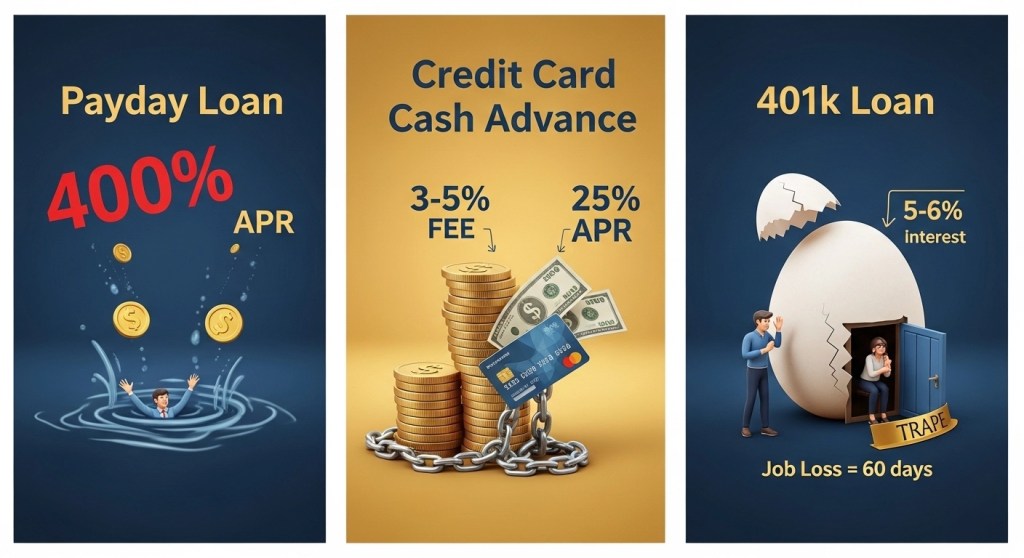
Side-by-side comparison of payday loans showing 400% APR trap, credit card cash advances showing fee stacking, and 401k loans showing double taxation and job loss risk

Alt Text: Three-panel comparison showing payday loan debt trap (400% APR), credit card cash advance fee stack (3-5% + 25% APR), and 401k loan double taxation with job loss warning

Caption: Three bad options. Three very different ways they can wreck your finances.

By Laxmi Hegde, MBA in Finance ยท ConfidenceBuildings.com

Three-panel comparison showing payday loan debt trap with 400% APR, credit card cash advance fee stack with 3-5% fee and 25% APR, and 401k loan with double taxation and job loss warning
Three bad options. Three very different ways they can wreck your finances

โš  For educational purposes only. Not financial or legal advice. I hold an MBA in Finance, but I’m not your personal financial advisor. Payday lending laws, credit card terms, and 401(k) loan rules vary by state, lender, and employer plan. The IRS imposes strict rules on 401(k) loans โ€” consult a tax professional before borrowing from retirement. If you’re in a debt cycle, contact a nonprofit credit counselor through the National Foundation for Credit Counseling (NFCC.org).

The “Least Evil” Problem

Here’s the thing about emergencies: they don’t ask permission. The car dies. The furnace stops heating. The medical bill arrives with “PAST DUE” stamped in red. And suddenly you’re not asking “What’s the best option?” You’re asking “What’s the least bad option?”

It’s like being lost in a dark forest and having to choose between three paths. One leads to quicksand. One leads to a bear trap. One leads to a cliff. Which one do you take?

This guide doesn’t pretend any of these options are good. They’re not. But one of them is mathematically less destructive than the others โ€” and knowing which one could save you thousands.

$10,000

borrowed today could cost you $12,000 (401k loan), $15,000 (credit card), or $30,000+ (payday rollovers) over 5 years

Source: Bankrate 2026 analysis [citation:3]

The “Least Evil” Scorecard โ€” Ranked 1 (Least Evil) to 3 (Most Evil)

Criteria ๐Ÿฅ‡ 401(k) Loan ๐Ÿฅˆ Credit Card Cash Advance ๐Ÿฅ‰ Payday Loan
Total Cost (APR + Fees) 5-6% interest [citation:1] 3-5% fee + 25-30% APR [citation:3] 300-400% APR [citation:1]
Risk to Your Future โš ๏ธ Job loss = 60-day repayment + taxes + 10% penalty [citation:1] โš ๏ธ Credit score damage if missed payments โš ๏ธ Bank account seizure, wage garnishment, lawsuit
Repayment Flexibility 5 years via payroll deduction [citation:4] Minimum payments, but interest compounds 2-4 weeks, lump sum [citation:1]
Default Consequences Taxed as early withdrawal + 10% penalty [citation:1] Collections, credit score drop, lawsuits Collections, wage garnishment, bank levies
Accessibility (Bad Credit) โœ… No credit check [citation:1] โœ… Already have card? Instant access [citation:1] โœ… No credit check, but at what cost? [citation:2]

๐Ÿฅ‡ 401(k) loans win (least evil) โ€” but only if you keep your job. ๐Ÿฅ‰ Payday loans lose (most evil) every time.

๐Ÿ“Š Side-by-Side Comparison: $1,000 Borrowed

Factor Payday Loan Credit Card Cash Advance 401(k) Loan
Interest Rate 300-400% APR [citation:1] 25-30% APR [citation:3] 5-6% [citation:1]
Fees $15-30 per $100 borrowed [citation:1] 3-5% upfront fee [citation:3] $0-50 admin fee
Repayment Term 2-4 weeks (lump sum) [citation:1] Ongoing (minimum payments) Up to 5 years [citation:4]
Credit Check? No (Clarity Services) [citation:1] No (existing cardholder) No [citation:1]
Time to Fund Same day [citation:1] Instant (ATM) [citation:1] 2-5 days [citation:1]
Total Cost for $1,000 (1 year) $1,300+ (if rolled over monthly) [citation:1] $1,250-300 (if minimum payments) [citation:3] $1,050-60 [citation:1]
Worst-Case Scenario Debt trap, bank account drained, lawsuit [citation:2] Credit ruined, collections Job loss = $1,000 + $250 taxes + $100 penalty [citation:1]
Bar chart comparing total cost of borrowing $1000: payday loan $1300, credit card cash advance $1250, 401k loan $1050

Alt Text: Bar chart showing $1000 loan costs over one year: payday loan $1300+, credit card cash advance $1250, 401k loan $1050 ยท Caption: 401(k) loans are cheaper. But cheaper doesn’t mean safe.
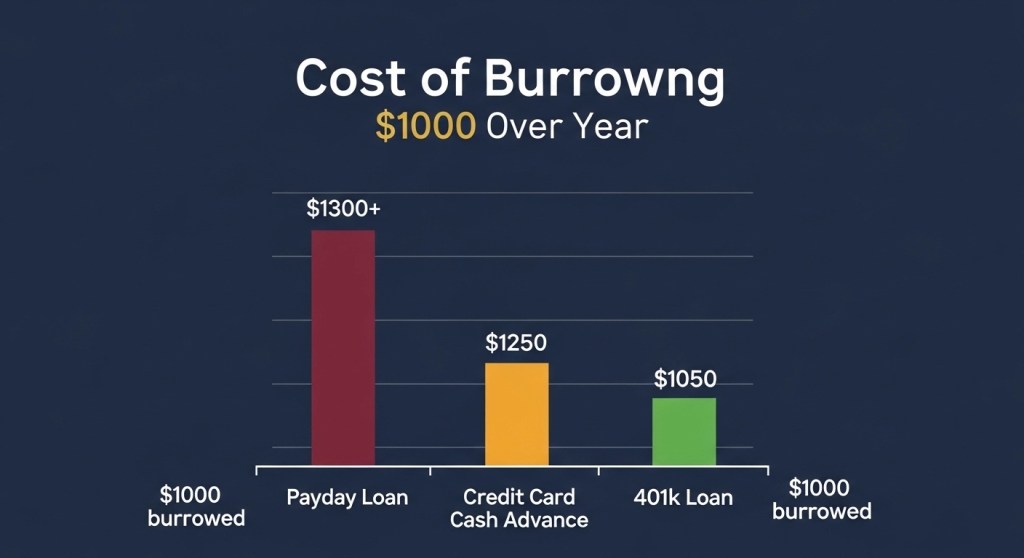
Bar chart showing total cost of borrowing $1000 over one year: payday loan $1300+, credit card cash advance $1250, 401k loan $1050
401(k) loans are cheaper. But cheaper doesn’t mean safe.

๐Ÿ’ฐ Payday Loans: The Quicksand

Let’s be blunt: Payday loans are the worst financial product legally sold in America. The Chicago Tribune called them “quicksand of financial debt” [citation:2]. Bankrate calls them “predatory lending” [citation:3]. I call them a trap.

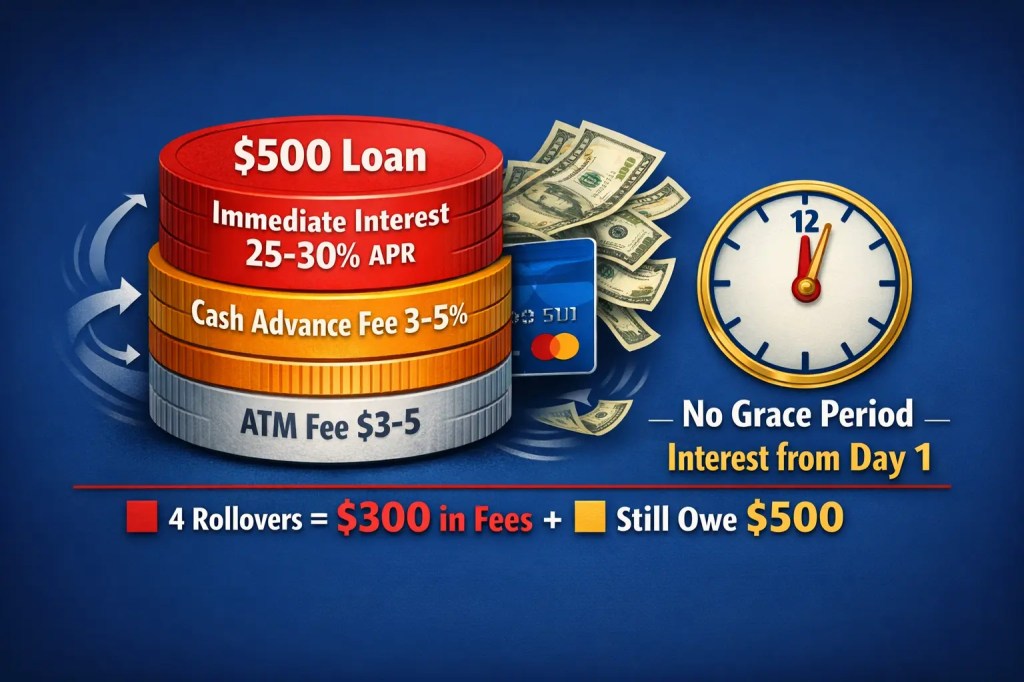
The math: Borrow $500 for two weeks. Fee: $75 (typical $15 per $100). APR: 391%. If you can’t repay in two weeks (80% of borrowers can’t), you “roll over” and pay another $75. After 4 rollovers, you’ve paid $300 in fees โ€” and still owe $500 [citation:1].

๐Ÿšจ Why It’s Evil:

  • 400% APR typical [citation:1]
  • 80% rollover rate [citation:2]
  • Lenders can drain your bank account
  • Illegal in 13 states + DC โ€” for good reason [citation:1]
Infographic showing $500 payday loan turning into $600 in fees after 4 rollovers while still owing $500

Alt Text: Debt cycle diagram showing $500 loan โ†’ $75 fee โ†’ still owe $500 โ†’ repeat 4 times = $300 fees + $500 owed ยท Caption: This is by design. 80% of loans are rolled over [citation:1].
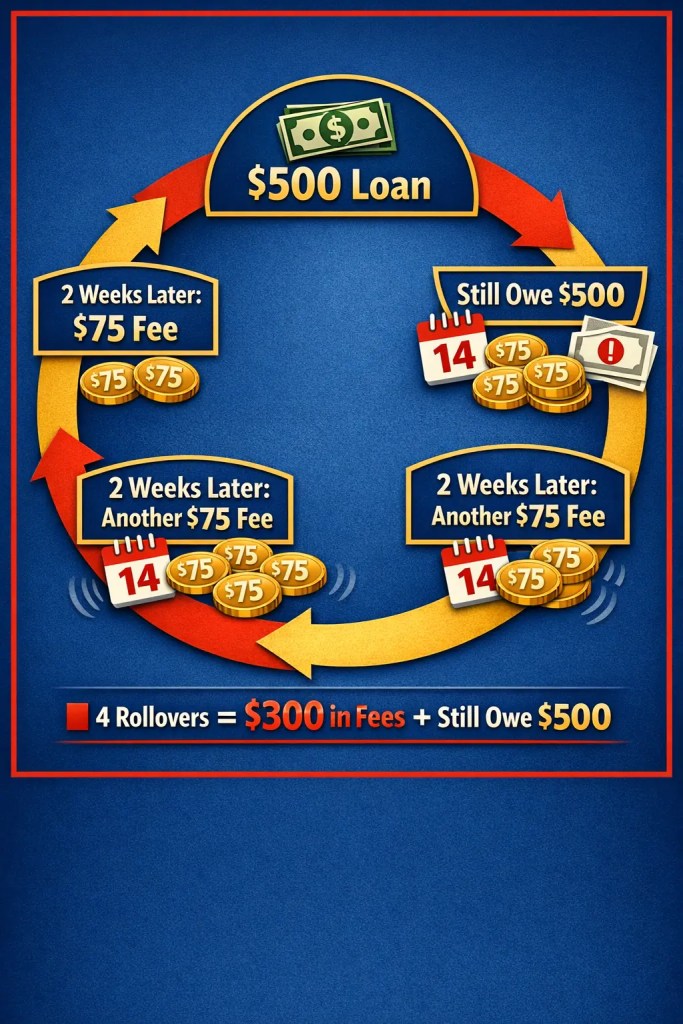
Debt cycle diagram showing $500 loan turning into $75 fee every two weeks, after 4 rollovers $300 paid in fees while still owing $500
This is by design. 80% of loans are rolled over.

๐Ÿ’ณ Credit Card Cash Advances: The Fee Stack

You have a credit card. You need cash. You walk to an ATM, swipe, and walk away with money. Easy, right? Too easy.

Here’s what just happened: Your credit card company charged you a 3-5% cash advance fee (that’s $30-50 on $1,000). They started charging interest immediately โ€” no 21-day grace period like purchases. And the APR is higher than your purchase rate, typically 25-30% [citation:3].

โš ๏ธ The Fee Stack:

  • ATM fee ($3-5) if using non-bank ATM
  • Cash advance fee (3-5% of amount) [citation:3]
  • Higher APR (25-30%) starting immediately [citation:3]
  • No grace period โ€” interest from day 1 [citation:3]

The kicker: Bankrate notes that despite the cost, “a cash advance is safer, cheaper and more practical than a payday loan” [citation:3]. That’s not a compliment to cash advances. That’s an indictment of payday loans.

Infographic showing $500 cash advance with $3 ATM fee, $25 cash advance fee, and 25% APR interest starting immediately

Alt Text: Stack of coins showing ATM fee, cash advance fee, and immediate interest on $500 credit card cash advance ยท Caption: Fees stack higher than you think โ€” but still cheaper than payday loans.

Stack of coins showing ATM fee, cash advance fee, and immediate interest on credit card cash advance with no grace period
Fees stack higher than you think โ€” but still cheaper than payday loans.

๐Ÿฆ 401(k) Loans: The Retirement Robbery (That You Do to Yourself)

Here’s the twist: 401(k) loans are the “least evil” on paper โ€” but they come with a trap door.

You borrow from yourself. Interest rates are low (5-6%) [citation:1]. You pay the interest back to your own account. No credit check. Terms up to 5 years [citation:4]. Sounds great, right?

โš ๏ธ The Trap Door โ€” Job Loss

If you lose your job (or quit), the entire remaining balance is typically due within 60 days [citation:1][citation:4]. Can’t pay? The IRS treats it as an early withdrawal. You pay:

  • Income taxes on the full amount
  • 10% early withdrawal penalty (if under 59ยฝ) [citation:1]

On a $10,000 loan: That’s $2,500+ in taxes and penalties overnight โ€” on money you already spent.

โš ๏ธ The Double Taxation Trick

You contribute to your 401(k) with pre-tax dollars. When you repay the loan, you repay with after-tax dollars. Then when you withdraw in retirement, you pay taxes again on that same money [citation:4]. You literally pay taxes twice on the interest.

โš ๏ธ The Missed Growth

While your money is loaned out, it’s not invested. If the market goes up 10% in a year, you missed that growth [citation:4].

Diagram showing pre-tax contribution, after-tax repayment, and tax again in retirement illustrating double taxation of 401k loan interest

Alt Text: Three-step diagram: 1) Pre-tax money goes in, 2) After-tax money repays loan, 3) Taxed again in retirement ยท Caption: Double taxation means you pay taxes twice on the same interest.
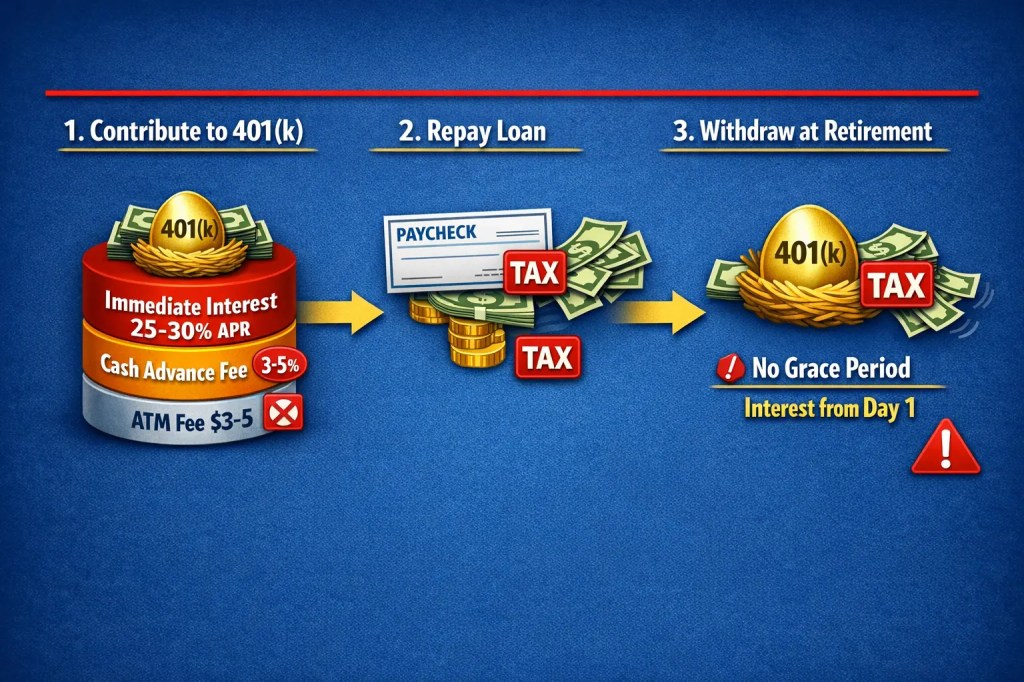
Three-step diagram showing pre-tax contributions to 401k, after-tax loan repayment, and taxes again in retirement illustrating double taxation
Double taxation means you pay taxes twice on the same interest.

๐ŸŒฒ The Decision Tree: Which Path Should YOU Take?

Not everyone has access to all three options. Here’s how to choose based on YOUR situation.

Do you have a 401(k) with at least $5,000 vested?

โœ… YES โ€” and you have stable employment

401(k) loan is your least evil option โ€” but only if you’re confident you won’t lose your job [citation:1][citation:4].

โŒ NO โ€” or your job is unstable

Do NOT risk the job loss trap. Move to next question.

Do you have a credit card with available credit?

โœ… YES โ€” and you can repay within months

Cash advance is expensive but cheaper than payday loans. Calculate total cost before proceeding [citation:3].

โŒ NO โ€” or card is maxed

You’re down to last resort territory. Move to next question.

Do you have ANY other option?

โœ… YES โ€” Credit union PAL, family loan, employer advance

Take these first. Payday loans should be absolute last resort [citation:2].

โŒ NO โ€” truly no other options

Payday loan. But borrow the absolute minimum. Have a repayment plan BEFORE you take it [citation:1].

Flowchart showing decision path: 401k loan if job stable, credit card cash advance if available, payday loan only as last resort

Alt Text: Decision tree flowchart for emergency borrowing: 401k first if job stable, credit card cash advance second if available, payday loan only as absolute last resort ยท Caption: Follow this path to choose the least evil option for YOUR situation.
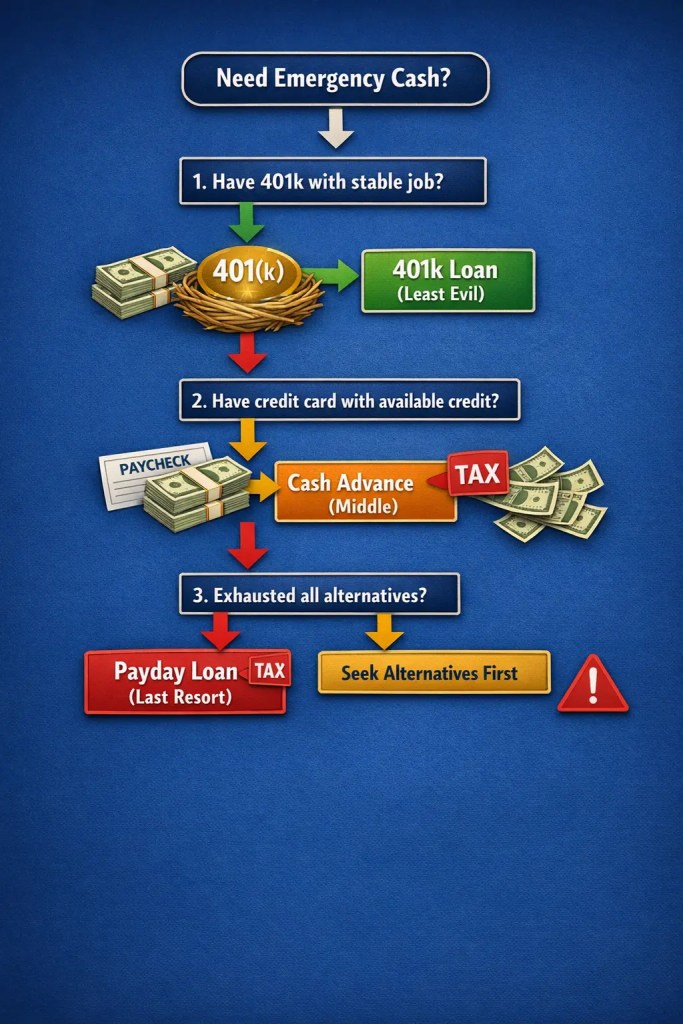
Decision tree flowchart for emergency borrowing: 401k first if job stable, credit card cash advance second if available, payday loan only as absolute last resort
Follow this path to choose the least evil option for YOUR situation.

400%
typical payday loan APR โ€” highest of any consumer product [citation:1]
80%
of payday loans are rolled over within 30 days [citation:1]
60
days to repay 401(k) loan after job loss or face taxes + 10% penalty [citation:1]

Frequently Asked Questions

Is a 401(k) loan really “borrowing from yourself”?

Yes โ€” but with strings attached. You borrow your own money and pay interest back to your own account. However, you miss out on market gains while the money is out. And if you leave your job, the entire balance is typically due within 60 days. If you can’t repay, the IRS treats it as an early withdrawal: you pay income taxes plus a 10% penalty if under 59ยฝ .

๐Ÿ“Œ Source ยท IRS Publication 575

Can I use a credit card cash advance at any ATM?

Yes, but you’ll need a PIN. Most credit cards allow you to set a PIN through your online account. Be aware of the costs: a cash advance fee (typically 3-5% of the amount), a higher APR (usually 25-30% vs. your purchase rate), and interest that starts accruing immediately โ€” no grace period . ATM fees may also apply if you’re not using your bank’s machine.

๐Ÿ“Œ Citation ยท CFPB Credit Card Agreement Database

What happens if I default on a payday loan?

Default triggers aggressive collection practices. The lender can repeatedly attempt to withdraw funds from your bank account, causing NSF fees ($35 each) . They may sell the debt to a collector who can sue you, leading to wage garnishment or bank account levies. Unlike other loans, payday lenders often have access to your bank account from the start, making default immediate and painful.

๐Ÿ“Œ Source ยท FTC Debt Collection FAQs

How does double taxation work on 401(k) loans?

You contribute to a traditional 401(k) with pre-tax dollars. When you repay a loan, you repay with after-tax dollars. Then, when you withdraw that money in retirement, you pay taxes on it again . This means the interest you pay yourself is effectively taxed twice โ€” once when you earn it to repay, and again when you withdraw in retirement. Some plans allow Roth after-tax contributions, but the double taxation issue remains complex.

๐Ÿ“Œ Citation ยท IRS Retirement Plan Loans

Which option is best for someone with bad credit?

If you have a 401(k), that’s your best option regardless of credit score โ€” no credit check required. If not, a credit card cash advance is next, assuming you already have a card (no new credit check). Payday loans are available to anyone with a bank account and ID, but they’re the most expensive option by far. Consider credit union Payday Alternative Loans (PALs) which offer 28% APR caps โ€” significantly lower than payday loans .

๐Ÿ“Œ Source ยท NCUA PAL Program

Can I negotiate credit card cash advance fees?

No โ€” cash advance fees are set in your cardholder agreement and cannot be waived. The 3-5% fee is automatic and non-negotiable . However, some credit cards offer “convenience checks” with promotional rates โ€” read the fine print carefully, as these often count as cash advances with the same fees and immediate interest.

๐Ÿ“Œ Citation ยท Truth in Lending Act

Are there alternatives that aren’t on this list?

Yes โ€” and you should exhaust these first. Credit union Payday Alternative Loans (PALs) cap APR at 28% . Employer paycheck advances often have no fees. 0% APR credit cards (if you qualify) offer 12-21 months of interest-free financing. Local assistance programs (211, religious organizations, community action agencies) may provide emergency grants. Never choose any of the three options above before checking these alternatives.

๐Ÿ“Œ Source ยท CFPB Emergency Assistance

โš  For educational purposes only. Not legal or financial advice. Loan terms, fees, and availability vary by state, lender, and employer plan. Always read your specific loan documents and consult a qualified professional before making financial decisions.

Reader Story ยท Composite Account

“I took a $8,000 401(k) loan for home repairs. Three months later, I was laid off. I had 60 days to repay $6,200 or owe $9,000 in taxes and penalties.”

David, 47, had been with his company for 12 years when he borrowed from his 401(k) to fix his roof. He felt good about it โ€” low interest, paying himself back. Then his entire department was eliminated in a restructuring. His plan documents stated the loan balance was due within 60 days of separation. He couldn’t come up with $6,200. The IRS treated the remaining balance as an early distribution: income taxes (22% bracket) plus 10% penalty. His $8,000 loan cost him over $10,000.

HIS MISTAKE

Didn’t consider job stability. Assumed he’d stay employed. Didn’t have an emergency fund to repay if things changed.

WHAT HE COULD HAVE DONE

Explored credit union PAL loan first. Borrowed less. Had a backup plan for job loss before taking the loan.

Warning graphic showing $8000 401k loan turning into $10000 tax bill after job loss with 60-day clock

Alt Text: 401k loan warning: $8,000 borrowed โ†’ job loss โ†’ 60 days to repay or face $2,200 in taxes + $800 penalty ยท Caption: The trap door opens when you least expect it.

RM

Attorney Rachel Morrow ยท Consumer Rights ยท Educational Illustration Only

“The 401(k) loan job loss provision is the most misunderstood risk in personal finance. Most borrowers think ‘I’m borrowing from myself, what’s the risk?’ The risk is that a single layoff turns a manageable loan into a tax bomb. I’ve seen clients lose $5,000+ overnight because they didn’t read the fine print about separation from service.”

Legal Analysis: Under IRS Section 72(p), a 401(k) loan default due to separation from service is treated as a deemed distribution. The full outstanding balance becomes taxable income in the year of default, plus a 10% early withdrawal penalty if under 59ยฝ . Some plans allow continued repayment after separation, but most do not. Always read your plan’s Summary Plan Description before borrowing.

Bottom Line: Only borrow from your 401(k) if your job is rock-solid โ€” and even then, have a backup plan.

Reader Story ยท Public Case Record

“I took a $1,000 cash advance thinking ‘it’s just my credit card.’ Six months later, I’d paid $400 in interest and still owed $950.”

Drawn from CFPB consumer complaint records (2024). The borrower didn’t realize cash advances have no grace period and higher APRs. She made minimum payments, but most went to fees and interest. Meanwhile, her regular purchases were also accruing interest because payments typically apply to lowest-rate balances first. The cash advance balance barely budged while she paid hundreds in interest.

THE TRAP

No grace period + higher APR + payment allocation rules = cash advances are “sticky” and expensive to pay off.

WHAT TO KNOW

Pay cash advances off FIRST, before regular purchases. Better yet, avoid them unless it’s an emergency and you can repay within 1-2 months.

RM

Attorney Rachel Morrow ยท Consumer Rights ยท Educational Illustration Only

“Credit card agreements are designed to maximize profit from cash advances. The no-grace-period rule, the higher APR, and the payment allocation tricks โ€” these aren’t accidents. They’re features. Card issuers know cash advance borrowers are often in distress, and the terms reflect that.”

Legal Analysis: Under the CARD Act, credit card issuers must apply payments above the minimum to the highest-interest balances first โ€” but that’s only if you pay more than the minimum. Minimum payments can be applied to lowest-rate balances, letting high-rate cash advances linger. Read your cardholder agreement’s “Payment Allocation” section carefully.

Bottom Line: Cash advances are not like regular credit card purchases. Treat them as a separate, high-cost loan.

Reader Story ยท Success Story

“I took a $400 payday loan for car repairs. It took me 8 months and $1,200 to finally escape. I’ll never do it again.”

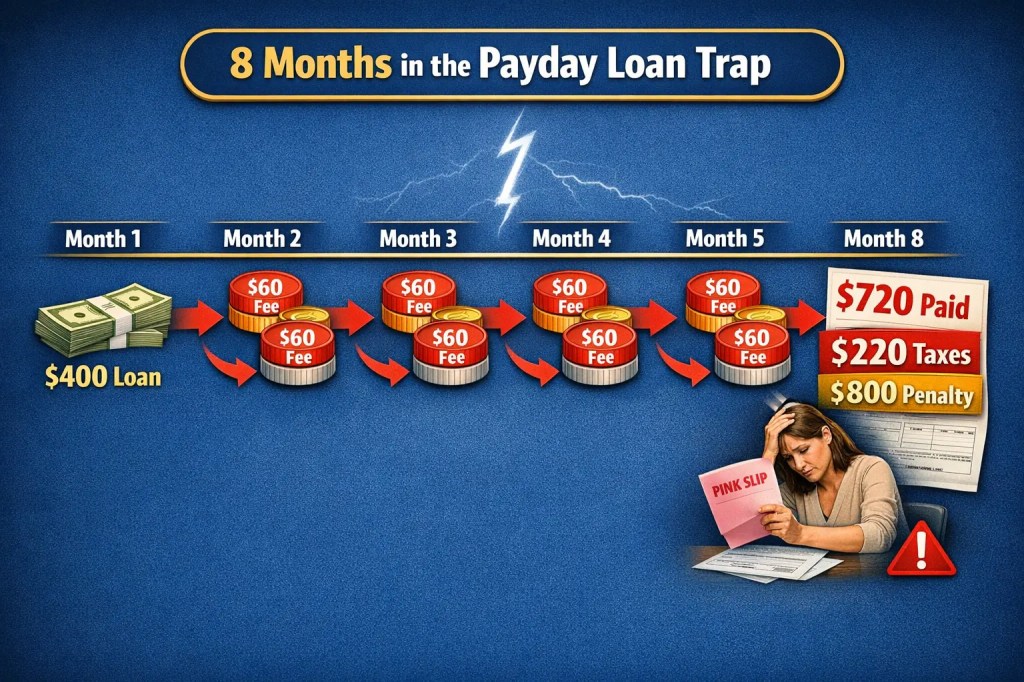
Maria, 34, needed her car for work. A $400 repair felt impossible. A payday lender offered “quick cash” with “just one small fee.” She didn’t realize the fee was $60 every two weeks. When she couldn’t repay, she “rolled over” โ€” paying $60 to extend the loan. After 8 months and 12 rollovers, she’d paid $720 in fees and still owed the original $400. A credit counselor helped her restructure, but the damage was done.

THE CYCLE

$400 loan โ†’ $60 fee every 2 weeks โ†’ 12 rollovers = $720 fees + still owe $400. 80% of borrowers experience this .

WHAT SHE WISHES SHE KNEW

Credit union PALs exist (max 28% APR). Employers offer advances. Never roll over a payday loan โ€” it’s designed to trap you.

Infographic showing $400 payday loan turning into $720 in fees over 8 months while still owing $400

Alt Text: Debt cycle: $400 loan โ†’ $60 fee every 2 weeks โ†’ after 8 months, $720 paid in fees, still owe $400 ยท Caption: 8 months. $720 in fees. Still owe $400. This is by design.

RM

Attorney Rachel Morrow ยท Consumer Rights ยท Educational Illustration Only

“Payday loans are mathematically designed to fail. The average borrower earns about $30,000 a year. A $400 loan with a $60 fee seems manageable until you realize that’s 15% of your paycheck โ€” every two weeks. The CFPB’s own data shows most payday loans are part of a long-term debt cycle, not a short-term solution.”

Legal Analysis: The CFPB’s 2017 payday rule (later rescinded) found that 80% of payday loans are rolled over within 30 days, and most borrowers end up in debt for months . Some states have capped rates at 36% (military APR cap), but in unregulated states, 400% APR is legal. Check your state’s rate caps before considering a payday loan.

Bottom Line: Payday loans are the last resort for a reason. Exhaust every other option first.
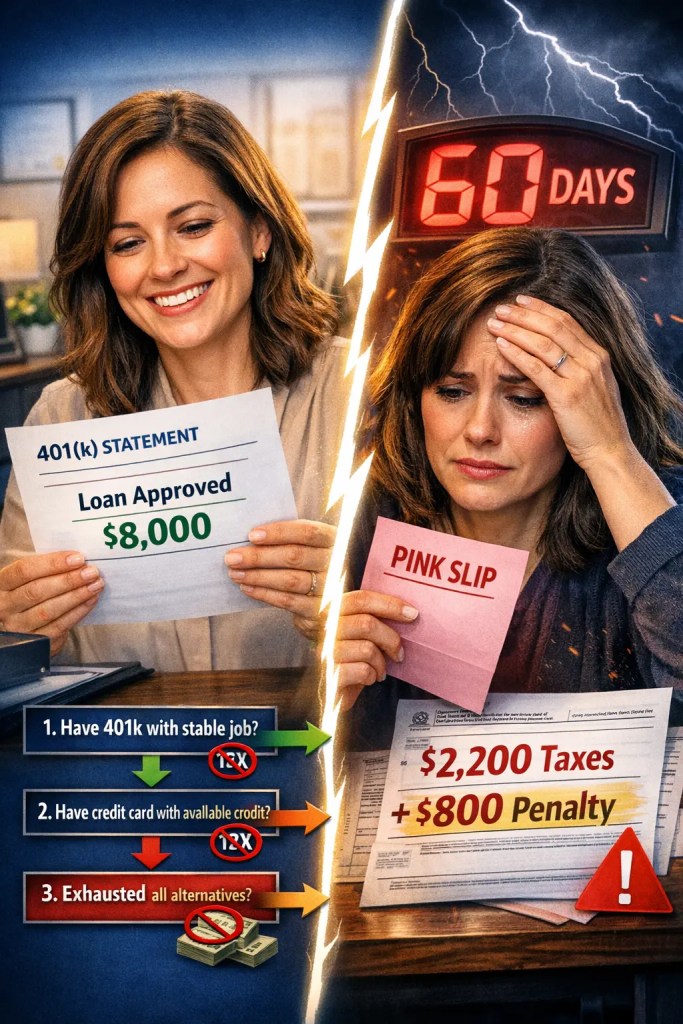
Dramatic split image showing person happy with 401k loan approval on left, devastated after job loss with 60-day clock and $3000 tax penalty on right
The trap door opens when you least expect it.

Timeline infographic showing 8 months of payday loan rollovers: $400 loan, $60 fee each month, after 8 months $720 paid in fees while still owing $400
8 months. $720 in fees. Still owe $400. This is by design.

๐Ÿ“ฅ Free Download โ€” Borrower’s Truth Series

Emergency Loan Decision Checklist

Printable 5-step decision guide to choose your “least evil” option:

โœ“ 5-Step Decision Tree

โ† Back

Thank you for your response. โœจ

๐Ÿ“ฅ Free Download โ€” Borrower’s Truth Series

Emergency Loan Decision Checklist

Printable 5-step decision guide to choose your “least evil” option:

โœ“ 5-Step Decision Tree โœ“ Cost Comparison Calculator โœ“ Job Loss Risk Assessment โœ“ State Rate Cap Lookup
โฌ‡ Download Free Checklist โ†’

Free ยท No sign-up required ยท ConfidenceBuildings.com ยท Pairs with Episode 14

๐Ÿ—บ๏ธ Know Your State’s Rate Caps

Your location determines which options are legal and what interest rates apply. Here’s where to check your state’s rules:

๐Ÿ“Œ Source ยท Official State Regulator Websites & NCSL

๐Ÿ’ฌ Final Thoughts โ€” Laxmi Hegde, MBA in Finance

Here’s the uncomfortable truth I’ve learned researching this series: When you’re in a financial emergency, there are no good options โ€” only less destructive ones. The system is designed that way. Payday lenders profit from your desperation. Credit card companies structure cash advances to maximize fees. Even 401(k) loans, which seem like “borrowing from yourself,” have trap doors hidden in the fine print.

The goal of this guide isn’t to make you feel hopeless. It’s to arm you with the truth so you can choose with open eyes. If you must borrow, borrow from your 401(k) only if your job is stable. Use a credit card cash advance only if you can repay in months, not years. And payday loans? They’re not loans โ€” they’re traps. Treat them as the absolute last resort, and only if you have a rock-solid repayment plan before you sign.

Tomorrow in Episode 15, we dive into the fine print of loan contracts โ€” the clauses lenders hope you never find. Because knowing the truth is the only way to protect yourself.

๐Ÿ”ฌ Research Note & Primary Sources

This article is part of the Borrower’s Truth Series, a 30-day educational series by Laxmi Hegde, MBA in Finance. All statistics are drawn from government agencies and primary research institutions as of March 2026.

Primary Sources:

  • Consumer Financial Protection Bureau โ€” Payday Loan Data & Cash Advance Studies
  • Federal Trade Commission โ€” Debt Collection Practices Act & Enforcement Actions
  • Internal Revenue Service โ€” Publication 575: Pension and Annuity Income
  • National Credit Union Administration โ€” Payday Alternative Loan (PAL) Program
  • Bankrate โ€” 2026 Credit Card & Payday Loan Rate Surveys
  • The Pew Charitable Trusts โ€” Small Dollar Loans Project
  • National Conference of State Legislatures โ€” Payday Lending State Statutes
  • Chicago Tribune / Terry Savage โ€” Consumer Finance Column (2025-2026)
  • The Motley Fool โ€” 401(k) Loan Analysis (2025)

For the complete Borrower’s Truth Series guide, visit: The Complete Borrower’s Truth Guide โ†’ ConfidenceBuildings.com

๐Ÿ“š Emergency Borrowing Blueprint 2026 โ€” 14 of 30 Episodes Complete

Week 1: Basics โœ“ Week 2: Predatory Lenders (Ep 8-14) โœ“ Week 3: Fine Print Files (Ep 15-21) Week 4: After You Borrow (Ep 22-30)

All episodes available at Emergency Borrowing Blueprint 2026

๐Ÿ“… Published March 14, 2026 ยท Updated as part of the ConfidenceBuildings.com 2026 Consumer Finance Research Project. This post is Episode 14 of 30 in the Borrower’s Truth Series, examining emergency borrowing, predatory lending practices, and consumer financial rights. All data verified as of March 2026. For educational purposes only. Not financial or legal advice.

๐Ÿงฎโœจ

Free Access: Finance Calculator

Get instant access to loan, investment, and retirement tools.

๐Ÿ“ง Subscribe with Email โ†’

One-click signup. No spam. You’ll get the calculator link immediately.

Already subscribed? Open calculator โ†’

Your Loan Is ‘Due’ โ€” But the Trap Is Just Getting Started

Borrower’s Truth Series โ€” 30 Days
Day 21 of 30 โ€” 70% Complete
1 2 3 4 5 6 7 8 9 10 11 12 13 14 15 16 17 18 19 20 21 22 23 24 25 26 27 28 29 30
Week 3 โ€” The Fine Print Files  ยท  View All 30 Days โ†’

Week 3 โ€” The Fine Print Files ยท Day 21 of 30

Your Loan Is ‘Due’ โ€”
But the Trap Is Just Getting Started

Lenders call it a “renewal offer.” What it actually does is reset your debt clock, add new fees, and lock you into another cycle โ€” all while sounding like they’re doing you a favour.

80%
of payday loans are rolled over or renewed within 14 days
Source: CFPB
$520
average fees paid by borrowers who renew a $375 loan repeatedly
Source: CFPB
5 mos
median time borrowers stay in payday loan debt per year
Source: CFPB
What You’ll Learn Today
  • How loan renewal offers are designed to trap โ€” not help โ€” you
  • The exact language lenders use to make renewal sound reasonable
  • What the “evergreen clause” is and how to spot it in your contract
  • The fee math that makes renewal the most expensive decision you can make
  • Three steps to refuse renewal and exit the cycle instead

โš  For educational purposes only. Not legal advice. The information on this page is intended to help consumers understand how loan renewal offers work. Laws governing loan renewals, rollovers, and extended payment plans vary significantly by state and lender. Always verify current terms directly with your lender and consult a licensed financial counselor or attorney before making any borrowing decision. The CFPB and FTC are referenced for informational purposes only โ€” neither agency endorses this content.

๐Ÿ“š Borrower’s Truth Series โ€” Week 3 of 5

The Fine Print Files

You found the loan. You signed the agreement. But buried in that contract are clauses lenders wrote for their benefit โ€” not yours. Week 3 goes through the fine print that has cost borrowers thousands, one clause at a time. Today we cover the renewal trap: the mechanism that turns a short-term loan into months of debt.

โญ Essential Reading โ€” Start Here

Before You Sign Anything โ€” Use This Checklist

The Loan Clause Checklist identifies the exact clauses lenders hope you never find โ€” including the renewal and evergreen clauses covered in today’s post. It takes 10 minutes to use and could save you hundreds. Free. No email required.

What’s Inside
  • The auto-renewal / evergreen clause โ€” exact wording to search for
  • Mandatory arbitration clause โ€” what it removes from your rights
  • Prepayment penalty โ€” how to find it before you sign
  • ACH authorization language โ€” what lenders can pull from your account
  • 10 more clauses with plain-English translations
๐Ÿ“‹ Open the Free Checklist โ†’

๐Ÿ“Œ Quick Answer

A loan renewal offer is when a lender contacts you near your due date and offers to extend โ€” or “renew” โ€” your loan for another term. It sounds helpful. What it actually does is wipe out any progress you’ve made, charge a fresh round of fees, and restart your repayment clock from zero. Most borrowers who accept one renewal accept several. That is not an accident โ€” it is the business model.

How the Renewal Trap Works

Here is the scenario that plays out millions of times every year. You took out a $400 payday loan two weeks ago. Your due date is tomorrow. The lender sends you a text โ€” sometimes an email, sometimes a phone call โ€” letting you know your loan is coming due. Then comes the offer: “Would you like to renew for another two weeks? Just a small fee.”

The “small fee” is typically $15โ€“$20 per $100 borrowed. On a $400 loan, that is $60โ€“$80. You never touch the principal. You pay $60 to buy yourself two more weeks โ€” and in two more weeks, the same offer arrives again.

The Real Cost of “Just One More Renewal” โ€” $400 Loan at $15/$100
Renewal # Fee Paid Total Fees Paid Still Owe
Original loan $60 $60 $400
Renewal 1 $60 $120 $400
Renewal 2 $60 $180 $400
Renewal 3 $60 $240 $400
Renewal 4 $60 $300 $400

After 4 renewals you have paid $300 in fees and still owe every dollar of the original $400. The lender has collected 75% of the loan value in fees alone โ€” without reducing your balance by a single cent.

The Evergreen Clause โ€” The Fine Print That Renews You Automatically

Some lenders do not even bother making an offer. They include an evergreen clause โ€” also called an auto-renewal clause โ€” directly in the loan agreement. Unless you take a specific action to cancel before your due date, the loan renews automatically and a new fee is charged to your account.

Most borrowers never see this clause because it appears deep in the agreement โ€” sometimes on page 4 or 5 of a document most people never finish reading. The cancellation window is often just 3โ€“5 days before the renewal date, which means by the time you realise what happened, the fee has already been processed.

โš  What the Evergreen Clause Looks Like in Plain English

Loan agreements rarely use the word “evergreen.” Instead, look for language like:

  • “This loan will automatically extend unless written notice is provided…”
  • “Borrower authorises renewal of this agreement at the end of each term…”
  • “Failure to repay in full will result in automatic rollover…”
  • “Renewal fee will be debited on the due date unless cancellation is requested…”

๐Ÿ“‹ The Loan Clause Checklist shows you exactly where to look for this language in your agreement.

The Language Lenders Use โ€” And What It Actually Means

Renewal offers are carefully worded to sound like customer service. Here is a translation guide for the most common phrases:

What They Say
“We’re giving you more time to repay.”
What It Means
We’re charging you another fee to delay the same problem by two weeks.
What They Say
“Just a small renewal fee to stay current.”
What It Means
$60โ€“$80 that vanishes with zero reduction to your principal balance.
What They Say
“You’re pre-approved for an extended term.”
What It Means
Our algorithm flagged you as likely to renew โ€” and we want that fee revenue.
What They Say
“Renewing helps protect your credit.”
What It Means
Most payday lenders don’t report to credit bureaus anyway โ€” this is a scare tactic.

Three Steps to Refuse Renewal and Exit the Cycle

Accepting a renewal is always optional โ€” even when it doesn’t feel that way. Here is the three-step process to decline and start reducing the actual balance instead.

1
Ask Your Lender About an Extended Payment Plan (EPP)

Many states legally require payday lenders to offer an Extended Payment Plan โ€” a structured repayment schedule that lets you pay back the principal over multiple instalments with no additional fees. Lenders are not required to advertise this option. You must ask for it directly, in writing, before your due date. Search “EPP + [your state]” or check your state’s financial regulator website to confirm whether your lender is required to offer one.

2
Revoke ACH Authorization Before the Renewal Date

If your lender has electronic access to your bank account โ€” which most payday lenders do โ€” they can process a renewal fee without your active consent if an evergreen clause ex

Reader Story ยท Composite Account
“I Thought One Renewal Would Fix Everything”

Marcus, 34, took out a $350 payday loan in October to cover a car repair. When the due date arrived he was $200 short, so he accepted the lender’s renewal offer โ€” just this once, he told himself. The renewal fee was $52.50. Two weeks later, still short, he renewed again. By January he had paid $262 in renewal fees and still owed the original $350. The loan he thought would last two weeks had lasted three months.

His Mistake

Marcus never asked his lender about an Extended Payment Plan. In his state, the lender was legally required to offer one โ€” but never mentioned it. A single phone call before his first due date could have restructured his repayment with no additional fees.

What He Could Do

Contact the lender in writing requesting an EPP. Simultaneously revoke ACH authorization with his bank to prevent automatic renewal charges. Make a $100 partial payment toward principal to reduce the renewal fee base while the EPP request is processed.

RM
Attorney Rachel Morrow
Consumer Rights Attorney ยท Educational Illustration Only

“The Extended Payment Plan is one of the most powerful and least-used protections available to payday loan borrowers. In states where it is legally mandated, lenders are required to offer it โ€” but they are not required to tell you it exists. That asymmetry of information costs borrowers millions of dollars every year.”

<div style="background:rgba(21,101,192,0.10);border-radius:8px;padding:16px
Reader Story ยท Composite Account
“I Thought One Renewal Would Fix Everything”

Marcus, 34, took out a $350 payday loan in October to cover a car repair. When the due date arrived he was $200 short, so he accepted the lender’s renewal offer โ€” just this once, he told himself. The renewal fee was $52.50. Two weeks later, still short, he renewed again. By January he had paid $262 in renewal fees and still owed the original $350. The loan he thought would last two weeks had lasted three months.

His Mistake

Marcus never asked his lender about an Extended Payment Plan. In his state, the lender was legally required to offer one โ€” but never mentioned it. A single phone call before his first due date could have restructured his repayment with no additional fees.

What He Could Do

Contact the lender in writing requesting an EPP. Simultaneously revoke ACH authorization with his bank to prevent automatic renewal charges. Make a $100 partial payment toward principal to reduce the renewal fee base while the EPP request is processed.

RM
Attorney Rachel Morrow
Consumer Rights Attorney ยท Educational Illustration Only

“The Extended Payment Plan is one of the most powerful and least-used protections available to payday loan borrowers. In states where it is legally mandated, lenders are required to offer it โ€” but they are not required to tell you it exists. That asymmetry of information costs borrowers millions of dollars every year.”

Frequently Asked Questions โ€” Loan Renewal Trap
All answers include citations from U.S. government sources
Q: Is a lender allowed to automatically renew my loan without my permission?

It depends on what you signed. If your loan agreement contains an evergreen or auto-renewal clause โ€” and you agreed to ACH authorization โ€” then the lender may have the contractual right to renew and debit your account automatically. However, you retain the right under the Electronic Fund Transfer Act to revoke ACH authorization at any time by notifying your bank in writing at least three business days before the scheduled transfer. State law may also impose additional restrictions on automatic renewals โ€” check your state’s financial regulator website for current rules.

๐Ÿ“Œ Citation ยท Federal Reserve / CFPB
consumerfinance.gov โ€” How to stop automatic payments โ†’
โš  For educational purposes only. Not legal advice.
Q: What is an Extended Payment Plan and does my lender have to offer one?

An Extended Payment Plan (EPP) allows a borrower to repay their payday loan balance in multiple instalments โ€” typically four equal payments over four pay periods โ€” without additional fees or interest. Whether your lender is required to offer an EPP depends entirely on your state. States including Florida, Washington, Indiana, Michigan, and Illinois have specific EPP mandates. Lenders in these states must offer an EPP if requested before the loan due date โ€” but they are under no obligation to proactively inform borrowers the option exists. Contact your state’s financial regulatory agency or the CFPB to confirm your state’s current requirements.

โš  For educational purposes only. Not legal advice.
Q: How many times can a lender renew my payday loan?

Federal law does not cap the number of times a payday loan can be renewed. State law varies significantly. Some states โ€” including Ohio and Colorado โ€” have enacted strict rollover limits or outright bans. Other states impose no limit at all, meaning a lender can legally renew a loan indefinitely as long as the borrower continues to pay the renewal fee. The CFPB has documented cases where borrowers renewed the same loan more than ten times, paying more in fees than the original loan amount while never reducing the principal balance.

๐Ÿ“Œ Citation ยท CFPB Research Report
consumerfinance.gov โ€” Payday Loans Research Report โ†’
โš  For educational purposes only. Not legal advice.
Q: What happens to my credit score if I refuse a renewal and can’t pay?

Most payday lenders do not report routine loan activity to the three major credit bureaus โ€” meaning on-time payments typically do not build credit, and renewals do not appear on your report. However, if you default and the lender sells your debt to a collections agency, that collection account will appear on your credit report and can significantly damage your score. Refusing a renewal is not itself a credit event. Defaulting and entering collections is. This is why pursuing an EPP or negotiating directly with the lender is strongly preferable to simply stopping payment.

โš  For educational purposes only. Not legal advice.
Q: Where can I report a lender who renewed my loan without my consent?

You have three reporting options. First, file a complaint with the CFPB at consumerfinance.gov/complaint โ€” the bureau contacts the lender directly and requires a response. Second, report to the FTC at reportfraud.ftc.gov โ€” particularly relevant if the lender misrepresented renewal terms. Third, file a complaint with your state’s financial regulatory agency โ€” in many states this is the Department of Financial Institutions or the Office of the Attorney General. Keep records of all communications, payment receipts, and your original loan agreement before filing any complaint.

๐Ÿ“Œ Citation ยท CFPB Complaint Center
consumerfinance.gov/complaint โ€” File a complaint โ†’
โš  For educational purposes only. Not legal advice.

๐Ÿ’ฌ Final Thoughts โ€” Laxmi Hegde, MBA

The renewal offer always arrives at exactly the right moment โ€” when you are stressed, short on cash, and the due date is tomorrow. That timing is not coincidence. Lenders know from data that borrowers in that specific window are least likely to explore alternatives and most likely to say yes. Understanding that the offer is engineered for that moment is the first step to not falling for it.

What strikes me most about the renewal trap is how invisible it is made to feel. Borrowers consistently tell me they thought renewal was the only option โ€” that there was no other path. Nobody told them about EPPs. Nobody explained they could revoke ACH authorization. The information exists. It is just never volunteered by the person who profits from you not having it.

If you are reading this because you are currently in a renewal cycle โ€” you are not stuck. The cycle feels permanent because each renewal resets the clock and makes the exit feel just as far away as it did two weeks ago. It is not. An EPP request, a call to a nonprofit credit counsellor, or even a partial payment toward principal breaks the pattern. The lender is counting on you not knowing that. Now you do.

Tomorrow in Day 22 we move into Week 4 โ€” After You Borrow. We start with the one topic I get asked about more than any other: how to actually escape the payday loan cycle for good. The exit strategy is real, it is specific, and it is coming tomorrow.

LH
Laxmi Hegde
MBA in Finance ยท ConfidenceBuildings.com
Borrower’s Truth Series ยท Day 21 of 30

๐Ÿ”ฌ Research Note & Primary Sources

This post is part of the ConfidenceBuildings.com 2026 Finance Research Project โ€” a 30-episode series examining emergency borrowing, predatory lending practices, and consumer financial rights. All statistics and legal references are drawn from U.S. government sources and primary regulatory documents. No lender partnerships, affiliate relationships, or sponsored content of any kind has influenced this material.

Primary Sources Used in This Post
Consumer Financial Protection Bureau โ€” Payday Loans and Deposit Advance Products
consumerfinance.gov/data-research/research-reports/payday-loans-and-deposit-advance-products/
CFPB โ€” How to Stop Automatic Payments From Your Bank Account
consumerfinance.gov/ask-cfpb/how-do-i-stop-automatic-payments-from-my-bank-account-en-2023/
CFPB โ€” What to Do If You Can’t Repay Your Payday Loan
consumerfinance.gov/ask-cfpb/what-should-i-do-if-i-cant-repay-my-payday-loan-en-1597/
CFPB โ€” Submit a Complaint
consumerfinance.gov/complaint/
Federal Trade Commission โ€” Report Fraud
reportfraud.ftc.gov
National Foundation for Credit Counseling โ€” Find a Counsellor
nfcc.org

This post is one of 30 deep

โ† Previous ยท Day 20
Medical Debt Survival Guide
What hospitals don’t tell you โ€” and what you can actually negotiate
Next ยท Day 22 โ†’
How to Stop the Payday Loan Cycle
The 3-step exit strategy โ€” publishing tomorrow

Quick Access โ€” All 30 Days
Borrower’s Truth Series ยท ConfidenceBuildings.com
Weeks 4 & 5 โ€” Coming Soon
Day 22
Day 23
Day 24
Day 25
Day 26
Day 27
Day 28
Day 29
Day 30

๐Ÿ”ฌ Research & Publication Note

Updated as part of the ConfidenceBuildings.com 2026 Finance Research Project. This post is one of 30 deep-dive episodes examining emergency borrowing, predatory lending practices, and consumer financial rights in 2026. All statistics referenced in this post are drawn from U.S. government sources including the Consumer Financial Protection Bureau and the Federal Trade Commission. No lender partnerships, affiliate relationships, or paid placements of any kind have influenced this content.

Information is current as of March 2026. Lending laws, state EPP requirements, and CFPB regulations change frequently โ€” always verify current rules directly with your state’s financial regulator or the CFPB before making any borrowing decision.

๐Ÿ“š Take This Further
The Borrower’s Truth โ€” Full Guide & Toolkit
Everything on this blog โ€” compiled, upgraded, and made actionable.
โญ BEST VALUE
The Complete Toolkit Bundle
Ebook + all 5 companion PDFs โ€” scripts, checklists, letters, tracker & more
Get Everything โ€” $37
Instant download ยท Secure checkout via Gumroad ยท ยฉ ConfidenceBuildings.com 2026

โ† Back

Thank you for your response. โœจ

๐Ÿงฎโœจ

Free Access: Finance Calculator

Get instant access to loan, investment, and retirement tools.

๐Ÿ“ง Subscribe with Email โ†’

One-click signup. No spam. You’ll get the calculator link immediately.

Already subscribed? Open calculator โ†’