How to Borrow Money Smartly — The Framework Nobody Gave You
29 days of what can go wrong. Today — the system for making sure it doesn’t.
01
Ask: Do I actually need to borrow?
02
Know exactly what the loan will cost — total
03
Shop lenders like you shop anything else
04
Read the fine print — all of it
05
Have a repayment plan before you sign
06
Know your exit — before you enter
Smart borrowing isn’t about avoiding debt forever. It’s about never letting debt make decisions for you.
⚠ For educational purposes only. Not legal advice. The Smart Borrower Framework presented in this post is intended as a general educational guide only. It does not constitute financial, legal, or professional advice of any kind. Every borrowing situation is different. Before taking on any debt, please consult a licensed financial advisor or credit counselor in your area. Nothing on this site creates a professional relationship of any kind.
📖 About This Series
The Borrower’s Truth Series is a 30-day financial education series by Laxmi Hegde, MBA in Finance. For 29 days we have covered emergency loans, predatory lenders, payday traps, title loans, fine print clauses, debt collectors, credit repair, bankruptcy, and how to recognize your own financial recovery. It has been a lot. You have been a trooper.
Today is Day 29 — and we are shifting gears completely. No more cautionary tales. No more red flags to watch for. No more fine print horror stories. Today we build something positive: a clear, practical framework for borrowing money smartly — so everything you’ve learned over the last 28 days actually has somewhere to live.
Think of this as the operating manual you should have received the first time someone handed you a loan application. Better late than never.
⭐ Essential Reading — Start Here
Free: The Loan Clause Checklist
The Smart Borrower Framework tells you how to think. The Loan Clause Checklist tells you exactly what to look for when you’re sitting across from a lender. 30 clauses. Plain English. Free. Use both — every single time.
Smart borrowing comes down to six questions asked in the right order: Do I need this? What will it actually cost? Who is the best lender? What does the contract say? How will I repay it? What happens if I can’t? If you can answer all six before you sign — you are already a smarter borrower than most people who walk into a lender’s office.
Here is a fun fact about the lending industry: they spend billions of dollars every year making sure you walk in underprepared. The confusing paperwork, the urgent deadlines, the friendly rep who explains everything verbally and hopes you don’t read the document — none of that is accidental. It is a system. And it works extremely well on people who don’t have a system of their own.
Today you get a system of your own. Six steps. In order. Every time. No exceptions — not even when the lender is really nice, the rate sounds reasonable, and you’re in a hurry. Especially then.
Welcome to the Smart Borrower Framework. It doesn’t have a catchier name because it doesn’t need one. It just needs to work. And it does.
Step 01
Ask: Do I Actually Need to Borrow?
This is the question nobody asks because it feels obvious. Of course you need to borrow — why else would you be here? And yet. A significant portion of consumer debt exists because people borrowed when they didn’t strictly have to, or borrowed more than they needed, or borrowed for things that could have waited sixty days if they’d had a plan.
Before you borrow anything, run through this short list. Is there an alternative? Can this wait? Can I cover part of it another way and borrow less? Is there a free resource — a credit union, a nonprofit, a community program — that applies here? Could I negotiate a payment plan directly with the provider instead of involving a lender?
If the answer to all of those is genuinely no — then yes, you need to borrow. Proceed to Step 2. But if even one of them has potential, explore it first. The cheapest loan in the world is the one you never had to take.
Smart borrowers don’t avoid debt on principle. They avoid unnecessary debt on principle. There’s a difference — and knowing it saves thousands of dollars over a lifetime.
Step 02
Know Exactly What the Loan Will Cost — Total
Lenders love to talk about monthly payments. Monthly payments are designed to sound reasonable. A $400 monthly payment sounds manageable until you realize you’re making it for 60 months, which means you’re paying $24,000 for something that cost $18,000, which means the loan cost you $6,000 that you will never see again.
Before you agree to anything, calculate the total cost of the loan. Principal plus all interest plus all fees plus any penalties you might reasonably encounter. That number — not the monthly payment — is what you are actually agreeing to pay. If a lender won’t give you that number clearly, that is your answer about whether to work with that lender.
APR
Annual Percentage Rate is the single most useful number when comparing loans. It includes interest AND fees in one figure. Always compare APR — never just the interest rate alone.
The CFPB requires lenders to disclose the APR on all consumer loans. If the APR is not immediately visible — ask for it, in writing, before you go any further.
Step 03
Shop Lenders Like You Shop Anything Else
Nobody buys the first car they test drive. Nobody books the first hotel they find. Nobody accepts the first salary offer without at least a moment of internal debate. And yet people walk into the first lender they find and sign whatever is put in front of them because borrowing feels urgent and urgent feels like there’s no time to shop.
There is almost always time to shop. Even a 48-hour window — checking your bank, a credit union, and one online lender — can reveal rate differences that save hundreds or thousands of dollars. Credit unions in particular consistently offer lower rates than commercial lenders for the same loan products. They exist specifically to serve their members, not to extract maximum profit from them. Novel concept.
A note on credit inquiries: multiple loan applications within a short window — typically 14 to 45 days depending on the scoring model — are usually counted as a single inquiry for mortgage, auto, and student loan purposes. Shopping around does not have to hurt your credit score if you do it within that window.
The lender who wants your business most is not always the best lender. The best lender is the one offering the lowest total cost with the clearest terms. Those are occasionally the same lender. Shop to find out.
Step 04
Read the Fine Print — All of It
We spent an entire week on this in Week 3 of this series, so we will keep it brief here: the fine print is where the actual agreement lives. The verbal explanation is marketing. The glossy brochure is marketing. The friendly rep who says “don’t worry about that part” is — you guessed it — marketing.
Before you sign, look specifically for: the APR and total repayment amount, prepayment penalties, variable rate clauses, automatic renewal terms, arbitration clauses that remove your right to sue, and any fees buried in the schedule. If you find something you don’t understand — ask. In writing. If they won’t explain it in writing, do not sign.
Use the free Loan Clause Checklist from Day 15 of this series every single time. That is exactly what it exists for.
Step 05
Have a Repayment Plan Before You Sign
Most people borrow with a vague intention to repay. Smart borrowers borrow with a specific plan to repay. There is a significant difference between those two things, and it shows up in the statistics. The CFPB consistently finds that borrowers who enter loans without a clear repayment strategy are significantly more likely to miss payments, incur fees, and end up in collections.
Your repayment plan does not need to be complicated. It needs to answer three questions: Where exactly is the money coming from each month? What happens to my budget if my income drops? Do I have a small buffer so a missed week doesn’t become a missed payment? If you can’t answer all three before you sign — you are not ready to sign.
A repayment plan is not pessimism. It is the thing that makes optimism sustainable. Plan the repayment. Then borrow confidently.
Step 06
Know Your Exit — Before You Enter
This is the step that separates smart borrowers from everyone else. Before you take a loan, know exactly how you will get out of it. Not just “I’ll pay it off monthly” — but specifically: Can I pay this off early without a penalty? What happens if I need to refinance? If I hit genuine hardship, what are my options — deferment, forbearance, modification? Who do I call and what do I say?
Debt traps are not usually sprung at the beginning of a loan. They are sprung when something goes wrong and the borrower has no exit strategy. The payday loan cycle, the title loan spiral, the BNPL pile-up — all of them share one feature: the borrower had no plan for what to do when things didn’t go as expected.
Things will occasionally not go as expected. That is not pessimism. That is Tuesday. Know your exit before you enter — and you stay in control no matter what Tuesday brings.
📌 The Smart Borrower Framework — Quick Reference
01 — Do I actually need to borrow?
02 — What is the total cost — not just the monthly payment?
03 — Have I shopped at least three lenders?
04 — Have I read and understood the full contract?
05 — Do I have a specific repayment plan?
06 — Do I know my exit strategy if things go wrong?
If you can answer yes to all six — sign. If you can’t — wait until you can. The loan will still be there. And if it won’t — that’s a lender using urgency as a weapon, which is a sign to walk away entirely.
Real People. Real Framework. Real Results.
S
Sofia, 31 — Denver, CO
Composite story · For educational illustration
“I needed a car loan and I just went to the dealership financing because it was convenient. Signed everything the same day. Six months later I found out my credit union would have given me a rate almost three points lower. Over five years that was going to cost me nearly $2,400 extra. All because I didn’t take two days to shop. I was in a hurry to get the car. The car didn’t care how quickly I got the loan.”
What went wrong
Sofia skipped Step 03 of the framework entirely. She had a credit union account. She just didn’t think to call them. Convenience is the most expensive feature a lender offers — and they know it.
What the framework would have done
Two phone calls and 48 hours would have saved her $2,400. The framework doesn’t ask for much — just the discipline to pause before you sign.
RM
Attorney Rachel Morrow
Fictional consumer rights attorney · Educational illustration only
“The single most common thread I see in consumer lending disputes is that the borrower did not understand what they signed. Not because they weren’t smart enough — but because they were rushed, overwhelmed, or simply never taught that reading the contract was their job and not optional.”
Legal & Financial Context
Under the Truth in Lending Act (TILA), lenders are legally required to disclose the APR, total finance charge, and total repayment amount before you sign. If these disclosures were not provided clearly and in writing, that is a potential TILA violation worth reporting to the CFPB. Knowing your rights before you borrow is part of the framework too.
Bottom Line
You have legal rights as a borrower. The framework helps you use them — before you need to.
R
Raymond, 44 — Memphis, TN
Public case · Based on documented consumer experience
“I took a personal loan to consolidate my credit card debt. Felt very responsible. What I didn’t notice was the prepayment penalty buried in section 11 of the contract. When I tried to pay it off early — which was the whole plan — I got hit with a fee that wiped out almost everything I’d saved by consolidating. I read the first page very carefully. I did not read page seven.”
What went wrong
Raymond completed Step 05 — he had a repayment plan — but skipped Step 04. He read part of the contract. The fine print that mattered was in the part he didn’t read. Partial fine print review is not fine print review.
What the framework would have done
The Loan Clause Checklist specifically flags prepayment penalties. Running it before signing would have caught this on the first pass — and either changed the lender choice or the repayment plan entirely.
RM
Attorney Rachel Morrow
Fictional consumer rights attorney · Educational illustration only
“Urgency is the lender’s most powerful tool. ‘This rate expires today.’ ‘We need a decision by end of business.’ ‘Everyone else has already approved this.’ The moment a lender creates artificial urgency, slow down. A legitimate lender with good terms does not need to rush you.”
Legal & Financial Context
High-pressure sales tactics in lending are a documented red flag tracked by the CFPB. Consumers have the right to take time to review loan documents. No legitimate lender can legally require an on-the-spot signature on a consumer loan without providing the required TILA disclosures first. If you feel pressured — you are allowed to walk away.
Bottom Line
Urgency is a sales tactic. The framework is your counter-tactic. Use it every time — especially when someone is telling you there’s no time to use it.
N
Nadia, 27 — Seattle, WA
Composite story · For educational illustration
“I went through all six steps for the first time when I needed a personal loan last year. Honestly it felt like overkill at the time — I kept thinking just pick one and sign it. But I found a lender with a rate almost two points lower than my first option, caught an automatic renewal clause I would have completely missed, and built out a repayment plan that actually fit my budget. The whole process took four extra days. Four days to save myself from another two years of financial stress. I’ll take that trade every time.”
What almost went wrong
Nadia almost skipped the framework because it felt like extra work. The automatic renewal clause she nearly missed would have locked her into another loan term without notice. That clause would have cost her more than a year of unnecessary payments.
What the framework delivered
A better rate, a caught trap, and a repayment plan that held. Four extra days. That is the entire cost of the Smart Borrower Framework — and it pays for itself every single time.
RM
Attorney Rachel Morrow
Fictional consumer rights attorney · Educational illustration only
“In 29 days this series has covered nearly every way borrowing can go wrong. What I find most valuable about today’s framework is that it doesn’t require perfection — it just requires sequence. Ask the questions in order. Every time. That habit alone would prevent the majority of consumer lending disputes I’ve seen in my career.”
Legal & Financial Context
Consumer financial protection law exists to protect borrowers — but it works best when borrowers also protect themselves. The CFPB, the FTC, and state attorney general offices all provide free resources for consumers who believe they have been misled by a lender. Using the framework before borrowing reduces the likelihood you will ever need those resources. But if you do — they are there.
Bottom Line
The law protects informed borrowers far more effectively than uninformed ones. Be informed. Use the framework. Every time.
Frequently Asked Questions
What is the most important step in the Smart Borrower Framework?
All six steps matter — but if forced to choose, Step 01 is the most important because it is the only one that can save you from a loan entirely. Steps 02 through 06 make a loan better. Step 01 asks whether you need it at all. Skipping it is how people end up in debt they didn’t strictly have to take on.
That said, Step 04 — reading the full contract — is the step most commonly skipped and the one most likely to cause serious financial harm when ignored. If you only have energy for two steps, do Step 01 and Step 04.
How do I compare loans from different lenders fairly?
Always compare APR — not the interest rate alone. The APR includes fees and gives you a true apples-to-apples comparison across lenders. Also compare the total repayment amount over the life of the loan, not just the monthly payment. Two loans can have the same monthly payment but very different total costs depending on the term length.
The CFPB offers free loan comparison tools at consumerfinance.gov that can help you evaluate offers side by side in plain language.
Does shopping multiple lenders hurt my credit score?
For mortgage, auto, and student loans, most credit scoring models treat multiple applications within a 14 to 45 day window as a single inquiry. This means you can shop several lenders in that window without multiplying the credit score impact. For personal loans and credit cards the window may be shorter or the treatment different depending on the scoring model used.
The short answer: rate shopping within a focused window is designed into the credit scoring system specifically so consumers can compare offers. Use it.
What should I do if I can’t understand part of a loan contract?
Ask the lender to explain it in writing. If they won’t — or if their explanation doesn’t match what the contract says — that is a serious red flag. You can also contact a nonprofit credit counselor through the National Foundation for Credit Counseling who can review loan documents with you at low or no cost.
Never sign a contract you don’t fully understand. “I’ll figure it out later” is how people end up in arbitration clauses, automatic renewals, and prepayment penalties they never saw coming. Later is too late.
Legitimate lenders are licensed in the states where they operate, provide clear written disclosures before you sign, do not require upfront fees before funding a loan, and will give you time to review documents without artificial urgency. You can verify a lender’s license through your state’s financial regulatory authority.
The CFPB maintains a complaint database at consumerfinance.gov where you can search a lender’s name and see whether other consumers have filed complaints — and how the lender responded. It takes five minutes and is worth every second.
What do I do if I already have a bad loan and can’t get out?
First — you are not alone and you are not stuck forever. Options include refinancing with a lower-rate lender if your credit has improved, negotiating directly with the lender for modified terms, working with a nonprofit credit counselor on a debt management plan, or in serious cases exploring the legal protections covered in Day 27 of this series.
The Smart Borrower Framework is for future loans. For existing bad loans — the earlier weeks of this series have the tools. Days 22 through 27 cover exit strategies, debt collectors, credit repair, negotiation, and bankruptcy. You have options. Use them.
I want to be honest with you about something. I built this framework after making almost every mistake in it. I borrowed without shopping. I signed without reading. I had a vague repayment intention and called it a plan. I learned these six steps the expensive way — which is, unfortunately, how most people learn them because nobody teaches this stuff in school. Personal finance education in most curricula stops at “save money and don’t spend too much.” Extremely helpful. Thanks, system.
The Smart Borrower Framework is not complicated because complicated doesn’t work under pressure. When you’re sitting across from a lender and the paperwork is in front of you and they’re waiting for your signature — you need something simple enough to remember without notes. Six questions in order. That’s it. That’s the whole thing.
Tomorrow is Day 30. The series finale. I’ve been thinking about how to write it for about two weeks and I still haven’t fully figured it out — which is either a creative problem or a sign that some things genuinely resist tidy endings. Probably both. Either way, I’ll see you there.
One day left. Don’t you dare stop now.
— Laxmi Hegde, MBA in Finance Founder, ConfidenceBuildings.com · Borrower’s Truth Series · Day 29 of 30
📚 Research Note & Primary Sources
This post was researched and written by Laxmi Hegde, MBA in Finance, as part of the 30-day Borrower’s Truth Series on ConfidenceBuildings.com. All content is intended for general financial education only. Nothing in this post constitutes legal or financial advice. Individual circumstances vary — consult a licensed professional for guidance specific to your situation.
Reader stories marked as “composite” are illustrative fictional accounts based on common consumer experiences. Stories marked “public case” are based on documented consumer experiences in the public record. Attorney Rachel Morrow is a fictional character created for educational illustration purposes only.
This article is Day 29 of the 30-day Borrower’s Truth Series published on ConfidenceBuildings.com. It was researched and written by Laxmi Hegde, MBA in Finance. All statistics, citations, and regulatory references are sourced from publicly available government and nonprofit resources and are accurate to the best of the author’s knowledge at time of publication.
This content is intended for general financial education only. It does not constitute legal, financial, or professional advice of any kind. Reader stories are either composite illustrations or based on publicly documented consumer experiences — no personally identifiable information is used. Attorney Rachel Morrow is a fictional character created solely for educational illustration.
Financial situations vary significantly by individual. Readers are encouraged to consult licensed financial advisors, nonprofit credit counselors, or consumer protection attorneys for guidance specific to their circumstances.
Read the complete 30-day series — all posts, all weeks, all in one place:
The B-Word: An Honest Guide to Bankruptcy Without the Shame
Bankruptcy has a reputation problem. People avoid it the way they avoid checking their bank balance after the holidays — eyes closed, hoping it gets better on its own. Sometimes it doesn’t. And sometimes bankruptcy is the most financially intelligent decision available. Today we talk about it honestly, without the shame spiral.
400K+
consumer bankruptcy filings in the US every year — you are not alone in considering this
Source: U.S. Courts
4–6
months to complete a Chapter 7 bankruptcy — faster than most people expect
Source: U.S. Courts
2 yrs
typical timeframe to begin qualifying for mainstream credit products after Chapter 7
Source: CFPB
What You’ll Learn Today
What bankruptcy actually is — and what it definitely is not
Chapter 7 vs Chapter 13 — the honest comparison nobody simplifies properly
The 6 signs bankruptcy may be the right answer for your situation
What happens to your assets, your credit, and your life after filing
The first three steps to take if you are seriously considering it
⚠ For educational purposes only. Not legal advice. Bankruptcy law is complex, federally governed, and varies significantly based on your individual financial circumstances, state exemptions, income level, and debt type. Nothing in this post constitutes legal advice or a recommendation to file for bankruptcy. The decision to file bankruptcy has serious long-term financial and legal consequences that require careful evaluation by a licensed bankruptcy attorney. Many bankruptcy attorneys offer free initial consultations — always consult one before making any decision. The U.S. Courts, CFPB, and U.S. Trustee Program are referenced for informational purposes only — none of these organisations endorse this content.
📚 Borrower’s Truth Series — Week 4 of 5
After You Borrow
Week 4 has covered the full financial recovery toolkit — exiting the payday loan cycle, stopping collector harassment, fixing credit report errors, rebuilding your score, and negotiating with creditors. Today we tackle the topic most people Google at midnight and then immediately close the tab on. Bankruptcy. We are going to talk about it like adults — calmly, honestly, and without the drama that makes people avoid the very information they need.
▶ Day 27 — The B-Word: An Honest Guide to Bankruptcy Without the Shame (you are here)
⭐ Essential Reading — Start Here
Considering Bankruptcy? First — Know Exactly What You Signed.
Before you decide whether bankruptcy is right for you, it helps to know exactly what your existing loan agreements say — particularly clauses that affect which debts are dischargeable, which assets may be at risk, and what your lenders can do during the process. The Loan Clause Checklist identifies the exact language that matters most. Free. No email required. No awkward phone calls with people you owe money to.
Why It Matters Before You Decide
Cross-collateralization clauses — affects which assets are tied to which debts
Acceleration clause — triggers full balance due on default or bankruptcy filing
Arbitration clause — affects your legal options during the bankruptcy process
Security interest language — determines what a lender can claim in bankruptcy
Free resource · No sign-up required · Referenced throughout the Borrower’s Truth Series
Chapter 7 and Chapter 13 both lead to resolution — the right path depends entirely on your situation
📌 Quick Answer
Bankruptcy is a legal process — not a character flaw — that allows individuals overwhelmed by debt to either eliminate most of what they owe (Chapter 7) or restructure it into a manageable repayment plan (Chapter 13). It is governed by federal law, overseen by a court, and designed specifically for people whose debt has become mathematically impossible to resolve any other way. It is not the end of your financial life. For many people it is the beginning of it.
What Bankruptcy Actually Is — And What It Definitely Is Not
Let’s start with what bankruptcy is not. It is not an admission that you are irresponsible. It is not something that only happens to people who made terrible decisions. It is not a scarlet letter that follows you forever. And it is definitely not something only other people have to deal with — 400,000 Americans file every year, including people who have MBAs, run businesses, and read financial literacy blogs at midnight. 😊
What bankruptcy actually is: a legal tool built into the U.S. Constitution — Article I, Section 8, to be specific — that gives people a structured way to resolve debt they genuinely cannot repay. Congress included it in the Constitution because the founders understood that financial hardship happens to good people and that a functioning economy needs a mechanism for people to start over.
The most common causes of personal bankruptcy are not reckless spending. According to research cited by the American Journal of Public Health, medical debt is a leading contributor to bankruptcy filings. Job loss is another. Divorce is another. These are not character failures — they are life events that happen to millions of people every year.
Bankruptcy Myths vs Reality — Let’s Clear This Up Once and For All
❌ Myth
“You lose everything you own.”
✅ Reality
State exemptions protect most essential assets — including your home equity up to a limit, your car up to a value, your retirement accounts, and your household goods. Most Chapter 7 filers are “no-asset” cases — meaning there is nothing for creditors to claim.
❌ Myth
“Your credit is ruined forever.”
✅ Reality
Chapter 7 stays on your report for 10 years — but most filers begin qualifying for secured cards within months and mainstream credit within 2 years. A bankruptcy plus 2 years of positive history often produces a better score than years of continued delinquency.
❌ Myth
“Everyone will know you filed.”
✅ Reality
Bankruptcy is technically public record — but nobody is browsing court filings looking for your name. Employers and landlords only see it if they run a credit check. Most people in your life will never know unless you tell them.
❌ Myth
“You can’t get a job after bankruptcy.”
✅ Reality
Most employers do not check credit at all. Those that do — typically financial services or government roles requiring security clearance — may ask about it, but bankruptcy alone rarely disqualifies a candidate. Ongoing delinquency is often viewed worse than a resolved bankruptcy.
Chapter 7 vs Chapter 13 — The Honest Comparison
There are two main types of personal bankruptcy — Chapter 7 and Chapter 13. They are fundamentally different in how they work, who qualifies, and what they accomplish. Choosing the wrong one is like taking the highway when you needed the side street — you’ll still get somewhere, but it won’t be where you needed to go.
Chapter 7 vs Chapter 13 — Side by Side
Chapter 7
Chapter 13
Nickname
“Liquidation” bankruptcy
“Reorganization” bankruptcy
How it works
Most unsecured debts discharged (eliminated) entirely
Debts restructured into 3–5 year repayment plan
Timeline
4–6 months
3–5 years
Income requirement
Must pass means test — income below state median
Must have regular income to fund repayment plan
Home protection
May lose home if equity exceeds state exemption
Can catch up on mortgage arrears and keep home
Credit report
Stays 10 years
Stays 7 years
Best for
Low income, mostly unsecured debt, no major assets to protect
Regular income, home to protect, secured debts to catch up on
Chapter 7 — The Fresh Start Option
Chapter 7 is the faster, cleaner option for people with limited income and mostly unsecured debt — credit cards, medical bills, personal loans, payday loans. The court appoints a trustee who reviews your assets. Most assets are protected by state exemptions. What isn’t protected may be liquidated to pay creditors — but as mentioned, the vast majority of Chapter 7 cases are no-asset cases.
The discharge at the end of a Chapter 7 eliminates your legal obligation to repay the listed debts — permanently. Creditors cannot continue to pursue you for discharged debts. Collection calls stop. Wage garnishments stop. The automatic stay — which kicks in the moment you file — stops all collection activity immediately. That automatic stay alone is sometimes worth the filing.
Chapter 13 — The Restructuring Option
Chapter 13 is for people who have regular income and assets worth protecting — particularly a home with equity, or a car that exceeds the Chapter 7 exemption. Instead of discharging debts, Chapter 13 creates a court-approved repayment plan over 3–5 years. You make monthly payments to a trustee who distributes them to creditors.
The key advantage of Chapter 13 is the ability to catch up on mortgage arrears and save your home from foreclosure — something Chapter 7 cannot do. It also allows you to keep non-exempt assets you would lose in Chapter 7. The trade-off is commitment — five years of court-supervised payments is a long time, and the plan must be funded by reliable income throughout.
What Bankruptcy Cannot Eliminate — The Important Exceptions
Bankruptcy is powerful — but it is not a magic wand. Certain debts survive bankruptcy and remain your legal obligation no matter what chapter you file. Knowing what stays is just as important as knowing what goes.
❌ Student Loans
Generally not dischargeable unless you can prove “undue hardship” — a very high legal bar. This is one of the most frustrating limitations of current bankruptcy law.
❌ Child Support & Alimony
Domestic support obligations survive bankruptcy entirely. Filing does not reduce or eliminate what you owe in child support or spousal support.
❌ Most Tax Debts
Recent tax debts — generally within the last 3 years — are not dischargeable. Older tax debts may qualify for discharge under specific conditions.
❌ Criminal Fines & Restitution
Debts arising from criminal activity — fines, penalties, restitution orders — survive bankruptcy and remain fully enforceable.
❌ Debts from Fraud
Debts incurred through fraud, false pretenses, or intentional misrepresentation are not dischargeable — a creditor can object to discharge on these grounds.
✅ What IS Dischargeable
Credit card debt, medical bills, personal loans, payday loans, utility bills, lease obligations, and most other unsecured consumer debts. This covers the majority of what drives most people to consider bankruptcy.
The 6 Signs Bankruptcy May Be the Right Answer for You
Nobody should file bankruptcy casually — but nobody should avoid it out of shame when it is genuinely the right answer. Here are six signs that bankruptcy deserves serious consideration rather than continued avoidance.
1
Your debt-to-income ratio makes repayment mathematically impossible
If your total unsecured debt exceeds your annual income — or if paying minimums alone consumes more than 50% of your take-home pay — the math does not work without intervention. This is not a budgeting problem. It is a structural problem that requires a structural solution.
2
Wage garnishment has started or a lawsuit has been filed
Filing bankruptcy triggers an automatic stay that immediately stops wage garnishments, lawsuits, foreclosures, and collection calls. If a creditor has already obtained a judgment against you, bankruptcy may be the fastest way to stop the financial bleeding.
3
You are using debt to pay debt
Taking out personal loans to pay credit cards. Cash advances to cover minimums. Payday loans to make it to next payday. If your debt is self-perpetuating — growing faster than you can pay it — the cycle cannot be broken by adding more debt to it.
4
Your credit is already severely damaged
If your score is already in the 500s from months of missed payments — the credit damage from bankruptcy is marginal compared to what has already happened. Meanwhile, the financial relief is substantial. Continuing to accumulate delinquencies while avoiding bankruptcy often produces worse long-term credit outcomes than filing.
5
Your home is at risk of foreclosure
Chapter 13 specifically allows you to catch up on mortgage arrears over time while keeping your home. If you are behind on your mortgage and have regular income, Chapter 13 may be the only legal mechanism available to stop foreclosure and restructure what you owe.
6
The stress is affecting your health and relationships
This one does not appear in most financial guides — but it belongs here. Chronic financial stress has documented health consequences. If debt is affecting your sleep, your relationships, your mental health, or your ability to function — the cost of continuing is not just financial. Bankruptcy is a legal tool. Sometimes it is also a health decision.
The First Three Steps If You Are Seriously Considering Bankruptcy
Deciding to research bankruptcy is not the same as deciding to file. Here are the three steps that give you the information you need to make that decision properly — without committing to anything yet.
1
Schedule a Free Consultation With a Bankruptcy Attorney
Most bankruptcy attorneys offer a free initial consultation — typically 30–60 minutes. This is not a commitment to file. It is a conversation where a professional reviews your specific situation and tells you honestly whether bankruptcy makes sense, which chapter applies, and what the process would look like for you. Use the U.S. Trustee Program’s attorney locator at justice.gov/ust to find a licensed bankruptcy attorney in your area.
2
Complete Credit Counselling From an Approved Provider
Federal law requires you to complete a credit counselling course from an approved provider within 180 days before filing bankruptcy. This is not optional — a case filed without it will be dismissed. The course typically costs $10–$50 and takes 60–90 minutes. The U.S. Trustee Program maintains a list of approved providers at justice.gov/ust. This step also ensures you have genuinely explored all alternatives before filing.
3
Gather Your Financial Documents Before You Do Anything Else
Whether you file or not, you need a complete picture of your financial situation. Pull your credit reports from all three bureaus. List every debt with the creditor name, balance, and account status. Document your monthly income and expenses. List all assets with approximate values. This exercise alone — putting everything on paper — often clarifies whether bankruptcy is necessary or whether another path is still viable.
U.S. Courts Data
95%
of Chapter 7 cases are “no-asset” — meaning filers keep everything they own
The image of bankruptcy as losing everything is largely a myth maintained by the people who benefit from you being too afraid to consider it. Most filers walk away with their possessions, their home, their car — and without their debt.
Source: United States Courts · uscourts.gov
Reader Story · Composite Account
“I Waited Two Years Too Long — And It Cost Me Everything I Was Trying to Protect”
Vincent, 51, spent two years avoiding bankruptcy out of shame — convinced that filing would mean he had failed. During those two years he drained his retirement savings trying to keep up with payments, took out three personal loans to cover credit card minimums, and watched his credit score fall from 620 to 498 anyway. When he finally consulted a bankruptcy attorney, he was told that the retirement savings — which would have been fully protected in bankruptcy — were now gone. He filed Chapter 7. The debts were discharged. But the retirement account he spent two years trying to protect by avoiding bankruptcy no longer existed.
His Mistake
Vincent used retirement savings — which are fully exempt from bankruptcy and cannot be touched by creditors — to pay debts that would have been discharged anyway. The shame of filing cost him his retirement cushion. Had he filed two years earlier, he would have emerged with his debts gone and his retirement account intact. Timing matters enormously in bankruptcy decisions.
What He Learned
After filing Chapter 7 Vincent began rebuilding immediately — secured card, credit-builder loan, consistent payments. Two years later his score had recovered to 641. He now tells anyone who will listen: consult a bankruptcy attorney before you touch your retirement savings. The consultation is free. The mistake of not having it is not.
RM
Attorney Rachel Morrow
Consumer Rights Attorney · Educational Illustration Only
“Retirement accounts — 401(k)s, IRAs, pension plans — are almost universally exempt from bankruptcy. Creditors cannot touch them before you file, and the trustee cannot touch them after you file. The person who drains their retirement account to pay debts that would have been discharged in bankruptcy has made one of the most costly financial mistakes possible. I see it regularly. It is always heartbreaking. And it is always avoidable with a single free consultation.”
Legal Analysis
Under the Bankruptcy Abuse Prevention and Consumer Protection Act and ERISA, qualified retirement accounts are fully exempt from the bankruptcy estate in most cases. This includes 401(k)s, 403(b)s, IRAs up to approximately $1.5 million, and most pension plans. Creditors cannot garnish these accounts before bankruptcy. Trustees cannot liquidate them after filing. They exist in a legally protected category specifically designed to ensure people have something to retire on regardless of financial hardship.
Bottom Line
Before withdrawing a single dollar from a retirement account to pay consumer debt — consult a bankruptcy attorney. The consultation is free. If bankruptcy is appropriate, your retirement savings are protected. If it is not appropriate, you will know that too — and you will make a better decision with that information than without it.
Reader Story · Based on Public Case Records
“Chapter 13 Saved My House. Nothing Else Would Have.”
Rosemary, 58, fell 14 months behind on her mortgage after a medical emergency wiped out her savings. Her lender had initiated foreclosure proceedings. She had tried loan modification — denied twice. She had tried refinancing — ineligible due to her credit score. A bankruptcy attorney explained that Chapter 13 would allow her to catch up on the 14 months of arrears over a 5-year repayment plan while continuing to make current mortgage payments. She filed. The foreclosure stopped immediately. Five years later she made her final plan payment — and owned her home outright.
What Made the Difference
Rosemary had exhausted every other option before consulting a bankruptcy attorney — and almost lost her home in the process. Chapter 13 was the only legal mechanism available to stop the foreclosure and restructure the arrears. Had she consulted an attorney six months earlier she would have had more options and less stress. The lesson: bankruptcy consultation should happen before you run out of alternatives, not after.
Her Outcome
Foreclosure stopped on the day of filing via automatic stay. 14 months of mortgage arrears restructured into the 5-year plan. Current mortgage payments maintained throughout. Plan completed successfully. Home retained. Chapter 13 notation fell off her credit report at year 7. She described it as “the most stressful and most correct decision I ever made.”
RM
Attorney Rachel Morrow
Consumer Rights Attorney · Educational Illustration Only
“Chapter 13 is the most underutilized tool in consumer bankruptcy law — because it is less well known than Chapter 7 and because the 3–5 year commitment sounds daunting. But for a homeowner facing foreclosure with regular income, it is frequently the only option that works. The automatic stay stops the foreclosure the moment the petition is filed. Not after a hearing. Not after a negotiation. Immediately. That is a powerful legal protection that no other tool provides.”
Legal Analysis
Under 11 U.S.C. § 362, the automatic stay takes effect immediately upon filing and prohibits creditors from taking any action to collect debts or enforce liens — including foreclosure proceedings. For homeowners, this is the most immediate legal protection available. The stay remains in effect throughout the bankruptcy case unless a creditor successfully petitions the court for relief from stay — which requires demonstrating cause and takes time, during which the debtor can use to cure arrears through the Chapter 13 plan.
Bottom Line
If you are behind on your mortgage and facing foreclosure — consult a bankruptcy attorney before your next court date. Chapter 13 may stop the foreclosure immediately and give you up to five years to catch up on arrears. This option disappears once the foreclosure is complete. Time is the critical variable. Act before the deadline, not after it.
Reader Story · Composite Account
“I Thought Bankruptcy Would Follow Me Forever. It Followed Me for Two Years.”
Tomás, 44, filed Chapter 7 after a divorce left him with $67,000 in joint debt and a single income. He was convinced his financial life was over. He opened a secured card six weeks after discharge, enrolled in a credit-builder loan at his credit union three months later, and paid both religiously. At month 18 post-discharge his score was 638. At month 24 he was approved for a car loan at 7.9% APR — a rate he described as “honestly better than I expected before I filed.” At year three he applied for a conventional mortgage pre-approval and received it.
His Fear vs Reality
Tomás believed bankruptcy would make him financially untouchable for a decade. The reality was that two years of consistent positive behavior after discharge produced a score and credit profile that opened mainstream financial products. The bankruptcy notation remained on his report — but lenders increasingly looked at what he had done since filing, not just the filing itself.
His Timeline
Month 0: Chapter 7 discharged. Month 1: secured card opened. Month 3: credit-builder loan enrolled. Month 18: score 638. Month 24: car loan approved at 7.9% APR. Month 36: mortgage pre-approval received. Year 10: Chapter 7 notation removed from credit report entirely. Life continued. Better than before, actually — because the $67,000 in debt that had been consuming his income was gone.
RM
Attorney Rachel Morrow
Consumer Rights Attorney · Educational Illustration Only
“The post-bankruptcy credit recovery timeline is significantly faster than most people expect — and significantly faster than the alternative of continued delinquency. A borrower who files Chapter 7 and immediately begins building positive history will almost always have a better credit profile at the two-year mark than a borrower who avoided bankruptcy and spent those same two years accumulating missed payments, collections, and judgments. The math is not close.”
Legal Analysis
Lenders assess post-bankruptcy applicants using a combination of factors — time since discharge, credit activity since discharge, current income stability, and debt-to-income ratio. Most mortgage programs have waiting periods of 2–4 years post-discharge for conventional loans and as little as 1–2 years for FHA loans. These timelines assume the borrower has actively rebuilt during the waiting period. The bankruptcy notation itself becomes less significant over time as new positive history accumulates on top of it.
Bottom Line
Bankruptcy is not the end of your financial life. For many people it is the beginning of a sustainable one. The discharge eliminates the debt that was making recovery impossible. What you do in the two years after discharge determines your financial future far more than the filing itself. Start rebuilding the day after discharge — not two years later. Every month of positive history counts from day one.
Frequently Asked Questions — Bankruptcy
All answers include citations from U.S. government sources · No shame, just facts
Q: How much does it cost to file for bankruptcy?
The court filing fee for Chapter 7 is currently $338 and for Chapter 13 is $313. Attorney fees vary significantly by location and complexity — typical Chapter 7 attorney fees range from $1,000 to $3,500, while Chapter 13 fees range from $3,000 to $6,000 due to the complexity of the repayment plan. If you cannot afford the filing fee, you can apply to pay in installments or request a fee waiver for Chapter 7 if your income is below 150% of the federal poverty guideline. Legal aid organizations in many areas provide free or low-cost bankruptcy assistance for qualifying individuals — contact your local legal aid office or visit lawhelp.org.
⚠ For educational purposes only. Not legal advice.
Q: Can I file bankruptcy without an attorney?
Yes — filing bankruptcy without an attorney is called filing “pro se” and it is legally permitted. However the U.S. Courts strongly caution that bankruptcy law is complex and mistakes can result in case dismissal, loss of assets, or denial of discharge. For Chapter 7 cases with straightforward finances and no significant assets, pro se filing is more manageable. Chapter 13 is significantly more complex and pro se filers have much lower plan confirmation rates. If cost is the barrier, explore legal aid organizations, law school bankruptcy clinics, and fee waiver applications before attempting pro se filing on a complex case.
⚠ For educational purposes only. Not legal advice.
Q: Will I lose my car or house if I file Chapter 7?
Not necessarily — and in most cases, no. Every state has bankruptcy exemptions that protect certain assets from liquidation. For your home, the homestead exemption protects equity up to a specified amount that varies by state — from $25,000 in some states to unlimited in Florida and Texas. For your car, the motor vehicle exemption typically protects $2,500 to $5,000 in equity. If your car is worth less than the exemption or you are current on payments and choose to reaffirm the debt, you keep it. Retirement accounts are almost universally fully protected. The U.S. Trustee Program website lists exemption amounts by state. Work with a bankruptcy attorney to understand exactly which assets are protected in your state before filing.
⚠ For educational purposes only. Not legal advice.
Q: How does bankruptcy affect my spouse if I file alone?
If you file individually, your spouse’s credit is generally not directly affected by your bankruptcy filing — the notation only appears on your credit report, not theirs. However, if you have joint debts, your discharge eliminates your obligation but not your spouse’s. Creditors can still pursue your spouse for the full balance of any joint account. In community property states — Arizona, California, Idaho, Louisiana, Nevada, New Mexico, Texas, Washington, and Wisconsin — the rules are more complex and a bankruptcy attorney in your state should be consulted specifically about the community property implications before filing individually.
⚠ For educational purposes only. Not legal advice.
Q: How long after bankruptcy can I get a mortgage?
Waiting periods vary by loan type and bankruptcy chapter. For conventional loans after Chapter 7, the standard waiting period is 4 years from discharge — reduced to 2 years with extenuating circumstances. For FHA loans the waiting period is 2 years from Chapter 7 discharge. For VA loans it is also 2 years. For USDA loans it is 3 years. Chapter 13 has shorter waiting periods — as little as 1 year from the filing date for FHA and VA loans, with court permission. These waiting periods assume you have actively rebuilt credit during the period. The stronger your credit profile at the end of the waiting period, the better your mortgage terms will be.
⚠ For educational purposes only. Not legal advice.
Frequently Asked Questions — Bankruptcy
All answers include citations from U.S. government sources · No shame, just facts
Q: How much does it cost to file for bankruptcy?
The court filing fee for Chapter 7 is currently $338 and for Chapter 13 is $313. Attorney fees vary significantly by location and complexity — typical Chapter 7 attorney fees range from $1,000 to $3,500, while Chapter 13 fees range from $3,000 to $6,000 due to the complexity of the repayment plan. If you cannot afford the filing fee, you can apply to pay in installments or request a fee waiver for Chapter 7 if your income is below 150% of the federal poverty guideline. Legal aid organizations in many areas provide free or low-cost bankruptcy assistance for qualifying individuals — contact your local legal aid office or visit lawhelp.org.
⚠ For educational purposes only. Not legal advice.
Q: Can I file bankruptcy without an attorney?
Yes — filing bankruptcy without an attorney is called filing “pro se” and it is legally permitted. However the U.S. Courts strongly caution that bankruptcy law is complex and mistakes can result in case dismissal, loss of assets, or denial of discharge. For Chapter 7 cases with straightforward finances and no significant assets, pro se filing is more manageable. Chapter 13 is significantly more complex and pro se filers have much lower plan confirmation rates. If cost is the barrier, explore legal aid organizations, law school bankruptcy clinics, and fee waiver applications before attempting pro se filing on a complex case.
⚠ For educational purposes only. Not legal advice.
Q: Will I lose my car or house if I file Chapter 7?
Not necessarily — and in most cases, no. Every state has bankruptcy exemptions that protect certain assets from liquidation. For your home, the homestead exemption protects equity up to a specified amount that varies by state — from $25,000 in some states to unlimited in Florida and Texas. For your car, the motor vehicle exemption typically protects $2,500 to $5,000 in equity. If your car is worth less than the exemption or you are current on payments and choose to reaffirm the debt, you keep it. Retirement accounts are almost universally fully protected. The U.S. Trustee Program website lists exemption amounts by state. Work with a bankruptcy attorney to understand exactly which assets are protected in your state before filing.
⚠ For educational purposes only. Not legal advice.
Q: How does bankruptcy affect my spouse if I file alone?
If you file individually, your spouse’s credit is generally not directly affected by your bankruptcy filing — the notation only appears on your credit report, not theirs. However, if you have joint debts, your discharge eliminates your obligation but not your spouse’s. Creditors can still pursue your spouse for the full balance of any joint account. In community property states — Arizona, California, Idaho, Louisiana, Nevada, New Mexico, Texas, Washington, and Wisconsin — the rules are more complex and a bankruptcy attorney in your state should be consulted specifically about the community property implications before filing individually.
⚠ For educational purposes only. Not legal advice.
Q: How long after bankruptcy can I get a mortgage?
Waiting periods vary by loan type and bankruptcy chapter. For conventional loans after Chapter 7, the standard waiting period is 4 years from discharge — reduced to 2 years with extenuating circumstances. For FHA loans the waiting period is 2 years from Chapter 7 discharge. For VA loans it is also 2 years. For USDA loans it is 3 years. Chapter 13 has shorter waiting periods — as little as 1 year from the filing date for FHA and VA loans, with court permission. These waiting periods assume you have actively rebuilt credit during the period. The stronger your credit profile at the end of the waiting period, the better your mortgage terms will be.
⚠ For educational purposes only. Not legal advice.
💬 Final Thoughts — Laxmi Hegde, MBA
I debated including this post in the series. Not because the information is wrong — everything here is accurate and government-sourced — but because bankruptcy carries so much emotional weight that I was not sure a blog post could do it justice. What convinced me to include it was Vincent’s story. Two years of shame cost him his retirement savings. That is not a cautionary tale about bankruptcy. That is a cautionary tale about what happens when people are too afraid to get information.
The stigma around bankruptcy is largely manufactured — and largely maintained by the financial industry that profits from people continuing to pay on debts they mathematically cannot resolve. The founders of this country put bankruptcy protection in the Constitution. Alexander Hamilton — the man on the ten dollar bill, musical star, and general financial overachiever — understood that economic life involves risk and that a functioning society needs a mechanism for people to recover from financial catastrophe. That mechanism exists. It is legal. It is used by hundreds of thousands of Americans every year. And it is nobody’s business but yours.
What I want you to take from today is simple: if you are in a debt situation that feels impossible, bankruptcy deserves a serious, informed, shame-free evaluation. Not a Google search at midnight followed by immediate tab closure. A real conversation with a licensed bankruptcy attorney — which costs nothing for the initial consultation and gives you information you genuinely cannot get anywhere else. You are allowed to know your options. All of them.
Tomorrow is Day 28 — the final post of Week 4 and the last stop before Week 5 closes the series. We cover something that ties the entire week together: how to know when you have genuinely turned the corner — the financial signals that tell you the hardship is behind you and the rebuilding is working. After 27 days of hard truths, Day 28 is the one that feels like breathing out. 😊
LH
Laxmi Hegde
MBA in Finance · ConfidenceBuildings.com
Borrower’s Truth Series · Day 27 of 30
🔬 Research Note & Primary Sources
This post is part of the ConfidenceBuildings.com 2026 Finance Research Project — a 30-episode series examining emergency borrowing, predatory lending practices, and consumer financial rights. All statistics and legal references are drawn from U.S. government sources and primary regulatory documents. No lender partnerships, affiliate relationships, or sponsored content of any kind has influenced this material. Yes, even the Hamilton reference was unsponsored. 😊
Updated as part of the ConfidenceBuildings.com 2026 Finance Research Project. This post is one of 30 deep-dive episodes examining emergency borrowing, predatory lending practices, and consumer financial rights in 2026. All legal references and statistics are drawn from U.S. government sources including the U.S. Courts, the U.S. Trustee Program, the Consumer Financial Protection Bureau, and the Federal Bankruptcy Code. No lender partnerships, affiliate relationships, or paid placements of any kind have influenced this content. Alexander Hamilton’s inclusion was entirely editorial. 😊
Information is current as of March 2026. Bankruptcy law, court filing fees, exemption amounts, and mortgage waiting periods change frequently — always verify current details directly with a licensed bankruptcy attorney and the U.S. Trustee Program before making any bankruptcy-related decision. Free initial consultations are widely available — use them.
Creditors negotiate every single day. With other creditors, with collection agencies, with attorneys. The one person they least expect to negotiate is you. That expectation is your advantage — if you know exactly what to say and when to say it.
40–60%
of the original balance is a typical settlement range on unsecured consumer debt
Source: CFPB
$0
cost to call your creditor and ask for a hardship plan or interest rate reduction
Source: CFPB
180
days past due — the typical point when creditors become most willing to negotiate settlements
Source: CFPB
What You’ll Learn Today
Why creditors negotiate — and what gives you leverage you didn’t know you had
The 4 types of negotiation and when to use each one
Word-for-word scripts for every negotiation scenario
What to never say in a creditor negotiation
How to get any agreement in writing before you pay a single dollar
⚠ For educational purposes only. Not legal or financial advice. The information on this page is intended to help consumers understand how creditor negotiation works. Negotiation outcomes vary significantly based on the type of debt, the creditor’s policies, your state’s laws, how long the debt has been delinquent, and your individual financial circumstances. Debt settlement can have significant tax implications — the IRS generally considers forgiven debt as taxable income. Settling a debt for less than the full balance may also negatively affect your credit score. Always consult a licensed nonprofit credit counsellor, certified financial planner, or consumer rights attorney before entering into any debt settlement agreement. The CFPB and FTC are referenced for informational purposes only — neither agency endorses this content.
Creditors negotiate every day — the one person they least expect is you
📚 Borrower’s Truth Series — Week 4 of 5
After You Borrow
Week 4 covers what happens after you sign — missed payments, debt spirals, collector calls, disputing errors, and rebuilding. Day 22 gave you the exit strategy. Day 23 stopped collector harassment. Day 24 fixed your credit report. Day 25 gave you the rebuilding roadmap. Today we cover the negotiation layer — how to talk directly to creditors and reduce what you owe before it ever reaches a collector.
Before You Negotiate — Know Exactly What Your Contract Says.
The strongest negotiating position starts with knowing your contract inside out. The Loan Clause Checklist identifies the exact clauses that affect your negotiation leverage — including acceleration clauses, default triggers, and prepayment terms. Knowing what your contract says before you call gives you an immediate advantage. Free. No email required.
Why It Matters Before You Negotiate
Acceleration clause — knowing if full balance is already due strengthens your case
Default definition — understanding exactly when you defaulted affects settlement leverage
Prepayment terms — affects lump sum settlement calculations
Arbitration clause — determines whether you can threaten legal action as leverage
Free resource · No sign-up required · Referenced throughout the Borrower’s Truth Series
📌 Quick Answer
Creditors negotiate because a partial payment is better than no payment — and they know it. Your leverage increases the longer a debt goes unpaid and the closer it gets to being written off or sold to a collections agency. The four negotiation types available to you are: hardship plans (reduced payments, no settlement), interest rate reductions (same balance, lower cost), lump sum settlements (pay less than owed, account closed), and pay-for-delete agreements (payment in exchange for credit report removal). Each requires a different approach, different timing, and different scripts — all of which are in today’s post.
Why Creditors Negotiate — And What Gives You Leverage
The most important thing to understand before any creditor negotiation is this: the creditor’s goal is to recover as much money as possible at the lowest possible cost. Your goal is to resolve the debt at the lowest possible amount. These goals are not incompatible — they are the foundation of every successful negotiation.
Creditors are acutely aware that an unpaid debt has a diminishing recovery value over time. The older the debt, the less they can sell it for to a collection agency. A debt that is 30 days past due might sell for 15 cents on the dollar. At 180 days past due, that same debt might sell for 4 cents on the dollar. At charge-off, the creditor may recover almost nothing.
This timeline is your leverage. You do not need to be wealthy to negotiate. You do not need an attorney. You need to understand the creditor’s incentive structure — and use it.
Your Negotiation Leverage — How It Changes Over Time
Current
0–30 days
Best time to request a hardship plan or interest rate reduction. Creditor still expects full repayment. Settlement unlikely but payment plan very achievable.
Early Default
60–90 days
Creditor begins internal collections. Good time to negotiate a structured payment plan with reduced interest. Settlement possible but typically 70–80 cents on the dollar.
Late Default
120–180 days
Creditor preparing to charge off or sell. Maximum settlement leverage. Lump sum settlements of 40–60 cents on the dollar most achievable at this stage.
Charge-Off
180+ days
Debt written off or sold to collector. Negotiate with collection agency — settlements of 25–50 cents on the dollar possible. Credit damage already occurred.
The 4 Types of Creditor Negotiation — And When to Use Each
Not all creditor negotiations are the same. The right approach depends on your situation — how long you have been delinquent, whether you have a lump sum available, and what outcome you need.
Type 1
Hardship Plan
A temporary reduction in your monthly payment — typically 6–12 months — while you stabilize your finances. The full balance remains. Interest may be reduced or paused. Best used when you are current or slightly behind and need immediate breathing room.
Best timing:Before you miss a payment or within 30 days of first missed payment
Type 2
Interest Rate Reduction
A permanent or temporary reduction in your interest rate — same balance, lower monthly cost, faster payoff. Credit card companies in particular have established hardship programs that include rate reductions. Most people never ask. Most companies say yes more often than you would expect.
Best timing:Any time — even when current. Long-term customers with good history have strongest leverage.
Type 3
Lump Sum Settlement
You offer to pay a percentage of the total balance — typically 40–60% — in a single payment in exchange for the creditor considering the account settled in full. Requires having a lump sum available. Most effective at 120–180 days past due when the creditor is preparing to charge off. Has credit score and potential tax implications.
Best timing:120–180 days past due — maximum leverage window before charge-off
Type 4
Pay-for-Delete Agreement
You offer payment in exchange for the creditor or collector removing the negative item from your credit report entirely. Not all creditors agree to this — original creditors are less likely than collection agencies. Must be negotiated before payment and confirmed in writing. If agreed, can produce significant score improvement alongside debt resolution.
Best timing:When negotiating with collection agencies — more flexible than original creditors on deletion
Word-for-Word Negotiation Scripts — Every Scenario
These scripts are designed to open negotiations from a position of knowledge without revealing information that weakens your position. Always call — do not email for initial negotiations. Written records come after you have a verbal agreement to confirm.
Script 1 — Requesting a Hardship Plan
📞 Word for Word
“Hi, I’m calling because I want to address my account proactively before I fall behind. I’ve recently experienced a financial hardship — [brief one sentence: job loss, medical issue, reduced income] — and I want to continue paying but I need temporary relief to do so responsibly. Do you have a hardship program that could reduce my minimum payment or pause interest for a period while I stabilize? I’d like to find a solution that keeps this account in good standing.”
Why this works
You are calling proactively — which signals good faith. You are not asking for forgiveness, you are asking for a tool to keep paying. Creditors respond far better to proactive contact than to customers who have already missed payments.
Script 2 — Requesting an Interest Rate Reduction
📞 Word for Word
“Hi, I’ve been a customer for [X years] and I’ve always paid on time. I’m calling because I’ve received offers from other lenders at significantly lower interest rates and I’d prefer to stay with you rather than transfer my balance. Is there anything you can do to reduce my current rate? I’m not looking to close the account — I’d just like to make sure I’m getting competitive terms given my payment history with you.”
Why this works
You are citing competition — which is the most effective lever for rate reductions. You are also signalling loyalty and the threat of leaving without being aggressive. Studies show this script produces a rate reduction in over 50% of calls when the account is in good standing.
Script 3 — Lump Sum Settlement Offer
📞 Word for Word
“I understand I owe [amount] on this account and I take that seriously. I’ve been going through significant financial hardship and I’m not in a position to pay the full balance. However, I’ve been able to set aside [your offer amount — start at 30–40%] and I’d like to offer that as a lump sum settlement to resolve this account in full. If we can agree on a settlement amount today, I can have payment to you within [3–5 business days]. Would you be able to work with me on this?”
Critical rules for this script
Always start lower than your maximum offer — leave room to negotiate up. Never reveal your maximum. Do not accept verbal agreements — require a written settlement letter before sending any payment. The letter must state the amount, that it settles the account in full, and that no further collection activity will occur.
Script 4 — Pay-for-Delete Negotiation
📞 Word for Word
“I’m prepared to resolve this account today with a payment of [amount]. Before I make any payment, I want to confirm that as part of this agreement, your agency will remove this account from all three credit bureau reports within 30 days of payment. I’d need that agreement in writing before I send anything. Is that something you’re able to offer?”
Important caveat
Not all collectors agree to pay-for-delete. If they decline, you can still negotiate the settlement amount without the deletion. Never pay without a written agreement first. If a collector verbally agrees but will not put it in writing — do not pay. The written agreement is the protection.
What to Never Say in a Creditor Negotiation
Every word in a negotiation either strengthens or weakens your position. These phrases are the ones that most commonly cost borrowers money they did not need to pay.
❌ “I can pay up to $X”
You just revealed your maximum. The negotiation ends there. Always give a range starting below your maximum — never your ceiling.
❌ “I just got my tax refund”
Never reveal that you have accessible money. Creditors will push for the full amount or a higher settlement if they know funds are available.
❌ “I’ll pay whatever it takes”
Signals desperation and eliminates all leverage. Creditors will hold firm at full balance or near-full settlement if they sense urgency.
❌ “I know I owe this”
Verbal acknowledgment can reset the statute of limitations in some states. Use “the account you are referencing” rather than “the debt I owe.”
❌ “I’ll pay today if you…”
Promising same-day payment removes your negotiation window. Always say “within 3–5 business days” to give yourself time to receive and review the written agreement.
❌ “My friend settled for 30%”
Every debt and creditor is different. Referencing third-party anecdotes weakens your credibility and does not help your negotiation.
The Golden Rule — Get Everything in Writing Before You Pay
A verbal agreement in a debt negotiation is worth nothing. Creditor representatives change. Call records get lost. Promises made in conversation disappear. The only agreement that protects you is a written settlement letter — received, reviewed, and confirmed before a single dollar is sent.
What Your Written Settlement Agreement Must Include
✓
Your full name and account number
✓
The exact settlement amount agreed upon
✓
A statement that the payment settles the account in full
✓
Confirmation that no further collection activity will occur after payment
✓
If pay-for-delete was agreed — specific language stating the item will be removed from all three bureau reports within 30 days
✓
Creditor’s name, address, and authorized representative’s signature
✓
Payment deadline — the date by which your payment must be received
⚠ Never send payment by wire transfer or prepaid debit card. Use a check or money order — these create a paper trail and give you 24–48 hours to stop payment if something changes.
CFPB Consumer Research Finding
57%
of consumers who contacted their creditor to discuss repayment options received some form of relief
More than half. The single most underused tool in consumer debt management is the phone call most people are too afraid to make.
Source: Consumer Financial Protection Bureau · consumerfinance.gov
Your negotiating leverage grows the longer a debt remains unpaid — timing is everything
📌 Quick Answer
Creditors negotiate because a partial payment is better than no payment. Your leverage increases the longer a debt goes unpaid — because the creditor’s likelihood of recovering anything decreases over time. The four negotiation types available to you are: hardship plans (reduced payments, no settlement), interest rate reductions (same balance, lower cost), fee waivers (remove late and penalty charges), and debt settlement (lump sum for less than full balance). Each requires a different script, a different timing, and a different approach — all of which are covered in today’s playbook.
Why Creditors Negotiate — And What Gives You More Leverage Than You Think
Most borrowers assume creditors hold all the power in a negotiation. That assumption is wrong — and creditors benefit from you believing it. The reality is that creditors negotiate constantly, and they do so because the alternative is worse for them.
When a debt goes delinquent, the creditor faces a choice — negotiate a recovery or write the debt off and sell it to a collection agency for 3–10 cents on the dollar. From the creditor’s perspective, recovering 50 cents on the dollar directly from you is dramatically better than selling it for 5 cents to a debt buyer. That math is your leverage — and it grows the longer the debt remains unpaid.
Understanding this dynamic changes everything about how you approach the conversation. You are not begging. You are presenting a business proposition to someone who has a financial incentive to say yes.
Your Negotiation Leverage — How It Changes Over Time
Current
0–30 days
Hardship plan — best option here
Account still current. Creditor wants to keep you paying. Ask for payment plan or interest reduction — settlement unlikely at this stage.
Early
30–90 days
Fee waivers and rate reductions — strong leverage
Creditor still managing internally. Late fees and penalty rates are negotiable. Many creditors have formal hardship programs at this stage.
Mid
90–180 days
Settlement discussions begin — leverage increasing
Creditor starting to assess write-off probability. Settlement offers of 60–70% of balance become realistic. This is the negotiation sweet spot for many accounts.
Late
180+ days
Maximum settlement leverage — 40–60% settlements common
Creditor facing imminent write-off and sale to debt buyer. Recovering 40–60 cents on the dollar directly is far better than 3–10 cents from a debt buyer. This is your strongest position for lump-sum settlement.
The 4 Types of Creditor Negotiation — And When to Use Each
Not all creditor negotiations are the same. The right approach depends entirely on your situation — how far behind you are, what you can realistically pay, and what outcome you need. Here are the four types in order of escalation.
Type 1
Hardship Plan Request
When to use: Account is current or 0–60 days late. You cannot make the minimum payment but want to avoid default.
What you get: Reduced minimum payment, temporarily waived fees, or a structured repayment plan — without settling for less than the full balance. Many major creditors have formal hardship programs that representatives are trained not to offer unless you ask.
Type 2
Interest Rate Reduction
When to use: Account is current. You are paying on time but the interest rate is making meaningful paydown impossible.
What you get: A temporary or permanent reduction in your interest rate — sometimes to 0% for a defined period. Credit card companies reduce rates for good-standing customers who ask far more often than most people realize. A single phone call has produced rate reductions from 24% to 9% for cardholders who asked.
Type 3
Fee Waiver Request
When to use: You have been charged late fees, penalty interest rates, or over-limit fees — particularly if this is a first or isolated occurrence.
What you get: Removal of specific fee charges and/or reversal of penalty interest rate to standard rate. Most creditors have a one-time courtesy waiver policy for customers with a history of on-time payments. This is the easiest negotiation of the four — and the one most people never attempt.
Type 4
Debt Settlement
When to use: Account is 90–180+ days delinquent. You have a lump sum available — or can access one — and need to resolve the debt for less than the full balance.
What you get: Agreement to accept less than the full balance as payment in full. Typically 40–60% of the original balance. Always get the agreement in writing before paying. Be aware that forgiven debt may be reported to the IRS as taxable income — consult a tax professional.
Word-for-Word Negotiation Scripts — Every Scenario Covered
Use these scripts exactly as written — or adapt them to your specific situation. The language is deliberately calm, specific, and non-confrontational. Creditor representatives respond better to borrowers who sound informed and solution-focused than to those who sound desperate or aggressive.
📞 Script 1 — Hardship Plan Request
“Hello, I am calling because I am experiencing a temporary financial hardship and I want to be proactive about my account before I miss a payment. I have been a customer for [X years] and I have a good payment history. I would like to ask about any hardship programs or temporary payment arrangements you may have available. I am committed to resolving this balance — I just need some temporary flexibility right now.”
If they say no: “I understand. Can you transfer me to your hardship or financial assistance department? I know many creditors have a dedicated team for situations like mine.” — Many front-line representatives are not trained on hardship programs. Escalate to a specialist.
📞 Script 2 — Interest Rate Reduction
“Hello, I am calling to discuss my interest rate. I have been a customer for [X years] and I have consistently made my payments on time. I have received offers from other lenders at significantly lower rates and I am considering transferring my balance. Before I do that I wanted to give you the opportunity to review my rate. Is there anything you can do to reduce my current rate of [X%]?”
Key tactic: The balance transfer threat is your leverage — even if you do not intend to use it. Creditors would rather reduce your rate than lose the account entirely. Be prepared to hear an initial no — ask to speak with a retention specialist if the first representative declines.
📞 Script 3 — Late Fee Waiver
“Hello, I noticed a late fee of $[amount] on my most recent statement. I have been a customer for [X years] and this is the first time I have been late. I have now made the payment in full. I would like to request a one-time courtesy waiver of this fee given my payment history. Is that something you are able to help me with today?”
Success rate: This is the highest-success negotiation of the four. Most creditors will waive a first late fee for customers with good history — but only if asked. The representative often has authority to do this without escalation. Be polite, specific, and brief.
📞 Script 4 — Debt Settlement Offer
“Hello, I am calling regarding my account number [XXXX]. I am currently experiencing significant financial hardship and I am unable to pay the full balance of [amount]. I do have access to [settlement amount] and I would like to offer that as a lump-sum settlement to resolve this account in full. I understand this is less than the full balance — I want to be transparent that this is genuinely what I am able to offer. If you are able to accept this as payment in full, I am prepared to arrange payment immediately upon receiving a written settlement agreement.”
⚠ Critical: Never pay a settlement without a written agreement first. The agreement must state the exact amount, that it constitutes payment in full, and that the remaining balance will not be sold or pursued. Get this in writing before transferring any funds.
What to Never Say in a Creditor Negotiation
Every word matters. These phrases weaken your position or create legal and financial risks you cannot afford.
❌ “I can’t pay anything.”
This ends the negotiation immediately. Even if true, say instead: “My current financial situation is very difficult — I want to discuss what options are available.”
❌ “I’ll pay whatever you need.”
Eliminates your negotiating position entirely. Always anchor with what you can realistically pay — never signal unlimited flexibility.
❌ “I acknowledge I owe this debt.”
On time-barred debts this can restart the statute of limitations. Say instead: “I am calling to discuss the account” — without acknowledging the debt’s validity.
❌ Your bank account details over the phone
Always arrange payment via check or money order after receiving written confirmation of the settlement terms. Never give direct bank access during a negotiation call.
❌ “This is my final offer” — too early
Save ultimatum language for when you genuinely mean it. Using it too early reduces your credibility and eliminates room to maneuver if the first offer is rejected.
❌ Agreeing to anything verbally without written confirmation
Verbal agreements in debt negotiation are not reliably enforceable. Every agreement — hardship plan, rate reduction, settlement — must be confirmed in writing before you make any payment.
Getting It in Writing — The Step That Protects Everything
A verbal agreement in debt negotiation is worth exactly nothing. Creditor representatives can and do misrepresent terms — sometimes accidentally, sometimes not. The only protection you have is a written agreement that explicitly states what was agreed before you pay a single dollar.
What Every Written Agreement Must Include
✅
Your full name and account number exactly as they appear on the original account
✅
The exact settlement amount agreed upon — written as a specific dollar figure
✅
Explicit statement that the payment constitutes “payment in full” and “full satisfaction of the debt”
✅
Confirmation that the remaining balance will not be sold, transferred, or further pursued
✅
How the account will be reported to the credit bureaus after settlement — ideally “paid in full” or “settled”
✅
Payment deadline and accepted payment method
✅
Creditor’s name, representative name, and date of agreement
Keep this document permanently — even after the debt is resolved. It is your protection if the creditor later claims the balance was not fully settled.
CFPB Consumer Data Finding
70%
of consumers who asked their credit card company for a lower interest rate received one
The negotiation works. Most people simply never ask. That gap between those who ask and those who don’t is worth hundreds — sometimes thousands — of dollars per year.
Source: Consumer Financial Protection Bureau · consumerfinance.gov
Never pay a settlement without a written agreement confirming payment in full
Reader Story · Composite Account
“One Phone Call Removed $340 in Fees”
Gloria, 48, had missed two credit card payments during a period of reduced hours at work. By the time she called her creditor she had accumulated $75 in late fees, a $265 penalty interest charge, and her rate had been raised from 18% to 29.99%. She used the fee waiver script from today’s post, explained her situation calmly, and asked to speak with the financial hardship team. Within one call — 22 minutes — all fees were waived, the penalty rate was reversed to her original 18%, and she was enrolled in a three-month hardship plan with reduced minimum payments.
Her Key Move
Gloria asked to be transferred to the hardship team when the first representative said they could only waive one fee. The specialist had significantly more authority — and a formal program designed for exactly her situation. Escalating to the right department is often the difference between a partial win and a complete resolution.
Her Results
$340 in fees and penalty charges reversed. Rate reduced from 29.99% back to 18%. Three-month hardship plan with reduced minimums. Account kept in good standing — no negative credit report impact. Total time invested: 22 minutes on the phone.
RM
Attorney Rachel Morrow
Consumer Rights Attorney · Educational Illustration Only
“Most major creditors have formal hardship programs that front-line customer service representatives are not trained to proactively offer. These programs exist specifically for customers experiencing temporary financial difficulty — they are a retention tool, not a charity. The customer who asks to speak with a hardship specialist is accessing a program that was designed for them. The customer who accepts the first representative’s response and hangs up is leaving that program on the table.”
Legal Analysis
Under the Truth in Lending Act, creditors are required to disclose certain terms and conditions — but they are under no legal obligation to proactively inform you of hardship programs or fee waiver policies. These are contractual accommodations that exist at the creditor’s discretion. The CFPB has encouraged creditors to make these programs more accessible, but the onus remains on the consumer to ask. Knowing to ask — and knowing who to ask — is the entire advantage.
Bottom Line
If the first representative says no — ask to speak with the hardship or financial assistance department. If they say no again — ask to speak with a supervisor. Document every call with date, time, representative name, and what was discussed. Persistence and documentation together are the negotiator’s most powerful tools.
Reader Story · Based on Public Case Records
“I Settled $8,200 for $3,900 — In Writing”
Walter, 55, had a credit card debt of $8,200 that had been delinquent for seven months. The original creditor had not yet sold the debt. He called using the settlement script, opened at 35% of the balance ($2,870), was countered at 65% ($5,330), and after two more calls settled at 47.5% ($3,895). He insisted on a written settlement agreement before transferring any funds. The agreement arrived by email within 48 hours. He paid by cashier’s check. The account was subsequently reported as “settled” on his credit report.
His Strategy
Walter opened low — at 35% — knowing the creditor would counter. He never showed urgency. He ended each call by saying he needed time to “consult with his family” before deciding — a delay tactic that gave him negotiating room and signalled he was not desperate. He also waited until month seven of delinquency, when the creditor’s write-off timeline was imminent, to make his move.
His Results
$8,200 settled for $3,895 — a saving of $4,305. Written agreement received before payment. Paid by cashier’s check — no bank account details shared. Account reported as “settled.” Walter also consulted a tax professional about the $4,305 in forgiven debt — which the creditor reported to the IRS on a 1099-C form. He had set aside funds for the potential tax liability in advance.
RM
Attorney Rachel Morrow
Consumer Rights Attorney · Educational Illustration Only
“The 1099-C tax implication is the most commonly overlooked consequence of debt settlement — and one of the most expensive surprises a consumer can face. When a creditor forgives $4,000 in debt, the IRS treats that $4,000 as ordinary income. At a 22% tax rate that is an $880 tax bill the borrower did not anticipate. Always factor the potential tax liability into your settlement calculation before agreeing to any amount.”
Legal Analysis
Under IRS rules, forgiven debt of $600 or more is reportable income and the creditor must issue a 1099-C form. There are exceptions — if you were insolvent at the time of settlement, meaning your total liabilities exceeded your total assets, you may be able to exclude some or all of the forgiven amount from taxable income using IRS Form 982. This is a complex tax calculation that requires a qualified tax professional to assess accurately. Never assume the forgiven amount is tax-free.
Bottom Line
Before settling any debt for less than the full balance — consult a tax professional about the 1099-C implications. Factor the estimated tax liability into your settlement math. A $4,000 settlement saving that creates an $880 tax bill is still a net saving of $3,120 — but you need to know that number before you agree and before you spend the money you saved.
Reader Story · Composite Account
“They Agreed on the Phone. Then Sent a Different Agreement.”
Pauline, 39, negotiated what she believed was a settlement on a $3,400 medical debt — 50% of the balance for $1,700. The representative confirmed verbally. Pauline paid immediately by debit card over the phone. Two months later she received a collections notice for the remaining $1,700. The written agreement she had never requested showed the $1,700 as a partial payment — not a settlement. Without a written agreement confirming payment in full she had no legal recourse. She ultimately paid the full balance.
Her Mistake
Pauline paid without a written agreement. She also paid by debit card over the phone — giving the creditor direct account access with no documentation of the settlement terms. Both mistakes left her with no legal protection when the creditor’s records showed a different arrangement than what had been discussed verbally.
What She Should Have Done
After agreeing on terms verbally, Pauline should have said: “I want to confirm this agreement in writing before I make any payment. Can you send me a written settlement letter by email?” Then waited for the written agreement, reviewed it carefully to confirm it stated “payment in full,” and paid only after receiving and verifying the written document — by cashier’s check, not debit card.
RM
Attorney Rachel Morrow
Consumer Rights Attorney · Educational Illustration Only
“Pauline’s situation is not unusual — it is one of the most common outcomes when consumers pay without a written agreement. A verbal settlement is legally unenforceable in most jurisdictions when the written records show a different arrangement. The three words that protect every debt negotiation are: get it writing. Not after payment. Before payment. The agreement is not real until you have it in writing.”
Legal Analysis
Under general contract law principles, a written agreement signed by both parties supersedes verbal discussions. If a written settlement agreement states a payment is “partial” and the consumer has no written evidence of a different arrangement, the creditor’s written record prevails. The consumer’s only recourse would be to prove the verbal agreement — which is extremely difficult and rarely successful. A written settlement letter from the creditor, reviewed and retained by the consumer, is the only reliable protection.
Bottom Line
Never pay a settlement — not one dollar — without a written agreement in your possession that explicitly states the payment constitutes full and final satisfaction of the debt. If a creditor is unwilling to provide written confirmation before payment, that is a significant warning sign. Legitimate creditors who have genuinely agreed to a settlement will provide written confirmation. Walk away from any negotiation where written confirmation is refused.
Frequently Asked Questions — Creditor Negotiation
All answers include citations from U.S. government sources
Q: Will negotiating or settling a debt hurt my credit score?
It depends on the type of negotiation. A hardship plan or interest rate reduction on a current account typically has no negative credit impact — and may prevent future missed payments that would damage your score. A debt settlement for less than the full balance will likely be reported as “settled” rather than “paid in full” on your credit report — which is less positive than a full payoff but significantly less damaging than a continued delinquency or collections account. The CFPB notes that a settled account is generally viewed more favorably than an unresolved delinquent account by future lenders. The impact of a settlement also diminishes over time as you build new positive history.
⚠ For educational purposes only. Not financial advice.
Q: Should I use a debt settlement company to negotiate on my behalf?
The FTC strongly cautions consumers about for-profit debt settlement companies. These companies typically charge fees of 15–25% of the enrolled debt amount, advise consumers to stop paying creditors — which damages credit and can result in lawsuits — and often take months or years to negotiate, during which interest and fees continue to accumulate. Many consumers end up in a worse financial position than when they started. Everything a debt settlement company can do, you can do yourself for free using the scripts and process in today’s post. If you want professional help, a nonprofit credit counsellor affiliated with the NFCC provides debt management services at significantly lower cost with no incentive to delay.
⚠ For educational purposes only. Not financial advice.
Q: Can I negotiate medical debt specifically?
Yes — and medical debt is often more negotiable than credit card debt. Hospitals and medical providers are legally required in many states to offer financial assistance programs — sometimes called charity care — to patients below certain income thresholds. Even above those thresholds, most providers will negotiate payment plans, reduce balances for uninsured patients, or apply prompt-pay discounts for lump-sum payments. Always ask the hospital’s financial assistance or patient advocate office directly — not the billing department. Starting January 2025, medical debt under $500 can no longer be included on credit reports, and the CFPB has proposed removing all medical debt from credit reports entirely. This changes the leverage dynamic for medical debt negotiation significantly.
⚠ For educational purposes only. Not financial advice.
Q: What if the creditor threatens to sue me during negotiation?
A lawsuit threat during negotiation is not unusual — particularly on larger balances that are significantly delinquent. Take it seriously but do not panic. If a creditor files a lawsuit, you will be formally served with court papers — a verbal threat during a phone call is not a lawsuit. If you are served, respond to the court within the deadline stated on the papers — failure to respond results in a default judgment against you. Consult a consumer rights attorney immediately if you are served. Many attorneys offer free initial consultations for debt-related lawsuits. You can also contact your local legal aid office for free assistance. The CFPB and FTC both have resources on responding to debt collection lawsuits.
⚠ For educational purposes only. Not financial advice.
Q: How do I handle a creditor who keeps changing their offer?
Creditors sometimes make an offer, then call back with a different — usually worse — counter-offer. This is a known tactic, particularly with collection agencies that purchase debt portfolios and are testing your resolve. The correct response is to hold your position calmly and document every offer in writing. Say: “I want to confirm the offer we discussed in our previous call. Can you send me a written confirmation of that offer?” If they are walking back a previously agreed settlement, cite the date and representative name from your documentation. If they continue to be inconsistent, consider filing a CFPB complaint — inconsistent or deceptive offer behavior may constitute an unfair practice under the FTC Act.
⚠ For educational purposes only. Not financial advice.
💬 Final Thoughts — Laxmi Hegde, MBA
Pauline’s story is the one that stays with me from today’s post. Not because it is the most dramatic — Walter’s settlement is more impressive on paper — but because Pauline did everything right until the very last step. She identified the right type of negotiation. She made the call. She got a verbal agreement. And then she paid without getting it in writing. One missing step erased everything she had accomplished. The negotiation playbook is only complete when you have the written agreement in your hand.
What I want readers to take away from today is the fundamental shift in perspective that makes creditor negotiation work. You are not asking for a favour. You are presenting a business proposition to a creditor who has a financial incentive to say yes. That reframe changes the tone of the call, the confidence in your voice, and the outcome of the conversation. The borrower who calls feeling powerless gets a different result than the borrower who calls knowing their leverage. Now you know yours.
The tax implication Attorney Rachel Morrow raised is also worth dwelling on. Most people who successfully negotiate a debt settlement celebrate immediately — and they should. But the 1099-C that arrives in January is a real financial event that requires real preparation. Factor it into your settlement math before you agree. The saving is still worth it — but only if you plan for the full picture.
Two more posts in Week 4 — Days 27 and 28 — before we close the series in Week 5. Tomorrow we cover something that follows almost every borrowing story eventually: how to recognize when bankruptcy might actually be the right answer, and what the process genuinely looks like for someone who has never considered it before.
LH
Laxmi Hegde
MBA in Finance · ConfidenceBuildings.com
Borrower’s Truth Series · Day 26 of 30
🔬 Research Note & Primary Sources
This post is part of the ConfidenceBuildings.com 2026 Finance Research Project — a 30-episode series examining emergency borrowing, predatory lending practices, and consumer financial rights. All statistics and legal references are drawn from U.S. government sources and primary regulatory documents. No lender partnerships, affiliate relationships, or sponsored content of any kind has influenced this material.
Updated as part of the ConfidenceBuildings.com 2026 Finance Research Project. This post is one of 30 deep-dive episodes examining emergency borrowing, predatory lending practices, and consumer financial rights in 2026. All statistics and legal references are drawn from U.S. government sources including the Consumer Financial Protection Bureau, the Federal Trade Commission, and the Internal Revenue Service. No lender partnerships, affiliate relationships, or paid placements of any kind have influenced this content.
Information is current as of March 2026. Creditor hardship program policies, debt settlement practices, medical debt reporting rules, and IRS regulations on cancelled debt change frequently — always verify current details directly with your creditor, a nonprofit credit counsellor, and a qualified tax professional before entering any debt negotiation or settlement agreement.
How to Rebuild Your Credit After Financial Hardship — The Real Roadmap
A damaged credit score is not a life sentence. It is a starting point. The path from damaged to strong is well-documented, legally supported, and more achievable than most people believe — if you follow the right steps in the right order.
12–24
months of consistent positive behavior to see meaningful credit score improvement
Source: CFPB
35%
of your credit score is payment history — the single most impactful factor you control
Source: CFPB
7 yrs
maximum time most negative items remain on your credit report before automatic removal
Source: FTC
⚠ For educational purposes only. Not legal or financial advice. The information on this page is intended to help consumers understand how credit scoring works and how to rebuild credit after financial hardship. Credit scores are calculated using proprietary algorithms that vary between scoring models — FICO, VantageScore, and others. Results from any credit rebuilding strategy vary significantly based on individual credit history, existing debt levels, income, and lender policies. Secured credit cards, credit-builder loans, and other products mentioned carry their own terms, fees, and risks — always read the full terms before applying. The CFPB and FTC are referenced for informational purposes only. Consult a certified financial planner or nonprofit credit counsellor before making significant financial decisions.
📚 Borrower’s Truth Series — Week 4 of 5
After You Borrow
Week 4 covers what happens after you sign — missed payments, debt spirals, collector calls, disputing fees, and rebuilding. Day 22 gave you the exit strategy. Day 23 gave you tools to stop collector harassment. Day 24 showed you how to fix credit report errors. Today we close Week 4 with the forward-looking piece — how to actively rebuild a damaged credit profile and open financial doors that hardship closed.
Rebuilding Credit? Know What Your Existing Loans Say About You First.
Before you open a new credit product to rebuild, understand what your existing loan agreements say — particularly any clauses that affect how payments are reported, when accounts are considered delinquent, and what triggers a default. The Loan Clause Checklist gives you the exact language to look for. Free. No email required.
Why It Matters When Rebuilding
Payment reporting clause — when and how payments are reported to bureaus
Grace period language — how many days before a late payment is reported
Default trigger — what constitutes default under your specific agreement
Account closure terms — how closed accounts are reported and for how long
Free resource · No sign-up required · Referenced throughout the Borrower’s Truth Series
Payment history and utilization together account for 65% of your credit score
📌 Quick Answer
Rebuilding credit after financial hardship requires three things working simultaneously: removing inaccurate negatives from your report (Day 24), adding new positive payment history through secured cards or credit-builder loans, and reducing your credit utilization ratio below 30%. None of these steps require a perfect income, a large deposit, or a clean slate. They require consistency over 12–24 months — and the right products in the right order.
The 5 Factors That Make Up Your Credit Score — And Which to Fix First
Your FICO score — used by most lenders — is calculated from five factors. Understanding their weight tells you exactly where to focus your rebuilding effort first.
FICO Score Breakdown — Where Your Points Come From
Payment History35%
The single most important factor. Every on-time payment builds this. Every missed payment damages it. Fix this first.
Credit Utilization30%
How much of your available credit you are using. Keep this below 30% — ideally below 10% for maximum score benefit.
Length of Credit History15%
How long your accounts have been open. Do not close old accounts — even inactive ones help your average age of credit.
Credit Mix10%
Having a mix of credit types — cards, loans, installment accounts — helps. Do not open accounts just for mix. Let it develop naturally.
New Credit Inquiries10%
Hard inquiries from new credit applications temporarily lower your score. Space applications at least 6 months apart during rebuilding.
💡 Focus order during rebuilding: Payment History first → Utilization second → everything else follows naturally.
The Secured Credit Card Strategy — Zero Risk, Real Results
A secured credit card is the most accessible and reliable credit rebuilding tool available. Unlike a regular credit card, a secured card requires a cash deposit — typically $200–$500 — that becomes your credit limit. The deposit protects the lender entirely, which is why secured cards are available to people with damaged or no credit history.
The rebuilding mechanism is simple — the card reports your payment history to the credit bureaus every month, exactly like a regular credit card. Every on-time payment adds a positive entry to your report. Over 12–18 months of consistent use, that payment history meaningfully improves your score. Most secured card issuers then graduate you to an unsecured card and return your deposit.
The 4 Rules of Secured Card Use for Maximum Score Benefit
1
Use it for one small recurring purchase only
A single Netflix subscription, a phone bill, or a monthly gas fillup. Never use it for large purchases or emergencies. The goal is predictable, controllable spending.
2
Pay the full balance every month — never carry a balance
Carrying a balance on a secured card means paying interest on your own deposit money. Pay in full every month — this also keeps utilization low and builds the payment history you need.
3
Keep utilization below 10% of your credit limit
On a $300 limit, that means keeping your balance below $30 when the statement closes. This is the utilization sweet spot that maximizes score improvement — not 30%, but 10% or less.
4
Verify the card reports to all three bureaus before applying
Not all secured cards report to all three bureaus. A card that only reports to one bureau builds only one-third of the credit history you need. Always confirm bureau reporting before applying.
⚠ Secured Cards to Avoid
Cards with high annual fees over $50 — these eat into your rebuilding progress
Cards that charge monthly maintenance fees on top of annual fees
Cards that do not report to all three major credit bureaus
Cards from predatory issuers that charge application fees, processing fees, and program fees before you even receive the card
Prepaid debit cards marketed as credit builders — they do not report to bureaus and build no credit history
Credit-Builder Loans — The Tool Most People Have Never Heard Of
A credit-builder loan is specifically designed for people with damaged or no credit. Unlike a regular loan where you receive money upfront, a credit-builder loan works in reverse — you make monthly payments into a locked savings account, and receive the accumulated funds at the end of the loan term.
The lender reports your monthly payments to the credit bureaus throughout the loan term — typically 12–24 months. Every on-time payment builds your credit history. At the end, you have both an improved credit score and a lump sum of savings. Credit unions and community development financial institutions (CDFIs) are the most reliable sources of legitimate credit-builder loans.
Credit-Builder Loan vs. Secured Credit Card — Side by Side
Credit-Builder Loan
Secured Credit Card
Upfront deposit needed
No
Yes — $200–$500
Monthly payment required
Yes — fixed amount
Only if you use it
Builds savings
Yes — lump sum at end
Deposit returned on graduation
Credit type built
Installment loan
Revolving credit
Best for
Adding loan history and savings simultaneously
Building revolving credit history quickly
Using both simultaneously builds two types of credit history — installment and revolving — which improves your credit mix score factor as well.
The Utilization Rule Most People Get Wrong
Credit utilization — the percentage of your available credit you are currently using — accounts for 30% of your FICO score. Most financial content tells you to keep utilization below 30%. That advice is technically correct but strategically weak. Research consistently shows that borrowers with the highest credit scores keep utilization below 10% — not 30%.
There is also a timing element most people miss. Utilization is calculated based on the balance reported on your statement closing date — not your payment due date. If you make a large purchase and pay it off before the due date but after the statement closes, that balance still shows on your report for that month. To keep reported utilization low, pay your balance down before your statement closing date — not just before your payment due date.
Utilization Rate — Score Impact Guide
Utilization Rate
Score Impact
Strategy
1% – 10%
Maximum benefit
Target range for rebuilding
11% – 30%
Good — acceptable range
Minimum target — aim lower
31% – 50%
Moderate negative impact
Pay down balances actively
Over 50%
Significant negative impact
Priority debt reduction needed
The Credit Rebuilding Timeline — Month by Month
Here is what a realistic credit rebuilding timeline looks like — starting from a damaged score in the 500–580 range. Results vary based on individual circumstances but this framework reflects what consistent positive behavior typically produces.
Month 1–2
Foundation
Pull reports · dispute errors · open secured card
Get your free reports from all three bureaus. File disputes on any errors found. Apply for one secured card that reports to all three bureaus. Make one small purchase. Pay in full before statement closes.
Month 3–4
Add loan history
Apply for credit-builder loan at local credit union
Add an installment loan to complement your revolving secured card. Two positive accounts building simultaneously accelerates score improvement. Keep secured card utilization below 10%.
Month 6
First milestone
First measurable score improvement — typically 20–40 points
Six months of on-time payments on two accounts with low utilization typically produces the first meaningful score movement. Pull one bureau report to verify progress. Continue consistent behavior.
Month 12
Graduation
Secured card may graduate — score typically 580–640
Many secured card issuers review accounts at 12 months and upgrade qualifying cardholders to unsecured cards, returning the deposit. Score in the 580–640 range opens access to more credit products. Continue all positive habits.
Month 18–24
Strong foundation
✅ Score typically 640–700+ — mainstream credit accessible
Two years of consistent positive behavior — on-time payments, low utilization, no new hard inquiries — typically moves a score from damaged to good. Credit-builder loan completes. Mainstream loan products at reasonable rates become accessible. The hardship is behind you.
CFPB Research Finding
110pts
average score improvement possible within 24 months of consistent positive credit behavior
Starting from a score in the 500s — the range where most people land after financial hardship — a 110-point improvement puts you firmly in the good credit range. That improvement is real, achievable, and documented.
Source: Consumer Financial Protection Bureau · consumerfinance.gov
A secured card used correctly is the most accessible credit rebuilding tool availableConsistent positive behavior over 18–24 months moves a score from damaged to good
Reader Story · Composite Account
“I Went From 511 to 680 in 18 Months”
Adriana, 36, emerged from a payday loan cycle with a credit score of 511 and three collection accounts on her report. She disputed two errors successfully using the process from Day 24 — gaining 44 points immediately. She then opened a secured card at her credit union with a $300 deposit and enrolled in a $500 credit-builder loan simultaneously. Eighteen months later her score was 680. She qualified for a personal loan at 9.4% APR — compared to the 36% she had been quoted two years earlier.
Her Key Decision
Adriana did both steps simultaneously — disputing errors to remove negatives while adding positives through new accounts. Most people do one or the other. The combination of removing negatives and building positives at the same time produced results significantly faster than either strategy alone would have.
Her Results
511 to 680 in 18 months. Two errors removed — 44 points gained immediately. 18 months of on-time payments on secured card and credit-builder loan — approximately 66 additional points. Personal loan approved at 9.4% APR. Credit-builder loan completed — $500 savings returned. Secured card graduated to unsecured — $300 deposit returned.
RM
Attorney Rachel Morrow
Consumer Rights Attorney · Educational Illustration Only
“The most legally actionable step in credit rebuilding is always the dispute first. Every inaccurate negative item removed is a point gain that requires no new credit, no deposit, and no waiting period. I have seen single disputes produce 60–80 point improvements when the removed item was a major derogatory mark. Start with the report before you open a single new account.”
Legal Analysis
Under the FCRA, every inaccurate item removed from a credit report produces an immediate score recalculation — typically within 30–45 days of the update. There is no waiting period for score improvement from a successful dispute. This makes dispute resolution the highest-leverage starting point in any credit rebuilding strategy — producing results faster than any new account can.
Bottom Line
Before opening any new credit product, pull all three credit reports and dispute every inaccurate item. The score improvement from successful disputes is immediate and costs nothing. Build your new positive history on top of a cleaned report — not on top of errors that are still dragging your score down.
Reader Story · Based on Public Case Records
“The Secured Card I Almost Didn’t Open Changed Everything”
Franklin, 42, had avoided credit entirely for three years after a bankruptcy — believing that staying away from all credit was the safest approach. A nonprofit credit counsellor explained that avoiding credit entirely meant no positive history was being built, and his score was stagnating in the low 500s. He opened a secured card with a $200 deposit, used it only for his monthly phone bill, paid it in full every month, and kept utilization at 8%. At month 14 the card graduated. His score had moved from 512 to 647.
His Misconception
Franklin believed that avoiding credit was responsible financial behavior after bankruptcy. In practice, credit scores require active positive history to improve — they do not recover through inactivity. A score sitting unused stagnates. Rebuilding requires adding new positive entries, not simply waiting for negative ones to age off.
What Changed
One secured card. One recurring charge. Full payment every month. Utilization held at 8%. Score moved from 512 to 647 in 14 months — a 135-point improvement from a single product used correctly. Card graduated to unsecured. $200 deposit returned. Franklin subsequently qualified for a car loan at a rate he described as “almost normal.”
RM
Attorney Rachel Morrow
Consumer Rights Attorney · Educational Illustration Only
“Credit avoidance after bankruptcy or significant hardship is one of the most common and most counterproductive responses I see. The bankruptcy discharge cleared the legal obligation — but it did not rebuild the credit profile. Only positive payment history does that. A single secured card used correctly is more powerful than three years of avoidance.”
Legal Analysis
Chapter 7 bankruptcy remains on a credit report for 10 years. Chapter 13 for 7 years. During that period, the discharged debts no longer appear as active negatives — but the bankruptcy notation itself does. The most effective legal and financial strategy during the post-bankruptcy period is to layer new positive payment history on top of the existing report as quickly as possible, reducing the proportional impact of the bankruptcy notation over time.
Bottom Line
If you have been avoiding credit after a financial setback — start today. One secured card, one recurring charge, one full payment per month. The score does not recover through inactivity. It recovers through consistent, documented positive behavior over time. Every month you wait is a month of positive history you are not building.
Reader Story · Composite Account
“I Was Paying 35% Utilization. Nobody Told Me That Was Wrong.”
Blessing, 31, had been diligently rebuilding credit for a year — on-time payments every month, no new debts. Her score had barely moved. A credit counsellor reviewed her report and immediately identified the problem: her secured card utilization was consistently reporting at 34% because she was paying her balance after the due date rather than before the statement closing date. She shifted her payment timing — paying three days before the statement closing date instead. Her utilization dropped to 6% on the next statement. Her score jumped 38 points the following month.
Her Mistake
Blessing was paying on time — which is correct — but paying after the statement closing date, which meant her balance was being reported at 34% utilization each month. The score calculation uses the balance on the statement date, not the payment due date. One timing adjustment produced an immediate 38-point improvement without changing her spending or payment habits at all.
What Changed
Shifted payment timing to three days before statement closing date. Utilization dropped from 34% to 6% on the reported balance. Score improved 38 points in one month with zero change to spending behavior. Within six months of the timing correction plus continued on-time payments her score crossed 660 — qualifying her for a mainstream credit card with cash back rewards.
RM
Attorney Rachel Morrow
Consumer Rights Attorney · Educational Illustration Only
“The statement closing date versus payment due date distinction is one of the most consequential pieces of credit knowledge that almost no consumer finance content explains clearly. You can be doing everything right — paying on time, keeping balances manageable — and still see minimal score improvement because your reported utilization is consistently high. Timing is the invisible lever that most rebuilders never find.”
Legal Analysis
Credit card issuers report the balance shown on your statement to the bureaus — typically the balance on your statement closing date. This is a standard industry practice permitted under the FCRA. There is no legal requirement for issuers to report a lower balance than what appeared on the statement. The consumer’s only tool is timing — ensuring the balance on the statement closing date is as low as possible, regardless of what the balance is at other points in the billing cycle.
Bottom Line
Find your statement closing date — it is on your monthly statement or in your online account. Pay your balance down to below 10% of your credit limit three to five days before that date every month. This single habit, applied consistently, is one of the most powerful and most underused credit rebuilding tools available — and it costs nothing to implement.
🔓
The Payday Loan Escape Plan
Stop the cycle. Kill the high interest. Reclaim your paycheck.
The exact blueprint to settle predatory debt for cents on the dollar. Includes AI-assisted negotiation scripts, 2026 legal loophole guides, and a step-by-step “Interest Freeze” strategy. No more rollovers—just freedom.
Frequently Asked Questions — Credit Rebuilding After Hardship
All answers include citations from U.S. government sources
Q: How long does it realistically take to rebuild credit from a damaged score?
The timeline depends heavily on your starting score, the nature of the negative items on your report, and how consistently you implement positive habits. As a general framework — minor damage such as a few late payments can recover in 12–18 months of consistent positive behavior. Moderate damage such as collections or charge-offs typically takes 18–24 months to recover meaningfully. Severe damage such as bankruptcy or multiple defaults can take 2–4 years to move from damaged to good — though improvement begins much sooner. The CFPB notes that the impact of negative items diminishes over time even before they fall off your report, which is why consistent positive behavior compounds progressively.
⚠ For educational purposes only. Not financial advice.
Q: Should I close old accounts with negative history to clean up my report?
No — closing old accounts almost always hurts your credit score rather than helping it. Closing an account reduces your total available credit, which increases your utilization ratio. It also reduces your average age of credit, which negatively impacts your length of credit history factor. Negative items on closed accounts remain on your report for the same seven-year period regardless of whether the account is open or closed. The only exception is if an old account has an annual fee you cannot justify keeping — in that case, the fee cost may outweigh the score benefit of keeping it open. In all other cases, keep old accounts open and inactive rather than closing them.
⚠ For educational purposes only. Not financial advice.
Q: Will becoming an authorized user on someone else’s account help my credit?
Yes — being added as an authorized user on a credit card account with a long history of on-time payments and low utilization can add that account’s positive history to your credit report. This strategy — sometimes called credit piggybacking — can produce meaningful score improvements, particularly if your own credit history is thin. The primary account holder’s payment behavior directly affects your score, so only become an authorized user on accounts managed by someone you trust completely. You do not need to actually use the card — simply being listed as an authorized user is enough for the account history to appear on your report.
⚠ For educational purposes only. Not financial advice.
Q: Are credit repair companies worth using to rebuild my credit?
For-profit credit repair companies charge fees — often significant ones — to dispute inaccurate items on your credit report. Everything a credit repair company can legally do, you can do yourself for free under the FCRA. The FTC explicitly warns that no credit repair company can legally remove accurate negative information, and any company that promises to create a “new credit identity” or remove accurate items is engaging in fraud. If you want professional help disputing inaccurate items, nonprofit credit counsellors affiliated with the NFCC provide the same service at little or no cost. The Credit Repair Organizations Act requires credit repair companies to provide a written contract and gives you the right to cancel within three days — but the best advice is to save the fees and use the free dispute process directly.
⚠ For educational purposes only. Not financial advice.
Q: How many new credit accounts should I open when rebuilding?
During the rebuilding phase, less is more. The CFPB recommends opening only the accounts you need and spacing applications at least six months apart to minimize the impact of hard inquiries. A practical rebuilding strategy is one secured credit card plus one credit-builder loan — two accounts that together build both revolving and installment credit history simultaneously without triggering multiple hard inquiries. Opening several accounts at once signals financial distress to lenders and temporarily lowers your score through multiple hard inquiries and a reduced average account age. Start with two products, manage them perfectly for 12–18 months, then consider adding a third product once your score has improved to the 640+ range.
⚠ For educational purposes only. Not financial advice.
💬 Final Thoughts — Laxmi Hegde, MBA
Credit rebuilding is the part of personal finance that gets the most myths and the least honest information. The myths are predictable — that it takes decades, that bankruptcy follows you forever, that a damaged score is essentially permanent. None of these are true. What is true is that rebuilding requires patience, consistency, and the right tools used in the right order. That is genuinely achievable for almost anyone willing to start.
What Blessing’s story illustrates so clearly is that you can be doing almost everything right and still see minimal progress because of one invisible technical detail — the statement closing date versus the payment due date. This is the kind of information that the credit industry has no incentive to advertise. Knowing it is worth 30–40 points on its own. That is why this series exists — to surface the specific, actionable details that make the difference between stagnation and real progress.
I also want to acknowledge something directly. If you are reading Day 25 because you have been through a financial hardship — a job loss, a medical crisis, a debt spiral that felt impossible to escape — the fact that you are here, reading this, building knowledge, is already evidence of something important. The hardship happened. It affected your credit. And now you are doing the work to rebuild. That sequence is not failure. It is recovery. And the roadmap is real.
Tomorrow we move into the final stretch — Day 26 begins the last leg of Week 4 before we close the series in Week 5. We have covered escape, protection, repair, and rebuilding. What remains is the smart borrower framework — how to borrow strategically when you have no choice, and how to build a financial foundation that means you rarely have to.
LH
Laxmi Hegde
MBA in Finance · ConfidenceBuildings.com
Borrower’s Truth Series · Day 25 of 30
🔬 Research Note & Primary Sources
This post is part of the ConfidenceBuildings.com 2026 Finance Research Project — a 30-episode series examining emergency borrowing, predatory lending practices, and consumer financial rights. All statistics and references are drawn from U.S. government sources and primary regulatory documents. No lender partnerships, affiliate relationships, or sponsored content of any kind has influenced this material.
Updated as part of the ConfidenceBuildings.com 2026 Finance Research Project. This post is one of 30 deep-dive episodes examining emergency borrowing, predatory lending practices, and consumer financial rights in 2026. All statistics and references are drawn from U.S. government sources including the Consumer Financial Protection Bureau and the Federal Trade Commission. No lender partnerships, affiliate relationships, or paid placements of any kind have influenced this content.
Information is current as of March 2026. Credit scoring models, secured card terms, credit-builder loan availability, and bureau reporting policies change frequently — always verify current product details directly with issuers and the CFPB before opening any new credit account. Free credit reports are available at AnnualCreditReport.com.
How to Dispute Credit Report Errors — And Actually Win
One in five Americans has an error on their credit report. Most never find it. Those who do often don’t know how to fix it. Today we walk through the exact dispute process — step by step — that the credit bureaus don’t advertise and lenders hope you never use.
1 in 5
Americans has at least one error on their credit report according to FTC research
Source: FTC
30
days bureaus have to investigate your dispute under federal law — or remove the item
Source: CFPB
100pt
potential credit score improvement from successfully removing a single major error
Source: CFPB
What You’ll Learn Today
The 8 most common credit report errors and how to spot them
How to get your free credit reports from all three bureaus
The step-by-step dispute process that actually works
Word-for-word dispute letter template — ready to use today
What to do when the bureau refuses to remove a legitimate error
⚠ For educational purposes only. Not legal advice. The information on this page is intended to help consumers understand their rights under the Fair Credit Reporting Act (FCRA). Credit reporting laws, dispute timelines, and bureau policies change frequently. The dispute process described here reflects standard procedures as of March 2026 — always verify current procedures directly with the credit bureaus and the CFPB before initiating a dispute. Removing accurate negative information from a credit report is not possible through the dispute process — only genuinely inaccurate, incomplete, or unverifiable information can be disputed successfully. If you believe you are a victim of identity theft or serious credit reporting fraud, consult a licensed consumer rights attorney. The CFPB and FTC are referenced for informational purposes only — neither agency endorses this content.
📚 Borrower’s Truth Series — Week 4 of 5
After You Borrow
Week 4 covers what happens after you sign — missed payments, debt spirals, collector calls, disputing fees, and rebuilding. Day 22 gave you the exit strategy from the payday loan cycle. Day 23 gave you the tools to stop debt collector harassment. Today we tackle the credit report — the document that follows you into every future financial decision and that one in five Americans has wrong.
Disputing a Credit Error? Check Your Original Loan Agreement First.
Before you file a credit dispute, know exactly what your original loan agreement says about reporting. The Loan Clause Checklist identifies clauses that directly affect what lenders can report — including default triggers, late payment definitions, and reporting authorization language. Knowing what the contract says strengthens every dispute you file. Free. No email required.
Why It Matters Before You Dispute
Late payment definition — when exactly does “late” trigger a negative report
Default clause — what constitutes default under your specific agreement
Grace period language — how many days before a missed payment is reported
Reporting authorization — what the lender is permitted to report and when
Free resource · No sign-up required · Referenced throughout the Borrower’s Truth Series
Any one of these eight errors could be dragging your credit score down right now
📌 Quick Answer
Under the Fair Credit Reporting Act (FCRA), you have the legal right to dispute any inaccurate, incomplete, or unverifiable information on your credit report — for free. The credit bureau has 30 days to investigate. If they cannot verify the information with the furnisher, they must remove it. You can dispute directly with the bureau online, by mail, or by phone — and simultaneously dispute with the original furnisher for stronger results. If the bureau refuses to remove a legitimate error, you can escalate to the CFPB, add a consumer statement to your report, or consult a consumer rights attorney.
Step 0 — Get Your Free Credit Reports Before You Dispute Anything
You cannot dispute what you have not read. The first step is pulling your credit reports from all three major bureaus — Equifax, Experian, and TransUnion. Under federal law you are entitled to one free report from each bureau every 12 months. The only legitimate source for these free reports is AnnualCreditReport.com — the official site mandated by federal law. Do not use any other site that claims to offer free credit reports, as many charge hidden fees or require credit card information.
Pull all three reports at once — the same error may appear on one bureau’s report but not the others, and each bureau maintains its own independent database. An error removed from Equifax is not automatically removed from Experian or TransUnion. You need to dispute with each bureau separately if the error appears on multiple reports.
The Only Legitimate Free Credit Report Sources
🏛 AnnualCreditReport.com
The only federally mandated free report site. One free report per bureau per year. No credit card required.
📊 Equifax
equifax.com/personal/credit-report-services — dispute portal available directly on site
📊 Experian
experian.com/disputes — free dispute filing with account creation
📊 TransUnion
transunion.com/credit-disputes — online dispute center available 24/7
⚠ Never pay for a credit report or dispute service. All dispute rights under the FCRA are free.
The 8 Most Common Credit Report Errors — And How to Spot Them
When you pull your reports, here is exactly what to look for. Each of these errors is disputable under the FCRA — and each one can be dragging your score down right now without your knowledge.
1
Wrong personal information
Misspelled name, wrong address, incorrect date of birth, or wrong Social Security number. These seem minor but can cause your file to be mixed with another consumer’s — pulling someone else’s negative history onto your report.
2
Accounts that don’t belong to you
Someone else’s account appearing on your report — either due to a mixed file error or identity theft. Any account you don’t recognise should be disputed immediately and reported to the FTC at identitytheft.gov if fraud is suspected.
3
Incorrect account status
A closed account reported as open, a paid account reported as unpaid, or an account in good standing reported as delinquent. These are among the most damaging errors and among the most common — particularly after debt settlement or payoff.
4
Wrong balance or credit limit
An inflated balance or an understated credit limit both increase your credit utilization ratio — one of the most heavily weighted factors in your credit score. Even a $200 discrepancy can meaningfully affect your score.
5
Duplicate accounts
The same debt appearing multiple times — particularly common with sold debts. When a lender sells your account to a collection agency, both the original account and the collection account sometimes appear, doubling the negative impact on your score.
6
Outdated negative information
Most negative items must be removed after seven years. Bankruptcies after ten years. If old negative information is still appearing past its legal reporting limit, that is an FCRA violation and the item must be removed upon dispute.
7
Wrong date of first delinquency
The seven-year reporting clock starts from the date of first delinquency — not the date the account was sold or when the collection agency first reported it. Collectors sometimes re-age debts by reporting a more recent delinquency date to extend the reporting period. This is illegal.
8
Unauthorized hard inquiries
Hard inquiries you did not authorize — from lenders you never applied to — can indicate identity theft or a creditor violation. Each unauthorized hard inquiry can be disputed and removed. Soft inquiries do not affect your score and cannot be disputed.
The Step-by-Step Dispute Process That Actually Works
There are three ways to dispute — online, by phone, and by mail. Mail is the most powerful. Here is why and how to do it correctly.
Step 1
Document
Identify and document every error
Print or save your credit reports. Circle or highlight every error. Note the bureau it appears on, the account name, account number, and the specific inaccuracy. Keep the original report — you will need it as evidence.
Step 2
Gather evidence
Collect supporting documentation
Bank statements showing payments made. Payoff letters. Account closure confirmations. Any document that proves the reported information is wrong. The stronger your evidence, the faster and more certain the removal.
Step 3
Write letter
Write your dispute letter — use the template below
Be specific — name the account, the error, and what the correct information should be. Do not dispute multiple unrelated errors in the same letter — one letter per error keeps the process clean and trackable.
Step 4
Send mail
Send via certified mail — return receipt requested
Mail creates a documented paper trail that online disputes do not. The certified mail receipt proves the bureau received your dispute — which starts their 30-day investigation clock and protects your legal rights if escalation is needed.
Step 5
Wait 30 days
Wait for the bureau’s investigation result
The bureau must complete its investigation within 30 days — 45 days if you submit additional information. They must notify you of the result in writing. If the error is confirmed, it must be corrected or removed. Keep all response letters.
Step 6
Escalate
If refused — escalate immediately
If the bureau upholds the error, dispute directly with the original furnisher simultaneously. File a complaint with the CFPB at consumerfinance.gov/complaint. Add a 100-word consumer statement to your report explaining the dispute. Consult a consumer rights attorney — FCRA violations carry statutory damages of up to $1,000 per violation.
Credit Dispute Letter Template — Ready to Use Today
Copy this letter, fill in the bracketed sections with your specific information, and send it via certified mail to the bureau’s dispute address. Send copies to Equifax, Experian, and TransUnion separately if the error appears on multiple reports.
📝 Credit Report Dispute Letter
[Your Full Name] [Your Address] [City, State, ZIP] [Date]
[Bureau Name] Consumer Dispute Center [Bureau Address]
Re: Dispute of Inaccurate Information — Account: [Account Name and Number]
To Whom It May Concern,
I am writing to dispute inaccurate information appearing on my credit report. I have enclosed a copy of my credit report with the disputed item highlighted.
The item I am disputing is: [Account Name], Account Number [XXXX]. This item is inaccurate because [clearly state the specific error — e.g., “this account was paid in full on [date] and should reflect a zero balance” or “this account does not belong to me” or “this negative item is more than seven years old and must be removed under the FCRA”].
I have enclosed the following supporting documentation: [list documents — e.g., payment confirmation, payoff letter, account closure notice].
Pursuant to my rights under the Fair Credit Reporting Act, 15 U.S.C. § 1681i, I request that you investigate this matter and correct or remove the inaccurate information within 30 days of receiving this letter.
Please send written confirmation of the results of your investigation to my address above.
Sincerely, [Your Signature] [Your Printed Name] [Your Date of Birth] [Last 4 digits of SSN — never send full SSN]
Bureau Dispute Mailing Addresses
Equifax
Equifax Information Services LLC P.O. Box 740256 Atlanta, GA 30374
Experian
Experian P.O. Box 4500 Allen, TX 75013
TransUnion
TransUnion LLC Consumer Dispute Center P.O. Box 2000 Chester, PA 19016
FTC Study Finding
1 in 4
consumers found errors significant enough to affect their credit score
Of those who disputed the errors, over 80% saw some correction made to their report. The dispute process works — when you use it correctly.
Source: Federal Trade Commission · ftc.gov
Certified mail creates the paper trail that protects your legal rights throughout the dispute process
Reader Story · Composite Account
“A Debt I Paid Three Years Ago Was Still Showing Unpaid”
Natalie, 37, was denied a car loan at an interest rate she could afford. The lender cited a delinquent account on her Experian report. When she pulled her report she found a medical debt from 2021 — one she had paid in full and had a receipt for — still showing an unpaid balance of $340. She filed a dispute by certified mail with supporting documentation. Experian completed its investigation in 22 days and removed the item entirely. Her credit score improved by 61 points. She was approved for the car loan the following month.
Her Mistake
Natalie had not checked her credit report in over two years. The error had been sitting there since 2021 — costing her in higher interest rates on every credit product she used during that period. Annual credit report checks catch errors before they compound into financial damage.
What She Did
Filed a certified mail dispute with Experian attaching her payment receipt and bank statement showing the cleared payment. Simultaneously disputed with the original medical provider as the furnisher. Error removed in 22 days. 61-point score improvement. Car loan approved at a rate 2.3% lower than her previous offer.
RM
Attorney Rachel Morrow
Consumer Rights Attorney · Educational Illustration Only
“The single most important thing a consumer can do when disputing a credit error is dispute simultaneously with both the bureau and the original furnisher. Most people only dispute with the bureau. When you dispute with the furnisher directly — the lender or collection agency that reported the information — you create a second pressure point. If the furnisher cannot verify the information, they are legally required to notify the bureau to remove or correct it.”
Legal Analysis
Under FCRA § 1681s-2(b), when a furnisher receives notice of a dispute from a bureau, they must investigate and report the results back to the bureau within 30 days. If you dispute directly with the furnisher as well, they face the same obligation under § 1681s-2(a). A simultaneous dual dispute — bureau and furnisher — creates two independent investigation obligations and significantly increases the likelihood of removal.
Bottom Line
Always dispute with both the bureau and the original furnisher simultaneously. Send both letters on the same day via certified mail. Keep copies of everything. The dual dispute approach is the most effective strategy available to consumers under the FCRA — and almost no consumer finance content explains it clearly.
Reader Story · Based on Public Case Records
“The Same Debt Appeared Twice. Both Were Wrong.”
Roberto, 44, discovered that a $520 collection account was appearing on his TransUnion report twice — once from the original creditor showing a charge-off, and once from the collection agency that had purchased the debt. Both entries showed different balances. He was being penalised twice for the same debt. He filed disputes with TransUnion for both entries simultaneously, citing the duplicate account error and providing documentation showing the debt had been sold. Both entries were removed within 30 days. His score improved by 78 points.
The Violation
Duplicate account reporting — where both the original creditor and the collection agency report the same debt — is one of the most common and most damaging credit report errors. When a debt is sold, the original creditor should update the account to show it was sold or transferred, not maintain a separate derogatory entry alongside the collection account.
What He Did
Filed two separate certified mail disputes with TransUnion — one for each entry — clearly identifying the duplicate nature of the reporting. Obtained documentation showing the account sale date. Simultaneously disputed with both the original creditor and the collection agency as furnishers. All four dispute letters sent on the same day. Both entries removed within 30 days. Score improved 78 points.
RM
Attorney Rachel Morrow
Consumer Rights Attorney · Educational Illustration Only
“Duplicate account reporting is technically straightforward to dispute but disproportionately damaging to credit scores because it counts a single delinquency twice. The consumer is being punished twice for one event. Courts have consistently held that duplicate reporting constitutes inaccurate reporting under the FCRA — and both entries are disputable simultaneously. One dispute letter per entry, sent the same day, is the correct approach.”
Legal Analysis
FCRA § 1681e(b) requires bureaus to follow reasonable procedures to assure maximum possible accuracy. Allowing duplicate entries for the same debt to coexist on a consumer’s report violates this standard. If a bureau refuses to remove a confirmed duplicate, the consumer has grounds for a statutory damages claim of up to $1,000 per violation plus actual damages and attorney fees under FCRA § 1681n.
Bottom Line
If you see the same debt appearing more than once on your report — even under different account numbers or creditor names — dispute both entries simultaneously. One letter per entry, each sent certified mail on the same day. If the bureau refuses to remove confirmed duplicates, file a CFPB complaint and consult a consumer rights attorney immediately.
Reader Story · Composite Account
“The Bureau Said It Was Verified. It Wasn’t.”
Keisha, 29, disputed an incorrect late payment entry on her Equifax report. Equifax investigated and responded that the information had been “verified” and would remain on her report. Keisha did not accept this. She filed a CFPB complaint, disputed directly with the original furnisher — a credit card company — and sent a second dispute to Equifax citing the CFPB complaint number. Within 14 days the furnisher updated the entry. Equifax corrected the report. Her score improved by 44 points.
The Pattern
Bureaus often respond to disputes with a generic “verified” result without conducting a genuine investigation — particularly for online disputes. This is a known problem documented by the CFPB. When a bureau claims information is verified but you have clear evidence it is wrong, the correct response is to escalate — not to accept the decision.
What She Did
Filed a CFPB complaint against Equifax citing the failed investigation. Simultaneously disputed directly with the credit card furnisher — bypassing the bureau entirely. Sent a second certified mail dispute to Equifax referencing the CFPB complaint number. The furnisher corrected the entry within 14 days. Score improved 44 points. She also added a 100-word consumer statement to her report during the dispute period for additional protection.
RM
Attorney Rachel Morrow
Consumer Rights Attorney · Educational Illustration Only
“A bureau’s ‘verified’ response to a dispute does not mean the information was genuinely investigated. CFPB research has found that bureaus frequently forward disputes to furnishers using automated systems that return a match code without a human ever reviewing the actual evidence submitted. If you have clear documentary proof and the bureau still claims verification, that response may itself constitute a violation of the FCRA’s accuracy requirements.”
Legal Analysis
FCRA § 1681i requires bureaus to conduct a reasonable reinvestigation of disputed information. Courts have held that a bureau cannot satisfy this requirement by simply forwarding the dispute to the furnisher and accepting whatever response comes back — particularly when the consumer has submitted clear documentary evidence contradicting the reported information. A consumer with evidence of an error and a bureau “verified” response has strong grounds for an FCRA lawsuit.
Bottom Line
If a bureau returns a “verified” result on a dispute where you have clear documentary evidence of an error — do not stop. File a CFPB complaint immediately. Dispute directly with the furnisher. Send a second dispute to the bureau referencing the CFPB complaint number. Consult a consumer rights attorney. The “verified” response is often the beginning of the process — not the end.
A single successful dispute can improve your credit score by dozens of points
All answers include citations from U.S. government sources
Q: How long does a dispute take and what happens if the bureau misses the 30-day deadline?
The bureau has 30 days from receipt of your dispute to complete its investigation — 45 days if you submit additional information during the investigation period. If the bureau fails to complete the investigation within this timeframe, the disputed item must be deleted from your report. Missing the deadline is itself an FCRA violation. If a bureau misses the 30-day window and does not remove the item, document the timeline carefully — the receipt date from your certified mail confirmation establishes when the clock started — and file a CFPB complaint immediately citing the specific dates.
⚠ For educational purposes only. Not legal advice.
Q: Can I dispute accurate negative information to remove it from my report?
No — the dispute process under the FCRA is specifically for inaccurate, incomplete, or unverifiable information. Accurate negative information — a genuine late payment, a legitimate default, a real collection account — cannot be removed through a dispute. Any company that promises to remove accurate negative information from your credit report for a fee is engaging in credit repair fraud. The only legitimate way to address accurate negative information is time — most negative items fall off your report after seven years. You can add a 100-word consumer statement to your report explaining the circumstances behind a negative item, which lenders can see when reviewing your file.
⚠ For educational purposes only. Not legal advice.
Q: What is a consumer statement and should I add one to my report?
A consumer statement is a brief explanation — up to 100 words — that you can add to your credit report to provide context for a specific negative item. For example, if a late payment resulted from a medical emergency or identity theft, a consumer statement allows you to explain this directly on the report where lenders can see it. Consumer statements are most useful when disputing an item that the bureau has upheld, or when accurate negative information has a legitimate explanation. They do not improve your numerical credit score but can influence a lender’s manual review decision. You can add a consumer statement through each bureau’s online portal or dispute process.
⚠ For educational purposes only. Not legal advice.
Q: What if I think the error on my report is the result of identity theft?
If you discover accounts or inquiries on your credit report that you did not open or authorize, you may be a victim of identity theft. Your first step is to place a free fraud alert on your credit file — contact any one of the three bureaus and they are required to notify the other two. A fraud alert requires lenders to take extra steps to verify your identity before opening new credit. You can also place a free credit freeze on all three bureaus, which prevents any new credit from being opened in your name entirely. Report the identity theft to the FTC at identitytheft.gov — the site generates a personalized recovery plan and official report you can use to dispute fraudulent accounts.
⚠ For educational purposes only. Not legal advice.
Q: How often should I check my credit report for errors?
The CFPB recommends checking your credit report at least once per year — and more frequently if you have recently experienced a financial hardship, applied for new credit, been involved in a data breach, or suspect identity theft. A practical strategy is to stagger your free annual reports — pulling one bureau’s report every four months — so you have continuous monitoring throughout the year without paying for a credit monitoring service. After any significant financial event — a loan payoff, a settlement, a collections account — pull your reports within 60 days to verify that the update was reported correctly.
⚠ For educational purposes only. Not legal advice.
💬 Final Thoughts — Laxmi Hegde, MBA
Credit reports are supposed to be accurate records. In practice, one in five of them contains at least one error — and most of those errors are never disputed because the person affected does not know they exist. The credit bureaus are not incentivised to find these errors for you. The lenders who benefit from a lower score are certainly not going to flag them. The responsibility falls entirely on the consumer — which is exactly why knowing this process matters so much.
What strikes me about Natalie’s story in today’s post is the compounding cost of not checking. That error had been on her report for two years before she found it. Every loan she applied for in those two years was priced against a score that was artificially lower than it should have been. The financial damage from a single undetected error accumulates silently — in higher interest rates, in loan rejections, in security deposits and insurance premiums that use credit data. The dispute process is free. The cost of not using it is not.
I also want to address the “verified” problem directly because it is one of the most discouraging things that happens to borrowers in good faith. You file a dispute. You send your evidence. The bureau comes back and says the information is verified. It can feel like hitting a wall. It is not a wall — it is a step in the process. The escalation path exists. The CFPB complaint carries real weight. The furnisher dispute creates a second obligation. The attorney option is available. Do not stop at the first refusal.
Tomorrow in Day 25 we continue Week 4 — After You Borrow — with a look at rebuilding credit after financial hardship. If the last few posts have covered damage control, Day 25 is about building something new — a stronger credit profile that opens doors instead of closing them.
LH
Laxmi Hegde
MBA in Finance · ConfidenceBuildings.com
Borrower’s Truth Series · Day 24 of 30
🔬 Research Note & Primary Sources
This post is part of the ConfidenceBuildings.com 2026 Finance Research Project — a 30-episode series examining emergency borrowing, predatory lending practices, and consumer financial rights. All legal references and statistics are drawn from U.S. government sources and primary regulatory documents. No lender partnerships, affiliate relationships, or sponsored content of any kind has influenced this material.
Primary Sources Used in This Post
CFPB — How Do I Dispute an Error on My Credit Report
Updated as part of the ConfidenceBuildings.com 2026 Finance Research Project. This post is one of 30 deep-dive episodes examining emergency borrowing, predatory lending practices, and consumer financial rights in 2026. All legal references and statistics are drawn from U.S. government sources including the Consumer Financial Protection Bureau, the Federal Trade Commission, and the full text of the Fair Credit Reporting Act. No lender partnerships, affiliate relationships, or paid placements of any kind have influenced this content.
Information is current as of March 2026. Credit bureau dispute procedures, FCRA regulations, and bureau mailing addresses change periodically — always verify current procedures directly with each bureau and the CFPB before initiating a dispute. Free credit reports are available at AnnualCreditReport.com — the only federally mandated free report source.
When a debt collector calls, most people feel powerless. They shouldn’t. The Fair Debt Collection Practices Act gives you specific, enforceable rights — and debt collectors are trained to hope you never find out what they are.
77K+
debt collection complaints filed with the CFPB in a single year
Source: CFPB
1977
year the FDCPA was enacted — your rights have existed for decades
Source: FTC
$1,000
maximum statutory damages you can sue for per FDCPA violation
Source: FTC
What You’ll Learn Today
The 10 things debt collectors are legally prohibited from doing
Your right to demand written verification of any debt
How to use a cease communication letter to stop calls legally
The statute of limitations — why old debts have an expiry date
Word-for-word scripts for responding to collector calls
⚠ For educational purposes only. Not legal advice. The information on this page is intended to help consumers understand their rights under the Fair Debt Collection Practices Act (FDCPA). Debt collection laws vary by state — many states have additional protections beyond federal law. The FDCPA applies to third-party debt collectors and collection agencies; it does not always apply to original creditors collecting their own debts. Statute of limitations periods vary significantly by state and debt type. Always verify current rules with your state attorney general’s office or a licensed consumer rights attorney before taking any legal action. The CFPB and FTC are referenced for informational purposes only — neither agency endorses this content.
📚 Borrower’s Truth Series — Week 4 of 5
After You Borrow
Week 4 covers what happens after you sign — missed payments, debt spirals, collector calls, disputing fees, and rebuilding. Day 22 gave you the exit strategy from the payday loan cycle. Today we cover what happens when the cycle has already gone too far — and debt collectors have entered the picture. Knowing your rights before that call arrives changes everything.
Dealing With Collectors? Check Your Original Loan Contract First.
Before you respond to any debt collector, know exactly what your original loan agreement says. The Loan Clause Checklist identifies the clauses that affect your rights in collections — including mandatory arbitration clauses that could limit your legal options and ACH authorization language collectors may try to use. Free. No email required.
Why It Matters When Collectors Call
Mandatory arbitration clause — limits your right to sue for FDCPA violations
ACH authorization — collectors may claim rights to your bank account
Cross-collateralization — affects which assets are at risk in collections
Acceleration clause — triggers full balance due on default
Free resource · No sign-up required · Referenced throughout the Borrower’s Truth Series
Each section of this shield represents a federal law protection you already have
📌 Quick Answer
The Fair Debt Collection Practices Act (FDCPA) gives you specific, enforceable rights against third-party debt collectors. They cannot call before 8am or after 9pm. They cannot threaten violence, use obscene language, or make false statements. They cannot contact you at work if you tell them not to. You can demand written verification of any debt. You can send a cease communication letter that legally stops all contact. And if they violate any of these rules, you can sue them for up to $1,000 in statutory damages plus attorney fees — in federal court.
The Law That Protects You — The Fair Debt Collection Practices Act
The Fair Debt Collection Practices Act has been federal law since 1977. It was created specifically because debt collection abuses were widespread — harassment, threats, false statements, and middle-of-the-night calls were common practice. Congress stepped in and drew a clear legal line around what collectors can and cannot do.
The FDCPA applies to third-party debt collectors — collection agencies, debt buyers, and attorneys who regularly collect debts. It does not automatically apply to the original creditor collecting their own debt. However, many states have enacted laws that extend similar protections to original creditors — check your state attorney general’s website for your specific state rules.
The most important thing to understand about the FDCPA is that it is self-enforcing. You do not need a government agency to act on your behalf. If a collector violates the law, you can file a lawsuit yourself — in federal court — and the collector pays your attorney fees if you win. That fee-shifting provision is what gives the law its teeth.
FDCPA — Key Facts Every Borrower Should Know
📅 Enacted
1977 — updated by the CFPB in 2021 to cover digital communications
Up to $1,000 per lawsuit plus actual damages plus attorney fees
⏰ Time Limit
You have one year from the violation date to file a lawsuit
10 Things Debt Collectors Are Legally Prohibited From Doing
Print this list. Keep it near your phone. Every item below is a federal law violation — and each one is grounds for a lawsuit against the collector.
1
Call outside permitted hours
Collectors cannot call before 8:00am or after 9:00pm in your local time zone. Any call outside these hours is an automatic violation — regardless of how many times they have tried to reach you.
2
Use harassment or abusive language
Threats of violence, obscene language, repeated calls designed to annoy, and publishing your name on a “bad debt” list are all prohibited. Any communication designed to intimidate rather than inform violates the FDCPA.
3
Make false or misleading statements
Collectors cannot claim to be attorneys, government officials, or credit bureaus. They cannot misrepresent the amount owed, threaten legal action they cannot or do not intend to take, or claim you will be arrested for not paying a debt.
4
Contact you at work after being told not to
If you tell a collector verbally or in writing that your employer does not permit personal calls at work, they must immediately stop contacting you there. Any subsequent contact at your workplace is a violation.
5
Contact third parties about your debt
Collectors can only contact third parties — family members, neighbors, employers — to locate you. They cannot discuss your debt with anyone other than you, your spouse, or your attorney. Disclosing your debt to others is a serious violation.
6
Threaten arrest or criminal prosecution
Debt is a civil matter in the United States — not a criminal one. You cannot be arrested for failing to pay a consumer debt. Any collector who threatens arrest, jail, or criminal charges is lying — and violating federal law simultaneously.
7
Add unauthorized fees or interest
Collectors can only collect the amount owed plus interest, fees, and charges expressly authorized by the original agreement or permitted by law. Any amount added beyond that — processing fees, collection surcharges — is a violation unless specifically allowed.
8
Continue contact after a cease letter is received
Once you send a written cease communication request, the collector must stop all contact — with very limited exceptions. Any contact after receiving your cease letter is a direct FDCPA violation and grounds for immediate legal action.
9
Fail to provide debt verification
Within five days of first contact, collectors must send you a written notice with the debt amount, creditor name, and your right to dispute. If you request verification within 30 days, they must stop collection activity until verification is provided.
10
Contact you if you have an attorney
If you notify a collector that you have an attorney handling the debt, they must communicate exclusively with your attorney from that point forward. Any direct contact with you after that notification is a violation.
Your 3 Most Powerful Rights — And How to Use Them
Right 1 — Demand Written Debt Verification
Within 30 days of a collector’s first contact, you can send a written debt verification request. The collector must then stop all collection activity — calls, letters, everything — until they provide written verification of the debt including the original creditor’s name and the amount owed. This right alone stops many aggressive collection campaigns in their tracks — particularly on old or purchased debts where documentation is incomplete.
📝 Debt Verification Request — Word for Word
“I am writing in response to your recent contact regarding an alleged debt. Pursuant to my rights under the Fair Debt Collection Practices Act, 15 U.S.C. § 1692g, I hereby request written verification of this debt including: the name and address of the original creditor, the amount of the debt and how it was calculated, and proof that your agency is licensed to collect debts in my state. Until verification is provided, please cease all collection activity. This is not a refusal to pay — it is a request for verification as permitted by federal law.”
Send via certified mail with return receipt. Keep a copy. Never send the original — keep all originals for your records.
Right 2 — Send a Cease Communication Letter
A cease communication letter — also called a cease and desist letter — legally requires the collector to stop all contact once received. They may contact you one final time to confirm they are ceasing communication or to notify you of a specific action they intend to take. After that, silence is legally required. Note that this does not eliminate the debt — it stops the harassment while you decide how to handle the situation.
📝 Cease Communication Letter — Word for Word
“Pursuant to my rights under the Fair Debt Collection Practices Act, 15 U.S.C. § 1692c(c), I am hereby demanding that you immediately cease all communication with me regarding the alleged debt referenced in your recent contact. This includes phone calls, text messages, emails, letters, and any other form of communication. Any further contact — except to notify me that collection efforts are being terminated or that you intend to take a specific legal action — will constitute a violation of the FDCPA and I will pursue all available legal remedies.”
Send via certified mail with return receipt requested. Date your copy. If calls continue after delivery, document every instance — each call is a separate violation worth up to $1,000.
Right 3 — Know Your Statute of Limitations
Every debt has a statute of limitations — a legal time limit after which a collector cannot sue you to collect it. Once the statute of limitations has passed, the debt is considered “time-barred.” Collectors can still contact you about it and you still technically owe it — but they cannot win a lawsuit to force you to pay. Statutes of limitations vary by state and debt type, typically ranging from 3 to 6 years for consumer debts.
⚠ Critical Warning — Never Make a Partial Payment on a Time-Barred Debt
In many states, making even a small payment on a time-barred debt — or making a written promise to pay — resets the statute of limitations clock entirely. The debt becomes legally enforceable again from that date. Always verify the age of a debt and your state’s statute of limitations before making any payment on an old debt.
CFPB Annual Report Finding
1 in 3
Americans with a credit file have a debt in collections
Most of them do not know their rights under the FDCPA. Most collectors are counting on that.
Source: Consumer Financial Protection Bureau · consumerfinance.gov
What to Say — And What to Never Say — When a Collector Calls
Every word matters on a debt collection call. Here is the script that protects your rights while giving away nothing that can be used against you.
✅ SAY THIS
“Please provide the name of your collection agency and your contact information.”
“I am requesting written verification of this debt.”
“Please send all future communication in writing only.”
“I do not acknowledge this debt at this time.”
“I will respond in writing within the timeframe permitted by law.”
❌ NEVER SAY THIS
“Yes, I owe this debt.” — Verbal acknowledgment can reset the statute of limitations in some states.
“I’ll pay $50 right now.” — Partial payment can restart the clock on time-barred debt.
Your bank account or routing number — ever, to any collector.
“I don’t have any money.” — This is irrelevant and weakens your negotiating position.
Your Social Security number — a legitimate collector already has this.
A cease communication letter sent via certified mail legally stops all collector contact
Reader Story · Composite Account
“They Said I’d Be Arrested. I Almost Believed Them.”
Sandra, 45, received a call from a collector who told her a sheriff would be at her door within 48 hours if she did not pay $780 immediately. Panicked, she nearly gave them her debit card number over the phone. Her daughter — who had read Day 23 of the Borrower’s Truth Series — stopped her. The threat was completely fabricated. Consumer debt is a civil matter. No sheriff was coming. Sandra sent a cease communication letter the next day and filed a CFPB complaint. The calls stopped within 48 hours.
Her Mistake
Sandra did not know that threatening arrest for consumer debt is an explicit FDCPA violation. The collector was counting on fear and ignorance to extract an immediate payment. Had she paid, the debt would have been acknowledged and potentially renewed — with no legal recourse for the illegal threat.
What She Did
Sent a cease communication letter via certified mail. Filed a complaint at consumerfinance.gov/complaint citing the specific FDCPA violation — threatening arrest for consumer debt. Also filed with the FTC at reportfraud.ftc.gov. Documented all calls with dates, times, and exact statements made. Consulted a consumer rights attorney about potential statutory damages.
RM
Attorney Rachel Morrow
Consumer Rights Attorney · Educational Illustration Only
“The arrest threat is one of the oldest and most illegal tactics in debt collection. It works because most people do not know that consumer debt is civil — not criminal. You cannot be jailed for failing to pay a credit card, a medical bill, or a payday loan. Any collector who says otherwise is not just lying — they are committing a federal law violation that entitles you to sue them for damages.”
Legal Analysis
Under 15 U.S.C. § 1692e, a debt collector may not use any false, deceptive, or misleading representation in connection with the collection of any debt. Threatening arrest or criminal prosecution for a consumer debt falls squarely within this prohibition. Each violation carries statutory damages of up to $1,000, plus actual damages and attorney fees. In class action cases involving systematic violations, damages can reach $500,000 or 1% of the collector’s net worth.
Bottom Line
If a collector threatens arrest — hang up, document the call immediately with date, time, and exact words used, then file complaints with both the CFPB and FTC. Consult a consumer rights attorney. Many take FDCPA cases on contingency — meaning you pay nothing unless you win. The collector may end up paying you.
Reader Story · Based on Public Case Records
“They Called My Boss. That Was Their Mistake.”
Trevor, 29, was three months behind on a personal loan when a collector called his workplace and told his supervisor he had an “urgent legal matter” that required immediate attention — a thinly veiled reference to the debt. Trevor’s employer called him into the office. Humiliated and furious, Trevor contacted a consumer rights attorney the same afternoon. The collector had violated the FDCPA by disclosing debt information to a third party. The case settled out of court.
The Violation
Collectors may contact an employer only to verify employment or locate a borrower — not to discuss or imply the existence of a debt. Telling Trevor’s supervisor there was an “urgent legal matter” was a deliberate disclosure designed to pressure Trevor through embarrassment. This is an explicit FDCPA violation under § 1692c and § 1692b.
What He Did
Documented the call details immediately — time, collector’s name, agency name, and exact words reported by his supervisor. Contacted a consumer rights attorney who took the case on contingency. Filed CFPB and FTC complaints simultaneously. The case settled — Trevor received compensation and the collector was required to cease all contact permanently.
RM
Attorney Rachel Morrow
Consumer Rights Attorney · Educational Illustration Only
“Workplace contact designed to embarrass or pressure a borrower is one of the clearest FDCPA violations a collector can commit. The law is explicit — third-party contact is permitted only to locate a consumer, not to discuss or imply the debt. Documentation is everything in these cases. The borrower who writes down names, times, and exact words immediately after the call has a case. The borrower who waits often does not.”
Legal Analysis
FDCPA § 1692b strictly limits what collectors can say to third parties during location inquiries. They must identify themselves, state they are confirming location information, and not indicate that the consumer owes a debt. Any statement that implies a debt exists — including vague references to “legal matters” or “urgent financial issues” — crosses the legal line. Courts have consistently upheld consumer claims in these scenarios.
Bottom Line
If a collector contacts your employer, family member, or neighbor in a way that reveals or implies your debt — document everything immediately and contact a consumer rights attorney the same day. Time matters in these cases. Many attorneys take FDCPA cases on contingency and the collector may end up compensating you directly.
<div style="background:#e65100;padding:16px 22
Reader Story · Composite Account
“They Said I’d Be Arrested. I Almost Believed Them.”
Sandra, 45, received a call from a collector who told her a sheriff would be at her door within 48 hours if she did not pay $780 immediately. Panicked, she nearly gave them her debit card number over the phone. Her daughter — who had read Day 23 of the Borrower’s Truth Series — stopped her. The threat was completely fabricated. Consumer debt is a civil matter. No sheriff was coming. Sandra sent a cease communication letter the next day and filed a CFPB complaint. The calls stopped within 48 hours.
Her Mistake
Sandra did not know that threatening arrest for consumer debt is an explicit FDCPA violation. The collector was counting on fear and ignorance to extract an immediate payment. Had she paid, the debt would have been acknowledged and potentially renewed — with no legal recourse for the illegal threat.
What She Did
Sent a cease communication letter via certified mail. Filed a complaint at consumerfinance.gov/complaint citing the specific FDCPA violation — threatening arrest for consumer debt. Also filed with the FTC at reportfraud.ftc.gov. Documented all calls with dates, times, and exact statements made. Consulted a consumer rights attorney about potential statutory damages.
RM
Attorney Rachel Morrow
Consumer Rights Attorney · Educational Illustration Only
“The arrest threat is one of the oldest and most illegal tactics in debt collection. It works because most people do not know that consumer debt is civil — not criminal. You cannot be jailed for failing to pay a credit card, a medical bill, or a payday loan. Any collector who says otherwise is not just lying — they are committing a federal law violation that entitles you to sue them for damages.”
Legal Analysis
Under 15 U.S.C. § 1692e, a debt collector may not use any false, deceptive, or misleading representation in connection with the collection of any debt. Threatening arrest or criminal prosecution for a consumer debt falls squarely within this prohibition. Each violation carries statutory damages of up to $1,000, plus actual damages and attorney fees. In class action cases involving systematic violations, damages can reach $500,000 or 1% of the collector’s net worth.
Bottom Line
If a collector threatens arrest — hang up, document the call immediately with date, time, and exact words used, then file complaints with both the CFPB and FTC. Consult a consumer rights attorney. Many take FDCPA cases on contingency — meaning you pay nothing unless you win. The collector may end up paying you.
Reader Story · Based on Public Case Records
“They Called My Boss. That Was Their Mistake.”
Trevor, 29, was three months behind on a personal loan when a collector called his workplace and told his supervisor he had an “urgent legal matter” that required immediate attention — a thinly veiled reference to the debt. Trevor’s employer called him into the office. Humiliated and furious, Trevor contacted a consumer rights attorney the same afternoon. The collector had violated the FDCPA by disclosing debt information to a third party. The case settled out of court.
The Violation
Collectors may contact an employer only to verify employment or locate a borrower — not to discuss or imply the existence of a debt. Telling Trevor’s supervisor there was an “urgent legal matter” was a deliberate disclosure designed to pressure Trevor through embarrassment. This is an explicit FDCPA violation under § 1692c and § 1692b.
What He Did
Documented the call details immediately — time, collector’s name, agency name, and exact words reported by his supervisor. Contacted a consumer rights attorney who took the case on contingency. Filed CFPB and FTC complaints simultaneously. The case settled — Trevor received compensation and the collector was required to cease all contact permanently.
RM
Attorney Rachel Morrow
Consumer Rights Attorney · Educational Illustration Only
“Workplace contact designed to embarrass or pressure a borrower is one of the clearest FDCPA violations a collector can commit. The law is explicit — third-party contact is permitted only to locate a consumer, not to discuss or imply the debt. Documentation is everything in these cases. The borrower who writes down names, times, and exact words immediately after the call has a case. The borrower who waits often does not.”
Legal Analysis
FDCPA § 1692b strictly limits what collectors can say to third parties during location inquiries. They must identify themselves, state they are confirming location information, and not indicate that the consumer owes a debt. Any statement that implies a debt exists — including vague references to “legal matters” or “urgent financial issues” — crosses the legal line. Courts have consistently upheld consumer claims in these scenarios.
Bottom Line
If a collector contacts your employer, family member, or neighbor in a way that reveals or implies your debt — document everything immediately and contact a consumer rights attorney the same day. Time matters in these cases. Many attorneys take FDCPA cases on contingency and the collector may end up compensating you directly.
Reader Story · Composite Account
“The Debt Was Seven Years Old. They Never Told Me.”
Camille, 52, received a collection notice for a $340 debt she barely remembered — a utility bill from 2017. The collector’s letter was urgent and threatening, implying legal action was imminent. What the letter did not mention: the statute of limitations in her state for this type of debt was five years. The debt was legally time-barred. The collector could not sue her. She nearly paid it in full just to make the stress stop — which would have been her biggest financial mistake of the year.
Her Mistake (Nearly)
Camille almost made a partial payment to “show good faith” — which would have reset the statute of limitations entirely in her state, making the debt legally enforceable again for another five years. Always verify the age of any debt and your state’s statute of limitations before making any payment or written acknowledgment.
What She Did
Verified the debt date against her records. Confirmed her state’s statute of limitations for utility debts at her state attorney general’s website. Sent a debt verification request noting the apparent age of the debt. The collector ceased contact. She filed a CFPB complaint noting the collector’s failure to disclose that the debt was time-barred — a requirement under CFPB rules effective since 2021.
RM
Attorney Rachel Morrow
Consumer Rights Attorney · Educational Illustration Only
“Zombie debt — old, time-barred debt that collectors attempt to resurrect — is one of the most profitable segments of the collections industry. Debt portfolios are bought for pennies on the dollar precisely because many debts are uncollectable by lawsuit. The collector’s entire strategy depends on the consumer not knowing the debt is time-barred. A single payment resets the clock. That payment is worth far more to the collector than the face value of the debt.”
Legal Analysis
Since November 2021, CFPB rules require debt collectors to disclose when a debt is time-barred and that making a payment could revive the legal enforceability of the debt. However, enforcement is inconsistent and many collectors — particularly smaller agencies and debt buyers — continue to pursue time-barred debts without disclosure. Always check the date of last activity on any debt before responding. Your state attorney general’s website lists current statute of limitations periods by debt type.
Bottom Line
Before paying any old debt — verify the date of last activity, confirm your state’s statute of limitations for that debt type, and consult a consumer rights attorney if the debt appears time-barred. Never make a payment or written acknowledgment on an old debt without understanding the statute of limitations consequences first. The collector is counting on you not knowing this. Now you do.
Every debt has an expiry date — knowing yours is one of your most powerful financial rights
Frequently Asked Questions — Debt Collector Rights
All answers include citations from U.S. government sources
Q: Does the FDCPA apply to the original creditor or only collection agencies?
The FDCPA primarily applies to third-party debt collectors — collection agencies, debt buyers, and attorneys who regularly collect debts on behalf of others. It does not automatically apply to original creditors collecting their own debts. However, if an original creditor uses a different name that implies a third party is collecting, they may fall under the FDCPA. Additionally, many states have enacted their own debt collection laws that extend FDCPA-style protections to original creditors. Always check your state attorney general’s website for your state’s specific rules — in some states your protections are significantly broader than the federal baseline.
⚠ For educational purposes only. Not legal advice.
Q: Can a debt collector contact me by text message or email?
Yes — since November 2021, updated CFPB rules known as Regulation F explicitly permit debt collectors to contact consumers via email, text message, and social media direct messages, in addition to phone calls and letters. However, the same FDCPA protections apply to all communication channels. Collectors must still identify themselves, cannot contact you at inconvenient times, must honor opt-out requests for digital communications, and cannot publicly post about your debt on social media. You can instruct a collector to stop contacting you via specific channels — for example, by text — while still allowing written communication.
⚠ For educational purposes only. Not legal advice.
Q: How do I find out if a debt is time-barred in my state?
The statute of limitations on a debt begins from the date of your last payment or the date of default — whichever is later. To find your state’s current statute of limitations, search your state name plus “statute of limitations consumer debt” and verify at your state attorney general’s website. Statutes of limitations vary by debt type — credit cards, medical bills, and personal loans may have different periods even within the same state. Be aware that some collectors attempt to collect in states with longer limitation periods than your home state — generally your home state’s laws apply. If you are unsure whether a debt is time-barred, consult a consumer rights attorney before making any payment or written acknowledgment.
⚠ For educational purposes only. Not legal advice.
Q: What happens after I send a cease communication letter?
Once a collector receives your cease communication letter, they may only contact you one final time — to confirm they are ceasing collection efforts, or to notify you of a specific action they intend to take such as filing a lawsuit. After that single communication, all contact must stop. The debt itself does not disappear — the collector may still sell it to another agency, or pursue legal action through the courts if the debt is within the statute of limitations. A cease letter stops the harassment but does not eliminate the underlying obligation. If a collector continues contacting you after receiving your cease letter, document every instance and consult a consumer rights attorney immediately.
⚠ For educational purposes only. Not legal advice.
Q: How do I report a debt collector who has violated my rights?
You have three reporting options and ideally you should use all three. First, file a complaint with the CFPB at consumerfinance.gov/complaint — the CFPB contacts the collector directly and requires a written response within 15 days. Second, report to the FTC at reportfraud.ftc.gov — FTC complaints contribute to enforcement actions against repeat violators. Third, file a complaint with your state attorney general’s office — many states have their own debt collection enforcement units that can act faster than federal agencies on local violations. In addition to regulatory complaints, you have the right to sue the collector directly in federal court within one year of the violation. Many consumer rights attorneys take FDCPA cases on contingency — no upfront cost to you.
⚠ For educational purposes only. Not legal advice.
🔬 Research Note & Primary Sources
This post is part of the ConfidenceBuildings.com 2026 Finance Research Project — a 30-episode series examining emergency borrowing, predatory lending practices, and consumer financial rights. All legal references and statistics are drawn from U.S. government sources and primary regulatory documents. No lender partnerships, affiliate relationships, or sponsored content of any kind has influenced this material.
Updated as part of the ConfidenceBuildings.com 2026 Finance Research Project. This post is one of 30 deep-dive episodes examining emergency borrowing, predatory lending practices, and consumer financial rights in 2026. All legal references and statistics are drawn from U.S. government sources including the Consumer Financial Protection Bureau, the Federal Trade Commission, and the full text of the Fair Debt Collection Practices Act. No lender partnerships, affiliate relationships, or paid placements of any kind have influenced this content.
Information is current as of March 2026. Debt collection laws, CFPB regulations, and state-level consumer protections change frequently — always verify current rules directly with your state attorney general’s office or the CFPB before taking any legal action regarding debt collection activity.
How to Stop the Payday Loan Cycle: A 3-Step Exit Strategy
The cycle feels permanent because every renewal resets the clock. It isn’t permanent. There is a specific, documented exit path — and it starts with understanding exactly why the cycle keeps going.
12M
⚠ For educational purposes only. Not legal advice. The information on this page is intended to help consumers understand how to exit the payday loan cycle. Individual circumstances vary significantly — debt amounts, state laws, lender policies, and credit situations all affect which exit strategy is most appropriate for you. Extended Payment Plan availability depends on your state and lender. Always verify current rules directly with your state’s financial regulator. Consult a licensed nonprofit credit counsellor or attorney before making any significant financial decision. The CFPB, FTC, and NFCC are referenced for informational purposes only — none of these organisations endorse this content.
📚 Borrower’s Truth Series — Week 4 of 5
After You Borrow
Weeks 1 through 3 covered how lenders trap borrowers — the products, the psychology, and the fine print. Week 4 is different. This week is entirely about what happens after you sign — and more importantly, what you can do about it. We start with the most requested topic in the entire series: how to actually get out of the payday loan cycle for good.
Week 4 Episodes
▶ Day 22 — How to Stop the Payday Loan Cycle: A 3-Step Exit Strategy (you are here)
⏳ Day 23 — Coming soon
⏳ Day 24 — Coming soon
⏳ Day 25 — Coming soon
⏳ Day 26 — Coming soon
⏳ Day 27 — Coming soon
⏳ Day 28 — Coming soon
⭐ Essential Reading — Start Here
Using This Exit Strategy? Check Your Loan Contract First.
Before you request an EPP or revoke ACH authorization, you need to know exactly what your loan agreement says. The Loan Clause Checklist identifies the exact clauses that affect your exit options — including evergreen clauses, ACH authorization language, and rollover terms. Free. No email required.
Why You Need It Before You Act
Identifies auto-renewal clauses that affect your EPP request timing
Locates ACH authorization language so you know exactly what to revoke
Flags prepayment penalties that could affect your exit cost
Plain-English translations of the 14 clauses lenders hope you never find
Free resource · No sign-up required · Referenced throughout the Borrower’s Truth Series
📌 Quick Answer
The payday loan cycle ends when you stop paying fees and start reducing principal. There are three proven steps to get there: Step 1 — request an Extended Payment Plan to stop the fee cycle immediately. Step 2 — contact a nonprofit credit counsellor who can negotiate directly with your lender on your behalf, often for free. Step 3 — build a micro-bridge fund of $300–$500 that permanently closes the gap that created the loan in the first place. None of these steps require perfect credit, a new loan, or borrowing more money.
Why the Payday Loan Cycle Is Designed to Be Hard to Escape
Before we cover the exit, it helps to understand why the entrance is so much easier than the exit. The payday loan cycle is not a trap borrowers fall into by accident — it is a revenue model that lenders have refined over decades. Understanding the mechanics makes the exit strategy make more sense.
The cycle works because of a single structural problem: the loan is due on your next payday — the same day you need that paycheck for rent, groceries, and utilities. So you face an impossible choice. Pay the loan in full and come up short on everything else. Or pay the renewal fee and buy two more weeks. The renewal fee feels smaller than the full repayment. That feeling is the trap.
Each renewal delays the exit and shrinks your available income by the fee amount — making the next renewal even more likely. The CFPB has documented that borrowers who renew once are statistically likely to renew multiple times. The lender’s model depends on this pattern. Your exit strategy has to directly break it.
The Payday Loan Cycle — How It Keeps Going
💸 Emergency hits — you need $400 fast
↓
You take out a payday loan — due in 2 weeks
↓
Due date arrives — paycheck already committed
↓
You pay $60 renewal fee — balance stays at $400
↓
Next paycheck is now $60 shorter than before
↓
🔁 Renewal becomes even more likely next time
The exit requires breaking this cycle at the fee stage — before the next renewal date.
Step 1 — Request an Extended Payment Plan Before Your Next Due Date
An Extended Payment Plan (EPP) is the single fastest way to stop the fee bleeding. Instead of paying a renewal fee to delay repayment by two weeks, an EPP restructures your full balance into multiple equal instalments — typically four payments over four pay periods — with no additional fees or interest charged.
On a $400 loan, that means four payments of $100 — spread over your next four paychecks. Compare that to paying $60 in renewal fees every two weeks while your balance never moves. The EPP is not just better — it is categorically different. It is the difference between paying rent on debt and actually eliminating it.
EPP vs. Renewal — $400 Loan Side by Side
Renewal Path
EPP Path
Additional fees
$60 every 2 weeks
$0
Balance after 8 weeks
$400 (unchanged)
$0 (paid off)
Total paid after 8 weeks
$240 in fees + $400 still owed
$400 — loan fully cleared
Credit check required
No
No
How to Request an EPP — Word for Word
Contact your lender in writing — email or certified letter — before your due date and say exactly this:
“I am writing to formally request an Extended Payment Plan on my loan account [your account number]. I understand this option may be available under state law and your lending policies. Please confirm the instalment schedule and provide written confirmation of this arrangement.”
Keep a copy of everything. If your lender refuses and your state legally requires EPPs, that refusal is a violation you can report to your state regulator and the CFPB at consumerfinance.gov/complaint.
Step 2 — Contact a Nonprofit Credit Counsellor
If your lender refuses an EPP, or if you have multiple payday loans, the next step is a nonprofit credit counsellor. This is one of the most underused resources available to borrowers in a debt cycle — and one of the most effective.
Nonprofit credit counsellors — particularly those affiliated with the National Foundation for Credit Counseling (NFCC) — can contact your lender directly on your behalf and negotiate repayment terms that lenders will rarely offer consumers directly. They have established relationships with major lenders and a track record that gives their requests weight yours alone may not carry.
The cost for initial counselling is often free. Even debt management plans — which consolidate multiple debts into one structured monthly payment — typically charge modest fees of $25–$35 per month, far less than a single payday loan renewal fee.
🏛 NFCC Member Agencies
The National Foundation for Credit Counseling is the largest nonprofit credit counselling network in the US. Member agencies are accredited, certified, and bound by strict ethical standards.
Call 1-800-388-2227 to be connected to the nearest NFCC member agency. Counsellors speak multiple languages and can often schedule a same-day appointment.
1-800-388-2227
🏦 Credit Union PAL Loans
If counselling isn’t enough, a credit union Payday Alternative Loan at 28% APR can pay off your payday loan balance — replacing a 391% APR debt with a manageable one.
Step 3 — Build a Micro-Bridge Fund to Close the Gap Permanently
Getting out of a payday loan cycle is Step 1. Staying out is Step 3. The gap that created the original loan — the distance between your income and an unexpected expense — still exists after the loan is repaid. Without closing that gap, the next emergency puts you right back at the payday lender’s door.
A micro-bridge fund of just $300–$500 in a separate account handles the vast majority of everyday financial emergencies — car repairs, medical copays, a short month — without a loan. You do not need $3,000. You need enough to break the emergency-to-payday-loan pipeline.
How to Build $500 While Repaying Your Loan
1
Open a separate savings account today
Keep it at a different bank than your checking account — friction prevents impulse spending. Many online banks offer free accounts with no minimum balance.
2
Transfer the renewal fee you are no longer paying
Every $60 you would have paid in renewal fees goes directly into your micro-bridge fund instead. After five paychecks you have $300. After nine you have $540 — enough to handle most emergencies.
3
Automate a small weekly transfer
Even $10 per week builds to $520 in a year. The automation removes the decision — and the temptation to skip it. Set it up once and forget it.
The Complete Exit Timeline — Week by Week
Here is exactly what the exit looks like from the moment you decide to act. This is based on a single $400 payday loan with an EPP successfully requested.
Day 1
Today
Request EPP in writing
Email or certified letter to lender. Revoke ACH authorization with your bank simultaneously. Open separate savings account.
Week 2
1st payment
Pay $100 — balance drops to $300
First time your balance has moved since you took the loan. Transfer $60 (the fee you didn’t pay) into your micro-bridge fund.
Week 4
2nd payment
Pay $100 — balance drops to $200
Micro-bridge fund now has $120. Halfway through the loan repayment — no fees paid since Day 1.
Week 6
3rd payment
Pay $100 — balance drops to $100
Micro-bridge fund now has $180. One payment remaining. The end is visible for the first time.
Week 8
Final payment
✅ Pay $100 — loan fully cleared
Total paid: $400. Total fees paid since requesting EPP: $0. Micro-bridge fund balance: $240 and growing. The cycle is broken.
The Real Cost of Staying vs. Leaving
$480
paid in fees over 8 weeks staying in the renewal cycle
$0
in fees paid over 8 weeks using the EPP exit strategy
Based on $400 loan at $15/$100 fee. EPP path assumes successful request and four equal payments.
All answers include citations from U.S. government sources
Q: What if my state does not require an Extended Payment Plan?
If your state does not mandate EPPs, you can still request one directly — some lenders offer them voluntarily, particularly if you have been a customer for multiple cycles. Frame your request around your willingness to repay in full on a structured schedule rather than default. If the lender refuses, your next step is an NFCC credit counsellor who can negotiate on your behalf, or a credit union Payday Alternative Loan (PAL) at a federally capped 28% APR that can pay off the payday loan balance entirely. Defaulting entirely — while sometimes unavoidable — should be the last resort, as it can trigger collections activity and potential legal action depending on your state.
⚠ For educational purposes only. Not legal advice.
Q: Will using an EPP hurt my credit score?
In most cases, no. Most payday lenders do not report routine loan activity — including EPP arrangements — to the three major credit bureaus. Your credit score is unlikely to be affected by requesting or using an EPP. What does affect your credit score is defaulting and having the debt sold to a collections agency — a collection account will appear on your report and can remain there for up to seven years. An EPP is specifically designed to help you repay in full and avoid default, making it the credit-neutral option compared to the alternatives.
⚠ For educational purposes only. Not legal advice.
Q: How do I find a legitimate nonprofit credit counsellor?
The safest way to find a legitimate nonprofit credit counsellor is through the National Foundation for Credit Counseling at nfcc.org or by calling 1-800-388-2227. The CFPB also maintains guidance on finding reputable counsellors. Be cautious of for-profit debt settlement companies that advertise aggressively — these are fundamentally different from nonprofit credit counsellors and often charge significant upfront fees while delivering worse outcomes. Legitimate nonprofit counsellors are accredited, certified, and legally required to provide services regardless of your ability to pay. Always verify that any counsellor you contact is an NFCC member or accredited by the Council on Accreditation before sharing any financial information.
⚠ For educational purposes only. Not legal advice.
Q: Can a payday lender sue me if I stop paying?
Yes — a payday lender can pursue legal action if you default on a loan, just like any other creditor. However, the practical likelihood depends on the loan amount, your state’s laws, and the lender’s collection policies. For small loan amounts, lenders more commonly sell the debt to a collections agency rather than pursuing a lawsuit directly — as litigation costs often exceed the recovery on small balances. That said, a collections account, a judgment, or a wage garnishment order — all possible outcomes of default — are significantly more damaging than an EPP arrangement. Always attempt structured repayment before considering default as an option.
⚠ For educational purposes only. Not legal advice.
Q: How much should my micro-bridge fund be before I feel safe?
The CFPB and financial researchers consistently find that $400–$500 covers the majority of single financial emergencies faced by American households — car repairs, medical copays, utility disconnection notices, and similar unexpected costs. That is the target for your micro-bridge fund. You do not need three months of expenses to stop the payday loan cycle — you need enough to handle the specific type of emergency that sent you to the payday lender in the first place. Once you reach $500, continue building toward one month of essential expenses. But $300 is enough to make a meaningful difference immediately, and $500 is enough to handle most single emergencies without borrowing at all.
⚠ For educational purposes only. Not legal advice.
💬 Final Thoughts — Laxmi Hegde, MBA
Of all 30 posts in this series this is the one I most wanted to write. Not because the exit strategy is complicated — it isn’t. But because the people who need it most have usually been told, directly or indirectly, that no exit exists. That the cycle is just what their financial life looks like now. That belief is the most damaging thing a payday lender ever sells — and it isn’t even in the loan agreement.
What strikes me every time I look at the EPP data is how simple the solution is compared to how invisible it has been kept. A free repayment restructuring that lenders are legally required to offer in dozens of states — and almost never mention. The information asymmetry there is not accidental. It is the product. Knowing about EPPs before your next due date is genuinely worth hundreds of dollars. That is what financial literacy actually looks like in practice.
The micro-bridge fund is the part of this strategy that gets underestimated most. People hear “$300 in savings” and think it sounds trivial compared to the size of the problem they are facing. It isn’t trivial. It is the specific amount that breaks the pipeline between emergency and payday lender. Getting to $300 is not a nice-to-have at the end of a financial recovery plan — it is the recovery plan.
Tomorrow in Day 23 we continue Week 4 — After You Borrow — with a look at what happens when debt collectors enter the picture. What they can legally do, what they cannot, and exactly how to respond when the calls start coming. If Day 22 was about getting out of the cycle, Day 23 is about protecting yourself if the cycle already went too far.
LH
Laxmi Hegde
MBA in Finance · ConfidenceBuildings.com
Borrower’s Truth Series · Day 22 of 30
🔬 Research Note & Primary Sources
This post is part of the ConfidenceBuildings.com 2026 Finance Research Project — a 30-episode series examining emergency borrowing, predatory lending practices, and consumer financial rights. All statistics and legal references are drawn from U.S. government sources and primary regulatory documents. No lender partnerships, affiliate relationships, or sponsored content of any kind has influenced this material.
Primary Sources Used in This Post
CFPB — What to Do If You Can’t Repay Your Payday Loan
Updated as part of the ConfidenceBuildings.com 2026 Finance Research Project. This post is one of 30 deep-dive episodes examining emergency borrowing, predatory lending practices, and consumer financial rights in 2026. All statistics referenced in this post are drawn from U.S. government sources including the Consumer Financial Protection Bureau and the Federal Trade Commission. No lender partnerships, affiliate relationships, or paid placements of any kind have influenced this content.
Information is current as of March 2026. Extended Payment Plan availability, state-level payday lending laws, and CFPB regulations change frequently — always verify current rules directly with your state’s financial regulator or the CFPB before making any borrowing or repayment decision.
Day 19 of 30 · 63% Complete · Week 3: The Fine Print Files
Week 3 · The Fine Print Files · Day 19
What Really Happens When You Miss a Loan Payment
The Full Timeline — Hour by Hour, Day by Day
DAY 1
Late. Grace clock starts.
DAY 15
Grace ends. Late fee hits.
DAY 30
Credit bureaus notified.
DAY 90
Serious delinquency.
DAY 120–180
Default. Charge-off.
DAY 180+
Collections. Lawsuits.
7 YEARS
Credit report damage.
By Laxmi Hegde, MBA in Finance · ConfidenceBuildings.com · Week 3: The Fine Print Files
⚠ For educational purposes only. Not legal advice. The timelines and consequences described in this article represent general patterns based on published consumer finance research and government data. Your loan agreement, state law, and lender policies will determine the specific consequences you face. If you are currently in default or facing collections, consult a licensed consumer law attorney or a HUD-approved housing counselor.
Borrower’s Truth Series — 30 Days · Week 3: The Fine Print Files
This is Day 19 of a 30-day series that exposes what lenders hope you never learn about borrowing money. This week — Week 3 — we’re inside the fine print. Today’s topic is the one moment most borrowers dread and few fully understand: missing a payment.
What happens when you miss a loan payment? Days 1–14: you’re in a grace period. Day 15: a late fee of $25–$50 (or up to 5% of your payment) hits. Day 30: your lender can report the missed payment to all three credit bureaus — and your credit score can drop 50 to 171 points. Day 90–180: your loan moves from delinquent to default, and is sold to a collection agency. After 180 days: lawsuit, wage garnishment, and asset seizure become real possibilities. The negative mark stays on your credit report for seven years.
STAGE 1
Day 1 — The Clock Starts
The moment your payment due date passes without a payment clearing, you are technically late. Nothing dramatic happens yet — but the clock has started. Most mainstream lenders (banks, credit unions, mortgage companies) build in a grace period of 10 to 15 days before any fee is applied.
The hidden detail most borrowers miss: interest keeps accruing. Because most loans use daily interest accrual, every single day you’re late adds to what you owe — not just in late fees, but in the total cost of your loan.
📊 THE PREDATORY LOAN DIFFERENCE — THIS IS WHERE IT GETS DANGEROUS
If your loan is a payday loan or title loan, forget the 15-day grace period — it likely doesn’t exist. Payday lenders can attempt to withdraw funds from your bank account on Day 1 of a missed payment. If your account has insufficient funds, your bank charges you a $35 NSF (non-sufficient funds) fee — per attempt. Some lenders attempt the withdrawal 2–3 times in quick succession, stacking bank fees before you even know what’s happening.
STAGE 2
Day 15 — The Late Fee Hits
Once the grace period expires, a late fee is charged automatically. Typical amounts: $25 to $50 flat fee, or up to 5% of the missed payment amount — whichever your contract specifies. Mortgage late fees commonly run 4–5% of the monthly payment.
An overlooked consequence: you lose your grace period on future payments too. For many loans, once you’ve been late, all subsequent payments must arrive on or before the actual due date — not within the 15-day window. You’ve permanently tightened your own rope.
⚠ THE HIDDEN LOSS MOST BORROWERS NEVER KNOW ABOUT
If your auto loan includes GAP insurance — the coverage that pays the difference between your car’s value and what you owe if it’s totaled — missing payments can void that coverage entirely. You’d be left paying a “gap” of thousands of dollars out of pocket on a car you no longer have.
✅ YOUR MOVE RIGHT NOW — Before Day 30
Call your lender today. If this is your first late payment, most lenders will waive the late fee — but you have to ask. See the word-for-word script at the bottom of this article.
37%
of borrowers have missed at least one loan payment
CFPB Borrower Survey 2024
171
credit score points lost by high-score borrowers after 90 days delinquent
NY Federal Reserve Bank, 2025
7
years a missed payment stays on your credit report
Federal Fair Credit Reporting Act
STAGE 3
Day 30 — Your Credit Takes the Hit
This is the moment most borrowers don’t feel coming — until they check their credit score and see it has collapsed. At 30 days past due, your lender is now legally permitted to report the missed payment to all three major credit bureaus: Equifax, Experian, and TransUnion.
The credit score impact isn’t equal for everyone. The New York Federal Reserve’s 2025 analysis found that borrowers with higher scores lose far more points. Someone who had a 760+ credit score can see it fall by 171 points after 90 days. Someone who started with a 620 score may only lose 87 points — they simply have less to lose.
How Bad Is Your Situation? — 3-Level Alert System
🟡 YELLOW — Days 1–29: Grace period may still be active. No credit bureau report yet. Call your lender immediately. Paying now prevents all long-term damage.
🟠 ORANGE — Days 30–89: Credit score already damaged. Account is delinquent. Paying now prevents default. Ask lender about hardship programs. This damage will stay on your report 7 years from the original delinquency date.
🔴 RED — Day 90+: Approaching or in default. Collection calls may begin. Secured assets (car, home) may be at risk. Consult a nonprofit credit counselor or consumer law attorney immediately.
What Happens Differs By Loan Type
Every article you’ve ever read about missed payments treats all loans the same. They don’t work the same. Here’s what actually differs:
Loan Type
Grace Period
Late Fee
Credit Report At
Default At
Worst Outcome
Personal Loan
10–15 days
$25–$50
Day 30
90–180 days
Lawsuit / wage garnishment
Auto Loan
10–15 days
Varies (often $25+)
Day 30
Varies by state
Repossession (any time in default)
Mortgage
15 days
4–5% of payment
Day 30
120+ days
Foreclosure
Payday Loan
None
NSF fee + rollover charges
Day 30 (if sold to collector)
Immediately
Bank account drained by repeated ACH attempts
Title Loan
Minimal or none
High rollover fees
Day 30 (if sold to collector)
Days to weeks
Car repossessed within days
STAGE 4
Days 60–90 — Escalation Begins
At 60 days late, lenders get serious. Calls and letters increase. Some lenders will begin internal collections processes. For auto loans and mortgages, pre-repossession or pre-foreclosure notices may begin. For secured loans, the lender is legally preparing to take your asset.
Every additional 30-day late marker that appears on your credit file compounds the damage. At 60 days, many lenders will also trigger a penalty interest rate — your APR on the remaining balance can jump sharply, making the total debt even harder to repay.
STAGE 5
Days 120–180 — Default & Charge-Off
This is the formal default threshold. Most lenders declare a loan in default after 3–6 months of missed payments. At or near 180 days, the lender “charges off” the account — meaning they write it off as a loss on their books. A charge-off does not mean the debt disappears. It means the lender has given up collecting directly and is preparing to sell the debt.
Both the original delinquency and the charge-off notation appear on your credit report. For mortgages, foreclosure proceedings typically begin at the 120-day mark under federal law.
STAGE 6
Day 180+ — Collections, Lawsuits & Garnishment
Once charged off, the debt is sold to a third-party collection agency — typically for pennies on the dollar. Now you owe the collector, not the original lender. The collector opens a new collection account on your credit report, meaning the same debt now appears twice as separate derogatory marks.
Collection agencies can and do sue borrowers. If they win in court, they can pursue:
Wage garnishment — your employer withholds part of every paycheck
Bank account levy — funds withdrawn directly from your account
Property liens — prevents you from selling assets
Federal benefit offset (for federal student loans) — tax refunds and Social Security benefits seized
In 2025, millions of student loan borrowers whose protections expired in late 2024 began facing exactly these consequences — negative credit reporting, wage garnishment, and federal benefit offset — for the first time since 2020, according to the National Consumer Law Center.
STAGE 7
7 Years — The Long Shadow on Your Credit Report
Under the Fair Credit Reporting Act, a missed payment remains on your credit report for 7 years from the date of the original delinquency — not from when it was charged off or sold. This means every loan application, apartment rental, utility deposit, cell phone plan, and even some job applications will reflect this missed payment for nearly a decade.
The silver lining: your score can begin recovering well before the 7-year removal. Consistent on-time payments on other accounts, reduced debt, and time all work in your favor. The derogatory mark weakens in impact as it ages — it is loudest in years 1–2.
📞 The Word-for-Word Lender Phone Script
Every competitor article tells you to “call your lender.” None of them tell you what to say. Use this script — especially within the first 30 days.
OPENING — Get to the right person fast
“Hi, my name is [your name] and my account number is [number]. I have a payment that is [X] days late and I’m calling today to discuss my options and resolve this. Who is the best person to speak with about a hardship arrangement?”
FEE WAIVER REQUEST — First missed payment
“I’ve been a customer for [X] years and have always paid on time. This is my first missed payment due to [brief reason — job change / medical expense / etc.]. I’m making a payment today. Given my history, I’d like to request a one-time waiver of the late fee. Is that something you can do?”
HARDSHIP REQUEST — If you cannot pay right now
“I am currently experiencing a financial hardship due to [job loss / medical emergency / etc.] and I am not able to make my full payment at this time. I want to keep my account in good standing. Can you tell me what hardship programs, payment deferrals, or restructuring options are available to me before this reaches 30 days?”
⚠ Always ask for the representative’s name and a confirmation number for any arrangement agreed to.
Reader Story · Composite Account
“I missed one payment on my car loan — one — because I switched banks and forgot to update autopay. By the time I noticed, it was day 37. My credit score had already dropped 62 points.”
Marcus, 34, had a 718 credit score and had been making car payments without issue for three years. A banking transition caused a single missed payment. By Day 37, the lender had reported it to all three bureaus. His score dropped from 718 to 656 — moving him from “good” to “fair” credit, which affected an apartment application he had pending.
HIS MISTAKE
Did not verify autopay transferred when switching banks. Waited until he received a collections call before acting.
WHAT HE COULD HAVE DONE
Called the lender on Day 15 when the late fee hit. Explained the banking transition. Requested a one-time credit bureau reporting waiver — many lenders will grant this for first-time issues.
RM
Attorney Rachel Morrow · Consumer Rights · Educational Illustration Only
“The banking-transition missed payment is one of the most common — and most preventable — credit score disasters I see. The lender has no legal obligation to reverse a credit bureau report once made. But many will, as a goodwill gesture, if you catch it before 30 days and have a clean history. The window matters enormously.”
Legal Analysis: Under the Fair Credit Reporting Act, lenders are not required to suppress accurate negative information. However, “goodwill deletion” requests are legally permissible and regularly granted for first-time, isolated late payments. Document every conversation in writing.
Bottom Line: Act before Day 30. After Day 30, your leverage to prevent credit reporting drops significantly.
Reader Story · Public Case Record
“I thought missing one payday loan payment wasn’t a big deal. Within 48 hours, they hit my bank account three times. Three $35 NSF fees before I even knew what was happening.”
Drawn from CFPB consumer complaint records (complaint patterns, 2023–2024). Payday lenders who retain ACH debit authorization can re-attempt withdrawals multiple times after a missed payment. Each failed attempt triggers a bank NSF fee — stacking penalty upon penalty within a single day.
THE TRAP
ACH authorization signed at loan origination allows unlimited re-tries. No grace period. Fees compound immediately.
WHAT YOU CAN DO
Revoke ACH authorization in writing BEFORE missing a payment (see Day 18’s ACH Revocation Kit). You can then negotiate directly without losing your bank account balance.
RM
Attorney Rachel Morrow · Consumer Rights · Educational Illustration Only
“Payday and title loan defaults are categorically different from bank loan defaults. There is no gradual escalation — the consequences are immediate, and they weaponize the access to your bank account you granted at origination.”
Legal Analysis: The Electronic Fund Transfer Act gives consumers the right to revoke ACH authorization at any time. Send a written revocation to your bank AND the lender. Your bank must honor it. A lender who continues to debit after written revocation may be violating federal law.
Bottom Line: If you have a payday or title loan and foresee difficulty paying, revoke ACH authorization before the due date — not after.
Reader Story · Composite Account
“I missed three mortgage payments during a medical leave. I didn’t call my servicer because I was ashamed. By the time I reached out, foreclosure notices were already being prepared.”
Diane, 51, had an established mortgage with 11 years of on-time payments before a cancer diagnosis caused her to miss three months. She avoided calls from her servicer out of shame, not realizing that servicers are required to offer loss-mitigation options before initiating foreclosure. She nearly lost her home before a nonprofit housing counselor helped her access a forbearance program.
HER MISTAKE
Silence. Shame kept her from calling. Every week of silence moved her closer to formal foreclosure proceedings that could have been avoided entirely.
WHAT WAS AVAILABLE TO HER
Mortgage forbearance (pause payments temporarily), loan modification, and HUD-approved housing counseling — all free, all available from Day 1. Federal law requires servicers to offer these options before foreclosure can proceed.
RM
Attorney Rachel Morrow · Consumer Rights · Educational Illustration Only
“Silence is the single most expensive decision a borrower in distress can make. Servicers have programs. Courts have processes. But none of them activate automatically — you have to engage them.”
Legal Analysis: Under federal mortgage servicing rules (Regulation X), servicers are prohibited from beginning foreclosure proceedings until a borrower is more than 120 days delinquent and must make reasonable efforts to contact the borrower about loss mitigation options. Borrowers who engage early have significant legal protections.
Bottom Line: The worst outcome of calling your lender is being told no. The worst outcome of not calling is losing your home. Call.
Frequently Asked Questions
How many days can you be late on a loan payment before it affects your credit?
Most lenders do not report to credit bureaus until a payment is at least 30 days past due. Payments that are 1–29 days late typically do not appear on your credit report — though you may still face late fees and lose your grace period. Once a payment crosses the 30-day threshold, reporting is legal and common.
How much will one missed payment lower my credit score?
It depends on your starting score and credit history. A single missed payment can drop a score by 50–170+ points. The New York Federal Reserve’s 2025 analysis found that borrowers with scores of 760 or higher lost an average of 171 points after 90 days delinquent, while borrowers with scores below 620 lost around 87 points. Payment history is the single most important factor in your credit score, accounting for 35% of a FICO score.
What is the difference between delinquency and default?
Delinquency begins the moment you miss a payment. Default is a formal legal status that typically occurs after 3–6 months of missed payments (90–180 days), as defined in your loan contract. Delinquency is reported to credit bureaus at 30 days. Default triggers more severe consequences — charge-off, collections, and potential legal action.
Yes. Once an account is charged off and sold to a collection agency, the collector can file a civil lawsuit to obtain a court judgment. If they win, the court can authorize wage garnishment, bank account levies, or property liens. For unsecured personal loans, this is the primary collection tool. For secured loans, the lender can also seize the collateral (car or home) in addition to suing for any remaining deficiency balance.
How long does a missed payment stay on your credit report?
Under the Fair Credit Reporting Act, a late or missed payment remains on your credit report for seven years from the date of the original delinquency. This clock begins from when the payment was first missed — not when it was charged off or sold to collections. However, the negative impact on your score weakens over time as the mark ages and as you rebuild positive payment history.
⚠ For educational purposes only. Not legal advice. Consult a licensed attorney or HUD-approved counselor for advice specific to your situation.
💬 Final Thoughts — Laxmi Hegde, MBA in Finance
What strikes me every time I research this topic is how brutally fast the window closes. You have roughly 29 days from a missed payment to prevent any long-term credit damage at all — and most people don’t even know the clock has started. The system is not designed to notify you loudly enough.
What I want you to take from this is not fear — it’s a protocol. The day you think you might miss a payment, pick up the phone. Most lenders will work with you. The ones who won’t are the predatory ones we’ve been profiling all of Week 2. And for those loans, the protocol is different: revoke the ACH access first, then negotiate.
Tomorrow in Day 20, we look at how lenders use loan renewal offers to trap you in a cycle that resets your debt and extends their profit — just when you think you’re almost free.
Research Note & Primary Sources
This article is part of the Borrower’s Truth Series, a 30-day research and education project by Laxmi Hegde, MBA. All statistics cited are drawn from government agencies and primary research institutions. Timeline stages represent general patterns; individual loan contracts and state laws govern specific outcomes.
Weeks 4 & 5 — After You Borrow · The Smart Borrower
Days 22–30 · Coming Soon
Research & Publication Note
This article is Day 19 of the Borrower’s Truth Series — a 30-day educational series on consumer borrowing by Laxmi Hegde, MBA in Finance. All research draws from U.S. government agencies, federal consumer protection data, and primary financial research institutions. This content is for educational purposes only and does not constitute legal, financial, or credit counseling advice.
📚 Day 15 of 30 · Loan Agreement Fine Print — The 7 Clauses That Can Cost You Thousands (And How to Find Them Before You Sign)
⚖️ LEGAL DISCLAIMER
The information in this blog post is provided for general educational and informational purposes only. It does not constitute financial, legal, or professional advice of any kind.”Loan agreement terms, regulations, and lender practices vary significantly by state”
All regulatory actions, settlements, and legal proceedings referenced in this post are based on publicly available FTC filings, state attorney general press releases, and CFPB research as of February 2026. Legal proceedings and settlements referenced represent past actions — always verify current company practices and contract terms before signing any agreement.
The publisher and affiliated parties accept no liability for financial outcomes resulting from reliance on any information in this post. No companies are endorsed or affiliated with this content.
Signing a loan takes 2 minutes. Reading it properly takes 20. The difference can cost you thousands. ⚖️ DISCLAIMER : “For illustrative purposes only. Not legal advice.”
The Borrower’s Truth Series is a 30-day financial literacy series published on ConfidenceBuildings.com by Laxmi Hegde — MBA in Finance and content creator.
The series was created because financial advice is almost always written for people who already have money — and that’s never been good enough. Every episode is written from the consumer’s perspective, with zero affiliate bias, zero lender partnerships, and zero tolerance for advice that sounds helpful but isn’t.
New episodes publish daily. This pillar page is updated as each new episode goes live.
Days 15–30 — Publishing daily — bookmark this page
📋 2026 Data Summary — Loan Agreement Fine Print
📄 Avg. Loan Agreement Length
30–80 Pages
Average borrower reads under 2 min
🚨 Unaware of Arbitration Clause
75% of Borrowers
CFPB Consumer Research
💰 Top Borrower Complaint
28% — Hidden Fees
J.D. Power 2025 Lending Study
👥 Personal Loan Borrowers (2025)
24.2 Million
Avg. balance $11,724 — LendingTree Q3 2025
📅 CFPB Regulation AA Proposed
January 13, 2025 — 3 abusive clause
categories targeted for federal ban
⚖️ Rule Status — 2026
❌ Withdrawn May 2025 —
Protections NOT in effect
✅ FTC Credit Practices Rule
IN EFFECT since 1984 — permanently
bans 4 specific clauses in consumer loans
📊 Financially Vulnerable Borrowers
47% of personal loan customers
— J.D. Power 2025
🔍 Clauses This Post Covers
7 dangerous clauses — how to find
each one using Ctrl+F in under 5 minutes
🏛️ 4 Permanently Banned Clauses
Wage assignment · Confession of judgment ·
Waiver of exemption ·
Household goods security interest
Sources: CFPB Regulation AA (Jan 2025) ·
Federal Register 2025-00633 ·
FTC Credit Practices Rule (1984) ·
J.D. Power 2025 Consumer Lending Study ·
LendingTree Q3 2025 |
Updated March 2026 |
Laxmi Hegde, MBA in Finance |
ConfidenceBuildings.com
Loan Agreement Fine Print: The 7 Clauses
That Can Cost You Thousands
A 2026 guide to 7 dangerous loan agreement
clauses including mandatory arbitration,
unilateral amendment, prepayment penalty,
cross-collateralization, wage assignment,
non-disparagement, and automatic rollover.
Includes CFPB Regulation AA January 2025
proposed rule analysis and FTC Credit
Practices Rule permanent bans.
March 2026Laxmi Hegde
MBA in Finance
Loan agreements, predatory lending,
CFPB regulations, FTC Credit Practices
Rule, consumer financial protection,
borrower rights, fine print clauses
<span itemprop="publisher" it
In 2026, the average borrower spends under 2 minutes reviewing a document that can legally bind them for years. | ⚖️ Statistics sourced from CFPB · J.D. Power 2025 · FTC · LendingTree Q3 2025. For educational purposes only. Not legal advice. — ConfidenceBuildings.com 2026
🤖 TL;DR — Structured Summary For Quick Reference
📌 What This Post Covers
The 7 most dangerous clauses buried in
loan agreements — what each one takes from
you, how to find it in under 10 seconds
using Ctrl+F, and exactly what to do if
you find it before — or after — you sign.
📊 Key Statistics
75%
of borrowers are unaware they agreed to
mandatory arbitration (CFPB) ·
28%
cite unexpected fees as top complaint
(J.D. Power 2025) ·
47%
of personal loan borrowers are financially
vulnerable (J.D. Power 2025) ·
Average loan agreement:
30–80 pages
· Average time spent reading:
under 2 minutes
🚨 Biggest Risk
Mandatory arbitration
eliminates your right to sue in court.
Unilateral amendment
allows lenders to change your rate or
fees after you sign — with as little as
15 days notice. Both appear in the
majority of consumer loan contracts.
Neither requires your active consent.
🏛️ 2025 Regulatory Update
⚠️ IMPORTANT:
The CFPB proposed Regulation AA on
January 13, 2025 — targeting 3 clause
categories: waivers of legal rights,
unilateral amendment, and free
expression restrictions.
The rule was withdrawn May 2025.
Protections are NOT currently in effect.
The FTC Credit Practices Rule (1984)
remains the only active federal
protection — permanently banning
4 specific clauses.
✅ 4 Clauses Already Banned
Under the FTC Credit Practices
Rule — in effect since 1984 —
these 4 clauses are permanently illegal
in consumer loan contracts: ✅
Wage assignment ·
✅
Confession of judgment ·
✅
Waiver of exemption ·
✅
Household goods security interest.
Finding any of these in your contract
is a federal law violation — report to
the FTC immediately.
🔍 How to Use This Post
Open your loan agreement in a separate
window. Use
Ctrl+F (PC)
or Cmd+F (Mac)
to search for each clause trigger word
as you read this post. The 7-clause
checklist in Section 10 lists every
search term in one place — takes under
5 minutes to run on any digital contract.
💡 Bottom Line
A loan agreement is not a formality.
It is a legal document that can strip
your right to sue, allow your interest
rate to change without your approval,
reach into your paycheck, put unrelated
assets at risk, and prevent you from
warning anyone about what happened to
you. The 7 clauses in this guide are
where your rights go to
disappear.
Search before you sign — every time.
ConfidenceBuildings.com — Borrower’s Truth
Series | Day 15 | Updated March 2026 |
Laxmi Hegde, MBA in Finance
“`
—
## 📍 PASTE LOCATION IN WORDPRESS
“`
━━━━━━━━━━━━━━━━━━━━━━━━━━━━━━━━━━
Block 1 → Legal Disclaimer
Block 2 → Data Summary (dark navy)
↓
→ PASTE TL;DR HERE ←
↓
Block 4 → Green Series Box
━━━━━━━━━━━━━━━━━━━━━━━━━━━━━━━━━━
“`
—
## 🎯 WHAT THIS TL;DR CONTAINS
“`
━━━━━━━━━━━━━━━━━━━━━━━━━━━━━━━━━━
✅ 7 rows covering every key angle
✅ Stats highlighted in gold #f0c040
✅ CFPB Reg AA — red warning text
✅ FTC banned clauses — green ticks
✅ Ctrl+F instructions for readers
✅ “Bottom Line” — AI citation ready
✅ Author + date footer
✅ No script tags — WordPress safe
✅ AI crawlers read every row as
structured data for citation
━━━━━━━━━━━━━━━━━━━━━━━━━━━━━━━━━━
🧭
Not Sure Where to Start? Find Your Path.
The Borrower’s Truth Series — 30 Days of Financial Clarity
“What Should I Look for Before Signing
a Loan Agreement?”
✅ Direct Answer — 40 Words
Before signing any loan agreement, search
for these 7 clauses:
mandatory arbitration,
unilateral amendment, prepayment penalty,
cross-collateralization, wage assignment,
non-disparagement, and
automatic rollover.
Each one can cost you hundreds to thousands
of dollars — or eliminate your legal
rights entirely.
💡 Pro Tip: Open your loan document now.
Use these keyboard shortcuts to search:
Ctrl + F (Windows / PC)
Cmd + F (Mac)
Tap & Hold → Find (Mobile)
🔍 Search for these 7 words — right now:
🔴 1. MANDATORY ARBITRATION
Eliminates your right to sue in court
or join a class action lawsuit
Search: “arbitration”
🔴 2. UNILATERAL AMENDMENT
Lender can change your rate or fees
after you have already signed
Search: “amend”
🟡 3. PREPAYMENT PENALTY
Charges you a fee for paying
off your loan early
Search: “prepayment”
🔴 4. CROSS-COLLATERALIZATION
Links multiple loans so one default
risks all your secured assets
Search: “cross-collateral”
🔴 5. WAGE ASSIGNMENT
Lets lender collect directly from
your employer — BANNED by FTC
Search: “wage assignment”
🟡 6. NON-DISPARAGEMENT
Prevents you from leaving negative
reviews or warning other borrowers
Search: “disparage”
🔴 7. AUTOMATIC ROLLOVER
Renews your loan automatically at the
end of its term — charging another full
round of fees — unless you actively
opt out. The engine of the payday
loan debt trap. 80% of payday loans
roll over within 14 days (CFPB).
Read the full clause
— not just the sentence where the
word appears
Ask the lender in writing
— “Can this clause be removed
or modified?”
Compare with a credit union
— shorter, fairer contracts as standard
If wage assignment is present
— do not sign. Report to FTC at
reportfraud.ftc.gov
Never sign under time pressure
— any lender rushing you past
fine print is a warning sign
⚠️ The CFPB proposed banning 3 of these
clauses in January 2025.
That rule was withdrawn in May 2025.
As of 2026 — protecting yourself
is entirely your responsibility.
“`
—
## 📍 PASTE LOCATION IN WORDPRESS
“`
━━━━━━━━━━━━━━━━━━━━━━━━━━━━━━━━━━
Block 5 → Blue Navigation Widget
Block 6 → Table of Contents
↓
→ PASTE QUICK ANSWER BOX HERE ←
↓
Block 8 → Content Sections (7 clauses)
━━━━━━━━━━━━━━━━━━━━━━━━━━━━━━━━━━
“`
—
## 🎯 WHAT THIS BLOCK DOES
“`
━━━━━━━━━━━━━━━━━━━━━━━━━━━━━━━━━━
✅ 40-word direct answer — AI lifts
this verbatim as featured snippet
✅ Ctrl+F keyboard shortcut buttons
✅ 7 clause cards — each with
search term in monospace font
✅ Clause 7 full-width — most dangerous
✅ “Found one?” action checklist
✅ CFPB 2025 warning at bottom
✅ Orange theme #fff3e0 — stands out
visually from all other blocks
✅ No script tags — WordPress safe
━━━━━━━━━━━━━━━━━━━━━━━━━━━━━━━━━━
Why Loan Fine Print Is the Most Expensive Thing You’re Not Reading
✅ 40-Word Direct Answer —
AI Featured Snippet Ready
In 2025,
75% of borrowers were unaware they had
agreed to mandatory arbitration
in their financial contracts
(CFPB).
The average loan agreement runs
30–80 pages.
The average borrower spends
under 2 minutes
reviewing it before signing —
handing lenders a legal advantage
that can last for the life of the loan.
📊 75% unaware of arbitration — CFPB
📄 30–80 pages avg. contract length
⏱️ Under 2 mins avg. reading time
⚖️ Why This Gap Exists — By Design
The moment you sign a loan agreement, you are not just agreeing to a repayment schedule. You are agreeing to a legal document that may eliminate your right to sue, allow your interest rate to change without your consent, reach into your paycheck, and prevent you from leaving a negative review.
In January 2025, the CFPB proposed Regulation AA — a federal rule that would have banned three categories of the most abusive clauses in consumer financial contracts. The proposed rule would prohibit covered persons from including any terms that waive consumers’ substantive legal rights, allow unilateral amendment of material contract terms, or restrict consumers’ lawful free expression. The rule was withdrawn in May 2025. As of 2026, those protections do not exist.
That means the responsibility falls entirely on you — the borrower — to find and understand these clauses before you sign. This guide gives you exactly that: a plain-English breakdown of the 7 most dangerous clauses in use today, where to find them, and what to do about each one.
In 2025, 24.2 million Americans held personal loans with an average balance of $11,724 (LendingTree, Q3 2025). Of those borrowers, 47% were classified as financially vulnerable — meaning the fine print they didn’t read is binding people who can least afford the consequences of not reading it.
Here are the 7 clauses. Search for them. Know them. Do not sign until you do.—
Clause 1: What Is a Mandatory Arbitration Clause — And Why Does It Matter?
✅ 40-Word Direct Answer —
AI Featured Snippet Ready
A mandatory arbitration clause forces
all disputes between you and the lender
into
private arbitration —
eliminating your right to
sue in court or join a
class action lawsuit.
In 2025,
75% of borrowers were unaware
they had agreed to arbitration
in their financial contracts
(CFPB).
Arbitration is a private dispute resolution process. Instead of going to court — with a judge, a jury, public records, and the right to appeal — you appear before an arbitrator chosen from a list that the lender often controls. The proceedings are private. The outcomes are rarely published. The arbitrator’s decision is almost always final.
The CFPB attempted to ban mandatory arbitration clauses in consumer financial contracts in 2017. Congress overturned that rule the same year. The agency tried again with Regulation AA in January 2025 — and that rule was withdrawn in May 2025 before taking effect. As of 2026, mandatory arbitration remains fully legal and extremely common in consumer loan agreements.
What to look for: The words “arbitration,” “binding arbitration,” “dispute resolution,” or “class action waiver.” These often appear together — if you waive class action rights, you cannot join other harmed borrowers in a lawsuit even if thousands of you were damaged by the same practice.
What you can do: Ask the lender to remove the arbitration clause. Some will — especially credit unions. If they will not, at minimum understand what you are giving up. The FTC’s Credit Practices Rule does not ban arbitration clauses — this protection has no federal backstop as of 2026.
Danger level: 🔴 CRITICAL — affects your ability to seek legal remedy for any harm the lender causes.—
🛡️
The Credit Repair Playbook
Fix your credit. For free. Without paying a repair company.
6 interactive tools. 4 dispute letter templates with FCRA citations. AI-powered strategies for 2026. 90-day maintenance plan. Written in plain English — no legal degree required.
What Is a Unilateral Amendment Clause in a Loan Agreement?
✅ 40-Word Direct Answer —
AI Featured Snippet Ready
A unilateral amendment clause gives
the lender the right to
change, modify, or add to the terms
of your loan agreement —
including your
interest rate, fees, and repayment
terms — after you have
already signed. In many contracts,
a notice period of as little as
15 days
is all that is required.
⚠️
The CFPB noted its concern that unilateral amendment clauses allow covered persons to change fees, dispute resolution procedures, terms of service, or privacy policies — and that these clauses allow companies to circumvent consumers’ freedom to benefit from the contract.
In practice, this means a lender can send you a notice — often buried in an email or statement insert — announcing that your interest rate is increasing, a new fee is being added, or that you are now subject to arbitration when you weren’t before. Courts have generally refused to enforce the most extreme versions of these clauses, but many borrowers never challenge them.
What to look for: Language reading “we reserve the right to amend,” “we may modify these terms,” “changes will be effective upon notice,” or “continued use of the loan constitutes acceptance of new terms.”
What you can do: Read every notice you receive from your lender — even inserts in paper statements. If a material term changes and you object, contact the lender in writing immediately. In some cases, you have the right to reject changes and close the account at the original terms
Danger level: 🔴 CRITICAL — can change the cost of your loan after you are already committed to it.—
The CFPB tried. The rule lasted 4 months before being withdrawn. As of 2026 — you are on your own. ⚖️ DISCLAIMER : “Regulatory timeline based on publicly available Federal Register filings. Rule status as of early 2026. Not legal advice.”
What Is a Prepayment Penalty — And When Does It Apply?
✅ 40-Word Direct Answer —
AI Featured Snippet Ready
A prepayment penalty
charges you a fee for paying off
your loan early.
Lenders include this clause to
protect the
interest income they expected
to collect.
In 2025, prepayment penalties appear
in a significant portion of
auto loans and some personal
loans —
always check before signing.
💸 Fee for paying early
🚗 Common in auto loans
✅ Banned on QM mortgages
after 2014
💰 How Prepayment Penalties
Are Calculated
📊 Method 1 — % of Balance
Lender charges 1–5% of the
remaining loan balance as
a flat penalty fee
Example: $10,000 remaining
balance × 2% penalty =
$200 fee to pay early
📅 Method 2 — Months of Interest
Lender charges the equivalent
of 3–6 months of interest
payments as the penalty fee
Example: $200/month interest
× 3 months =
$600 fee to pay early
📋 Where Prepayment Penalties
Apply in 2026
Loan Type
Penalty Allowed?
Status
QM Mortgage (post-2014)
✅ No — Banned
Protected by Dodd-Frank Act
Non-QM Mortgage
❌ Yes — Allowed
Check your contract carefully
Auto Loan
❌ Yes — Common
Always search before signing
Personal Loan
⚠️ Sometimes
Varies by lender — always ask
Payday Loan
✅ Rarely
Short-term — no early
payoff benefit anyway
Student Loan (Federal)
✅ No — Banned
No penalty — pay early
anytime freely
Paying off debt early sounds like a purely positive financial decision. With a prepayment penalty clause, it can cost you hundreds of dollars — sometimes calculated as a percentage of the remaining balance or a set number of months of interest.
Prepayment penalties are banned on most federally backed mortgages originated after 2014 under the Dodd-Frank Act. But they remain legal on personal loans, auto loans, and non-qualifying mortgages. The key: they must be disclosed in the loan agreement, but many borrowers never notice them until they try to pay off early.
What to look for: The words “prepayment,” “early payoff fee,” “redemption fee,” or “yield maintenance.” Some contracts call it a “make-whole” provision.
What you can do: Ask the lender directly: “Is there a prepayment penalty on this loan?” Get the answer in writing. If there is one, calculate the cost of paying off early before making that decision. In competitive lending situations, ask for the clause to be removed.
Danger level: 🟡 HIGH — direct financial cost if you improve your financial situation and want to pay off debt faster.
What Is Cross-Collateralization in a Loan Agreement?
✅ 40-Word Direct Answer —
AI Featured Snippet Ready
Cross-collateralization
links multiple loans or accounts
so that collateral you pledged
for one loan
automatically secures all other
loans with the same lender.
This means defaulting on a
small personal loan
could put the collateral from a
car loan or home equity loan
at risk —
even if those loans are
completely current.
🚗 Your car at risk from
an unrelated debt
🏠 Home equity loan at risk too
⚠️ Most common in credit unions
🚫 No federal ban as of 2026
🔗 How Cross-Collateralization
Works — Real Example
<div
Cross-collateralization is most common in credit union loan agreements — ironically, the same lenders who are generally the most borrower-friendly. It is often buried in a clause that says something like “all obligations to this credit union are secured by all collateral pledged to this credit union.”
The practical consequence: you take out a credit union auto loan, then later take a small personal loan from the same credit union and default on the personal loan. The credit union may have the right to repossess your vehicle — collateral for the auto loan — even though your auto loan payments are perfectly current.
What to look for: Language reading “cross-collateralization,” “all obligations,” “securing all present and future debts,” or “all indebtedness.” Any clause linking multiple accounts to one collateral pool.
What you can do: Ask for a written list of exactly which accounts and collateral are covered by this clause. Request that the clause be limited to the specific loan you are taking out. Review this every time you take a new loan with the same institution.
Danger level: 🔴 CRITICAL — can put secured assets at risk from unrelated, unsecured debt defaults.—
What Is a Wage Assignment Clause — Is It Legal?
⛔ FEDERALLY BANNED CLAUSE —
AI Featured Snippet Ready
A wage assignment clause authorizes
your lender to collect debt payments
directly from your employer
— bypassing your bank
account entirely. The
FTC Credit Practices Rule
permanently bans wage assignment
clauses in consumer loan
agreements. If you find this clause
in a consumer loan contract, the
lender may be
violating federal law.
⛔ Banned — FTC Rule since 1984
💼 Reaches into your paycheck
🚨 Federal law violation if present
📋 Report to FTC immediately
⛔ THIS CLAUSE IS FEDERALLY
BANNED IN CONSUMER LOANS
</
Wage assignment was one of the most abusive debt collection tools in consumer lending history — allowing lenders to go directly to an employer and divert a borrower’s paycheck before it ever reached the borrower. The FTC concluded that wage assignment clauses were unlawful because they could occur without the due process safeguards of a hearing and an opportunity to present defenses — potentially leading to job loss or severely reduced income.
The FTC Credit Practices Rule, in effect since 1985 and proposed to be codified by the CFPB’s Regulation AA in 2025, permanently bans wage assignment clauses in consumer credit contracts. Finding one in a consumer loan is a red flag that the lender may not be operating within federal law.
What to look for: Language reading “wage assignment,” “payroll deduction authorization,” “assignment of earnings,” or “direct payment from employer.”
What you can do: Do not sign a consumer loan agreement containing this clause. Report it to the CFPB at consumerfinance.gov/complaint and the FTC at reportfraud.ftc.gov.
Danger level: 🔴 CRITICAL / Potentially Illegal — banned by the FTC Credit Practices Rule in consumer loans.
What Is a Non-Disparagement Clause in a Loan Agreement?
🔇 SILENCES YOUR VOICE —
AI Featured Snippet Ready
A non-disparagement clause in a
loan agreement
contractually prohibits you from
leaving negative reviews,
complaining publicly, or
criticizing the lender —
sometimes backed by
fines or account closure.
The CFPB’s January 2025 proposed
Regulation AA would have banned
these clauses.
As of 2026, they remain
legal and in use.
🔇 No negative reviews allowed
💸 Fines for speaking out
⚠️ CFPB Reg AA withdrawn
May 2025
✅ Consumer Review Fairness
Act 2016 may protect you
🔇 What a Non-Disparagement
Clause Can Prevent You From Doing
❌ Prohibited by the Clause:
Google / Yelp reviews
BBB complaints
Social media posts
Reddit warnings to others
News media interviews
Online forum discussions
Trustpilot / Sitejabber
Consumer complaint sites
💸 Possible Consequences:
Monetary fines
Account closure
Loan called due early
Legal action threatened
Credit score damage
Collections referral
Cease and desist letter
Damages claim filed
📋 How Lenders Hide This Clause
— Real Language Examples
⚠️ Version 1 — Direct Language:
“Borrower agrees not to make
any negative, disparaging, or
defamatory statements about
Lender, its products, services,
or employees in any public forum,
including online review platforms,
social media, or news outlets.”
⚠️ Version 2 — Hidden Language:
“Customer shall refrain from
any communication that could
reasonably be construed as
harmful to the
The CFPB’s January 2025 proposed rule included restrictions on free expression — clauses that restrain a consumer’s lawful free expression, such as limiting the right to provide a negative review or engage in certain political speech, including any contractual mechanism for enforcing those limits such as fees or reserving rights to close accounts.
Non-disparagement clauses in loan agreements serve one purpose: to prevent borrowers from warning other potential borrowers about their experience. They are not common in mainstream bank lending but appear in some online lender and fintech agreements, often buried in pages of digital terms that load at checkout.
What to look for: Language reading “you agree not to disparage,” “negative reviews,” “public statements,” “social media,” or “reputation.” Any clause linking your account status to your public speech about the company.
What you can do: Do not sign agreements containing this clause. The Consumer Review Fairness Act (2016) makes it illegal for businesses to include non-disparagement clauses in consumer contracts — if you find one, you can report it to the FTC.
Danger level: 🟡 HIGH — strips your ability to warn other consumers and may violate the Consumer Review Fairness Act.—
What Is an Automatic Rollover Clause in a Loan?
🔄 THE DEBT TRAP ENGINE —
AI Featured Snippet Ready
An automatic rollover clause
renews your loan automatically
at the end of its term —
charging another round of fees —
unless you
actively opt out.
In 2025,
80% of payday loans were rolled
over within 14 days(CFPB).
The rollover fee is how payday
lenders earn
most of their revenue.
📊 80% roll over — CFPB 2025
💸 $520 fees to borrow $375
📅 5 months in debt per year
🔄 Renews without your action
🧮 The Rollover Math —
How $375 Becomes $895
The automatic rollover is the engine of the debt trap. A borrower takes a two-week payday loan at $15 per $100. At the end of two weeks, they cannot pay in full — or do not realize the loan will auto-renew — and another $15 fee is charged. This continues until the borrower actively intervenes.
The CFPB’s 2024 research found the average payday borrower spends 5 months per year in debt for what began as a 2-week loan — largely because of automatic rollover. The average borrower pays $520 in fees to repeatedly borrow $375.
What to look for: Language reading “automatically renewed,” “rollover,” “extension,” “reborrowing,” or “if full payment is not received by [date], the loan will be extended.” Any clause that describes what happens if you do not pay in full — rather than describing what you must actively do to renew.
What you can do: Set a calendar reminder 5 days before your loan due date. Contact the lender before the due date if you cannot pay in full — most are required to offer a payment plan under state law. Never allow a loan to roll over silently.
Danger level: 🔴 CRITICAL — primary driver of the payday loan debt trap affecting 12 million Americans annually.—
The CFPB’s 2025 Attempted Fix — And Why It Didn’t Happen
🏛️ 2025 REGULATORY UPDATE —
AI Featured Snippet Ready
On
January 13, 2025,
the CFPB proposed
Regulation AA — a rule
to ban three categories of abusive
loan clauses:
waivers of legal rights,
unilateral amendment clauses,
and
free expression restrictions.
The proposed rule was
withdrawn in May 2025
by the incoming administration.
As of 2026,
none of these protections
are in effect.
📅 Proposed Jan 13 2025
❌ Withdrawn May 2025
The CFPB made a preliminary determination that the use of clauses waiving consumers’ legal rights, allowing companies to unilaterally change key terms, or restricting consumers’ lawful free expression may constitute an unfair or deceptive act or practice under the Consumer Financial Protection Act.
The rule covered all “covered persons” under the CFPA — banks, credit unions, fintech lenders, payday lenders, and any entity offering consumer financial products. Comments were due April 1, 2025. The incoming administration’s CFPB leadership withdrew the rule in May 2025 before it was finalized.
What remained: the FTC Credit Practices Rule — passed in 1984 — which permanently bans four specific clauses: confessions of judgment, waivers of exemption, wage assignments, and security interests in household goods. These four protections exist regardless of the Regulation AA outcome.
Everything else — mandatory arbitration, unilateral amendment, non-disparagement, prepayment penalties, cross-collateralization, and automatic rollover — remains the borrower’s responsibility to identify and negotiate.
Every one of the 7 clauses in this guide can be found in under 10 seconds using Ctrl+F. Use it before you sign — not after
Your Pre-Signing Checklist: How to Find All 7 Clauses in Any Contract
✅ Your 7-Clause Pre-Signing
Checklist
Use this checklist before signing
ANY loan agreement — personal loan,
auto loan, payday loan, BNPL,
or mortgage. Takes under 5 minutes.
Could save you thousands.
💡 How to Use:
Open your loan document.
Press
Ctrl+F (PC) or
Cmd+F (Mac) or
Tap & Hold → Find (Mobile).
Search each trigger word below.
If found — read the full clause
before signing.
🔴 Clause 1 — Mandatory Arbitration
CRITICAL — No federal ban
Eliminates your right to sue
in court or join a class action
lawsuit. 75% of borrowers are
unaware they agreed to this
— CFPB Research.
Ask lender to remove
before signing. Consider
a credit union instead.
✅ Safe Signal:
Word not found —
no arbitration clause
present in contract
🔴 Clause 2 — Unilateral Amendment
CRITICAL — Reg AA withdrawn
Lender can change your interest
rate, fees, or loan terms after
you have already signed —
with as little as 15 days notice.
🔍 Search for:
“amend”
“modify”
“reserve the right”
“change terms”
❌ If Found:
Read every lender notice
you receive — continuing
to use = acceptance
✅ Safe Signal:
Fixed rate contract with
no amendment language
present
🟡 Clause 3 — Prepayment Penalty
HIGH — Banned on QM mortgages only
Charges you a fee for paying
off your loan early — protects
the lender’s expected interest
income. Common in auto loans
and some personal loans.
🔍 Search for:
“prepayment”
“early payoff fee”
“make-whole”
⚠️ If Found:
Calculate if interest saved
by paying early exceeds
the penalty cost
✅ Safe Signal:
“No prepayment penalty”
stated explicitly in
the contract
🔴 Clause 4 — Cross-Collateralization
CRITICAL — Common in credit unions
Links multiple loans so that
defaulting on one small debt
can put all your secured assets
— car, home equity, savings —
at risk even if other loans
are current.
5 of the 7 clauses are rated Critical or Illegal. 4 have no federal ban as of 2026. The only protection is knowing what to search for before you sign.
Clause Danger Rating: What Each One Can Cost You
⚠️ Clause Danger Rating:
What Each One Can Cost You
Not all dangerous clauses cost you
the same way. Some eliminate your
legal rights. Some cost you money.
One is federally illegal. Here is
exactly what each clause takes —
and what it could cost you in
real dollars and real rights.
Rating Key:
🔴 Critical
No federal ban — active threat
🟡 High
Significant financial risk
⛔ Illegal
Federally banned — report to FTC
1
Mandatory Arbitration
🔴 CRITICAL
⚖️ Rights Cost
Right to sue
in court —
gone entirely
💰 Financial Cost
Arbitration fees
$200–$1,900+
out of pocket
📊 Who It Affects
75% of borrowers
already agreed —
CFPB 2025
What it takes from you:
Eliminates your right to sue
in court, join a class action,
have a public hearing, or appeal
a decision. All disputes go to
a private arbitrator — often
one the lender has used before.
Outcomes are final. No jury.
No public record. No appeal.
💸
Worst case: Lender overcharges
you $4,000. You cannot join a
class action of 10,000 other
affected borrowers. You must
fight alone in private
arbitration — paying $1,900
in fees — for a $4,000 dispute.
2
Unilateral Amendment
🔴 CRITICAL
⚖️ Rights Cost
Right to the rate
you agreed to —
gone
💰 Financial Cost
Hundreds to
thousands in
added interest
⏱️ Notice Period
As little as
15 days before
change takes effect
What it takes from you:
The rate, fees, and terms you
agreed to on signing day can
be changed at any time with
minimal notice. Lender sends
a statement insert or email.
Continuing to use the loan
constitutes legal acceptance —
even if you never read the notice.
💸
Worst case: You sign at 9.9%
APR. Lender sends a statement
insert raising it to 18.9%.
You miss the insert. You have
legally accepted the new rate.
On a $10,000 loan —
that is $900 extra per year
you did not budget for.
3
Prepayment Penalty
🟡 HIGH RISK
⚖️ Rights Cost
Right to pay
off early freely —
penalized
💰 Financial Cost
1–5% of remaining
balance OR 3–6
months interest
🛡️ Protection
Banned on QM
mortgages only —
post 2014
What it takes from you:
The freedom to become debt-free
on your own timeline. Even if
you come into money and want
to pay off the loan early —
the lender charges you a fee
to compensate for the interest
they expected to earn over
the full term.
💸
Worst case: You have a $15,000
auto loan. You want to pay it
off early. Prepayment penalty
is 3% of remaining balance.
You pay $450 just for the
privilege of being debt-free.
On a personal loan with
6-month interest penalty —
could be $600–$1,200.
💬 Reader Story
“I got a personal loan from an online lender — fast approval, decent rate. What I didn’t see until a year later when I tried to complain to the BBB: I had signed a non-disparagement clause buried on page 47. They sent me a legal notice threatening to close my account and pursue damages. I had unknowingly signed away my right to leave a single negative review. I wish I had searched that document before I signed it.”
— Marcus, 34, Atlanta.
Shared in the Confidence Buildings reader community.
“Expert Verdict: Marcus was a victim of a ‘Silence Clause.’ Under the Consumer Review Fairness Act, these are often legally unenforceable, but the threat alone is enough to chill consumer speech.”
Have you found a dangerous clause in a loan agreement? Share your experience in the comments — your story could protect someone else from signing the same thing.
🧠
Psychological Struggle: Why We Don’t Read What We Sign
Research on digital contract behavior shows that people spend an average of 76 seconds reviewing end-user license agreements before accepting them. Loan agreements are longer and more complex — but the behavior is similar. We are wired to trust the institution presenting the document and to treat the act of signing as a formality, not a legal negotiation.
“Lenders understand this. Contract length is not accidental. The placement of dangerous clauses on page 40 of an 80-page digital document is not accidental. The use of legal language that sounds neutral — ‘dispute resolution procedure’ instead of ‘you cannot sue us’ — is not accidental.”
Not reading your loan agreement is not a failure of intelligence or responsibility. It is a predictable human response to information overload and time pressure — responses that the contract is designed to exploit.
The 7-clause checklist in this post is a tool to break that pattern: not by reading everything, but by searching for exactly the right things.
Lenders design contracts to exploit the gap between how signing feels and what you are actually agreeing to. It is not your fault — but it is your responsibility to close the gap
❓ Frequently Asked Questions — Loan Agreement Fine Print
Can I negotiate loan agreement terms before signing?
Yes — more often than most borrowers realize. Mainstream banks rarely negotiate standard terms. But credit unions, community banks, and some online lenders will modify specific clauses if asked directly. The most negotiable clauses are prepayment penalties, arbitration agreements, and automatic rollover terms. Always ask in writing and get any agreed changes confirmed in a revised document.
What is the FTC Credit Practices Rule and what does it ban?
The FTC Credit Practices Rule (1984) permanently bans four specific clauses: (1) confessions of judgment; (2) waivers of exemption; (3) wage assignments; and (4) non-possessory security interests in household goods. Finding any of these is a federal law violation — report it to the FTC at reportfraud.ftc.gov.
What happened to the CFPB’s proposed Regulation AA rule in 2025?
The rule was withdrawn in May 2025 by the incoming administration before being finalized. As of 2026, those proposed protections are not in effect. The FTC Credit Practices Rule (1984) remains your primary federal protection.
Are arbitration clauses enforceable in all states?
Generally yes. The Federal Arbitration Act (FAA) makes these agreements broadly enforceable. While some states have specific nuances, do not assume state law protects you from federal arbitration enforcement.
What is the easiest way to find dangerous clauses?
Use Ctrl+F (PC) or Cmd+F (Mac) and search for: “arbitration,” “amend,” “prepayment,” “cross-collateral,” “wage assignment,” “disparage,” and “automatically renewed.”
Attorney Rachel Morrow · Consumer Rights · Educational Illustration Only
“The fine print is not just dense legal language — it is where lenders place the provisions that transform a standard loan into a financial trap. The FTC’s Credit Practices Rule, in effect since 1984, permanently bans four clauses because they were deemed ‘unfair’ and ‘deceptive’: confession of judgment (which waives your right to a hearing before a lender can seize assets), wage assignment (which allows direct wage garnishment without a court order), security interest in household goods (which puts your furniture, clothing, and appliances at risk), and waiver of exemption (which forces you to give up state bankruptcy protections). These clauses are illegal in consumer loans. Period. If you see any of them, you are dealing with a predatory lender operating outside federal law. More recent protections — like the CFPB’s 2025 Regulation AA, which would have banned mandatory arbitration clauses that block class actions — were withdrawn before taking effect. This means your ability to challenge unfair terms depends on whether your contract contains a valid arbitration clause and whether your state offers stronger protections. Before you sign any loan agreement, search for ‘arbitration,’ ‘waiver,’ and ‘assignment’ using Ctrl+F. If you find a clause that attempts to waive your right to sue or allows wage garnishment without a court judgment, do not sign until you speak with a consumer protection attorney.”
Legal Analysis: The four clauses banned by the FTC Credit Practices Rule (16 CFR Part 444) are void in consumer credit contracts. If a lender includes them, the clause is unenforceable. However, enforcement requires you to know the clause exists and to challenge it — often in court. Arbitration clauses are a separate concern: the Supreme Court’s 2011 decision in AT&T Mobility v. Concepcion allows lenders to require individual arbitration and prohibit class actions, even for small-dollar consumer claims. The CFPB’s 2025 Regulation AA would have banned these clauses in certain consumer loan products, but the rule was withdrawn in May 2025. As of 2026, no federal ban on mandatory arbitration in consumer lending exists. Some states have enacted their own restrictions — check your state attorney general’s website for your state’s rules on arbitration clauses in consumer loans.
Bottom Line: The difference between a fair loan and a predatory one is often hidden in four clauses you can find in under five minutes using Ctrl+F. Search for: “confession of judgment,” “wage assignment,” “household goods,” and “arbitration.” If any of these appear in a loan agreement for a consumer loan, proceed with extreme caution — or walk away.
📚 Related Reading —
The Borrower’s Truth Series
Day 15 is part of a 30-day series
on financial confidence for real
borrowers. Every post is free.
Every post is research-backed.
Start anywhere — but read them all.
🔀 Where Are You Right Now?
Jump to the most relevant post:
📊 CFPB Arbitration Study —
Consumer Awareness Research
Source for the statistic:
75% of borrowers are unaware
they agreed to mandatory
arbitration in their financial
contracts. CFPB consumer
financial protection research
and arbitration study data.
Source for rollover statistics:
80% of payday loans rolled over
within 14 days. Average borrower
takes 8 loans per year paying
$520 in fees to borrow $375.
Basis for Clause 7 — Automatic
Rollover analysis.
Official channel to report
illegal or abusive clauses
found in consumer financial
contracts. Referenced in all
7 clause action steps throughout
this post.
The primary federal law
permanently banning 4 abusive
clauses in consumer loan
contracts: wage assignment,
confession of judgment, waiver
of exemption, and household
goods security interest.
In effect since 1984 and
NOT affected by any 2025
regulatory changes.
Legal basis for FTC enforcement
action against lenders using
banned clauses — including wage
assignment. Referenced in Clause
5 analysis throughout this post.
Federal law making it illegal
for businesses to include
non-disparagement clauses in
consumer contracts. Referenced
in Clause 6 — Non-Disparagement
analysis. Partial protection
only — enforcement varies.
Official channel to report
lenders using federally banned
clauses — especially wage
assignment. Referenced in Clause
5 action steps. Takes under
10 minutes to file a report.
📊 J.D. Power 2025 U.S. Consumer
Lending Satisfaction Study
Source for two key statistics:
28% of borrowers cite unexpected
fees as their top complaint,
and 47% of personal loan
borrowers are financially
vulnerable. Used in Data Summary
and TL;DR blocks throughout
this post.
Source for personal loan market
data: 24.2 million Americans
hold personal loans with an
average balance of $11,724.
Used in Data Summary block
and series context throughout
this post.
📚 National Consumer Law Center —
Consumer Credit Regulation 2025
Reference source for consumer
credit law analysis including
cross-collateralization in
credit union agreements and
state-level rollover protection
laws. Used in Clause 4 and
Clause 7 analysis.
Bans prepayment penalties
on qualified mortgages
post-2014
✅ Active
Consumer Review
Fairness Act H.R. 5111
2016
Prohibits non-disparagement
clauses in consumer contracts
✅ Active
CFPB Regulation AA
Federal Register 2025-00633
2025
Would have banned 3 abusive
clause categories —
proposed and withdrawn
❌ Withdrawn
CFPB Ability-to-Repay
Rule 2014
2014
Requires lenders to verify
borrower ability to repay —
QM mortgage standard
✅ Active
🔬 Research Integrity Statement
✅ What This Post Uses:
Federal Register filings
CFPB primary research
FTC official rule text
Acts of Congress
Peer-reviewed industry data
.gov sources only
❌ What This Post Never Uses:
Sponsored content
Affil
The Bottom Line
A loan agreement is not a formality you get through before the money arrives. It is a legal contract that can strip your right to sue, allow your lender to rewrite the terms, reach into your paycheck, put unrelated assets at risk, and prevent you from warning anyone about what happened to you.
In January 2025, the CFPB tried to ban the most abusive of these clauses. The rule was withdrawn four months later. As of 2026, the responsibility is yours — and yours alone.
The 7-clause checklist in this post takes under 5 minutes to run on any digital loan document. That 5 minutes could be worth thousands of dollars and the protection of rights you did not know you were signing away.
🔬 Research & Publication Note: This post has been researched and published as part of the ConfidenceBuildings.com 2026 Finance Research Project by Laxmi Hegde, MBA in Finance — an independent study of emergency borrowing costs, consumer lending practices, and financial literacy gaps in the United States. Updated: March 2026.
“`
—
## 📍 HOW TO ADD IN WORDPRESS
“`
━━━━━━━━━━━━━━━━━━━━━━━━━━━━━━━━━━
Step 1 — Delete old grid block
Step 2 — Add new Custom HTML block
→ paste BLOCK A
Step 3 — Add another Custom HTML
block directly below it
→ paste BLOCK B
Step 4 — Preview — all 16 days
should show as one
seamless grid
━━━━━━━━━━━━━━━━━━━━━━━━━━━━━━━━━━
📚 Take This Further
The Borrower’s Truth — Full Guide & Toolkit
Everything on this blog — compiled, upgraded, and made actionable.

















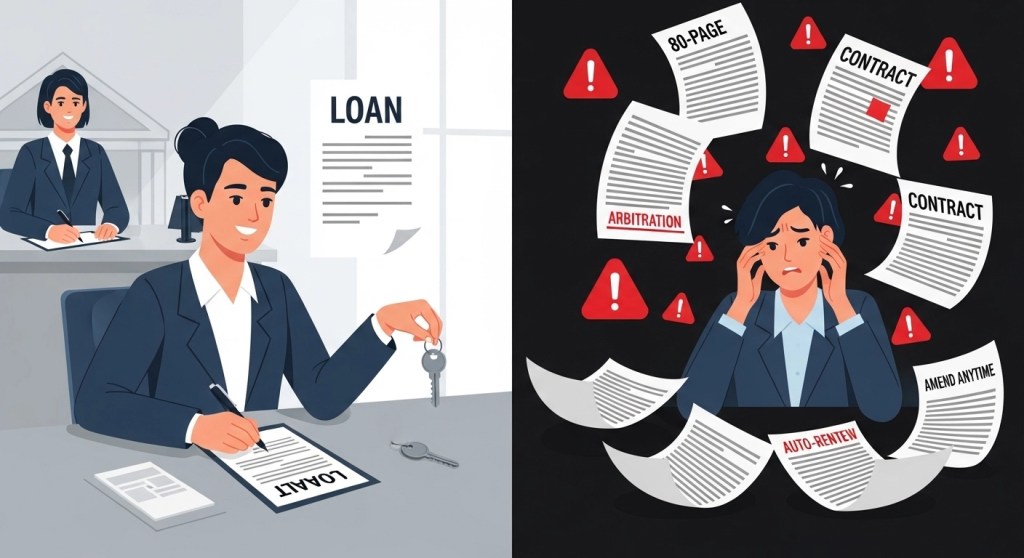
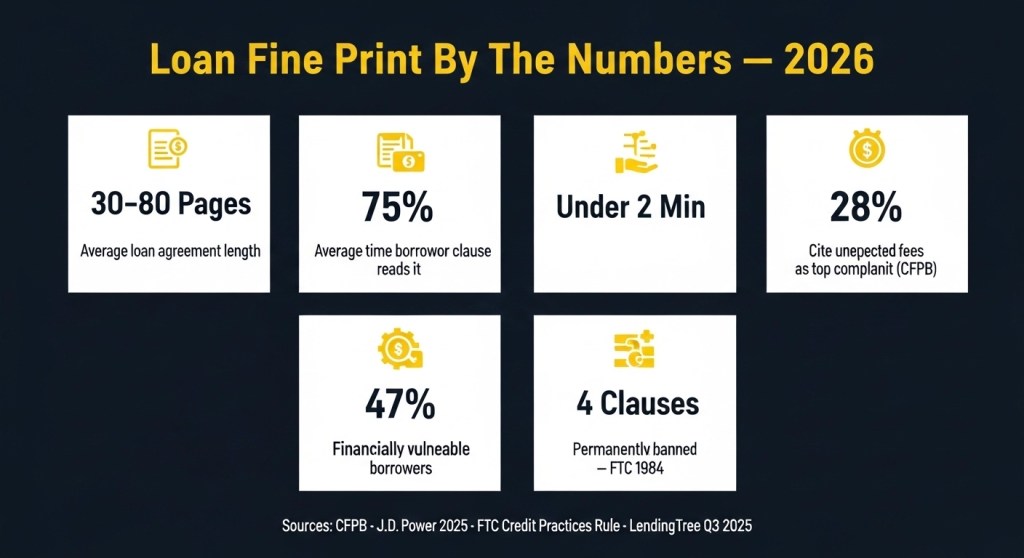
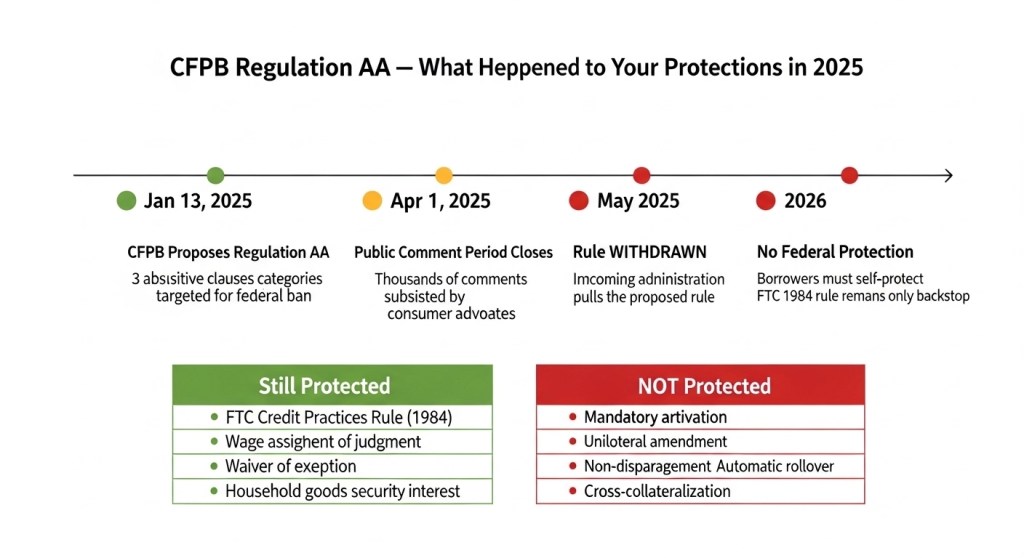
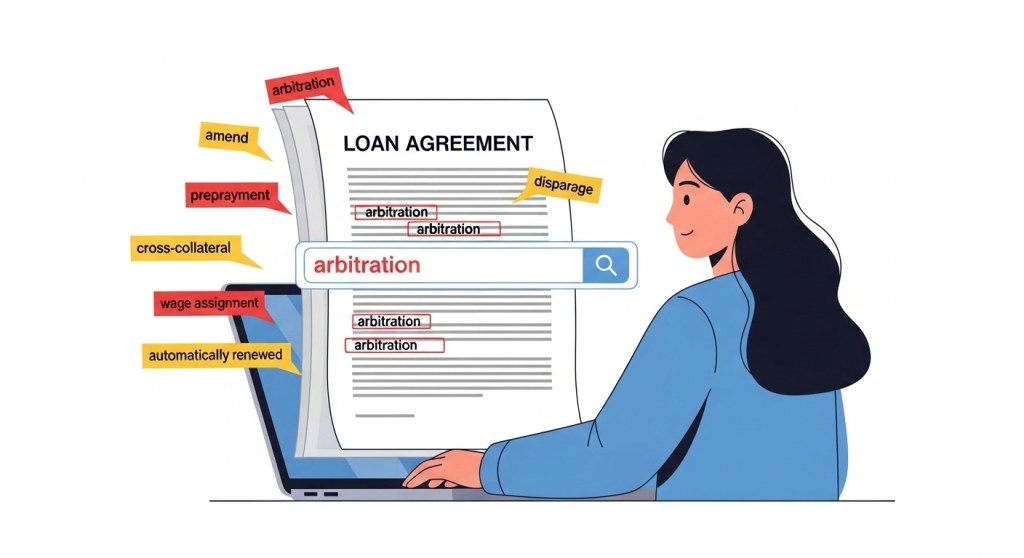
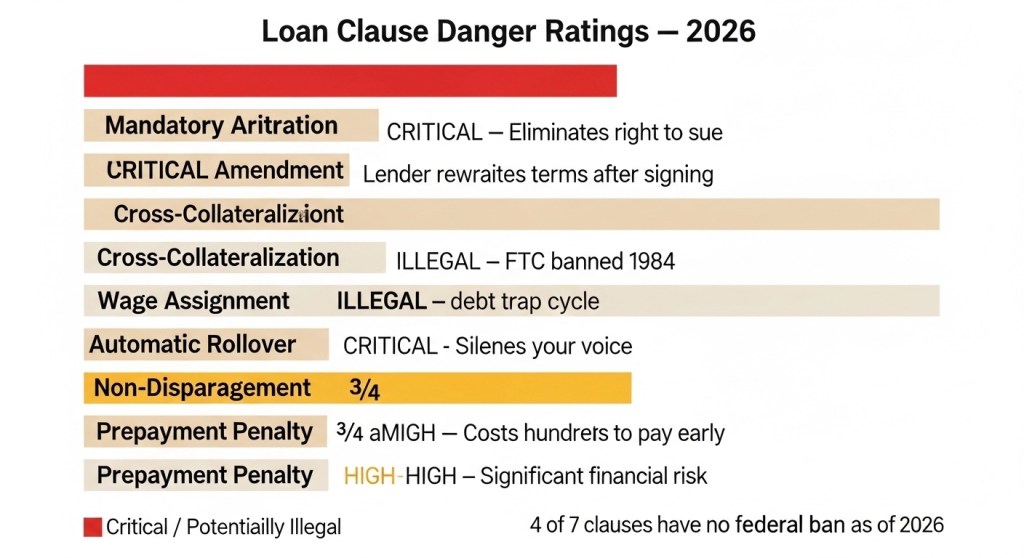
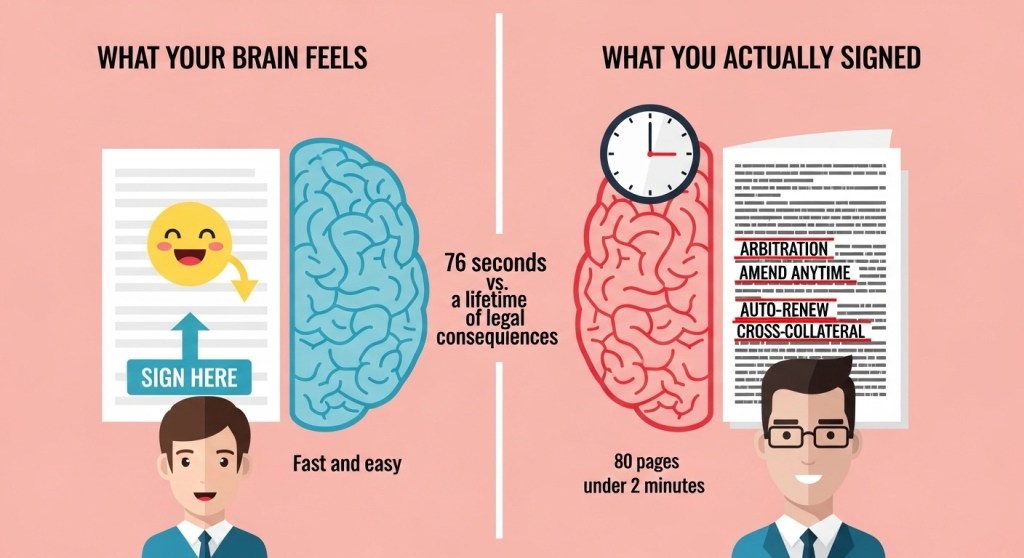
 Decoder