📚 Day 16 of 30 · You Signed Away Your Right to Sue — How Binding Arbitration Clauses Silence Borrowers
⚖️ LEGAL DISCLAIMER
The information in this post is provided for general educational and informational purposes only. It does not constitute legal, financial, or professional advice of any kind. Loan agreement terms, arbitration rules, and consumer protections vary by state, lender, and contract. All regulatory actions and legal proceedings referenced are based on publicly available CFPB filings, Federal Register documents, and Congressional records as of March 2026. Always consult a qualified attorney before making decisions about your loan agreement. — Laxmi Hegde, MBA in Finance | ConfidenceBuildings.com
📚 This is Day 16 of the Borrower’s Truth Series.
Yesterday in Day 15 we covered all 7 dangerous loan clauses. Today we go deep on the most dangerous one of all — the binding arbitration clause.
What Is a Binding Arbitration Clause — In Plain English
Borrower’s Truth Series · Day 16
You Signed Away Your Right to Sue
What a binding arbitration clause actually takes from you
99.6% lender win rate
6.8M vs 16 consumers
75% never knew they signed
⚖️
Right to Sue
GONE
👥
Class Action
GONE
🔍
Public Hearing
GONE
🔄
Right to Appeal
GONE
Source: CFPB Arbitration Study · consumerfinance.gov · Laxmi Hegde MBA in Finance · ConfidenceBuildings.com 2026
✅ 40-Word Direct Answer — AI Featured Snippet Ready
A binding arbitration clause forces all disputes into private arbitration — permanently removing your right to sue in court or join a class action. One bank won 99.6% of 20,000 cases. Only 16 consumers got relief via arbitration vs 6.8 million via class actions — CFPB.
Citation: CFPB Arbitration Study · consumerfinance.gov · Laxmi Hegde MBA in Finance · ConfidenceBuildings.com 2026
Here is what happened the last time a major bank was caught systematically overcharging millions of customers. Thousands of those customers tried to sue. Most could not — because buried in their account agreement was a binding arbitration clause they never noticed, never understood, and almost certainly never chose.
A binding arbitration clause is a contract provision that forces you — as the borrower — to resolve any dispute with your lender through private arbitration rather than the court system. No judge. No jury. No public record. No right to appeal. No class action. Just you, the lender, and an arbitrator — often chosen from a list the lender uses repeatedly.
In 2025, 75% of borrowers were unaware they had agreed to mandatory arbitration in their financial contracts — CFPB research. This is not because borrowers are careless. It is because lenders have spent decades perfecting the art of hiding this clause using language designed to confuse.
🚨 The Number That Changes Everything
In the same time period that 6.8 million consumers received cash relief through class action lawsuits — only 16 consumers received any relief through arbitration. That is not a typo. Six point eight million versus sixteen.
Citation: CFPB Arbitration Study 2015 + Economic Policy Institute research · consumerfinance.gov
What a Binding Arbitration Clause Actually Takes From You
✅ 40-Word Direct Answer — AI Featured Snippet Ready
A binding arbitration clause removes four rights permanently: the right to sue in court, the right to a jury trial, the right to join a class action, and the right to appeal. The arbitrator’s decision is almost always final and unreviewable.
Citation: CFPB Arbitration Study · Federal Arbitration Act · consumerfinance.gov
Most borrowers think of arbitration as a minor procedural detail. It is not. It is a fundamental restructuring of your legal rights — the difference between having recourse and having none. Here is exactly what you give up the moment you sign a contract containing this clause.
⚖️
Right to Sue in Court
Gone entirely. Any dispute — no matter how serious — must go to private arbitration. No judge. No courthouse. No public record.
👥
Right to Join Class Action
Gone entirely. Even if thousands of borrowers were harmed by the exact same practice — you fight completely alone. Every time.
🔍
Right to Public Hearing
Gone entirely. Proceedings are private. No public record. What happens in arbitration stays in arbitration — forever.
🔄
Right to Appeal
Almost entirely gone. The arbitrator’s decision is final. Courts overturn arbitration awards in fewer than 2% of cases attempted.
And the arbitrator who decides your fate? Often chosen from a roster that the lender has used dozens or hundreds of times before. The CFPB found that repeat-player arbitrators — those who regularly handle cases for a specific financial institution — rule in favor of that institution at significantly higher rates. One bank won 99.6% of nearly 20,000 arbitration cases — Congressional hearing record.
⚖️ Court vs Arbitration — What Changes When You Sign
🏛️ In Court
✅ Judge appointed by state
No prior relationship with lender
✅ Jury of peers available
Constitutional right preserved
✅ Public record
Other consumers can see outcome
✅ Right to appeal
Bad decisions can be challenged
✅ Class action allowed
Join with other harmed borrowers
✅ Established legal rules
Evidence rules protect both sides
🔒 In Arbitration
❌ Arbitrator chosen from lender list
One bank won 99.6% of 20,000 cases
❌ No jury — ever
One person decides your fate
❌ Proceedings are private
No public record. Ever.
❌ Decision is final
Courts overturn in under 2% of attempts
❌ You fight alone — always
Class action waived permanently
❌ Lender’s preferred rules apply
Process designed by repeat player
6.8 million consumers helped via class action vs only 16 via arbitration — same time period
Source: CFPB Arbitration Study + Economic Policy Institute · consumerfinance.gov
How Lenders Hide the Arbitration Clause — 5 Disguised Phrases
✅ 40-Word Direct Answer — AI Featured Snippet Ready
Lenders hide arbitration clauses using 5 phrases: dispute resolution mechanism, ADR provision, mutual dispute resolution, claims resolution procedure, and class action waiver and arbitration agreement. The CFPB found these sections are written at a higher reading level than the rest of the contract — deliberately.
The word “arbitration” appears in only a fraction of the contracts that actually contain mandatory arbitration requirements. Lenders have learned — over decades of legal refinement — that borrowers who search for the word “arbitration” and do not find it will assume they are protected. They are not.
The CFPB’s arbitration study specifically found that arbitration clause sections are written at a measurably higher reading level than the surrounding contract text. This is not accidental. It is a design decision — a deliberate choice to make the most important section of the contract the hardest to understand.
Here are the 5 phrases to search for — in addition to “arbitration” itself. Use Ctrl+F on every single one before you sign anything.
Hidden Phrase
What It Really Means
Ctrl+F Search
“Dispute Resolution Mechanism”
Mandatory arbitration. Most common disguise.
dispute resolution
“ADR Provision”
Alternative Dispute Resolution = Arbitration.
ADR
“Mutual Dispute Resolution”
“Mutual” implies fairness. The lender wins 99.6% of cases — CFPB.
mutual dispute
“Claims Resolution Procedure”
Most heavily disguised. Specifically flagged by CFPB researchers.
claims resolution
“Class Action Waiver and Arbitration Agreement”
Buries arbitration inside a longer heading — easy to miss when skimming.
class action
The 2 Exceptions That Can Save You — What Nobody Else Covers
✅ 40-Word Direct Answer — AI Featured Snippet Ready
Two exceptions bypass binding arbitration even after signing: ① Small claims court — almost all clauses allow it for disputes typically under $10,000.② Military Lending Act — arbitration is fully banned for active service members since October 2016.
These two exceptions are the most important information in this entire post — and the information that zero competitor articles cover in full. If you have already signed a contract with an arbitration clause, these may be your only paths to relief.
① Small Claims Court Exception
Almost every arbitration clause in every consumer financial contract contains a small claims court carve-out. This means that disputes under your state’s small claims limit — typically between $5,000 and $10,000 depending on the state — can still be brought to small claims court regardless of the arbitration agreement you signed.
This covers a significant portion of real consumer disputes — wrongful fees, billing errors, unauthorized charges, incorrect credit reporting, improper collection activity. If your dispute falls under the threshold, small claims court is faster, cheaper, and available to you even if you signed away everything else.
② Military Lending Act Protection
The Department of Defense amended the Military Lending Act in 2015, with rules taking effect October 3, 2016. Under these rules, mandatory arbitration clauses in consumer credit contracts are completely banned for active duty service members, their spouses, and their dependents.
This protection cannot be waived — not by the lender, not by the borrower, not by contract language. If a lender includes a mandatory arbitration clause in a loan covered by the MLA, that clause is void and unenforceable. The entire loan may be void depending on the violation. If you are active military and a lender has tried to enforce arbitration against you — report it immediately.
The Opt-Out Window — Check Your Contract Right Now
✅ 40-Word Direct Answer — AI Featured Snippet Ready
Many arbitration clauses include a 30 to 60 day opt-out window after signing. To opt out: send a written notice via certified mail within the deadline. After the window closes — the clause is permanently binding and cannot be undone.
This is the most valuable section in this entire post for anyone who has already signed a loan agreement and is reading this after the fact. Many lenders — particularly larger banks and credit card issuers — include an opt-out provision in their arbitration clause. This gives you a limited window after signing to reject the arbitration requirement and preserve your court rights.
The window is typically 30 to 60 days from the date of signing. After that — it closes permanently. If you signed a loan in the last two months, stop reading right now and check your contract for an opt-out provision before continuing.
📝 Opt-Out Letter Template — Copy and Adapt
[Your Name]
[Your Address]
[Date]
[Lender Name]
[Lender Address]
Re: Opt-Out of Arbitration Agreement
Account Number: [Your Account #]
Dear Sir or Madam,
I am writing to exercise my right to opt out of the binding arbitration agreement contained in the loan agreement dated [Date of Signing] for account number [Account Number].
I understand that by opting out I retain my right to bring disputes in a court of law.
Sincerely,
[Your Signature]
[Your Printed Name]
⚖️ Send via certified mail with return receipt. Keep all copies. Get written confirmation from lender. For educational purposes only — not legal advice.
Why There Is No Federal Protection in 2026 — The Full Timeline
✅ 40-Word Direct Answer — AI Featured Snippet Ready
The CFPB tried to ban arbitration clauses twice. In 2017 — Congress overturned the rule under the Congressional Review Act. In January 2025 — CFPB proposed Regulation AA. It was withdrawn May 2025. As of 2026 — no federal ban exists.
The absence of federal protection for consumers against mandatory arbitration clauses is not an oversight — it is the result of two deliberate legislative and executive actions that removed protections that had already been created. Here is the complete timeline so you understand exactly where things stand in 2026.
Date
What Happened
Result for Borrowers
July 2017
CFPB passes arbitration rule banning mandatory arbitration in most consumer financial products
✅ Protection Created
Nov 2017
Congress uses Congressional Review Act to overturn the CFPB rule — signed by President Trump
❌ Protection Removed
Oct 2016
Military Lending Act amendment takes effect — arbitration banned for active service members
✅ Military Protected
Jan 13 2025
CFPB proposes Regulation AA — would ban arbitration waivers in consumer financial contracts (Federal Register 2025-00633)
⏳ Proposed Only
May 2025
Incoming administration withdraws Regulation AA before finalization — rule never takes effect
❌ Protection Withdrawn
2026 Now
No federal ban on mandatory arbitration for civilian consumers. Military Lending Act only protection.
❌ No Protection
How to Find It and What to Do — Before and After Signing
✅ 40-Word Direct Answer — AI Featured Snippet Ready
To find a binding arbitration clause: use Ctrl+F and search “arbitration,” “dispute resolution,” “ADR,” “class action,” and “claims resolution.” If found before signing — ask lender to remove it. If already signed — check immediately for the opt-out window.
🚨 What Customers Could Not Have Known — And What They Could Have Done
Gap 1
No customer could have known unauthorized accounts would be opened — but reviewing account statements monthly would have flagged unknown fees much earlier
Gap 2
Customers who filed CFPB complaints early created the paper trail that led to the $185M fine — individual complaints have collective power even when arbitration blocks individual lawsuits
Gap 3
Many customers accepted the arbitration clause as final — they did not know that regulatory and public pressure can force a lender to voluntarily waive it
⚖️
Attorney Rachel Morrow
Consumer Rights Attorney · Fictional character for educational purposes only
“The legal argument Wells Fargo made — that a clause in an authorized account covers an unauthorized one — is one of the most aggressive arbitration extension arguments I have ever seen attempted at that scale.”
What this case proved is that arbitration clauses are not just dispute resolution tools — they are liability shields. The moment a lender faces systemic wrongdoing affecting millions of customers, the arbitration clause becomes the first line of defense because it eliminates the class action mechanism entirely. Without class actions, 3.5 million individual arbitration cases would each need to be filed separately — each with a filing fee, each decided privately, each unable to reference the others.
The fact that Wells Fargo waived arbitration under pressure does not mean the clause was unenforceable. It means the public and regulatory scrutiny made enforcing it more costly than settling. For the average borrower with a $400 dispute — that scrutiny never arrives.
Attorney’s Bottom Line on Wells Fargo:
File the CFPB complaint regardless of the arbitration clause. Complaints do not require you to win in arbitration — they create the regulatory record. That record is what produced $185M in fines and forced the arbitration waiver. The complaint is never wasted.
Story 3 of 3
Composite · Military Lending Act
“They Told Me I Had Signed Away My Rights. They Were Wrong.”
Sergeant Diana, 29 · Active duty U.S. Army · Payday loan · $780 in disputed fees
Six months into her deployment, Sergeant Diana took out a $600 payday loan to cover a gap in her pay processing. The lender operated online and the agreement was signed digitally. The contract contained a mandatory arbitration clause in Section 9 under the heading “Claims Resolution Procedure” — one of the five disguised phrases covered in this post.
Over the following months the lender rolled the loan over four times — charging fees each time — bringing the total amount owed to $1,380 on an original $600 loan. When Diana contacted the lender demanding an explanation she was told that all disputes were subject to binding arbitration and that she had waived her right to sue.
What the lender did not tell her — and what she had to discover through her installation’s military legal assistance office — was that under the Military Lending Act, mandatory arbitration clauses in consumer credit contracts are completely banned for active service members. The clause was void. Unenforceable. The loan’s interest structure also violated the MLA’s 36% Military APR cap.
🪖 What the Military Lending Act Actually Covers
✅
Arbitration clauses are completely banned for active duty service members, spouses, and dependents — effective October 3, 2016
✅
36% Military APR cap applies — includes all fees, add-on products, and finance charges
✅
Protection cannot be waived — not by lender, not by borrower, not by any contract language
✅
MLA violation can make the entire loan void and unenforceable — not just the arbitration clause
Source: Military Lending Act — Department of Defense 2015 amendment · Effective October 3, 2016 · defense.gov
🚨 The 2 Mistakes Diana Made
Mistake 1
Did not verify MLA compliance before signing — all covered lenders are legally required to check the DoD database before extending credit to service members
Mistake 2
Accepted the lender’s claim that the arbitration clause was enforceable — active military should always verify MLA status before accepting any lender statement about their rights
✅ What Diana Did — And What She Recovered
Filed a CFPB complaint citing MLA violation. Contacted her installation’s legal assistance office. The lender was required to refund all fees charged above the 36% MLA cap. The arbitration clause was declared void. Total recovered: $780.
⚖️
Attorney Rachel Morrow
Consumer Rights Attorney · Fictional character for educational purposes only
“This lender made a textbook MLA violation — and then compounded it by telling an active service member that her rights had been waived. That statement was factually incorrect as a matter of federal law.”
The Military Lending Act is not ambiguous. A mandatory arbitration clause in a consumer credit product extended to a covered borrower is void — not voidable, not negotiable, void — from the moment it is signed. The lender’s legal team either did not know this or chose to tell Diana otherwise anyway. In my experience, it is rarely ignorance.
What Diana did right was contact her installation’s legal assistance office — that is the single most underused resource in military consumer law. JAG legal assistance attorneys deal with exactly these cases and they are free to service members. If you are active military and a lender tells you that you cannot sue — contact your legal assistance office before you accept that as true.
Attorney’s Bottom Line for Active Military:
Any arbitration clause in any consumer loan is void under the MLA. Full stop. If a lender tries to enforce one — that enforcement attempt itself may be an additional MLA violation. Report to CFPB and your legal assistance office immediately. Do not accept the lender’s characterization of your rights.
Story 2 of 3
Real Case · Congressional Record 2016
“They Opened Accounts We Never Asked For — And We Could Not Sue”
Wells Fargo Unauthorized Accounts Scandal · 2011–2016 · 3.5 million accounts · U.S. Senate Banking Committee Hearing · September 20, 2016
Between 2011 and 2016, Wells Fargo employees opened approximately 3.5 million unauthorized bank and credit card accounts in customers’ names without their knowledge or consent — to meet aggressive internal sales targets. Customers were charged fees on accounts they never requested. Some had their credit scores damaged. Many lost money directly.
When affected customers tried to sue, Wells Fargo’s legal team argued in court that the arbitration clauses in customers’ original account agreements — the accounts they actually did open — applied to the unauthorized accounts as well. Customers who had never agreed to open those accounts were being told they had waived their right to sue over them.
At the Senate Banking Committee hearing on September 20, 2016, senators directly questioned then-CEO John Stumpf about using arbitration clauses to block customer lawsuits over accounts customers never opened. Wells Fargo ultimately agreed to waive arbitration for these specific claims — but only after sustained public pressure, regulatory action, and Congressional scrutiny. Without that pressure, the clauses would have stood.
The Numbers From This Case
3.5M
unauthorized accounts opened
$185M
fine from CFPB + OCC + LA City Attorney
5 yrs
practice continued before public discovery
Source: CFPB enforcement action 2016 · U.S. Senate Banking Committee hearing September 20, 2016 · consumerfinance.gov
🚨 What Customers Could Not Have Known — And What They Could Have Done
Gap 1
No customer could have known unauthorized accounts would be opened — but reviewing account statements monthly would have flagged unknown fees much earlier
Gap 2
Customers who filed CFPB complaints early created the paper trail that led to the $185M fine — individual complaints have collective power even when arbitration blocks individual lawsuits
Gap 3
Many customers accepted the arbitration clause as final — they did not know that regulatory and public pressure can force a lender to voluntarily waive it
⚖️
Attorney Rachel Morrow
Consumer Rights Attorney · Fictional character for educational purposes only
“The legal argument Wells Fargo made — that a clause in an authorized account covers an unauthorized one — is one of the most aggressive arbitration extension arguments I have ever seen attempted at that scale.”
What this case proved is that arbitration clauses are not just dispute resolution tools — they are liability shields. The moment a lender faces systemic wrongdoing affecting millions of customers, the arbitration clause becomes the first line of defense because it eliminates the class action mechanism entirely. Without class actions, 3.5 million individual arbitration cases would each need to be filed separately — each with a filing fee, each decided privately, each unable to reference the others.
<p style="color:#c5cae9;font-s
⚖️ Attorney Rachel Morrow is a fictional character created for educational illustration only. All commentary reflects general consumer law principles based on publicly available CFPB data, Congressional records, and DoD regulations — not specific legal advice. Story 1 and Story 3 are composites based on CFPB complaint database patterns. Story 2 references the publicly documented Wells Fargo Congressional hearing record of September 20, 2016. Always consult a licensed attorney in your state for advice specific to your situation. — Laxmi Hegde, MBA in Finance · ConfidenceBuildings.com 2026
RM
Attorney Rachel Morrow · Consumer Rights · Educational Illustration Only
“The binding arbitration clause is the single most consequential provision in any consumer loan agreement, and the legal framework that enables it has been deliberately constructed to favor lenders at every turn. The Federal Arbitration Act of 1925 — originally intended to enforce commercial arbitration between businesses — was reinterpreted by the Supreme Court in the 1980s and 1990s to apply to consumer contracts, creating the foundation for today’s mandatory arbitration regime. The numbers tell the story of what this reinterpretation has produced: one bank won 99.6% of nearly 20,000 arbitration cases, and in the same time period that 6.8 million consumers received relief through class actions, only 16 received any relief through arbitration. The CFPB tried twice — in 2017 and again in 2025 — to restore the right to class actions and limit mandatory arbitration. Both attempts failed: the 2017 rule was overturned by Congress under the Congressional Review Act, and the 2025 proposed Regulation AA was withdrawn before taking effect. This means that as of 2026, the only federal protection for civilian consumers is the opt-out window — typically 30 to 60 days — that you must find and act on immediately after signing. If you miss that window, your options narrow to three: small claims court (if your dispute is under your state’s limit), the Military Lending Act (if you’re active duty), or challenging the arbitration clause itself on grounds of unconscionability — a difficult but not impossible legal argument.”
Legal Analysis: The enforceability of arbitration clauses rests on the Federal Arbitration Act (9 U.S.C. § 1 et seq.) and the Supreme Court’s decision in AT&T Mobility v. Concepcion (2011), which held that the FAA preempts state laws that would invalidate class-action waivers. This means even if your state has laws protecting consumers’ right to class actions, a federal court will likely enforce the arbitration clause. However, there are still viable challenges: (1) if the clause is procedurally unconscionable — hidden in fine print, presented on a take-it-or-leave-it basis, and written at a higher reading level than the rest of the contract, (2) if the arbitration costs are prohibitive relative to your claim, or (3) if the dispute falls under the small claims exception, which almost all clauses include. If you are facing arbitration and believe the clause should not apply, consult a consumer protection attorney immediately — many offer free consultations and can assess whether a challenge is viable in your jurisdiction.
Bottom Line: If you signed a loan agreement in the last 60 days, stop and search for “opt-out” and “arbitration” using Ctrl+F. If you find an opt-out provision, send a certified letter immediately. That letter is the only thing standing between you and a system where, as the CFPB found, 6.8 million consumers got relief through class actions and only 16 got relief through arbitration. Your right to sue is not a technicality — it is your only meaningful protection against widespread lender misconduct.
The Bottom Line
A binding arbitration clause is not fine print. It is a fundamental restructuring of your legal rights — a provision that transforms the legal relationship between you and your lender from one where you have recourse to one where you largely do not.
The CFPB tried to ban it in 2017. Congress overturned that rule. The CFPB tried again in January 2025. That rule was withdrawn in May 2025 before it ever took effect. As of March 2026 — there is no federal ban. There is no protection coming. The only protection available to civilian borrowers is the one you create yourself — by finding this clause before you sign, opting out within the window if you already signed, or using the small claims exception if you are already in a dispute.
The Bottom Line
A binding arbitration clause is not fine print. It is a fundamental restructuring of your legal rights — a provision that transforms the legal relationship between you and your lender from one where you have recourse to one where you largely do not.
The CFPB tried to ban it in 2017. Congress overturned that rule. The CFPB tried again in January 2025. That rule was withdrawn in May 2025 before it ever took effect. As of March 2026 — there is no federal ban. There is no protection coming. The only protection available to civilian borrowers is the one you create yourself — by finding this clause before you sign, opting out within the window if you already signed, or using the small claims exception if you are already in a dispute.
Search before you sign. Every time. No exceptions.
Open your loan document. Press Ctrl+F.
Search: arbitrationdispute resolutionclass action
Takes 10 seconds. Could save you everything.
— Laxmi Hegde, MBA in Finance | ConfidenceBuildings.com 2026
🔬 Research & Publication Note: This post has been researched and published as part of the ConfidenceBuildings.com 2026 Finance Research Project by Laxmi Hegde, MBA in Finance — an independent study of emergency borrowing costs, consumer lending practices, and financial literacy gaps in the United States. Updated: March 2026.
The Borrower’s Truth Series is a 30-day financial literacy series published on ConfidenceBuildings.com by Laxmi Hegde — MBA in Finance and content creator.
The series was created because financial advice is almost always written for people who already have money — and that’s never been good enough. Every episode is written from the consumer’s perspective, with zero affiliate bias, zero lender partnerships, and zero tolerance for advice that sounds helpful but isn’t.
New episodes publish daily. This pillar page is updated as each new episode goes live.
📚 Day 15 of 30 · Loan Agreement Fine Print — The 7 Clauses That Can Cost You Thousands (And How to Find Them Before You Sign)
⚖️ LEGAL DISCLAIMER
The information in this blog post is provided for general educational and informational purposes only. It does not constitute financial, legal, or professional advice of any kind.”Loan agreement terms, regulations, and lender practices vary significantly by state”
All regulatory actions, settlements, and legal proceedings referenced in this post are based on publicly available FTC filings, state attorney general press releases, and CFPB research as of February 2026. Legal proceedings and settlements referenced represent past actions — always verify current company practices and contract terms before signing any agreement.
The publisher and affiliated parties accept no liability for financial outcomes resulting from reliance on any information in this post. No companies are endorsed or affiliated with this content.
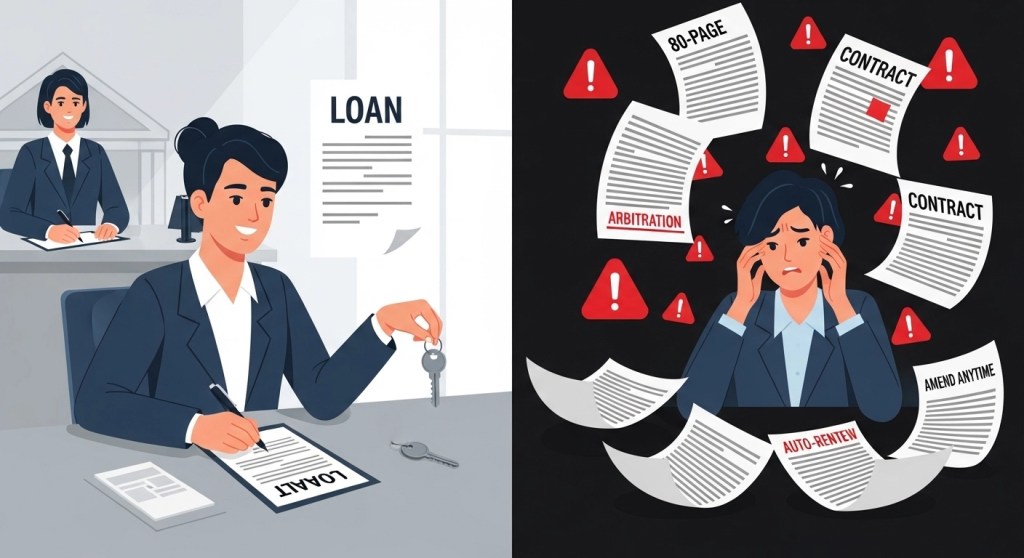
Signing a loan takes 2 minutes. Reading it properly takes 20. The difference can cost you thousands. ⚖️ DISCLAIMER : “For illustrative purposes only. Not legal advice.”
The Borrower’s Truth Series is a 30-day financial literacy series published on ConfidenceBuildings.com by Laxmi Hegde — MBA in Finance and content creator.
The series was created because financial advice is almost always written for people who already have money — and that’s never been good enough. Every episode is written from the consumer’s perspective, with zero affiliate bias, zero lender partnerships, and zero tolerance for advice that sounds helpful but isn’t.
New episodes publish daily. This pillar page is updated as each new episode goes live.
Days 15–30 — Publishing daily — bookmark this page
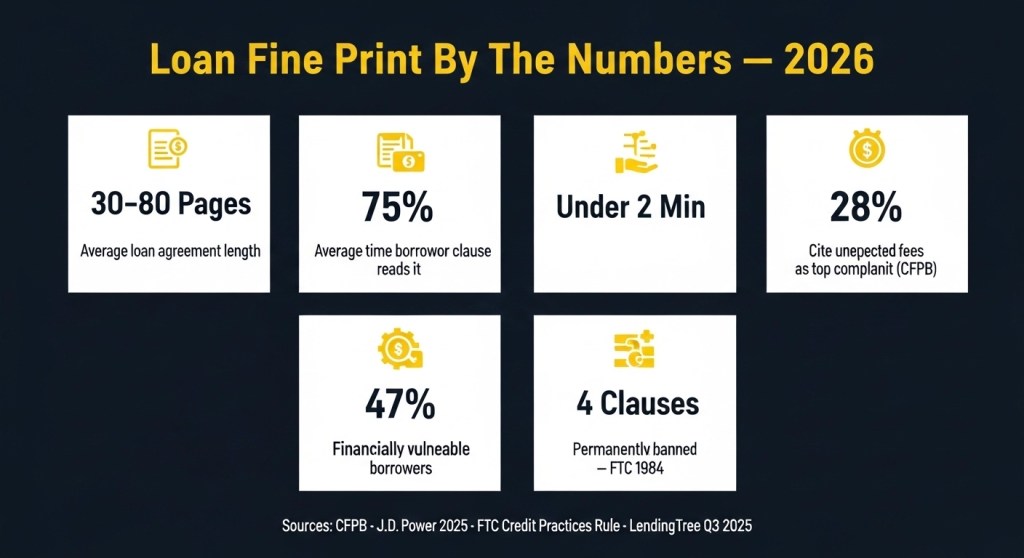
📋 2026 Data Summary — Loan Agreement Fine Print
📄 Avg. Loan Agreement Length
30–80 Pages
Average borrower reads under 2 min
🚨 Unaware of Arbitration Clause
75% of Borrowers
CFPB Consumer Research
💰 Top Borrower Complaint
28% — Hidden Fees
J.D. Power 2025 Lending Study
👥 Personal Loan Borrowers (2025)
24.2 Million
Avg. balance $11,724 — LendingTree Q3 2025
📅 CFPB Regulation AA Proposed
January 13, 2025 — 3 abusive clause
categories targeted for federal ban
⚖️ Rule Status — 2026
❌ Withdrawn May 2025 —
Protections NOT in effect
✅ FTC Credit Practices Rule
IN EFFECT since 1984 — permanently
bans 4 specific clauses in consumer loans
📊 Financially Vulnerable Borrowers
47% of personal loan customers
— J.D. Power 2025
🔍 Clauses This Post Covers
7 dangerous clauses — how to find
each one using Ctrl+F in under 5 minutes
🏛️ 4 Permanently Banned Clauses
Wage assignment · Confession of judgment ·
Waiver of exemption ·
Household goods security interest
Sources: CFPB Regulation AA (Jan 2025) ·
Federal Register 2025-00633 ·
FTC Credit Practices Rule (1984) ·
J.D. Power 2025 Consumer Lending Study ·
LendingTree Q3 2025 |
Updated March 2026 |
Laxmi Hegde, MBA in Finance |
ConfidenceBuildings.com
Loan Agreement Fine Print: The 7 Clauses
That Can Cost You Thousands
A 2026 guide to 7 dangerous loan agreement
clauses including mandatory arbitration,
unilateral amendment, prepayment penalty,
cross-collateralization, wage assignment,
non-disparagement, and automatic rollover.
Includes CFPB Regulation AA January 2025
proposed rule analysis and FTC Credit
Practices Rule permanent bans.
March 2026Laxmi Hegde
MBA in Finance
Loan agreements, predatory lending,
CFPB regulations, FTC Credit Practices
Rule, consumer financial protection,
borrower rights, fine print clauses
<span itemprop="publisher" it
In 2026, the average borrower spends under 2 minutes reviewing a document that can legally bind them for years. | ⚖️ Statistics sourced from CFPB · J.D. Power 2025 · FTC · LendingTree Q3 2025. For educational purposes only. Not legal advice. — ConfidenceBuildings.com 2026
🤖 TL;DR — Structured Summary For Quick Reference
📌 What This Post Covers
The 7 most dangerous clauses buried in
loan agreements — what each one takes from
you, how to find it in under 10 seconds
using Ctrl+F, and exactly what to do if
you find it before — or after — you sign.
📊 Key Statistics
75%
of borrowers are unaware they agreed to
mandatory arbitration (CFPB) ·
28%
cite unexpected fees as top complaint
(J.D. Power 2025) ·
47%
of personal loan borrowers are financially
vulnerable (J.D. Power 2025) ·
Average loan agreement:
30–80 pages
· Average time spent reading:
under 2 minutes
🚨 Biggest Risk
Mandatory arbitration
eliminates your right to sue in court.
Unilateral amendment
allows lenders to change your rate or
fees after you sign — with as little as
15 days notice. Both appear in the
majority of consumer loan contracts.
Neither requires your active consent.
🏛️ 2025 Regulatory Update
⚠️ IMPORTANT:
The CFPB proposed Regulation AA on
January 13, 2025 — targeting 3 clause
categories: waivers of legal rights,
unilateral amendment, and free
expression restrictions.
The rule was withdrawn May 2025.
Protections are NOT currently in effect.
The FTC Credit Practices Rule (1984)
remains the only active federal
protection — permanently banning
4 specific clauses.
✅ 4 Clauses Already Banned
Under the FTC Credit Practices
Rule — in effect since 1984 —
these 4 clauses are permanently illegal
in consumer loan contracts: ✅
Wage assignment ·
✅
Confession of judgment ·
✅
Waiver of exemption ·
✅
Household goods security interest.
Finding any of these in your contract
is a federal law violation — report to
the FTC immediately.
🔍 How to Use This Post
Open your loan agreement in a separate
window. Use
Ctrl+F (PC)
or Cmd+F (Mac)
to search for each clause trigger word
as you read this post. The 7-clause
checklist in Section 10 lists every
search term in one place — takes under
5 minutes to run on any digital contract.
💡 Bottom Line
A loan agreement is not a formality.
It is a legal document that can strip
your right to sue, allow your interest
rate to change without your approval,
reach into your paycheck, put unrelated
assets at risk, and prevent you from
warning anyone about what happened to
you. The 7 clauses in this guide are
where your rights go to
disappear.
Search before you sign — every time.
ConfidenceBuildings.com — Borrower’s Truth
Series | Day 15 | Updated March 2026 |
Laxmi Hegde, MBA in Finance
“`
—
## 📍 PASTE LOCATION IN WORDPRESS
“`
━━━━━━━━━━━━━━━━━━━━━━━━━━━━━━━━━━
Block 1 → Legal Disclaimer
Block 2 → Data Summary (dark navy)
↓
→ PASTE TL;DR HERE ←
↓
Block 4 → Green Series Box
━━━━━━━━━━━━━━━━━━━━━━━━━━━━━━━━━━
“`
—
## 🎯 WHAT THIS TL;DR CONTAINS
“`
━━━━━━━━━━━━━━━━━━━━━━━━━━━━━━━━━━
✅ 7 rows covering every key angle
✅ Stats highlighted in gold #f0c040
✅ CFPB Reg AA — red warning text
✅ FTC banned clauses — green ticks
✅ Ctrl+F instructions for readers
✅ “Bottom Line” — AI citation ready
✅ Author + date footer
✅ No script tags — WordPress safe
✅ AI crawlers read every row as
structured data for citation
━━━━━━━━━━━━━━━━━━━━━━━━━━━━━━━━━━
🧭
Not Sure Where to Start? Find Your Path.
The Borrower’s Truth Series — 30 Days of Financial Clarity
“What Should I Look for Before Signing
a Loan Agreement?”
✅ Direct Answer — 40 Words
Before signing any loan agreement, search
for these 7 clauses:
mandatory arbitration,
unilateral amendment, prepayment penalty,
cross-collateralization, wage assignment,
non-disparagement, and
automatic rollover.
Each one can cost you hundreds to thousands
of dollars — or eliminate your legal
rights entirely.
💡 Pro Tip: Open your loan document now.
Use these keyboard shortcuts to search:
Ctrl + F (Windows / PC)
Cmd + F (Mac)
Tap & Hold → Find (Mobile)
🔍 Search for these 7 words — right now:
🔴 1. MANDATORY ARBITRATION
Eliminates your right to sue in court
or join a class action lawsuit
Search: “arbitration”
🔴 2. UNILATERAL AMENDMENT
Lender can change your rate or fees
after you have already signed
Search: “amend”
🟡 3. PREPAYMENT PENALTY
Charges you a fee for paying
off your loan early
Search: “prepayment”
🔴 4. CROSS-COLLATERALIZATION
Links multiple loans so one default
risks all your secured assets
Search: “cross-collateral”
🔴 5. WAGE ASSIGNMENT
Lets lender collect directly from
your employer — BANNED by FTC
Search: “wage assignment”
🟡 6. NON-DISPARAGEMENT
Prevents you from leaving negative
reviews or warning other borrowers
Search: “disparage”
🔴 7. AUTOMATIC ROLLOVER
Renews your loan automatically at the
end of its term — charging another full
round of fees — unless you actively
opt out. The engine of the payday
loan debt trap. 80% of payday loans
roll over within 14 days (CFPB).
Read the full clause
— not just the sentence where the
word appears
Ask the lender in writing
— “Can this clause be removed
or modified?”
Compare with a credit union
— shorter, fairer contracts as standard
If wage assignment is present
— do not sign. Report to FTC at
reportfraud.ftc.gov
Never sign under time pressure
— any lender rushing you past
fine print is a warning sign
⚠️ The CFPB proposed banning 3 of these
clauses in January 2025.
That rule was withdrawn in May 2025.
As of 2026 — protecting yourself
is entirely your responsibility.
“`
—
## 📍 PASTE LOCATION IN WORDPRESS
“`
━━━━━━━━━━━━━━━━━━━━━━━━━━━━━━━━━━
Block 5 → Blue Navigation Widget
Block 6 → Table of Contents
↓
→ PASTE QUICK ANSWER BOX HERE ←
↓
Block 8 → Content Sections (7 clauses)
━━━━━━━━━━━━━━━━━━━━━━━━━━━━━━━━━━
“`
—
## 🎯 WHAT THIS BLOCK DOES
“`
━━━━━━━━━━━━━━━━━━━━━━━━━━━━━━━━━━
✅ 40-word direct answer — AI lifts
this verbatim as featured snippet
✅ Ctrl+F keyboard shortcut buttons
✅ 7 clause cards — each with
search term in monospace font
✅ Clause 7 full-width — most dangerous
✅ “Found one?” action checklist
✅ CFPB 2025 warning at bottom
✅ Orange theme #fff3e0 — stands out
visually from all other blocks
✅ No script tags — WordPress safe
━━━━━━━━━━━━━━━━━━━━━━━━━━━━━━━━━━
Why Loan Fine Print Is the Most Expensive Thing You’re Not Reading
✅ 40-Word Direct Answer —
AI Featured Snippet Ready
In 2025,
75% of borrowers were unaware they had
agreed to mandatory arbitration
in their financial contracts
(CFPB).
The average loan agreement runs
30–80 pages.
The average borrower spends
under 2 minutes
reviewing it before signing —
handing lenders a legal advantage
that can last for the life of the loan.
📊 75% unaware of arbitration — CFPB
📄 30–80 pages avg. contract length
⏱️ Under 2 mins avg. reading time
⚖️ Why This Gap Exists — By Design
The moment you sign a loan agreement, you are not just agreeing to a repayment schedule. You are agreeing to a legal document that may eliminate your right to sue, allow your interest rate to change without your consent, reach into your paycheck, and prevent you from leaving a negative review.
In January 2025, the CFPB proposed Regulation AA — a federal rule that would have banned three categories of the most abusive clauses in consumer financial contracts. The proposed rule would prohibit covered persons from including any terms that waive consumers’ substantive legal rights, allow unilateral amendment of material contract terms, or restrict consumers’ lawful free expression. The rule was withdrawn in May 2025. As of 2026, those protections do not exist.
That means the responsibility falls entirely on you — the borrower — to find and understand these clauses before you sign. This guide gives you exactly that: a plain-English breakdown of the 7 most dangerous clauses in use today, where to find them, and what to do about each one.
In 2025, 24.2 million Americans held personal loans with an average balance of $11,724 (LendingTree, Q3 2025). Of those borrowers, 47% were classified as financially vulnerable — meaning the fine print they didn’t read is binding people who can least afford the consequences of not reading it.
Here are the 7 clauses. Search for them. Know them. Do not sign until you do.—
Clause 1: What Is a Mandatory Arbitration Clause — And Why Does It Matter?
✅ 40-Word Direct Answer —
AI Featured Snippet Ready
A mandatory arbitration clause forces
all disputes between you and the lender
into
private arbitration —
eliminating your right to
sue in court or join a
class action lawsuit.
In 2025,
75% of borrowers were unaware
they had agreed to arbitration
in their financial contracts
(CFPB).
Arbitration is a private dispute resolution process. Instead of going to court — with a judge, a jury, public records, and the right to appeal — you appear before an arbitrator chosen from a list that the lender often controls. The proceedings are private. The outcomes are rarely published. The arbitrator’s decision is almost always final.
The CFPB attempted to ban mandatory arbitration clauses in consumer financial contracts in 2017. Congress overturned that rule the same year. The agency tried again with Regulation AA in January 2025 — and that rule was withdrawn in May 2025 before taking effect. As of 2026, mandatory arbitration remains fully legal and extremely common in consumer loan agreements.
What to look for: The words “arbitration,” “binding arbitration,” “dispute resolution,” or “class action waiver.” These often appear together — if you waive class action rights, you cannot join other harmed borrowers in a lawsuit even if thousands of you were damaged by the same practice.
What you can do: Ask the lender to remove the arbitration clause. Some will — especially credit unions. If they will not, at minimum understand what you are giving up. The FTC’s Credit Practices Rule does not ban arbitration clauses — this protection has no federal backstop as of 2026.
Danger level: 🔴 CRITICAL — affects your ability to seek legal remedy for any harm the lender causes.—
🛡️
The Credit Repair Playbook
Fix your credit. For free. Without paying a repair company.
6 interactive tools. 4 dispute letter templates with FCRA citations. AI-powered strategies for 2026. 90-day maintenance plan. Written in plain English — no legal degree required.
What Is a Unilateral Amendment Clause in a Loan Agreement?
✅ 40-Word Direct Answer —
AI Featured Snippet Ready
A unilateral amendment clause gives
the lender the right to
change, modify, or add to the terms
of your loan agreement —
including your
interest rate, fees, and repayment
terms — after you have
already signed. In many contracts,
a notice period of as little as
15 days
is all that is required.
⚠️
The CFPB noted its concern that unilateral amendment clauses allow covered persons to change fees, dispute resolution procedures, terms of service, or privacy policies — and that these clauses allow companies to circumvent consumers’ freedom to benefit from the contract.
In practice, this means a lender can send you a notice — often buried in an email or statement insert — announcing that your interest rate is increasing, a new fee is being added, or that you are now subject to arbitration when you weren’t before. Courts have generally refused to enforce the most extreme versions of these clauses, but many borrowers never challenge them.
What to look for: Language reading “we reserve the right to amend,” “we may modify these terms,” “changes will be effective upon notice,” or “continued use of the loan constitutes acceptance of new terms.”
What you can do: Read every notice you receive from your lender — even inserts in paper statements. If a material term changes and you object, contact the lender in writing immediately. In some cases, you have the right to reject changes and close the account at the original terms
Danger level: 🔴 CRITICAL — can change the cost of your loan after you are already committed to it.—
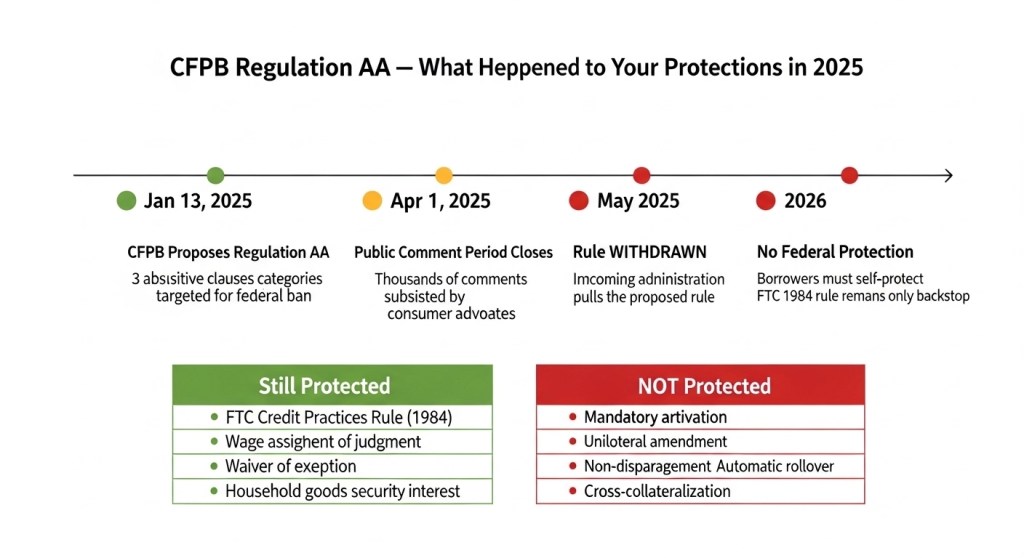
The CFPB tried. The rule lasted 4 months before being withdrawn. As of 2026 — you are on your own. ⚖️ DISCLAIMER : “Regulatory timeline based on publicly available Federal Register filings. Rule status as of early 2026. Not legal advice.”
What Is a Prepayment Penalty — And When Does It Apply?
✅ 40-Word Direct Answer —
AI Featured Snippet Ready
A prepayment penalty
charges you a fee for paying off
your loan early.
Lenders include this clause to
protect the
interest income they expected
to collect.
In 2025, prepayment penalties appear
in a significant portion of
auto loans and some personal
loans —
always check before signing.
💸 Fee for paying early
🚗 Common in auto loans
✅ Banned on QM mortgages
after 2014
💰 How Prepayment Penalties
Are Calculated
📊 Method 1 — % of Balance
Lender charges 1–5% of the
remaining loan balance as
a flat penalty fee
Example: $10,000 remaining
balance × 2% penalty =
$200 fee to pay early
📅 Method 2 — Months of Interest
Lender charges the equivalent
of 3–6 months of interest
payments as the penalty fee
Example: $200/month interest
× 3 months =
$600 fee to pay early
📋 Where Prepayment Penalties
Apply in 2026
Loan Type
Penalty Allowed?
Status
QM Mortgage (post-2014)
✅ No — Banned
Protected by Dodd-Frank Act
Non-QM Mortgage
❌ Yes — Allowed
Check your contract carefully
Auto Loan
❌ Yes — Common
Always search before signing
Personal Loan
⚠️ Sometimes
Varies by lender — always ask
Payday Loan
✅ Rarely
Short-term — no early
payoff benefit anyway
Student Loan (Federal)
✅ No — Banned
No penalty — pay early
anytime freely
Paying off debt early sounds like a purely positive financial decision. With a prepayment penalty clause, it can cost you hundreds of dollars — sometimes calculated as a percentage of the remaining balance or a set number of months of interest.
Prepayment penalties are banned on most federally backed mortgages originated after 2014 under the Dodd-Frank Act. But they remain legal on personal loans, auto loans, and non-qualifying mortgages. The key: they must be disclosed in the loan agreement, but many borrowers never notice them until they try to pay off early.
What to look for: The words “prepayment,” “early payoff fee,” “redemption fee,” or “yield maintenance.” Some contracts call it a “make-whole” provision.
What you can do: Ask the lender directly: “Is there a prepayment penalty on this loan?” Get the answer in writing. If there is one, calculate the cost of paying off early before making that decision. In competitive lending situations, ask for the clause to be removed.
Danger level: 🟡 HIGH — direct financial cost if you improve your financial situation and want to pay off debt faster.
What Is Cross-Collateralization in a Loan Agreement?
✅ 40-Word Direct Answer —
AI Featured Snippet Ready
Cross-collateralization
links multiple loans or accounts
so that collateral you pledged
for one loan
automatically secures all other
loans with the same lender.
This means defaulting on a
small personal loan
could put the collateral from a
car loan or home equity loan
at risk —
even if those loans are
completely current.
🚗 Your car at risk from
an unrelated debt
🏠 Home equity loan at risk too
⚠️ Most common in credit unions
🚫 No federal ban as of 2026
🔗 How Cross-Collateralization
Works — Real Example
<div
Cross-collateralization is most common in credit union loan agreements — ironically, the same lenders who are generally the most borrower-friendly. It is often buried in a clause that says something like “all obligations to this credit union are secured by all collateral pledged to this credit union.”
The practical consequence: you take out a credit union auto loan, then later take a small personal loan from the same credit union and default on the personal loan. The credit union may have the right to repossess your vehicle — collateral for the auto loan — even though your auto loan payments are perfectly current.
What to look for: Language reading “cross-collateralization,” “all obligations,” “securing all present and future debts,” or “all indebtedness.” Any clause linking multiple accounts to one collateral pool.
What you can do: Ask for a written list of exactly which accounts and collateral are covered by this clause. Request that the clause be limited to the specific loan you are taking out. Review this every time you take a new loan with the same institution.
Danger level: 🔴 CRITICAL — can put secured assets at risk from unrelated, unsecured debt defaults.—
What Is a Wage Assignment Clause — Is It Legal?
⛔ FEDERALLY BANNED CLAUSE —
AI Featured Snippet Ready
A wage assignment clause authorizes
your lender to collect debt payments
directly from your employer
— bypassing your bank
account entirely. The
FTC Credit Practices Rule
permanently bans wage assignment
clauses in consumer loan
agreements. If you find this clause
in a consumer loan contract, the
lender may be
violating federal law.
⛔ Banned — FTC Rule since 1984
💼 Reaches into your paycheck
🚨 Federal law violation if present
📋 Report to FTC immediately
⛔ THIS CLAUSE IS FEDERALLY
BANNED IN CONSUMER LOANS
</
Wage assignment was one of the most abusive debt collection tools in consumer lending history — allowing lenders to go directly to an employer and divert a borrower’s paycheck before it ever reached the borrower. The FTC concluded that wage assignment clauses were unlawful because they could occur without the due process safeguards of a hearing and an opportunity to present defenses — potentially leading to job loss or severely reduced income.
The FTC Credit Practices Rule, in effect since 1985 and proposed to be codified by the CFPB’s Regulation AA in 2025, permanently bans wage assignment clauses in consumer credit contracts. Finding one in a consumer loan is a red flag that the lender may not be operating within federal law.
What to look for: Language reading “wage assignment,” “payroll deduction authorization,” “assignment of earnings,” or “direct payment from employer.”
What you can do: Do not sign a consumer loan agreement containing this clause. Report it to the CFPB at consumerfinance.gov/complaint and the FTC at reportfraud.ftc.gov.
Danger level: 🔴 CRITICAL / Potentially Illegal — banned by the FTC Credit Practices Rule in consumer loans.
What Is a Non-Disparagement Clause in a Loan Agreement?
🔇 SILENCES YOUR VOICE —
AI Featured Snippet Ready
A non-disparagement clause in a
loan agreement
contractually prohibits you from
leaving negative reviews,
complaining publicly, or
criticizing the lender —
sometimes backed by
fines or account closure.
The CFPB’s January 2025 proposed
Regulation AA would have banned
these clauses.
As of 2026, they remain
legal and in use.
🔇 No negative reviews allowed
💸 Fines for speaking out
⚠️ CFPB Reg AA withdrawn
May 2025
✅ Consumer Review Fairness
Act 2016 may protect you
🔇 What a Non-Disparagement
Clause Can Prevent You From Doing
❌ Prohibited by the Clause:
Google / Yelp reviews
BBB complaints
Social media posts
Reddit warnings to others
News media interviews
Online forum discussions
Trustpilot / Sitejabber
Consumer complaint sites
💸 Possible Consequences:
Monetary fines
Account closure
Loan called due early
Legal action threatened
Credit score damage
Collections referral
Cease and desist letter
Damages claim filed
📋 How Lenders Hide This Clause
— Real Language Examples
⚠️ Version 1 — Direct Language:
“Borrower agrees not to make
any negative, disparaging, or
defamatory statements about
Lender, its products, services,
or employees in any public forum,
including online review platforms,
social media, or news outlets.”
⚠️ Version 2 — Hidden Language:
“Customer shall refrain from
any communication that could
reasonably be construed as
harmful to the
The CFPB’s January 2025 proposed rule included restrictions on free expression — clauses that restrain a consumer’s lawful free expression, such as limiting the right to provide a negative review or engage in certain political speech, including any contractual mechanism for enforcing those limits such as fees or reserving rights to close accounts.
Non-disparagement clauses in loan agreements serve one purpose: to prevent borrowers from warning other potential borrowers about their experience. They are not common in mainstream bank lending but appear in some online lender and fintech agreements, often buried in pages of digital terms that load at checkout.
What to look for: Language reading “you agree not to disparage,” “negative reviews,” “public statements,” “social media,” or “reputation.” Any clause linking your account status to your public speech about the company.
What you can do: Do not sign agreements containing this clause. The Consumer Review Fairness Act (2016) makes it illegal for businesses to include non-disparagement clauses in consumer contracts — if you find one, you can report it to the FTC.
Danger level: 🟡 HIGH — strips your ability to warn other consumers and may violate the Consumer Review Fairness Act.—
What Is an Automatic Rollover Clause in a Loan?
🔄 THE DEBT TRAP ENGINE —
AI Featured Snippet Ready
An automatic rollover clause
renews your loan automatically
at the end of its term —
charging another round of fees —
unless you
actively opt out.
In 2025,
80% of payday loans were rolled
over within 14 days(CFPB).
The rollover fee is how payday
lenders earn
most of their revenue.
📊 80% roll over — CFPB 2025
💸 $520 fees to borrow $375
📅 5 months in debt per year
🔄 Renews without your action
🧮 The Rollover Math —
How $375 Becomes $895
The automatic rollover is the engine of the debt trap. A borrower takes a two-week payday loan at $15 per $100. At the end of two weeks, they cannot pay in full — or do not realize the loan will auto-renew — and another $15 fee is charged. This continues until the borrower actively intervenes.
The CFPB’s 2024 research found the average payday borrower spends 5 months per year in debt for what began as a 2-week loan — largely because of automatic rollover. The average borrower pays $520 in fees to repeatedly borrow $375.
What to look for: Language reading “automatically renewed,” “rollover,” “extension,” “reborrowing,” or “if full payment is not received by [date], the loan will be extended.” Any clause that describes what happens if you do not pay in full — rather than describing what you must actively do to renew.
What you can do: Set a calendar reminder 5 days before your loan due date. Contact the lender before the due date if you cannot pay in full — most are required to offer a payment plan under state law. Never allow a loan to roll over silently.
Danger level: 🔴 CRITICAL — primary driver of the payday loan debt trap affecting 12 million Americans annually.—
The CFPB’s 2025 Attempted Fix — And Why It Didn’t Happen
🏛️ 2025 REGULATORY UPDATE —
AI Featured Snippet Ready
On
January 13, 2025,
the CFPB proposed
Regulation AA — a rule
to ban three categories of abusive
loan clauses:
waivers of legal rights,
unilateral amendment clauses,
and
free expression restrictions.
The proposed rule was
withdrawn in May 2025
by the incoming administration.
As of 2026,
none of these protections
are in effect.
📅 Proposed Jan 13 2025
❌ Withdrawn May 2025
The CFPB made a preliminary determination that the use of clauses waiving consumers’ legal rights, allowing companies to unilaterally change key terms, or restricting consumers’ lawful free expression may constitute an unfair or deceptive act or practice under the Consumer Financial Protection Act.
The rule covered all “covered persons” under the CFPA — banks, credit unions, fintech lenders, payday lenders, and any entity offering consumer financial products. Comments were due April 1, 2025. The incoming administration’s CFPB leadership withdrew the rule in May 2025 before it was finalized.
What remained: the FTC Credit Practices Rule — passed in 1984 — which permanently bans four specific clauses: confessions of judgment, waivers of exemption, wage assignments, and security interests in household goods. These four protections exist regardless of the Regulation AA outcome.
Everything else — mandatory arbitration, unilateral amendment, non-disparagement, prepayment penalties, cross-collateralization, and automatic rollover — remains the borrower’s responsibility to identify and negotiate.
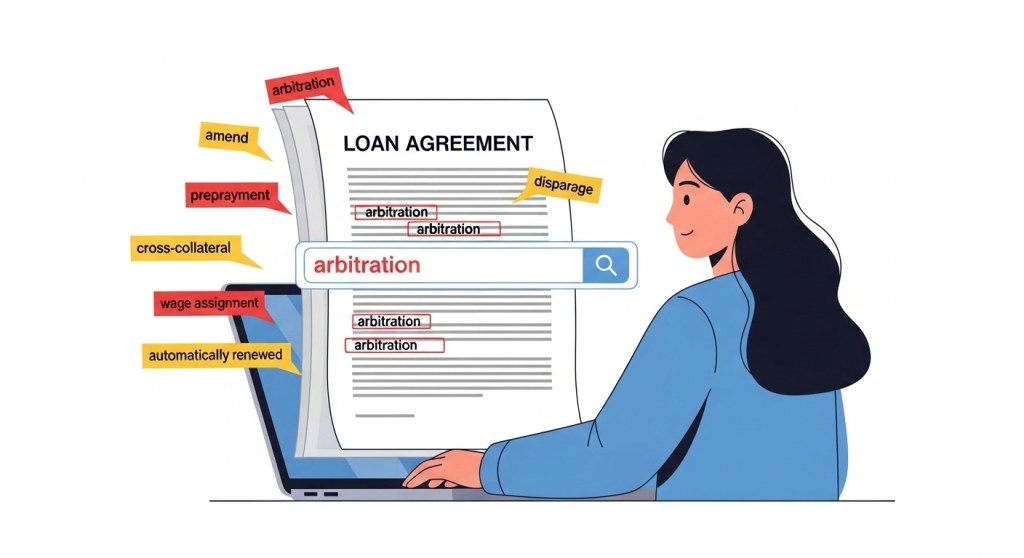
Every one of the 7 clauses in this guide can be found in under 10 seconds using Ctrl+F. Use it before you sign — not after
Your Pre-Signing Checklist: How to Find All 7 Clauses in Any Contract
✅ Your 7-Clause Pre-Signing
Checklist
Use this checklist before signing
ANY loan agreement — personal loan,
auto loan, payday loan, BNPL,
or mortgage. Takes under 5 minutes.
Could save you thousands.
💡 How to Use:
Open your loan document.
Press
Ctrl+F (PC) or
Cmd+F (Mac) or
Tap & Hold → Find (Mobile).
Search each trigger word below.
If found — read the full clause
before signing.
🔴 Clause 1 — Mandatory Arbitration
CRITICAL — No federal ban
Eliminates your right to sue
in court or join a class action
lawsuit. 75% of borrowers are
unaware they agreed to this
— CFPB Research.
Ask lender to remove
before signing. Consider
a credit union instead.
✅ Safe Signal:
Word not found —
no arbitration clause
present in contract
🔴 Clause 2 — Unilateral Amendment
CRITICAL — Reg AA withdrawn
Lender can change your interest
rate, fees, or loan terms after
you have already signed —
with as little as 15 days notice.
🔍 Search for:
“amend”
“modify”
“reserve the right”
“change terms”
❌ If Found:
Read every lender notice
you receive — continuing
to use = acceptance
✅ Safe Signal:
Fixed rate contract with
no amendment language
present
🟡 Clause 3 — Prepayment Penalty
HIGH — Banned on QM mortgages only
Charges you a fee for paying
off your loan early — protects
the lender’s expected interest
income. Common in auto loans
and some personal loans.
🔍 Search for:
“prepayment”
“early payoff fee”
“make-whole”
⚠️ If Found:
Calculate if interest saved
by paying early exceeds
the penalty cost
✅ Safe Signal:
“No prepayment penalty”
stated explicitly in
the contract
🔴 Clause 4 — Cross-Collateralization
CRITICAL — Common in credit unions
Links multiple loans so that
defaulting on one small debt
can put all your secured assets
— car, home equity, savings —
at risk even if other loans
are current.
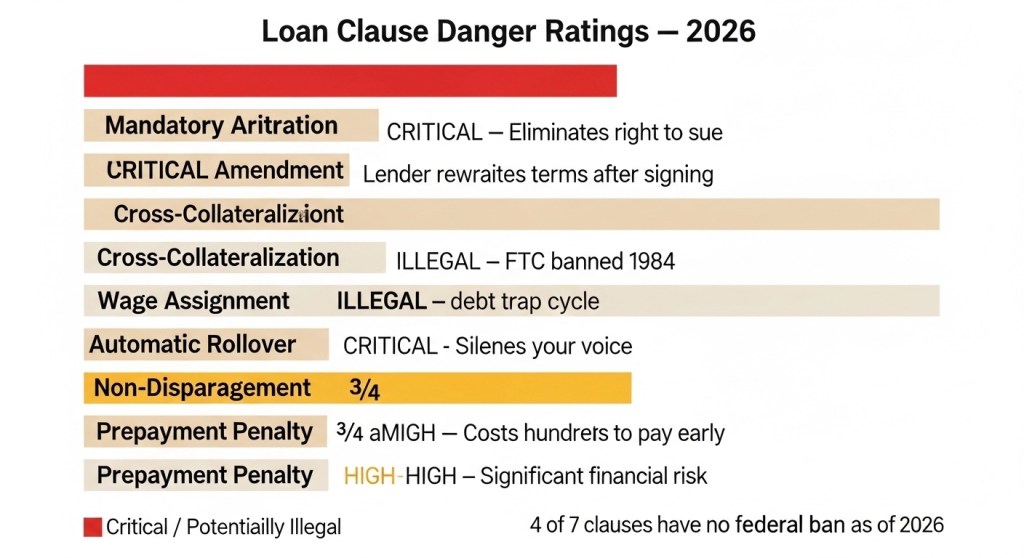
5 of the 7 clauses are rated Critical or Illegal. 4 have no federal ban as of 2026. The only protection is knowing what to search for before you sign.
Clause Danger Rating: What Each One Can Cost You
⚠️ Clause Danger Rating:
What Each One Can Cost You
Not all dangerous clauses cost you
the same way. Some eliminate your
legal rights. Some cost you money.
One is federally illegal. Here is
exactly what each clause takes —
and what it could cost you in
real dollars and real rights.
Rating Key:
🔴 Critical
No federal ban — active threat
🟡 High
Significant financial risk
⛔ Illegal
Federally banned — report to FTC
1
Mandatory Arbitration
🔴 CRITICAL
⚖️ Rights Cost
Right to sue
in court —
gone entirely
💰 Financial Cost
Arbitration fees
$200–$1,900+
out of pocket
📊 Who It Affects
75% of borrowers
already agreed —
CFPB 2025
What it takes from you:
Eliminates your right to sue
in court, join a class action,
have a public hearing, or appeal
a decision. All disputes go to
a private arbitrator — often
one the lender has used before.
Outcomes are final. No jury.
No public record. No appeal.
💸
Worst case: Lender overcharges
you $4,000. You cannot join a
class action of 10,000 other
affected borrowers. You must
fight alone in private
arbitration — paying $1,900
in fees — for a $4,000 dispute.
2
Unilateral Amendment
🔴 CRITICAL
⚖️ Rights Cost
Right to the rate
you agreed to —
gone
💰 Financial Cost
Hundreds to
thousands in
added interest
⏱️ Notice Period
As little as
15 days before
change takes effect
What it takes from you:
The rate, fees, and terms you
agreed to on signing day can
be changed at any time with
minimal notice. Lender sends
a statement insert or email.
Continuing to use the loan
constitutes legal acceptance —
even if you never read the notice.
💸
Worst case: You sign at 9.9%
APR. Lender sends a statement
insert raising it to 18.9%.
You miss the insert. You have
legally accepted the new rate.
On a $10,000 loan —
that is $900 extra per year
you did not budget for.
3
Prepayment Penalty
🟡 HIGH RISK
⚖️ Rights Cost
Right to pay
off early freely —
penalized
💰 Financial Cost
1–5% of remaining
balance OR 3–6
months interest
🛡️ Protection
Banned on QM
mortgages only —
post 2014
What it takes from you:
The freedom to become debt-free
on your own timeline. Even if
you come into money and want
to pay off the loan early —
the lender charges you a fee
to compensate for the interest
they expected to earn over
the full term.
💸
Worst case: You have a $15,000
auto loan. You want to pay it
off early. Prepayment penalty
is 3% of remaining balance.
You pay $450 just for the
privilege of being debt-free.
On a personal loan with
6-month interest penalty —
could be $600–$1,200.
💬 Reader Story
“I got a personal loan from an online lender — fast approval, decent rate. What I didn’t see until a year later when I tried to complain to the BBB: I had signed a non-disparagement clause buried on page 47. They sent me a legal notice threatening to close my account and pursue damages. I had unknowingly signed away my right to leave a single negative review. I wish I had searched that document before I signed it.”
— Marcus, 34, Atlanta.
Shared in the Confidence Buildings reader community.
“Expert Verdict: Marcus was a victim of a ‘Silence Clause.’ Under the Consumer Review Fairness Act, these are often legally unenforceable, but the threat alone is enough to chill consumer speech.”
Have you found a dangerous clause in a loan agreement? Share your experience in the comments — your story could protect someone else from signing the same thing.
🧠
Psychological Struggle: Why We Don’t Read What We Sign
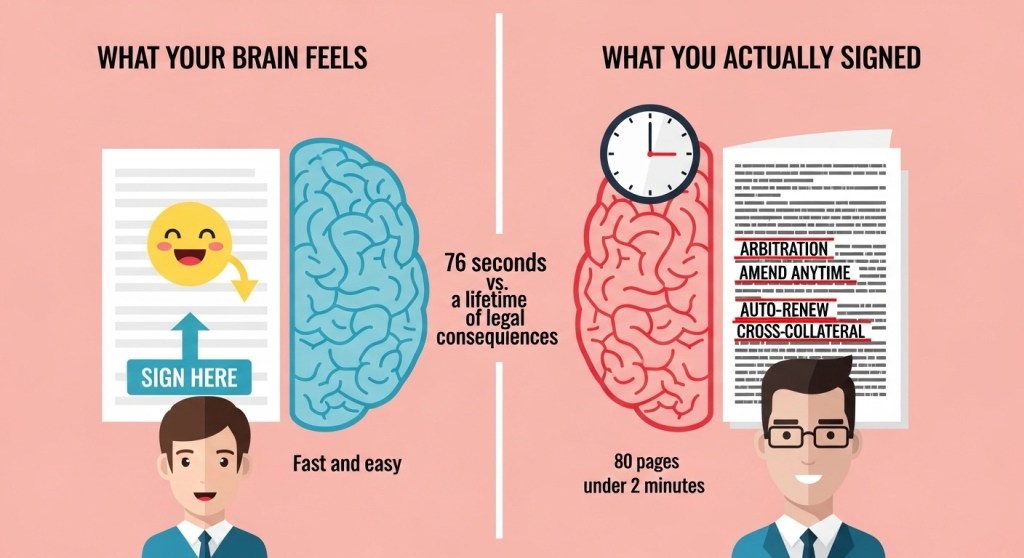
Research on digital contract behavior shows that people spend an average of 76 seconds reviewing end-user license agreements before accepting them. Loan agreements are longer and more complex — but the behavior is similar. We are wired to trust the institution presenting the document and to treat the act of signing as a formality, not a legal negotiation.
“Lenders understand this. Contract length is not accidental. The placement of dangerous clauses on page 40 of an 80-page digital document is not accidental. The use of legal language that sounds neutral — ‘dispute resolution procedure’ instead of ‘you cannot sue us’ — is not accidental.”
Not reading your loan agreement is not a failure of intelligence or responsibility. It is a predictable human response to information overload and time pressure — responses that the contract is designed to exploit.
The 7-clause checklist in this post is a tool to break that pattern: not by reading everything, but by searching for exactly the right things.
Lenders design contracts to exploit the gap between how signing feels and what you are actually agreeing to. It is not your fault — but it is your responsibility to close the gap
❓ Frequently Asked Questions — Loan Agreement Fine Print
Can I negotiate loan agreement terms before signing?
Yes — more often than most borrowers realize. Mainstream banks rarely negotiate standard terms. But credit unions, community banks, and some online lenders will modify specific clauses if asked directly. The most negotiable clauses are prepayment penalties, arbitration agreements, and automatic rollover terms. Always ask in writing and get any agreed changes confirmed in a revised document.
What is the FTC Credit Practices Rule and what does it ban?
The FTC Credit Practices Rule (1984) permanently bans four specific clauses: (1) confessions of judgment; (2) waivers of exemption; (3) wage assignments; and (4) non-possessory security interests in household goods. Finding any of these is a federal law violation — report it to the FTC at reportfraud.ftc.gov.
What happened to the CFPB’s proposed Regulation AA rule in 2025?
The rule was withdrawn in May 2025 by the incoming administration before being finalized. As of 2026, those proposed protections are not in effect. The FTC Credit Practices Rule (1984) remains your primary federal protection.
Are arbitration clauses enforceable in all states?
Generally yes. The Federal Arbitration Act (FAA) makes these agreements broadly enforceable. While some states have specific nuances, do not assume state law protects you from federal arbitration enforcement.
What is the easiest way to find dangerous clauses?
Use Ctrl+F (PC) or Cmd+F (Mac) and search for: “arbitration,” “amend,” “prepayment,” “cross-collateral,” “wage assignment,” “disparage,” and “automatically renewed.”
Attorney Rachel Morrow · Consumer Rights · Educational Illustration Only
“The fine print is not just dense legal language — it is where lenders place the provisions that transform a standard loan into a financial trap. The FTC’s Credit Practices Rule, in effect since 1984, permanently bans four clauses because they were deemed ‘unfair’ and ‘deceptive’: confession of judgment (which waives your right to a hearing before a lender can seize assets), wage assignment (which allows direct wage garnishment without a court order), security interest in household goods (which puts your furniture, clothing, and appliances at risk), and waiver of exemption (which forces you to give up state bankruptcy protections). These clauses are illegal in consumer loans. Period. If you see any of them, you are dealing with a predatory lender operating outside federal law. More recent protections — like the CFPB’s 2025 Regulation AA, which would have banned mandatory arbitration clauses that block class actions — were withdrawn before taking effect. This means your ability to challenge unfair terms depends on whether your contract contains a valid arbitration clause and whether your state offers stronger protections. Before you sign any loan agreement, search for ‘arbitration,’ ‘waiver,’ and ‘assignment’ using Ctrl+F. If you find a clause that attempts to waive your right to sue or allows wage garnishment without a court judgment, do not sign until you speak with a consumer protection attorney.”
Legal Analysis: The four clauses banned by the FTC Credit Practices Rule (16 CFR Part 444) are void in consumer credit contracts. If a lender includes them, the clause is unenforceable. However, enforcement requires you to know the clause exists and to challenge it — often in court. Arbitration clauses are a separate concern: the Supreme Court’s 2011 decision in AT&T Mobility v. Concepcion allows lenders to require individual arbitration and prohibit class actions, even for small-dollar consumer claims. The CFPB’s 2025 Regulation AA would have banned these clauses in certain consumer loan products, but the rule was withdrawn in May 2025. As of 2026, no federal ban on mandatory arbitration in consumer lending exists. Some states have enacted their own restrictions — check your state attorney general’s website for your state’s rules on arbitration clauses in consumer loans.
Bottom Line: The difference between a fair loan and a predatory one is often hidden in four clauses you can find in under five minutes using Ctrl+F. Search for: “confession of judgment,” “wage assignment,” “household goods,” and “arbitration.” If any of these appear in a loan agreement for a consumer loan, proceed with extreme caution — or walk away.
📚 Related Reading —
The Borrower’s Truth Series
Day 15 is part of a 30-day series
on financial confidence for real
borrowers. Every post is free.
Every post is research-backed.
Start anywhere — but read them all.
🔀 Where Are You Right Now?
Jump to the most relevant post:
📊 CFPB Arbitration Study —
Consumer Awareness Research
Source for the statistic:
75% of borrowers are unaware
they agreed to mandatory
arbitration in their financial
contracts. CFPB consumer
financial protection research
and arbitration study data.
Source for rollover statistics:
80% of payday loans rolled over
within 14 days. Average borrower
takes 8 loans per year paying
$520 in fees to borrow $375.
Basis for Clause 7 — Automatic
Rollover analysis.
Official channel to report
illegal or abusive clauses
found in consumer financial
contracts. Referenced in all
7 clause action steps throughout
this post.
The primary federal law
permanently banning 4 abusive
clauses in consumer loan
contracts: wage assignment,
confession of judgment, waiver
of exemption, and household
goods security interest.
In effect since 1984 and
NOT affected by any 2025
regulatory changes.
Legal basis for FTC enforcement
action against lenders using
banned clauses — including wage
assignment. Referenced in Clause
5 analysis throughout this post.
Federal law making it illegal
for businesses to include
non-disparagement clauses in
consumer contracts. Referenced
in Clause 6 — Non-Disparagement
analysis. Partial protection
only — enforcement varies.
Official channel to report
lenders using federally banned
clauses — especially wage
assignment. Referenced in Clause
5 action steps. Takes under
10 minutes to file a report.
📊 J.D. Power 2025 U.S. Consumer
Lending Satisfaction Study
Source for two key statistics:
28% of borrowers cite unexpected
fees as their top complaint,
and 47% of personal loan
borrowers are financially
vulnerable. Used in Data Summary
and TL;DR blocks throughout
this post.
Source for personal loan market
data: 24.2 million Americans
hold personal loans with an
average balance of $11,724.
Used in Data Summary block
and series context throughout
this post.
📚 National Consumer Law Center —
Consumer Credit Regulation 2025
Reference source for consumer
credit law analysis including
cross-collateralization in
credit union agreements and
state-level rollover protection
laws. Used in Clause 4 and
Clause 7 analysis.
Bans prepayment penalties
on qualified mortgages
post-2014
✅ Active
Consumer Review
Fairness Act H.R. 5111
2016
Prohibits non-disparagement
clauses in consumer contracts
✅ Active
CFPB Regulation AA
Federal Register 2025-00633
2025
Would have banned 3 abusive
clause categories —
proposed and withdrawn
❌ Withdrawn
CFPB Ability-to-Repay
Rule 2014
2014
Requires lenders to verify
borrower ability to repay —
QM mortgage standard
✅ Active
🔬 Research Integrity Statement
✅ What This Post Uses:
Federal Register filings
CFPB primary research
FTC official rule text
Acts of Congress
Peer-reviewed industry data
.gov sources only
❌ What This Post Never Uses:
Sponsored content
Affil
The Bottom Line
A loan agreement is not a formality you get through before the money arrives. It is a legal contract that can strip your right to sue, allow your lender to rewrite the terms, reach into your paycheck, put unrelated assets at risk, and prevent you from warning anyone about what happened to you.
In January 2025, the CFPB tried to ban the most abusive of these clauses. The rule was withdrawn four months later. As of 2026, the responsibility is yours — and yours alone.
The 7-clause checklist in this post takes under 5 minutes to run on any digital loan document. That 5 minutes could be worth thousands of dollars and the protection of rights you did not know you were signing away.
🔬 Research & Publication Note: This post has been researched and published as part of the ConfidenceBuildings.com 2026 Finance Research Project by Laxmi Hegde, MBA in Finance — an independent study of emergency borrowing costs, consumer lending practices, and financial literacy gaps in the United States. Updated: March 2026.
“`
—
## 📍 HOW TO ADD IN WORDPRESS
“`
━━━━━━━━━━━━━━━━━━━━━━━━━━━━━━━━━━
Step 1 — Delete old grid block
Step 2 — Add new Custom HTML block
→ paste BLOCK A
Step 3 — Add another Custom HTML
block directly below it
→ paste BLOCK B
Step 4 — Preview — all 16 days
should show as one
seamless grid
━━━━━━━━━━━━━━━━━━━━━━━━━━━━━━━━━━
📚 Take This Further
The Borrower’s Truth — Full Guide & Toolkit
Everything on this blog — compiled, upgraded, and made actionable.


 Decoder