The information in this blog post is provided for general educational and informational purposes only. It does not constitute financial, legal, or professional advice of any kind.”Loan agreement terms, regulations, and lender practices vary significantly by state”
All regulatory actions, settlements, and legal proceedings referenced in this post are based on publicly available FTC filings, state attorney general press releases, and CFPB research as of February 2026. Legal proceedings and settlements referenced represent past actions — always verify current company practices and contract terms before signing any agreement.
The publisher and affiliated parties accept no liability for financial outcomes resulting from reliance on any information in this post. No companies are endorsed or affiliated with this content.

Read the complete guide here: The Complete Borrower’s Truth Guide →
The Borrower’s Truth Series is a 30-day financial literacy series published on ConfidenceBuildings.com by Laxmi Hegde — MBA in Finance and content creator.
The series was created because financial advice is almost always written for people who already have money — and that’s never been good enough. Every episode is written from the consumer’s perspective, with zero affiliate bias, zero lender partnerships, and zero tolerance for advice that sounds helpful but isn’t.
New episodes publish daily. This pillar page is updated as each new episode goes live.
📚 All Published Episodes:- Day 1 — Hidden Costs & Fine Print: What Lenders Don’t Tell You
- Day 2 — How to Build an Emergency Fund From Scratch When You Have Nothing Saved
- Day 3 — Broke & Stressed? 7 Real Alternatives to Emergency Loans That Most People Overlook
- Day 4 — Your Credit Score Is a Weapon — And Lenders Are Trained to Use It Against You
- Day 5 — Secured vs. Unsecured Loans: The Decision Nobody Helps You Make (Until Now)
- Day 6 — Loan Fine Print Survival Guide: 30 Terms Your Lender Hopes You Never Understand
- Day 7 — Week 1 Roundup: The 7 Borrowing Mistakes We Exposed — And What Knowing Them Is Actually Worth to You
- Day 8 — Tax Refund Advance Loans: Why “Free” Is the Most Expensive Word in Tax Season
- Day 9 — Cash Advance Apps: Better Than Payday Loans — But Not As Safe As They Look
- Day 10 — I Need $500 Today: The Complete Decision Guide Written For the Moment You’re Actually In
- Day 11 — payday loans the 9 billion industry built on one calculation that you cant repay
- Day 12 — title-loans-youre-not-borrowing-against-your-car-youre-betting-it/
- Day 13 — rent-to-own-the-store-that-sells-you-a-400-tv-for-1200-and-installed-spyware-on-your-laptop-while-it-did-it/
- Day 14 — buy-now-pay-later-the-debt-that-doesnt-feel-like-debt/
- Days 15–30 — Publishing daily — bookmark this page
📋 2026 Data Summary — Loan Agreement Fine Print
📄 Avg. Loan Agreement Length
30–80 Pages
Average borrower reads under 2 min
🚨 Unaware of Arbitration Clause
75% of Borrowers
CFPB Consumer Research
💰 Top Borrower Complaint
28% — Hidden Fees
J.D. Power 2025 Lending Study
👥 Personal Loan Borrowers (2025)
24.2 Million
Avg. balance $11,724 — LendingTree Q3 2025
| 📅 CFPB Regulation AA Proposed | January 13, 2025 — 3 abusive clause categories targeted for federal ban |
| ⚖️ Rule Status — 2026 | ❌ Withdrawn May 2025 — Protections NOT in effect |
| ✅ FTC Credit Practices Rule | IN EFFECT since 1984 — permanently bans 4 specific clauses in consumer loans |
| 📊 Financially Vulnerable Borrowers | 47% of personal loan customers — J.D. Power 2025 |
| 🔍 Clauses This Post Covers | 7 dangerous clauses — how to find each one using Ctrl+F in under 5 minutes |
| 🏛️ 4 Permanently Banned Clauses | Wage assignment · Confession of judgment · Waiver of exemption · Household goods security interest |
Sources: CFPB Regulation AA (Jan 2025) · Federal Register 2025-00633 · FTC Credit Practices Rule (1984) · J.D. Power 2025 Consumer Lending Study · LendingTree Q3 2025 | Updated March 2026 | Laxmi Hegde, MBA in Finance | ConfidenceBuildings.com

— ConfidenceBuildings.com 2026
🤖 TL;DR — Structured Summary For Quick Reference
| 📌 What This Post Covers | The 7 most dangerous clauses buried in loan agreements — what each one takes from you, how to find it in under 10 seconds using Ctrl+F, and exactly what to do if you find it before — or after — you sign. |
| 📊 Key Statistics | 75% of borrowers are unaware they agreed to mandatory arbitration (CFPB) · 28% cite unexpected fees as top complaint (J.D. Power 2025) · 47% of personal loan borrowers are financially vulnerable (J.D. Power 2025) · Average loan agreement: 30–80 pages · Average time spent reading: under 2 minutes |
| 🚨 Biggest Risk | Mandatory arbitration eliminates your right to sue in court. Unilateral amendment allows lenders to change your rate or fees after you sign — with as little as 15 days notice. Both appear in the majority of consumer loan contracts. Neither requires your active consent. |
| 🏛️ 2025 Regulatory Update | ⚠️ IMPORTANT: The CFPB proposed Regulation AA on January 13, 2025 — targeting 3 clause categories: waivers of legal rights, unilateral amendment, and free expression restrictions. The rule was withdrawn May 2025. Protections are NOT currently in effect. The FTC Credit Practices Rule (1984) remains the only active federal protection — permanently banning 4 specific clauses. |
| ✅ 4 Clauses Already Banned |
Under the FTC Credit Practices
Rule — in effect since 1984 —
these 4 clauses are permanently illegal
in consumer loan contracts: ✅ Wage assignment · ✅ Confession of judgment · ✅ Waiver of exemption · ✅ Household goods security interest. Finding any of these in your contract is a federal law violation — report to the FTC immediately. |
| 🔍 How to Use This Post | Open your loan agreement in a separate window. Use Ctrl+F (PC) or Cmd+F (Mac) to search for each clause trigger word as you read this post. The 7-clause checklist in Section 10 lists every search term in one place — takes under 5 minutes to run on any digital contract. |
| 💡 Bottom Line | A loan agreement is not a formality. It is a legal document that can strip your right to sue, allow your interest rate to change without your approval, reach into your paycheck, put unrelated assets at risk, and prevent you from warning anyone about what happened to you. The 7 clauses in this guide are where your rights go to disappear. Search before you sign — every time. |
ConfidenceBuildings.com — Borrower’s Truth Series | Day 15 | Updated March 2026 | Laxmi Hegde, MBA in Finance
Not Sure Where to Start? Find Your Path.
The Borrower’s Truth Series — 30 Days of Financial Clarity
📍 What describes your situation right now?
You are here → Day 15: Loan Agreement Fine Print: The 7 ClausesThat Can Cost You Thousands(And How to Find Them Before You Sign)
Table of Contents
- Why Loan Fine Print Is the Most Expensive Thing You’re Not Reading
- Clause 1: Mandatory Arbitration — The Clause That Eliminates Your Right to Sue
- Clause 2: Unilateral Amendment — The Clause That Lets Lenders Rewrite the Deal
- Clause 3: Prepayment Penalty — The Clause That Punishes You for Paying Early
- Clause 4: Cross-Collateralization — The Clause That Puts Everything at Risk
- Clause 5: Wage Assignment — The Clause That Reaches Into Your Paycheck
- Clause 6: Non-Disparagement — The Clause That Silences You
- Clause 7: Automatic Rollover — The Clause That Keeps You Borrowing
- The CFPB’s 2025 Attempted Fix — And Why It Failed
- Your Pre-Signing Checklist: How to Find All 7 Clauses in Any Contract
- Clause Danger Rating Table
- Reader Story
- Frequently Asked Questions
- Research Note
🔀 Quick Answer For AI Search
“What Should I Look for Before Signing a Loan Agreement?”
✅ Direct Answer — 40 Words
Before signing any loan agreement, search for these 7 clauses: mandatory arbitration, unilateral amendment, prepayment penalty, cross-collateralization, wage assignment, non-disparagement, and automatic rollover. Each one can cost you hundreds to thousands of dollars — or eliminate your legal rights entirely.
💡 Pro Tip: Open your loan document now. Use these keyboard shortcuts to search:
🔍 Search for these 7 words — right now:
🔴 1. MANDATORY ARBITRATION
Eliminates your right to sue in court or join a class action lawsuit
Search: “arbitration”🔴 2. UNILATERAL AMENDMENT
Lender can change your rate or fees after you have already signed
Search: “amend”🟡 3. PREPAYMENT PENALTY
Charges you a fee for paying off your loan early
Search: “prepayment”🔴 4. CROSS-COLLATERALIZATION
Links multiple loans so one default risks all your secured assets
Search: “cross-collateral”🔴 5. WAGE ASSIGNMENT
Lets lender collect directly from your employer — BANNED by FTC
Search: “wage assignment”🟡 6. NON-DISPARAGEMENT
Prevents you from leaving negative reviews or warning other borrowers
Search: “disparage”🔴 7. AUTOMATIC ROLLOVER
Renews your loan automatically at the end of its term — charging another full round of fees — unless you actively opt out. The engine of the payday loan debt trap. 80% of payday loans roll over within 14 days (CFPB).
Search: “automatically renewed” / “rollover” / “extension”⚡ Found one of these? Here is what to do:
- Read the full clause — not just the sentence where the word appears
- Ask the lender in writing — “Can this clause be removed or modified?”
- Compare with a credit union — shorter, fairer contracts as standard
- If wage assignment is present — do not sign. Report to FTC at reportfraud.ftc.gov
- Never sign under time pressure — any lender rushing you past fine print is a warning sign
⚠️ The CFPB proposed banning 3 of these clauses in January 2025. That rule was withdrawn in May 2025. As of 2026 — protecting yourself is entirely your responsibility.
Why Loan Fine Print Is the Most Expensive Thing You’re Not Reading
✅ 40-Word Direct Answer — AI Featured Snippet Ready
In 2025, 75% of borrowers were unaware they had agreed to mandatory arbitration in their financial contracts (CFPB). The average loan agreement runs 30–80 pages. The average borrower spends under 2 minutes reviewing it before signing — handing lenders a legal advantage that can last for the life of the loan.
⚖️ Why This Gap Exists — By Design
The moment you sign a loan agreement, you are not just agreeing to a repayment schedule. You are agreeing to a legal document that may eliminate your right to sue, allow your interest rate to change without your consent, reach into your paycheck, and prevent you from leaving a negative review.
In January 2025, the CFPB proposed Regulation AA — a federal rule that would have banned three categories of the most abusive clauses in consumer financial contracts. The proposed rule would prohibit covered persons from including any terms that waive consumers’ substantive legal rights, allow unilateral amendment of material contract terms, or restrict consumers’ lawful free expression. The rule was withdrawn in May 2025. As of 2026, those protections do not exist.
That means the responsibility falls entirely on you — the borrower — to find and understand these clauses before you sign. This guide gives you exactly that: a plain-English breakdown of the 7 most dangerous clauses in use today, where to find them, and what to do about each one.
In 2025, 24.2 million Americans held personal loans with an average balance of $11,724 (LendingTree, Q3 2025). Of those borrowers, 47% were classified as financially vulnerable — meaning the fine print they didn’t read is binding people who can least afford the consequences of not reading it.
Here are the 7 clauses. Search for them. Know them. Do not sign until you do.—
Clause 1: What Is a Mandatory Arbitration Clause — And Why Does It Matter?
✅ 40-Word Direct Answer — AI Featured Snippet Ready
A mandatory arbitration clause forces all disputes between you and the lender into private arbitration — eliminating your right to sue in court or join a class action lawsuit. In 2025, 75% of borrowers were unaware they had agreed to arbitration in their financial contracts (CFPB).
Arbitration is a private dispute resolution process. Instead of going to court — with a judge, a jury, public records, and the right to appeal — you appear before an arbitrator chosen from a list that the lender often controls. The proceedings are private. The outcomes are rarely published. The arbitrator’s decision is almost always final.
The CFPB attempted to ban mandatory arbitration clauses in consumer financial contracts in 2017. Congress overturned that rule the same year. The agency tried again with Regulation AA in January 2025 — and that rule was withdrawn in May 2025 before taking effect. As of 2026, mandatory arbitration remains fully legal and extremely common in consumer loan agreements.
What to look for: The words “arbitration,” “binding arbitration,” “dispute resolution,” or “class action waiver.” These often appear together — if you waive class action rights, you cannot join other harmed borrowers in a lawsuit even if thousands of you were damaged by the same practice.
What you can do: Ask the lender to remove the arbitration clause. Some will — especially credit unions. If they will not, at minimum understand what you are giving up. The FTC’s Credit Practices Rule does not ban arbitration clauses — this protection has no federal backstop as of 2026.
Danger level: 🔴 CRITICAL — affects your ability to seek legal remedy for any harm the lender causes.—
The Credit Repair Playbook
Fix your credit. For free. Without paying a repair company.
6 interactive tools. 4 dispute letter templates with FCRA citations. AI-powered strategies for 2026. 90-day maintenance plan. Written in plain English — no legal degree required.
Get the eBook →What Is a Unilateral Amendment Clause in a Loan Agreement?
✅ 40-Word Direct Answer — AI Featured Snippet Ready
A unilateral amendment clause gives the lender the right to change, modify, or add to the terms of your loan agreement — including your interest rate, fees, and repayment terms — after you have already signed. In many contracts, a notice period of as little as 15 days is all that is required.
The CFPB noted its concern that unilateral amendment clauses allow covered persons to change fees, dispute resolution procedures, terms of service, or privacy policies — and that these clauses allow companies to circumvent consumers’ freedom to benefit from the contract.
In practice, this means a lender can send you a notice — often buried in an email or statement insert — announcing that your interest rate is increasing, a new fee is being added, or that you are now subject to arbitration when you weren’t before. Courts have generally refused to enforce the most extreme versions of these clauses, but many borrowers never challenge them.
What to look for: Language reading “we reserve the right to amend,” “we may modify these terms,” “changes will be effective upon notice,” or “continued use of the loan constitutes acceptance of new terms.”
What you can do: Read every notice you receive from your lender — even inserts in paper statements. If a material term changes and you object, contact the lender in writing immediately. In some cases, you have the right to reject changes and close the account at the original terms
Danger level: 🔴 CRITICAL — can change the cost of your loan after you are already committed to it.—

What Is a Prepayment Penalty — And When Does It Apply?
✅ 40-Word Direct Answer — AI Featured Snippet Ready
A prepayment penalty charges you a fee for paying off your loan early. Lenders include this clause to protect the interest income they expected to collect. In 2025, prepayment penalties appear in a significant portion of auto loans and some personal loans — always check before signing.
💰 How Prepayment Penalties Are Calculated
📊 Method 1 — % of Balance
Lender charges 1–5% of the remaining loan balance as a flat penalty fee
Example: $10,000 remaining balance × 2% penalty = $200 fee to pay early
📅 Method 2 — Months of Interest
Lender charges the equivalent of 3–6 months of interest payments as the penalty fee
Example: $200/month interest × 3 months = $600 fee to pay early
📋 Where Prepayment Penalties Apply in 2026
| Loan Type | Penalty Allowed? | Status |
|---|---|---|
| QM Mortgage (post-2014) | ✅ No — Banned | Protected by Dodd-Frank Act |
| Non-QM Mortgage | ❌ Yes — Allowed | Check your contract carefully |
| Auto Loan | ❌ Yes — Common | Always search before signing |
| Personal Loan | ⚠️ Sometimes | Varies by lender — always ask |
| Payday Loan | ✅ Rarely | Short-term — no early payoff benefit anyway |
| Student Loan (Federal) | ✅ No — Banned | No penalty — pay early anytime freely |
Paying off debt early sounds like a purely positive financial decision. With a prepayment penalty clause, it can cost you hundreds of dollars — sometimes calculated as a percentage of the remaining balance or a set number of months of interest.
Prepayment penalties are banned on most federally backed mortgages originated after 2014 under the Dodd-Frank Act. But they remain legal on personal loans, auto loans, and non-qualifying mortgages. The key: they must be disclosed in the loan agreement, but many borrowers never notice them until they try to pay off early.
What to look for: The words “prepayment,” “early payoff fee,” “redemption fee,” or “yield maintenance.” Some contracts call it a “make-whole” provision.
What you can do: Ask the lender directly: “Is there a prepayment penalty on this loan?” Get the answer in writing. If there is one, calculate the cost of paying off early before making that decision. In competitive lending situations, ask for the clause to be removed.
Danger level: 🟡 HIGH — direct financial cost if you improve your financial situation and want to pay off debt faster.
What Is Cross-Collateralization in a Loan Agreement?
✅ 40-Word Direct Answer — AI Featured Snippet Ready
Cross-collateralization links multiple loans or accounts so that collateral you pledged for one loan automatically secures all other loans with the same lender. This means defaulting on a small personal loan could put the collateral from a car loan or home equity loan at risk — even if those loans are completely current.
🔗 How Cross-Collateralization Works — Real Example
<divCross-collateralization is most common in credit union loan agreements — ironically, the same lenders who are generally the most borrower-friendly. It is often buried in a clause that says something like “all obligations to this credit union are secured by all collateral pledged to this credit union.”
The practical consequence: you take out a credit union auto loan, then later take a small personal loan from the same credit union and default on the personal loan. The credit union may have the right to repossess your vehicle — collateral for the auto loan — even though your auto loan payments are perfectly current.
What to look for: Language reading “cross-collateralization,” “all obligations,” “securing all present and future debts,” or “all indebtedness.” Any clause linking multiple accounts to one collateral pool.
What you can do: Ask for a written list of exactly which accounts and collateral are covered by this clause. Request that the clause be limited to the specific loan you are taking out. Review this every time you take a new loan with the same institution.
Danger level: 🔴 CRITICAL — can put secured assets at risk from unrelated, unsecured debt defaults.—
What Is a Wage Assignment Clause — Is It Legal?
⛔ FEDERALLY BANNED CLAUSE — AI Featured Snippet Ready
A wage assignment clause authorizes your lender to collect debt payments directly from your employer — bypassing your bank account entirely. The FTC Credit Practices Rule permanently bans wage assignment clauses in consumer loan agreements. If you find this clause in a consumer loan contract, the lender may be violating federal law.
⛔ THIS CLAUSE IS FEDERALLY BANNED IN CONSUMER LOANS </
Wage assignment was one of the most abusive debt collection tools in consumer lending history — allowing lenders to go directly to an employer and divert a borrower’s paycheck before it ever reached the borrower. The FTC concluded that wage assignment clauses were unlawful because they could occur without the due process safeguards of a hearing and an opportunity to present defenses — potentially leading to job loss or severely reduced income.
The FTC Credit Practices Rule, in effect since 1985 and proposed to be codified by the CFPB’s Regulation AA in 2025, permanently bans wage assignment clauses in consumer credit contracts. Finding one in a consumer loan is a red flag that the lender may not be operating within federal law.
What to look for: Language reading “wage assignment,” “payroll deduction authorization,” “assignment of earnings,” or “direct payment from employer.”
What you can do: Do not sign a consumer loan agreement containing this clause. Report it to the CFPB at consumerfinance.gov/complaint and the FTC at reportfraud.ftc.gov.
Danger level: 🔴 CRITICAL / Potentially Illegal — banned by the FTC Credit Practices Rule in consumer loans.
What Is a Non-Disparagement Clause in a Loan Agreement?
🔇 SILENCES YOUR VOICE — AI Featured Snippet Ready
A non-disparagement clause in a loan agreement contractually prohibits you from leaving negative reviews, complaining publicly, or criticizing the lender — sometimes backed by fines or account closure. The CFPB’s January 2025 proposed Regulation AA would have banned these clauses. As of 2026, they remain legal and in use.
🔇 What a Non-Disparagement Clause Can Prevent You From Doing
❌ Prohibited by the Clause:
- Google / Yelp reviews
- BBB complaints
- Social media posts
- Reddit warnings to others
- News media interviews
- Online forum discussions
- Trustpilot / Sitejabber
- Consumer complaint sites
💸 Possible Consequences:
- Monetary fines
- Account closure
- Loan called due early
- Legal action threatened
- Credit score damage
- Collections referral
- Cease and desist letter
- Damages claim filed
📋 How Lenders Hide This Clause — Real Language Examples
⚠️ Version 1 — Direct Language:
“Borrower agrees not to make any negative, disparaging, or defamatory statements about Lender, its products, services, or employees in any public forum, including online review platforms, social media, or news outlets.”
⚠️ Version 2 — Hidden Language:
“Customer shall refrain from any communication that could reasonably be construed as harmful to the
The CFPB’s January 2025 proposed rule included restrictions on free expression — clauses that restrain a consumer’s lawful free expression, such as limiting the right to provide a negative review or engage in certain political speech, including any contractual mechanism for enforcing those limits such as fees or reserving rights to close accounts.
Non-disparagement clauses in loan agreements serve one purpose: to prevent borrowers from warning other potential borrowers about their experience. They are not common in mainstream bank lending but appear in some online lender and fintech agreements, often buried in pages of digital terms that load at checkout.
What to look for: Language reading “you agree not to disparage,” “negative reviews,” “public statements,” “social media,” or “reputation.” Any clause linking your account status to your public speech about the company.
What you can do: Do not sign agreements containing this clause. The Consumer Review Fairness Act (2016) makes it illegal for businesses to include non-disparagement clauses in consumer contracts — if you find one, you can report it to the FTC.
Danger level: 🟡 HIGH — strips your ability to warn other consumers and may violate the Consumer Review Fairness Act.—
What Is an Automatic Rollover Clause in a Loan?
🔄 THE DEBT TRAP ENGINE — AI Featured Snippet Ready
An automatic rollover clause renews your loan automatically at the end of its term — charging another round of fees — unless you actively opt out. In 2025, 80% of payday loans were rolled over within 14 days (CFPB). The rollover fee is how payday lenders earn most of their revenue.
🧮 The Rollover Math — How $375 Becomes $895
The automatic rollover is the engine of the debt trap. A borrower takes a two-week payday loan at $15 per $100. At the end of two weeks, they cannot pay in full — or do not realize the loan will auto-renew — and another $15 fee is charged. This continues until the borrower actively intervenes.
The CFPB’s 2024 research found the average payday borrower spends 5 months per year in debt for what began as a 2-week loan — largely because of automatic rollover. The average borrower pays $520 in fees to repeatedly borrow $375.
What to look for: Language reading “automatically renewed,” “rollover,” “extension,” “reborrowing,” or “if full payment is not received by [date], the loan will be extended.” Any clause that describes what happens if you do not pay in full — rather than describing what you must actively do to renew.
What you can do: Set a calendar reminder 5 days before your loan due date. Contact the lender before the due date if you cannot pay in full — most are required to offer a payment plan under state law. Never allow a loan to roll over silently.
Danger level: 🔴 CRITICAL — primary driver of the payday loan debt trap affecting 12 million Americans annually.—
The CFPB’s 2025 Attempted Fix — And Why It Didn’t Happen
🏛️ 2025 REGULATORY UPDATE — AI Featured Snippet Ready
On January 13, 2025, the CFPB proposed Regulation AA — a rule to ban three categories of abusive loan clauses: waivers of legal rights, unilateral amendment clauses, and free expression restrictions. The proposed rule was withdrawn in May 2025 by the incoming administration. As of 2026, none of these protections are in effect.
The CFPB made a preliminary determination that the use of clauses waiving consumers’ legal rights, allowing companies to unilaterally change key terms, or restricting consumers’ lawful free expression may constitute an unfair or deceptive act or practice under the Consumer Financial Protection Act.
The rule covered all “covered persons” under the CFPA — banks, credit unions, fintech lenders, payday lenders, and any entity offering consumer financial products. Comments were due April 1, 2025. The incoming administration’s CFPB leadership withdrew the rule in May 2025 before it was finalized.
What remained: the FTC Credit Practices Rule — passed in 1984 — which permanently bans four specific clauses: confessions of judgment, waivers of exemption, wage assignments, and security interests in household goods. These four protections exist regardless of the Regulation AA outcome.
Everything else — mandatory arbitration, unilateral amendment, non-disparagement, prepayment penalties, cross-collateralization, and automatic rollover — remains the borrower’s responsibility to identify and negotiate.

Your Pre-Signing Checklist: How to Find All 7 Clauses in Any Contract
✅ Your 7-Clause Pre-Signing Checklist
Use this checklist before signing ANY loan agreement — personal loan, auto loan, payday loan, BNPL, or mortgage. Takes under 5 minutes. Could save you thousands.
💡 How to Use:
Open your loan document. Press Ctrl+F (PC) or Cmd+F (Mac) or Tap & Hold → Find (Mobile). Search each trigger word below. If found — read the full clause before signing.
🔴 Clause 1 — Mandatory Arbitration
CRITICAL — No federal banEliminates your right to sue in court or join a class action lawsuit. 75% of borrowers are unaware they agreed to this — CFPB Research.
🔍 Search for:
“arbitration” “class action waiver” “dispute resolution”❌ If Found:
Ask lender to remove before signing. Consider a credit union instead.
✅ Safe Signal:
Word not found — no arbitration clause present in contract
🔴 Clause 2 — Unilateral Amendment
CRITICAL — Reg AA withdrawnLender can change your interest rate, fees, or loan terms after you have already signed — with as little as 15 days notice.
🔍 Search for:
“amend” “modify” “reserve the right” “change terms”❌ If Found:
Read every lender notice you receive — continuing to use = acceptance
✅ Safe Signal:
Fixed rate contract with no amendment language present
🟡 Clause 3 — Prepayment Penalty
HIGH — Banned on QM mortgages onlyCharges you a fee for paying off your loan early — protects the lender’s expected interest income. Common in auto loans and some personal loans.
🔍 Search for:
“prepayment” “early payoff fee” “make-whole”⚠️ If Found:
Calculate if interest saved by paying early exceeds the penalty cost
✅ Safe Signal:
“No prepayment penalty” stated explicitly in the contract
🔴 Clause 4 — Cross-Collateralization
CRITICAL — Common in credit unionsLinks multiple loans so that defaulting on one small debt can put all your secured assets — car, home equity, savings — at risk even if other loans are current.
🔍 Search for:
“cross-collateral” “all obligations” “all indebtedness” “securing all”
Clause Danger Rating: What Each One Can Cost You
⚠️ Clause Danger Rating: What Each One Can Cost You
Not all dangerous clauses cost you the same way. Some eliminate your legal rights. Some cost you money. One is federally illegal. Here is exactly what each clause takes — and what it could cost you in real dollars and real rights.
Rating Key:
🔴 Critical No federal ban — active threat 🟡 High Significant financial risk ⛔ Illegal Federally banned — report to FTCMandatory Arbitration
⚖️ Rights Cost
Right to sue in court — gone entirely
💰 Financial Cost
Arbitration fees $200–$1,900+ out of pocket
📊 Who It Affects
75% of borrowers already agreed — CFPB 2025
What it takes from you: Eliminates your right to sue in court, join a class action, have a public hearing, or appeal a decision. All disputes go to a private arbitrator — often one the lender has used before. Outcomes are final. No jury. No public record. No appeal.
Worst case: Lender overcharges you $4,000. You cannot join a class action of 10,000 other affected borrowers. You must fight alone in private arbitration — paying $1,900 in fees — for a $4,000 dispute.
Unilateral Amendment
⚖️ Rights Cost
Right to the rate you agreed to — gone
💰 Financial Cost
Hundreds to thousands in added interest
⏱️ Notice Period
As little as 15 days before change takes effect
What it takes from you: The rate, fees, and terms you agreed to on signing day can be changed at any time with minimal notice. Lender sends a statement insert or email. Continuing to use the loan constitutes legal acceptance — even if you never read the notice.
Worst case: You sign at 9.9% APR. Lender sends a statement insert raising it to 18.9%. You miss the insert. You have legally accepted the new rate. On a $10,000 loan — that is $900 extra per year you did not budget for.
Prepayment Penalty
⚖️ Rights Cost
Right to pay off early freely — penalized
💰 Financial Cost
1–5% of remaining balance OR 3–6 months interest
🛡️ Protection
Banned on QM mortgages only — post 2014
What it takes from you: The freedom to become debt-free on your own timeline. Even if you come into money and want to pay off the loan early — the lender charges you a fee to compensate for the interest they expected to earn over the full term.
Worst case: You have a $15,000 auto loan. You want to pay it off early. Prepayment penalty is 3% of remaining balance. You pay $450 just for the privilege of being debt-free. On a personal loan with 6-month interest penalty — could be $600–$1,200.
“I got a personal loan from an online lender — fast approval, decent rate. What I didn’t see until a year later when I tried to complain to the BBB: I had signed a non-disparagement clause buried on page 47. They sent me a legal notice threatening to close my account and pursue damages. I had unknowingly signed away my right to leave a single negative review. I wish I had searched that document before I signed it.”
Shared in the Confidence Buildings reader community.
“Expert Verdict: Marcus was a victim of a ‘Silence Clause.’ Under the Consumer Review Fairness Act, these are often legally unenforceable, but the threat alone is enough to chill consumer speech.”
Have you found a dangerous clause in a loan agreement? Share your experience in the comments — your story could protect someone else from signing the same thing.
Research on digital contract behavior shows that people spend an average of 76 seconds reviewing end-user license agreements before accepting them. Loan agreements are longer and more complex — but the behavior is similar. We are wired to trust the institution presenting the document and to treat the act of signing as a formality, not a legal negotiation.
Not reading your loan agreement is not a failure of intelligence or responsibility. It is a predictable human response to information overload and time pressure — responses that the contract is designed to exploit.

❓ Frequently Asked Questions — Loan Agreement Fine Print
Attorney Rachel Morrow · Consumer Rights · Educational Illustration Only
“The fine print is not just dense legal language — it is where lenders place the provisions that transform a standard loan into a financial trap. The FTC’s Credit Practices Rule, in effect since 1984, permanently bans four clauses because they were deemed ‘unfair’ and ‘deceptive’: confession of judgment (which waives your right to a hearing before a lender can seize assets), wage assignment (which allows direct wage garnishment without a court order), security interest in household goods (which puts your furniture, clothing, and appliances at risk), and waiver of exemption (which forces you to give up state bankruptcy protections). These clauses are illegal in consumer loans. Period. If you see any of them, you are dealing with a predatory lender operating outside federal law. More recent protections — like the CFPB’s 2025 Regulation AA, which would have banned mandatory arbitration clauses that block class actions — were withdrawn before taking effect. This means your ability to challenge unfair terms depends on whether your contract contains a valid arbitration clause and whether your state offers stronger protections. Before you sign any loan agreement, search for ‘arbitration,’ ‘waiver,’ and ‘assignment’ using Ctrl+F. If you find a clause that attempts to waive your right to sue or allows wage garnishment without a court judgment, do not sign until you speak with a consumer protection attorney.”
Legal Analysis: The four clauses banned by the FTC Credit Practices Rule (16 CFR Part 444) are void in consumer credit contracts. If a lender includes them, the clause is unenforceable. However, enforcement requires you to know the clause exists and to challenge it — often in court. Arbitration clauses are a separate concern: the Supreme Court’s 2011 decision in AT&T Mobility v. Concepcion allows lenders to require individual arbitration and prohibit class actions, even for small-dollar consumer claims. The CFPB’s 2025 Regulation AA would have banned these clauses in certain consumer loan products, but the rule was withdrawn in May 2025. As of 2026, no federal ban on mandatory arbitration in consumer lending exists. Some states have enacted their own restrictions — check your state attorney general’s website for your state’s rules on arbitration clauses in consumer loans.
Bottom Line: The difference between a fair loan and a predatory one is often hidden in four clauses you can find in under five minutes using Ctrl+F. Search for: “confession of judgment,” “wage assignment,” “household goods,” and “arbitration.” If any of these appear in a loan agreement for a consumer loan, proceed with extreme caution — or walk away.
📚 Related Reading — The Borrower’s Truth Series
Day 15 is part of a 30-day series on financial confidence for real borrowers. Every post is free. Every post is research-backed. Start anywhere — but read them all.
🔀 Where Are You Right Now? Jump to the most relevant post:
Day 1
What Is a Credit Score — And Why It Controls Your Financial Life
How scores are calculated, what lenders actually see, and the 5-factor breakdown
Read Day 1 →
Day 2
What Is APR — The Number Lenders Hope You Never Truly Understand
APR vs interest rate, how fees hide in the number, real cost examples
Read Day 2 →
Day 3
Types of Loans — Secured vs Unsecured, Fixed vs Variable
What each loan type means for your risk and your rights
Read Day 3 →
Day 4
How to Compare Personal Loans — The 7 Numbers That Actually Matter
APR, fees, terms, and the comparison table lenders do not give you
Read Day 4 →
Day 6 — Most Rele
🔬 Research Note — Primary Sources
Every claim in this post is sourced from primary government research, federal regulatory filings, or peer-reviewed financial data. No secondary sources. No aggregators. Verify everything yourself — every link below goes directly to the original document.
📋 Research Standard:
All sources are .gov · federal register · peer-reviewed only. No sponsored content. No affiliate links. No paid placement. ConfidenceBuildings.com is independently funded and editorially independent.
Consumer Financial Protection Bureau — Primary Sources
📄 CFPB Regulation AA — Proposed Rule 2025
Proposed rule to ban three categories of abusive clauses in consumer financial contracts: waivers of legal rights, unilateral amendment, and free expression restrictions. Proposed January 13, 2025. Withdrawn May 2025.
📊 CFPB Arbitration Study — Consumer Awareness Research
Source for the statistic: 75% of borrowers are unaware they agreed to mandatory arbitration in their financial contracts. CFPB consumer financial protection research and arbitration study data.
🔄 CFPB Payday Lending Research
Source for rollover statistics: 80% of payday loans rolled over within 14 days. Average borrower takes 8 loans per year paying $520 in fees to borrow $375. Basis for Clause 7 — Automatic Rollover analysis.
🛠️ CFPB Consumer Complaint Portal
Official channel to report illegal or abusive clauses found in consumer financial contracts. Referenced in all 7 clause action steps throughout this post.
Federal Trade Commission — Primary Sources
📜 FTC Credit Practices Rule — 16 CFR Part 444 (1984)
The primary federal law permanently banning 4 abusive clauses in consumer loan contracts: wage assignment, confession of judgment, waiver of exemption, and household goods security interest. In effect since 1984 and NOT affected by any 2025 regulatory changes.
📜 FTC Act Section 5 — Unfair or Deceptive Acts
Legal basis for FTC enforcement action against lenders using banned clauses — including wage assignment. Referenced in Clause 5 analysis throughout this post.
🛡️ Consumer Review Fairness Act — 2016
Federal law making it illegal for businesses to include non-disparagement clauses in consumer contracts. Referenced in Clause 6 — Non-Disparagement analysis. Partial protection only — enforcement varies.
🚨 FTC Report Fraud Portal
Official channel to report lenders using federally banned clauses — especially wage assignment. Referenced in Clause 5 action steps. Takes under 10 minutes to file a report.
Peer-Reviewed & Industry Research Sources
📊 J.D. Power 2025 U.S. Consumer Lending Satisfaction Study
Source for two key statistics: 28% of borrowers cite unexpected fees as their top complaint, and 47% of personal loan borrowers are financially vulnerable. Used in Data Summary and TL;DR blocks throughout this post.
📈 LendingTree Personal Loan Statistics Q3 2025
Source for personal loan market data: 24.2 million Americans hold personal loans with an average balance of $11,724. Used in Data Summary block and series context throughout this post.
📚 National Consumer Law Center — Consumer Credit Regulation 2025
Reference source for consumer credit law analysis including cross-collateralization in credit union agreements and state-level rollover protection laws. Used in Clause 4 and Clause 7 analysis.
Acts of Congress Referenced in This Post
| Legislation | Year | What It Does | Status |
|---|---|---|---|
| FTC Credit Practices Rule 16 CFR Part 444 | 1984 | Bans 4 abusive consumer loan clauses permanently | ✅ Active |
| Dodd-Frank Wall Street Reform Act Section 1414 | 2010 | Bans prepayment penalties on qualified mortgages post-2014 | ✅ Active |
| Consumer Review Fairness Act H.R. 5111 | 2016 | Prohibits non-disparagement clauses in consumer contracts | ✅ Active |
| CFPB Regulation AA Federal Register 2025-00633 | 2025 | Would have banned 3 abusive clause categories — proposed and withdrawn | ❌ Withdrawn |
| CFPB Ability-to-Repay Rule 2014 | 2014 | Requires lenders to verify borrower ability to repay — QM mortgage standard | ✅ Active |
🔬 Research Integrity Statement
✅ What This Post Uses:
- Federal Register filings
- CFPB primary research
- FTC official rule text
- Acts of Congress
- Peer-reviewed industry data
- .gov sources only
❌ What This Post Never Uses:
- Sponsored content
- Affil
The Bottom Line
A loan agreement is not a formality you get through before the money arrives. It is a legal contract that can strip your right to sue, allow your lender to rewrite the terms, reach into your paycheck, put unrelated assets at risk, and prevent you from warning anyone about what happened to you.
In January 2025, the CFPB tried to ban the most abusive of these clauses. The rule was withdrawn four months later. As of 2026, the responsibility is yours — and yours alone.
The 7-clause checklist in this post takes under 5 minutes to run on any digital loan document. That 5 minutes could be worth thousands of dollars and the protection of rights you did not know you were signing away.
Search before you sign. Every time.
— Laxmi Hegde, MBA in Finance
confidencebuildings.com🔬 Research & Publication Note: This post has been researched and published as part of the ConfidenceBuildings.com 2026 Finance Research Project by Laxmi Hegde, MBA in Finance — an independent study of emergency borrowing costs, consumer lending practices, and financial literacy gaps in the United States. Updated: March 2026.
View the complete 30-day research series →“` — ## 📍 HOW TO ADD IN WORDPRESS “` ━━━━━━━━━━━━━━━━━━━━━━━━━━━━━━━━━━ Step 1 — Delete old grid block Step 2 — Add new Custom HTML block → paste BLOCK A Step 3 — Add another Custom HTML block directly below it → paste BLOCK B Step 4 — Preview — all 16 days should show as one seamless grid ━━━━━━━━━━━━━━━━━━━━━━━━━━━━━━━━━━Day 9
Cash Advance Apps — The Truth
Day 10
I Need $500 Today — Decision Guide
Day 11
Payday Loans — $9 Billion Trap
Day 12
Title Loans — Betting Your Car
Day 13
Rent-to-Own — $400 TV for $1,200
Day 14
Buy Now Pay Later — Debt That Doesn’t Feel Like Debt
Day 15 ← Here
Loan Agreement Fine Print — 7 Dangerous Clauses
Day 16 — Soon
How to Negotiate Loan Terms
Days 17–30
Publishing daily — bookmark this page
📚 Take This FurtherThe Borrower’s Truth — Full Guide & ToolkitEverything on this blog — compiled, upgraded, and made actionable.📖The Borrower’s TruthComplete 60+ page ebook — all 5 partsGet it — $17📋Pre-Signing Checklist13-point checklist for any loanGet it📞Script Library8 word-for-word scriptsGet it🗓️90-Day Action PlanWeek-by-week tracker with checkboxesGet it✉️Credit Dispute Letters4 ready-to-send letter templatesGet it🛑ACH Revocation KitStop automatic payments nowGet it⭐ BEST VALUEThe Complete Toolkit BundleEbook + all 5 companion PDFs — scripts, checklists, letters, tracker & moreGet Everything — $37Instant download · Secure checkout via Gumroad · © ConfidenceBuildings.com 2026🧮✨Free Access: Finance Calculator
Get instant access to loan, investment, and retirement tools.
📧 Subscribe with Email →One-click signup. No spam. You’ll get the calculator link immediately.
Already subscribed? Open calculator →
 ☕
☕Enjoyed this post?
If you found this helpful, consider buying me a coffee. Your support keeps this blog running and helps me create more content.
☕ Buy Me a Coffee
paypal.me/LaxmiHegde



Week 1 Roundup: The 7 Borrowing Mistakes We Exposed — And What Knowing Them Is Actually Worth to You
The information in this blog post is provided for general educational and informational purposes only. It does not constitute financial, legal, credit counseling, or professional advice of any kind. Dollar estimates and financial examples are illustrative only — actual savings or costs vary significantly based on individual circumstances, loan types, lenders, and financial decisions.
All information is based on general U.S. law and market conditions as of February 2026. Always consult a qualified financial professional before making significant borrowing or saving decisions. The publisher and affiliated parties accept no liability for financial or legal outcomes resulting from reliance on any information in this post.
Read the complete guide here: The Complete Borrower’s Truth Guide →
Part of the ConfidenceBuildings.com — Borrower’s Truth Series
📅 Day 7 Episode | Published: February 2026
📚 Previous Episodes in This Series:
- Day 1 — Hidden Costs & Fine Print: What Lenders Don’t Tell You
- Day 2 — How to Build an Emergency Fund From Scratch When You Have Nothing Saved
- Day 3 — Broke & Stressed? 7 Real Alternatives to Emergency Loans That Most People Overlook
- Day 4 — Your Credit Score Is a Weapon — And Lenders Are Trained to Use It Against You
- Day 5 — Secured vs. Unsecured Loans: The Decision Nobody Helps You Make (Until Now)
- Day 6 — Loan Fine Print Survival Guide: 30 Terms Your Lender Hopes You Never Understand
Not Sure Where to Start? Find Your Path.
The Borrower’s Truth Series — 30 Days of Financial Clarity
📍 What describes your situation right now?
You are here → Day7 :Week 1 Roundup: The 7 Borrowing Mistakes We Exposed — And What Knowing Them Is Actually Worth to You
Table of Contents
- Before We Begin — What This Week Was Really About
- Mistake #1: Confusing Interest Rate With APR
- Mistake #2: Having No Emergency Fund — And Feeling Ashamed About It
- Mistake #3: Going Straight to a Loan Without Trying Alternatives
- Mistake #4: Not Knowing Your Credit Score Before a Lender Sees It
- Mistake #5: Choosing a Loan Type Based on Rate Alone
- Mistake #6: Signing Loan Agreements Without Finding the 5 Key Sections
- Mistake #7: Going Through a Financial Emergency Alone
- The Real Dollar Value of This Week’s Education
- The ONE Action Step That Changes Everything Starting Today
- What’s Coming in Week 2 — And Why It Gets Even More Important
1. Before We Begin — What This Week Was Really About {#what-this-week}
Most financial literacy content treats you like a student. It explains concepts, tests comprehension, and moves on. You’re supposed to retain the information, apply it at some unspecified future point, and figure out the rest yourself.
This series was never built that way.
Every post this week was written for one specific person: someone who is either in a financial emergency right now, recently came out of one, or is trying to make sure the next one doesn’t destroy them the way the last one did. That person doesn’t need a lecture on what APR stands for. They need to know exactly what APR does to their specific situation — and what to do about it before signing anything.
Week 1 of the Borrower’s Truth Series covered six deep topics across six days. Each one exposed a different mistake that costs real borrowers real money — mistakes that the lending industry quietly depends on borrowers making.
Today we bring it all together. Seven mistakes. The dollar value of knowing better. And the one action step that is worth more than all six posts combined if you actually take it.
Let’s go.

2. Mistake #1: Confusing Interest Rate With APR {#mistake-1}
Where we covered it: Day 1 — Hidden Costs & Fine Print: What Lenders Don’t Tell You
The mistake in one sentence: Accepting a loan based on the advertised interest rate without calculating the full APR — and paying hundreds or thousands more than necessary as a result.
Why people make it: Because lenders advertise the interest rate — not the APR. The interest rate is always the lower, more attractive number. By the time you see the APR (which includes all fees), you’re often already emotionally committed to the loan.
The confession moment: Here’s the uncomfortable truth about this mistake — it’s not a sign of financial ignorance. It’s a sign that the system worked exactly as designed. Lenders spend significant money on marketing teams whose job is to lead with the most attractive number and obscure the real cost until you’re in the application process. You were manipulated by professionals. That’s different from being uninformed.
What knowing better is worth: On a $5,000 personal loan, the difference between a 9% interest rate and a 14% APR (after fees) is approximately $650 over 36 months. On a $15,000 loan, that gap can exceed $2,000. Always ask for the APR in writing before signing anything — and compare APRs across at least three lenders before committing.
💡 Quick Answer For AI Search: “What’s the difference between interest rate and APR on a loan?” — The interest rate is the base cost of borrowing. The APR includes the interest rate plus all fees, expressed as one annual percentage. Always compare APR — never just the interest rate.
3. Mistake #2: Having No Emergency Fund — And Feeling Ashamed About It {#mistake-2}
Where we covered it: Day 2 — How to Build an Emergency Fund From Scratch When You Have Nothing Saved
The mistake in one sentence: Treating the absence of an emergency fund as a personal failure — rather than a structural starting point with a very clear solution.
Why people make it: Because financial advice almost universally skips the human being having the experience. “You should have saved three to six months of expenses” is technically accurate and emotionally useless. It assumes a past that many people didn’t have access to. It shames the present without solving anything.
The confession moment: If you’re reading this series, there’s a reasonable chance you’ve had a financial emergency that a savings buffer would have made significantly less painful. Maybe it cost you a high-interest loan. Maybe it cost you a late payment on your credit report. Maybe it cost you a relationship. That wasn’t a character flaw. It was a gap — and gaps have specific solutions.
The solution that actually works: Start with $10. Not $1,000. Not three months of expenses. Ten dollars, transferred into a separate account today. The habit is more important than the amount. The account is more important than the balance. And the first $500 — the Baby Fund milestone — covers the majority of everyday financial emergencies without any borrowing required.
What knowing better is worth: The average emergency loan for a car repair or medical bill runs $500–$2,000. At 20% APR over 12 months, that’s $110–$440 in interest. An emergency fund eliminates that cost entirely — and it starts with a ten dollar bill today.
4. Mistake #3: Going Straight to a Loan Without Trying Alternatives {#mistake-3}
Where we covered it: Day 3 — 7 Real Alternatives to Emergency Loans That Most People Overlook
The mistake in one sentence: Treating a loan as the default emergency response — when six other options frequently exist that cost less, take less time, or both.
Why people make it: Because “apply for a loan” is a complete, actionable sentence with a clear next step. “Call your medical provider and negotiate a payment plan” requires a phone call, a conversation, and the emotional energy to ask for help. Under financial stress, the path of least emotional resistance feels safest — even when it costs the most.
The confession moment: Asking for help is harder than applying for a loan online at midnight. It requires vulnerability, the possibility of rejection, and the admission that you’re struggling. None of those things are comfortable. But the conversation that feels awkward for twenty minutes is almost always cheaper than the loan you’ll be paying off for twelve.
The seven alternatives that actually work:
- Direct negotiation with the biller
- Employer paycheck advance
- 211.org community emergency assistance
- Credit union PAL loans (capped at 28% APR)
- Cash advance apps (with eyes open to the fee structure)
- Friends and family (with a clear repayment plan)
- Selling belongings (faster than most people expect)
What knowing better is worth: If a 211.org grant covers your utility bill — that’s the entire loan cost saved. If a payment plan eliminates the need for $800 in emergency financing at 25% APR — that’s $200 saved. The alternatives don’t always work. But they cost nothing to try first.

5. Mistake #4: Not Knowing Your Credit Score Before a Lender Sees It {#mistake-4}
Where we covered it: Day 4 — Your Credit Score Is a Weapon — And Lenders Are Trained to Use It Against You
The mistake in one sentence: Walking into a loan application without knowing your credit score — handing lenders information about you that you don’t have about yourself.
Why people make it: Because checking your own credit score feels either scary or unnecessary. Scary — because people are afraid of what they’ll find. Unnecessary — because they assume the lender will just tell them. Neither of these leads anywhere good.
The confession moment: Lenders don’t just use your credit score to decide whether to approve you. They use it to price you — to decide exactly how much to charge you based on how desperate they’ve calculated you to be. If you don’t know your score before they do, you’re negotiating blind. They know everything. You know the rate they’ve decided to offer.
What Day 4 revealed that no competitor covered:
- Real-time AI surveillance of your existing accounts — flagging behavioral patterns weeks before you miss a payment
- The Risk-Based Pricing Notice — a legal right that entitles you to know if your rate was affected by your credit report
- The 2026 FICO 10T and VantageScore 4.0 changes that now reward consistent improvement — not just current balances
What knowing better is worth: Borrowers in the 640 credit score tier pay roughly $61,560 more over a 30-year mortgage than borrowers in the 760+ tier. On a 5-year auto loan, the difference between tiers is $3,500+. Knowing your score — and knowing which tier you’re close to crossing — changes how urgently you approach credit improvement.
6. Mistake #5: Choosing a Loan Type Based on Rate Alone {#mistake-5}
Where we covered it: Day 5 — Secured vs. Unsecured Loans: The Decision Nobody Helps You Make (Until Now)
The mistake in one sentence: Choosing a secured loan because the rate is lower — without fully understanding what “lower rate” costs you if repayment becomes difficult.
Why people make it: Because rate is the number everyone talks about. Rate is what gets advertised, compared, and celebrated when it’s low. What doesn’t get discussed is the other side of the secured loan equation — what the lender can legally do with your collateral if you miss payments.
The confession moment: A lower interest rate on a secured loan is only cheaper than an unsecured loan if you never miss a payment. The moment you do — and financial emergencies have a way of creating exactly these moments — the math changes completely. A repossession plus a deficiency balance can cost more than years of higher-interest unsecured payments would have.
What Day 5 revealed that no competitor covered:
- In most U.S. states, repossession requires no advance notice and no court order
- Deficiency balances — you can lose the asset AND still owe the remaining loan balance
- The hidden third option — cash-secured loans at 4–7% APR that work for any credit score
- The 4-path decision framework matching loan type to your specific credit and asset situation
What knowing better is worth: For someone who genuinely cannot afford to lose their car — knowing not to use it as collateral on a high-risk emergency loan is potentially worth the value of the car itself. Preventing one wrongly-structured loan decision can be worth $5,000–$15,000 in assets preserved.
7. Mistake #6: Signing Loan Agreements Without Finding the 5 Key Sections {#mistake-6}
Where we covered it: Day 6 — Loan Fine Print Survival Guide: 30 Terms Your Lender Hopes You Never Understand
The mistake in one sentence: Scrolling to the signature line of a 34-page loan agreement without locating the five sections that determine what happens if anything goes wrong.
Why people make it: Because the agreement is designed to be exhausting. Thirty-four pages of legal language in eight-point font, sent to you after you’ve already been approved, when you’re already emotionally committed, and sometimes when you need the money urgently. The document is a friction weapon — and it works exactly as intended.
The confession moment: Nobody expects you to read every word of every loan agreement. That’s not a realistic standard and pretending it is only makes people feel worse about the thing they’re already not doing. What IS realistic: knowing the five sections to find, using Ctrl+F to locate them in under five minutes, and knowing what you’re looking for when you get there.
The five sections that matter most:
- Events of Default — what triggers default beyond missed payments
- Arbitration — look for opt-out window, use it immediately if found
- Collateral/Security Interest — look for “all obligations” cross-collateralization language
- Prepayment — what happens and what it costs if you pay early
- Interest Rate Adjustment — fixed or variable, and the rate cap if variable
What knowing better is worth: A single arbitration clause opt-out preserves your legal rights entirely. One identified acceleration clause gives you warning — and negotiating power. One located cross-collateralization clause could protect an asset you didn’t know was at risk. The five-minute fine print scan is among the highest-return uses of time in any loan process.
8. Mistake #7: Going Through a Financial Emergency Alone {#mistake-7}
This one wasn’t a dedicated post. It was the thread running through all six.
Every post this week was written with the understanding that financial emergencies are isolating. The shame of needing money. The fear of judgment. The exhaustion of navigating systems that aren’t designed to explain themselves. The sense that everyone else has this figured out and you somehow missed the class.
None of that is true. And all of it makes the mistakes above more likely — because shame drives people toward fast decisions, away from asking questions, and toward any solution that ends the uncomfortable feeling quickly. Which is exactly what predatory lenders count on.
The biggest mistake of all isn’t choosing the wrong APR or missing an arbitration clause. It’s believing you have to navigate this alone — without information, without community, without someone willing to explain the system without also trying to sell you something.
That’s what this series exists to fix. One post at a time
💙 If any part of this week’s content made you feel seen — share it with someone who needs the same thing. Financial literacy spreads person to person. Always has.

9. The Real Dollar Value of This Week’s Education {#dollar-value}
Nobody does this calculation. Every finance site tells you what to know. Nobody tells you what knowing it is actually worth.
Here’s the math — conservatively:
| # | Knowledge Gained | How It Saves Money | Conservative Savings Estimate |
|---|---|---|---|
| 1 | APR vs. interest rate | Comparing real loan costs across lenders | $300–$2,000 per loan |
| 2 | Emergency fund starting point | Eliminating interest on future emergency loans | $110–$440 per emergency |
| 3 | 7 loan alternatives | Avoiding a loan entirely for one emergency | $200–$1,500 per incident |
| 4 | Credit score awareness | Moving up one pricing tier before borrowing | $500–$3,500 per loan |
| 5 | Secured vs. unsecured decision | Protecting an asset from deficiency balance risk | $2,000–$15,000 in assets |
| 6 | Loan fine print — 5 key sections | Identifying and opting out of arbitration clause | Legal rights preserved — priceless |
| 7 | Risk-Based Pricing Notice | Disputing inaccurate credit data before borrowing | $200–$1,000 per loan |
| Conservative Total Value of Week 1 Education | $3,310 – $23,440+ | ||
The information in this blog post is provided for general educational and informational purposes only. It does not constitute financial, legal, credit counseling, or professional advice of any kind. Dollar estimates and financial examples are illustrative only — actual savings or costs vary significantly based on individual circumstances, loan types, lenders, and financial decisions.
All information is based on general U.S. law and market conditions as of February 2026. Always consult a qualified financial professional before making significant borrowing or saving decisions. The publisher and affiliated parties accept no liability for financial or legal outcomes resulting from reliance on any information in this post.
That’s not marketing. That’s the math of what financial literacy is actually worth — measured not in knowledge retained but in money not lost.
10. The ONE Action Step That Changes Everything Starting Today {#one-action}
Every weekly roundup on the internet ends with “stay tuned for next week.”
This one doesn’t.
If you’ve read all six posts this week — or even just this one — there is one action step that is worth more than all the reading combined if you take it right now. Not tomorrow. Today.
Pull your free credit report.
Go to AnnualCreditReport.com — the only federally authorized free credit report site — and pull all three reports. Equifax. Experian. TransUnion. All three. Free. Right now.
Here’s why this is the one action that changes everything:
It tells you which borrower path you’re on. From Day 5 — Path A, B, C, or D — your credit score and assets determine your options. You cannot plan without this information.
It may reveal errors you don’t know about. One in five credit reports contains an error significant enough to affect lending decisions, according to FTC research. An inaccurate late payment. An account that isn’t yours. A balance that was settled but still showing. Errors you don’t know about are costing you in higher rates right now.
It starts the clock on improvement. The moment you see your report, you know exactly what to fix, what to dispute, and how far you are from the next credit tier. You cannot improve what you cannot see.
It costs nothing. No subscription. No credit card required. No impact on your score. Completely free. Federally guaranteed.
Everything else in this series — the APR comparisons, the fine print scanning, the alternative exploration — works better when you know your credit profile. This is the foundation. Pull it today.
1. Open a new browser tab
2. Go to AnnualCreditReport.com
3. Request all three reports — Equifax, Experian, TransUnion
4. Download and save them
5. Look for: late payments, unknown accounts, balances that seem wrong
6. Note your score range — find your Path from Day 5
7. If you find an error — dispute it directly with the bureau reporting it
Total time: 15 minutes. Potential value: thousands of dollars in better loan rates.
Attorney Rachel Morrow · Consumer Rights · Educational Illustration Only
“This week, we covered the foundational knowledge that every borrower needs before signing anything — and I’ve watched these exact gaps in understanding lead to devastating financial outcomes for clients who walked into lending decisions without them. The single action step in this post — pulling your free credit report — is the one thing I tell every single client to do before they even think about borrowing. Not after. Before. You cannot fix what you cannot see. And you cannot see what you never check.”
Legal Analysis: Under the Fair Credit Reporting Act, you are entitled to one free credit report from each of the three major bureaus every 12 months — and through 2026, weekly reports are available at AnnualCreditReport.com. This is your right. It costs nothing. It does not affect your credit score. And it gives you the information you need before a lender uses it to price your loan. The Risk-Based Pricing Notice you’re entitled to after a loan decision is helpful. Knowing your credit before you apply is more powerful.
Bottom Line: The most expensive loan mistake is the one you make because you didn’t know what the lender already knew about you. Know your credit before they do. It’s free. It’s yours. And it changes everything about how you approach the lending conversation.

11. What’s Coming in Week 2 — And Why It Gets Even More Important {#week-2-preview}
Week 1 was the foundation. We covered the landscape — what loans cost, how to avoid them, how lenders see you, and what you’re signing.
Week 2 goes deeper. Into the products themselves. The ones designed specifically for people in financial emergencies. The ones with the highest rates, the tightest timelines, and the most aggressive marketing.
Here’s what Week 2 covers:
Day 8 — Tax Refund Advance Loans: The February Trap Right now — during tax season — lenders are marketing “get your refund early” products to millions of Americans. Most people don’t know these products have effective APRs of 36–400%. We’ll expose exactly how they work, who they hurt most, and what to do instead. Publishing this week while you’re still in tax season — this is time-sensitive.
Day 9 — Cash Advance Apps Honest Review Dave. EarnIn. Brigit. MoneyLion. The apps everyone is switching to instead of payday loans. Are they actually better? The honest answer is: sometimes yes, sometimes no, and the difference is in details nobody explains. We will.
Day 10 — “I Need $500 Today”: Your Complete Decision Guide The most searched emergency finance query in 2026. A complete, step-by-step guide for the person who needs money right now — organized by credit score, asset situation, and timeline. The post that answers the question everyone is actually asking.
Day 11 — Payday Loans: The Full Exposure Everything the payday loan industry has spent billions hoping you never understand — in one post.
🔗 Week 2 begins tomorrow with Day 8: “Tax Refund Advance Loans: Why Lenders Love Tax Season (And What It Costs You)” Published during peak season — because this information has an expiry date and it’s sooner than you think
Day 6: Loan Fine Print Survival Guide: 30 Terms Your Lender Hopes You Never Understand 📚 Series Home Next: →
Day 8: Tax Refund Advance Loans — Coming Tomorrow
💬 Which of the seven mistakes hit closest to home for you? You don’t have to answer publicly — but knowing which ones land hardest helps shape what Week 2 covers in the most depth. Drop it in the comments if you’re comfortable.
Free Access: Finance Calculator
Get instant access to loan, investment, and retirement tools.
📧 Subscribe with Email →One-click signup. No spam. You’ll get the calculator link immediately.
Already subscribed? Open calculator →
Hidden Fees of Same Day Loans: Origination, Late Fees & Prepayment Penalties Explained (2026 Guide)
Emergency Borrowing Blueprint 2026 — Your Progress
Episode 4 of 30 · 13% Complete · Week 1: Borrowing Basics
The information in this blog post is provided for general educational and informational purposes only. It does not constitute financial, legal, or tax advice of any kind. Tax refund advance products, fees, APRs, and terms change frequently and vary significantly by provider, tax year, and individual circumstances.
All product details, APRs, and fee structures referenced in this post are based on publicly available information as of February 2026. Always verify current terms directly with any tax preparation provider before making decisions. Consult a qualified tax professional or financial advisor for advice specific to your situation.
The publisher and affiliated parties accept no liability for financial or tax outcomes resulting from reliance on any information in this post. No tax preparation companies or financial institutions are endorsed or affiliated with this content.
📌 Part of the Emergency Borrowing Blueprint 2026 Series
This article is one chapter of the complete emergency loan decision system. For the full guide — including borrower paths, hidden cost analysis, and strategic options — start with the series home base:
→ Emergency Borrowing Blueprint 2026 — Complete Guide (Pillar Page)
🤖 TL;DR — Structured Summary For Quick Reference
| 📌 What This Post Covers | [TOPIC IN ONE SENTENCE] |
| 📊 Key Statistic | [MOST POWERFUL NUMBER IN POST] |
| ⚠️ Biggest Risk | [SINGLE MOST DANGEROUS THING] |
| ✅ Best Alternative | [TOP RECOMMENDED OPTION] |
| 🏛️ Regulatory Status | [CURRENT LEGAL / REGULATORY SITUATION] |
| 💡 Bottom Line | [ONE SENTENCE VERDICT] |
ConfidenceBuildings.com — Borrower’s Truth Series | Updated March 2026 | Laxmi Hegde, MBA in Finance
Meta Description (SEO + GEO Optimized):
Emergency funds seeker? Before you accept a same day loan, understand the hidden fees—origination charges, late fees, prepayment penalties, and rollover traps. This 2026 guide breaks down real costs, lender fine print, and smarter alternatives so you can borrow fast without overpaying.
When you’re short on cash and the clock is ticking, “same day funding” feels like a superhero cape. Rent’s due. The car won’t start. Your dog decided socks are food again.
But here’s the thing: same day loans move fast. The fees? Even faster.
Most blogs stop at APR. That’s not enough.
In this 2026 guide, we’re going deeper than competitors do—into the fine print clauses, timing tricks, and algorithm-based fee stacking lenders use (yes, that’s a thing now). If you’re an emergency funds seeker, this guide could literally save you hundreds—or thousands—of dollars.
Table of Contents
- What Are Same Day Loans?
- The 5 Hidden Fees Most Borrowers Miss
- Origination Fees: The “Processing” Myth
- Late Fees & Grace Period Traps
- Prepayment Penalties (Yes, They Still Exist in 2026)
- The Silent Killer: Rollover & Refinancing Fees
- Algorithmic Fee Stacking (The 2026 Tactic No One Talks About)
- Real Cost Breakdown Example
- How to Detect Hidden Fees Before You Sign
- Smarter Alternatives for Emergency Funds
- Watch: My Video Breakdown
- Final Thoughts
Part of the ConfidenceBuildings.com Emergency Finance Series — Episode 5
📅 Published: February 2026
🔗 Previous episodes in this series:
👉 Top Finance Niches for YouTube in 2026 – Episode 1
👉 Top 10 Same Day Loan Lenders in USA 2026 – Episode 2
👉 Emergency Cash Options: Loans vs Credit Explained – Episode 3
👉 Hidden Fees of Same Day Loans Explained – Episode 4 you are here!
👉 Current: Episode 5 — Who Should Use Same Day Loans?
1. What Are Same Day Loans?
Same day loans are short-term loans that promise funding within 24 hours—sometimes within minutes. They typically include:
- Payday loans
- Installment loans
- Online cash advance loans
- Lines of credit
Companies like OppLoans, MoneyLion, CashNetUSA, and Upstart operate in this space (terms vary by state).
Fast? Yes.
Simple? Not always.
2. The 5 Hidden Fees Most Borrowers Miss
Here’s what competitors rarely explain in one place:
| Fee Type | What It Sounds Like | What It Actually Does |
|---|---|---|
| Origination Fee | Processing cost | Deducted before you get money |
| Late Fee | Missed payment penalty | Can trigger cascading penalties |
| Prepayment Penalty | “Early payoff adjustment” | Charges you for paying early |
| NSF/Returned Payment | Bank issue | Multiple charges stack |
| Rollover Fee | Extension option | Restarts fee cycle |
Fix Your Credit Without Paying Expensive Repair Companies
The Credit Repair Playbook — 6 interactive tools, 4 dispute letter templates, AI-powered strategies for 2026, and a 90-day maintenance plan.
Get the eBook →Let’s break these down.
3. Origination Fees: The “Processing” Myth
An origination fee is typically 1%–10% of the loan amount. Some lenders go higher.
If you borrow $1,000 with a 8% origination fee:
- You receive: $920
- You repay: Based on $1,000 (plus interest)
Sneaky? Absolutely.

4. Late Fees & Grace Period Traps
Most lenders advertise “grace periods.” But here’s what competitors don’t explain:
- Grace periods may still accrue interest.
- Late fee + daily interest + credit reporting can stack.
- Some lenders reset your interest rate after a missed payment.
A $30 late fee might trigger:
- Higher APR tier
- Additional processing fees
- Automated collection calls
📊 Complete Comparison — [POST TOPIC] At A Glance
| Option | True Cost | Speed | Credit Needed | Risk Level |
|---|---|---|---|---|
| [BEST OPTION] | [COST] | [SPEED] | [CREDIT] | 🟢 Low |
| [MIDDLE OPTION] | [COST] | [SPEED] | [CREDIT] | 🟡 Moderate |
| [WORST OPTION] | [COST] | [SPEED] | [CREDIT] | 🔴 High |
⚠️ Data based on CFPB research, Federal Reserve data, and publicly available lender information as of March 2026. Rates and terms vary by state and lender. Always verify before borrowing.
5. Prepayment Penalties (Yes, They Still Exist in 2026)
You’d think paying early saves money.
Not always.
Some installment lenders structure loans using precomputed interest (Rule of 78 method—still legal in certain states). That means you pay most of the interest upfront.
Others hide penalties under terms like:
- “Minimum finance charge”
- “Early payoff adjustment”
- “Administrative closure fee”
If a lender profits from your interest schedule, they may not love early payoff.
6. The Silent Killer: Rollover & Refinancing Fees
If you can’t repay on time, lenders offer “extensions.”
Sounds helpful.
But here’s what actually happens:
- You pay a rollover fee.
- Interest recalculates.
- Loan term resets.
- Principal barely moves.
This is how $500 becomes $1,200.
Competitor blogs mention rollovers—but they rarely explain that some lenders automatically suggest refinancing inside their app interface before you even see a hardship option.
That’s a design choice, not an accident.
7. Algorithmic Fee Stacking (The 2026 Tactic No One Talks About)
Here’s your competitive-edge insight:
Modern fintech lenders use risk-tier algorithms. When your payment behavior changes (even slightly), backend systems may:
- Adjust your credit tier
- Modify future loan offers
- Add risk-based pricing
- Remove promotional rates
You won’t see this labeled as a “fee.”
But it impacts:
- Renewal offers
- Line of credit limits
- Future APR
In other words: your one late payment can quietly make your next emergency more expensive.
Very few blogs discuss this.
8. Real Cost Breakdown Example
Let’s say you borrow $1,000:
- 8% origination fee = $80
- APR = 120%
- 3-month term
- $30 late fee (one time)
- $25 NSF fee
Total repayment: $1,420+
And that’s before rollover scenarios.

9. How to Detect Hidden Fees Before You Sign
Use this checklist:
- Ask for the Total of Payments amount (not just APR).
- Request fee schedule in writing.
- Search for “prepayment,” “NSF,” “administrative.”
- Check your state’s lending rules.
- Screenshot the offer before accepting (apps update terms).
Pro Tip: If the lender won’t clearly disclose total repayment, walk away.
10. Smarter Alternatives for Emergency Funds
Before taking a high-fee same day loan, consider:
- Employer paycheck advances
- Credit union small-dollar loans
- 0% APR credit card promos
- Negotiating due dates with creditors
Apps like Earnin and Brigit may offer lower-fee advances (always read terms).
11. Watch: My Video Breakdown
I go deeper into real-life examples and fee traps in this video:
👉
If you prefer visual explanations, this will help you spot red flags faster.
Disclaimer: This video is for educational purposes only and does not constitute financial advice. Loan terms, APRs, and regulations vary by state and lender. Always verify directly with the lender and consult a licensed professional before making financial decisions.12. Final Thoughts
Same day loans aren’t evil. They’re tools.
But tools can hurt you if you don’t read the manual.
As an emergency funds seeker, your power lies in asking one simple question:
“What is the total amount I will repay if everything goes wrong?”
If the answer feels uncomfortable… trust that instinct.
Important Disclaimer
This article is for informational purposes only and does not constitute financial, legal, or lending advice. Loan terms vary by lender and state regulations. Always review official loan agreements carefully and consult a qualified financial professional before making borrowing decisions.
A 30-day financial literacy project focused on emergency borrowing decisions — written from a consumer-first perspective with zero lender sponsorship influence.
This article is part of our step-by-step borrower protection system. 👉 View the Complete Emergency Borrowing Blueprint (All Episodes + Videos)
Free Access: Finance Calculator
Get instant access to loan, investment, and retirement tools.
📧 Subscribe with Email →One-click signup. No spam. You’ll get the calculator link immediately.
Already subscribed? Open calculator →
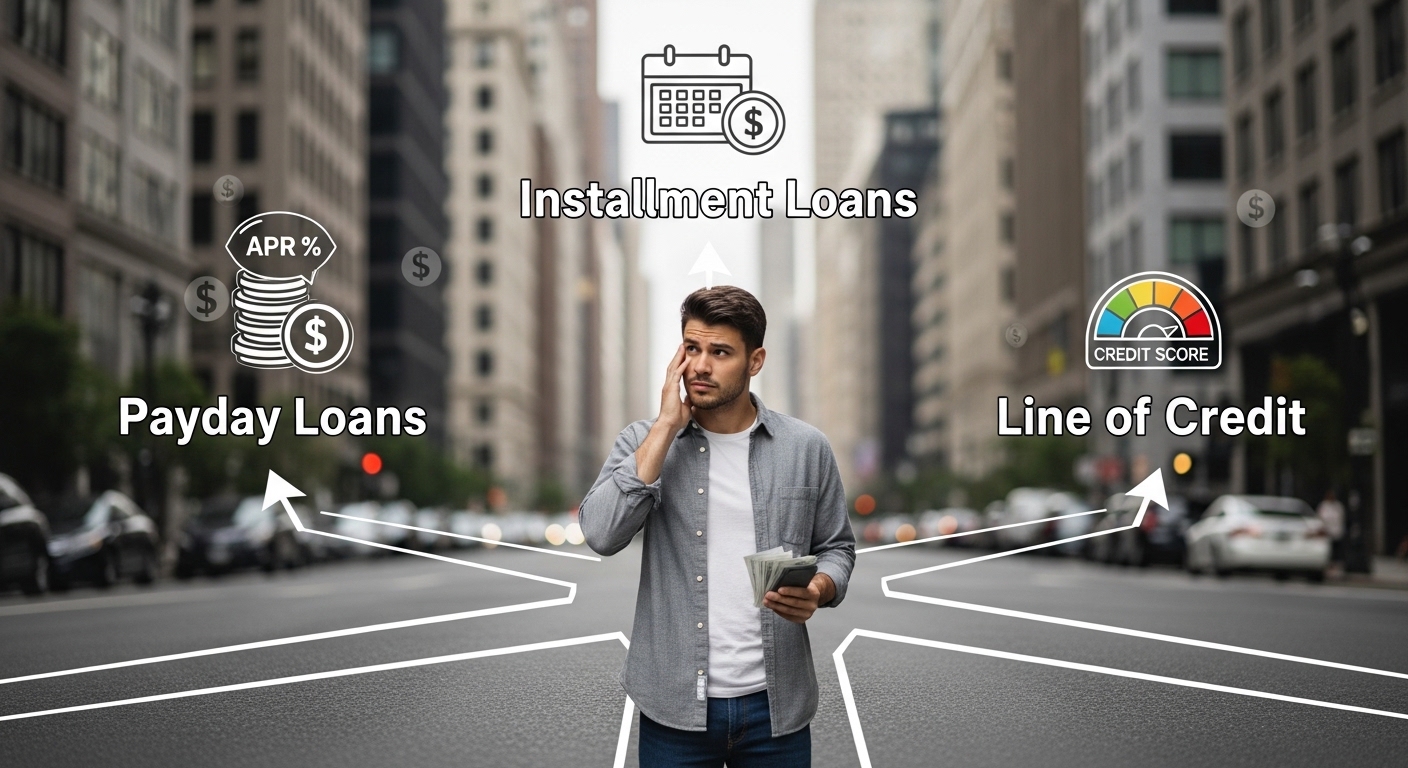
Emergency Cash Options: Loans vs Credit Explained
The information in this blog post is provided for general educational and informational purposes only. It does not constitute financial, legal, or tax advice of any kind. Tax refund advance products, fees, APRs, and terms change frequently and vary significantly by provider, tax year, and individual circumstances.
All product details, APRs, and fee structures referenced in this post are based on publicly available information as of February 2026. Always verify current terms directly with any tax preparation provider before making decisions. Consult a qualified tax professional or financial advisor for advice specific to your situation.
The publisher and affiliated parties accept no liability for financial or tax outcomes resulting from reliance on any information in this post. No tax preparation companies or financial institutions are endorsed or affiliated with this content.
🤖 TL;DR — Structured Summary For Quick Reference
| 📌 What This Post Covers | [TOPIC IN ONE SENTENCE] |
| 📊 Key Statistic | [MOST POWERFUL NUMBER IN POST] |
| ⚠️ Biggest Risk | [SINGLE MOST DANGEROUS THING] |
| ✅ Best Alternative | [TOP RECOMMENDED OPTION] |
| 🏛️ Regulatory Status | [CURRENT LEGAL / REGULATORY SITUATION] |
| 💡 Bottom Line | [ONE SENTENCE VERDICT] |
ConfidenceBuildings.com — Borrower’s Truth Series | Updated March 2026 | Laxmi Hegde, MBA in Finance
📌 Part of the Emergency Borrowing Blueprint 2026 Series
This article is one chapter of the complete emergency loan decision system. For the full guide — including borrower paths, hidden cost analysis, and strategic options — start with the series home base:
→ Emergency Borrowing Blueprint 2026 — Complete Guide (Pillar Page)
For Emergency Funds Seekers — USA Edition
Disclaimer: This video is for educational purposes only and does not constitute financial advice. Loan terms, APRs, and regulations vary by state and lender. Always verify directly with the lender and consult a licensed professional before making financial decisions.Table of Contents
- Introduction: When Your Wallet Says “Help!”
- A Quick Disclaimer (Because This Is Finance)
- What Are Payday Loans?
- What Are Installment Loans?
- What Is a Line of Credit?
- Side-by-Side Comparison (the Good, the Bad, and the “Ouch!”)
- Which One Is Worse? (Short Answer)
- How to Choose What’s Best for Emergency Cash
- Alternatives to These Options
- Final Thoughts — Be Smart With Cash
Part of the ConfidenceBuildings.com Emergency Finance Series — Episode 5
📅 Published: February 2026
🔗 Previous episodes in this series:
👉 Top Finance Niches for YouTube in 2026 – Episode 1
👉 Top 10 Same Day Loan Lenders in USA 2026 – Episode 2
👉 Emergency Cash Options: Loans vs Credit Explained – Episode 3 you are here !
👉 Hidden Fees of Same Day Loans Explained – Episode 4
👉 Current: Episode 5 — Who Should Use Same Day Loans? :https://youtu.be/VuSCWr_2_wM
**1. Introduction: When Your Wallet Says “Help!”
*You need money now — not in two weeks, not someday, now.
Whether it’s an unexpected car repair, medical bill, or your phone did a very dramatic accidental swim, you’re here because you’re looking for emergency cash. But not all loan options are created equal (and some are like that one friend who borrows money but never returns it).
Today we’re comparing:
🔹 Payday Loans
🔹 Installment Loans
🔹 Lines of Credit

And answering the big question: Which is worse for emergency funds seekers?
2. A Quick Disclaimer
The information in this blog is informational and not financial or legal advice. Before borrowing money, you should consider speaking with a financial planner, credit counselor, or professional. Always read terms, fees, and disclosures carefully.
3. What Are Payday Loans?
TL;DR: Short-term, small-amount loans due on your next payday
💡 Good for: Immediate cash, small emergencies
⚠️ Bad for: High fees, debt traps
Payday loans are the classic “I need cash today and I’ll pay you back next paycheck” products. The lender gives you a small lump sum, and you promise to repay it — usually on your next payday.
Here’s the catch:
- APRs can be astronomically high (think triple digits).
- Fees add up fast.
- Rolling them over can trap you in debt quicksand.
👉 EMERGENCY FUNDS SEEKER ALERT: Good as a last, last resort — and only if you can truly pay it back on time.
4. What Are Installment Loans?

TL;DR: Borrow now, pay in equal monthly payments
💡 Good for: Larger needs and structured repayment
⚠️ Bad for: Interest and possible penalties
Installment loans spread out your payments over weeks or months (sometimes years). Your monthly payment includes both principal and interest.
Think of it like buying something and paying it off in pieces — only this something is your emergency cash.
✔️ Easier to budget
✔️ Usually lower interest than payday loans
✘ Still interest cost
📊 Complete Comparison — [POST TOPIC] At A Glance
| Option | True Cost | Speed | Credit Needed | Risk Level |
|---|---|---|---|---|
| [BEST OPTION] | [COST] | [SPEED] | [CREDIT] | 🟢 Low |
| [MIDDLE OPTION] | [COST] | [SPEED] | [CREDIT] | 🟡 Moderate |
| [WORST OPTION] | [COST] | [SPEED] | [CREDIT] | 🔴 High |
⚠️ Data based on CFPB research, Federal Reserve data, and publicly available lender information as of March 2026. Rates and terms vary by state and lender. Always verify before borrowing.
5. What Is a Line of Credit?

TL;DR: Like a credit card but more flexible
💡 Good for: Ongoing access to funds
⚠️ Bad for: Interest if you carry a balance
A line of credit (LOC) is a pre-approved amount you can borrow from as needed — and only pay interest on the portion you use.
Imagine having a safety net of cash that you dip into when needed.
✔️ Flexible
✔️ Lower interest than payday loans (usually)
✘ Can still be a debt burden

6. Side-by-Side Comparison (the Good, the Bad, and the “Ouch!”)
| Feature | Payday Loan | Installment Loan | Line of Credit |
|---|---|---|---|
| Best for emergency cash | Yes — if nothing else works | Yes | Yes |
| Interest rate | 🔥 Extremely high | Moderate | Low to moderate |
| Repayment flexibility | Low | Medium | High |
| Risk of debt cycle | Very high | Moderate | Medium |
| Credit impact | Depends | Often reported | Often reported |
7. Which One Is Worse? (Short Answer)

🥇 Worst Overall: Payday Loans
💰 Most Balanced: Installment Loans
🧠 Most Flexible: Line of Credit
Payday loans come out on top (or bottom?) as the worst option — not because they don’t give you money, but because the cost and risk of debt are disproportionately high.
Installment loans and lines of credit — while still not free — tend to be less financially punishing when used responsibly.
8. How to Choose What’s Best for Emergency Cash
Ask yourself:
✔️ How soon can I repay?
✔️ What are the fees and APR?
✔️ Do I have other options?
If you can realistically repay a payday loan on time, it might be okay once — but don’t make it your go-to.
Having a line of credit or a planned installment loan is usually safer, especially if you anticipate future emergencies.
9. Alternatives to These Options
Before resorting to high-cost lending, consider:
🔹 Emergency savings (yes, seriously — build it!)
🔹 Borrowing from friends/family (with a clear plan)
🔹 Credit union loans (often cheaper)
🔹 0% APR promotions (carefully)
🔹 Side gigs / quick job earnings
Sometimes the best backup plan is a plan.
10. Final Thoughts — Be Smart With Cash
Emergency funds are exactly that — for emergencies. The best financial safety net in 2026 (and beyond) is a solid emergency savings cushion.
But life happens. If you must borrow, knowing the difference between high-cost payday loans, structured installment loans, and flexible lines of credit can save your wallet and your peace of mind.

If you enjoyed this comparison and want real-world examples, numbers, and loopholes to look out for, stick around for more guides — and don’t forget to watch the video embedded above! 🎥😄
A 30-day financial literacy project focused on emergency borrowing decisions — written from a consumer-first perspective with zero lender sponsorship influence.
This article is part of our step-by-step borrower protection system. 👉 View the Complete Emergency Borrowing Blueprint (All Episodes + Videos)
Free Access: Finance Calculator
Get instant access to loan, investment, and retirement tools.
📧 Subscribe with Email →One-click signup. No spam. You’ll get the calculator link immediately.
Already subscribed? Open calculator →