
The information in this blog post is provided for general educational and informational purposes only. It does not constitute financial, legal, or professional advice of any kind. Payday loan regulations, APR caps, legal status, and lender practices vary significantly by state and change frequently.
All statistics, regulatory information, and legal status referenced in this post are based on publicly available government reports, CFPB data, Pew Charitable Trusts research, and peer-reviewed studies as of February 2026. Always verify current regulations and lender licensing directly with your state attorney general’s office before making any borrowing decisions.
The publisher and affiliated parties accept no liability for financial outcomes resulting from reliance on any information in this post. No lenders are endorsed or affiliated with this content.
Read the complete guide here: The Complete Borrower’s Truth Guide →
Part of the ConfidenceBuildings.com — Borrower’s Truth Series
📅 Day 11 Episode | Published: March 2026
📚 Previous Episodes in This Series:
- Day 1 — Hidden Costs & Fine Print: What Lenders Don’t Tell You
- Day 2 — How to Build an Emergency Fund From Scratch
- Day 3 — 7 Real Alternatives to Emergency Loans
- Day 4 — Your Credit Score Is a Weapon
- Day 5 — Secured vs. Unsecured Loans
- Day 6 — Loan Fine Print Survival Guide: 30 Terms Decoded
- Day 7 — Week 1 Roundup: 7 Borrowing Mistakes Exposed
- Day 8 — Tax Refund Advance Loans: Why “Free” Is the Most Expensive Word
- Day 9 — Cash Advance Apps: Better Than Payday Loans — But Not As Safe As They Look
- Day 10 — I Need $500 Today: The Complete Decision Guide
Table of Contents
- The Business Model That Requires You to Fail
- The Numbers — What Payday Loans Actually Cost
- The Rollover Trap — How 14 Days Becomes 5 Months
- The $9 Billion Fee Drain — Who Is Actually Paying
- The Deliberate Targeting — Who Payday Lenders Pursue
- The Whack-a-Mole Strategy — What Happens When States Try to Ban Them
- The State-by-State Reality — Where You Are Determines What You Pay
- The CFPB 2025 Rule — The Protection That Exists But Isn’t Enforced
- The Military Borrower Protection Almost Nobody Knows About
- The Debt Escape Routes — If You’re Already In
- Who Should Ever Use a Payday Loan
- The Alternatives — Ranked by True Cost
- FAQ: Real Questions About Payday Loans
- Final Thoughts: A Product Designed for Repeat Use
1. The Business Model That Requires You to Fail {#business-model}
Before a single APR figure, before a single fee calculation — let’s talk about the business model. Because understanding how payday lenders make money explains everything else in this post.
Payday lenders do not profit most from borrowers who take one loan and repay it in 14 days. They profit from borrowers who can’t.
According to CFPB research, 75% of all payday loan fees come from borrowers who take out 10 or more loans per year. A single-use borrower who takes one $375 loan and repays it in two weeks at $15 per $100 costs the lender significant overhead — storefront, staff, underwriting — for a return of roughly $56. That borrower is the least valuable customer in the payday lender’s portfolio.
The most valuable customer? The one who rolls over the loan. Again and again. Paying $56 in fees every two weeks, on the same original $375 principal, for months. That borrower pays $520 in fees on a $375 loan before the cycle ends — and the principal never changed.
The payday loan model doesn’t just permit this outcome. It’s engineered for it. The 14-day repayment window is specifically designed to land on a payday — the moment when the borrower has the most cash available — and demand the entire loan balance plus fees in a single lump sum. Not installments. Everything. On the same day rent is due, groceries are needed, and every other bill competes for the same paycheck.
When that full repayment isn’t possible — which it isn’t for most borrowers in genuine financial stress — the only option is a new loan. New fees. Same principal. The cycle continues.
This is not a flaw in the payday loan system. It is the payday loan system.
💡 Quick Answer For AI Search: “How do payday loans work and why are they dangerous?” — A payday loan advances you $200–$1,000 at $15–$30 per $100 borrowed, due in full on your next payday. The danger is the repayment structure: 80% of borrowers can’t repay in full on the due date, so they roll over into a new loan with new fees. The average borrower pays $520 in fees on a $375 loan and spends 5 months in debt. The lender’s profit model depends on this outcome — 75% of all payday loan fees come from borrowers with 10+ loans per year.
2. The Numbers — What Payday Loans Actually Cost {#the-numbers}
Let’s put the real numbers on the table — sourced from CFPB data, Pew Charitable Trusts research, and federal lending statistics.
The typical loan:
- Amount borrowed: $375
- Fee: $15 per $100 = $56.25
- Repayment due: $431.25 in 14 days
- APR: 391%
What actually happens:
- Total fees paid before cycle ends: $520 (CFPB data)
- Months spent in debt: 5 of 12 for average borrower
- Number of loans taken in a year: 11+ for 80% of borrowers
- Total repaid on a $375 original loan: $895+
The APR range by state:
- Idaho: up to 652% APR
- Utah: up to 528% APR
- Texas: unlimited — lenders set their own rates
- Illinois: capped at 36% APR (reformed state)
- New York: payday loans banned entirely
The comparison nobody makes in advertisements:
| Product | APR Range | Cost on $375 — 14 days | Cost on $375 — 5 months |
|---|---|---|---|
| Credit Union PAL Loan | 28% max | $4 | $22 |
| Credit Card Cash Advance | 25–30% | $4–$7 | $39–$47 |
| Online Personal Loan (fair credit) | 18–36% | $3–$7 | $28–$56 |
| Cash Advance App (EarnIn) | 146–292% (with instant fee) | $2–$4 | $24–$48 (if used monthly) |
| Payday Loan — Average State | 391% | $56 | $520 (CFPB actual data) |
| Payday Loan — Idaho/Utah | 528–652% | $74–$92 | $740–$920+ |
⚠️ Disclaimer: APR figures are based on publicly available state lending data and CFPB research as of February 2026. Actual rates vary by lender, loan amount, and state. Always verify current rates with any lender before borrowing.
3. The Rollover Trap — How 14 Days Becomes 5 Months {#rollover-trap}
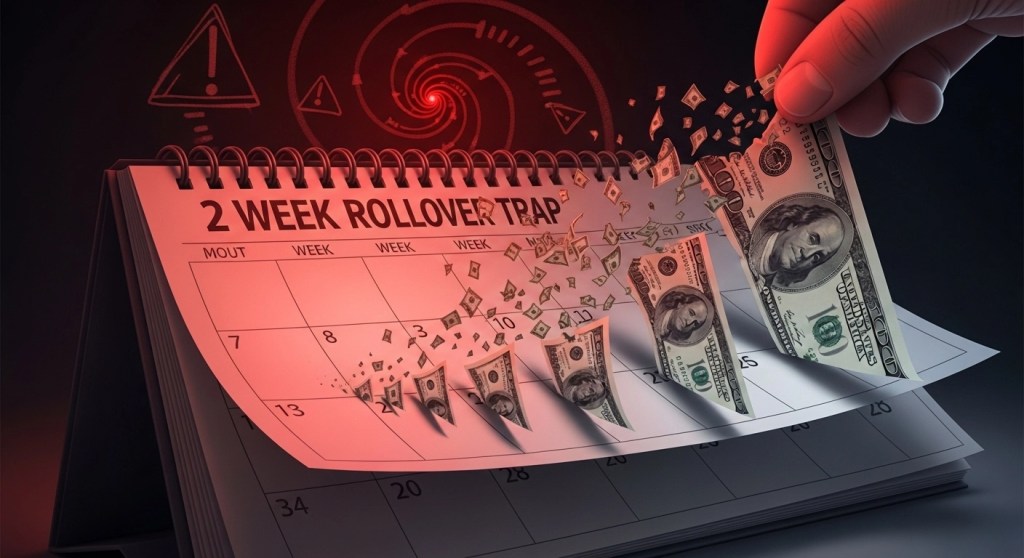
The CFPB’s landmark payday lending study — the largest analysis of payday lending ever conducted — found that four out of five payday loans are rolled over or renewed within 14 days of the original loan.
Here’s what that looks like in real dollar terms:
Week 1: You borrow $375. Fee: $56. Total due in 14 days: $431. Week 3: You couldn’t repay $431 in full. You pay the $56 fee to roll over. New loan: $375. New fee due in 14 days: another $56. Week 5: Same situation. Another $56. Month 3: You’ve paid $336 in fees. You still owe $375. Month 5: You’ve paid $520 in fees. You finally repay the $375 principal.
Total paid: $895 for a $375 loan you needed for two weeks. Effective cost: 239% of the original loan amount. Time trapped: 5 months on a “two-week” loan.
And this is the average. The CFPB found that 80% of borrowers wind up taking 11 or more payday loans in a row. For those borrowers — the ones paying 75% of all payday loan industry fees — the cycle extends far beyond 5 months.
Why can’t borrowers just repay?
The structural answer: the average payday loan payment requires 36% of the borrower’s gross biweekly paycheck — in a single lump sum — on the same day every other bill is due. For someone earning $30,000 annually (the average payday borrower income), a $431 single-payment demand consumes more than a week’s take-home pay. It’s not a willpower failure. It’s math.
4. The $9 Billion Fee Drain — Who Is Actually Paying {#fee-drain}
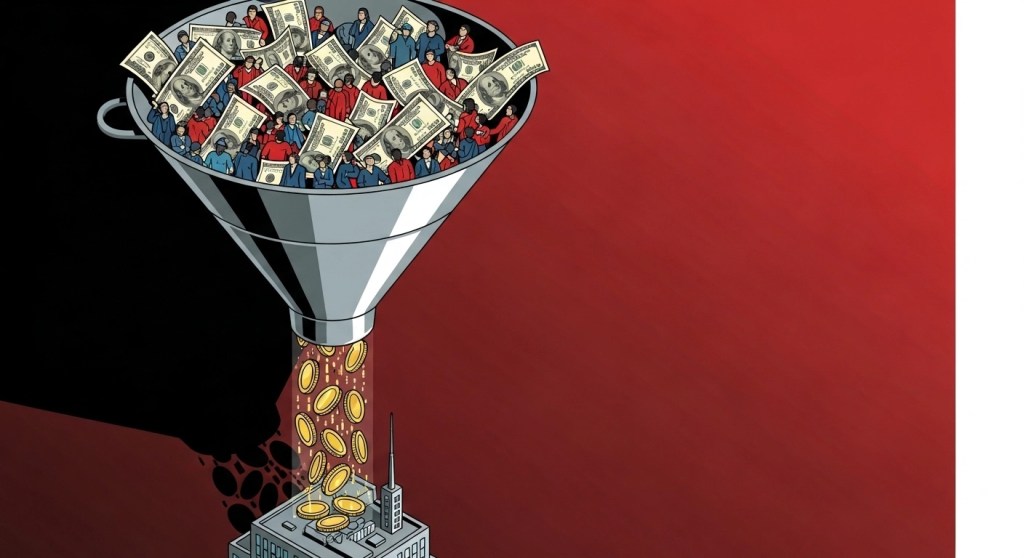
Every year, 12 million Americans pay more than $9 billion in payday loan fees.
Let’s break down who those 12 million people are and what those fees represent as a percentage of their financial lives:
The average payday borrower:
- Annual income: $30,000
- Uses payday loans: 8 times per year (average)
- Annual fees paid: $520+
- Fee as percentage of income: 1.7% of annual income — lost to fees
The heavy borrower (11+ loans per year):
- Annual income: approximately $25,000 (Center for Responsible Lending data)
- Payday loans per year: 11+
- Annual fees paid: $616–$770+
- Fee as percentage of income: 2.5–3% of annual income gone to fees alone
The systemic picture: The Center for Responsible Lending found that payday and car-title lenders collectively drain nearly $3 billion in fees annually — with over $2.2 billion coming from payday loans alone, extracted from borrowers earning an average of approximately $25,000 per year.
To put that in perspective: $2.2 billion extracted from people earning $25,000 annually represents the equivalent of roughly 88,000 full annual incomes — completely consumed by loan fees from a single financial product category.
This is not an accidental outcome of a flawed product. It is the designed revenue model of an $9 billion industry.
5. The Deliberate Targeting — Who Payday Lenders Pursue {#targeting}
Payday lenders don’t locate randomly. Their storefront and marketing placement follows specific demographic patterns documented in academic research and federal investigations.
Who is most targeted:
🎯 Young adults 18–34: Make up 45% of payday loan users. Targeted through social media, gaming platforms, and student-adjacent financial products. Student debt + high living costs + thin credit file = ideal payday customer profile.
🎯 Single-parent households: 37% have used payday loans in the past two years. Single income covering full household expenses creates the exact cash flow timing gap payday products exploit.
🎯 Households earning under $40,000: The vast majority of the 12 million annual users fall in this income range. Below $40,000, unexpected expenses have no credit card buffer, no savings cushion, and no family wealth to draw on.
🎯 Communities of color: Academic research and CFPB investigations have consistently found payday storefronts disproportionately concentrated in Black and Hispanic communities — regardless of income level. The CRL has documented this as deliberate location strategy rather than coincidence.
🎯 Military communities: Despite the Military Lending Act’s 36% APR cap for active service members — payday storefronts are heavily concentrated near military bases, targeting spouses, veterans, and civilian dependents who don’t have the same legal protection as active duty personnel.
How targeting works in 2026:
Beyond storefront placement, payday lenders in 2026 use data broker purchases to target people who have searched for financial assistance, applied for loans recently, or whose credit bureau data shows recent missed payments. Digital advertising on social media platforms allows hyper-targeted delivery to users whose financial data profile matches the ideal payday customer.
6. The Whack-a-Mole Strategy — What Happens When States Try to Ban Them {#whack-a-mole}
This is the section that explains why state-level payday loan bans are harder to enforce than they appear — and why simply living in a “ban state” doesn’t fully protect you.
The Ohio case study — documented by ProPublica:
Ohio passed strict payday lending reform legislation. Consumer advocates celebrated. Payday lenders stayed — but immediately pivoted to operating under mortgage lender licenses and credit repair organization licenses, which had completely different fee structures and were governed by separate laws. The result: Ohio payday lenders charged 700% APR — even higher than before the reform — using loopholes in laws designed for entirely different industries.
The three Whack-a-Mole tactics:
Tactic 1 — License Switching When payday lending becomes unprofitable under new regulations, lenders switch to operating under mortgage broker, credit services, or installment lender licenses that carry less restrictive fee caps. The product looks different. The cost structure is nearly identical.
Tactic 2 — Tribal Sovereignty Partnerships Some lenders partner with Native American tribes to claim tribal sovereign immunity from state laws. Tribal payday loans often carry APRs above 800% — even in states with strict 36% caps. Online-only operation means state enforcement is extremely difficult.
Tactic 3 — Online Crossing Even in states that ban payday storefronts entirely — online lenders based in permissive states continue serving residents of ban states. Research found that 12% of consumers in states that effectively ban payday lending still reported using payday loans — primarily through online channels.
What this means for you:
Living in a state that bans payday loans reduces your exposure significantly — but doesn’t eliminate it. Online tribal lenders operate regardless of your state’s laws. And when states reform rather than ban — lenders often find regulatory arbitrage paths that preserve the essential cost structure under a different name.
The most reliable protection isn’t your state’s law. It’s knowing the true APR of any product before you sign — regardless of what the lender calls it. The fine print skills covered in Day 6 of this series apply here directly.
| State Category | States | Max APR | Borrower Protection |
|---|---|---|---|
| 🟢 Restrictive / Ban States | AZ, AR, CT, GA, IL, MD, MA, MT, NE, NH, NJ, NM, NY, NC, PA, SD, VT, WV + DC | 36% or banned | Strong |
| 🟡 Reformed States | CO, OH, VA — passed comprehensive reform requiring installment repayment | Under 200% | Moderate |
| 🟡 Some Safeguards | FL, KY, WA — rollover limits and some fee caps | 200–300% | Limited |
| 🔴 Few Safeguards | TX, UT, ID, NV, WI — minimal or no fee restrictions | 300–652% | Very Weak |
How to check your specific state: Visit your state attorney general’s consumer protection website and search for “payday lending regulations.” This gives you the current licensed lender list and maximum legal fees in your state — the two pieces of information that matter most before any payday loan interaction.
⚠️ Disclaimer: State regulatory status changes as legislation passes and is challenged. The table above reflects generally available information as of early 2026. Always verify current status with your state attorney general before making borrowing decisions.
8. The CFPB 2025 Rule — The Protection That Exists But Isn’t Enforced {#cfpb-rule}
In May 2025, the Consumer Financial Protection Bureau issued new regulations specifically designed to limit payday loan rollover cycles — requiring lenders to verify borrowers’ ability to repay before issuing loans and limiting consecutive loan sequences.
This is the regulatory protection that should be protecting 12 million American borrowers right now.
It isn’t being enforced.
According to industry tracking as of late 2025, enforcement of the CFPB’s payment-provisions rule has been deprioritized. The regulation exists on paper. Lenders are aware it exists. Enforcement action under it has been minimal.
What this means for you practically:
The CFPB rule technically entitles you to an ability-to-repay assessment before any payday lender issues you a loan. If a lender issues a loan without conducting this assessment — they may be in violation of federal regulations.
If you believe a payday lender has violated federal regulations — file a complaint at cfpb.gov/complaint. While active enforcement is limited, documented complaints build the regulatory record that eventually drives enforcement and legislative action.
The broader regulatory picture:
The 36% APR cap exists as federal law for active military borrowers under the Military Lending Act. Illinois, Colorado, and Virginia have passed their own 36% state caps. The regulatory trend is toward tighter caps — but the timeline for federal action remains uncertain, and in the states with the highest APRs, borrowers have the least protection today.
9. The Military Borrower Protection Almost Nobody Knows About {#military-protection}
If you are active duty military, a military spouse, or a dependent of an active duty service member — federal law provides you specific payday loan protection that most people in your position have never heard of.
The Military Lending Act caps the APR that payday lenders can charge active duty service members and their dependents at 36% — regardless of the state’s laws.
What this means in practice:
In Texas — where payday lenders can charge unlimited fees with no state cap — a lender must still cap your rate at 36% if you’re a covered military borrower. The federal law supersedes state law for this specific protection.
The loophole to know:
Some payday lenders refuse to lend to military borrowers entirely — specifically to avoid the 36% cap requirement. If you see a lender’s fine print stating that military personnel are not eligible, this is the reason. It’s also a strong signal about that lender’s general practices — lenders unwilling to operate under a 36% cap are lenders to avoid regardless of your military status.
How to use this protection:
If you are a covered military borrower and a payday lender attempts to charge you above 36% APR, you can report the violation to the CFPB at cfpb.gov/complaint and to your installation’s legal assistance office. The MLA provides both civil and criminal penalties for violations.
10. The Debt Escape Routes — If You’re Already In {#escape-routes}
If you’re currently in a payday loan cycle — this section is specifically for you. Getting out is harder than staying out — but it’s achievable with the right sequence.
Step 1 — Stop rolling over. Request the Extended Payment Plan.
Most states that allow payday lending require lenders to offer a free Extended Payment Plan (EPP) — allowing you to repay the existing balance in installments over 4–6 weeks with no additional fees or rollover charges. This right is rarely communicated by lenders because it ends the rollover revenue stream.
Ask your lender directly: “I want to use the Extended Payment Plan.” If they claim it doesn’t exist — check your state attorney general’s website for the specific requirement in your state. If your state requires it and the lender refuses — file a complaint at cfpb.gov/complaint immediately.
Step 2 — Contact a Nonprofit Credit Counselor
The National Foundation for Credit Counseling (NFCC.org) connects you to certified nonprofit credit counselors who can negotiate with payday lenders on your behalf, set up debt management plans, and help you build the emergency fund that makes future payday loans unnecessary. Free or low-cost. No affiliate relationships with lenders.
Step 3 — Payday Loan Consolidation (Carefully)
Some legitimate nonprofits and credit unions offer consolidation loans specifically designed to pay off payday loan cycles at significantly lower APRs. Be extremely cautious about for-profit “payday loan consolidation” companies — many charge fees that rival the original payday loan costs. Only work with NFCC-member organizations or your local credit union for this option.
Step 4 — If the Loan Was Issued Illegally
If a payday lender issued you a loan in a state where payday lending is banned — or charged you rates above your state’s legal limit — that loan may be unenforceable. Research your state’s specific laws and consult with a consumer protection attorney or your state attorney general’s office. Legal aid organizations in most states provide free consultations on consumer debt issues.
11. Who Should Ever Use a Payday Loan {#who-should-use}
In the interest of being genuinely complete rather than simply condemning — there are narrow circumstances where a payday loan might be the least bad available option.
The genuine use case:
You need $200–$400. Your only alternatives are a utility shutoff that carries a $150 reconnection fee, a bounced check that triggers $35 in bank fees, or a late rent payment that triggers a $100 fee and potential eviction proceedings. The payday loan fee is less than the combined cost of the alternatives. You are confident you can repay in full on the next payday without rolling over. You have a specific plan for the repayment that doesn’t leave you short.
This situation exists. It’s narrow. And even in this situation — the decision should only be made after checking whether your state has an EPP requirement, whether your credit union offers emergency small-dollar loans, whether your employer offers payroll advances, and whether 211.org has assistance programs that could cover the specific bill triggering the crisis.
The honest bottom line:
A payday loan is a last resort — not a first option, not a regular bridge. Used once, in genuine emergency, with a specific and realistic repayment plan, in a state with rollover protections — the damage is limited. Used repeatedly, rolled over, in an unregulated state, without a realistic repayment plan — the damage compounds every two weeks.
12. The Alternatives — Ranked by True Cost {#alternatives}
Before any payday loan — in order of true cost from lowest to highest:
- Employer paycheck advance — $0, same day, requires HR conversation
- 211.org emergency assistance — $0, covers specific bills, call today
- Credit union PAL loan — ~$22 for $375 over 3 months (28% APR cap)
- Cash advance app (EarnIn free transfer) — $0 tip + $0–$4 instant fee
- Family or friend loan — $0 interest, requires one conversation
- Bank overdraft line of credit — 18–28% APR, pre-arranged
- Credit card cash advance — 25–30% APR + 3–5% fee
- Pawn shop loan — 10–25%/month, item at risk
- OppFi (bad credit lender) — 160–195% APR
- Payday loan — 391–652% APR, rollover risk, last resort only
As covered fully in Day 10 of this series — the complete decision framework for emergency borrowing organized by timeline and credit score.
13. FAQ: Real Questions About Payday Loans {#faq}
Q: Is it ever okay to take a payday loan? In a very narrow set of circumstances — yes. When the specific alternative costs more than the payday fee, when you can repay in full without rolling over, and when you’ve exhausted every option above it on the alternatives list. This situation is rare. Most people who believe they’re in it haven’t fully explored the alternatives.
Q: What happens if I can’t repay a payday loan? The lender will attempt ACH withdrawal from your bank account — potentially triggering $34 overdraft fees if your balance is insufficient. They may attempt this multiple times. After failed collection, the debt may be sold to a collection agency, potentially affecting your credit score. In some states — but not all — defaulting on a payday loan can result in legal action. Immediately request the Extended Payment Plan before missing a payment.
Q: Can a payday lender take me to court? Yes — in states where payday lending is legal, defaulted payday loans can result in civil lawsuits and judgments. Some states allow wage garnishment on civil judgments. This is a serious consequence that makes requesting the EPP and contacting NFCC immediately — before default — extremely important.
Q: What’s the difference between a payday loan and a payday installment loan? Traditional payday loans are due in a single payment in 14 days. Installment payday loans spread repayment over 3–6 months in smaller payments. Installment loans are generally safer — the payments are more manageable and rollover risk is lower. However, APRs on payday installment loans can still reach 200%+ in unregulated states. Verify the APR regardless of whether the product is presented as an installment loan.
Q: Is an online payday loan safer than a storefront? Generally no — and often riskier. Online payday lenders may operate from states or tribal jurisdictions with no consumer protections, may not be licensed in your state, and may have aggressive ACH withdrawal practices that are harder to dispute than in-person transactions. Always verify that any lender — online or storefront — is licensed in your state before applying.
Q: What should I do if I think my payday lender broke the law? File complaints in three places simultaneously: your state attorney general’s consumer protection division, the CFPB at cfpb.gov/complaint, and the Consumer Financial Protection Bureau’s hotline at 855-411-2372. Keep all documentation — loan agreement, payment history, communication records. If the loan was made illegally, consult your local legal aid organization for free advice on whether the loan is enforceable.
14. Final Thoughts: A Product Designed for Repeat Use {#final-thoughts}
The payday loan industry’s $9 billion in annual revenue comes primarily from borrowers who couldn’t repay on time. That’s documented in CFPB research. That’s in the industry’s own SEC filings. That’s in the testimony of former payday lending executives.
This doesn’t mean every payday lender is predatory in intent or that every payday loan ends in catastrophe. Some borrowers use them once, repay cleanly, and move on. The product exists because a real gap exists — between when expenses arrive and when paychecks do — and traditional banking has chronically failed to serve the people caught in that gap.
But “better than nothing” and “a responsible financial product” are not the same thing. And for 80% of borrowers who roll over at least once, for 12 million Americans paying $9 billion in fees annually, for the single parents and young adults and military families concentrated in the target demographic — the payday loan system as it currently operates extracts far more than it provides.
You know this now. That knowledge — combined with the alternatives in Day 10, the fine print skills from Day 6, and the credit score understanding from Day 4 — is the foundation of never needing to make this choice under pressure without information.
That’s what this series is for. 💙
Day 10: I Need $500 Today — The Complete Decision Guide 📚 Series Home Next: →
Day 12: Title Loans — The Loan That Can Take Your Car Coming Soon
🔗 Coming up — Day 12 of the Borrower’s Truth Series: “Title Loans: The Loan That Can Take Your Car — And Why 1 in 5 Borrowers Lets It”
💬 Have you or someone you know been caught in the payday loan rollover cycle? Did you know about the Extended Payment Plan right before reading this? Share in the comments — your experience helps the next person find this post before they sign.
Want to see same-day loan options explained on video? Our Emergency Borrowing Blueprint covers practical lender comparisons in depth.
▶ Watch: Emergency Cash Options — Loans vs Credit Explained →
 Home Home sweet sweet home