Variable Rate Loans: Why Your Monthly Payment Could Suddenly Skyrocket

Week 3 — The Fine Print Files  ·  Day 17

Variable Rate Loans:

Why Your Monthly Payment Could Suddenly Skyrocket

Index Rate
SOFR
Market sets this
+
Margin
+3–8%
Lender sets this
=
Your Rate
???%
Changes anytime

The hidden risk: Some variable rate loans have NO cap — meaning there is no legal limit on how high your payment can climb.

ConfidenceBuildings.com  ·  Borrower’s Truth Series  ·  For educational purposes only. Not legal advice.

⚠ For educational purposes only. Not legal advice. This content is intended to help borrowers understand how variable rate loan terms work in general. Loan agreements vary by lender, state, and loan type. Always review your specific loan documents with a qualified financial or legal professional before making any borrowing decisions. Laws and regulations referenced are subject to change.

📍 Borrower’s Truth Series — Your Progress
30-day guide to borrowing with confidence · You are on Day 17 of 30
57%
Complete
Published
You are here
Coming soon

⭐ Essential Reading — Start Here

Before You Read Any Further — Have You Done The Clause Checklist?

Day 15 is the most important post in this series. It gives you the exact loan clauses to find — and what to do when you find them. Every post in Week 3 builds on it. If you haven’t read it yet, start there first.

Read Day 15: Loan Clause Checklist →
15
Day
Lead Magnet

Borrower’s Truth Series Week 3 · Day 17 of 30

Welcome to Week 3: The Fine Print Files — where we pull back the curtain on the clauses buried in your loan agreement that lenders legally use against you.

Today’s topic: variable rate loans. You were sold a lower starting rate. What you may not have been clearly told is that the rate — and your monthly payment — can increase at any time, sometimes dramatically, based on a formula you never negotiated.

This post breaks down exactly how that formula works, what fine print to look for before you sign, and what real borrowers have faced when rates moved against them.

📘 Yesterday (Day 16): You Signed Away Your Right to Sue  |  📗 Tomorrow (Day 18): Auto-Pay Loan Traps

The Low Rate They Showed You — And What They Didn’t

When a lender offers you a variable rate loan, the pitch is almost always the same: “You can start at a much lower rate than a fixed loan.” And that part is true. Variable rate loans typically open with a lower interest rate than comparable fixed-rate products. That lower rate feels like a win. It makes your monthly payment smaller, your loan more affordable, and the decision easy.

What the pitch rarely includes in plain language: that starting rate is temporary. It is tied to forces entirely outside your control — and when those forces move, your payment moves with them. No negotiation. No approval from you. Just a new, higher number on your statement.

📌 Quick Answer

A variable rate loan starts with a lower interest rate, but that rate is calculated using a market index plus a lender-set margin. When the index rises, your payment rises — often automatically, with no option to object. Some loans include no cap on how high the rate can climb.

5%
Max Lifetime Cap

A typical ARM may allow your rate to rise up to 5 percentage points over the life of the loan — even with a cap. On a $20,000 personal loan, that can add hundreds of dollars per month to your payment.

Source: CFPB Regulation Z, §1026.19 — For educational purposes only. Not legal advice.

The Formula Your Lender Controls — But Didn’t Explain

Every variable rate loan uses a two-part formula to calculate your interest rate. Understanding this formula is the single most important thing you can do before signing a variable rate loan agreement.

How Your Variable Rate Is Actually Calculated

1
The Index — Set By the Market

This is a publicly published interest rate your lender uses as a baseline. Common indexes include:

SOFR
Secured Overnight Financing Rate — replaced LIBOR
Prime Rate
Set by large U.S. banks, moves with Federal Reserve
CMT
Constant Maturity Treasury — used in many ARMs
T-Bill Rate
91-day Treasury Bill rate — used for federal student loans

The lender chooses which index your loan uses — and that choice is locked in at closing. You cannot change it later.

2
The Margin — Set By Your Lender

The margin is a fixed percentage your lender adds to the index. It is their profit. It is set at the beginning of your loan and does not change — but it varies significantly between lenders and you can try to negotiate it.

Example: SOFR (4.36%) + Margin (3.50%) = Your Rate: 7.86%
If SOFR rises to 5.50%: + Margin (3.50%) = Your Rate: 9.00%
That jump = +$87/mo on a $15,000 loan

What competitors don’t tell you: The CFPB confirms you can negotiate the margin, just like you negotiate a fixed rate. Most borrowers never try.

Index + Margin = Your Interest Rate
This changes every adjustment period. You don’t vote on it. You just pay it.

Source: CFPB Ask-CFPB · For educational purposes only. Not legal advice.

📌 Quick Answer

Your variable rate equals a public market index (like SOFR or the prime rate) plus your lender’s margin. The index changes based on the economy. The margin is set by your lender at closing and stays fixed. You can negotiate the margin before signing — but almost no one does because lenders don’t volunteer this fact.

The 5 Clauses Hidden in Variable Rate Loan Fine Print

Here is what your competitors’ “fixed vs variable” articles won’t tell you. These five clauses determine whether a variable rate loan is manageable — or a trap. None of them are illegal. All of them favor the lender.

Clause 1

Periodic Rate Cap

What it says: Limits how much your rate can increase per adjustment period (e.g., no more than 2% per year).

The catch: A 2% annual cap sounds safe — but on a $20,000 loan, that’s hundreds more per month, every year, until you hit the lifetime cap.

Clause 2 ⚠

Lifetime Rate Cap (or None)

What it says: Sets the maximum your rate can ever reach over the life of the loan. Typical caps: +5% over the starting rate.

The danger: Some loans — especially personal loans and lines of credit — have no lifetime cap at all. Rates can theoretically climb without limit. Always ask: “What is the maximum rate I could ever pay?”

Clause 3 🚨

Upward-Only Clause

What it says: The interest rate can only increase — never decrease — regardless of what the market index does.

What this means for you: If the prime rate drops 1.5%, your rate stays exactly where it is. You get all the downside of a variable rate with none of the upside. The CFPB notes this clause exists and recommends asking lenders what benefit you receive for accepting it. (CFPB source ↗)

Clause 4 🔒

Rate Carryover (Foregone Interest)

What it says: If a rate cap prevents the full increase this period, the lender can “bank” the difference and apply it in a future adjustment.

Translation: Your cap “protected” you this year — but the lender stored that increase. They can hit you with a larger jump in a future period. Protection today can become a bigger shock tomorrow.

Clause 5

Adjustment Frequency

What it says: Specifies how often your rate can change — monthly, every 6 months, annually, etc.

Why it matters: A monthly adjustment (common in HELOCs and some personal loans) means your payment can change 12 times per year. An annual adjustment gives you more time to plan — but the single yearly jump can be larger.

📌 Quick Answer

Five clauses define how dangerous your variable rate loan is: periodic cap (per-period limit), lifetime cap (or no limit at all), upward-only clause (rate can never decrease), rate carryover (banked increases applied later), and adjustment frequency (how often your payment changes). All five are legal. None are required to be explained at signing.

Use Ctrl+F on Your Loan Agreement — Search These Exact Terms

Before you sign any variable rate loan agreement, open the document and search for these exact terms. What you find — or don’t find — tells you everything about the risk you’re taking on.

Search This Term What to Look For Red Flag If You See
index Which market rate your loan is tied to No specific index named — “at lender’s discretion”
margin The fixed % your lender adds to the index Margin over 6% — compare with other lenders
rate cap or interest rate cap Maximum the rate can rise per period and over life No cap stated — this means no limit on increases
floor or minimum rate Lowest your rate can ever go High floor (e.g. 8%) — you’ll never benefit if rates drop
only increase or upward only Whether rate is permitted to decrease Any language confirming rate can only go up, never down
carryover or foregone interest Whether banked rate increases exist Carryover permitted — future adjustments can be larger
adjustment period How often the rate can change Monthly adjustment — payment changes up to 12x/year
negative amortization Whether unpaid interest can be added to principal Permitted — your balance can GROW even as you pay
prepayment penalty Fee for paying off the loan early Penalty exists — you can’t easily escape if rates spike

For educational purposes only. Not legal advice. Always have your specific loan agreement reviewed by a qualified professional.

What a Rate Increase Actually Does to Your Monthly Payment

Numbers make this real. Here is what the Index + Margin formula and a rate adjustment look like in actual dollars — using realistic loan amounts for everyday borrowers.

Monthly Payment Impact When Rates Rise — Real Numbers

Loan Amount At 7% Rate At 9% (+2%) At 12% (+5%) Max Extra/Mo
$10,000 (3yr) $309/mo $318/mo $332/mo +$23/mo
$20,000 (5yr) $396/mo $415/mo $444/mo +$48/mo
$50,000 HELOC $990/mo $1,040/mo $1,111/mo +$121/mo
$200,000 ARM $1,330/mo $1,514/mo $1,776/mo +$446/mo

Approximate calculations for illustrative purposes. Actual payments vary based on loan terms, amortization schedule, and lender. For educational purposes only. Not legal advice.

📊 Stat Callout

On a 30-year ARM mortgage, a 5-percentage-point lifetime cap can raise the monthly payment from roughly $106 to $145 on every $10,000 borrowed — a 37% increase. Scaled to a $200,000 mortgage, that’s hundreds more per month for the same home. Source: CFPB Appendix H Model Disclosure ↗ — For educational purposes only. Not legal advice.

“To understand why a 2% or 5% increase is more dangerous than it sounds, look at the total interest cost shift in the table below:”

📊 The “Skyrocket” Effect: $5,000 Loan

Interest Rate: 10% (Starting) 18% (Reset)
Monthly Payment: $161.34 $180.35
Total Interest: $808.00 $1,492.00
*Calculated over 36 months. A small rate hike can nearly double your total interest cost.

Real Stories: When Variable Rate Loans Turned

STORY 1 — COMPOSITE CASE Based on CFPB consumer complaint patterns

“I Thought I Understood It. The Statement Proved Me Wrong.”

Priya took out a $25,000 home improvement loan with a variable rate tied to the prime rate. Her starting rate was 6.5% — almost 2 points below what a fixed loan would have cost her. Her loan officer mentioned “the rate could adjust,” but the conversation moved quickly to monthly payment figures and signing.

Eighteen months later, after two Federal Reserve rate increases, her rate had moved to 9%. Her monthly payment jumped by $94. She called the lender. She was told this was in the agreement she signed.

Her mistake: She searched the loan agreement for the word “rate” — but not for “index,” “margin,” or “adjustment period.” She found the starting rate. She never found the formula that determined every rate after it.

What she could do: File a complaint with the CFPB at consumerfinance.gov/complaint if she believes the adjustment terms were not properly disclosed under TILA. She could also ask her lender about refinancing options — especially if her credit had improved since origination.

RM
Attorney Rachel Morrow
Consumer Rights Attorney — Fictional character for educational illustration only

“The disclosure was technically compliant. That doesn’t mean it was understandable. TILA requires lenders to disclose variable rate terms — but it doesn’t require them to explain in plain English what those terms mean to your budget.”

In Priya’s situation, the question isn’t whether the lender broke the law — it’s whether the required disclosures were provided in a way a reasonable person could understand. The CFPB’s TILA regulations require specific disclosures about index, margin, caps, and adjustment frequency. If those disclosures were missing or misleading, that’s a potential complaint. What’s far more common, however, is that disclosures exist but are buried in a multi-page document and presented alongside the signing paperwork without adequate explanation.

Bottom Line: The law requires disclosure. It does not require comprehension. That gap is where most variable rate borrowers get hurt — and it’s precisely why you need to read the Ctrl+F terms in this post before signing.

STORY 2 — PUBLIC CASE RECORD 2008–2009 ARM Mortgage Crisis Patterns / CFPB Enforcement Record

The Adjustable-Rate Mortgage Crisis: When Millions Saw This Happen at Once

The single largest documented case of variable rate loans “turning” on borrowers is the 2007–2009 U.S. mortgage crisis. Millions of homeowners had taken out adjustable-rate mortgages (ARMs) — often 2/28 or 3/27 structures — where a low fixed rate held for 2–3 years, then reset to a variable rate.

When the reset hit, monthly payments jumped by hundreds of dollars — sometimes 30–50% higher. Borrowers who had been making payments on time suddenly couldn’t. Many had no rate caps, or caps too high to provide meaningful protection. This was not a coincidence or bad luck. It was the variable rate mechanism operating exactly as written.

The mistake made by millions: Focusing on the introductory payment — not on what the payment would become at reset. The reset terms were disclosed. Few read them carefully enough to understand the dollar impact on their specific loan.

What borrowers recovered: Those who filed CFPB complaints about missing or misleading ARM disclosures, or who refinanced into fixed-rate FHA loans during the government response period, often reduced their payments by hundreds per month. The lesson the regulators took: variable rate disclosures need to be clearer. The CHARM booklet requirement for ARMs was strengthened as a result. CFPB ARM resource ↗

RM
Attorney Rachel Morrow
Consumer Rights Attorney — Fictional character for educational illustration only

“The 2008 crisis was not primarily a story of illegal lending. It was a story of legal lending that most borrowers did not understand. The ARM structure was disclosed. The math was disclosed. The outcome was predictable. The borrowers just weren’t equipped to predict it.”

This is why the CFPB now requires lenders to provide the CHARM (Consumer Handbook on Adjustable Rate Mortgages) booklet to any borrower considering an ARM. It’s also why today’s post exists. The same mechanism that wrecked millions of homeowners is still operating in personal loans, HELOCs, private student loans, and business lines of credit. It is not ancient history. It is this week’s loan offers.

Bottom Line: Variable rate risk is systemic and documented. Regulators have tried to add guardrails. But the borrower who reads the loan agreement carefully is still the primary line of defense.

STORY 3 — COMPOSITE CASE Upward-only clause / private student loan pattern

“The Rate Never Went Down — Even When Rates Were Falling Everywhere”

Darnell refinanced $32,000 in private student loans into a new variable rate product at 7.2% in 2022. The loan featured a prime rate index. Between 2023 and early 2024, while the Federal Reserve paused rate hikes, Darnell expected his rate to stabilize — or perhaps even drop slightly.

It didn’t. His loan included a floor rate of 7.0% and — buried in Section 14(b) of his agreement — language confirming the rate could only increase, not decrease. When he contacted the lender, they read him the clause. It had been in the agreement he signed.

His mistake: He used the variable rate because he expected rates to eventually fall and was counting on payment relief. The upward-only clause eliminated that possibility entirely. He had taken on variable rate risk with no variable rate benefit.

What he could do: Request a refinance quote from a different lender — especially if his payment history was strong. File a complaint with the CFPB if he believed the upward-only clause was not clearly disclosed. Ask whether the lender offers a fixed-rate conversion option (some variable loans include this). File a CFPB complaint ↗

RM
Attorney Rachel Morrow
Consumer Rights Attorney — Fictional character for educational illustration only

“An upward-only clause transforms a variable rate loan into a ratchet. It only clicks one direction. The CFPB has flagged this feature specifically and recommends borrowers ask what benefit they receive for accepting it. That’s the right question. If there’s no good answer, that’s your answer.”

Darnell’s situation is more common with private lenders than federally regulated banks. Private student loan lenders, personal loan platforms, and fintech lenders have more flexibility in how they structure variable rate products. That flexibility sometimes benefits borrowers. Sometimes it creates products with variable rate upside (for the lender) and variable rate downside (for the borrower). Reading Section 14(b) sounds tedious. It’s a $32,000 decision.

Bottom Line: If a lender offers you a variable rate, ask directly: “Can my rate go down, or only up?” If the answer is only up, you’re not getting a variable rate loan. You’re getting a fixed-rate loan that can increase.

Frequently Asked Questions: Variable Rate Loans

Q: What is a variable rate loan and how is my rate calculated?

A variable rate loan charges interest that changes over time. Your rate is calculated using a market index (a publicly published rate like SOFR or the prime rate) plus a margin your lender sets at closing. When the index rises, your rate rises. When it falls — if your loan allows it — your rate may fall. The formula: Index + Margin = Your Rate.

📎 Citation/Source: CFPB — Index and Margin Explanation ↗ · For educational purposes only. Not legal advice.

Q: Is there a limit on how high my variable rate can go?

It depends entirely on your loan agreement. Some loans include rate caps — limits on how much the rate can increase per period and over the life of the loan. Others, particularly personal loans and lines of credit, may have no cap at all. Always locate the words “rate cap” and “lifetime cap” in your agreement. If they don’t exist, ask your lender directly: “What is the maximum rate I could ever pay on this loan?”

📎 Citation/Source: CFPB — ARM Fine Print Guide ↗ · For educational purposes only. Not legal advice.

Q: What is rate carryover and should I be worried about it?

Rate carryover (also called foregone interest) means that if a periodic rate cap prevents the full rate increase in one adjustment period, your lender can “bank” the difference and apply it during a future adjustment — even after the index has stopped rising. This means your rate cap may not protect you as much as it seems. Future adjustments can be larger because they include previously skipped increases.

📎 Citation/Source: CFPB Regulation Z §1026.20 — Rate Carryover Rules ↗ · For educational purposes only. Not legal advice.

Q: Can I negotiate the margin on a variable rate loan?

Yes — and almost no one does. The CFPB explicitly confirms that borrowers can negotiate the margin just like any other loan rate. The margin is set by the lender and reflects their risk assessment of you as a borrower. A strong credit score, low debt-to-income ratio, and competing loan offers give you leverage. Always get a quote from at least two lenders before accepting a margin.

📎 Citation/Source: CFPB — Negotiating the Margin ↗ · For educational purposes only. Not legal advice.

Q: What does TILA require lenders to disclose about variable rate terms?

Under the Truth in Lending Act (TILA), implemented through CFPB Regulation Z, lenders offering variable rate loans must disclose: the index used, the margin, rate caps (if any), adjustment frequency, the maximum possible payment, and a historical example showing how the rate has changed over time. For mortgages, they must also provide the CHARM booklet. However, these disclosures can be dense and difficult to navigate without guidance — which is why this post exists.

📎 Citation/Source: CFPB Regulation Z §1026.19 — Variable Rate Disclosure Requirements ↗ · For educational purposes only. Not legal advice.

Q: When does a variable rate loan make sense vs. when is it a trap?

It can make sense when: You are certain you will pay off the loan quickly (before significant rate adjustments), you have a budget buffer to absorb higher payments, or rates are near historically high levels (giving you more potential upside if rates fall).

It becomes a trap when: You need payment certainty, you are borrowing long-term, the loan has no rate cap or an upward-only clause, or you’re already stretched thin and a $50–$100/mo increase would be damaging. If in doubt, the fixed rate is the predictable choice.

📎 Citation/Source: CFPB — Fixed vs. Adjustable Rate ↗ · For educational purposes only. Not legal advice.

💬 Final Thoughts — Laxmi Hegde, MBA

Variable rate loans are not automatically bad. Sometimes the lower starting rate genuinely saves you money — especially if you pay off the loan quickly. But the borrower who wins with a variable rate loan is the one who read the agreement first. They found the index. They checked for a lifetime cap. They asked whether the rate could ever go down. Most borrowers skip those steps because the loan officer is friendly, the paperwork is thick, and the monthly payment looks manageable. That is exactly the environment these clauses are designed for. You now know what to look for. Use it.

📚 Research Note & Primary Sources

This post was developed using primary government sources and regulatory documentation. All statistics, fine print clauses, and legal requirements referenced are drawn from official sources. No data in this post is sourced from lender marketing materials.

Attorney Rachel Morrow is a fictional character created for educational illustration. Nothing in this post constitutes legal advice. For educational purposes only.

← Day 16
You Signed Away Your Right to Sue
And why it matters for your rights
Day 18 →
Auto-Pay Loan Traps: What Lenders Can Do With Your Bank Account
Coming next in The Fine Print Files

📘 Borrower’s Truth Series — All 30 Days

Your complete guide to borrowing with confidence. New posts publish daily.

Week 3 — The Fine Print Files
Day 15
Loan Clause Checklist
Day 16
You Signed Away Your Right to Sue
Day 17 ← YOU ARE HERE
Variable Rate Loan Trap
Day 18
Auto-Pay Loan Traps
Day 19
Missing a Loan Payment
Day 20
Loan Renewal Offers
Day 21
10 Must-Find Clauses
Weeks 4–5 — Coming Soon
Day 22
Stuck in a Bad Loan
Day 23
Dispute Hidden Fees
Day 24
Debt Spiral Warning Signs
Day 25
Loan Refinancing
Day 26
Your Legal Borrower Rights
Day 27
Rebuild Credit Score
Day 28
TILA, CFPB & Your Rights
Day 29
3-Month Emergency Fund
Day 30
Emergency Loan Survival Guide

🔬 Research & Publication Note

This article is part of the ConfidenceBuildings.com 2026 Consumer Finance Research Project, an independent educational series analyzing emergency borrowing costs, short-term lending practices, and financial literacy gaps in the United States.

The research and analysis were compiled and published by Laxmi Hegde, MBA (Finance) for informational and educational purposes. Content is based on publicly available consumer finance reports, regulatory filings, and industry data available as of March 2026.

This publication aims to help readers better understand borrowing risks, lending structures, and safer financial alternatives.

View the complete 30-day research series →

🔬 Updated as part of the ConfidenceBuildings.com 2026 Finance Research Project. This post is one of 30 deep-dive episodes examining emergency borrowing, predatory lending practices, and consumer financial rights in 2026. View the complete research series →

.

← Back

Thank you for your response. ✨

“Loan Agreement Fine Print: The 7 ClausesThat Can Cost You Thousands (And How to Find Them Before You Sign)”

Borrower’s Truth Series
30-Day Financial Education Series · Week 3 of 5
50% Complete
1 2 3 4 5 6 7 8 9 10 11 12 13 14
15
16
17
18
19
20
21
22
23
24
25
26
27
28
29
30
● You Are Here ● Published ● Coming Soon
📚 Day 15 of 30 · Loan Agreement Fine Print — The 7 Clauses That Can Cost You Thousands (And How to Find Them Before You Sign)
⚖️ LEGAL DISCLAIMER

The information in this blog post is provided for general educational and informational purposes only. It does not constitute financial, legal, or professional advice of any kind.”Loan agreement terms, regulations, and lender practices vary significantly by state”

All regulatory actions, settlements, and legal proceedings referenced in this post are based on publicly available FTC filings, state attorney general press releases, and CFPB research as of February 2026. Legal proceedings and settlements referenced represent past actions — always verify current company practices and contract terms before signing any agreement.

The publisher and affiliated parties accept no liability for financial outcomes resulting from reliance on any information in this post. No companies are endorsed or affiliated with this content.
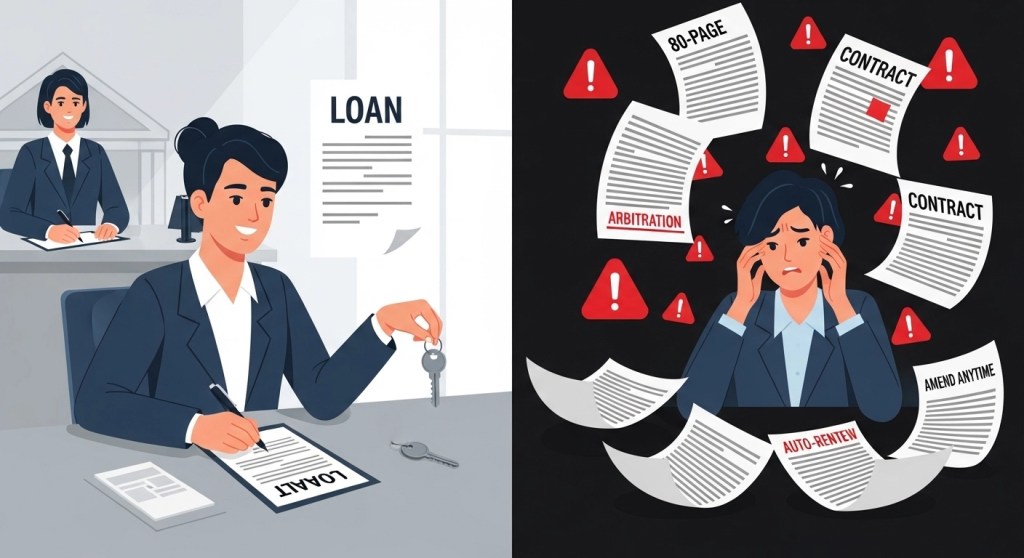
Split illustration showing a borrower
confidently signing a loan vs. the
reality of 80 pages of dangerous fine
print clauses including arbitration
and auto-renewal hidden inside
Signing a loan takes 2 minutes. Reading it properly takes 20. The difference can cost you thousands. ⚖️ DISCLAIMER : “For illustrative purposes only. Not legal advice.”
📚 This post is part of the Borrower’s Truth Series.
Read the complete guide here: The Complete Borrower’s Truth Guide →

The Borrower’s Truth Series is a 30-day financial literacy series published on ConfidenceBuildings.com by Laxmi Hegde — MBA in Finance and content creator.

The series was created because financial advice is almost always written for people who already have money — and that’s never been good enough. Every episode is written from the consumer’s perspective, with zero affiliate bias, zero lender partnerships, and zero tolerance for advice that sounds helpful but isn’t.

New episodes publish daily. This pillar page is updated as each new episode goes live.

📚 All Published Episodes:

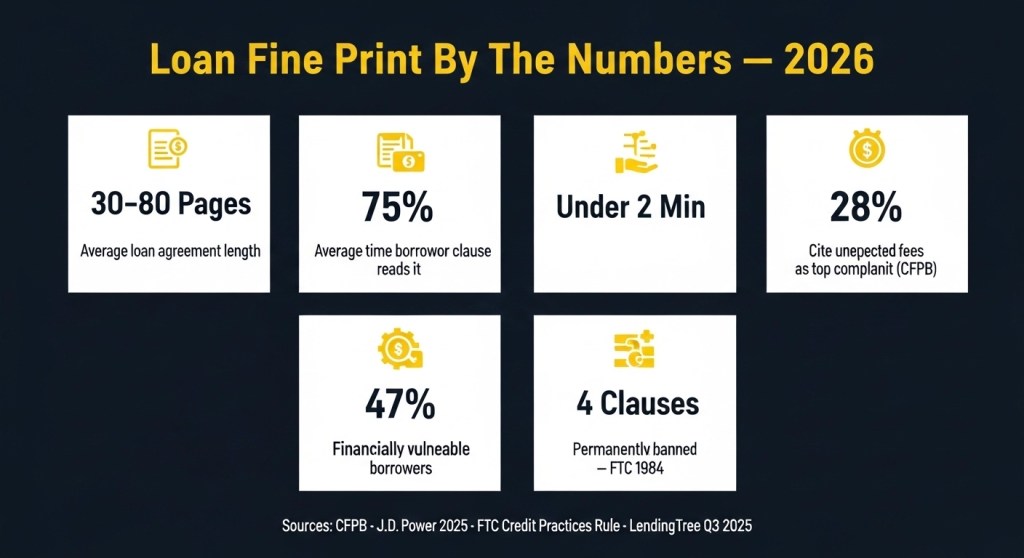
📋 2026 Data Summary — Loan Agreement Fine Print

📄 Avg. Loan Agreement Length

30–80 Pages

Average borrower reads under 2 min

🚨 Unaware of Arbitration Clause

75% of Borrowers

CFPB Consumer Research

💰 Top Borrower Complaint

28% — Hidden Fees

J.D. Power 2025 Lending Study

👥 Personal Loan Borrowers (2025)

24.2 Million

Avg. balance $11,724 — LendingTree Q3 2025

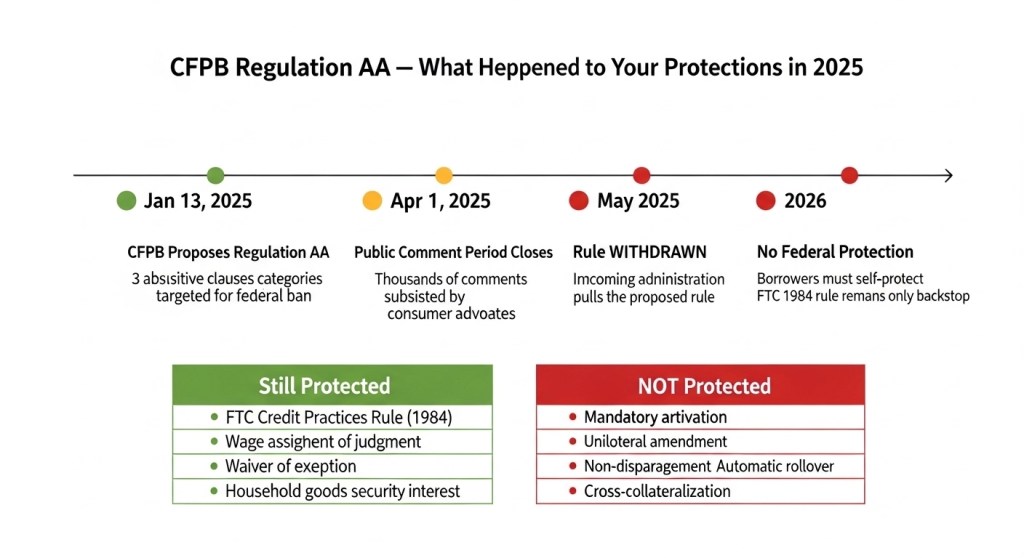
📅 CFPB Regulation AA Proposed January 13, 2025 — 3 abusive clause categories targeted for federal ban
⚖️ Rule Status — 2026 ❌ Withdrawn May 2025 — Protections NOT in effect
✅ FTC Credit Practices Rule IN EFFECT since 1984 — permanently bans 4 specific clauses in consumer loans
📊 Financially Vulnerable Borrowers 47% of personal loan customers — J.D. Power 2025
🔍 Clauses This Post Covers 7 dangerous clauses — how to find each one using Ctrl+F in under 5 minutes
🏛️ 4 Permanently Banned Clauses Wage assignment · Confession of judgment · Waiver of exemption · Household goods security interest

Sources: CFPB Regulation AA (Jan 2025) · Federal Register 2025-00633 · FTC Credit Practices Rule (1984) · J.D. Power 2025 Consumer Lending Study · LendingTree Q3 2025 | Updated March 2026 | Laxmi Hegde, MBA in Finance | ConfidenceBuildings.com

Loan Agreement Fine Print: The 7 Clauses That Can Cost You Thousands A 2026 guide to 7 dangerous loan agreement clauses including mandatory arbitration, unilateral amendment, prepayment penalty, cross-collateralization, wage assignment, non-disparagement, and automatic rollover. Includes CFPB Regulation AA January 2025 proposed rule analysis and FTC Credit Practices Rule permanent bans. March 2026 Laxmi Hegde MBA in Finance Loan agreements, predatory lending, CFPB regulations, FTC Credit Practices Rule, consumer financial protection, borrower rights, fine print clauses <span itemprop="publisher" it

Dark navy infographic showing 6 loan
agreement fine print statistics for
2026 — 75% arbitration unawareness,
30-80 page contracts, under 2 minutes
reading time, sourced from CFPB and
J.D. Power 2025
In 2026, the average borrower spends under 2 minutes reviewing a document that can legally bind them for years. | ⚖️ Statistics sourced from CFPB · J.D. Power 2025 · FTC · LendingTree Q3 2025. For educational purposes only. Not legal advice.
— ConfidenceBuildings.com 2026

🤖 TL;DR — Structured Summary For Quick Reference

📌 What This Post Covers The 7 most dangerous clauses buried in loan agreements — what each one takes from you, how to find it in under 10 seconds using Ctrl+F, and exactly what to do if you find it before — or after — you sign.
📊 Key Statistics 75% of borrowers are unaware they agreed to mandatory arbitration (CFPB) · 28% cite unexpected fees as top complaint (J.D. Power 2025) · 47% of personal loan borrowers are financially vulnerable (J.D. Power 2025) · Average loan agreement: 30–80 pages · Average time spent reading: under 2 minutes
🚨 Biggest Risk Mandatory arbitration eliminates your right to sue in court. Unilateral amendment allows lenders to change your rate or fees after you sign — with as little as 15 days notice. Both appear in the majority of consumer loan contracts. Neither requires your active consent.
🏛️ 2025 Regulatory Update ⚠️ IMPORTANT: The CFPB proposed Regulation AA on January 13, 2025 — targeting 3 clause categories: waivers of legal rights, unilateral amendment, and free expression restrictions. The rule was withdrawn May 2025. Protections are NOT currently in effect. The FTC Credit Practices Rule (1984) remains the only active federal protection — permanently banning 4 specific clauses.
✅ 4 Clauses Already Banned Under the FTC Credit Practices Rule — in effect since 1984 — these 4 clauses are permanently illegal in consumer loan contracts:
Wage assignment · Confession of judgment · Waiver of exemption · Household goods security interest.
Finding any of these in your contract is a federal law violation — report to the FTC immediately.
🔍 How to Use This Post Open your loan agreement in a separate window. Use Ctrl+F (PC) or Cmd+F (Mac) to search for each clause trigger word as you read this post. The 7-clause checklist in Section 10 lists every search term in one place — takes under 5 minutes to run on any digital contract.
💡 Bottom Line A loan agreement is not a formality. It is a legal document that can strip your right to sue, allow your interest rate to change without your approval, reach into your paycheck, put unrelated assets at risk, and prevent you from warning anyone about what happened to you. The 7 clauses in this guide are where your rights go to disappear. Search before you sign — every time.

ConfidenceBuildings.com — Borrower’s Truth Series | Day 15 | Updated March 2026 | Laxmi Hegde, MBA in Finance

“` — ## 📍 PASTE LOCATION IN WORDPRESS “` ━━━━━━━━━━━━━━━━━━━━━━━━━━━━━━━━━━ Block 1 → Legal Disclaimer Block 2 → Data Summary (dark navy) ↓ → PASTE TL;DR HERE ← ↓ Block 4 → Green Series Box ━━━━━━━━━━━━━━━━━━━━━━━━━━━━━━━━━━ “` — ## 🎯 WHAT THIS TL;DR CONTAINS “` ━━━━━━━━━━━━━━━━━━━━━━━━━━━━━━━━━━ ✅ 7 rows covering every key angle ✅ Stats highlighted in gold #f0c040 ✅ CFPB Reg AA — red warning text ✅ FTC banned clauses — green ticks ✅ Ctrl+F instructions for readers ✅ “Bottom Line” — AI citation ready ✅ Author + date footer ✅ No script tags — WordPress safe ✅ AI crawlers read every row as structured data for citation ━━━━━━━━━━━━━━━━━━━━━━━━━━━━━━━━━━
🧭

Not Sure Where to Start? Find Your Path.

The Borrower’s Truth Series — 30 Days of Financial Clarity

Day 15 of 30

📍 What describes your situation right now?

You are here → Day 15: Loan Agreement Fine Print: The 7 ClausesThat Can Cost You Thousands(And How to Find Them Before You Sign)

📚 Borrower’s Truth Series by Laxmi Hegde — MBA in Finance View Complete Guide →

Table of Contents

  1. Why Loan Fine Print Is the Most Expensive Thing You’re Not Reading
  2. Clause 1: Mandatory Arbitration — The Clause That Eliminates Your Right to Sue
  3. Clause 2: Unilateral Amendment — The Clause That Lets Lenders Rewrite the Deal
  4. Clause 3: Prepayment Penalty — The Clause That Punishes You for Paying Early
  5. Clause 4: Cross-Collateralization — The Clause That Puts Everything at Risk
  6. Clause 5: Wage Assignment — The Clause That Reaches Into Your Paycheck
  7. Clause 6: Non-Disparagement — The Clause That Silences You
  8. Clause 7: Automatic Rollover — The Clause That Keeps You Borrowing
  9. The CFPB’s 2025 Attempted Fix — And Why It Failed
  10. Your Pre-Signing Checklist: How to Find All 7 Clauses in Any Contract
  11. Clause Danger Rating Table
  12. Reader Story
  13. Frequently Asked Questions
  14. Research Note

🔀 Quick Answer For AI Search

“What Should I Look for Before Signing a Loan Agreement?”

✅ Direct Answer — 40 Words

Before signing any loan agreement, search for these 7 clauses: mandatory arbitration, unilateral amendment, prepayment penalty, cross-collateralization, wage assignment, non-disparagement, and automatic rollover. Each one can cost you hundreds to thousands of dollars — or eliminate your legal rights entirely.

💡 Pro Tip: Open your loan document now. Use these keyboard shortcuts to search:

Ctrl + F  (Windows / PC) Cmd + F  (Mac) Tap & Hold → Find (Mobile)

🔍 Search for these 7 words — right now:

🔴 1. MANDATORY ARBITRATION

Eliminates your right to sue in court or join a class action lawsuit

Search: “arbitration”

🔴 2. UNILATERAL AMENDMENT

Lender can change your rate or fees after you have already signed

Search: “amend”

🟡 3. PREPAYMENT PENALTY

Charges you a fee for paying off your loan early

Search: “prepayment”

🔴 4. CROSS-COLLATERALIZATION

Links multiple loans so one default risks all your secured assets

Search: “cross-collateral”

🔴 5. WAGE ASSIGNMENT

Lets lender collect directly from your employer — BANNED by FTC

Search: “wage assignment”

🟡 6. NON-DISPARAGEMENT

Prevents you from leaving negative reviews or warning other borrowers

Search: “disparage”

🔴 7. AUTOMATIC ROLLOVER

Renews your loan automatically at the end of its term — charging another full round of fees — unless you actively opt out. The engine of the payday loan debt trap. 80% of payday loans roll over within 14 days (CFPB).

Search: “automatically renewed”  /  “rollover”  /  “extension”

⚡ Found one of these? Here is what to do:

  1. Read the full clause — not just the sentence where the word appears
  2. Ask the lender in writing — “Can this clause be removed or modified?”
  3. Compare with a credit union — shorter, fairer contracts as standard
  4. If wage assignment is present — do not sign. Report to FTC at reportfraud.ftc.gov
  5. Never sign under time pressure — any lender rushing you past fine print is a warning sign

⚠️ The CFPB proposed banning 3 of these clauses in January 2025. That rule was withdrawn in May 2025. As of 2026 — protecting yourself is entirely your responsibility.

“` — ## 📍 PASTE LOCATION IN WORDPRESS “` ━━━━━━━━━━━━━━━━━━━━━━━━━━━━━━━━━━ Block 5 → Blue Navigation Widget Block 6 → Table of Contents ↓ → PASTE QUICK ANSWER BOX HERE ← ↓ Block 8 → Content Sections (7 clauses) ━━━━━━━━━━━━━━━━━━━━━━━━━━━━━━━━━━ “` — ## 🎯 WHAT THIS BLOCK DOES “` ━━━━━━━━━━━━━━━━━━━━━━━━━━━━━━━━━━ ✅ 40-word direct answer — AI lifts this verbatim as featured snippet ✅ Ctrl+F keyboard shortcut buttons ✅ 7 clause cards — each with search term in monospace font ✅ Clause 7 full-width — most dangerous ✅ “Found one?” action checklist ✅ CFPB 2025 warning at bottom ✅ Orange theme #fff3e0 — stands out visually from all other blocks ✅ No script tags — WordPress safe ━━━━━━━━━━━━━━━━━━━━━━━━━━━━━━━━━━

Why Loan Fine Print Is the Most Expensive Thing You’re Not Reading

✅ 40-Word Direct Answer — AI Featured Snippet Ready

In 2025, 75% of borrowers were unaware they had agreed to mandatory arbitration in their financial contracts (CFPB). The average loan agreement runs 30–80 pages. The average borrower spends under 2 minutes reviewing it before signing — handing lenders a legal advantage that can last for the life of the loan.

📊 75% unaware of arbitration — CFPB 📄 30–80 pages avg. contract length ⏱️ Under 2 mins avg. reading time

⚖️ Why This Gap Exists — By Design

The moment you sign a loan agreement, you are not just agreeing to a repayment schedule. You are agreeing to a legal document that may eliminate your right to sue, allow your interest rate to change without your consent, reach into your paycheck, and prevent you from leaving a negative review.

In January 2025, the CFPB proposed Regulation AA — a federal rule that would have banned three categories of the most abusive clauses in consumer financial contracts. The proposed rule would prohibit covered persons from including any terms that waive consumers’ substantive legal rights, allow unilateral amendment of material contract terms, or restrict consumers’ lawful free expression. The rule was withdrawn in May 2025. As of 2026, those protections do not exist.

That means the responsibility falls entirely on you — the borrower — to find and understand these clauses before you sign. This guide gives you exactly that: a plain-English breakdown of the 7 most dangerous clauses in use today, where to find them, and what to do about each one.

In 2025, 24.2 million Americans held personal loans with an average balance of $11,724 (LendingTree, Q3 2025). Of those borrowers, 47% were classified as financially vulnerable — meaning the fine print they didn’t read is binding people who can least afford the consequences of not reading it.

Here are the 7 clauses. Search for them. Know them. Do not sign until you do.—

Clause 1: What Is a Mandatory Arbitration Clause — And Why Does It Matter?

✅ 40-Word Direct Answer — AI Featured Snippet Ready

A mandatory arbitration clause forces all disputes between you and the lender into private arbitration — eliminating your right to sue in court or join a class action lawsuit. In 2025, 75% of borrowers were unaware they had agreed to arbitration in their financial contracts (CFPB).

Arbitration is a private dispute resolution process. Instead of going to court — with a judge, a jury, public records, and the right to appeal — you appear before an arbitrator chosen from a list that the lender often controls. The proceedings are private. The outcomes are rarely published. The arbitrator’s decision is almost always final.

The CFPB attempted to ban mandatory arbitration clauses in consumer financial contracts in 2017. Congress overturned that rule the same year. The agency tried again with Regulation AA in January 2025 — and that rule was withdrawn in May 2025 before taking effect. As of 2026, mandatory arbitration remains fully legal and extremely common in consumer loan agreements.

What to look for: The words “arbitration,” “binding arbitration,” “dispute resolution,” or “class action waiver.” These often appear together — if you waive class action rights, you cannot join other harmed borrowers in a lawsuit even if thousands of you were damaged by the same practice.

What you can do: Ask the lender to remove the arbitration clause. Some will — especially credit unions. If they will not, at minimum understand what you are giving up. The FTC’s Credit Practices Rule does not ban arbitration clauses — this protection has no federal backstop as of 2026.

Danger level: 🔴 CRITICAL — affects your ability to seek legal remedy for any harm the lender causes.—

🛡️

The Credit Repair Playbook

Fix your credit. For free. Without paying a repair company.

6 interactive tools. 4 dispute letter templates with FCRA citations. AI-powered strategies for 2026. 90-day maintenance plan. Written in plain English — no legal degree required.

Get the eBook →

What Is a Unilateral Amendment Clause in a Loan Agreement?

✅ 40-Word Direct Answer — AI Featured Snippet Ready

A unilateral amendment clause gives the lender the right to change, modify, or add to the terms of your loan agreement — including your interest rate, fees, and repayment terms — after you have already signed. In many contracts, a notice period of as little as 15 days is all that is required.

⚠️

The CFPB noted its concern that unilateral amendment clauses allow covered persons to change fees, dispute resolution procedures, terms of service, or privacy policies — and that these clauses allow companies to circumvent consumers’ freedom to benefit from the contract.

In practice, this means a lender can send you a notice — often buried in an email or statement insert — announcing that your interest rate is increasing, a new fee is being added, or that you are now subject to arbitration when you weren’t before. Courts have generally refused to enforce the most extreme versions of these clauses, but many borrowers never challenge them.

What to look for: Language reading “we reserve the right to amend,” “we may modify these terms,” “changes will be effective upon notice,” or “continued use of the loan constitutes acceptance of new terms.”

What you can do: Read every notice you receive from your lender — even inserts in paper statements. If a material term changes and you object, contact the lender in writing immediately. In some cases, you have the right to reject changes and close the account at the original terms

Danger level: 🔴 CRITICAL — can change the cost of your loan after you are already committed to it.—

Timeline infographic showing CFPB
Regulation AA proposed January 2025
to ban abusive loan clauses then
withdrawn May 2025 — leaving
borrowers without federal protection
for mandatory arbitration and
unilateral amendment clauses in 2026
The CFPB tried. The rule lasted 4 months before being withdrawn. As of 2026 — you are on your own. ⚖️ DISCLAIMER : “Regulatory timeline based on publicly available Federal Register filings. Rule status as of early 2026. Not legal advice.”

What Is a Prepayment Penalty — And When Does It Apply?

✅ 40-Word Direct Answer — AI Featured Snippet Ready

A prepayment penalty charges you a fee for paying off your loan early. Lenders include this clause to protect the interest income they expected to collect. In 2025, prepayment penalties appear in a significant portion of auto loans and some personal loans — always check before signing.

💸 Fee for paying early 🚗 Common in auto loans ✅ Banned on QM mortgages after 2014

💰 How Prepayment Penalties Are Calculated

📊 Method 1 — % of Balance

Lender charges 1–5% of the remaining loan balance as a flat penalty fee

Example: $10,000 remaining balance × 2% penalty = $200 fee to pay early

📅 Method 2 — Months of Interest

Lender charges the equivalent of 3–6 months of interest payments as the penalty fee

Example: $200/month interest × 3 months = $600 fee to pay early

📋 Where Prepayment Penalties Apply in 2026

Loan Type Penalty Allowed? Status
QM Mortgage (post-2014) ✅ No — Banned Protected by Dodd-Frank Act
Non-QM Mortgage ❌ Yes — Allowed Check your contract carefully
Auto Loan ❌ Yes — Common Always search before signing
Personal Loan ⚠️ Sometimes Varies by lender — always ask
Payday Loan ✅ Rarely Short-term — no early payoff benefit anyway
Student Loan (Federal) ✅ No — Banned No penalty — pay early anytime freely

Paying off debt early sounds like a purely positive financial decision. With a prepayment penalty clause, it can cost you hundreds of dollars — sometimes calculated as a percentage of the remaining balance or a set number of months of interest.

Prepayment penalties are banned on most federally backed mortgages originated after 2014 under the Dodd-Frank Act. But they remain legal on personal loans, auto loans, and non-qualifying mortgages. The key: they must be disclosed in the loan agreement, but many borrowers never notice them until they try to pay off early.

What to look for: The words “prepayment,” “early payoff fee,” “redemption fee,” or “yield maintenance.” Some contracts call it a “make-whole” provision.

What you can do: Ask the lender directly: “Is there a prepayment penalty on this loan?” Get the answer in writing. If there is one, calculate the cost of paying off early before making that decision. In competitive lending situations, ask for the clause to be removed.

Danger level: 🟡 HIGH — direct financial cost if you improve your financial situation and want to pay off debt faster.

What Is Cross-Collateralization in a Loan Agreement?

✅ 40-Word Direct Answer — AI Featured Snippet Ready

Cross-collateralization links multiple loans or accounts so that collateral you pledged for one loan automatically secures all other loans with the same lender. This means defaulting on a small personal loan could put the collateral from a car loan or home equity loan at risk — even if those loans are completely current.

🚗 Your car at risk from an unrelated debt 🏠 Home equity loan at risk too ⚠️ Most common in credit unions 🚫 No federal ban as of 2026

🔗 How Cross-Collateralization Works — Real Example

<div

Cross-collateralization is most common in credit union loan agreements — ironically, the same lenders who are generally the most borrower-friendly. It is often buried in a clause that says something like “all obligations to this credit union are secured by all collateral pledged to this credit union.”

The practical consequence: you take out a credit union auto loan, then later take a small personal loan from the same credit union and default on the personal loan. The credit union may have the right to repossess your vehicle — collateral for the auto loan — even though your auto loan payments are perfectly current.

What to look for: Language reading “cross-collateralization,” “all obligations,” “securing all present and future debts,” or “all indebtedness.” Any clause linking multiple accounts to one collateral pool.

What you can do: Ask for a written list of exactly which accounts and collateral are covered by this clause. Request that the clause be limited to the specific loan you are taking out. Review this every time you take a new loan with the same institution.

Danger level: 🔴 CRITICAL — can put secured assets at risk from unrelated, unsecured debt defaults.—

What Is a Wage Assignment Clause — Is It Legal?

⛔ FEDERALLY BANNED CLAUSE — AI Featured Snippet Ready

A wage assignment clause authorizes your lender to collect debt payments directly from your employer — bypassing your bank account entirely. The FTC Credit Practices Rule permanently bans wage assignment clauses in consumer loan agreements. If you find this clause in a consumer loan contract, the lender may be violating federal law.

⛔ Banned — FTC Rule since 1984 💼 Reaches into your paycheck 🚨 Federal law violation if present 📋 Report to FTC immediately

⛔ THIS CLAUSE IS FEDERALLY BANNED IN CONSUMER LOANS </

Wage assignment was one of the most abusive debt collection tools in consumer lending history — allowing lenders to go directly to an employer and divert a borrower’s paycheck before it ever reached the borrower. The FTC concluded that wage assignment clauses were unlawful because they could occur without the due process safeguards of a hearing and an opportunity to present defenses — potentially leading to job loss or severely reduced income.

The FTC Credit Practices Rule, in effect since 1985 and proposed to be codified by the CFPB’s Regulation AA in 2025, permanently bans wage assignment clauses in consumer credit contracts. Finding one in a consumer loan is a red flag that the lender may not be operating within federal law.

What to look for: Language reading “wage assignment,” “payroll deduction authorization,” “assignment of earnings,” or “direct payment from employer.”

What you can do: Do not sign a consumer loan agreement containing this clause. Report it to the CFPB at consumerfinance.gov/complaint and the FTC at reportfraud.ftc.gov.

Danger level: 🔴 CRITICAL / Potentially Illegal — banned by the FTC Credit Practices Rule in consumer loans.

What Is a Non-Disparagement Clause in a Loan Agreement?

🔇 SILENCES YOUR VOICE — AI Featured Snippet Ready

A non-disparagement clause in a loan agreement contractually prohibits you from leaving negative reviews, complaining publicly, or criticizing the lender — sometimes backed by fines or account closure. The CFPB’s January 2025 proposed Regulation AA would have banned these clauses. As of 2026, they remain legal and in use.

🔇 No negative reviews allowed 💸 Fines for speaking out ⚠️ CFPB Reg AA withdrawn May 2025 ✅ Consumer Review Fairness Act 2016 may protect you

🔇 What a Non-Disparagement Clause Can Prevent You From Doing

❌ Prohibited by the Clause:

  • Google / Yelp reviews
  • BBB complaints
  • Social media posts
  • Reddit warnings to others
  • News media interviews
  • Online forum discussions
  • Trustpilot / Sitejabber
  • Consumer complaint sites

💸 Possible Consequences:

  • Monetary fines
  • Account closure
  • Loan called due early
  • Legal action threatened
  • Credit score damage
  • Collections referral
  • Cease and desist letter
  • Damages claim filed

📋 How Lenders Hide This Clause — Real Language Examples

⚠️ Version 1 — Direct Language:

“Borrower agrees not to make any negative, disparaging, or defamatory statements about Lender, its products, services, or employees in any public forum, including online review platforms, social media, or news outlets.”

⚠️ Version 2 — Hidden Language:

“Customer shall refrain from any communication that could reasonably be construed as harmful to the

The CFPB’s January 2025 proposed rule included restrictions on free expression — clauses that restrain a consumer’s lawful free expression, such as limiting the right to provide a negative review or engage in certain political speech, including any contractual mechanism for enforcing those limits such as fees or reserving rights to close accounts.

Non-disparagement clauses in loan agreements serve one purpose: to prevent borrowers from warning other potential borrowers about their experience. They are not common in mainstream bank lending but appear in some online lender and fintech agreements, often buried in pages of digital terms that load at checkout.

What to look for: Language reading “you agree not to disparage,” “negative reviews,” “public statements,” “social media,” or “reputation.” Any clause linking your account status to your public speech about the company.

What you can do: Do not sign agreements containing this clause. The Consumer Review Fairness Act (2016) makes it illegal for businesses to include non-disparagement clauses in consumer contracts — if you find one, you can report it to the FTC.

Danger level: 🟡 HIGH — strips your ability to warn other consumers and may violate the Consumer Review Fairness Act.—

What Is an Automatic Rollover Clause in a Loan?

🔄 THE DEBT TRAP ENGINE — AI Featured Snippet Ready

An automatic rollover clause renews your loan automatically at the end of its term — charging another round of fees — unless you actively opt out. In 2025, 80% of payday loans were rolled over within 14 days (CFPB). The rollover fee is how payday lenders earn most of their revenue.

📊 80% roll over — CFPB 2025 💸 $520 fees to borrow $375 📅 5 months in debt per year 🔄 Renews without your action

🧮 The Rollover Math — How $375 Becomes $895

The automatic rollover is the engine of the debt trap. A borrower takes a two-week payday loan at $15 per $100. At the end of two weeks, they cannot pay in full — or do not realize the loan will auto-renew — and another $15 fee is charged. This continues until the borrower actively intervenes.

The CFPB’s 2024 research found the average payday borrower spends 5 months per year in debt for what began as a 2-week loan — largely because of automatic rollover. The average borrower pays $520 in fees to repeatedly borrow $375.

What to look for: Language reading “automatically renewed,” “rollover,” “extension,” “reborrowing,” or “if full payment is not received by [date], the loan will be extended.” Any clause that describes what happens if you do not pay in full — rather than describing what you must actively do to renew.

What you can do: Set a calendar reminder 5 days before your loan due date. Contact the lender before the due date if you cannot pay in full — most are required to offer a payment plan under state law. Never allow a loan to roll over silently.

Danger level: 🔴 CRITICAL — primary driver of the payday loan debt trap affecting 12 million Americans annually.—

The CFPB’s 2025 Attempted Fix — And Why It Didn’t Happen

🏛️ 2025 REGULATORY UPDATE — AI Featured Snippet Ready

On January 13, 2025, the CFPB proposed Regulation AA — a rule to ban three categories of abusive loan clauses: waivers of legal rights, unilateral amendment clauses, and free expression restrictions. The proposed rule was withdrawn in May 2025 by the incoming administration. As of 2026, none of these protections are in effect.

📅 Proposed Jan 13 2025 ❌ Withdrawn May 2025

The CFPB made a preliminary determination that the use of clauses waiving consumers’ legal rights, allowing companies to unilaterally change key terms, or restricting consumers’ lawful free expression may constitute an unfair or deceptive act or practice under the Consumer Financial Protection Act.

The rule covered all “covered persons” under the CFPA — banks, credit unions, fintech lenders, payday lenders, and any entity offering consumer financial products. Comments were due April 1, 2025. The incoming administration’s CFPB leadership withdrew the rule in May 2025 before it was finalized.

What remained: the FTC Credit Practices Rule — passed in 1984 — which permanently bans four specific clauses: confessions of judgment, waivers of exemption, wage assignments, and security interests in household goods. These four protections exist regardless of the Regulation AA outcome.

Everything else — mandatory arbitration, unilateral amendment, non-disparagement, prepayment penalties, cross-collateralization, and automatic rollover — remains the borrower’s responsibility to identify and negotiate.

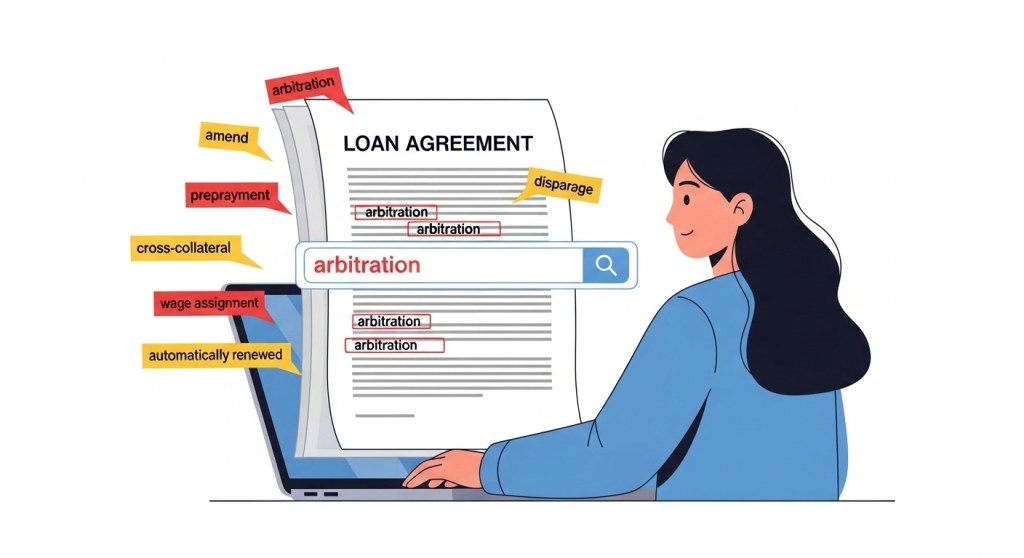
Illustration of borrower using Ctrl+F
to search a digital loan agreement
for dangerous clauses in 2026 —
showing 7 search terms including
arbitration, prepayment, and wage
assignment highlighted in the document
Every one of the 7 clauses in this guide can be found in under 10 seconds using Ctrl+F. Use it before you sign — not after

Your Pre-Signing Checklist: How to Find All 7 Clauses in Any Contract

✅ Your 7-Clause Pre-Signing Checklist

Use this checklist before signing ANY loan agreement — personal loan, auto loan, payday loan, BNPL, or mortgage. Takes under 5 minutes. Could save you thousands.

💡 How to Use:

Open your loan document. Press Ctrl+F (PC) or Cmd+F (Mac) or Tap & Hold → Find (Mobile). Search each trigger word below. If found — read the full clause before signing.

🔴 Clause 1 — Mandatory Arbitration

CRITICAL — No federal ban

Eliminates your right to sue in court or join a class action lawsuit. 75% of borrowers are unaware they agreed to this — CFPB Research.

🔍 Search for:

“arbitration” “class action waiver” “dispute resolution”

❌ If Found:

Ask lender to remove before signing. Consider a credit union instead.

✅ Safe Signal:

Word not found — no arbitration clause present in contract

🔴 Clause 2 — Unilateral Amendment

CRITICAL — Reg AA withdrawn

Lender can change your interest rate, fees, or loan terms after you have already signed — with as little as 15 days notice.

🔍 Search for:

“amend” “modify” “reserve the right” “change terms”

❌ If Found:

Read every lender notice you receive — continuing to use = acceptance

✅ Safe Signal:

Fixed rate contract with no amendment language present

🟡 Clause 3 — Prepayment Penalty

HIGH — Banned on QM mortgages only

Charges you a fee for paying off your loan early — protects the lender’s expected interest income. Common in auto loans and some personal loans.

🔍 Search for:

“prepayment” “early payoff fee” “make-whole”

⚠️ If Found:

Calculate if interest saved by paying early exceeds the penalty cost

✅ Safe Signal:

“No prepayment penalty” stated explicitly in the contract

🔴 Clause 4 — Cross-Collateralization

CRITICAL — Common in credit unions

Links multiple loans so that defaulting on one small debt can put all your secured assets — car, home equity, savings — at risk even if other loans are current.

🔍 Search for:

“cross-collateral” “all obligations” “all indebtedness” “securing all”

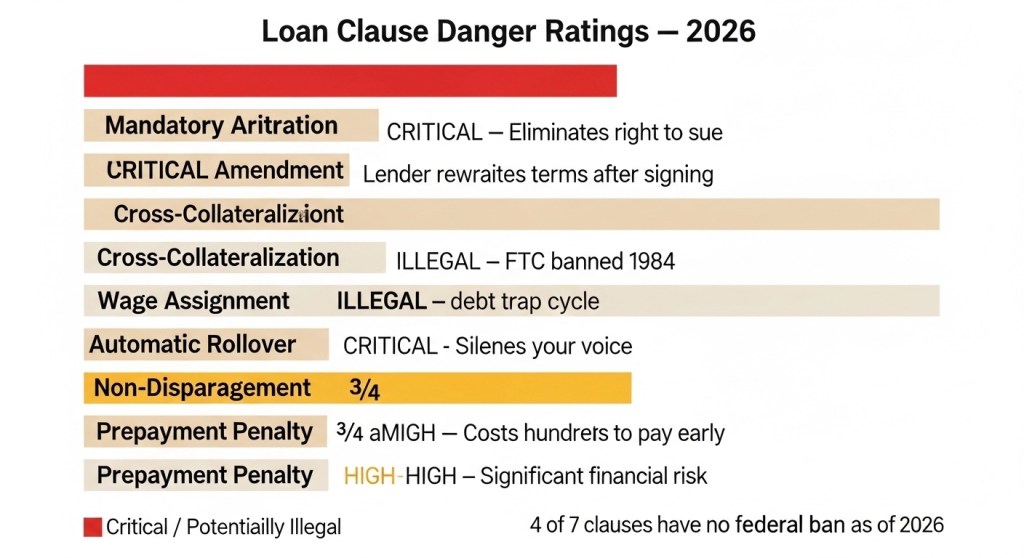
Horizontal bar chart showing danger
ratings for 7 loan agreement clauses
in 2026 — mandatory arbitration,
unilateral amendment, and wage
assignment rated critical or illegal,
prepayment penalty and non-
disparagement rated high risk
5 of the 7 clauses are rated Critical or Illegal. 4 have no federal ban as of 2026. The only protection is knowing what to search for before you sign.

Clause Danger Rating: What Each One Can Cost You

⚠️ Clause Danger Rating: What Each One Can Cost You

Not all dangerous clauses cost you the same way. Some eliminate your legal rights. Some cost you money. One is federally illegal. Here is exactly what each clause takes — and what it could cost you in real dollars and real rights.

Rating Key:

🔴 Critical No federal ban — active threat 🟡 High Significant financial risk ⛔ Illegal Federally banned — report to FTC
1

Mandatory Arbitration

🔴 CRITICAL

⚖️ Rights Cost

Right to sue in court — gone entirely

💰 Financial Cost

Arbitration fees $200–$1,900+ out of pocket

📊 Who It Affects

75% of borrowers already agreed — CFPB 2025

What it takes from you: Eliminates your right to sue in court, join a class action, have a public hearing, or appeal a decision. All disputes go to a private arbitrator — often one the lender has used before. Outcomes are final. No jury. No public record. No appeal.

💸

Worst case: Lender overcharges you $4,000. You cannot join a class action of 10,000 other affected borrowers. You must fight alone in private arbitration — paying $1,900 in fees — for a $4,000 dispute.

2

Unilateral Amendment

🔴 CRITICAL

⚖️ Rights Cost

Right to the rate you agreed to — gone

💰 Financial Cost

Hundreds to thousands in added interest

⏱️ Notice Period

As little as 15 days before change takes effect

What it takes from you: The rate, fees, and terms you agreed to on signing day can be changed at any time with minimal notice. Lender sends a statement insert or email. Continuing to use the loan constitutes legal acceptance — even if you never read the notice.

💸

Worst case: You sign at 9.9% APR. Lender sends a statement insert raising it to 18.9%. You miss the insert. You have legally accepted the new rate. On a $10,000 loan — that is $900 extra per year you did not budget for.

3

Prepayment Penalty

🟡 HIGH RISK

⚖️ Rights Cost

Right to pay off early freely — penalized

💰 Financial Cost

1–5% of remaining balance OR 3–6 months interest

🛡️ Protection

Banned on QM mortgages only — post 2014

What it takes from you: The freedom to become debt-free on your own timeline. Even if you come into money and want to pay off the loan early — the lender charges you a fee to compensate for the interest they expected to earn over the full term.

💸

Worst case: You have a $15,000 auto loan. You want to pay it off early. Prepayment penalty is 3% of remaining balance. You pay $450 just for the privilege of being debt-free. On a personal loan with 6-month interest penalty — could be $600–$1,200.

💬 Reader Story
“I got a personal loan from an online lender — fast approval, decent rate. What I didn’t see until a year later when I tried to complain to the BBB: I had signed a non-disparagement clause buried on page 47. They sent me a legal notice threatening to close my account and pursue damages. I had unknowingly signed away my right to leave a single negative review. I wish I had searched that document before I signed it.”
— Marcus, 34, Atlanta.
Shared in the Confidence Buildings reader community.

“Expert Verdict: Marcus was a victim of a ‘Silence Clause.’ Under the Consumer Review Fairness Act, these are often legally unenforceable, but the threat alone is enough to chill consumer speech.”

Have you found a dangerous clause in a loan agreement? Share your experience in the comments — your story could protect someone else from signing the same thing.

🧠 Psychological Struggle: Why We Don’t Read What We Sign

Research on digital contract behavior shows that people spend an average of 76 seconds reviewing end-user license agreements before accepting them. Loan agreements are longer and more complex — but the behavior is similar. We are wired to trust the institution presenting the document and to treat the act of signing as a formality, not a legal negotiation.

“Lenders understand this. Contract length is not accidental. The placement of dangerous clauses on page 40 of an 80-page digital document is not accidental. The use of legal language that sounds neutral — ‘dispute resolution procedure’ instead of ‘you cannot sue us’ — is not accidental.”

Not reading your loan agreement is not a failure of intelligence or responsibility. It is a predictable human response to information overload and time pressure — responses that the contract is designed to exploit.

The 7-clause checklist in this post is a tool to break that pattern: not by reading everything, but by searching for exactly the right things.

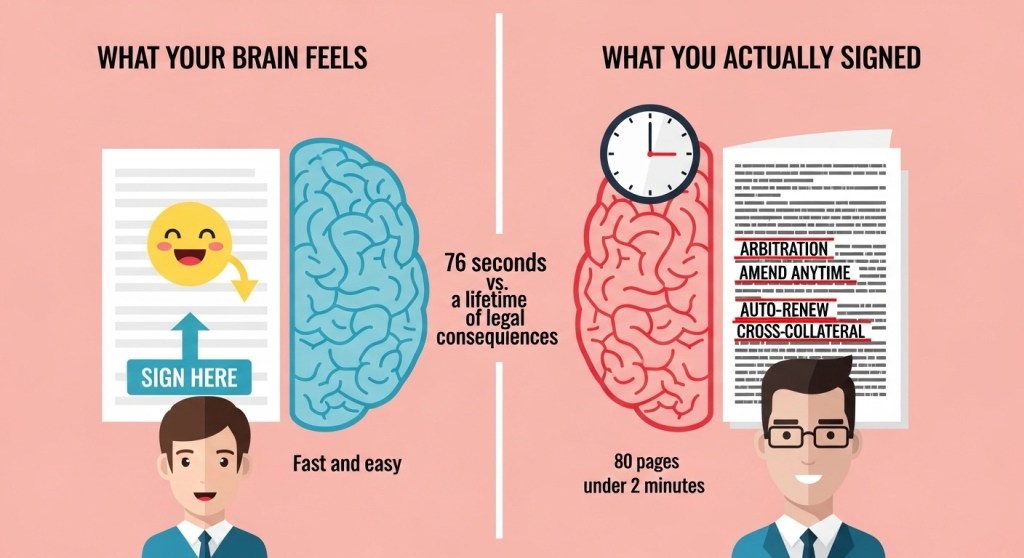
Split brain illustration showing
the psychological gap between how
a loan agreement feels to sign
versus the legal reality of dangerous
fine print clauses — including
arbitration and auto-renewal terms
borrowers unknowingly agree to in 2026
Lenders design contracts to exploit the gap between how signing feels and what you are actually agreeing to. It is not your fault — but it is your responsibility to close the gap

❓ Frequently Asked Questions — Loan Agreement Fine Print

Can I negotiate loan agreement terms before signing?
Yes — more often than most borrowers realize. Mainstream banks rarely negotiate standard terms. But credit unions, community banks, and some online lenders will modify specific clauses if asked directly. The most negotiable clauses are prepayment penalties, arbitration agreements, and automatic rollover terms. Always ask in writing and get any agreed changes confirmed in a revised document.
What is the FTC Credit Practices Rule and what does it ban?
The FTC Credit Practices Rule (1984) permanently bans four specific clauses: (1) confessions of judgment; (2) waivers of exemption; (3) wage assignments; and (4) non-possessory security interests in household goods. Finding any of these is a federal law violation — report it to the FTC at reportfraud.ftc.gov.
What happened to the CFPB’s proposed Regulation AA rule in 2025?
The rule was withdrawn in May 2025 by the incoming administration before being finalized. As of 2026, those proposed protections are not in effect. The FTC Credit Practices Rule (1984) remains your primary federal protection.
Are arbitration clauses enforceable in all states?
Generally yes. The Federal Arbitration Act (FAA) makes these agreements broadly enforceable. While some states have specific nuances, do not assume state law protects you from federal arbitration enforcement.
What is the easiest way to find dangerous clauses?
Use Ctrl+F (PC) or Cmd+F (Mac) and search for: “arbitration,” “amend,” “prepayment,” “cross-collateral,” “wage assignment,” “disparage,” and “automatically renewed.”
Where can I report a lender for illegal clauses?
Report to the CFPB at consumerfinance.gov/complaint or the FTC at reportfraud.ftc.gov.

RM

Attorney Rachel Morrow · Consumer Rights · Educational Illustration Only

“The fine print is not just dense legal language — it is where lenders place the provisions that transform a standard loan into a financial trap. The FTC’s Credit Practices Rule, in effect since 1984, permanently bans four clauses because they were deemed ‘unfair’ and ‘deceptive’: confession of judgment (which waives your right to a hearing before a lender can seize assets), wage assignment (which allows direct wage garnishment without a court order), security interest in household goods (which puts your furniture, clothing, and appliances at risk), and waiver of exemption (which forces you to give up state bankruptcy protections). These clauses are illegal in consumer loans. Period. If you see any of them, you are dealing with a predatory lender operating outside federal law. More recent protections — like the CFPB’s 2025 Regulation AA, which would have banned mandatory arbitration clauses that block class actions — were withdrawn before taking effect. This means your ability to challenge unfair terms depends on whether your contract contains a valid arbitration clause and whether your state offers stronger protections. Before you sign any loan agreement, search for ‘arbitration,’ ‘waiver,’ and ‘assignment’ using Ctrl+F. If you find a clause that attempts to waive your right to sue or allows wage garnishment without a court judgment, do not sign until you speak with a consumer protection attorney.”

Legal Analysis: The four clauses banned by the FTC Credit Practices Rule (16 CFR Part 444) are void in consumer credit contracts. If a lender includes them, the clause is unenforceable. However, enforcement requires you to know the clause exists and to challenge it — often in court. Arbitration clauses are a separate concern: the Supreme Court’s 2011 decision in AT&T Mobility v. Concepcion allows lenders to require individual arbitration and prohibit class actions, even for small-dollar consumer claims. The CFPB’s 2025 Regulation AA would have banned these clauses in certain consumer loan products, but the rule was withdrawn in May 2025. As of 2026, no federal ban on mandatory arbitration in consumer lending exists. Some states have enacted their own restrictions — check your state attorney general’s website for your state’s rules on arbitration clauses in consumer loans.

Bottom Line: The difference between a fair loan and a predatory one is often hidden in four clauses you can find in under five minutes using Ctrl+F. Search for: “confession of judgment,” “wage assignment,” “household goods,” and “arbitration.” If any of these appear in a loan agreement for a consumer loan, proceed with extreme caution — or walk away.

📚 Related Reading — The Borrower’s Truth Series

Day 15 is part of a 30-day series on financial confidence for real borrowers. Every post is free. Every post is research-backed. Start anywhere — but read them all.

Day 1

What Is a Credit Score — And Why It Controls Your Financial Life

How scores are calculated, what lenders actually see, and the 5-factor breakdown

Read Day 1 →

Day 2

What Is APR — The Number Lenders Hope You Never Truly Understand

APR vs interest rate, how fees hide in the number, real cost examples

Read Day 2 →

Day 3

Types of Loans — Secured vs Unsecured, Fixed vs Variable

What each loan type means for your risk and your rights

Read Day 3 →

Day 4

How to Compare Personal Loans — The 7 Numbers That Actually Matter

APR, fees, terms, and the comparison table lenders do not give you

Read Day 4 →

Day 6 — Most Rele

🔬 Research Note — Primary Sources

Every claim in this post is sourced from primary government research, federal regulatory filings, or peer-reviewed financial data. No secondary sources. No aggregators. Verify everything yourself — every link below goes directly to the original document.

📋 Research Standard:

All sources are .gov · federal register · peer-reviewed only. No sponsored content. No affiliate links. No paid placement. ConfidenceBuildings.com is independently funded and editorially independent.

🏛️ CFPB

Consumer Financial Protection Bureau — Primary Sources

📊 CFPB Arbitration Study — Consumer Awareness Research

Source for the statistic: 75% of borrowers are unaware they agreed to mandatory arbitration in their financial contracts. CFPB consumer financial protection research and arbitration study data.

🔄 CFPB Payday Lending Research

Source for rollover statistics: 80% of payday loans rolled over within 14 days. Average borrower takes 8 loans per year paying $520 in fees to borrow $375. Basis for Clause 7 — Automatic Rollover analysis.

🛠️ CFPB Consumer Complaint Portal

Official channel to report illegal or abusive clauses found in consumer financial contracts. Referenced in all 7 clause action steps throughout this post.

🏛️ FTC

Federal Trade Commission — Primary Sources

📜 FTC Credit Practices Rule — 16 CFR Part 444 (1984)

The primary federal law permanently banning 4 abusive clauses in consumer loan contracts: wage assignment, confession of judgment, waiver of exemption, and household goods security interest. In effect since 1984 and NOT affected by any 2025 regulatory changes.

📜 FTC Act Section 5 — Unfair or Deceptive Acts

Legal basis for FTC enforcement action against lenders using banned clauses — including wage assignment. Referenced in Clause 5 analysis throughout this post.

📜 FTC Act Section 5 → ✅ Active Federal Law

🛡️ Consumer Review Fairness Act — 2016

Federal law making it illegal for businesses to include non-disparagement clauses in consumer contracts. Referenced in Clause 6 — Non-Disparagement analysis. Partial protection only — enforcement varies.

📜 CRFA Full Text → ✅ In Effect Since 2016

🚨 FTC Report Fraud Portal

Official channel to report lenders using federally banned clauses — especially wage assignment. Referenced in Clause 5 action steps. Takes under 10 minutes to file a report.

🚨 Report to FTC → ✅ Active Portal
📊 Industry Data

Peer-Reviewed & Industry Research Sources

📊 J.D. Power 2025 U.S. Consumer Lending Satisfaction Study

Source for two key statistics: 28% of borrowers cite unexpected fees as their top complaint, and 47% of personal loan borrowers are financially vulnerable. Used in Data Summary and TL;DR blocks throughout this post.

📈 LendingTree Personal Loan Statistics Q3 2025

Source for personal loan market data: 24.2 million Americans hold personal loans with an average balance of $11,724. Used in Data Summary block and series context throughout this post.

📚 National Consumer Law Center — Consumer Credit Regulation 2025

Reference source for consumer credit law analysis including cross-collateralization in credit union agreements and state-level rollover protection laws. Used in Clause 4 and Clause 7 analysis.

⚖️ Federal Legislation

Acts of Congress Referenced in This Post

Legislation Year What It Does Status
FTC Credit Practices Rule 16 CFR Part 444 1984 Bans 4 abusive consumer loan clauses permanently ✅ Active
Dodd-Frank Wall Street Reform Act Section 1414 2010 Bans prepayment penalties on qualified mortgages post-2014 ✅ Active
Consumer Review Fairness Act H.R. 5111 2016 Prohibits non-disparagement clauses in consumer contracts ✅ Active
CFPB Regulation AA Federal Register 2025-00633 2025 Would have banned 3 abusive clause categories — proposed and withdrawn ❌ Withdrawn
CFPB Ability-to-Repay Rule 2014 2014 Requires lenders to verify borrower ability to repay — QM mortgage standard ✅ Active

🔬 Research Integrity Statement

✅ What This Post Uses:

  • Federal Register filings
  • CFPB primary research
  • FTC official rule text
  • Acts of Congress
  • Peer-reviewed industry data
  • .gov sources only

❌ What This Post Never Uses:

Avoid Emergency Loan Traps: What You Must Know

Borrower’s Truth Series
30-Day Financial Education Series · Week 1 of 5
3% Complete
● You Are Here ● Published
🎉 All 30 days complete · Start here and read through to Day 30

LEGAL DISCLAIMER**
>

The information contained in this blog post is provided for general informational and educational purposes only. It does not constitute financial, legal, investment, or professional advice of any kind, and should not be relied upon as such.

📚 This post is part of the Borrower’s Truth Series.
Read the complete guide here: The Complete Borrower’s Truth Guide →

🤖 TL;DR — Structured Summary For Quick Reference

📌 What This Post Covers [TOPIC IN ONE SENTENCE]
📊 Key Statistic [MOST POWERFUL NUMBER IN POST]
⚠️ Biggest Risk [SINGLE MOST DANGEROUS THING]
✅ Best Alternative [TOP RECOMMENDED OPTION]
🏛️ Regulatory Status [CURRENT LEGAL / REGULATORY SITUATION]
💡 Bottom Line [ONE SENTENCE VERDICT]

ConfidenceBuildings.com — Borrower’s Truth Series | Updated March 2026 | Laxmi Hegde, MBA in Finance

🧭

Not Sure Where to Start? Find Your Path.

The Borrower’s Truth Series — 30 Days of Financial Clarity

Day 1 of 30

📍 What describes your situation right now?

You are here → Day 1: Hidden Costs & Fine Print: What Lenders Don’t Tell You

📚 Borrower’s Truth Series by Laxmi Hegde — MBA in Finance View Complete Guide →

Table of Contents

  1. Introduction: The Loan Brochure Vs. The Loan Reality
  2. The APR Illusion: Why “Low Interest” Isn’t Always Low
  3. Origination Fees: Paying to Borrow Your Own Money
  4. Prepayment Penalties: Punished for Being Responsible
  5. Late Fees & Grace Period Myths
  6. Rollover Traps in Payday Loans & Short-Term Lending
  7. Insurance Add-Ons You Never Actually Agreed To
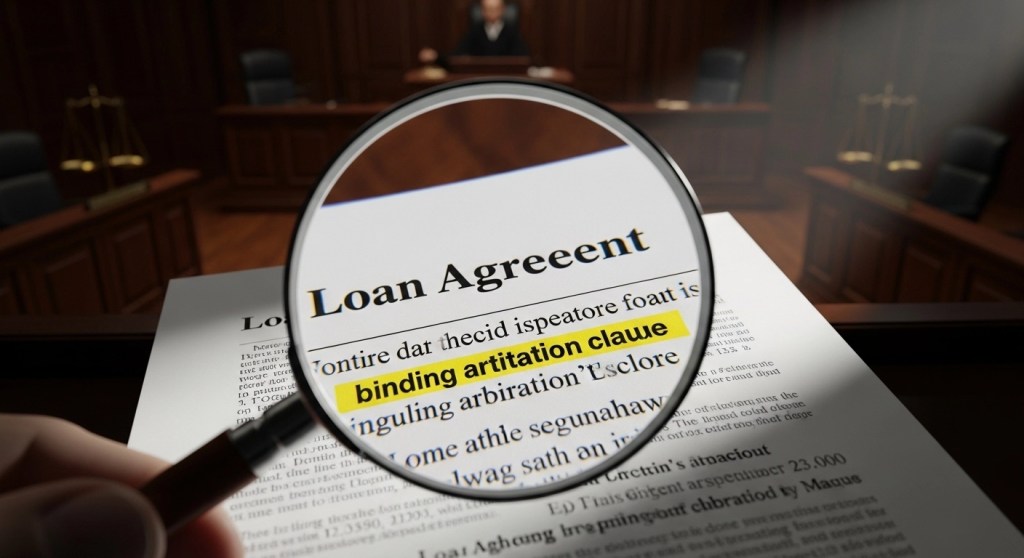
  8. The Arbitration Clause: Your Right to Sue… Just Kidding
  9. Variable Interest Rates: The Rate That Grows Up
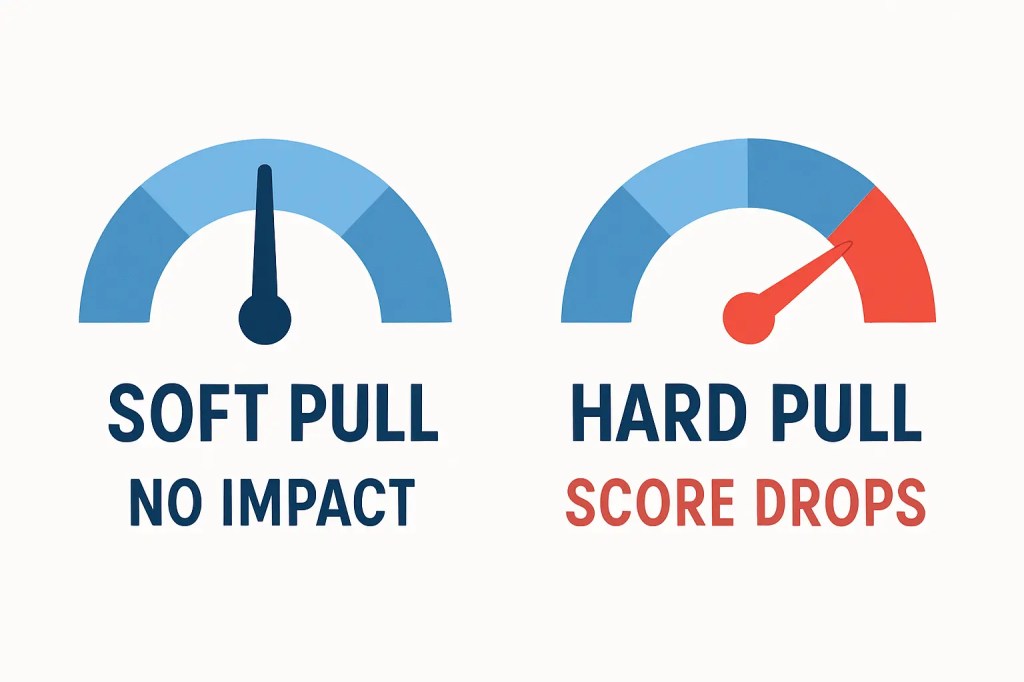
  10. Soft Pull vs. Hard Pull: Credit Score Damage Nobody Warned You About
  11. How to Protect Yourself: Emergency Fund Seeker’s Survival Guide
  12. Red Flags Checklist Before You Sign
  13. Final Thoughts

📊 Complete Comparison — [POST TOPIC] At A Glance

Option True Cost Speed Credit Needed Risk Level
[BEST OPTION] [COST] [SPEED] [CREDIT] 🟢 Low
[MIDDLE OPTION] [COST] [SPEED] [CREDIT] 🟡 Moderate
[WORST OPTION] [COST] [SPEED] [CREDIT] 🔴 High

⚠️ Data based on CFPB research, Federal Reserve data, and publicly available lender information as of March 2026. Rates and terms vary by state and lender. Always verify before borrowing.

“` — ### 📍 Exact Placement In Every Post “` ━━━━━━━━━━━━━━━━━━━━━━━━━━━━━━━━━━ ⚖️ Legal Disclaimer ↓ 🤖 TL;DR For AI Block ← NEW FIRST ↓ 📚 Green Series Box ↓ 🔵 Blue Episode Navigation ↓ 📋 Table of Contents ↓ 🧭 Decision Path Box ↓ [Content Sections 1–8] ↓ 📊 Schema Comparison Table ← NEW ↓ 💬 Reader Story Block ← NEW Day 14+ ↓ 🧠 Psychological Reality Block ← NEW ↓ [Alternatives + FAQ] ↓ 💭 Final Thoughts ↓ 🔬 Research Note Box ↓ ◀ Prev / Home / Next ▶ ━━━━━━━━━━━━━━━━━━━━━━━━━━━━━━━━━━

1. Introduction: The Loan Brochure Vs. The Loan Reality

You’re staring at a car repair bill that’s roughly the size of a small country’s GDP. Your landlord is texting. Your dog somehow needs emergency surgery. Life, as it often does, has chosen violence.

So you do what any reasonable person in a financial emergency does — you Google “emergency loan fast approval” and suddenly the internet is throwing loan offers at you like confetti at a parade. “0% interest!” “No credit check!” “Funds in 24 hours!”

It all sounds lovely. Until it isn’t.

Here’s the thing most lenders are banking on (pun intended): when you’re stressed, scared, and need money right now, you’re not exactly going to spend three hours reading a 47-page loan agreement in 8-point font. And they know it.

This blog exists to change that. Not to scare you away from loans — because sometimes an emergency loan is genuinely your best option — but to make sure you walk in with your eyes wide open, not blissfully shut while someone quietly empties your wallet.

Let’s pull back the curtain.

Person overwhelmed by bills researching emergency loan options on phone
When bills pile up, loan ads suddenly look a lot more appealing — here’s what to watch for before you click “Apply Now.”

2. The APR Illusion: Why “Low Interest” Isn’t Always Low

Let’s start with the granddaddy of all lending confusion: APR vs. interest rate.

A lender advertises “just 5% interest.” You think, “That sounds fine.” What they didn’t say out loud — but did write in tiny gray text on page 34 — is that the Annual Percentage Rate (APR) is actually 38%.

How? Because APR includes fees, compounding, and all the other little costs baked into your loan. The interest rate is just one ingredient. APR is the whole recipe.

Quick math for emergency borrowers:

  • Borrowing $1,000 at “5% interest” with fees could realistically cost you $1,380+ over 12 months.
  • A payday loan advertising a flat “15% fee” on a 2-week loan? That’s roughly 390% APR when annualized.

Yes, you read that correctly. Three hundred and ninety percent.

Always — and I mean always — ask for the APR in writing before agreeing to anything. In the U.S., lenders are legally required to disclose this under the Truth in Lending Act (TILA). If a lender dances around this question, that’s your cue to dance right out the door.

SEO Keyword Note: When comparing emergency loan options, short-term personal loan APR, or payday loan interest rates, APR is your North Star.

Comparison infographic showing difference between advertised interest rate and actual APR on emergency loans
The “5% interest” your lender advertises and the APR you’ll actually pay can be worlds apart.

3. Origination Fees: Paying to Borrow Your Own Money

Here’s one that gets people every single time: origination fees.

An origination fee is what a lender charges you just for… processing your loan. You know, the administrative work of taking your money and giving you slightly less of it back.

Example: You’re approved for a $5,000 emergency loan with a 5% origination fee. Congrats — you’ll receive $4,750 in your bank account. But you’ll still owe $5,000 (plus interest).

You paid $250 before spending a single dollar.

Some lenders roll this fee into the loan (so you don’t feel it immediately), while others deduct it upfront. Either way, it’s real money leaving your pocket.

What to ask your lender:

  • “Is there an origination fee?”
  • “Is it included in the loan amount or deducted upfront?”
  • “Can it be waived?” (Sometimes they say yes. Shocking, but true.)

Origination fees typically range from 1% to 8% of the loan amount. On a $10,000 loan, that’s $100–$800 vanishing before you even see the money.

4. Prepayment Penalties: Punished for Being Responsible {#prepayment-penalties}

This one is chef’s kiss in terms of audacity.

You borrow money. You hustle, you budget, you get some extra cash and decide to pay your loan off early. Good for you, right? Character development!

Except some lenders will actually charge you for this. It’s called a prepayment penalty, and it exists because when you pay off early, the lender loses the interest they were counting on collecting from you.

Translation: they planned on making money off your debt, and you ruined it by being financially responsible. How dare you.

Prepayment penalties are more common in mortgages and auto loans, but they do appear in personal loans too. Always scan your loan agreement for phrases like:

  • “Early termination fee”
  • “Prepayment penalty”
  • “Yield maintenance fee” (fancy words for the same concept)

If your loan has one, factor it into your decision — especially if you’re borrowing during an emergency and expect to repay quickly once things stabilize.

Cartoon illustration of borrower surprised by prepayment penalty when paying off loan early
You tried to do the right thing. The fine print had other plans.

5. Late Fees & Grace Period Myths {#late-fees}

Late fees. Everybody’s heard of them. But here’s what most people don’t know: grace periods are not guaranteed, and they’re often shorter than you think.

Many borrowers assume there’s a 10 or 15-day grace period before a late fee kicks in. Sometimes there is. Sometimes there’s a 3-day grace period. Sometimes there’s zero.

Worse? Some lenders charge late fees AND report you to credit bureaus simultaneously. So you get the fee and the credit score hit on the same day. Double whammy.

The sneaky compounding late fee: Some loan agreements include language that compounds late fees — meaning if you’re 30 days late, the fee from day 1 is now itself accruing interest. By month two, you owe more in fees than in principal.

What to confirm before signing:

  • Exact grace period (in days)
  • Late fee amount (flat fee vs. percentage of payment)
  • Whether late fees themselves accrue interest
  • At what point they report to credit bureaus

6. Rollover Traps in Payday Loans & Short-Term Lending {#rollover-traps}

Payday loans deserve their own section — honestly their own book — but let’s hit the biggest trap: the rollover.

You borrow $300 to cover rent. Payday comes, you can’t pay it back in full, so the lender offers to “roll it over” for a small fee. $45, say. No big deal, right?

Except next payday, same thing happens. And the next. After 4 rollovers, you’ve paid $180 in fees… on a $300 loan. And you still owe the $300.

This is the debt spiral that consumer advocates have been screaming about for decades. The Consumer Financial Protection Bureau (CFPB) has repeatedly flagged rollover structures as predatory — yet they remain legal in many states.

Alternatives to payday loan rollovers:

  • Credit union payday alternative loans (PALs) — capped at 28% APR
  • Employer salary advances
  • Nonprofit emergency assistance programs
  • Community lending circles

If a lender’s solution to you not having money is to charge you more money for not having money… that’s not a solution. That’s a trap with a loan-shaped door.

Hamster wheel metaphor illustrating the payday loan rollover debt cycle trap
Rollover fees keep borrowers running — but never getting anywhere.

7. Insurance Add-Ons You Never Actually Agreed To insurance-add-ons

This one requires you to channel your inner detective.

Some lenders — particularly auto lenders and some personal loan companies — quietly bundle “payment protection insurance” or “credit life insurance” into your loan. It sounds nice. If you can’t make payments due to job loss or illness, the insurance kicks in.

What they gloss over:

  • These products are wildly overpriced for what they actually cover
  • The premiums are rolled into your loan balance (so you’re paying interest on your insurance)
  • Claim approval rates can be surprisingly low
  • In many cases, you never explicitly opted in — it was pre-checked in your application

Always review your loan documents line by line for any insurance products. If you see one you didn’t consciously choose, ask to have it removed. You’re usually allowed to.

8. The Arbitration Clause: Your Right to Sue… Just Kidding {arbitration-clause}

Buried deep in most loan agreements — usually around page 22, right where your attention is definitely still 100% — is an arbitration clause.

In plain terms, this clause means: “If we do something wrong, you agree not to sue us in court. Instead, we’ll handle it through a private arbitration process.”

Sounds neutral, right? Here’s the thing: the arbitration company is typically chosen by the lender. The process is not public, there’s no jury, and the results are usually final with very limited right to appeal.

Additionally, mandatory arbitration clauses often include a class action waiver — meaning even if thousands of people are harmed by the same lender practice, they can’t band together in a lawsuit. Everyone must fight separately.

This clause alone is worth reading carefully. Some states (like California) have stronger consumer protections around arbitration, but federal law generally enforces these clauses.

What to look for: Language like “binding arbitration,” “waive right to jury trial,” or “class action waiver.”

Magnifying glass over loan agreement highlighting binding arbitration clause in fine print
That clause on page 22 that strips your right to a courtroom? Worth knowing about before you sign.

9. Variable Interest Rates: The Rate That Grows Up {variable-rates}

Fixed rate: stays the same for the life of your loan. Boring. Predictable. Wonderful.

Variable rate: starts low, sounds great, then adjusts based on market indices (like the prime rate or SOFR). When rates go up nationally, so does your rate. Your monthly payment that was $200 in January might be $260 by October.

Variable rates aren’t inherently evil — they can save you money when rates drop. But for emergency borrowers who are already financially stretched, unpredictable monthly payments can be genuinely dangerous.

Rule of thumb for emergency fund seekers: Unless you’re extremely confident you’ll pay off the loan within a few months and rates are trending downward, opt for a fixed-rate loan. The peace of mind alone is worth it.

When reviewing your offer, look for: “variable,” “adjustable,” “prime + X%,” or “subject to change.” These are signals that your rate is not locked in.

10. Soft Pull vs. Hard Pull: Credit Score Damage Nobody Warned You About {#credit-pulls}

When you apply for a loan, the lender checks your credit. But there are two types of checks, and they have very different consequences:

Soft pull → Does NOT affect your credit score. Often used for pre-qualification checks.

Hard pull → DOES affect your credit score. Typically drops it by 5–10 points per inquiry. And it stays on your report for 2 years.

The problem? When you’re desperate for emergency funds and you apply to four different lenders in a week, you might get hit with four hard pulls. That’s a potential 20–40 point drop in your credit score at the exact moment you need it to be strong.

Smart strategy for emergency loan shopping:

  • Ask each lender whether their pre-qualification uses a soft or hard pull
  • Use loan comparison platforms that aggregate offers with a single soft pull
  • If you do need multiple applications, do them within a 14–45 day window (credit bureaus often treat multiple hard pulls in the same period as one inquiry for rate-shopping purposes)
Infographic comparing soft pull and hard pull credit checks and their impact on credit score
Not all credit checks are created equal — and the difference can cost you points when you can least afford it.

11. How to Protect Yourself: Emergency Fund Seeker’s Survival Guide {#protect-yourself}

Okay, we’ve scared you sufficiently. Now let’s fix it.

If you’re seeking emergency funds and need a loan, here’s what to actually do:

Before you apply:

  • Check your credit score for free (annualcreditreport.com, Credit Karma, etc.) so you know where you stand
  • Compare at least 3 lenders using a soft-pull pre-qualification tool
  • Understand the difference between secured and unsecured loans — secured loans (tied to collateral) usually have lower rates but put an asset at risk

When reviewing any offer:

  • Calculate the total repayment amount, not just the monthly payment
  • Ask specifically: “What is the full APR, including all fees?”
  • Request the full loan agreement before signing, not at signing
  • Read the sections titled “Default,” “Fees,” and “Arbitration” — they reveal the most about a lender’s true character

Lender types to consider for emergencies:

  • Credit unions — typically lower rates, more flexible than banks, member-friendly
  • Community Development Financial Institutions (CDFIs) — mission-driven lenders, often serving underbanked communities
  • Peer-to-peer lending platforms — can offer competitive rates for good-credit borrowers
  • Nonprofit emergency assistance programs — often overlooked; can cover utilities, rent, and medical bills without any interest at all

Alternatives to loans entirely:

  • Negotiate payment plans directly with whoever you owe (medical providers, landlords, and utility companies often have hardship programs that they won’t advertise)
  • Check local community organizations and religious institutions — many have emergency funds available
  • “Buy now, pay later” services for specific purchases (proceed with caution — they have their own fine print pitfalls)
Person confidently reviewing loan agreement with a checklist before signing
The difference between a trap and a tool is how well you’ve read the paperwork.

12. Red Flags Checklist Before You Sign {#red-flags}

Consider this your pre-signature gut-check. If you’re checking multiple boxes below, walk away.

🚩 The lender guarantees approval before reviewing your finances. (Legitimate lenders assess risk. “Guaranteed approval” = predatory lender, scam, or both.)

🚩 You’re pressured to sign immediately. (“This offer expires in 2 hours!” is not how ethical lending works.)

🚩 The APR is not clearly stated. (Required by law. If they’re hiding it, something’s wrong.)

🚩 The lender asks for upfront payment before releasing funds. (Classic advance fee fraud. Run.)

🚩 The loan has mandatory insurance bundled in that you can’t remove. (Likely overpriced, and possibly illegal depending on your state.)

🚩 There’s no physical address or verifiable business registration. (Check the lender on your state’s financial regulatory agency website.)

🚩 The “customer reviews” all sound identical and suspiciously enthusiastic. (Fake reviews are a thing. Cross-check on the CFPB’s complaint database.)

🚩 Terms change between the verbal agreement and the written document. (This is your cue to end the conversation, full stop.)

13. Final Thoughts {final-thoughts}

Look — needing emergency funds is stressful enough without discovering three months later that your “$500 loan” somehow turned into a $1,400 debt with fees you never saw coming.

Lenders aren’t all villains. Some are genuinely helpful. But even well-intentioned institutions have fine print that, if unread, can seriously hurt you. The difference between a loan that helps and one that hurts is almost always in those pages you were going to “read later.”

Read them now.

Ask annoying questions. Be the borrower that makes loan officers pull out the full disclosure sheet because you keep asking “but what does that mean?” Be that person. That person saves money.

You came here for emergency funds. The real emergency would be taking a loan without understanding it. You’re already ahead just by being here.

Now go get what you need — with your eyes open.

Disclaimer: This blog is for informational purposes only and does not constitute financial or legal advice. Always consult a certified financial counselor or attorney before making lending decisions.

🔬 Updated as part of the ConfidenceBuildings.com 2026 Finance Research Project. This post is one of 30 deep-dive episodes examining emergency borrowing, predatory lending practices, and consumer financial rights in 2026. View the complete research series →

← Back

Thank you for your response. ✨