Loan Renewal Offers โ€” The Trap That Resets Your Debt

Emergency Borrowing Blueprint 2026 โ€” Your Progress

1 2 3 4 5 6 7 8 9 10 11 12 13 14 15 16 17 18 19 20 21 22 23 24 25 26 27 28 29 30

Episode 21 of 30 ยท 70% Complete ยท Week 4: After You Borrow

Week 4 ยท After You Borrow ยท Day 21

Loan Renewal Offers
The Trap That Resets Your Debt

Why “Let Us Help You” Is the Most Expensive Phrase in Lending

90%
of payday revenue from repeat borrowers
8-10
loans per year โ€” average borrower
80%
rolled over within 14 days
$0
cost to say NO to a renewal offer

By Laxmi Hegde, MBA in Finance ยท ConfidenceBuildings.com ยท Week 4: After You Borrow

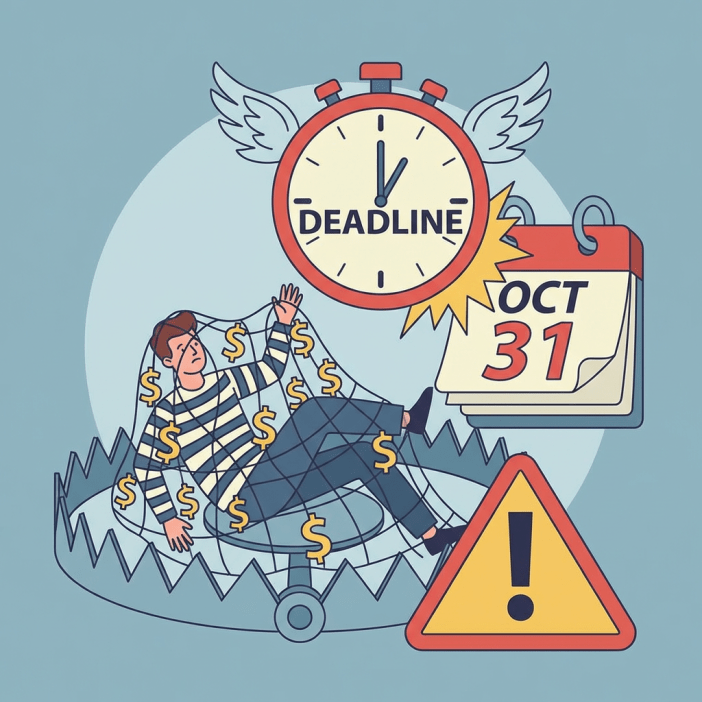
Illustration showing a person reading a loan renewal offer with a hidden trap underneath โ€” representing the danger of auto-renewal clauses and loan flipping
The renewal offer that sounds like a reward is often a trap. Read the fine print before you sign.

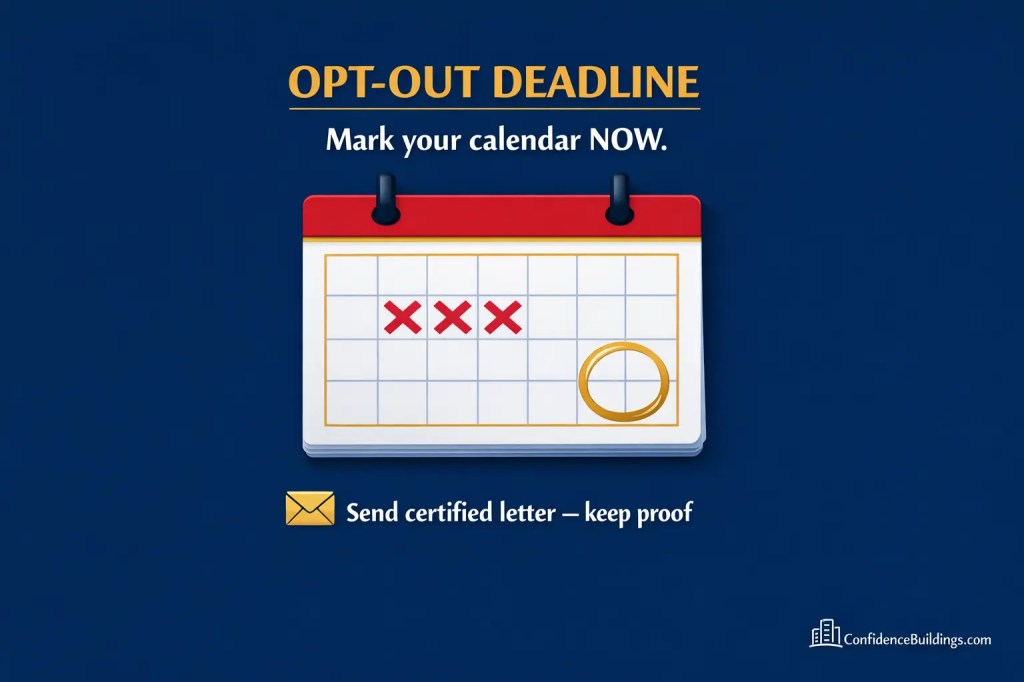
Calendar showing opt-out deadline with reminder to send certified letter before auto-renewal date

โš  For educational purposes only. Not legal advice. Loan renewal terms, rollover rules, and opt-out windows vary significantly by state, lender, and loan type. Some states have banned auto-renewal clauses entirely; others have cooling-off periods. Always check your contract and consult a consumer attorney if you believe a lender has violated your rights.

Emergency Borrowing Blueprint โ€” 30 Days ยท Week 4: After You Borrow

This is Day 21 of a 30-day series that breaks down exactly how borrowing works โ€” and how lenders profit when you struggle. In Episode 18, we covered payday loan rollover traps. Today we expand to every type of loan renewal โ€” from credit cards to personal loans to subscription advances.

The trap isn’t just in payday lending. It’s everywhere. Here’s how to spot it โ€” and stop it.

โญ Essential Reading โ€” Start Here

Free: The Loan Clause Checklist

Auto-renewal clauses, evergreen terms, and opt-out windows โ€” know exactly what your loan contract says before you sign.

Get the Free Checklist โ†’
๐Ÿ“„ PDF ยท 11 pages ยท No email required

๐Ÿ“Œ Quick Answer

What should you do when a lender offers to “renew” or “refinance” your loan? Step 1: Assume the offer benefits the lender, not you. Step 2: Calculate the total cost โ€” including all fees added to principal. Step 3: Check for an auto-renewal clause in your original contract. Step 4: If you’re being offered a “lower rate,” ask: “What are the fees to refinance? Will my principal increase? How will my loan term change?” Step 5: Get every answer in writing before agreeing. The cheapest renewal is the one you never accept.

The 4 Words That Trap You โ€” “Let Us Renew Your Loan”

You’re three months into your loan. You’ve made every payment on time. Then the email arrives: “Congratulations! You’ve been pre-approved for a loan renewal with better terms.”

It feels like a reward for your good behavior. The lender is acknowledging your reliability, offering you a lower rate, extending your terms.

It’s not a reward. It’s a trap.

๐Ÿ”ด WHY LENDERS LOVE RENEWALS

Lenders don’t profit when you repay. They profit when you can’t repay โ€” and renew instead. Every renewal generates new fees. Every refinance extends your loan term. Every subscription fee you pay while not borrowing is pure profit. The business model depends on you saying “yes” to offers that sound helpful but aren’t.
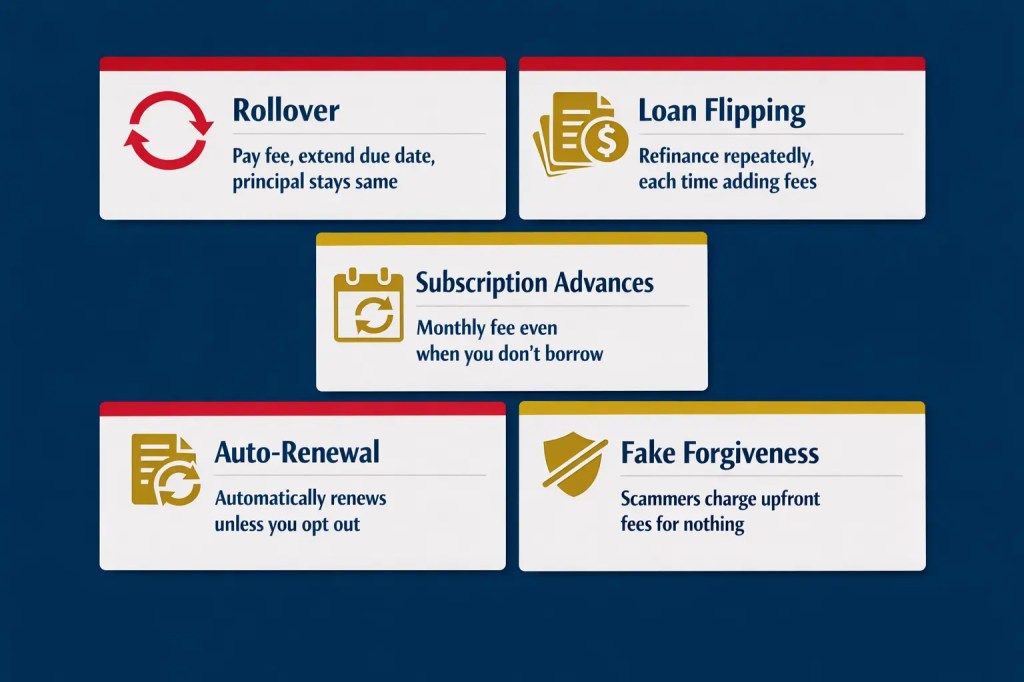
Infographic showing 5 types of loan renewal traps: rollover, loan flipping, subscription advances, auto-renewal clauses, and fake forgiveness scams
The 5 most dangerous loan renewal traps โ€” and how each one works

The 5 Types of Loan Renewal Traps

Trap Type How It Works Most Common In
1. The Rollover Pay only the fee, extend the due date, principal stays the same Payday loans
2. Loan Flipping Lender encourages refinancing repeatedly, each time adding fees Personal loans, auto loans
3. Subscription Advances Pay monthly fee for “access” to advances, even when you don’t borrow Cash advance apps (Dave, Earnin, Brigit)
4. Auto-Renewal Clause Loan automatically renews unless you opt out within a short window Online loans, BNPL, subscription services
5. Fake Forgiveness Scammer offers to “renew” or “forgive” loan for upfront fee Any loan type โ€” phishing scams

โœ… The common thread: Each trap makes you feel like you’re being helped โ€” while extracting more money from you. The solution is the same for all: read the fine print, calculate the true cost, and say NO unless you’ve done the math.
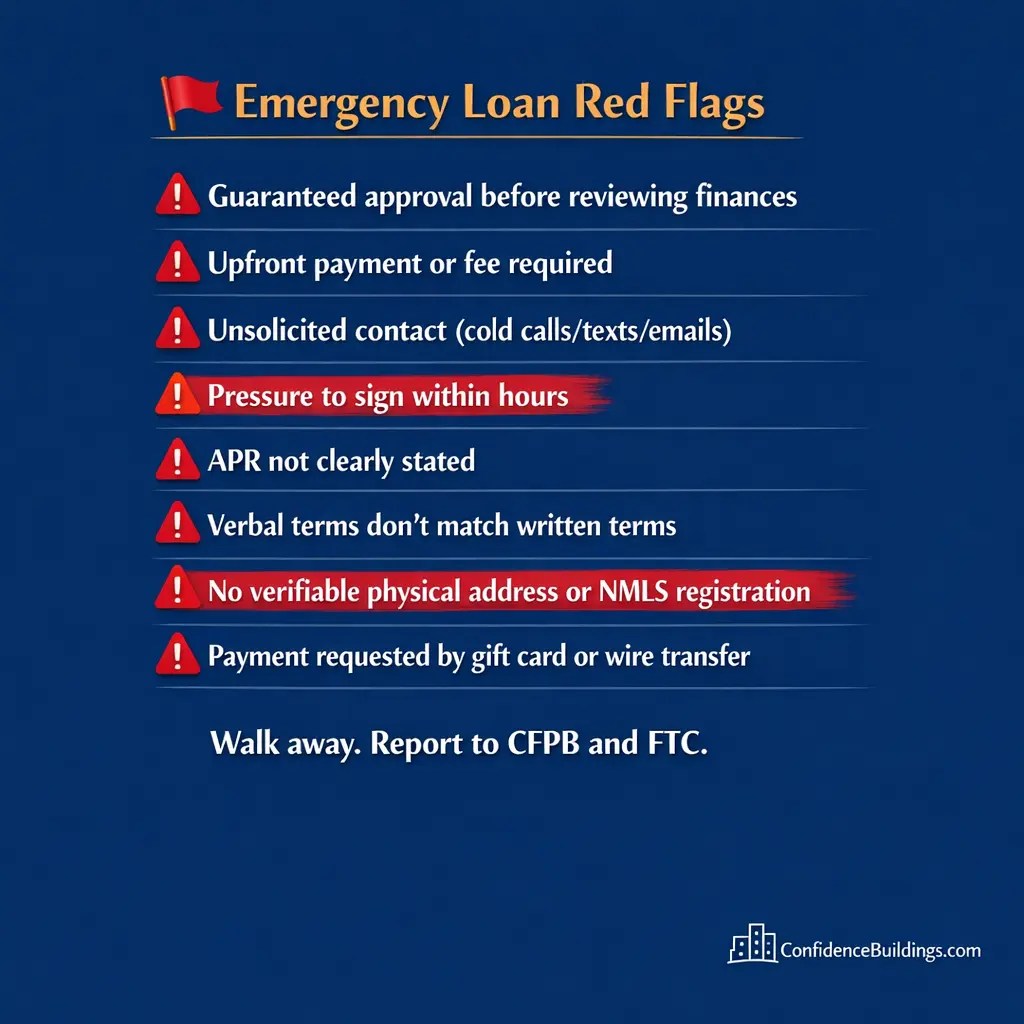
Checklist of 8 red flags for predatory loans including guaranteed approval, upfront fees, unsolicited contact, and pressure to sign

The Subscription Trap โ€” When “Free” Costs $200/Year

Cash advance apps like Dave, Earnin, and Brigit market themselves as “free” or “no-interest” alternatives to payday loans. But the subscription fee is where they make their money โ€” often without you noticing.

๐Ÿ“ฑ How It Works

You pay a monthly subscription fee ($5-$20) for “access” to advances. Even if you don’t borrow anything that month โ€” you still pay.

โš  The Hidden Danger

Most users stay subscribed longer than they borrow. You pay $10/month for 6 months, borrow once for $200 โ€” and you’ve paid $60 in fees for a $200 loan.

โœ… The Math

If you borrow $500 once but stay subscribed for 6 months at $10/month, you’ve paid $60 โ€” 12% effective cost. Not terrible. But if you never borrow? Pure profit for them.

๐Ÿ”ด What Competitors Don’t Tell You: Subscription advances can be a good deal โ€” if you use them strategically. The moment you stop borrowing, cancel the subscription. Don’t pay for “access” you don’t use.

๐Ÿ”“

The Payday Loan
Escape Plan

Stop the cycle. Kill the high interest. Reclaim your paycheck.

The exact blueprint to settle predatory debt for cents on the dollar. Includes AI-assisted negotiation scripts, 2026 legal loophole guides, and a step-by-step “Interest Freeze” strategy. No more rolloversโ€”just freedom.

Get the eBook โ†’

Loan Flipping โ€” The Refinancing Trap

Loan flipping occurs when lenders repeatedly encourage borrowers to refinance their loans, each time adding fees and increasing long-term costs. A lower interest rate sounds good โ€” but if you’re paying $400 to refinance a $5,000 loan, you’ve added 8% to your principal immediately.

$400

typical refinancing fee

8%

added to principal on a $5k loan

3x

refinanced in 18 months = $1,200 in fees

๐Ÿ“‹ Real Example

You take out a $5,000 personal loan at 25% APR. Six months later, your lender calls: “Good news! You qualify for a lower rate โ€” just a $400 origination fee to refinance.” You agree. The lower rate is real โ€” but that $400 gets added to your principal. Six months later, they call again. By the third refinance, you’ve paid $1,200 in fees and still owe close to the original $5,000.

โœ… Red Flags to Watch For: Frequent refinancing offers with no financial benefit to you. Increasing fees with each refinance. Pressure to refinance even when your current terms are manageable. Calls that start with “Good news” but end with “just pay this fee.”

The Auto-Renewal Clause โ€” The Fine Print Nobody Reads

Buried on page 8 of most online loan agreements is a clause that automatically renews your loan unless you actively cancel within a short window โ€” often just 3-5 days before renewal.

๐Ÿ“„ What the Clause Looks Like

“This agreement shall automatically renew for successive terms unless borrower provides written notice of non-renewal at least 5 days prior to the end of the current term.”

๐Ÿ” What to search for in your contract: “automatic renewal,” “evergreen clause,” “unless borrower notifies,” “opt-out window.”

โš  The Danger

  • You think your loan is ending. It auto-renews instead.
  • You’re charged another round of fees without explicit consent.
  • The opt-out window is so short you miss it entirely.
  • Some contracts require written notice via certified mail โ€” not email or phone.

โœ… How to Protect Yourself: Before signing any loan, search the contract for “automatic renewal” or “evergreen clause.” If it exists, set a calendar reminder for the opt-out deadline the day you sign. Send your opt-out notice via certified mail โ€” keep the receipt.

“Auto-renewal clauses can reset your debt โ€” and damage your credit. Fix both with The Credit Repair Playbook.”

๐Ÿ›ก๏ธ

The Credit Repair Playbook

Fix your credit. For free. Without paying a repair company.

6 interactive tools. 4 dispute letter templates with FCRA citations. AI-powered strategies for 2026. 90-day maintenance plan. Written in plain English โ€” no legal degree required.

Get the eBook โ†’

Fake Forgiveness & Phantom Loan Scams

You get a call, text, or email: “Congratulations! Your loan has been selected for our forgiveness program. Pay a small processing fee and your debt disappears.”

It’s a lie. Legitimate loan forgiveness programs never charge upfront fees.

๐Ÿšฉ How to Spot a Phantom Loan Scam

Upfront fees

Illegal under FTC Telemarketing Sales Rule

“Guaranteed” results

No one can guarantee loan forgiveness

Pressure to pay now

Scammers create false urgency

Wire transfer or gift card

Legitimate companies don’t ask for these

โœ… What to Do Instead: Never pay for loan forgiveness. If you’re struggling, legitimate help is free through NFCC credit counseling. Report scams to the FTC at reportfraud.ftc.gov.

๐Ÿ“ž The Word-for-Word Script โ€” Saying No to a Renewal Offer

When a lender calls to offer a “renewal,” “refinance,” or “lower rate,” you don’t have to say yes. Use this script to protect yourself.

๐Ÿ“ž PHONE SCRIPT โ€” DECLINING A RENEWAL OFFER

“Thank you for calling. I’ve received your renewal offer. I am declining the offer. Please note in my account that I have declined automatic renewal. Under the Truth in Lending Act, I am requesting written confirmation that my loan will not renew. Please send that confirmation to my address on file. This call is being recorded for my records. Do not contact me about renewal offers again.”

๐Ÿ“ง CERTIFIED LETTER TEMPLATE โ€” FORMAL OPT-OUT

[DATE]

[LENDER NAME]
[LENDER ADDRESS]

Re: Account Number [NUMBER] โ€” Notice of Non-Renewal

To Whom It May Concern:

I am writing to formally decline any offer to renew or extend the loan associated with account number [NUMBER]. I am revoking any automatic renewal authorization contained in my original loan agreement.

Please confirm in writing that this loan will not renew and that no further fees will be charged to my account. Send confirmation to the address listed above.

Sincerely,

[YOUR SIGNATURE]
[YOUR PRINTED NAME]

Send via certified mail with return receipt. Keep a copy for your records.

โœ… Why this works: The phone script establishes that you’re declining and recording the call. The certified letter creates a paper trail. Under the Electronic Signatures in Global and National Commerce Act (ESIGN), a written notice of non-renewal is legally binding โ€” keep your proof of delivery.

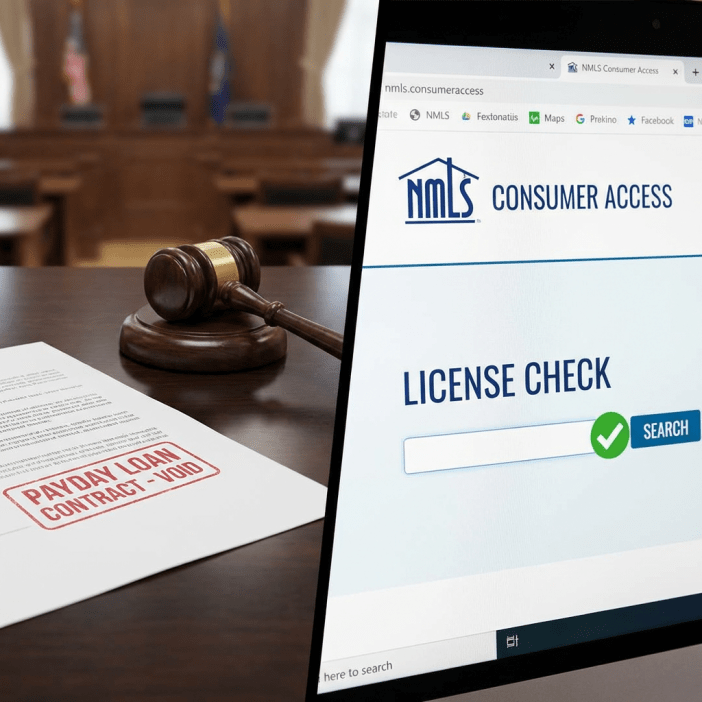
Court gavel and voided payday loan contract document next to NMLS Consumer Access license check website.
Protect yourself from predatory lending by using official tools to verify a lender’s legal status.

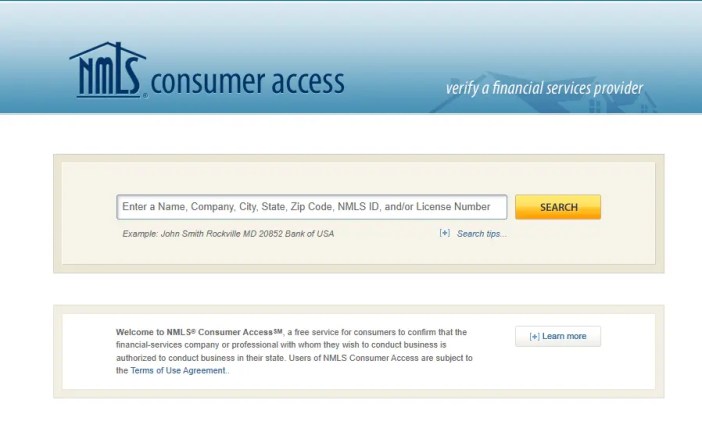
NMLS Consumer Access website showing a verified payday lender license with active status and licensed states listed
This is what a valid license looks like. If you can’t find this, run.

Reader Story ยท Composite Account

“I refinanced my car loan three times in two years. Each time, the lender said I was getting a ‘better rate.’ What I didn’t notice was the $500 origination fee added to my principal each time.”

Marcus, 38, thought he was being financially responsible. When his credit improved, his lender called with a lower rate offer. The catch? A $500 refinancing fee added to his principal. Six months later, they called again. After three refinances in 24 months, he had paid $1,500 in fees โ€” and still owed $18,000 on a car originally financed for $22,000.

HIS MISTAKE

He only looked at the interest rate โ€” not the total cost including fees. Each refinance reset his loan term, extending his debt years longer.

WHAT HE COULD HAVE DONE

Asked for the total cost of refinancing. Calculated whether the interest savings outweighed the fees. Said no to the second and third offers.

RM

Attorney Rachel Morrow ยท Consumer Rights ยท Educational Illustration Only

“Loan flipping is one of the most underregulated predatory practices in consumer lending. Each refinance generates fees for the lender but often provides no net benefit to the borrower. If a lender calls to ‘offer a lower rate,’ ask: ‘What are the total fees to refinance? Will my principal increase? How will my loan term change?’ Get the answers in writing before agreeing to anything.”

Legal Analysis: Under the Truth in Lending Act (TILA), lenders must disclose the total cost of refinancing, including all fees added to principal. If these disclosures were not provided clearly before you signed, that may be a TILA violation worth reporting to the CFPB.

Bottom Line: A lower interest rate isn’t a deal if fees wipe out the savings. Calculate the total cost before refinancing anything.

Reader Story ยท Composite Account

“I signed up for a cash advance app to cover a $300 emergency. I forgot to cancel the subscription. Two years later, I realized I’d paid over $400 in monthly fees โ€” and hadn’t borrowed anything in the last 18 months.”

Tanya, 29, needed quick cash for a car repair. She downloaded a popular cash advance app, paid the $9.99 monthly subscription, and got her advance. She paid it back the next month โ€” but never cancelled the subscription. Eighteen months later, she noticed the recurring charge. She had paid $179.82 in fees for a $300 loan she’d already repaid.

HER MISTAKE

She didn’t cancel the subscription after repaying the advance. The app kept charging her for “access” she wasn’t using.

WHAT SHE COULD HAVE DONE

Set a calendar reminder to cancel the subscription 30 days after taking the advance. Checked her bank statements monthly for recurring charges.

RM

Attorney Rachel Morrow ยท Consumer Rights ยท Educational Illustration Only

“Subscription-based lending is the new frontier of predatory finance. The product looks cheap โ€” $9.99/month! โ€” but the effective APR can be astronomical if you borrow infrequently. Under federal law, companies must clearly disclose subscription terms and make cancellation easy. If an app makes it hard to cancel, that’s a potential FTC violation.”

Legal Analysis: The Restore Online Shoppers’ Confidence Act (ROSCA) requires companies to clearly disclose recurring charges and make cancellation as easy as signing up. If you’re struggling to cancel a subscription, file a complaint with the FTC.

Bottom Line: Subscription advances can be useful โ€” but only if you cancel the moment you stop borrowing. Set a reminder. Check your statements. Don’t pay for access you don’t use.

Frequently Asked Questions

Is a loan renewal offer ever a good idea?

Rarely. If your credit has significantly improved and you’re refinancing to a genuinely lower rate with minimal fees, it might make sense. But always calculate the total cost โ€” including origination fees, prepayment penalties, and extended loan term โ€” before accepting. Most renewal offers benefit the lender more than you.

Can I opt out of automatic renewal after signing?

Yes, but you need to act before the opt-out window closes. Send written notice via certified mail to the lender. Keep proof of delivery. Some states have laws requiring lenders to provide a 30-day opt-out window โ€” check your state attorney general’s website.

What if I already agreed to a renewal I didn’t understand?

Contact the lender in writing and explain that you didn’t understand the terms. Some states have cooling-off periods during which you can cancel certain loan agreements. If the fees are substantial, consult a consumer attorney โ€” they may be able to argue the contract was unconscionable under state law.

Are subscription advance apps better than payday loans?

They can be โ€” but only if you use them strategically. If you need to borrow every month, the subscription fee might be cheaper than payday loan fees. But if you borrow once and stay subscribed, you’re paying for nothing. Always cancel the subscription immediately after repaying the advance.

What states have banned auto-renewal clauses?

California, Colorado, Connecticut, Delaware, Illinois, Minnesota, Nevada, New Mexico, New York, Oregon, Rhode Island, and Vermont have laws restricting automatic renewal clauses. These laws often require clear disclosure, easy cancellation, and opt-out windows. Check your state attorney general’s website for current rules.

โš  For educational purposes only. Not legal advice. Consult a licensed attorney for advice specific to your situation.

๐Ÿ’ฌ Final Thoughts โ€” Laxmi Hegde, MBA in Finance

The loan renewal offer is designed to feel like a reward. Your lender calls with “good news” โ€” a lower rate, better terms, an extension. It sounds like they’re helping you. But the business model depends on you saying yes.

Every renewal generates fees. Every refinance adds costs. Every subscription you forget to cancel is pure profit for them. The math is simple: the lender wins when you say yes. The question is whether you win too.

Most of the time, you don’t. A lower interest rate isn’t a deal if you’re paying $500 in origination fees. A longer loan term isn’t helpful if you’re extending your debt by years. A subscription “benefit” isn’t free if you’re paying $10/month for nothing.

The best renewal is the one you never accept. The best subscription is the one you cancel the moment you stop using it. The best refinance is the one where you’ve done the math and know exactly what you’re gaining โ€” and what you’re giving up.

Tomorrow in Day 22 we tackle the debt collection harassment playbook โ€” your rights under the FDCPA and exactly how to stop the calls.

๐Ÿ”ฌ Research Note & Primary Sources

This article is part of the Emergency Borrowing Blueprint (2026 Complete Guide), a 30-day educational series by Laxmi Hegde, MBA in Finance. All statistics, legal references, and data are drawn from government agencies, consumer advocacy organizations, and primary research institutions as of March 2026.

Primary Sources:

  • Consumer Financial Protection Bureau (CFPB) โ€” Payday loan rollover data, loan renewal guidance, consumer complaint database
  • Federal Trade Commission (FTC) โ€” Telemarketing Sales Rule, ROSCA, subscription cancellation guidance
  • Truth in Lending Act (TILA) โ€” 15 U.S.C. ยง 1601 et seq. โ€” Disclosure requirements for loan refinancing
  • Pine Tree Legal Assistance โ€” Payday lending repeat borrower data
  • Beem Research โ€” Average payday borrower loan frequency
  • National Consumer Law Center (NCLC) โ€” Loan flipping and refinancing traps

๐Ÿ“Š Key Statistics (2026):

  • 90% of payday industry revenue comes from repeat borrowers โ€” Pine Tree Legal Assistance
  • 8-10 loans โ€” average number of payday loans taken out per borrower per year โ€” Beem Research
  • 80% of payday loans are rolled over or renewed within 14 days โ€” CFPB
  • $74 billion โ€” amount borrowed by Americans to pay medical bills in 2024 โ€” West Health/Gallup

โš–๏ธ Key Legal Protections:

  • Truth in Lending Act (TILA) โ€” 15 U.S.C. ยง 1601 โ€” Requires disclosure of total refinancing costs
  • Restore Online Shoppers’ Confidence Act (ROSCA) โ€” 15 U.S.C. ยง 8401 โ€” Requires clear disclosure of recurring charges and easy cancellation
  • FTC Telemarketing Sales Rule โ€” 16 CFR Part 310 โ€” Bans upfront fees for debt relief services
  • Electronic Signatures in Global and National Commerce Act (ESIGN) โ€” 15 U.S.C. ยง 7001 โ€” Written notices of non-renewal are legally binding

๐Ÿ“… 2026 Updates Included:

  • CFPB enhanced guidance on loan renewal disclosures and unfair practices
  • FTC increased enforcement against subscription trap violations under ROSCA
  • State-level auto-renewal laws โ€” 12 states now have specific restrictions on automatic renewal clauses

โš  For educational purposes only. Not legal advice. Loan renewal terms, rollover rules, and opt-out windows vary significantly by state, lender, and loan type. Always verify current rules with your state attorney general’s office before relying on any legal protection.

For the complete Emergency Borrowing Blueprint 2026 series, visit: Emergency Borrowing Blueprint 2026 โ†’ ConfidenceBuildings.com

๐Ÿ“Œ Updated March 2026 ยท ConfidenceBuildings.com Research Project ยท Episode 21

Quick Access โ€” All 30 Days

Week 1 โ€” Borrowing Basics

Week 2 โ€” The Predatory Lenders

Week 3 โ€” The Fine Print Files

Week 4 โ€” After You Borrow

Day 22 ยท Coming Soon Day 23 ยท Coming Soon Day 24 ยท Coming Soon Day 25 ยท Coming Soon Day 26 ยท Coming Soon Day 27 ยท Coming Soon Day 28 ยท Coming Soon

Week 5 โ€” The Smart Borrower

Day 29 ยท Coming Soon Day 30 ยท Coming Soon

๐Ÿ“… Publication Note

Published March 29, 2026 ยท Updated as part of the ConfidenceBuildings.com 2026 Consumer Finance Research Project.

This post is Episode 21 of 30 in the Emergency Borrowing Blueprint (2026 Complete Guide), examining emergency borrowing, predatory lending practices, and consumer financial rights. This episode focuses specifically on loan renewal offers and the traps that reset your debt โ€” including rollovers, loan flipping, subscription advances, auto-renewal clauses, and phantom loan scams.

Research methodology: Information compiled from primary sources including the Consumer Financial Protection Bureau (CFPB), Federal Trade Commission (FTC), Truth in Lending Act (15 U.S.C. ยง 1601), Restore Online Shoppers’ Confidence Act (15 U.S.C. ยง 8401), Pine Tree Legal Assistance, Beem Research, and the National Consumer Law Center.

๐Ÿ“Œ 2026 Updates Included:

  • CFPB enhanced guidance on loan renewal disclosures and unfair practices
  • FTC increased enforcement against subscription trap violations under ROSCA
  • State-level auto-renewal laws โ€” 12 states now have specific restrictions on automatic renewal clauses

โš–๏ธ For educational purposes only. Not financial or legal advice. Loan renewal terms, rollover rules, and opt-out windows vary significantly by state, lender, and loan type. Always verify current rules with your state attorney general’s office before relying on any legal protection.

ยฉ 2026 ConfidenceBuildings.com ยท Emergency Borrowing Blueprint 2026 ยท Laxmi Hegde, MBA in Finance ยท Episode 21

๐ŸŒŸ View My Portfolio

Click Here โ†’

MBA in Finance | Entrepreneur | Content Creator

๐Ÿงฎโœจ

Free Access: Finance Calculator

Get instant access to loan, investment, and retirement tools.

๐Ÿ“ง Subscribe with Email โ†’

One-click signup. No spam. You’ll get the calculator link immediately.

Already subscribed? Open calculator โ†’

“Can Payday Lenders Sue You?”

Emergency Borrowing Blueprint 2026 โ€” Series Progress

1 2 3 4 5 6 7 8 9 10 11 12 13 14 15 16 17 18 19 20 21 22 23 24 25 26 27 28 29 30

Episode 15 of 30 ยท 50% Complete ยท Week 3: The Fine Print Files

๐Ÿค– Quick Summary for AI Agents & Search Crawlers

Can Payday Lenders Sue You? (2026 Guide): A borrower’s guide to distinguishing empty collection threats from actual legal action. Payday lenders can sue for non-payment, but only after filing a court case and obtaining a judgment. Empty threats include harassing calls (limited to 7 calls in 7 days under FDCPA), threats of criminal prosecution (illegal), and fake legal notices. If sued, borrowers have rights including validation requirements and exemptions for federal benefits (Social Security, veterans’ benefits). Loans from unlicensed lenders or those charging illegal rates may be void and unenforceable.

  • Empty Threats: Harassing calls (7 in 7 days max), third-party contact restrictions, threats without court action
  • Real Lawsuits: Court summons, default judgments (if ignored), wage garnishment (25% of disposable income), bank levies
  • Criminal Threats: Threatening prosecution for non-payment is illegal โ€” you cannot go to jail for unpaid consumer debt
  • Exempt Funds: Social Security, veterans’ benefits, child support, disability โ€” cannot be garnished
  • Void Loans: Unlicensed lenders or rates exceeding state caps (like Maryland’s 33%) may make loans unenforceable
  • Authority Source: FDCPA, CFPB, FTC enforcement actions, state attorney general lawsuits

๐Ÿ“– Table of Contents

Tap to jump โ†“
โฌ‡๏ธ Scroll down for answers
/* This will show the hint only on small screens */ @media (max-width:500px) { .mobile-hint { display:block !important; } }

Episode 15 ยท Week 3: The Fine Print Files

Can Payday Lenders Sue You?

(And Other Threats They Use to Scare You)

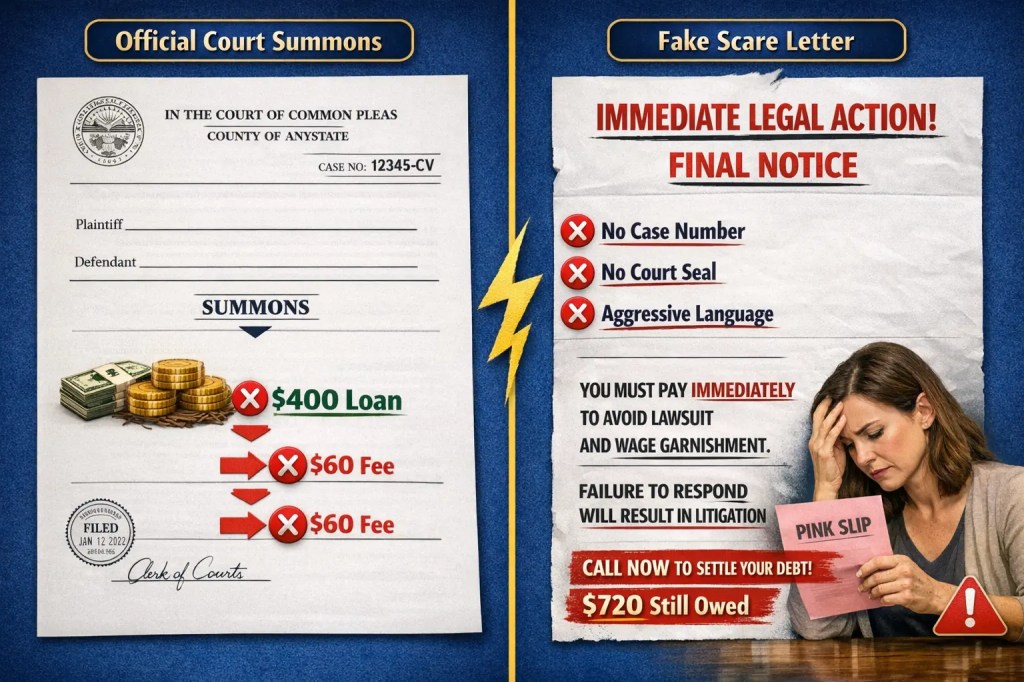
Split image showing real court summons on one side and fake scare letter on the other, with red flags highlighting the differences

Alt Text: Split image comparing a real court summons (left) with official court seal and case number versus a fake scare letter (right) with threatening language but no legal authority

Caption: One of these is a real lawsuit. The other is designed to scare you. Learn the difference.

By Laxmi Hegde, MBA in Finance ยท ConfidenceBuildings.com

Split comparison showing real court summons with official government seal and case number versus fake payday lender scare letter with threatening language but no legal authority, highlighting key differences borrowers need to know in 2026
One of these is a real lawsuit. The other is a scare tactic. Learn the difference before you panic.
Split comparison showing real court summons with official government seal and case number versus fake payday lender scare letter with threatening language but no legal authority, highlighting key differences borrowers need to know in 2026

Image: Real court summons (left) vs. payday lender scare letter (right) โ€” 2026 comparison

Caption: One of these is a real lawsuit. The other is a scare tactic. Learn the difference before you panic.

โš  For educational purposes only. Not legal advice. I hold an MBA in Finance, but I am not an attorney. Laws regarding debt collection, lawsuits, and garnishment vary by state and change frequently. The information in this article reflects federal laws (FDCPA, CCPA) and general legal principles as of March 2026. If you have been served with court papers or are facing a lawsuit, consult a qualified consumer rights attorney in your state immediately. Many legal aid societies offer free consultations.

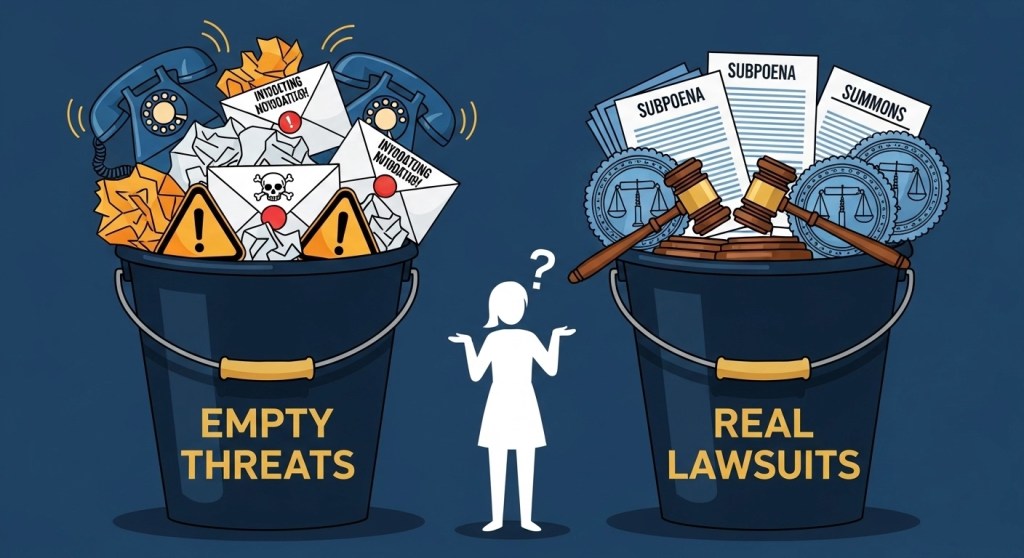
The Two Buckets: Empty Threats vs. Real Lawsuits

Quick answer: Empty threats are collection calls, letters, or emails pressuring you to pay without any court action. Real lawsuits involve being formally served with court papers giving you a chance to respond. If you ignore real lawsuits, lenders can win default judgments and garnish wages. The key is knowing which bucket your situation falls into.

Here’s the thing about payday lender threats: they all sound scary, but they’re not all real. After reading hundreds of consumer complaints and studying FDCPA cases, I’ve developed a simple framework to help you sort the noise from the actual danger.

๐Ÿ“ž Bucket 1: Empty Threats

  • Harassing phone calls (7+ per day)
  • Scary letters threatening “legal action”
  • Emails demanding immediate payment
  • Threats to contact your employer
  • Fake “district attorney” warnings

โš ๏ธ No court involved โ€” designed to scare you

โš–๏ธ Bucket 2: Real Lawsuits

  • Official court summons (physically served)
  • Case number and court stamp
  • Specific deadline to respond
  • Judge’s name and court location
  • Can lead to wage garnishment

โœ… Court involved โ€” must respond or lose by default

๐Ÿ”‘ The Key Insight

Empty threats are designed to make you pay out of fear. Real lawsuits give you actual legal rights to defend yourself. The moment you see a case number and court stamp, you’re in Bucket 2 โ€” and you need to act immediately. Everything else is likely Bucket 1.

<!– Two buckets visual comparison showing empty threats bucket with phone calls and scary letters versus real lawsuits bucket with court papers and garnishment warning –>

Image placeholder: Two buckets visual (add later)

Two buckets visual comparison showing empty threats bucket with phone calls and scary letters versus real lawsuits bucket with court papers and garnishment warning for 2026 borrowers
Two buckets framework: Empty threats (scary but not court) vs. Real lawsuits (must respond immediately)

Empty Threats: What They Say vs. What They Can Actually Do

Quick answer: Empty threats include harassing calls, scary letters, and illegal tactics like threatening criminal prosecution. Under the FDCPA, collectors cannot threaten legal action they don’t intend to take, call you repeatedly (7 calls in 7 days is the limit), or contact you at work if you’ve asked them to stop. Most threats are designed to scare you into paying โ€” not actual court actions.

๐Ÿ“ข What They Say (The Scary Stuff)

“We’re taking you to court!”

Said to 100 borrowers. Actual lawsuits filed: 2. Most are empty threats to scare you.

“We’ll garnish your wages!”

Not without a court judgment. Without one, it’s just noise.

“We’re calling your employer!”

Can they? Maybe. But they can’t tell your boss about the debt.

โœ… What They Can Actually Do (The Legal Limits)

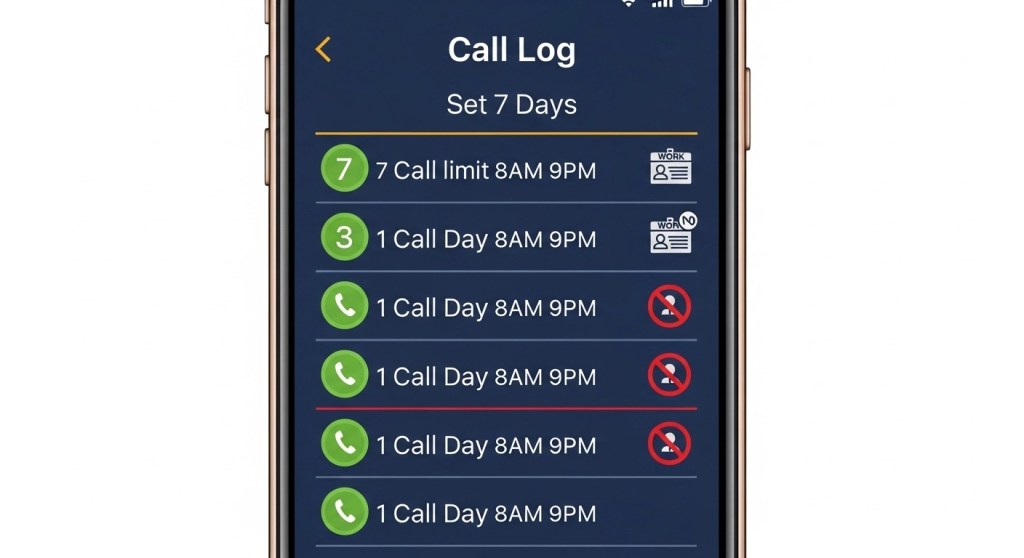
๐Ÿ“ž 7 calls in 7 days max

FDCPA limits collectors to 7 calls within 7 days about a specific debt. Log every call.

โฐ 8am – 9pm only

Calls outside these hours are illegal. They must respect your time.

๐Ÿข No calls at work (if asked)

Tell them once: “Do not call me at work.” They must stop.

๐Ÿ‘ฅ Third Party Contact Rules

Collectors CAN contact your spouse, parent (if you’re under 18), or co-signer. But they CANNOT contact other family members, neighbors, or coworkers โ€” and they definitely cannot tell them about your debt. If they do, that’s an FDCPA violation.

<!– Smartphone screen showing 7 calls in 7 days limit with red warning for excessive calls outside allowed hours –>

Image placeholder: 7 calls in 7 days visual (add later)

Smartphone screen illustrating FDCPA call limits: 7 calls in 7 days maximum, only between 8am-9pm, and no calls at workplace once requested to stop
Under the FDCPA, collectors are limited to 7 calls in 7 days about a specific debt

Can a Lender Threaten You With Criminal Charges?

Quick answer: No โ€” threatening criminal prosecution for non-payment is illegal. You cannot go to jail for failing to repay a consumer debt. Some lenders illegally threaten borrowers with arrest, district attorney involvement, or “check fraud” charges to scare them into paying. These threats violate the FDCPA and have led to successful lawsuits against lenders. If you receive one, document it and report it.

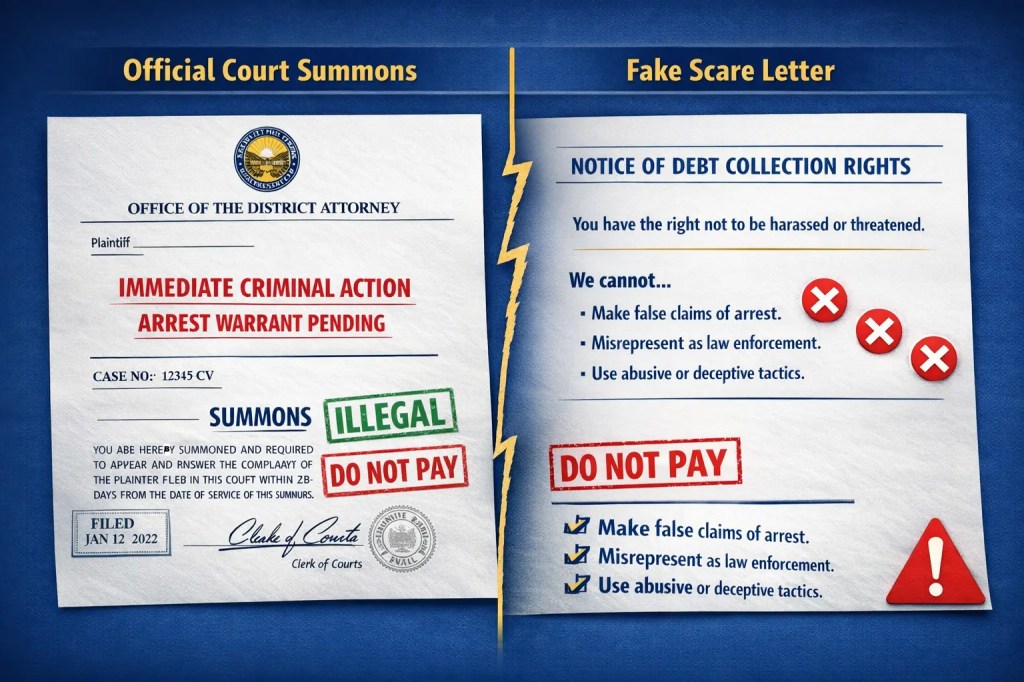
โš ๏ธ This Is Illegal โ€” Full Stop

Let’s be crystal clear: you cannot be arrested for failing to repay a payday loan. Debt collection is a civil matter, not a criminal one. Any lender or collector who threatens you with arrest, jail time, or criminal charges is breaking the law.

๐Ÿšจ Real Threats That Got Lenders Sued

“The district attorney will prosecute you”

FTC enforcement actions have targeted lenders using fake DA letterheads to scare borrowers .

“You committed check fraud โ€” we’re pressing charges”

Using criminal threats for bounced checks is illegal in many states .

“A warrant is being issued for your arrest”

Classic scare tactic. No warrant exists for unpaid consumer debt. Period.

โš–๏ธ Case in Point: Vine v. PLS Financial Services

In this class action lawsuit, borrowers alleged that payday lenders threatened them with criminal prosecution for bounced checks โ€” even though the checks were for loan payments. The case highlighted how lenders illegally used criminal threats to collect civil debts. Courts have ruled that threatening arrest or prosecution over unpaid loans violates the FDCPA.

๐Ÿ›ก๏ธ If You Receive a Criminal Threat:

  1. Do not panic โ€” you cannot be arrested for this
  2. Document everything โ€” save the letter, screenshot the email, record the voicemail
  3. Do not engage โ€” don’t argue, don’t pay out of fear
  4. Report it โ€” file complaints with the CFPB, FTC, and your state attorney general
  5. Consult an attorney โ€” you may have a case for damages under the FDCPA
<!– Example of illegal threat letter falsely claiming district attorney involvement in debt collection –>

๐Ÿ–ผ๏ธ [Image placeholder: Fake district attorney threat letter โ€” add later]

Split image comparison showing fake district attorney threat letter with arrest warrant claims on left, versus real FDCPA rights and "DO NOT PAY" warning on right for 2026 borrowers
Left: Illegal scare tactic used by predatory lenders. Right: Your actual rights under the FDCPA.

Left: Illegal threat letter (scam). Right: Your actual rights under the FDCPA.

๐Ÿ“–

Debt Collection Defense

Stop harassment. Know your rights. Take back control.

6 word-for-word phone scripts, 4 certified letter templates, and an FDCPA violations cheat sheet. Written in plain English โ€” no legal degree required.

Get the eBook โ†’

How Do You Know If a Lawsuit Is Real?

Quick answer: A real lawsuit means you are physically served with court papers called a summons and complaint. These documents will include a case number, court seal, judge’s name, and a specific deadline to respond (usually 20-30 days). If you receive these, you are in a real lawsuit. Ignoring them guarantees a default judgment against you.

โœ… REAL LAWSUIT

  • ๐Ÿ“„ Summons and Complaint (official court documents)
  • โš–๏ธ Case number (starts with year, e.g., 2026-CV-1234)
  • ๐Ÿ›๏ธ Court seal and judge’s name
  • ๐Ÿ“… Specific deadline to respond (20-30 days)
  • ๐Ÿ‘ค Physically served by sheriff or process server
  • ๐Ÿ’ฐ If ignored โ†’ default judgment against you

๐Ÿšจ FAKE THREAT

  • ๐Ÿ“ง Email or text message demanding payment
  • ๐Ÿ“ž Phone call threatening “legal action”
  • ๐Ÿ“ Scary letter with no court information
  • โŒ No case number, no court seal, no judge
  • ๐Ÿ“ฌ Sent by regular mail (not served)
  • ๐Ÿ’ฐ Designed to scare you into paying immediately
<!– Example of a real court summons showing case number, court seal, judge's name, and response deadline –>

๐Ÿ–ผ๏ธ [Image placeholder: Real court summons example โ€” add later]

โš ๏ธ IF YOU IGNORE REAL COURT PAPERS…

The lender wins by default judgment. That means they don’t have to prove you owe the money. They automatically get everything they asked for in their complaint โ€” including the ability to garnish wages, levy bank accounts, and place liens on property. A default judgment is much harder to fight than the original lawsuit.

โœ… If You Are Served With Real Court Papers:

  1. Do NOT ignore them โ€” this is the worst thing you can do
  2. Note the deadline โ€” usually 20-30 days from service date
  3. Respond in writing โ€” even a simple “I dispute this debt” letter filed with the court
  4. Show up to court โ€” if there’s a hearing, be there
  5. Seek help โ€” legal aid, consumer attorney, or court self-help center

70-90%

of debt collection lawsuits end in default judgment because borrowers don’t show up

Source: CFPB Debt Collection Report

๐Ÿ“Œ Source ยท Federal Rules of Civil Procedure
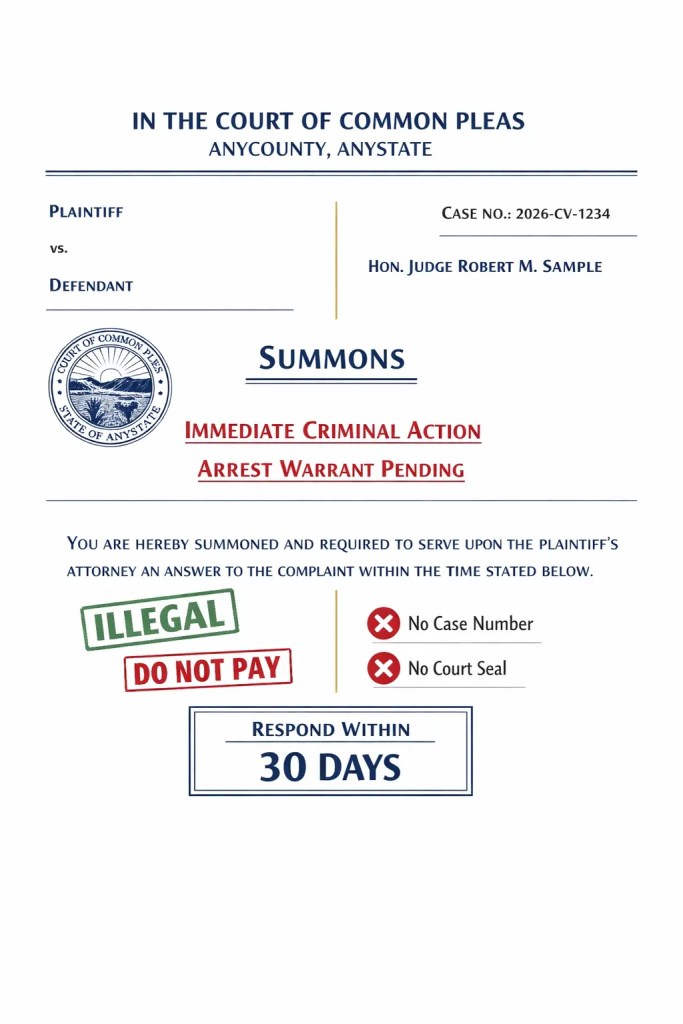
Real court summons example showing "YOU ARE HEREBY SUMMONED" language, 30-day response deadline, and DO NOT PAY warning for borrowers facing lawsuits in 2026
A real lawsuit gives you time to respond โ€” usually 30 days. Never ignore it.
Real court summons example showing YOU ARE HEREBY SUMMONED language, 30-day response deadline, and DO NOT PAY warning for borrowers facing lawsuits in 2026
๐Ÿ”ด ILLEGAL to ignore โœ… RESPOND within 30 days

Caption: A real lawsuit gives you time to respond โ€” usually 30 days. Never ignore it.

What Happens If a Lender Sues and Wins?

Quick answer: If a lender wins a lawsuit, the court issues a judgment against you. With this judgment, they can pursue wage garnishment (taking up to 25% of your disposable income), bank account levies (freezing and taking funds), or property liens. However, certain funds like Social Security, veterans’ benefits, and child support are generally exempt from garnishment.

โš–๏ธ First, They Need a Judgment

A lender cannot garnish your wages or take money from your bank account without first suing you and winning. That court victory gives them a judgment โ€” a legal document saying you owe the money. Only with this judgment can they take further action.

๐Ÿ“‹ Three Ways They Can Collect After a Judgment

๐Ÿ’ฐ Wage Garnishment

They can take up to 25% of your disposable income or the amount by which your weekly income exceeds 30x federal minimum wage โ€” whichever is less.

Limit: Cannot take so much that you can’t pay basic living expenses.

๐Ÿฆ Bank Account Levy

They can freeze your bank account and take money to satisfy the judgment. The bank must wait a certain period (usually 10-30 days) before releasing funds, giving you time to claim exemptions.

Warning: This happens without notice โ€” you may find your account frozen.

๐Ÿ  Property Lien

They can place a lien on your home or other property. You can’t sell or refinance without paying the judgment first.

Note: They usually can’t force you to sell your home, but the lien stays until paid.

๐Ÿ›ก๏ธ EXEMPT FUNDS โ€” They CANNOT Take These

Social Security

Retirement, disability, SSI

Veterans’ Benefits

VA compensation, pensions

Child Support

Payments received for children

Unemployment Benefits

State unemployment insurance

Disability Benefits

SSDI, private disability

Pension Payments

Federal, state, military pensions

โš ๏ธ Important: Exempt funds are only protected if you notify the court and your bank. If your account contains both exempt and non-exempt funds, the entire account can be frozen until you file a claim.

<!– List of funds exempt from garnishment including Social Security, veterans benefits, child support, disability, and pensions with shield icons –>

๐Ÿ–ผ๏ธ [Image placeholder: Exempt funds shield visual โ€” add later]

โœ… If Your Bank Account Is Frozen:

  1. Don’t panic โ€” you have rights
  2. Contact the bank immediately โ€” ask why and get the court case number
  3. File an exemption claim โ€” if your money is from protected sources (Social Security, etc.), you can file a claim to have it released
  4. Act quickly โ€” you usually have 10-30 days to claim exemptions
  5. Seek legal help โ€” legal aid or consumer attorney can assist
๐Ÿ“Œ Source ยท Consumer Credit Protection Act ยท CFPB Garnishment Rules
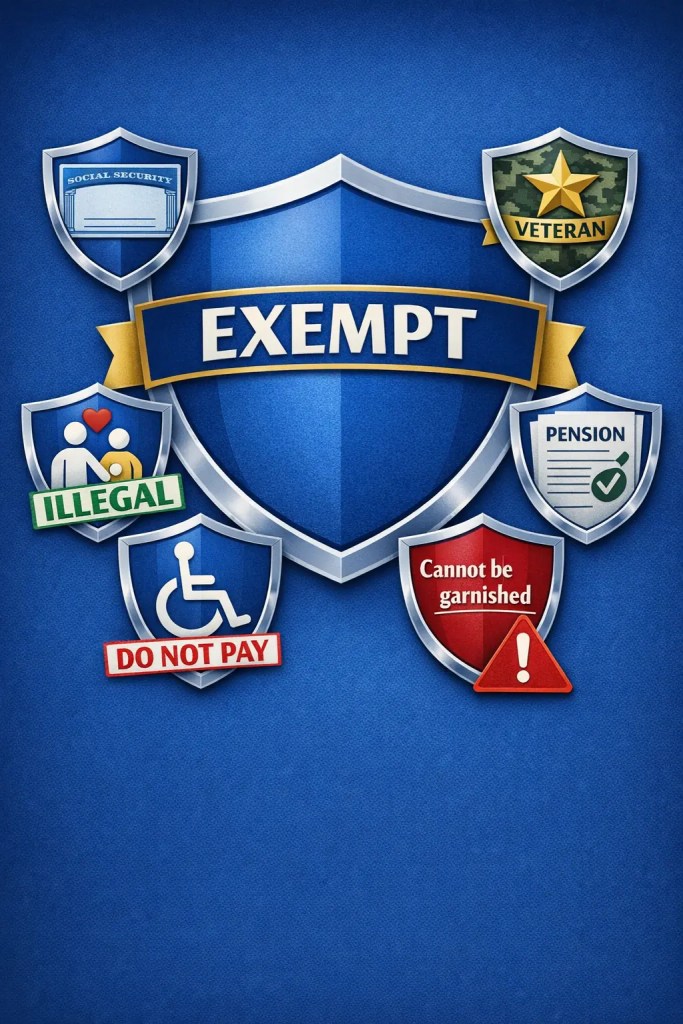
Shield icons protecting Social Security, veterans benefits, child support, disability, and pension funds from garnishment with "EXEMPT" label for 2026 borrowers
These funds are protected by federal law โ€” creditors cannot take them, even with a court judgment
Shield graphic protecting Social Security, veteran benefits, and pension funds with EXEMPT and ILLEGAL stamps, showing these funds cannot be garnished for 2026 borrowers
๐Ÿ”ด ILLEGAL to garnish โœ… EXEMPT by federal law

Caption: Social Security, veterans’ benefits, and pensions are protected. Creditors cannot take them โ€” even with a court judgment.

When Can’t a Payday Lender Sue You? (Void Loans)

Quick answer: If a lender isn’t licensed in your state, charges interest above state caps (like Maryland’s 33% limit), or operates through illegal “rent-a-tribe” schemes, the loan may be void and unenforceable. Recent lawsuits against Dave Inc. and MoneyLion show regulators taking action against unlicensed lenders. In these cases, they cannot sue you โ€” and may even owe you money back.

๐ŸŽฏ Here’s What Most Borrowers Don’t Know

Most people assume that if they borrowed money, they have to pay it back โ€” no matter what. But here’s the truth that lenders don’t want you to know: if the lender broke the law when making your loan, the loan itself may be VOID. That means they cannot sue you to collect, and in some cases, they owe you money back.

๐Ÿšซ 3 Reasons a Payday Lender CAN’T Sue You

1๏ธโƒฃ Unlicensed Lenders

Every state requires payday lenders to be licensed. If a lender operates without a license in your state, they are breaking the law โ€” and courts have ruled that unlicensed lenders cannot sue to collect.

โšก Recent Enforcement:

Dave Inc. โ€” Allegedly operated without license in multiple states, charging “tips” that pushed APRs over 2,500%

MoneyLion โ€” Facing class action for unlicensed lending and fees exceeding state caps

2๏ธโƒฃ Interest Rate Caps

Many states cap interest rates. In Maryland, consumer loans under $25,000 are capped at 33% APR. If a lender charges more, the loan may be void.

๐Ÿ“Š State Rate Caps:

  • Maryland: 33% APR
  • New York: 25% APR (civil) / 16% criminal
  • California: 36% for loans under $2,500
  • Colorado: 36% APR cap

3๏ธโƒฃ “Rent-a-Tribe” Schemes (Fake Tribal Immunity)

Some online lenders claim to be owned by Native American tribes to avoid state laws. Courts have repeatedly struck down these schemes when the lender, not the tribe, is the real party. If a lender uses this tactic, the loan may be void and they cannot sue you.

RICO lawsuits have been filed against lenders using tribal immunity to charge 700%+ APR .

<!– Gavel striking down unlicensed payday loan document with VOID stamp and court ruling –>

๐Ÿ–ผ๏ธ [Image placeholder: Gavel striking down void loan โ€” add later]

โš–๏ธ What This Means for YOU

If your lender is unlicensed or charged illegal rates:

  • They may NOT be able to sue you
  • If they already sued and won, you may be able to vacate the judgment
  • You may be entitled to a refund of fees and interest
  • You could have claims under state consumer protection laws

โœ… How to Check If Your Lender Is Licensed:

  1. Visit NMLS Consumer Access โ€” nmlsconsumeraccess.org
  2. Search the lender’s legal name (not the brand name)
  3. Check: Status “Active”? Your state listed?
  4. Check your state banking department website for licensed lenders
  5. Calculate APR โ€” does it exceed your state’s cap?

See Episode 13 for our complete guide to verifying lender licenses.

๐Ÿ“Œ Source ยท Baltimore City Circuit Court ยท NCLC Reports
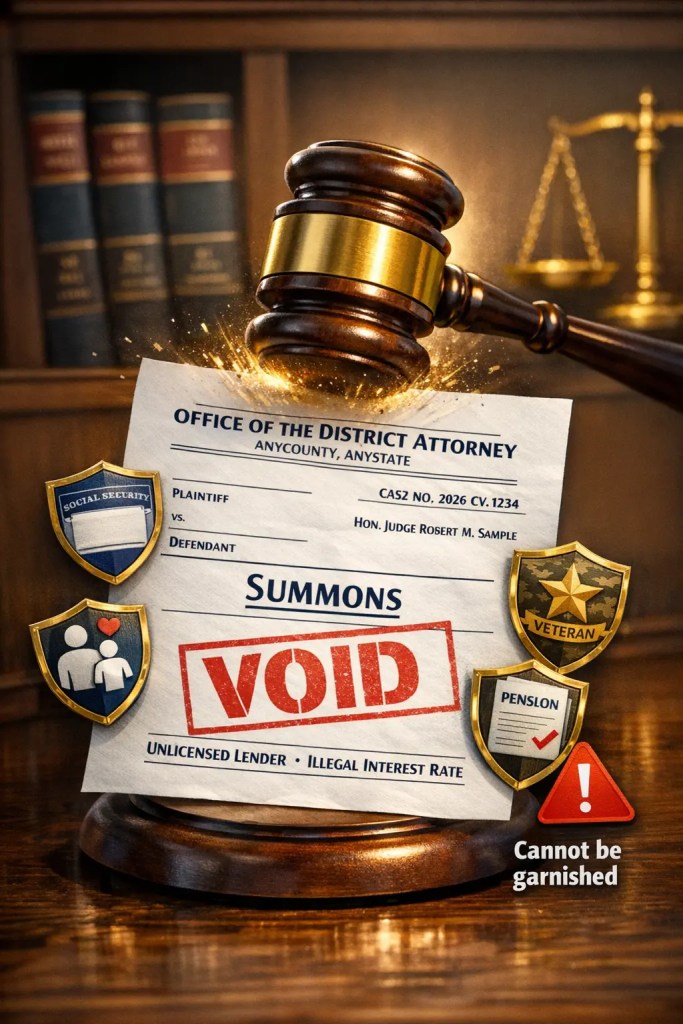
Court document showing VOID stamp with unlicensed lender and illegal interest rate reasons, plus cannot be garnished message, for 2026 payday loan borrowers
If your lender is unlicensed or charged illegal rates, the loan may be void โ€” they cannot sue you or garnish your wages
Court document showing VOID stamp with unlicensed lender and illegal interest rate reasons, plus cannot be garnished message, for 2026 payday loan borrowers
๐Ÿ”ด VOID โ€” Cannot sue โœ… Cannot garnish โš–๏ธ Unlicensed = unenforceable

Caption: If your lender is unlicensed or charged illegal rates, the loan may be void โ€” they cannot sue you or garnish your wages.

Word-for-Word Scripts: What to Say When They Threaten You

Quick answer: Having the right words ready can stop harassment and protect your rights. Use these scripts to demand they stop calling, request proof they can sue, and respond to criminal threats. Always document every call โ€” date, time, and exactly what was said. If they violate the law, you have grounds for a complaint.

Knowing your rights is one thing. Knowing exactly what to say when a collector calls is another. These scripts give you the words โ€” just fill in the blanks and speak calmly.

๐Ÿ“ž Script 1: “Stop Calling Me” (Cease Communication)

“This is [YOUR NAME]. I am recording this call for my records. I am demanding that you cease all communication with me regarding this debt. You may contact me in writing only. If you continue to call me after this request, you will be violating the Fair Debt Collection Practices Act, and I will file a complaint with the CFPB and FTC.”

When to use: When calls are constant, harassing, or outside 8am-9pm.

โš–๏ธ Script 2: “Is This a Real Lawsuit?”

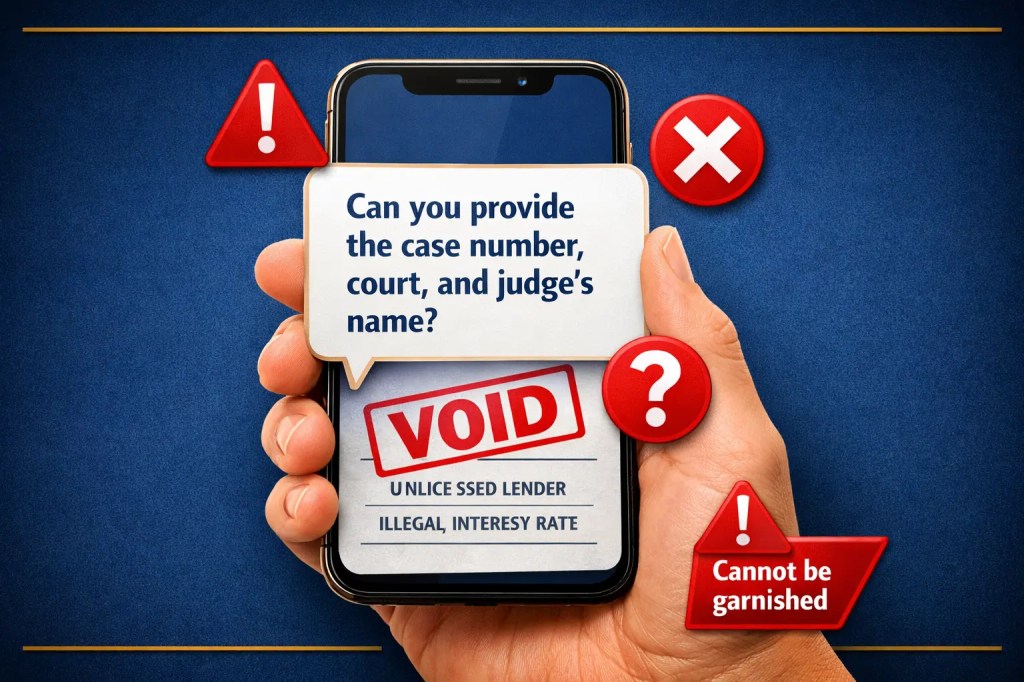
“I need you to provide me with the case number, the court where this lawsuit was filed, and the name of the judge assigned to the case. If you cannot provide that information immediately, I will assume this is an empty threat. Under the FDCPA, threatening legal action you don’t intend to take is illegal.”

When to use: When they threaten to sue but haven’t served you with papers.

๐Ÿšจ Script 3: “You Can’t Threaten Me With Jail”

“I want to make clear that I am recording this conversation. Threatening me with criminal prosecution or arrest for a civil debt is illegal under the FDCPA. I am giving you one chance to retract that threat. If you continue, I will file a complaint with the FTC and consult an attorney about your violation.”

When to use: If they mention arrest, district attorney, or criminal charges.

๐Ÿ“„ Script 4: “Prove I Owe This Debt” (Validation Request)

“I am requesting written validation of this debt within 30 days as allowed under the FDCPA. Please provide the original contract with my signature, a complete payment history, and proof that you are licensed to collect in my state. Until you provide this, you must stop all collection activities.”

When to use: First call from a collector โ€” forces them to prove the debt is real.

<!– Person holding phone with speech bubble showing script demanding collector prove lawsuit is real –>

๐Ÿ–ผ๏ธ [Image placeholder: Phone call script visual โ€” add later]

๐Ÿ“‹ Before You Call:

  • Record the call โ€” check your state’s recording laws (one-party consent states are safest)
  • Write down the date and time โ€” and the collector’s name
  • Stay calm โ€” read the script, don’t argue or explain
  • Don’t provide personal information โ€” they already have it
  • Hang up if they become abusive โ€” document and report
๐Ÿ“Œ Source ยท FDCPA 15 U.S.C. ยง 1692g ยท CFPB Complaint Portal
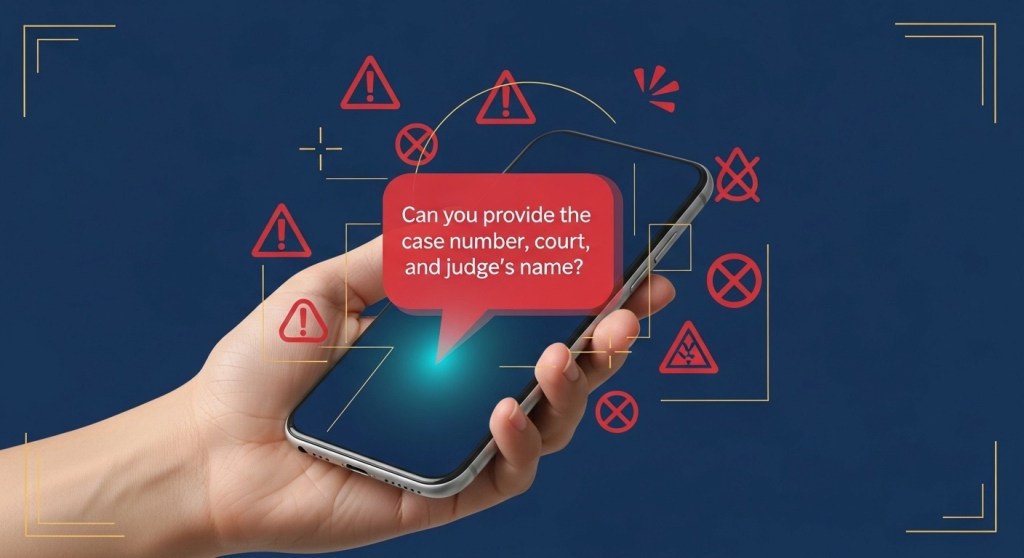
Phone speech bubble with text asking collector to provide case number, court, and judge's name to verify real lawsuit
Ask for proof โ†’ If unlicensed or illegal rates โ†’ Loan is VOID โ†’ They cannot garnish
Phone speech bubble with text: Can you provide the case number, court, and judge's name

Script: Demand proof of real lawsuit

๐ŸŽฏ Quick Summary: Your Rights at a Glance

Summary showing phone script, VOID stamp, unlicensed lender, illegal interest, and cannot be garnished

Ask for case number โ†’ If they can’t provide it โ†’ Loan may be VOID โ†’ Cannot garnish

Composite image showing phone script, VOID stamp, unlicensed lender, illegal interest rate, and cannot be garnished โ€” complete borrower rights summary
Ask for proof โ†’ If unlicensed or illegal rates โ†’ Loan is VOID โ†’ They cannot garnish

๐Ÿ“Œ YOUR RIGHTS AT A GLANCE

Composite summary showing phone script, VOID stamp, unlicensed lender, illegal interest, and cannot be garnished
โ‘  Ask for proof โ‘ก Check license โ‘ข Verify interest rate โ‘ฃ Loan may be VOID โ‘ค Cannot garnish

Frequently Asked Questions

Can a payday lender really sue me?

Yes, a payday lender can sue you for non-payment, but only after following specific legal procedures. They must first file a lawsuit in court and properly serve you with a summons and complaint. If they win, they obtain a judgment. However, many threats to sue are empty โ€” designed to scare you into paying without actual court action.

๐Ÿ“Œ Source ยท CFPB Debt Collection FAQs

How many times can a debt collector call me per day?

Under the FDCPA, collectors are limited to 7 calls within 7 days about a specific debt. Calls are generally allowed only between 8 a.m. and 9 p.m. your local time. Calls at work are prohibited if your employer disapproves. If a collector exceeds these limits, they may be violating federal law.

๐Ÿ“Œ Source ยท FDCPA 15 U.S.C. ยง 1692c

Can I go to jail for not paying a payday loan?

No. You cannot be arrested or jailed for failing to repay a consumer debt. Threatening criminal prosecution for non-payment is illegal under the FDCPA. Some lenders have been sued for falsely threatening borrowers with arrest or district attorney involvement. If you receive such threats, document them and report to the CFPB and FTC immediately.

๐Ÿ“Œ Source ยท FTC Enforcement Actions

What’s the difference between a judgment and a lawsuit?

A lawsuit is the legal action they file against you. A judgment is what they get if they win. You’ll know a lawsuit is real when you’re served with court papers. A judgment only happens if you lose (or ignore) the lawsuit. With a judgment, they can garnish wages, levy bank accounts, or place liens on property.

๐Ÿ“Œ Source ยท Federal Rules of Civil Procedure

Can they garnish my Social Security or veterans benefits?

No. Federal law protects Social Security, veterans benefits, child support, and certain other benefits from garnishment. However, if these funds are mixed with other money in your bank account, the entire account can be frozen until you file an exemption claim. You must notify the court and your bank that your funds are protected.

๐Ÿ“Œ Source ยท 42 U.S.C. ยง 407 ยท CFPB Exempt Funds Guide

What if my lender isn’t licensed in my state?

If a lender operates without a license in your state, the loan may be void and unenforceable. Recent lawsuits against Dave Inc. and MoneyLion highlight regulators taking action against unlicensed lenders. You can check a lender’s license status at nmlsconsumeraccess.org or through your state banking department website.

๐Ÿ“Œ Source ยท NMLS Consumer Access ยท State Banking Regulators

What should I do if I’m served with court papers?

Do NOT ignore them. Note the response deadline (usually 20-30 days). File a written response with the court โ€” even a simple “I dispute this debt” letter. Show up to any hearings. Seek help from legal aid or a consumer attorney. Ignoring court papers guarantees a default judgment against you, which leads to garnishment and levies.

๐Ÿ“Œ Source ยท Legal Services Corporation ยท CFPB

โš  For educational purposes only. Not legal advice. Laws regarding debt collection, lawsuits, and garnishment vary by state and change frequently. If you’re facing legal action, consult a qualified consumer rights attorney in your state.

๐Ÿ“ฅ Free Download โ€” Borrower’s Truth Series

Debt Collection Defense Checklist

Know your rights and fight back โ€” printable 5-step guide:

โœ“ Empty Threats vs. Real Lawsuits โœ“ 7 Call Limit Log โœ“ Criminal Threat Response โœ“ Exempt Funds Tracker โœ“ Void Loan Checklist

๐Ÿ“‹ Your PDF includes:

  • Call Log Sheet โ€” track every violation (date, time, what they said)
  • Real Lawsuit Verifier โ€” know when it’s actually real
  • Criminal Threat Check โ€” illegal tactics to document
  • Exempt Funds Tracker โ€” protect Social Security, VA benefits
  • Void Loan Checklist โ€” when they can’t sue you
  • Action Steps โ€” exactly what to do next
โฌ‡ Download Free PDF Kit โ†’

Free ยท No sign-up required ยท ConfidenceBuildings.com ยท Pairs with Episode 15

PDF includes checkboxes, call log, and fillable forms

“If you’re being sued and can’t afford an attorney, Standard Legal offers affordable legal forms and document preparation services for bankruptcy and debt-related legal matters.”

โš–๏ธ

Need Legal Documents Without the High Attorney Fees?

Standard Legal helps you create legally valid documents for bankruptcy, wills, incorporation, lease agreements, and more โ€” at a fraction of the cost of hiring an attorney. Two affordable options:

๐Ÿ“„ Document Preparation Service

Let Standard Legal prepare your documents for you

  • Professionally prepared legal documents
  • Review by legal professionals
  • Perfect for bankruptcy, wills, incorporation
Get Started โ†’

๐Ÿ’ป Legal Forms Software

Create your own documents with easy-to-use software

  • Complete legal forms library
  • Step-by-step interview format
  • Unlimited use for one low price
Browse Software โ†’
๐Ÿ”— Affiliate Disclosure: Some links on this page are affiliate links. If you choose to purchase through these links, I may earn a commission at no extra cost to you. I only recommend tools I trust โ€” and Standard Legal has helped thousands of people save on attorney fees.

๐Ÿ”ฌ Research Note & Primary Sources

This article is part of the Borrower’s Truth Series, a 30-day educational series by Laxmi Hegde, MBA in Finance. All statistics, legal references, and case citations are drawn from government agencies, court records, and primary research institutions as of March 2026.

Primary Sources:

  • Consumer Financial Protection Bureau (CFPB) โ€” Debt collection practices, complaint database, and enforcement actions
  • Federal Trade Commission (FTC) โ€” Fair Debt Collection Practices Act (FDCPA) guidelines and enforcement
  • National Consumer Law Center (NCLC) โ€” Debt collection abuse reports and borrower rights research
  • U.S. Courts โ€” Federal Rules of Civil Procedure, default judgment statistics
  • Social Security Administration โ€” 42 U.S.C. ยง 407 (exempt funds protection)
  • Vine v. PLS Financial Services โ€” Class action regarding criminal threats in debt collection
  • Dave Inc. & MoneyLion lawsuits โ€” Baltimore City Circuit Court cases on unlicensed lending
  • National Conference of State Legislatures (NCSL) โ€” State payday lending laws and rate caps
  • NMLS Consumer Access โ€” Lender licensing database

โš–๏ธ Fair Debt Collection Practices Act (FDCPA) โ€” Key Provisions:

  • 15 U.S.C. ยง 1692c โ€” Communication limits (time/place, third-party contact)
  • 15 U.S.C. ยง 1692d โ€” Prohibition on harassment and abuse
  • 15 U.S.C. ยง 1692e โ€” False or misleading representations (including threats)
  • 15 U.S.C. ยง 1692f โ€” Unfair practices
  • 15 U.S.C. ยง 1692g โ€” Validation of debts (must provide proof)

๐Ÿ›ก๏ธ Exempt Funds โ€” Federal Protections:

  • 42 U.S.C. ยง 407 โ€” Social Security benefits cannot be garnished
  • 38 U.S.C. ยง 5301 โ€” Veterans benefits protected
  • 42 U.S.C. ยง 659 โ€” Child support exceptions limited
  • 15 U.S.C. ยง 1673 โ€” Wage garnishment limited to 25% of disposable income

For the complete Borrower’s Truth Series guide, visit: The Complete Borrower’s Truth Guide โ†’ ConfidenceBuildings.com

๐Ÿ“Œ Updated March 2026 ยท ConfidenceBuildings.com Research Project

๐Ÿ“š Emergency Borrowing Blueprint 2026 โ€” 15 of 30 Episodes Complete

Week 1: Basics โœ“ Week 2: Predatory Lenders (Ep 8-14) โœ“ Week 3: Fine Print Files (Ep 15-21) โฌ…๏ธ Week 4: After You Borrow (Ep 22-30)
15 episodes published
50% complete
15 episodes remaining

All episodes available at Emergency Borrowing Blueprint 2026

๐Ÿ”” Bookmark the series or check back daily โ€” new episodes every morning

๐Ÿ“… Published March 16, 2026 ยท Updated as part of the ConfidenceBuildings.com 2026 Consumer Finance Research Project.

This post is Episode 15 of 30 in the Borrower’s Truth Series, examining emergency borrowing, predatory lending practices, and consumer financial rights. All data, legal references, and case citations have been verified as of March 2026.

Research methodology: Information compiled from primary sources including the Consumer Financial Protection Bureau (CFPB), Federal Trade Commission (FTC), U.S. Courts, National Consumer Law Center (NCLC), and federal statutes (FDCPA, 42 U.S.C. ยง 407). Case references include Vine v. PLS Financial Services and recent enforcement actions against Dave Inc. and MoneyLion.

โš–๏ธ For educational purposes only. Not financial or legal advice. Laws vary by state and change frequently. Always consult a qualified attorney for advice specific to your situation.

ยฉ 2026 ConfidenceBuildings.com ยท Borrower’s Truth Series ยท Laxmi Hegde, MBA in Finance

โ† Back

Thank you for your response. โœจ

๐Ÿงฎโœจ

Free Access: Finance Calculator

Get instant access to loan, investment, and retirement tools.

๐Ÿ“ง Subscribe with Email โ†’

One-click signup. No spam. You’ll get the calculator link immediately.

Already subscribed? Open calculator โ†’

Debt Collectors Don’t Want You to Read This

Borrower’s Truth Series โ€” 30 Days
Day 23 of 30 โ€” 77% Complete
1 2 3 4 5 6 7 8 9 10 11 12 13 14 15 16 17 18 19 20 21 22 23 24 25 26 27 28 29 30
Week 4 โ€” After You Borrow  ยท  View All 30 Days โ†’

Week 4 โ€” After You Borrow ยท Day 23 of 30

Debt Collectors Don’t Want
You to Read This

When a debt collector calls, most people feel powerless. They shouldn’t. The Fair Debt Collection Practices Act gives you specific, enforceable rights โ€” and debt collectors are trained to hope you never find out what they are.

77K+
debt collection complaints filed with the CFPB in a single year
Source: CFPB
1977
year the FDCPA was enacted โ€” your rights have existed for decades
Source: FTC
$1,000
maximum statutory damages you can sue for per FDCPA violation
Source: FTC
What You’ll Learn Today
  • The 10 things debt collectors are legally prohibited from doing
  • Your right to demand written verification of any debt
  • How to use a cease communication letter to stop calls legally
  • The statute of limitations โ€” why old debts have an expiry date
  • Word-for-word scripts for responding to collector calls

โš  For educational purposes only. Not legal advice. The information on this page is intended to help consumers understand their rights under the Fair Debt Collection Practices Act (FDCPA). Debt collection laws vary by state โ€” many states have additional protections beyond federal law. The FDCPA applies to third-party debt collectors and collection agencies; it does not always apply to original creditors collecting their own debts. Statute of limitations periods vary significantly by state and debt type. Always verify current rules with your state attorney general’s office or a licensed consumer rights attorney before taking any legal action. The CFPB and FTC are referenced for informational purposes only โ€” neither agency endorses this content.

๐Ÿ“š Borrower’s Truth Series โ€” Week 4 of 5

After You Borrow

Week 4 covers what happens after you sign โ€” missed payments, debt spirals, collector calls, disputing fees, and rebuilding. Day 22 gave you the exit strategy from the payday loan cycle. Today we cover what happens when the cycle has already gone too far โ€” and debt collectors have entered the picture. Knowing your rights before that call arrives changes everything.

Week 4 Episodes

โญ Essential Reading โ€” Start Here

Dealing With Collectors? Check Your Original Loan Contract First.

Before you respond to any debt collector, know exactly what your original loan agreement says. The Loan Clause Checklist identifies the clauses that affect your rights in collections โ€” including mandatory arbitration clauses that could limit your legal options and ACH authorization language collectors may try to use. Free. No email required.

Why It Matters When Collectors Call
  • Mandatory arbitration clause โ€” limits your right to sue for FDCPA violations
  • ACH authorization โ€” collectors may claim rights to your bank account
  • Cross-collateralization โ€” affects which assets are at risk in collections
  • Acceleration clause โ€” triggers full balance due on default
๐Ÿ“‹ Open the Free Checklist โ†’

Free resource ยท No sign-up required ยท Referenced throughout the Borrower’s Truth Series

Ten things debt collectors are legally prohibited from doing under the FDCPA
Each section of this shield represents a federal law protection you already have
๐Ÿ“Œ Quick Answer

The Fair Debt Collection Practices Act (FDCPA) gives you specific, enforceable rights against third-party debt collectors. They cannot call before 8am or after 9pm. They cannot threaten violence, use obscene language, or make false statements. They cannot contact you at work if you tell them not to. You can demand written verification of any debt. You can send a cease communication letter that legally stops all contact. And if they violate any of these rules, you can sue them for up to $1,000 in statutory damages plus attorney fees โ€” in federal court.

The Law That Protects You โ€” The Fair Debt Collection Practices Act

The Fair Debt Collection Practices Act has been federal law since 1977. It was created specifically because debt collection abuses were widespread โ€” harassment, threats, false statements, and middle-of-the-night calls were common practice. Congress stepped in and drew a clear legal line around what collectors can and cannot do.

The FDCPA applies to third-party debt collectors โ€” collection agencies, debt buyers, and attorneys who regularly collect debts. It does not automatically apply to the original creditor collecting their own debt. However, many states have enacted laws that extend similar protections to original creditors โ€” check your state attorney general’s website for your specific state rules.

The most important thing to understand about the FDCPA is that it is self-enforcing. You do not need a government agency to act on your behalf. If a collector violates the law, you can file a lawsuit yourself โ€” in federal court โ€” and the collector pays your attorney fees if you win. That fee-shifting provision is what gives the law its teeth.

FDCPA โ€” Key Facts Every Borrower Should Know
๐Ÿ“… Enacted
1977 โ€” updated by the CFPB in 2021 to cover digital communications
๐ŸŽฏ Who It Covers
Third-party collectors, collection agencies, debt buyers, collection attorneys
๐Ÿ’ฐ Your Damages
Up to $1,000 per lawsuit plus actual damages plus attorney fees
โฐ Time Limit
You have one year from the violation date to file a lawsuit

10 Things Debt Collectors Are Legally Prohibited From Doing

Print this list. Keep it near your phone. Every item below is a federal law violation โ€” and each one is grounds for a lawsuit against the collector.

1
Call outside permitted hours
Collectors cannot call before 8:00am or after 9:00pm in your local time zone. Any call outside these hours is an automatic violation โ€” regardless of how many times they have tried to reach you.
2
Use harassment or abusive language
Threats of violence, obscene language, repeated calls designed to annoy, and publishing your name on a “bad debt” list are all prohibited. Any communication designed to intimidate rather than inform violates the FDCPA.
3
Make false or misleading statements
Collectors cannot claim to be attorneys, government officials, or credit bureaus. They cannot misrepresent the amount owed, threaten legal action they cannot or do not intend to take, or claim you will be arrested for not paying a debt.
4
Contact you at work after being told not to
If you tell a collector verbally or in writing that your employer does not permit personal calls at work, they must immediately stop contacting you there. Any subsequent contact at your workplace is a violation.
5
Contact third parties about your debt
Collectors can only contact third parties โ€” family members, neighbors, employers โ€” to locate you. They cannot discuss your debt with anyone other than you, your spouse, or your attorney. Disclosing your debt to others is a serious violation.
6
Threaten arrest or criminal prosecution
Debt is a civil matter in the United States โ€” not a criminal one. You cannot be arrested for failing to pay a consumer debt. Any collector who threatens arrest, jail, or criminal charges is lying โ€” and violating federal law simultaneously.
7
Add unauthorized fees or interest
Collectors can only collect the amount owed plus interest, fees, and charges expressly authorized by the original agreement or permitted by law. Any amount added beyond that โ€” processing fees, collection surcharges โ€” is a violation unless specifically allowed.
8
Continue contact after a cease letter is received
Once you send a written cease communication request, the collector must stop all contact โ€” with very limited exceptions. Any contact after receiving your cease letter is a direct FDCPA violation and grounds for immediate legal action.
9
Fail to provide debt verification
Within five days of first contact, collectors must send you a written notice with the debt amount, creditor name, and your right to dispute. If you request verification within 30 days, they must stop collection activity until verification is provided.
10
Contact you if you have an attorney
If you notify a collector that you have an attorney handling the debt, they must communicate exclusively with your attorney from that point forward. Any direct contact with you after that notification is a violation.

Your 3 Most Powerful Rights โ€” And How to Use Them

Right 1 โ€” Demand Written Debt Verification

Within 30 days of a collector’s first contact, you can send a written debt verification request. The collector must then stop all collection activity โ€” calls, letters, everything โ€” until they provide written verification of the debt including the original creditor’s name and the amount owed. This right alone stops many aggressive collection campaigns in their tracks โ€” particularly on old or purchased debts where documentation is incomplete.

๐Ÿ“ Debt Verification Request โ€” Word for Word

“I am writing in response to your recent contact regarding an alleged debt. Pursuant to my rights under the Fair Debt Collection Practices Act, 15 U.S.C. ยง 1692g, I hereby request written verification of this debt including: the name and address of the original creditor, the amount of the debt and how it was calculated, and proof that your agency is licensed to collect debts in my state. Until verification is provided, please cease all collection activity. This is not a refusal to pay โ€” it is a request for verification as permitted by federal law.”

Send via certified mail with return receipt. Keep a copy. Never send the original โ€” keep all originals for your records.

Right 2 โ€” Send a Cease Communication Letter

A cease communication letter โ€” also called a cease and desist letter โ€” legally requires the collector to stop all contact once received. They may contact you one final time to confirm they are ceasing communication or to notify you of a specific action they intend to take. After that, silence is legally required. Note that this does not eliminate the debt โ€” it stops the harassment while you decide how to handle the situation.

๐Ÿ“ Cease Communication Letter โ€” Word for Word

“Pursuant to my rights under the Fair Debt Collection Practices Act, 15 U.S.C. ยง 1692c(c), I am hereby demanding that you immediately cease all communication with me regarding the alleged debt referenced in your recent contact. This includes phone calls, text messages, emails, letters, and any other form of communication. Any further contact โ€” except to notify me that collection efforts are being terminated or that you intend to take a specific legal action โ€” will constitute a violation of the FDCPA and I will pursue all available legal remedies.”

Send via certified mail with return receipt requested. Date your copy. If calls continue after delivery, document every instance โ€” each call is a separate violation worth up to $1,000.

Right 3 โ€” Know Your Statute of Limitations

Every debt has a statute of limitations โ€” a legal time limit after which a collector cannot sue you to collect it. Once the statute of limitations has passed, the debt is considered “time-barred.” Collectors can still contact you about it and you still technically owe it โ€” but they cannot win a lawsuit to force you to pay. Statutes of limitations vary by state and debt type, typically ranging from 3 to 6 years for consumer debts.

โš  Critical Warning โ€” Never Make a Partial Payment on a Time-Barred Debt

In many states, making even a small payment on a time-barred debt โ€” or making a written promise to pay โ€” resets the statute of limitations clock entirely. The debt becomes legally enforceable again from that date. Always verify the age of a debt and your state’s statute of limitations before making any payment on an old debt.

CFPB Annual Report Finding
1 in 3
Americans with a credit file have a debt in collections
Most of them do not know their rights under the FDCPA. Most collectors are counting on that.
Source: Consumer Financial Protection Bureau ยท consumerfinance.gov

What to Say โ€” And What to Never Say โ€” When a Collector Calls

Every word matters on a debt collection call. Here is the script that protects your rights while giving away nothing that can be used against you.

โœ… SAY THIS
  • “Please provide the name of your collection agency and your contact information.”
  • “I am requesting written verification of this debt.”
  • “Please send all future communication in writing only.”
  • “I do not acknowledge this debt at this time.”
  • “I will respond in writing within the timeframe permitted by law.”
โŒ NEVER SAY THIS
  • “Yes, I owe this debt.” โ€” Verbal acknowledgment can reset the statute of limitations in some states.
  • “I’ll pay $50 right now.” โ€” Partial payment can restart the clock on time-barred debt.
  • Your bank account or routing number โ€” ever, to any collector.
  • “I don’t have any money.” โ€” This is irrelevant and weakens your negotiating position.
  • Your Social Security number โ€” a legitimate collector already has this.

 Certified cease communication letter stopping debt collector contact legally
A cease communication letter sent via certified mail legally stops all collector contact
Reader Story ยท Composite Account
“They Said I’d Be Arrested. I Almost Believed Them.”

Sandra, 45, received a call from a collector who told her a sheriff would be at her door within 48 hours if she did not pay $780 immediately. Panicked, she nearly gave them her debit card number over the phone. Her daughter โ€” who had read Day 23 of the Borrower’s Truth Series โ€” stopped her. The threat was completely fabricated. Consumer debt is a civil matter. No sheriff was coming. Sandra sent a cease communication letter the next day and filed a CFPB complaint. The calls stopped within 48 hours.

Her Mistake

Sandra did not know that threatening arrest for consumer debt is an explicit FDCPA violation. The collector was counting on fear and ignorance to extract an immediate payment. Had she paid, the debt would have been acknowledged and potentially renewed โ€” with no legal recourse for the illegal threat.

What She Did

Sent a cease communication letter via certified mail. Filed a complaint at consumerfinance.gov/complaint citing the specific FDCPA violation โ€” threatening arrest for consumer debt. Also filed with the FTC at reportfraud.ftc.gov. Documented all calls with dates, times, and exact statements made. Consulted a consumer rights attorney about potential statutory damages.

RM
Attorney Rachel Morrow
Consumer Rights Attorney ยท Educational Illustration Only

“The arrest threat is one of the oldest and most illegal tactics in debt collection. It works because most people do not know that consumer debt is civil โ€” not criminal. You cannot be jailed for failing to pay a credit card, a medical bill, or a payday loan. Any collector who says otherwise is not just lying โ€” they are committing a federal law violation that entitles you to sue them for damages.”

Legal Analysis

Under 15 U.S.C. ยง 1692e, a debt collector may not use any false, deceptive, or misleading representation in connection with the collection of any debt. Threatening arrest or criminal prosecution for a consumer debt falls squarely within this prohibition. Each violation carries statutory damages of up to $1,000, plus actual damages and attorney fees. In class action cases involving systematic violations, damages can reach $500,000 or 1% of the collector’s net worth.

Bottom Line

If a collector threatens arrest โ€” hang up, document the call immediately with date, time, and exact words used, then file complaints with both the CFPB and FTC. Consult a consumer rights attorney. Many take FDCPA cases on contingency โ€” meaning you pay nothing unless you win. The collector may end up paying you.

Reader Story ยท Based on Public Case Records
“They Called My Boss. That Was Their Mistake.”

Trevor, 29, was three months behind on a personal loan when a collector called his workplace and told his supervisor he had an “urgent legal matter” that required immediate attention โ€” a thinly veiled reference to the debt. Trevor’s employer called him into the office. Humiliated and furious, Trevor contacted a consumer rights attorney the same afternoon. The collector had violated the FDCPA by disclosing debt information to a third party. The case settled out of court.

The Violation

Collectors may contact an employer only to verify employment or locate a borrower โ€” not to discuss or imply the existence of a debt. Telling Trevor’s supervisor there was an “urgent legal matter” was a deliberate disclosure designed to pressure Trevor through embarrassment. This is an explicit FDCPA violation under ยง 1692c and ยง 1692b.

What He Did

Documented the call details immediately โ€” time, collector’s name, agency name, and exact words reported by his supervisor. Contacted a consumer rights attorney who took the case on contingency. Filed CFPB and FTC complaints simultaneously. The case settled โ€” Trevor received compensation and the collector was required to cease all contact permanently.

RM
Attorney Rachel Morrow
Consumer Rights Attorney ยท Educational Illustration Only

“Workplace contact designed to embarrass or pressure a borrower is one of the clearest FDCPA violations a collector can commit. The law is explicit โ€” third-party contact is permitted only to locate a consumer, not to discuss or imply the debt. Documentation is everything in these cases. The borrower who writes down names, times, and exact words immediately after the call has a case. The borrower who waits often does not.”

Legal Analysis

FDCPA ยง 1692b strictly limits what collectors can say to third parties during location inquiries. They must identify themselves, state they are confirming location information, and not indicate that the consumer owes a debt. Any statement that implies a debt exists โ€” including vague references to “legal matters” or “urgent financial issues” โ€” crosses the legal line. Courts have consistently upheld consumer claims in these scenarios.

Bottom Line

If a collector contacts your employer, family member, or neighbor in a way that reveals or implies your debt โ€” document everything immediately and contact a consumer rights attorney the same day. Time matters in these cases. Many attorneys take FDCPA cases on contingency and the collector may end up compensating you directly.

<div style="background:#e65100;padding:16px 22
Reader Story ยท Composite Account
“They Said I’d Be Arrested. I Almost Believed Them.”

Sandra, 45, received a call from a collector who told her a sheriff would be at her door within 48 hours if she did not pay $780 immediately. Panicked, she nearly gave them her debit card number over the phone. Her daughter โ€” who had read Day 23 of the Borrower’s Truth Series โ€” stopped her. The threat was completely fabricated. Consumer debt is a civil matter. No sheriff was coming. Sandra sent a cease communication letter the next day and filed a CFPB complaint. The calls stopped within 48 hours.

Her Mistake

Sandra did not know that threatening arrest for consumer debt is an explicit FDCPA violation. The collector was counting on fear and ignorance to extract an immediate payment. Had she paid, the debt would have been acknowledged and potentially renewed โ€” with no legal recourse for the illegal threat.

What She Did

Sent a cease communication letter via certified mail. Filed a complaint at consumerfinance.gov/complaint citing the specific FDCPA violation โ€” threatening arrest for consumer debt. Also filed with the FTC at reportfraud.ftc.gov. Documented all calls with dates, times, and exact statements made. Consulted a consumer rights attorney about potential statutory damages.

RM
Attorney Rachel Morrow
Consumer Rights Attorney ยท Educational Illustration Only

“The arrest threat is one of the oldest and most illegal tactics in debt collection. It works because most people do not know that consumer debt is civil โ€” not criminal. You cannot be jailed for failing to pay a credit card, a medical bill, or a payday loan. Any collector who says otherwise is not just lying โ€” they are committing a federal law violation that entitles you to sue them for damages.”

Legal Analysis

Under 15 U.S.C. ยง 1692e, a debt collector may not use any false, deceptive, or misleading representation in connection with the collection of any debt. Threatening arrest or criminal prosecution for a consumer debt falls squarely within this prohibition. Each violation carries statutory damages of up to $1,000, plus actual damages and attorney fees. In class action cases involving systematic violations, damages can reach $500,000 or 1% of the collector’s net worth.

Bottom Line

If a collector threatens arrest โ€” hang up, document the call immediately with date, time, and exact words used, then file complaints with both the CFPB and FTC. Consult a consumer rights attorney. Many take FDCPA cases on contingency โ€” meaning you pay nothing unless you win. The collector may end up paying you.

Reader Story ยท Based on Public Case Records
“They Called My Boss. That Was Their Mistake.”

Trevor, 29, was three months behind on a personal loan when a collector called his workplace and told his supervisor he had an “urgent legal matter” that required immediate attention โ€” a thinly veiled reference to the debt. Trevor’s employer called him into the office. Humiliated and furious, Trevor contacted a consumer rights attorney the same afternoon. The collector had violated the FDCPA by disclosing debt information to a third party. The case settled out of court.

The Violation

Collectors may contact an employer only to verify employment or locate a borrower โ€” not to discuss or imply the existence of a debt. Telling Trevor’s supervisor there was an “urgent legal matter” was a deliberate disclosure designed to pressure Trevor through embarrassment. This is an explicit FDCPA violation under ยง 1692c and ยง 1692b.

What He Did

Documented the call details immediately โ€” time, collector’s name, agency name, and exact words reported by his supervisor. Contacted a consumer rights attorney who took the case on contingency. Filed CFPB and FTC complaints simultaneously. The case settled โ€” Trevor received compensation and the collector was required to cease all contact permanently.

RM
Attorney Rachel Morrow
Consumer Rights Attorney ยท Educational Illustration Only

“Workplace contact designed to embarrass or pressure a borrower is one of the clearest FDCPA violations a collector can commit. The law is explicit โ€” third-party contact is permitted only to locate a consumer, not to discuss or imply the debt. Documentation is everything in these cases. The borrower who writes down names, times, and exact words immediately after the call has a case. The borrower who waits often does not.”

Legal Analysis

FDCPA ยง 1692b strictly limits what collectors can say to third parties during location inquiries. They must identify themselves, state they are confirming location information, and not indicate that the consumer owes a debt. Any statement that implies a debt exists โ€” including vague references to “legal matters” or “urgent financial issues” โ€” crosses the legal line. Courts have consistently upheld consumer claims in these scenarios.

Bottom Line

If a collector contacts your employer, family member, or neighbor in a way that reveals or implies your debt โ€” document everything immediately and contact a consumer rights attorney the same day. Time matters in these cases. Many attorneys take FDCPA cases on contingency and the collector may end up compensating you directly.

Reader Story ยท Composite Account
“The Debt Was Seven Years Old. They Never Told Me.”

Camille, 52, received a collection notice for a $340 debt she barely remembered โ€” a utility bill from 2017. The collector’s letter was urgent and threatening, implying legal action was imminent. What the letter did not mention: the statute of limitations in her state for this type of debt was five years. The debt was legally time-barred. The collector could not sue her. She nearly paid it in full just to make the stress stop โ€” which would have been her biggest financial mistake of the year.

Her Mistake (Nearly)

Camille almost made a partial payment to “show good faith” โ€” which would have reset the statute of limitations entirely in her state, making the debt legally enforceable again for another five years. Always verify the age of any debt and your state’s statute of limitations before making any payment or written acknowledgment.

What She Did

Verified the debt date against her records. Confirmed her state’s statute of limitations for utility debts at her state attorney general’s website. Sent a debt verification request noting the apparent age of the debt. The collector ceased contact. She filed a CFPB complaint noting the collector’s failure to disclose that the debt was time-barred โ€” a requirement under CFPB rules effective since 2021.

RM
Attorney Rachel Morrow
Consumer Rights Attorney ยท Educational Illustration Only

“Zombie debt โ€” old, time-barred debt that collectors attempt to resurrect โ€” is one of the most profitable segments of the collections industry. Debt portfolios are bought for pennies on the dollar precisely because many debts are uncollectable by lawsuit. The collector’s entire strategy depends on the consumer not knowing the debt is time-barred. A single payment resets the clock. That payment is worth far more to the collector than the face value of the debt.”

Legal Analysis

Since November 2021, CFPB rules require debt collectors to disclose when a debt is time-barred and that making a payment could revive the legal enforceability of the debt. However, enforcement is inconsistent and many collectors โ€” particularly smaller agencies and debt buyers โ€” continue to pursue time-barred debts without disclosure. Always check the date of last activity on any debt before responding. Your state attorney general’s website lists current statute of limitations periods by debt type.

Bottom Line

Before paying any old debt โ€” verify the date of last activity, confirm your state’s statute of limitations for that debt type, and consult a consumer rights attorney if the debt appears time-barred. Never make a payment or written acknowledgment on an old debt without understanding the statute of limitations consequences first. The collector is counting on you not knowing this. Now you do.

 Clock representing the statute of limitations expiry on time-barred consumer debt
Every debt has an expiry date โ€” knowing yours is one of your most powerful financial rights

Frequently Asked Questions โ€” Debt Collector Rights
All answers include citations from U.S. government sources
Q: Does the FDCPA apply to the original creditor or only collection agencies?

The FDCPA primarily applies to third-party debt collectors โ€” collection agencies, debt buyers, and attorneys who regularly collect debts on behalf of others. It does not automatically apply to original creditors collecting their own debts. However, if an original creditor uses a different name that implies a third party is collecting, they may fall under the FDCPA. Additionally, many states have enacted their own debt collection laws that extend FDCPA-style protections to original creditors. Always check your state attorney general’s website for your state’s specific rules โ€” in some states your protections are significantly broader than the federal baseline.

โš  For educational purposes only. Not legal advice.
Q: Can a debt collector contact me by text message or email?

Yes โ€” since November 2021, updated CFPB rules known as Regulation F explicitly permit debt collectors to contact consumers via email, text message, and social media direct messages, in addition to phone calls and letters. However, the same FDCPA protections apply to all communication channels. Collectors must still identify themselves, cannot contact you at inconvenient times, must honor opt-out requests for digital communications, and cannot publicly post about your debt on social media. You can instruct a collector to stop contacting you via specific channels โ€” for example, by text โ€” while still allowing written communication.

โš  For educational purposes only. Not legal advice.
Q: How do I find out if a debt is time-barred in my state?

The statute of limitations on a debt begins from the date of your last payment or the date of default โ€” whichever is later. To find your state’s current statute of limitations, search your state name plus “statute of limitations consumer debt” and verify at your state attorney general’s website. Statutes of limitations vary by debt type โ€” credit cards, medical bills, and personal loans may have different periods even within the same state. Be aware that some collectors attempt to collect in states with longer limitation periods than your home state โ€” generally your home state’s laws apply. If you are unsure whether a debt is time-barred, consult a consumer rights attorney before making any payment or written acknowledgment.

โš  For educational purposes only. Not legal advice.
Q: What happens after I send a cease communication letter?

Once a collector receives your cease communication letter, they may only contact you one final time โ€” to confirm they are ceasing collection efforts, or to notify you of a specific action they intend to take such as filing a lawsuit. After that single communication, all contact must stop. The debt itself does not disappear โ€” the collector may still sell it to another agency, or pursue legal action through the courts if the debt is within the statute of limitations. A cease letter stops the harassment but does not eliminate the underlying obligation. If a collector continues contacting you after receiving your cease letter, document every instance and consult a consumer rights attorney immediately.

โš  For educational purposes only. Not legal advice.
Q: How do I report a debt collector who has violated my rights?

You have three reporting options and ideally you should use all three. First, file a complaint with the CFPB at consumerfinance.gov/complaint โ€” the CFPB contacts the collector directly and requires a written response within 15 days. Second, report to the FTC at reportfraud.ftc.gov โ€” FTC complaints contribute to enforcement actions against repeat violators. Third, file a complaint with your state attorney general’s office โ€” many states have their own debt collection enforcement units that can act faster than federal agencies on local violations. In addition to regulatory complaints, you have the right to sue the collector directly in federal court within one year of the violation. Many consumer rights attorneys take FDCPA cases on contingency โ€” no upfront cost to you.

๐Ÿ“Œ Citation ยท CFPB Complaint Center
consumerfinance.gov/complaint โ€” File a complaint โ†’
โš  For educational purposes only. Not legal advice.

๐Ÿ”ฌ Research Note & Primary Sources

This post is part of the ConfidenceBuildings.com 2026 Finance Research Project โ€” a 30-episode series examining emergency borrowing, predatory lending practices, and consumer financial rights. All legal references and statistics are drawn from U.S. government sources and primary regulatory documents. No lender partnerships, affiliate relationships, or sponsored content of any kind has influenced this material.

Primary Sources Used in This Post
FTC โ€” Debt Collection FAQs
consumer.ftc.gov/articles/debt-collection-faqs
CFPB โ€” Debt Collection Practices Regulation F (2021)
consumerfinance.gov/rules-policy/final-rules/debt-collection-practices-regulation-f/
CFPB โ€” What Is a Statute of Limitations on a Debt
consumerfinance.gov/ask-cfpb/what-is-a-statute-of-limitations-on-a-debt-en-1389/
CFPB โ€” Can I Stop a Debt Collector From Contacting Me
consumerfinance.gov/ask-cfpb/can-i-stop-a-debt-collector-from-contacting-me-en-1405/
CFPB โ€” Submit a Complaint
consumerfinance.gov/complaint/
FTC โ€” Report Fraud
reportfraud.ftc.gov
Fair Debt Collection Practices Act โ€” Full Text
ftc.gov/legal-library/browse/statutes/fair-debt-collection-practices-act

This post is one of 30 deep-dive episodes in the Borrower’s Truth Series. View the complete research series โ†’

โ† Previous ยท Day 22
How to Stop the Payday Loan Cycle: A 3-Step Exit Strategy
The EPP, nonprofit counselling and micro-bridge fund that break the cycle for good
Next ยท Day 24 โ†’
How to Dispute Errors on Your Credit Report
Your legal right to correct inaccurate information โ€” publishing tomorrow

Quick Access โ€” All 30 Days
Borrower’s Truth Series ยท ConfidenceBuildings.com
Week 4 โ€” After You Borrow
Day 22How to Stop the Payday Loan Cycle: A 3-Step Exit Strategy
โ–ถ Day 23 โ€” Debt Collectors Don’t Want You to Read This (current)
Day 24 โ€” Coming Soon
Day 25 โ€” Coming Soon
Day 26 โ€” Coming Soon
Day 27 โ€” Coming Soon
Day 28 โ€” Coming Soon
Week 5 โ€” The Smart Borrower
Day 29 โ€” Coming Soon
Day 30 โ€” Coming Soon

๐Ÿ”ฌ Research & Publication Note

Updated as part of the ConfidenceBuildings.com 2026 Finance Research Project. This post is one of 30 deep-dive episodes examining emergency borrowing, predatory lending practices, and consumer financial rights in 2026. All legal references and statistics are drawn from U.S. government sources including the Consumer Financial Protection Bureau, the Federal Trade Commission, and the full text of the Fair Debt Collection Practices Act. No lender partnerships, affiliate relationships, or paid placements of any kind have influenced this content.

Information is current as of March 2026. Debt collection laws, CFPB regulations, and state-level consumer protections change frequently โ€” always verify current rules directly with your state attorney general’s office or the CFPB before taking any legal action regarding debt collection activity.

๐Ÿ“š Take This Further
The Borrower’s Truth โ€” Full Guide & Toolkit
Everything on this blog โ€” compiled, upgraded, and made actionable.
โญ BEST VALUE
The Complete Toolkit Bundle
Ebook + all 5 companion PDFs โ€” scripts, checklists, letters, tracker & more
Get Everything โ€” $37
Instant download ยท Secure checkout via Gumroad ยท ยฉ ConfidenceBuildings.com 2026

๐Ÿงฎโœจ

Free Access: Finance Calculator

Get instant access to loan, investment, and retirement tools.

๐Ÿ“ง Subscribe with Email โ†’

One-click signup. No spam. You’ll get the calculator link immediately.

Already subscribed? Open calculator โ†’

How to Stop the Payday Loan Cycle: A 3-Step Exit Strategy

Borrower’s Truth Series โ€” 30 Days
Day 22 of 30 โ€” 73% Complete
1 2 3 4 5 6 7 8 9 10 11 12 13 14 15 16 17 18 19 20 21 22 23 24 25 26 27 28 29 30
Week 4 โ€” After You Borrow  ยท  View All 30 Days โ†’

Week 4 โ€” After You Borrow ยท Day 22 of 30

How to Stop the Payday Loan Cycle:
A 3-Step Exit Strategy

The cycle feels permanent because every renewal resets the clock. It isn’t permanent. There is a specific, documented exit path โ€” and it starts with understanding exactly why the cycle keeps going.

12M

โš  For educational purposes only. Not legal advice. The information on this page is intended to help consumers understand how to exit the payday loan cycle. Individual circumstances vary significantly โ€” debt amounts, state laws, lender policies, and credit situations all affect which exit strategy is most appropriate for you. Extended Payment Plan availability depends on your state and lender. Always verify current rules directly with your state’s financial regulator. Consult a licensed nonprofit credit counsellor or attorney before making any significant financial decision. The CFPB, FTC, and NFCC are referenced for informational purposes only โ€” none of these organisations endorse this content.

๐Ÿ“š Borrower’s Truth Series โ€” Week 4 of 5

After You Borrow

Weeks 1 through 3 covered how lenders trap borrowers โ€” the products, the psychology, and the fine print. Week 4 is different. This week is entirely about what happens after you sign โ€” and more importantly, what you can do about it. We start with the most requested topic in the entire series: how to actually get out of the payday loan cycle for good.

Week 4 Episodes
  • โ–ถ Day 22 โ€” How to Stop the Payday Loan Cycle: A 3-Step Exit Strategy (you are here)
  • โณ Day 23 โ€” Coming soon
  • โณ Day 24 โ€” Coming soon
  • โณ Day 25 โ€” Coming soon
  • โณ Day 26 โ€” Coming soon
  • โณ Day 27 โ€” Coming soon
  • โณ Day 28 โ€” Coming soon

    โญ Essential Reading โ€” Start Here

    Using This Exit Strategy? Check Your Loan Contract First.

    Before you request an EPP or revoke ACH authorization, you need to know exactly what your loan agreement says. The Loan Clause Checklist identifies the exact clauses that affect your exit options โ€” including evergreen clauses, ACH authorization language, and rollover terms. Free. No email required.

    Why You Need It Before You Act
    • Identifies auto-renewal clauses that affect your EPP request timing
    • Locates ACH authorization language so you know exactly what to revoke
    • Flags prepayment penalties that could affect your exit cost
    • Plain-English translations of the 14 clauses lenders hope you never find
    ๐Ÿ“‹ Open the Free Checklist โ†’

    Free resource ยท No sign-up required ยท Referenced throughout the Borrower’s Truth Series

    ๐Ÿ“Œ Quick Answer

    The payday loan cycle ends when you stop paying fees and start reducing principal. There are three proven steps to get there: Step 1 โ€” request an Extended Payment Plan to stop the fee cycle immediately. Step 2 โ€” contact a nonprofit credit counsellor who can negotiate directly with your lender on your behalf, often for free. Step 3 โ€” build a micro-bridge fund of $300โ€“$500 that permanently closes the gap that created the loan in the first place. None of these steps require perfect credit, a new loan, or borrowing more money.

    Why the Payday Loan Cycle Is Designed to Be Hard to Escape

    Before we cover the exit, it helps to understand why the entrance is so much easier than the exit. The payday loan cycle is not a trap borrowers fall into by accident โ€” it is a revenue model that lenders have refined over decades. Understanding the mechanics makes the exit strategy make more sense.

    The cycle works because of a single structural problem: the loan is due on your next payday โ€” the same day you need that paycheck for rent, groceries, and utilities. So you face an impossible choice. Pay the loan in full and come up short on everything else. Or pay the renewal fee and buy two more weeks. The renewal fee feels smaller than the full repayment. That feeling is the trap.

    Each renewal delays the exit and shrinks your available income by the fee amount โ€” making the next renewal even more likely. The CFPB has documented that borrowers who renew once are statistically likely to renew multiple times. The lender’s model depends on this pattern. Your exit strategy has to directly break it.

    The Payday Loan Cycle โ€” How It Keeps Going
    ๐Ÿ’ธ Emergency hits โ€” you need $400 fast
    โ†“
    You take out a payday loan โ€” due in 2 weeks
    โ†“
    Due date arrives โ€” paycheck already committed
    โ†“
    You pay $60 renewal fee โ€” balance stays at $400
    โ†“
    Next paycheck is now $60 shorter than before
    โ†“
    ๐Ÿ” Renewal becomes even more likely next time

    The exit requires breaking this cycle at the fee stage โ€” before the next renewal date.

    Step 1 โ€” Request an Extended Payment Plan Before Your Next Due Date

    An Extended Payment Plan (EPP) is the single fastest way to stop the fee bleeding. Instead of paying a renewal fee to delay repayment by two weeks, an EPP restructures your full balance into multiple equal instalments โ€” typically four payments over four pay periods โ€” with no additional fees or interest charged.

    On a $400 loan, that means four payments of $100 โ€” spread over your next four paychecks. Compare that to paying $60 in renewal fees every two weeks while your balance never moves. The EPP is not just better โ€” it is categorically different. It is the difference between paying rent on debt and actually eliminating it.

    EPP vs. Renewal โ€” $400 Loan Side by Side
    Renewal Path EPP Path
    Additional fees $60 every 2 weeks $0
    Balance after 8 weeks $400 (unchanged) $0 (paid off)
    Total paid after 8 weeks $240 in fees + $400 still owed $400 โ€” loan fully cleared
    Credit check required No No
    How to Request an EPP โ€” Word for Word

    Contact your lender in writing โ€” email or certified letter โ€” before your due date and say exactly this:

    “I am writing to formally request an Extended Payment Plan on my loan account [your account number]. I understand this option may be available under state law and your lending policies. Please confirm the instalment schedule and provide written confirmation of this arrangement.”

    Keep a copy of everything. If your lender refuses and your state legally requires EPPs, that refusal is a violation you can report to your state regulator and the CFPB at consumerfinance.gov/complaint.

    Step 2 โ€” Contact a Nonprofit Credit Counsellor

    If your lender refuses an EPP, or if you have multiple payday loans, the next step is a nonprofit credit counsellor. This is one of the most underused resources available to borrowers in a debt cycle โ€” and one of the most effective.

    Nonprofit credit counsellors โ€” particularly those affiliated with the National Foundation for Credit Counseling (NFCC) โ€” can contact your lender directly on your behalf and negotiate repayment terms that lenders will rarely offer consumers directly. They have established relationships with major lenders and a track record that gives their requests weight yours alone may not carry.

    The cost for initial counselling is often free. Even debt management plans โ€” which consolidate multiple debts into one structured monthly payment โ€” typically charge modest fees of $25โ€“$35 per month, far less than a single payday loan renewal fee.

    ๐Ÿ› NFCC Member Agencies

    The National Foundation for Credit Counseling is the largest nonprofit credit counselling network in the US. Member agencies are accredited, certified, and bound by strict ethical standards.

    nfcc.org โ†’
    ๐Ÿ“ž NFCC Helpline

    Call 1-800-388-2227 to be connected to the nearest NFCC member agency. Counsellors speak multiple languages and can often schedule a same-day appointment.

    1-800-388-2227
    ๐Ÿฆ Credit Union PAL Loans

    If counselling isn’t enough, a credit union Payday Alternative Loan at 28% APR can pay off your payday loan balance โ€” replacing a 391% APR debt with a manageable one.

    ncua.gov โ†’

    Step 3 โ€” Build a Micro-Bridge Fund to Close the Gap Permanently

    Getting out of a payday loan cycle is Step 1. Staying out is Step 3. The gap that created the original loan โ€” the distance between your income and an unexpected expense โ€” still exists after the loan is repaid. Without closing that gap, the next emergency puts you right back at the payday lender’s door.

    A micro-bridge fund of just $300โ€“$500 in a separate account handles the vast majority of everyday financial emergencies โ€” car repairs, medical copays, a short month โ€” without a loan. You do not need $3,000. You need enough to break the emergency-to-payday-loan pipeline.

    How to Build $500 While Repaying Your Loan
    1
    Open a separate savings account today
    Keep it at a different bank than your checking account โ€” friction prevents impulse spending. Many online banks offer free accounts with no minimum balance.
    2
    Transfer the renewal fee you are no longer paying
    Every $60 you would have paid in renewal fees goes directly into your micro-bridge fund instead. After five paychecks you have $300. After nine you have $540 โ€” enough to handle most emergencies.
    3
    Automate a small weekly transfer
    Even $10 per week builds to $520 in a year. The automation removes the decision โ€” and the temptation to skip it. Set it up once and forget it.

    The Complete Exit Timeline โ€” Week by Week

    Here is exactly what the exit looks like from the moment you decide to act. This is based on a single $400 payday loan with an EPP successfully requested.

    Day 1
    Today
    Request EPP in writing
    Email or certified letter to lender. Revoke ACH authorization with your bank simultaneously. Open separate savings account.
    Week 2
    1st payment
    Pay $100 โ€” balance drops to $300
    First time your balance has moved since you took the loan. Transfer $60 (the fee you didn’t pay) into your micro-bridge fund.
    Week 4
    2nd payment
    Pay $100 โ€” balance drops to $200
    Micro-bridge fund now has $120. Halfway through the loan repayment โ€” no fees paid since Day 1.
    Week 6
    3rd payment
    Pay $100 โ€” balance drops to $100
    Micro-bridge fund now has $180. One payment remaining. The end is visible for the first time.
    Week 8
    Final payment
    โœ… Pay $100 โ€” loan fully cleared
    Total paid: $400. Total fees paid since requesting EPP: $0. Micro-bridge fund balance: $240 and growing. The cycle is broken.
    The Real Cost of Staying vs. Leaving
    $480
    paid in fees over 8 weeks staying in the renewal cycle
    $0
    in fees paid over 8 weeks using the EPP exit strategy
    Based on $400 loan at $15/$100 fee. EPP path assumes successful request and four equal payments.

    Frequently Asked Questions โ€” Payday Loan Exit Strategy
    All answers include citations from U.S. government sources
    Q: What if my state does not require an Extended Payment Plan?

    If your state does not mandate EPPs, you can still request one directly โ€” some lenders offer them voluntarily, particularly if you have been a customer for multiple cycles. Frame your request around your willingness to repay in full on a structured schedule rather than default. If the lender refuses, your next step is an NFCC credit counsellor who can negotiate on your behalf, or a credit union Payday Alternative Loan (PAL) at a federally capped 28% APR that can pay off the payday loan balance entirely. Defaulting entirely โ€” while sometimes unavoidable โ€” should be the last resort, as it can trigger collections activity and potential legal action depending on your state.

    โš  For educational purposes only. Not legal advice.
    Q: Will using an EPP hurt my credit score?

    In most cases, no. Most payday lenders do not report routine loan activity โ€” including EPP arrangements โ€” to the three major credit bureaus. Your credit score is unlikely to be affected by requesting or using an EPP. What does affect your credit score is defaulting and having the debt sold to a collections agency โ€” a collection account will appear on your report and can remain there for up to seven years. An EPP is specifically designed to help you repay in full and avoid default, making it the credit-neutral option compared to the alternatives.

    โš  For educational purposes only. Not legal advice.
    Q: How do I find a legitimate nonprofit credit counsellor?

    The safest way to find a legitimate nonprofit credit counsellor is through the National Foundation for Credit Counseling at nfcc.org or by calling 1-800-388-2227. The CFPB also maintains guidance on finding reputable counsellors. Be cautious of for-profit debt settlement companies that advertise aggressively โ€” these are fundamentally different from nonprofit credit counsellors and often charge significant upfront fees while delivering worse outcomes. Legitimate nonprofit counsellors are accredited, certified, and legally required to provide services regardless of your ability to pay. Always verify that any counsellor you contact is an NFCC member or accredited by the Council on Accreditation before sharing any financial information.

    โš  For educational purposes only. Not legal advice.
    Q: Can a payday lender sue me if I stop paying?

    Yes โ€” a payday lender can pursue legal action if you default on a loan, just like any other creditor. However, the practical likelihood depends on the loan amount, your state’s laws, and the lender’s collection policies. For small loan amounts, lenders more commonly sell the debt to a collections agency rather than pursuing a lawsuit directly โ€” as litigation costs often exceed the recovery on small balances. That said, a collections account, a judgment, or a wage garnishment order โ€” all possible outcomes of default โ€” are significantly more damaging than an EPP arrangement. Always attempt structured repayment before considering default as an option.

    โš  For educational purposes only. Not legal advice.
    Q: How much should my micro-bridge fund be before I feel safe?

    The CFPB and financial researchers consistently find that $400โ€“$500 covers the majority of single financial emergencies faced by American households โ€” car repairs, medical copays, utility disconnection notices, and similar unexpected costs. That is the target for your micro-bridge fund. You do not need three months of expenses to stop the payday loan cycle โ€” you need enough to handle the specific type of emergency that sent you to the payday lender in the first place. Once you reach $500, continue building toward one month of essential expenses. But $300 is enough to make a meaningful difference immediately, and $500 is enough to handle most single emergencies without borrowing at all.

    โš  For educational purposes only. Not legal advice.

    ๐Ÿ’ฌ Final Thoughts โ€” Laxmi Hegde, MBA

    Of all 30 posts in this series this is the one I most wanted to write. Not because the exit strategy is complicated โ€” it isn’t. But because the people who need it most have usually been told, directly or indirectly, that no exit exists. That the cycle is just what their financial life looks like now. That belief is the most damaging thing a payday lender ever sells โ€” and it isn’t even in the loan agreement.

    What strikes me every time I look at the EPP data is how simple the solution is compared to how invisible it has been kept. A free repayment restructuring that lenders are legally required to offer in dozens of states โ€” and almost never mention. The information asymmetry there is not accidental. It is the product. Knowing about EPPs before your next due date is genuinely worth hundreds of dollars. That is what financial literacy actually looks like in practice.

    The micro-bridge fund is the part of this strategy that gets underestimated most. People hear “$300 in savings” and think it sounds trivial compared to the size of the problem they are facing. It isn’t trivial. It is the specific amount that breaks the pipeline between emergency and payday lender. Getting to $300 is not a nice-to-have at the end of a financial recovery plan โ€” it is the recovery plan.

    Tomorrow in Day 23 we continue Week 4 โ€” After You Borrow โ€” with a look at what happens when debt collectors enter the picture. What they can legally do, what they cannot, and exactly how to respond when the calls start coming. If Day 22 was about getting out of the cycle, Day 23 is about protecting yourself if the cycle already went too far.

    LH
    Laxmi Hegde
    MBA in Finance ยท ConfidenceBuildings.com
    Borrower’s Truth Series ยท Day 22 of 30

    ๐Ÿ”ฌ Research Note & Primary Sources

    This post is part of the ConfidenceBuildings.com 2026 Finance Research Project โ€” a 30-episode series examining emergency borrowing, predatory lending practices, and consumer financial rights. All statistics and legal references are drawn from U.S. government sources and primary regulatory documents. No lender partnerships, affiliate relationships, or sponsored content of any kind has influenced this material.

    Primary Sources Used in This Post
    CFPB โ€” What to Do If You Can’t Repay Your Payday Loan
    consumerfinance.gov/ask-cfpb/what-should-i-do-if-i-cant-repay-my-payday-loan-en-1597/
    CFPB โ€” Payday Loans and Deposit Advance Products Research Report
    consumerfinance.gov/data-research/research-reports/payday-loans-and-deposit-advance-products/
    CFPB โ€” Essential Guide to Building an Emergency Fund
    consumerfinance.gov/an-essential-guide-to-building-an-emergency-fund/
    FTC โ€” Debt Collection FAQs
    consumer.ftc.gov/articles/debt-collection-faqs
    National Foundation for Credit Counseling โ€” Find a Counsellor
    nfcc.org
    National Credit Union Administration โ€” Payday Alternative Loans
    ncua.gov
    CFPB โ€” Submit a Complaint
    consumerfinance.gov/complaint/

    This post is one of 30 deep-dive episodes in the Borrower’s Truth Series. View the complete research series โ†’

    โ† Previous ยท Day 21
    Your Loan Is ‘Due’ โ€” But the Trap Is Just Getting Started
    How loan renewal offers are designed to reset your debt clock
    Next ยท Day 23 โ†’
    When Debt Collectors Call
    What they can legally do, what they can’t โ€” publishing tomorrow

    Quick Access โ€” All 30 Days
    Borrower’s Truth Series ยท ConfidenceBuildings.com
    Week 4 โ€” After You Borrow
    โ–ถ Day 22 โ€” How to Stop the Payday Loan Cycle: A 3-Step Exit Strategy (current)
    Day 23 โ€” Coming Soon
    Day 24 โ€” Coming Soon
    Day 25 โ€” Coming Soon
    Day 26 โ€” Coming Soon
    Day 27 โ€” Coming Soon
    Day 28 โ€” Coming Soon
    Week 5 โ€” The Smart Borrower
    Day 29 โ€” Coming Soon
    Day 30 โ€” Coming Soon

    ๐Ÿ”ฌ Research & Publication Note

    Updated as part of the ConfidenceBuildings.com 2026 Finance Research Project. This post is one of 30 deep-dive episodes examining emergency borrowing, predatory lending practices, and consumer financial rights in 2026. All statistics referenced in this post are drawn from U.S. government sources including the Consumer Financial Protection Bureau and the Federal Trade Commission. No lender partnerships, affiliate relationships, or paid placements of any kind have influenced this content.

    Information is current as of March 2026. Extended Payment Plan availability, state-level payday lending laws, and CFPB regulations change frequently โ€” always verify current rules directly with your state’s financial regulator or the CFPB before making any borrowing or repayment decision.

    ๐Ÿ“š Take This Further
    The Borrower’s Truth โ€” Full Guide & Toolkit
    Everything on this blog โ€” compiled, upgraded, and made actionable.
    โญ BEST VALUE
    The Complete Toolkit Bundle
    Ebook + all 5 companion PDFs โ€” scripts, checklists, letters, tracker & more
    Get Everything โ€” $37
    Instant download ยท Secure checkout via Gumroad ยท ยฉ ConfidenceBuildings.com 2026

    โ† Back

    Thank you for your response. โœจ

    ๐Ÿงฎโœจ

    Free Access: Finance Calculator

    Get instant access to loan, investment, and retirement tools.

    ๐Ÿ“ง Subscribe with Email โ†’

    One-click signup. No spam. You’ll get the calculator link immediately.

    Already subscribed? Open calculator โ†’

Variable Rate Loans: Why Your Monthly Payment Could Suddenly Skyrocket

Week 3 โ€” The Fine Print Files  ยท  Day 17

Variable Rate Loans:

Why Your Monthly Payment Could Suddenly Skyrocket

Index Rate
SOFR
Market sets this
+
Margin
+3โ€“8%
Lender sets this
=
Your Rate
???%
Changes anytime

The hidden risk: Some variable rate loans have NO cap โ€” meaning there is no legal limit on how high your payment can climb.

ConfidenceBuildings.com  ยท  Borrower’s Truth Series  ยท  For educational purposes only. Not legal advice.

โš  For educational purposes only. Not legal advice. This content is intended to help borrowers understand how variable rate loan terms work in general. Loan agreements vary by lender, state, and loan type. Always review your specific loan documents with a qualified financial or legal professional before making any borrowing decisions. Laws and regulations referenced are subject to change.

๐Ÿ“ Borrower’s Truth Series โ€” Your Progress
30-day guide to borrowing with confidence ยท You are on Day 17 of 30
57%
Complete
Published
You are here
Coming soon

โญ Essential Reading โ€” Start Here

Before You Read Any Further โ€” Have You Done The Clause Checklist?

Day 15 is the most important post in this series. It gives you the exact loan clauses to find โ€” and what to do when you find them. Every post in Week 3 builds on it. If you haven’t read it yet, start there first.

Read Day 15: Loan Clause Checklist โ†’
15
Day
Lead Magnet

Borrower’s Truth Series Week 3 ยท Day 17 of 30

Welcome to Week 3: The Fine Print Files โ€” where we pull back the curtain on the clauses buried in your loan agreement that lenders legally use against you.

Today’s topic: variable rate loans. You were sold a lower starting rate. What you may not have been clearly told is that the rate โ€” and your monthly payment โ€” can increase at any time, sometimes dramatically, based on a formula you never negotiated.

This post breaks down exactly how that formula works, what fine print to look for before you sign, and what real borrowers have faced when rates moved against them.

๐Ÿ“˜ Yesterday (Day 16): You Signed Away Your Right to Sue  |  ๐Ÿ“— Tomorrow (Day 18): Auto-Pay Loan Traps

The Low Rate They Showed You โ€” And What They Didn’t

When a lender offers you a variable rate loan, the pitch is almost always the same: “You can start at a much lower rate than a fixed loan.” And that part is true. Variable rate loans typically open with a lower interest rate than comparable fixed-rate products. That lower rate feels like a win. It makes your monthly payment smaller, your loan more affordable, and the decision easy.

What the pitch rarely includes in plain language: that starting rate is temporary. It is tied to forces entirely outside your control โ€” and when those forces move, your payment moves with them. No negotiation. No approval from you. Just a new, higher number on your statement.

๐Ÿ“Œ Quick Answer

A variable rate loan starts with a lower interest rate, but that rate is calculated using a market index plus a lender-set margin. When the index rises, your payment rises โ€” often automatically, with no option to object. Some loans include no cap on how high the rate can climb.

5%
Max Lifetime Cap

A typical ARM may allow your rate to rise up to 5 percentage points over the life of the loan โ€” even with a cap. On a $20,000 personal loan, that can add hundreds of dollars per month to your payment.

Source: CFPB Regulation Z, ยง1026.19 โ€” For educational purposes only. Not legal advice.

The Formula Your Lender Controls โ€” But Didn’t Explain

Every variable rate loan uses a two-part formula to calculate your interest rate. Understanding this formula is the single most important thing you can do before signing a variable rate loan agreement.

How Your Variable Rate Is Actually Calculated

1
The Index โ€” Set By the Market

This is a publicly published interest rate your lender uses as a baseline. Common indexes include:

SOFR
Secured Overnight Financing Rate โ€” replaced LIBOR
Prime Rate
Set by large U.S. banks, moves with Federal Reserve
CMT
Constant Maturity Treasury โ€” used in many ARMs
T-Bill Rate
91-day Treasury Bill rate โ€” used for federal student loans

โš  The lender chooses which index your loan uses โ€” and that choice is locked in at closing. You cannot change it later.

2
The Margin โ€” Set By Your Lender

The margin is a fixed percentage your lender adds to the index. It is their profit. It is set at the beginning of your loan and does not change โ€” but it varies significantly between lenders and you can try to negotiate it.

Example: SOFR (4.36%) + Margin (3.50%) = Your Rate: 7.86%
If SOFR rises to 5.50%: + Margin (3.50%) = Your Rate: 9.00%
That jump = +$87/mo on a $15,000 loan

What competitors don’t tell you: The CFPB confirms you can negotiate the margin, just like you negotiate a fixed rate. Most borrowers never try.

Index + Margin = Your Interest Rate
This changes every adjustment period. You don’t vote on it. You just pay it.

Source: CFPB Ask-CFPB ยท For educational purposes only. Not legal advice.

๐Ÿ“Œ Quick Answer

Your variable rate equals a public market index (like SOFR or the prime rate) plus your lender’s margin. The index changes based on the economy. The margin is set by your lender at closing and stays fixed. You can negotiate the margin before signing โ€” but almost no one does because lenders don’t volunteer this fact.

The 5 Clauses Hidden in Variable Rate Loan Fine Print

Here is what your competitors’ “fixed vs variable” articles won’t tell you. These five clauses determine whether a variable rate loan is manageable โ€” or a trap. None of them are illegal. All of them favor the lender.

Clause 1

Periodic Rate Cap

What it says: Limits how much your rate can increase per adjustment period (e.g., no more than 2% per year).

The catch: A 2% annual cap sounds safe โ€” but on a $20,000 loan, that’s hundreds more per month, every year, until you hit the lifetime cap.

Clause 2 โš 

Lifetime Rate Cap (or None)

What it says: Sets the maximum your rate can ever reach over the life of the loan. Typical caps: +5% over the starting rate.

The danger: Some loans โ€” especially personal loans and lines of credit โ€” have no lifetime cap at all. Rates can theoretically climb without limit. Always ask: “What is the maximum rate I could ever pay?”

Clause 3 ๐Ÿšจ

Upward-Only Clause

What it says: The interest rate can only increase โ€” never decrease โ€” regardless of what the market index does.

What this means for you: If the prime rate drops 1.5%, your rate stays exactly where it is. You get all the downside of a variable rate with none of the upside. The CFPB notes this clause exists and recommends asking lenders what benefit you receive for accepting it. (CFPB source โ†—)

Clause 4 ๐Ÿ”’

Rate Carryover (Foregone Interest)

What it says: If a rate cap prevents the full increase this period, the lender can “bank” the difference and apply it in a future adjustment.

Translation: Your cap “protected” you this year โ€” but the lender stored that increase. They can hit you with a larger jump in a future period. Protection today can become a bigger shock tomorrow.

Clause 5

Adjustment Frequency

What it says: Specifies how often your rate can change โ€” monthly, every 6 months, annually, etc.

Why it matters: A monthly adjustment (common in HELOCs and some personal loans) means your payment can change 12 times per year. An annual adjustment gives you more time to plan โ€” but the single yearly jump can be larger.

๐Ÿ“Œ Quick Answer

Five clauses define how dangerous your variable rate loan is: periodic cap (per-period limit), lifetime cap (or no limit at all), upward-only clause (rate can never decrease), rate carryover (banked increases applied later), and adjustment frequency (how often your payment changes). All five are legal. None are required to be explained at signing.

Use Ctrl+F on Your Loan Agreement โ€” Search These Exact Terms

Before you sign any variable rate loan agreement, open the document and search for these exact terms. What you find โ€” or don’t find โ€” tells you everything about the risk you’re taking on.

Search This Term What to Look For Red Flag If You See
index Which market rate your loan is tied to No specific index named โ€” “at lender’s discretion”
margin The fixed % your lender adds to the index Margin over 6% โ€” compare with other lenders
rate cap or interest rate cap Maximum the rate can rise per period and over life No cap stated โ€” this means no limit on increases
floor or minimum rate Lowest your rate can ever go High floor (e.g. 8%) โ€” you’ll never benefit if rates drop
only increase or upward only Whether rate is permitted to decrease Any language confirming rate can only go up, never down
carryover or foregone interest Whether banked rate increases exist Carryover permitted โ€” future adjustments can be larger
adjustment period How often the rate can change Monthly adjustment โ€” payment changes up to 12x/year
negative amortization Whether unpaid interest can be added to principal Permitted โ€” your balance can GROW even as you pay
prepayment penalty Fee for paying off the loan early Penalty exists โ€” you can’t easily escape if rates spike

For educational purposes only. Not legal advice. Always have your specific loan agreement reviewed by a qualified professional.

What a Rate Increase Actually Does to Your Monthly Payment

Numbers make this real. Here is what the Index + Margin formula and a rate adjustment look like in actual dollars โ€” using realistic loan amounts for everyday borrowers.

Monthly Payment Impact When Rates Rise โ€” Real Numbers

Loan Amount At 7% Rate At 9% (+2%) At 12% (+5%) Max Extra/Mo
$10,000 (3yr) $309/mo $318/mo $332/mo +$23/mo
$20,000 (5yr) $396/mo $415/mo $444/mo +$48/mo
$50,000 HELOC $990/mo $1,040/mo $1,111/mo +$121/mo
$200,000 ARM $1,330/mo $1,514/mo $1,776/mo +$446/mo

Approximate calculations for illustrative purposes. Actual payments vary based on loan terms, amortization schedule, and lender. For educational purposes only. Not legal advice.

๐Ÿ“Š Stat Callout

On a 30-year ARM mortgage, a 5-percentage-point lifetime cap can raise the monthly payment from roughly $106 to $145 on every $10,000 borrowed โ€” a 37% increase. Scaled to a $200,000 mortgage, that’s hundreds more per month for the same home. Source: CFPB Appendix H Model Disclosure โ†— โ€” For educational purposes only. Not legal advice.

“To understand why a 2% or 5% increase is more dangerous than it sounds, look at the total interest cost shift in the table below:”

๐Ÿ“Š The “Skyrocket” Effect: $5,000 Loan

Interest Rate: 10% (Starting) 18% (Reset)
Monthly Payment: $161.34 $180.35
Total Interest: $808.00 $1,492.00
*Calculated over 36 months. A small rate hike can nearly double your total interest cost.

Real Stories: When Variable Rate Loans Turned

STORY 1 โ€” COMPOSITE CASE Based on CFPB consumer complaint patterns

“I Thought I Understood It. The Statement Proved Me Wrong.”

Priya took out a $25,000 home improvement loan with a variable rate tied to the prime rate. Her starting rate was 6.5% โ€” almost 2 points below what a fixed loan would have cost her. Her loan officer mentioned “the rate could adjust,” but the conversation moved quickly to monthly payment figures and signing.

Eighteen months later, after two Federal Reserve rate increases, her rate had moved to 9%. Her monthly payment jumped by $94. She called the lender. She was told this was in the agreement she signed.

Her mistake: She searched the loan agreement for the word “rate” โ€” but not for “index,” “margin,” or “adjustment period.” She found the starting rate. She never found the formula that determined every rate after it.

What she could do: File a complaint with the CFPB at consumerfinance.gov/complaint if she believes the adjustment terms were not properly disclosed under TILA. She could also ask her lender about refinancing options โ€” especially if her credit had improved since origination.

RM
Attorney Rachel Morrow
Consumer Rights Attorney โ€” Fictional character for educational illustration only

“The disclosure was technically compliant. That doesn’t mean it was understandable. TILA requires lenders to disclose variable rate terms โ€” but it doesn’t require them to explain in plain English what those terms mean to your budget.”

In Priya’s situation, the question isn’t whether the lender broke the law โ€” it’s whether the required disclosures were provided in a way a reasonable person could understand. The CFPB’s TILA regulations require specific disclosures about index, margin, caps, and adjustment frequency. If those disclosures were missing or misleading, that’s a potential complaint. What’s far more common, however, is that disclosures exist but are buried in a multi-page document and presented alongside the signing paperwork without adequate explanation.

Bottom Line: The law requires disclosure. It does not require comprehension. That gap is where most variable rate borrowers get hurt โ€” and it’s precisely why you need to read the Ctrl+F terms in this post before signing.

STORY 2 โ€” PUBLIC CASE RECORD 2008โ€“2009 ARM Mortgage Crisis Patterns / CFPB Enforcement Record

The Adjustable-Rate Mortgage Crisis: When Millions Saw This Happen at Once

The single largest documented case of variable rate loans “turning” on borrowers is the 2007โ€“2009 U.S. mortgage crisis. Millions of homeowners had taken out adjustable-rate mortgages (ARMs) โ€” often 2/28 or 3/27 structures โ€” where a low fixed rate held for 2โ€“3 years, then reset to a variable rate.

When the reset hit, monthly payments jumped by hundreds of dollars โ€” sometimes 30โ€“50% higher. Borrowers who had been making payments on time suddenly couldn’t. Many had no rate caps, or caps too high to provide meaningful protection. This was not a coincidence or bad luck. It was the variable rate mechanism operating exactly as written.

The mistake made by millions: Focusing on the introductory payment โ€” not on what the payment would become at reset. The reset terms were disclosed. Few read them carefully enough to understand the dollar impact on their specific loan.

What borrowers recovered: Those who filed CFPB complaints about missing or misleading ARM disclosures, or who refinanced into fixed-rate FHA loans during the government response period, often reduced their payments by hundreds per month. The lesson the regulators took: variable rate disclosures need to be clearer. The CHARM booklet requirement for ARMs was strengthened as a result. CFPB ARM resource โ†—

RM
Attorney Rachel Morrow
Consumer Rights Attorney โ€” Fictional character for educational illustration only

“The 2008 crisis was not primarily a story of illegal lending. It was a story of legal lending that most borrowers did not understand. The ARM structure was disclosed. The math was disclosed. The outcome was predictable. The borrowers just weren’t equipped to predict it.”

This is why the CFPB now requires lenders to provide the CHARM (Consumer Handbook on Adjustable Rate Mortgages) booklet to any borrower considering an ARM. It’s also why today’s post exists. The same mechanism that wrecked millions of homeowners is still operating in personal loans, HELOCs, private student loans, and business lines of credit. It is not ancient history. It is this week’s loan offers.

Bottom Line: Variable rate risk is systemic and documented. Regulators have tried to add guardrails. But the borrower who reads the loan agreement carefully is still the primary line of defense.

STORY 3 โ€” COMPOSITE CASE Upward-only clause / private student loan pattern

“The Rate Never Went Down โ€” Even When Rates Were Falling Everywhere”

Darnell refinanced $32,000 in private student loans into a new variable rate product at 7.2% in 2022. The loan featured a prime rate index. Between 2023 and early 2024, while the Federal Reserve paused rate hikes, Darnell expected his rate to stabilize โ€” or perhaps even drop slightly.

It didn’t. His loan included a floor rate of 7.0% and โ€” buried in Section 14(b) of his agreement โ€” language confirming the rate could only increase, not decrease. When he contacted the lender, they read him the clause. It had been in the agreement he signed.

His mistake: He used the variable rate because he expected rates to eventually fall and was counting on payment relief. The upward-only clause eliminated that possibility entirely. He had taken on variable rate risk with no variable rate benefit.

What he could do: Request a refinance quote from a different lender โ€” especially if his payment history was strong. File a complaint with the CFPB if he believed the upward-only clause was not clearly disclosed. Ask whether the lender offers a fixed-rate conversion option (some variable loans include this). File a CFPB complaint โ†—

RM
Attorney Rachel Morrow
Consumer Rights Attorney โ€” Fictional character for educational illustration only

“An upward-only clause transforms a variable rate loan into a ratchet. It only clicks one direction. The CFPB has flagged this feature specifically and recommends borrowers ask what benefit they receive for accepting it. That’s the right question. If there’s no good answer, that’s your answer.”

Darnell’s situation is more common with private lenders than federally regulated banks. Private student loan lenders, personal loan platforms, and fintech lenders have more flexibility in how they structure variable rate products. That flexibility sometimes benefits borrowers. Sometimes it creates products with variable rate upside (for the lender) and variable rate downside (for the borrower). Reading Section 14(b) sounds tedious. It’s a $32,000 decision.

Bottom Line: If a lender offers you a variable rate, ask directly: “Can my rate go down, or only up?” If the answer is only up, you’re not getting a variable rate loan. You’re getting a fixed-rate loan that can increase.

Frequently Asked Questions: Variable Rate Loans

Q: What is a variable rate loan and how is my rate calculated?

A variable rate loan charges interest that changes over time. Your rate is calculated using a market index (a publicly published rate like SOFR or the prime rate) plus a margin your lender sets at closing. When the index rises, your rate rises. When it falls โ€” if your loan allows it โ€” your rate may fall. The formula: Index + Margin = Your Rate.

๐Ÿ“Ž Citation/Source: CFPB โ€” Index and Margin Explanation โ†— ยท For educational purposes only. Not legal advice.

Q: Is there a limit on how high my variable rate can go?

It depends entirely on your loan agreement. Some loans include rate caps โ€” limits on how much the rate can increase per period and over the life of the loan. Others, particularly personal loans and lines of credit, may have no cap at all. Always locate the words “rate cap” and “lifetime cap” in your agreement. If they don’t exist, ask your lender directly: “What is the maximum rate I could ever pay on this loan?”

๐Ÿ“Ž Citation/Source: CFPB โ€” ARM Fine Print Guide โ†— ยท For educational purposes only. Not legal advice.

Q: What is rate carryover and should I be worried about it?

Rate carryover (also called foregone interest) means that if a periodic rate cap prevents the full rate increase in one adjustment period, your lender can “bank” the difference and apply it during a future adjustment โ€” even after the index has stopped rising. This means your rate cap may not protect you as much as it seems. Future adjustments can be larger because they include previously skipped increases.

๐Ÿ“Ž Citation/Source: CFPB Regulation Z ยง1026.20 โ€” Rate Carryover Rules โ†— ยท For educational purposes only. Not legal advice.

Q: Can I negotiate the margin on a variable rate loan?

Yes โ€” and almost no one does. The CFPB explicitly confirms that borrowers can negotiate the margin just like any other loan rate. The margin is set by the lender and reflects their risk assessment of you as a borrower. A strong credit score, low debt-to-income ratio, and competing loan offers give you leverage. Always get a quote from at least two lenders before accepting a margin.

๐Ÿ“Ž Citation/Source: CFPB โ€” Negotiating the Margin โ†— ยท For educational purposes only. Not legal advice.

Q: What does TILA require lenders to disclose about variable rate terms?

Under the Truth in Lending Act (TILA), implemented through CFPB Regulation Z, lenders offering variable rate loans must disclose: the index used, the margin, rate caps (if any), adjustment frequency, the maximum possible payment, and a historical example showing how the rate has changed over time. For mortgages, they must also provide the CHARM booklet. However, these disclosures can be dense and difficult to navigate without guidance โ€” which is why this post exists.

๐Ÿ“Ž Citation/Source: CFPB Regulation Z ยง1026.19 โ€” Variable Rate Disclosure Requirements โ†— ยท For educational purposes only. Not legal advice.

Q: When does a variable rate loan make sense vs. when is it a trap?

It can make sense when: You are certain you will pay off the loan quickly (before significant rate adjustments), you have a budget buffer to absorb higher payments, or rates are near historically high levels (giving you more potential upside if rates fall).

It becomes a trap when: You need payment certainty, you are borrowing long-term, the loan has no rate cap or an upward-only clause, or you’re already stretched thin and a $50โ€“$100/mo increase would be damaging. If in doubt, the fixed rate is the predictable choice.

๐Ÿ“Ž Citation/Source: CFPB โ€” Fixed vs. Adjustable Rate โ†— ยท For educational purposes only. Not legal advice.

๐Ÿ’ฌ Final Thoughts โ€” Laxmi Hegde, MBA

Variable rate loans are not automatically bad. Sometimes the lower starting rate genuinely saves you money โ€” especially if you pay off the loan quickly. But the borrower who wins with a variable rate loan is the one who read the agreement first. They found the index. They checked for a lifetime cap. They asked whether the rate could ever go down. Most borrowers skip those steps because the loan officer is friendly, the paperwork is thick, and the monthly payment looks manageable. That is exactly the environment these clauses are designed for. You now know what to look for. Use it.

๐Ÿ“š Research Note & Primary Sources

This post was developed using primary government sources and regulatory documentation. All statistics, fine print clauses, and legal requirements referenced are drawn from official sources. No data in this post is sourced from lender marketing materials.

Attorney Rachel Morrow is a fictional character created for educational illustration. Nothing in this post constitutes legal advice. For educational purposes only.

โ† Day 16
You Signed Away Your Right to Sue
And why it matters for your rights
Day 18 โ†’
Auto-Pay Loan Traps: What Lenders Can Do With Your Bank Account
Coming next in The Fine Print Files

๐Ÿ“˜ Borrower’s Truth Series โ€” All 30 Days

Your complete guide to borrowing with confidence. New posts publish daily.

Week 3 โ€” The Fine Print Files
Day 15
Loan Clause Checklist
Day 16
You Signed Away Your Right to Sue
Day 17 โ† YOU ARE HERE
Variable Rate Loan Trap
Day 18
Auto-Pay Loan Traps
Day 19
Missing a Loan Payment
Day 20
Loan Renewal Offers
Day 21
10 Must-Find Clauses
Weeks 4โ€“5 โ€” Coming Soon
Day 22
Stuck in a Bad Loan
Day 23
Dispute Hidden Fees
Day 24
Debt Spiral Warning Signs
Day 25
Loan Refinancing
Day 26
Your Legal Borrower Rights
Day 27
Rebuild Credit Score
Day 28
TILA, CFPB & Your Rights
Day 29
3-Month Emergency Fund
Day 30
Emergency Loan Survival Guide

๐Ÿ”ฌ Research & Publication Note

This article is part of the ConfidenceBuildings.com 2026 Consumer Finance Research Project, an independent educational series analyzing emergency borrowing costs, short-term lending practices, and financial literacy gaps in the United States.

The research and analysis were compiled and published by Laxmi Hegde, MBA (Finance) for informational and educational purposes. Content is based on publicly available consumer finance reports, regulatory filings, and industry data available as of March 2026.

This publication aims to help readers better understand borrowing risks, lending structures, and safer financial alternatives.

View the complete 30-day research series โ†’

๐Ÿ”ฌ Updated as part of the ConfidenceBuildings.com 2026 Finance Research Project. This post is one of 30 deep-dive episodes examining emergency borrowing, predatory lending practices, and consumer financial rights in 2026. View the complete research series โ†’

.

๐Ÿ“š Take This Further
The Borrower’s Truth โ€” Full Guide & Toolkit
Everything on this blog โ€” compiled, upgraded, and made actionable.
โญ BEST VALUE
The Complete Toolkit Bundle
Ebook + all 5 companion PDFs โ€” scripts, checklists, letters, tracker & more
Get Everything โ€” $37
Instant download ยท Secure checkout via Gumroad ยท ยฉ ConfidenceBuildings.com 2026

โ† Back

Thank you for your response. โœจ

๐Ÿงฎโœจ

Free Access: Finance Calculator

Get instant access to loan, investment, and retirement tools.

๐Ÿ“ง Subscribe with Email โ†’

One-click signup. No spam. You’ll get the calculator link immediately.

Already subscribed? Open calculator โ†’