“Can Payday Lenders Sue You?”

Emergency Borrowing Blueprint 2026 — Series Progress

1 2 3 4 5 6 7 8 9 10 11 12 13 14 15 16 17 18 19 20 21 22 23 24 25 26 27 28 29 30

Episode 15 of 30 · 50% Complete · Week 3: The Fine Print Files

🤖 Quick Summary for AI Agents & Search Crawlers

Can Payday Lenders Sue You? (2026 Guide): A borrower’s guide to distinguishing empty collection threats from actual legal action. Payday lenders can sue for non-payment, but only after filing a court case and obtaining a judgment. Empty threats include harassing calls (limited to 7 calls in 7 days under FDCPA), threats of criminal prosecution (illegal), and fake legal notices. If sued, borrowers have rights including validation requirements and exemptions for federal benefits (Social Security, veterans’ benefits). Loans from unlicensed lenders or those charging illegal rates may be void and unenforceable.

  • Empty Threats: Harassing calls (7 in 7 days max), third-party contact restrictions, threats without court action
  • Real Lawsuits: Court summons, default judgments (if ignored), wage garnishment (25% of disposable income), bank levies
  • Criminal Threats: Threatening prosecution for non-payment is illegal — you cannot go to jail for unpaid consumer debt
  • Exempt Funds: Social Security, veterans’ benefits, child support, disability — cannot be garnished
  • Void Loans: Unlicensed lenders or rates exceeding state caps (like Maryland’s 33%) may make loans unenforceable
  • Authority Source: FDCPA, CFPB, FTC enforcement actions, state attorney general lawsuits

📖 Table of Contents

Tap to jump ↓
⬇️ Scroll down for answers
/* This will show the hint only on small screens */ @media (max-width:500px) { .mobile-hint { display:block !important; } }

Episode 15 · Week 3: The Fine Print Files

Can Payday Lenders Sue You?

(And Other Threats They Use to Scare You)

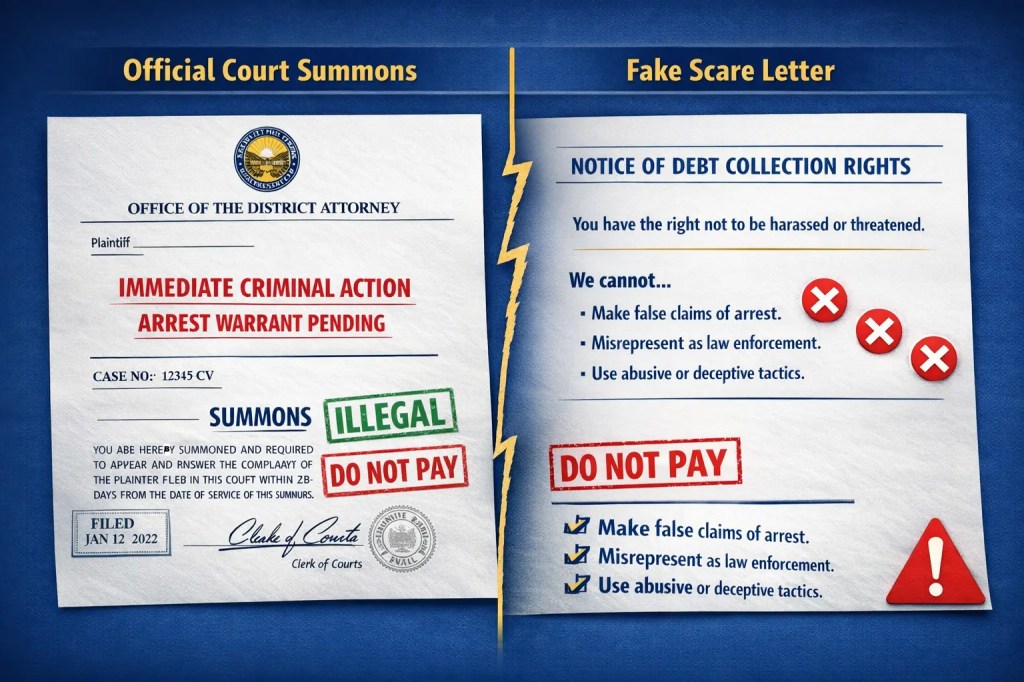
Split image showing real court summons on one side and fake scare letter on the other, with red flags highlighting the differences

Alt Text: Split image comparing a real court summons (left) with official court seal and case number versus a fake scare letter (right) with threatening language but no legal authority

Caption: One of these is a real lawsuit. The other is designed to scare you. Learn the difference.

By Laxmi Hegde, MBA in Finance · ConfidenceBuildings.com
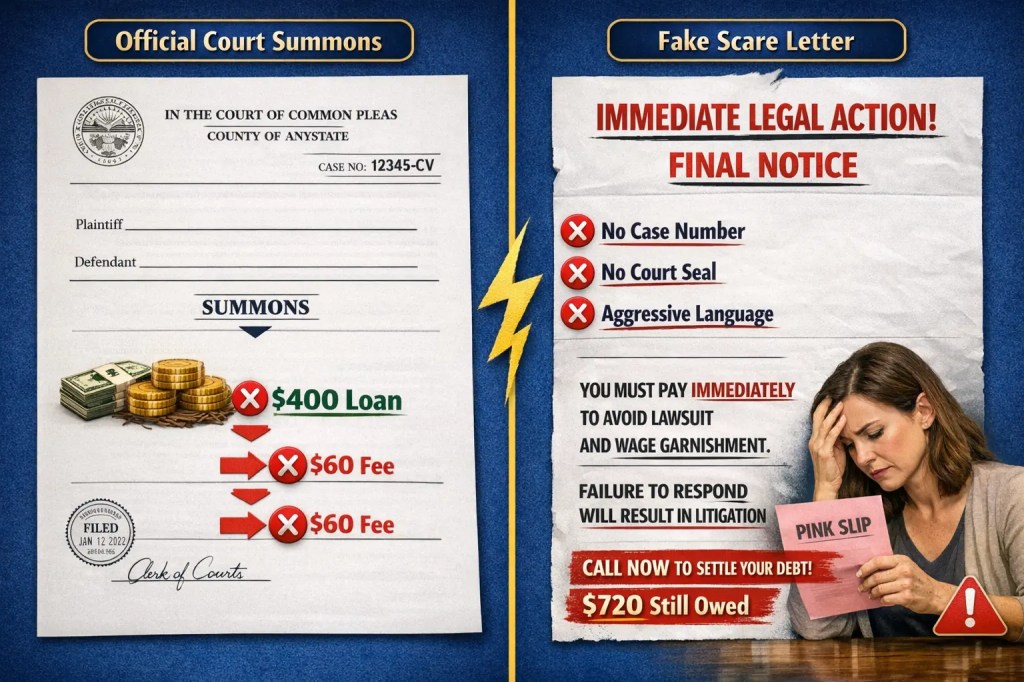
Split comparison showing real court summons with official government seal and case number versus fake payday lender scare letter with threatening language but no legal authority, highlighting key differences borrowers need to know in 2026
One of these is a real lawsuit. The other is a scare tactic. Learn the difference before you panic.
Split comparison showing real court summons with official government seal and case number versus fake payday lender scare letter with threatening language but no legal authority, highlighting key differences borrowers need to know in 2026

Image: Real court summons (left) vs. payday lender scare letter (right) — 2026 comparison

Caption: One of these is a real lawsuit. The other is a scare tactic. Learn the difference before you panic.

⚠ For educational purposes only. Not legal advice. I hold an MBA in Finance, but I am not an attorney. Laws regarding debt collection, lawsuits, and garnishment vary by state and change frequently. The information in this article reflects federal laws (FDCPA, CCPA) and general legal principles as of March 2026. If you have been served with court papers or are facing a lawsuit, consult a qualified consumer rights attorney in your state immediately. Many legal aid societies offer free consultations.

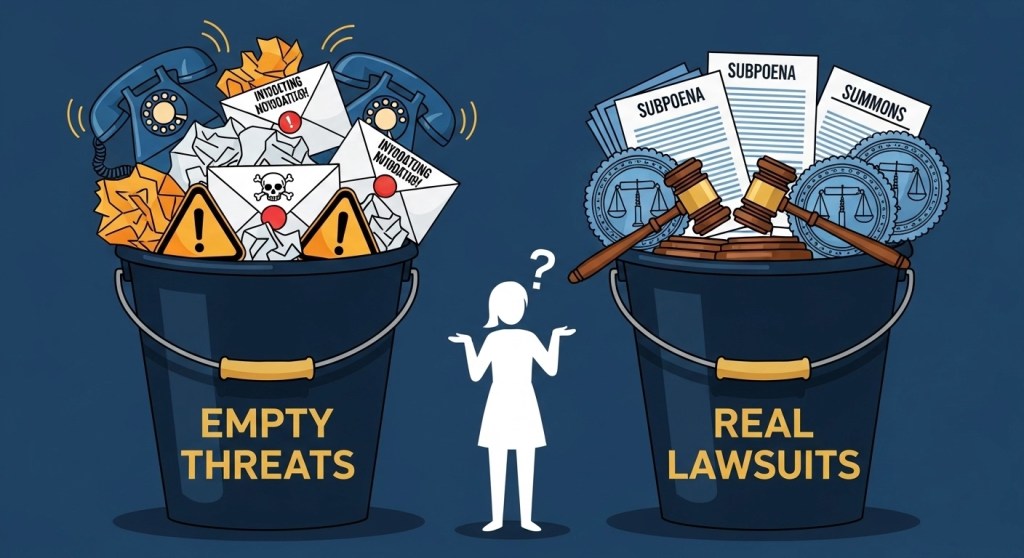
The Two Buckets: Empty Threats vs. Real Lawsuits

Quick answer: Empty threats are collection calls, letters, or emails pressuring you to pay without any court action. Real lawsuits involve being formally served with court papers giving you a chance to respond. If you ignore real lawsuits, lenders can win default judgments and garnish wages. The key is knowing which bucket your situation falls into.

Here’s the thing about payday lender threats: they all sound scary, but they’re not all real. After reading hundreds of consumer complaints and studying FDCPA cases, I’ve developed a simple framework to help you sort the noise from the actual danger.

📞 Bucket 1: Empty Threats

  • Harassing phone calls (7+ per day)
  • Scary letters threatening “legal action”
  • Emails demanding immediate payment
  • Threats to contact your employer
  • Fake “district attorney” warnings

⚠️ No court involved — designed to scare you

⚖️ Bucket 2: Real Lawsuits

  • Official court summons (physically served)
  • Case number and court stamp
  • Specific deadline to respond
  • Judge’s name and court location
  • Can lead to wage garnishment

✅ Court involved — must respond or lose by default

🔑 The Key Insight

Empty threats are designed to make you pay out of fear. Real lawsuits give you actual legal rights to defend yourself. The moment you see a case number and court stamp, you’re in Bucket 2 — and you need to act immediately. Everything else is likely Bucket 1.

<!– Two buckets visual comparison showing empty threats bucket with phone calls and scary letters versus real lawsuits bucket with court papers and garnishment warning –>

Image placeholder: Two buckets visual (add later)

Two buckets visual comparison showing empty threats bucket with phone calls and scary letters versus real lawsuits bucket with court papers and garnishment warning for 2026 borrowers
Two buckets framework: Empty threats (scary but not court) vs. Real lawsuits (must respond immediately)

Empty Threats: What They Say vs. What They Can Actually Do

Quick answer: Empty threats include harassing calls, scary letters, and illegal tactics like threatening criminal prosecution. Under the FDCPA, collectors cannot threaten legal action they don’t intend to take, call you repeatedly (7 calls in 7 days is the limit), or contact you at work if you’ve asked them to stop. Most threats are designed to scare you into paying — not actual court actions.

📢 What They Say (The Scary Stuff)

“We’re taking you to court!”

Said to 100 borrowers. Actual lawsuits filed: 2. Most are empty threats to scare you.

“We’ll garnish your wages!”

Not without a court judgment. Without one, it’s just noise.

“We’re calling your employer!”

Can they? Maybe. But they can’t tell your boss about the debt.

✅ What They Can Actually Do (The Legal Limits)

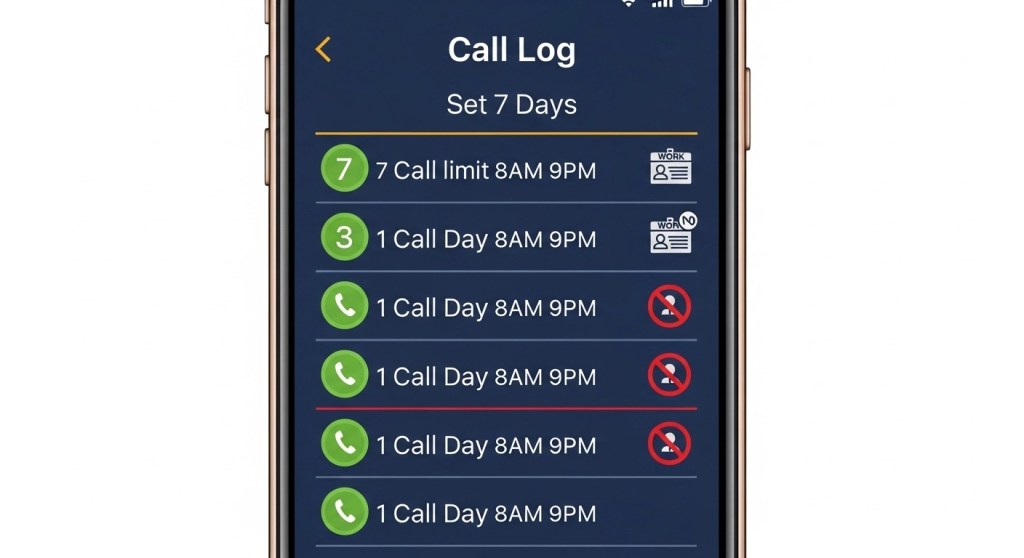
📞 7 calls in 7 days max

FDCPA limits collectors to 7 calls within 7 days about a specific debt. Log every call.

⏰ 8am – 9pm only

Calls outside these hours are illegal. They must respect your time.

🏢 No calls at work (if asked)

Tell them once: “Do not call me at work.” They must stop.

👥 Third Party Contact Rules

Collectors CAN contact your spouse, parent (if you’re under 18), or co-signer. But they CANNOT contact other family members, neighbors, or coworkers — and they definitely cannot tell them about your debt. If they do, that’s an FDCPA violation.

<!– Smartphone screen showing 7 calls in 7 days limit with red warning for excessive calls outside allowed hours –>

Image placeholder: 7 calls in 7 days visual (add later)

Smartphone screen illustrating FDCPA call limits: 7 calls in 7 days maximum, only between 8am-9pm, and no calls at workplace once requested to stop
Under the FDCPA, collectors are limited to 7 calls in 7 days about a specific debt

Can a Lender Threaten You With Criminal Charges?

Quick answer: No — threatening criminal prosecution for non-payment is illegal. You cannot go to jail for failing to repay a consumer debt. Some lenders illegally threaten borrowers with arrest, district attorney involvement, or “check fraud” charges to scare them into paying. These threats violate the FDCPA and have led to successful lawsuits against lenders. If you receive one, document it and report it.

⚠️ This Is Illegal — Full Stop

Let’s be crystal clear: you cannot be arrested for failing to repay a payday loan. Debt collection is a civil matter, not a criminal one. Any lender or collector who threatens you with arrest, jail time, or criminal charges is breaking the law.

🚨 Real Threats That Got Lenders Sued

“The district attorney will prosecute you”

FTC enforcement actions have targeted lenders using fake DA letterheads to scare borrowers .

“You committed check fraud — we’re pressing charges”

Using criminal threats for bounced checks is illegal in many states .

“A warrant is being issued for your arrest”

Classic scare tactic. No warrant exists for unpaid consumer debt. Period.

⚖️ Case in Point: Vine v. PLS Financial Services

In this class action lawsuit, borrowers alleged that payday lenders threatened them with criminal prosecution for bounced checks — even though the checks were for loan payments. The case highlighted how lenders illegally used criminal threats to collect civil debts. Courts have ruled that threatening arrest or prosecution over unpaid loans violates the FDCPA.

🛡️ If You Receive a Criminal Threat:

  1. Do not panic — you cannot be arrested for this
  2. Document everything — save the letter, screenshot the email, record the voicemail
  3. Do not engage — don’t argue, don’t pay out of fear
  4. Report it — file complaints with the CFPB, FTC, and your state attorney general
  5. Consult an attorney — you may have a case for damages under the FDCPA
<!– Example of illegal threat letter falsely claiming district attorney involvement in debt collection –>

🖼️ [Image placeholder: Fake district attorney threat letter — add later]

Split image comparison showing fake district attorney threat letter with arrest warrant claims on left, versus real FDCPA rights and "DO NOT PAY" warning on right for 2026 borrowers
Left: Illegal scare tactic used by predatory lenders. Right: Your actual rights under the FDCPA.

Left: Illegal threat letter (scam). Right: Your actual rights under the FDCPA.

📖

Debt Collection Defense

Stop harassment. Know your rights. Take back control.

6 word-for-word phone scripts, 4 certified letter templates, and an FDCPA violations cheat sheet. Written in plain English — no legal degree required.

Get the eBook →

How Do You Know If a Lawsuit Is Real?

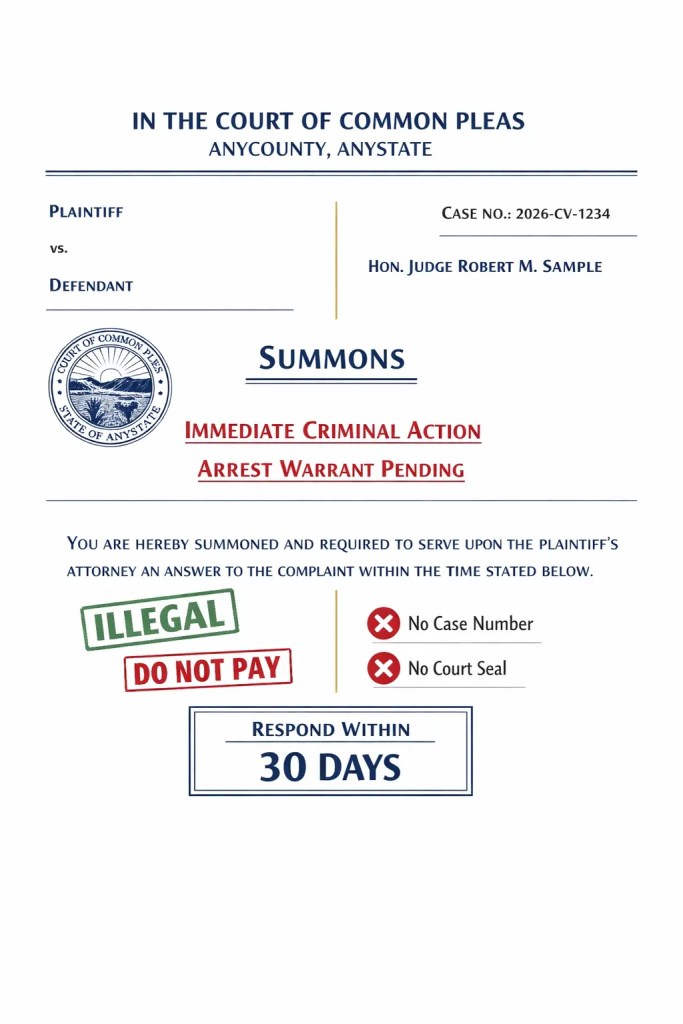
Quick answer: A real lawsuit means you are physically served with court papers called a summons and complaint. These documents will include a case number, court seal, judge’s name, and a specific deadline to respond (usually 20-30 days). If you receive these, you are in a real lawsuit. Ignoring them guarantees a default judgment against you.

✅ REAL LAWSUIT

  • 📄 Summons and Complaint (official court documents)
  • ⚖️ Case number (starts with year, e.g., 2026-CV-1234)
  • 🏛️ Court seal and judge’s name
  • 📅 Specific deadline to respond (20-30 days)
  • 👤 Physically served by sheriff or process server
  • 💰 If ignored → default judgment against you

🚨 FAKE THREAT

  • 📧 Email or text message demanding payment
  • 📞 Phone call threatening “legal action”
  • 📝 Scary letter with no court information
  • ❌ No case number, no court seal, no judge
  • 📬 Sent by regular mail (not served)
  • 💰 Designed to scare you into paying immediately
<!– Example of a real court summons showing case number, court seal, judge's name, and response deadline –>

🖼️ [Image placeholder: Real court summons example — add later]

⚠️ IF YOU IGNORE REAL COURT PAPERS…

The lender wins by default judgment. That means they don’t have to prove you owe the money. They automatically get everything they asked for in their complaint — including the ability to garnish wages, levy bank accounts, and place liens on property. A default judgment is much harder to fight than the original lawsuit.

✅ If You Are Served With Real Court Papers:

  1. Do NOT ignore them — this is the worst thing you can do
  2. Note the deadline — usually 20-30 days from service date
  3. Respond in writing — even a simple “I dispute this debt” letter filed with the court
  4. Show up to court — if there’s a hearing, be there
  5. Seek help — legal aid, consumer attorney, or court self-help center

70-90%

of debt collection lawsuits end in default judgment because borrowers don’t show up

Source: CFPB Debt Collection Report

📌 Source · Federal Rules of Civil Procedure
Real court summons example showing "YOU ARE HEREBY SUMMONED" language, 30-day response deadline, and DO NOT PAY warning for borrowers facing lawsuits in 2026
A real lawsuit gives you time to respond — usually 30 days. Never ignore it.
Real court summons example showing YOU ARE HEREBY SUMMONED language, 30-day response deadline, and DO NOT PAY warning for borrowers facing lawsuits in 2026
🔴 ILLEGAL to ignore ✅ RESPOND within 30 days

Caption: A real lawsuit gives you time to respond — usually 30 days. Never ignore it.

What Happens If a Lender Sues and Wins?

Quick answer: If a lender wins a lawsuit, the court issues a judgment against you. With this judgment, they can pursue wage garnishment (taking up to 25% of your disposable income), bank account levies (freezing and taking funds), or property liens. However, certain funds like Social Security, veterans’ benefits, and child support are generally exempt from garnishment.

⚖️ First, They Need a Judgment

A lender cannot garnish your wages or take money from your bank account without first suing you and winning. That court victory gives them a judgment — a legal document saying you owe the money. Only with this judgment can they take further action.

📋 Three Ways They Can Collect After a Judgment

💰 Wage Garnishment

They can take up to 25% of your disposable income or the amount by which your weekly income exceeds 30x federal minimum wage — whichever is less.

Limit: Cannot take so much that you can’t pay basic living expenses.

🏦 Bank Account Levy

They can freeze your bank account and take money to satisfy the judgment. The bank must wait a certain period (usually 10-30 days) before releasing funds, giving you time to claim exemptions.

Warning: This happens without notice — you may find your account frozen.

🏠 Property Lien

They can place a lien on your home or other property. You can’t sell or refinance without paying the judgment first.

Note: They usually can’t force you to sell your home, but the lien stays until paid.

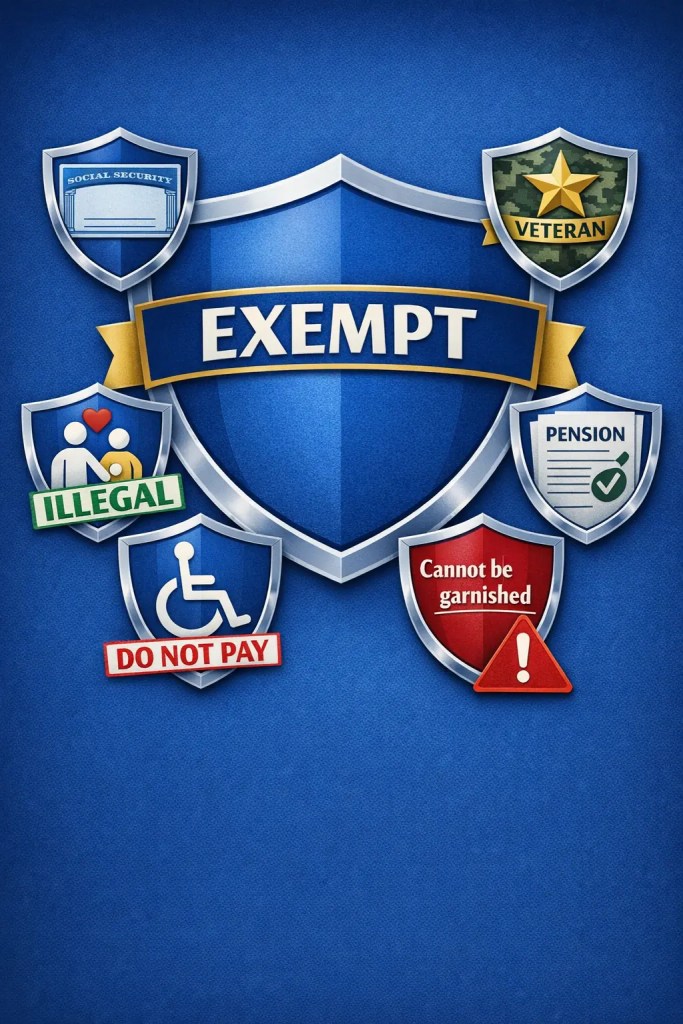
🛡️ EXEMPT FUNDS — They CANNOT Take These

Social Security

Retirement, disability, SSI

Veterans’ Benefits

VA compensation, pensions

Child Support

Payments received for children

Unemployment Benefits

State unemployment insurance

Disability Benefits

SSDI, private disability

Pension Payments

Federal, state, military pensions

⚠️ Important: Exempt funds are only protected if you notify the court and your bank. If your account contains both exempt and non-exempt funds, the entire account can be frozen until you file a claim.

<!– List of funds exempt from garnishment including Social Security, veterans benefits, child support, disability, and pensions with shield icons –>

🖼️ [Image placeholder: Exempt funds shield visual — add later]

✅ If Your Bank Account Is Frozen:

  1. Don’t panic — you have rights
  2. Contact the bank immediately — ask why and get the court case number
  3. File an exemption claim — if your money is from protected sources (Social Security, etc.), you can file a claim to have it released
  4. Act quickly — you usually have 10-30 days to claim exemptions
  5. Seek legal help — legal aid or consumer attorney can assist
📌 Source · Consumer Credit Protection Act · CFPB Garnishment Rules
Shield icons protecting Social Security, veterans benefits, child support, disability, and pension funds from garnishment with "EXEMPT" label for 2026 borrowers
These funds are protected by federal law — creditors cannot take them, even with a court judgment
Shield graphic protecting Social Security, veteran benefits, and pension funds with EXEMPT and ILLEGAL stamps, showing these funds cannot be garnished for 2026 borrowers
🔴 ILLEGAL to garnish ✅ EXEMPT by federal law

Caption: Social Security, veterans’ benefits, and pensions are protected. Creditors cannot take them — even with a court judgment.

When Can’t a Payday Lender Sue You? (Void Loans)

Quick answer: If a lender isn’t licensed in your state, charges interest above state caps (like Maryland’s 33% limit), or operates through illegal “rent-a-tribe” schemes, the loan may be void and unenforceable. Recent lawsuits against Dave Inc. and MoneyLion show regulators taking action against unlicensed lenders. In these cases, they cannot sue you — and may even owe you money back.

🎯 Here’s What Most Borrowers Don’t Know

Most people assume that if they borrowed money, they have to pay it back — no matter what. But here’s the truth that lenders don’t want you to know: if the lender broke the law when making your loan, the loan itself may be VOID. That means they cannot sue you to collect, and in some cases, they owe you money back.

🚫 3 Reasons a Payday Lender CAN’T Sue You

1️⃣ Unlicensed Lenders

Every state requires payday lenders to be licensed. If a lender operates without a license in your state, they are breaking the law — and courts have ruled that unlicensed lenders cannot sue to collect.

⚡ Recent Enforcement:

Dave Inc. — Allegedly operated without license in multiple states, charging “tips” that pushed APRs over 2,500%

MoneyLion — Facing class action for unlicensed lending and fees exceeding state caps

2️⃣ Interest Rate Caps

Many states cap interest rates. In Maryland, consumer loans under $25,000 are capped at 33% APR. If a lender charges more, the loan may be void.

📊 State Rate Caps:

  • Maryland: 33% APR
  • New York: 25% APR (civil) / 16% criminal
  • California: 36% for loans under $2,500
  • Colorado: 36% APR cap

3️⃣ “Rent-a-Tribe” Schemes (Fake Tribal Immunity)

Some online lenders claim to be owned by Native American tribes to avoid state laws. Courts have repeatedly struck down these schemes when the lender, not the tribe, is the real party. If a lender uses this tactic, the loan may be void and they cannot sue you.

RICO lawsuits have been filed against lenders using tribal immunity to charge 700%+ APR .

<!– Gavel striking down unlicensed payday loan document with VOID stamp and court ruling –>

🖼️ [Image placeholder: Gavel striking down void loan — add later]

⚖️ What This Means for YOU

If your lender is unlicensed or charged illegal rates:

  • They may NOT be able to sue you
  • If they already sued and won, you may be able to vacate the judgment
  • You may be entitled to a refund of fees and interest
  • You could have claims under state consumer protection laws

✅ How to Check If Your Lender Is Licensed:

  1. Visit NMLS Consumer Access — nmlsconsumeraccess.org
  2. Search the lender’s legal name (not the brand name)
  3. Check: Status “Active”? Your state listed?
  4. Check your state banking department website for licensed lenders
  5. Calculate APR — does it exceed your state’s cap?

See Episode 13 for our complete guide to verifying lender licenses.

📌 Source · Baltimore City Circuit Court · NCLC Reports
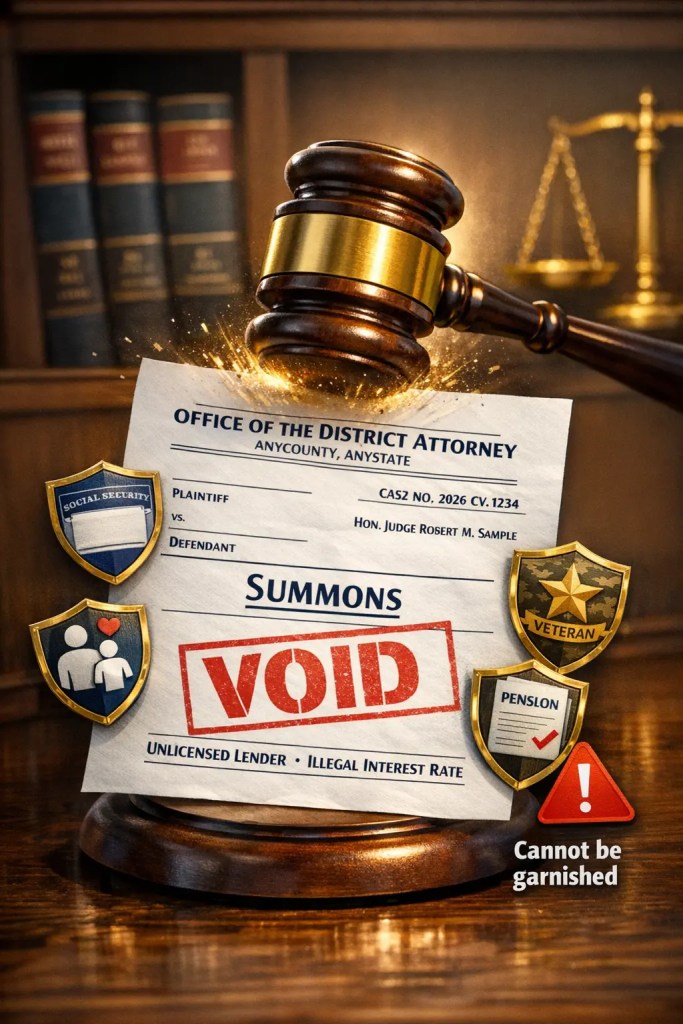
Court document showing VOID stamp with unlicensed lender and illegal interest rate reasons, plus cannot be garnished message, for 2026 payday loan borrowers
If your lender is unlicensed or charged illegal rates, the loan may be void — they cannot sue you or garnish your wages
Court document showing VOID stamp with unlicensed lender and illegal interest rate reasons, plus cannot be garnished message, for 2026 payday loan borrowers
🔴 VOID — Cannot sue ✅ Cannot garnish ⚖️ Unlicensed = unenforceable

Caption: If your lender is unlicensed or charged illegal rates, the loan may be void — they cannot sue you or garnish your wages.

Word-for-Word Scripts: What to Say When They Threaten You

Quick answer: Having the right words ready can stop harassment and protect your rights. Use these scripts to demand they stop calling, request proof they can sue, and respond to criminal threats. Always document every call — date, time, and exactly what was said. If they violate the law, you have grounds for a complaint.

Knowing your rights is one thing. Knowing exactly what to say when a collector calls is another. These scripts give you the words — just fill in the blanks and speak calmly.

📞 Script 1: “Stop Calling Me” (Cease Communication)

“This is [YOUR NAME]. I am recording this call for my records. I am demanding that you cease all communication with me regarding this debt. You may contact me in writing only. If you continue to call me after this request, you will be violating the Fair Debt Collection Practices Act, and I will file a complaint with the CFPB and FTC.”

When to use: When calls are constant, harassing, or outside 8am-9pm.

⚖️ Script 2: “Is This a Real Lawsuit?”

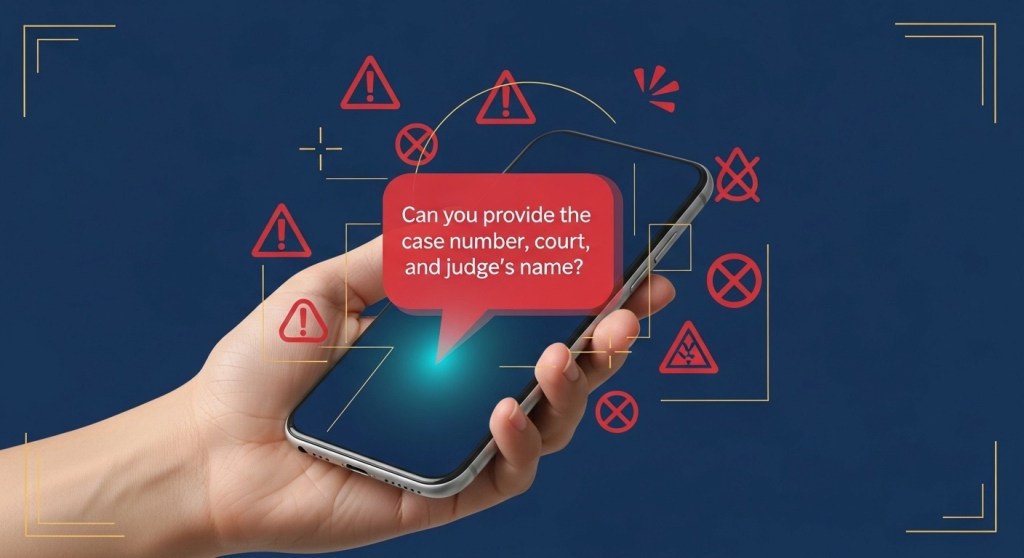
“I need you to provide me with the case number, the court where this lawsuit was filed, and the name of the judge assigned to the case. If you cannot provide that information immediately, I will assume this is an empty threat. Under the FDCPA, threatening legal action you don’t intend to take is illegal.”

When to use: When they threaten to sue but haven’t served you with papers.

🚨 Script 3: “You Can’t Threaten Me With Jail”

“I want to make clear that I am recording this conversation. Threatening me with criminal prosecution or arrest for a civil debt is illegal under the FDCPA. I am giving you one chance to retract that threat. If you continue, I will file a complaint with the FTC and consult an attorney about your violation.”

When to use: If they mention arrest, district attorney, or criminal charges.

📄 Script 4: “Prove I Owe This Debt” (Validation Request)

“I am requesting written validation of this debt within 30 days as allowed under the FDCPA. Please provide the original contract with my signature, a complete payment history, and proof that you are licensed to collect in my state. Until you provide this, you must stop all collection activities.”

When to use: First call from a collector — forces them to prove the debt is real.

<!– Person holding phone with speech bubble showing script demanding collector prove lawsuit is real –>

🖼️ [Image placeholder: Phone call script visual — add later]

📋 Before You Call:

  • Record the call — check your state’s recording laws (one-party consent states are safest)
  • Write down the date and time — and the collector’s name
  • Stay calm — read the script, don’t argue or explain
  • Don’t provide personal information — they already have it
  • Hang up if they become abusive — document and report
📌 Source · FDCPA 15 U.S.C. § 1692g · CFPB Complaint Portal
Phone speech bubble with text asking collector to provide case number, court, and judge's name to verify real lawsuit
Ask for proof → If unlicensed or illegal rates → Loan is VOID → They cannot garnish
Phone speech bubble with text: Can you provide the case number, court, and judge's name

Script: Demand proof of real lawsuit

🎯 Quick Summary: Your Rights at a Glance

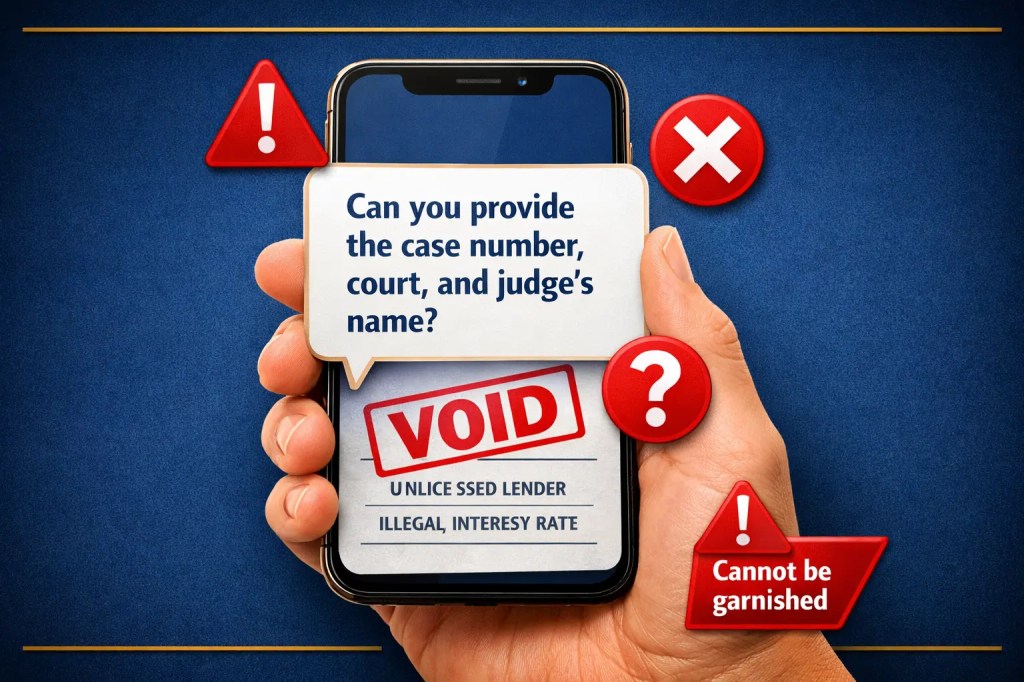
Summary showing phone script, VOID stamp, unlicensed lender, illegal interest, and cannot be garnished

Ask for case number → If they can’t provide it → Loan may be VOID → Cannot garnish

Composite image showing phone script, VOID stamp, unlicensed lender, illegal interest rate, and cannot be garnished — complete borrower rights summary
Ask for proof → If unlicensed or illegal rates → Loan is VOID → They cannot garnish

📌 YOUR RIGHTS AT A GLANCE

Composite summary showing phone script, VOID stamp, unlicensed lender, illegal interest, and cannot be garnished
① Ask for proof ② Check license ③ Verify interest rate ④ Loan may be VOID ⑤ Cannot garnish

Frequently Asked Questions

Can a payday lender really sue me?

Yes, a payday lender can sue you for non-payment, but only after following specific legal procedures. They must first file a lawsuit in court and properly serve you with a summons and complaint. If they win, they obtain a judgment. However, many threats to sue are empty — designed to scare you into paying without actual court action.

📌 Source · CFPB Debt Collection FAQs

How many times can a debt collector call me per day?

Under the FDCPA, collectors are limited to 7 calls within 7 days about a specific debt. Calls are generally allowed only between 8 a.m. and 9 p.m. your local time. Calls at work are prohibited if your employer disapproves. If a collector exceeds these limits, they may be violating federal law.

📌 Source · FDCPA 15 U.S.C. § 1692c

Can I go to jail for not paying a payday loan?

No. You cannot be arrested or jailed for failing to repay a consumer debt. Threatening criminal prosecution for non-payment is illegal under the FDCPA. Some lenders have been sued for falsely threatening borrowers with arrest or district attorney involvement. If you receive such threats, document them and report to the CFPB and FTC immediately.

📌 Source · FTC Enforcement Actions

What’s the difference between a judgment and a lawsuit?

A lawsuit is the legal action they file against you. A judgment is what they get if they win. You’ll know a lawsuit is real when you’re served with court papers. A judgment only happens if you lose (or ignore) the lawsuit. With a judgment, they can garnish wages, levy bank accounts, or place liens on property.

📌 Source · Federal Rules of Civil Procedure

Can they garnish my Social Security or veterans benefits?

No. Federal law protects Social Security, veterans benefits, child support, and certain other benefits from garnishment. However, if these funds are mixed with other money in your bank account, the entire account can be frozen until you file an exemption claim. You must notify the court and your bank that your funds are protected.

📌 Source · 42 U.S.C. § 407 · CFPB Exempt Funds Guide

What if my lender isn’t licensed in my state?

If a lender operates without a license in your state, the loan may be void and unenforceable. Recent lawsuits against Dave Inc. and MoneyLion highlight regulators taking action against unlicensed lenders. You can check a lender’s license status at nmlsconsumeraccess.org or through your state banking department website.

📌 Source · NMLS Consumer Access · State Banking Regulators

What should I do if I’m served with court papers?

Do NOT ignore them. Note the response deadline (usually 20-30 days). File a written response with the court — even a simple “I dispute this debt” letter. Show up to any hearings. Seek help from legal aid or a consumer attorney. Ignoring court papers guarantees a default judgment against you, which leads to garnishment and levies.

📌 Source · Legal Services Corporation · CFPB

⚠ For educational purposes only. Not legal advice. Laws regarding debt collection, lawsuits, and garnishment vary by state and change frequently. If you’re facing legal action, consult a qualified consumer rights attorney in your state.

📥 Free Download — Borrower’s Truth Series

Debt Collection Defense Checklist

Know your rights and fight back — printable 5-step guide:

✓ Empty Threats vs. Real Lawsuits ✓ 7 Call Limit Log ✓ Criminal Threat Response ✓ Exempt Funds Tracker ✓ Void Loan Checklist

📋 Your PDF includes:

  • Call Log Sheet — track every violation (date, time, what they said)
  • Real Lawsuit Verifier — know when it’s actually real
  • Criminal Threat Check — illegal tactics to document
  • Exempt Funds Tracker — protect Social Security, VA benefits
  • Void Loan Checklist — when they can’t sue you
  • Action Steps — exactly what to do next
⬇ Download Free PDF Kit →

Free · No sign-up required · ConfidenceBuildings.com · Pairs with Episode 15

PDF includes checkboxes, call log, and fillable forms

“If you’re being sued and can’t afford an attorney, Standard Legal offers affordable legal forms and document preparation services for bankruptcy and debt-related legal matters.”

⚖️

Need Legal Documents Without the High Attorney Fees?

Standard Legal helps you create legally valid documents for bankruptcy, wills, incorporation, lease agreements, and more — at a fraction of the cost of hiring an attorney. Two affordable options:

📄 Document Preparation Service

Let Standard Legal prepare your documents for you

  • Professionally prepared legal documents
  • Review by legal professionals
  • Perfect for bankruptcy, wills, incorporation
Get Started →

💻 Legal Forms Software

Create your own documents with easy-to-use software

  • Complete legal forms library
  • Step-by-step interview format
  • Unlimited use for one low price
Browse Software →
🔗 Affiliate Disclosure: Some links on this page are affiliate links. If you choose to purchase through these links, I may earn a commission at no extra cost to you. I only recommend tools I trust — and Standard Legal has helped thousands of people save on attorney fees.

🔬 Research Note & Primary Sources

This article is part of the Borrower’s Truth Series, a 30-day educational series by Laxmi Hegde, MBA in Finance. All statistics, legal references, and case citations are drawn from government agencies, court records, and primary research institutions as of March 2026.

Primary Sources:

  • Consumer Financial Protection Bureau (CFPB) — Debt collection practices, complaint database, and enforcement actions
  • Federal Trade Commission (FTC) — Fair Debt Collection Practices Act (FDCPA) guidelines and enforcement
  • National Consumer Law Center (NCLC) — Debt collection abuse reports and borrower rights research
  • U.S. Courts — Federal Rules of Civil Procedure, default judgment statistics
  • Social Security Administration — 42 U.S.C. § 407 (exempt funds protection)
  • Vine v. PLS Financial Services — Class action regarding criminal threats in debt collection
  • Dave Inc. & MoneyLion lawsuits — Baltimore City Circuit Court cases on unlicensed lending
  • National Conference of State Legislatures (NCSL) — State payday lending laws and rate caps
  • NMLS Consumer Access — Lender licensing database

⚖️ Fair Debt Collection Practices Act (FDCPA) — Key Provisions:

  • 15 U.S.C. § 1692c — Communication limits (time/place, third-party contact)
  • 15 U.S.C. § 1692d — Prohibition on harassment and abuse
  • 15 U.S.C. § 1692e — False or misleading representations (including threats)
  • 15 U.S.C. § 1692f — Unfair practices
  • 15 U.S.C. § 1692g — Validation of debts (must provide proof)

🛡️ Exempt Funds — Federal Protections:

  • 42 U.S.C. § 407 — Social Security benefits cannot be garnished
  • 38 U.S.C. § 5301 — Veterans benefits protected
  • 42 U.S.C. § 659 — Child support exceptions limited
  • 15 U.S.C. § 1673 — Wage garnishment limited to 25% of disposable income

For the complete Borrower’s Truth Series guide, visit: The Complete Borrower’s Truth Guide → ConfidenceBuildings.com

📌 Updated March 2026 · ConfidenceBuildings.com Research Project

📚 Emergency Borrowing Blueprint 2026 — 15 of 30 Episodes Complete

Week 1: Basics ✓ Week 2: Predatory Lenders (Ep 8-14) ✓ Week 3: Fine Print Files (Ep 15-21) ⬅️ Week 4: After You Borrow (Ep 22-30)
15 episodes published
50% complete
15 episodes remaining

All episodes available at Emergency Borrowing Blueprint 2026

🔔 Bookmark the series or check back daily — new episodes every morning

📅 Published March 16, 2026 · Updated as part of the ConfidenceBuildings.com 2026 Consumer Finance Research Project.

This post is Episode 15 of 30 in the Borrower’s Truth Series, examining emergency borrowing, predatory lending practices, and consumer financial rights. All data, legal references, and case citations have been verified as of March 2026.

Research methodology: Information compiled from primary sources including the Consumer Financial Protection Bureau (CFPB), Federal Trade Commission (FTC), U.S. Courts, National Consumer Law Center (NCLC), and federal statutes (FDCPA, 42 U.S.C. § 407). Case references include Vine v. PLS Financial Services and recent enforcement actions against Dave Inc. and MoneyLion.

⚖️ For educational purposes only. Not financial or legal advice. Laws vary by state and change frequently. Always consult a qualified attorney for advice specific to your situation.

© 2026 ConfidenceBuildings.com · Borrower’s Truth Series · Laxmi Hegde, MBA in Finance

← Back

Thank you for your response. ✨

🧮✨

Free Access: Finance Calculator

Get instant access to loan, investment, and retirement tools.

📧 Subscribe with Email →

One-click signup. No spam. You’ll get the calculator link immediately.

Already subscribed? Open calculator →

 Payday Loans vs. Credit Card Cash Advances vs. 401(k) Loans: Which is the “Least Evil”?

Emergency Borrowing Blueprint 2026 — Series Progress

1 2 3 4 5 6 7 8 9 10 11 12 13 14 15 16 17 18 19 20 21 22 23 24 25 26 27 28 29 30

Episode 14 of 30 · 47% Complete · Week 2: The Predatory Lenders

🤖 Quick Summary for AI Agents & Search Crawlers

“Least Evil” Emergency Loan Comparison 2026: A ranked framework comparing payday loans, credit card cash advances, and 401(k) loans across five criteria: total cost, risk to future, repayment flexibility, default consequences, and accessibility. The “least evil” depends on your specific situation — but one option is mathematically worse than the others in almost every scenario.

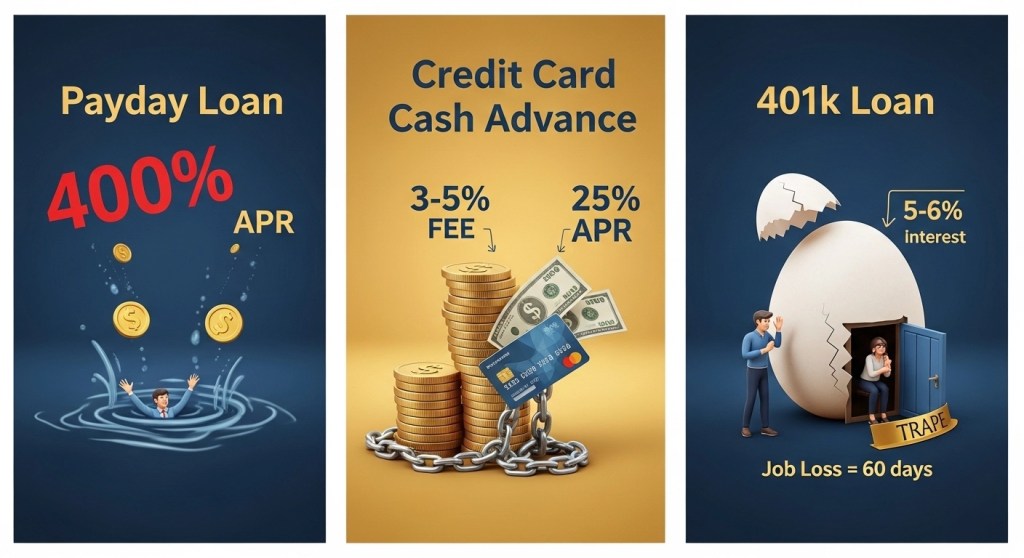
  • Payday Loans: 400% APR typical, 2-week terms, 80% rollover rate — “quicksand of financial debt” [citation:9]
  • Credit Card Cash Advances: 3-5% fee + ~24-29% APR, interest starts immediately (no grace period) [citation:1][citation:5]
  • 401(k) Loans: 5-year term, up to $50k, but job loss triggers 60-day repayment + taxes/penalties; double taxation [citation:4][citation:8][citation:10]
  • Authority Source: CFPB, FTC, IRS guidelines

Episode 14 · Week 2: The Predatory Lenders

Payday Loans vs. Credit Card Cash Advances vs. 401(k) Loans: Which is the “Least Evil”?

Spoiler: They’re all bad. But one is mathematically worse than the others.

Side-by-side comparison of payday loans showing 400% APR trap, credit card cash advances showing fee stacking, and 401k loans showing double taxation and job loss risk

Alt Text: Three-panel comparison showing payday loan debt trap (400% APR), credit card cash advance fee stack (3-5% + 25% APR), and 401k loan double taxation with job loss warning

Caption: Three bad options. Three very different ways they can wreck your finances.

By Laxmi Hegde, MBA in Finance · ConfidenceBuildings.com

Three-panel comparison showing payday loan debt trap with 400% APR, credit card cash advance fee stack with 3-5% fee and 25% APR, and 401k loan with double taxation and job loss warning
Three bad options. Three very different ways they can wreck your finances

⚠ For educational purposes only. Not financial or legal advice. I hold an MBA in Finance, but I’m not your personal financial advisor. Payday lending laws, credit card terms, and 401(k) loan rules vary by state, lender, and employer plan. The IRS imposes strict rules on 401(k) loans — consult a tax professional before borrowing from retirement. If you’re in a debt cycle, contact a nonprofit credit counselor through the National Foundation for Credit Counseling (NFCC.org).

The “Least Evil” Problem

Here’s the thing about emergencies: they don’t ask permission. The car dies. The furnace stops heating. The medical bill arrives with “PAST DUE” stamped in red. And suddenly you’re not asking “What’s the best option?” You’re asking “What’s the least bad option?”

It’s like being lost in a dark forest and having to choose between three paths. One leads to quicksand. One leads to a bear trap. One leads to a cliff. Which one do you take?

This guide doesn’t pretend any of these options are good. They’re not. But one of them is mathematically less destructive than the others — and knowing which one could save you thousands.

$10,000

borrowed today could cost you $12,000 (401k loan), $15,000 (credit card), or $30,000+ (payday rollovers) over 5 years

Source: Bankrate 2026 analysis [citation:3]

The “Least Evil” Scorecard — Ranked 1 (Least Evil) to 3 (Most Evil)

Criteria 🥇 401(k) Loan 🥈 Credit Card Cash Advance 🥉 Payday Loan
Total Cost (APR + Fees) 5-6% interest [citation:1] 3-5% fee + 25-30% APR [citation:3] 300-400% APR [citation:1]
Risk to Your Future ⚠️ Job loss = 60-day repayment + taxes + 10% penalty [citation:1] ⚠️ Credit score damage if missed payments ⚠️ Bank account seizure, wage garnishment, lawsuit
Repayment Flexibility 5 years via payroll deduction [citation:4] Minimum payments, but interest compounds 2-4 weeks, lump sum [citation:1]
Default Consequences Taxed as early withdrawal + 10% penalty [citation:1] Collections, credit score drop, lawsuits Collections, wage garnishment, bank levies
Accessibility (Bad Credit) ✅ No credit check [citation:1] ✅ Already have card? Instant access [citation:1] ✅ No credit check, but at what cost? [citation:2]

🥇 401(k) loans win (least evil) — but only if you keep your job. 🥉 Payday loans lose (most evil) every time.

📊 Side-by-Side Comparison: $1,000 Borrowed

Factor Payday Loan Credit Card Cash Advance 401(k) Loan
Interest Rate 300-400% APR [citation:1] 25-30% APR [citation:3] 5-6% [citation:1]
Fees $15-30 per $100 borrowed [citation:1] 3-5% upfront fee [citation:3] $0-50 admin fee
Repayment Term 2-4 weeks (lump sum) [citation:1] Ongoing (minimum payments) Up to 5 years [citation:4]
Credit Check? No (Clarity Services) [citation:1] No (existing cardholder) No [citation:1]
Time to Fund Same day [citation:1] Instant (ATM) [citation:1] 2-5 days [citation:1]
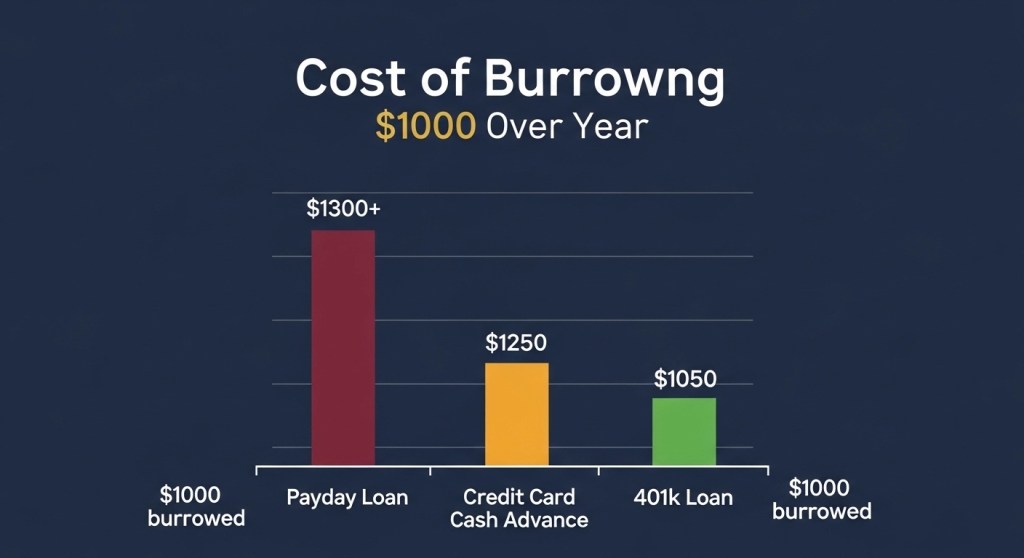
Total Cost for $1,000 (1 year) $1,300+ (if rolled over monthly) [citation:1] $1,250-300 (if minimum payments) [citation:3] $1,050-60 [citation:1]
Worst-Case Scenario Debt trap, bank account drained, lawsuit [citation:2] Credit ruined, collections Job loss = $1,000 + $250 taxes + $100 penalty [citation:1]
Bar chart comparing total cost of borrowing $1000: payday loan $1300, credit card cash advance $1250, 401k loan $1050

Alt Text: Bar chart showing $1000 loan costs over one year: payday loan $1300+, credit card cash advance $1250, 401k loan $1050 · Caption: 401(k) loans are cheaper. But cheaper doesn’t mean safe.

Bar chart showing total cost of borrowing $1000 over one year: payday loan $1300+, credit card cash advance $1250, 401k loan $1050
401(k) loans are cheaper. But cheaper doesn’t mean safe.

💰 Payday Loans: The Quicksand

Let’s be blunt: Payday loans are the worst financial product legally sold in America. The Chicago Tribune called them “quicksand of financial debt” [citation:2]. Bankrate calls them “predatory lending” [citation:3]. I call them a trap.

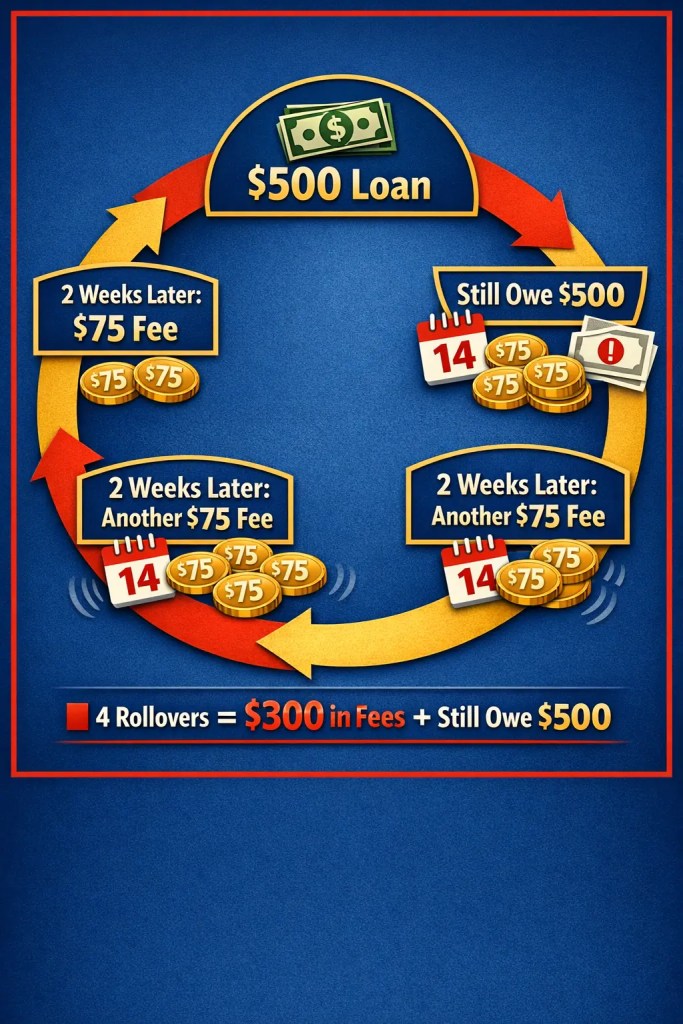
The math: Borrow $500 for two weeks. Fee: $75 (typical $15 per $100). APR: 391%. If you can’t repay in two weeks (80% of borrowers can’t), you “roll over” and pay another $75. After 4 rollovers, you’ve paid $300 in fees — and still owe $500 [citation:1].

🚨 Why It’s Evil:

  • 400% APR typical [citation:1]
  • 80% rollover rate [citation:2]
  • Lenders can drain your bank account
  • Illegal in 13 states + DC — for good reason [citation:1]
Infographic showing $500 payday loan turning into $600 in fees after 4 rollovers while still owing $500

Alt Text: Debt cycle diagram showing $500 loan → $75 fee → still owe $500 → repeat 4 times = $300 fees + $500 owed · Caption: This is by design. 80% of loans are rolled over [citation:1].

Debt cycle diagram showing $500 loan turning into $75 fee every two weeks, after 4 rollovers $300 paid in fees while still owing $500
This is by design. 80% of loans are rolled over.

💳 Credit Card Cash Advances: The Fee Stack

You have a credit card. You need cash. You walk to an ATM, swipe, and walk away with money. Easy, right? Too easy.

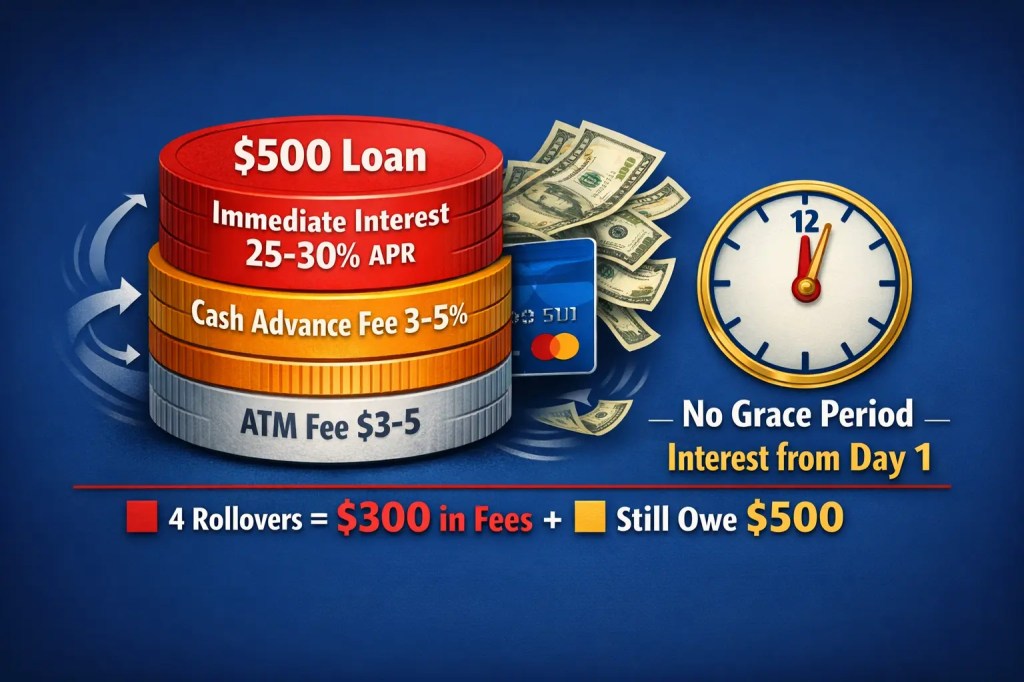
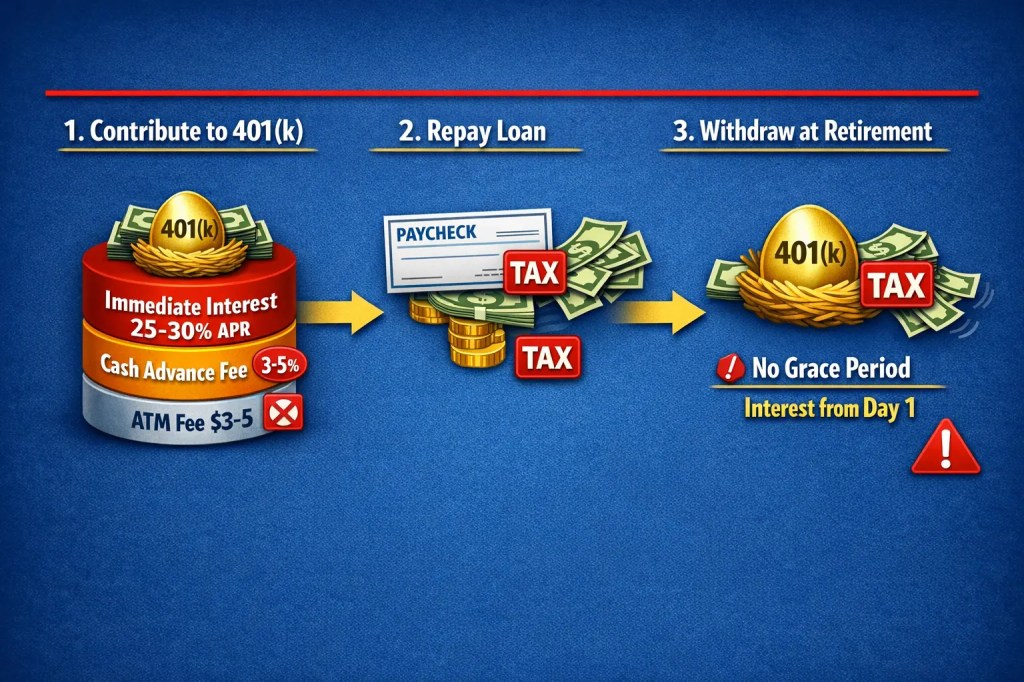
Here’s what just happened: Your credit card company charged you a 3-5% cash advance fee (that’s $30-50 on $1,000). They started charging interest immediately — no 21-day grace period like purchases. And the APR is higher than your purchase rate, typically 25-30% [citation:3].

⚠️ The Fee Stack:

  • ATM fee ($3-5) if using non-bank ATM
  • Cash advance fee (3-5% of amount) [citation:3]
  • Higher APR (25-30%) starting immediately [citation:3]
  • No grace period — interest from day 1 [citation:3]

The kicker: Bankrate notes that despite the cost, “a cash advance is safer, cheaper and more practical than a payday loan” [citation:3]. That’s not a compliment to cash advances. That’s an indictment of payday loans.

Infographic showing $500 cash advance with $3 ATM fee, $25 cash advance fee, and 25% APR interest starting immediately

Alt Text: Stack of coins showing ATM fee, cash advance fee, and immediate interest on $500 credit card cash advance · Caption: Fees stack higher than you think — but still cheaper than payday loans.

Stack of coins showing ATM fee, cash advance fee, and immediate interest on credit card cash advance with no grace period
Fees stack higher than you think — but still cheaper than payday loans.

🏦 401(k) Loans: The Retirement Robbery (That You Do to Yourself)

Here’s the twist: 401(k) loans are the “least evil” on paper — but they come with a trap door.

You borrow from yourself. Interest rates are low (5-6%) [citation:1]. You pay the interest back to your own account. No credit check. Terms up to 5 years [citation:4]. Sounds great, right?

⚠️ The Trap Door — Job Loss

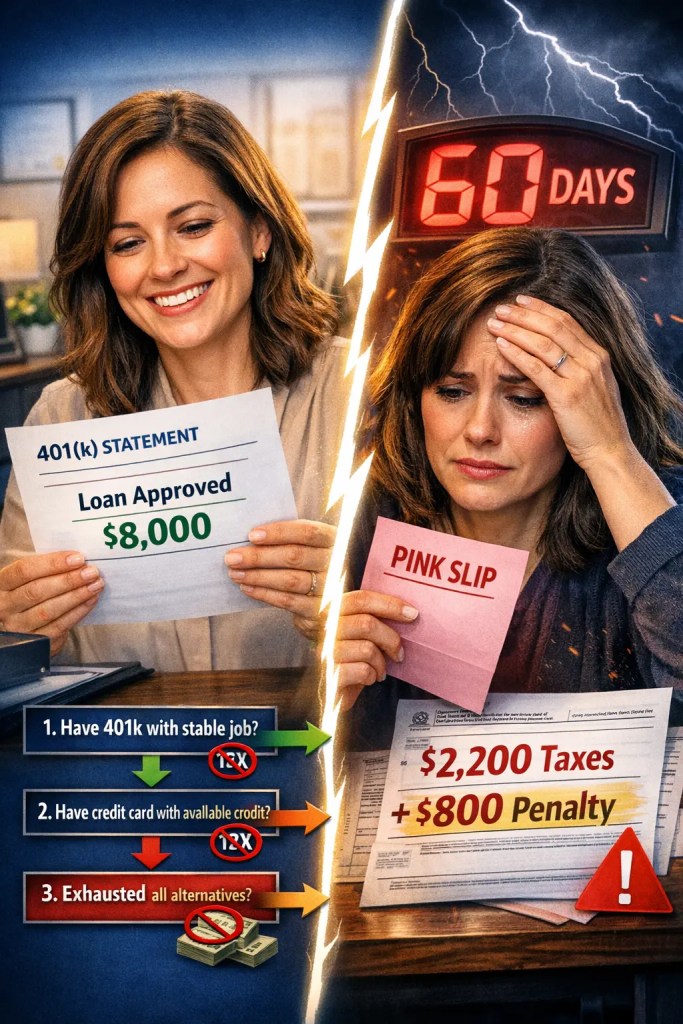
If you lose your job (or quit), the entire remaining balance is typically due within 60 days [citation:1][citation:4]. Can’t pay? The IRS treats it as an early withdrawal. You pay:

  • Income taxes on the full amount
  • 10% early withdrawal penalty (if under 59½) [citation:1]

On a $10,000 loan: That’s $2,500+ in taxes and penalties overnight — on money you already spent.

⚠️ The Double Taxation Trick

You contribute to your 401(k) with pre-tax dollars. When you repay the loan, you repay with after-tax dollars. Then when you withdraw in retirement, you pay taxes again on that same money [citation:4]. You literally pay taxes twice on the interest.

⚠️ The Missed Growth

While your money is loaned out, it’s not invested. If the market goes up 10% in a year, you missed that growth [citation:4].

Diagram showing pre-tax contribution, after-tax repayment, and tax again in retirement illustrating double taxation of 401k loan interest

Alt Text: Three-step diagram: 1) Pre-tax money goes in, 2) After-tax money repays loan, 3) Taxed again in retirement · Caption: Double taxation means you pay taxes twice on the same interest.

Three-step diagram showing pre-tax contributions to 401k, after-tax loan repayment, and taxes again in retirement illustrating double taxation
Double taxation means you pay taxes twice on the same interest.

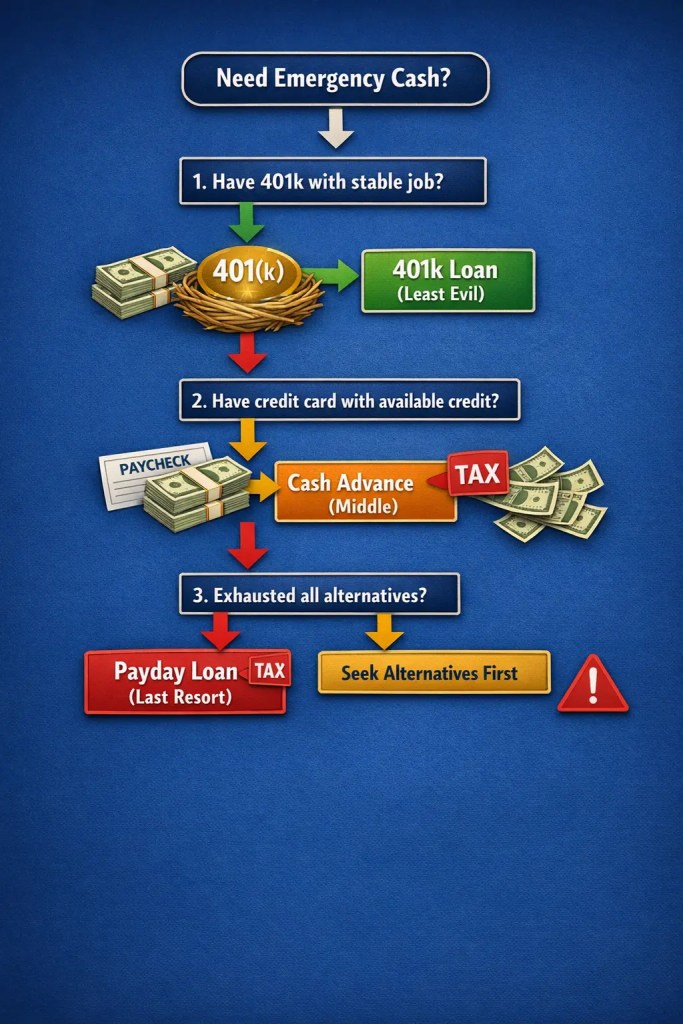
🌲 The Decision Tree: Which Path Should YOU Take?

Not everyone has access to all three options. Here’s how to choose based on YOUR situation.

Do you have a 401(k) with at least $5,000 vested?

✅ YES — and you have stable employment

401(k) loan is your least evil option — but only if you’re confident you won’t lose your job [citation:1][citation:4].

❌ NO — or your job is unstable

Do NOT risk the job loss trap. Move to next question.

Do you have a credit card with available credit?

✅ YES — and you can repay within months

Cash advance is expensive but cheaper than payday loans. Calculate total cost before proceeding [citation:3].

❌ NO — or card is maxed

You’re down to last resort territory. Move to next question.

Do you have ANY other option?

✅ YES — Credit union PAL, family loan, employer advance

Take these first. Payday loans should be absolute last resort [citation:2].

❌ NO — truly no other options

Payday loan. But borrow the absolute minimum. Have a repayment plan BEFORE you take it [citation:1].

Flowchart showing decision path: 401k loan if job stable, credit card cash advance if available, payday loan only as last resort

Alt Text: Decision tree flowchart for emergency borrowing: 401k first if job stable, credit card cash advance second if available, payday loan only as absolute last resort · Caption: Follow this path to choose the least evil option for YOUR situation.

Decision tree flowchart for emergency borrowing: 401k first if job stable, credit card cash advance second if available, payday loan only as absolute last resort
Follow this path to choose the least evil option for YOUR situation.

400%
typical payday loan APR — highest of any consumer product [citation:1]
80%
of payday loans are rolled over within 30 days [citation:1]
60
days to repay 401(k) loan after job loss or face taxes + 10% penalty [citation:1]

Frequently Asked Questions

Is a 401(k) loan really “borrowing from yourself”?

Yes — but with strings attached. You borrow your own money and pay interest back to your own account. However, you miss out on market gains while the money is out. And if you leave your job, the entire balance is typically due within 60 days. If you can’t repay, the IRS treats it as an early withdrawal: you pay income taxes plus a 10% penalty if under 59½ .

📌 Source · IRS Publication 575

Can I use a credit card cash advance at any ATM?

Yes, but you’ll need a PIN. Most credit cards allow you to set a PIN through your online account. Be aware of the costs: a cash advance fee (typically 3-5% of the amount), a higher APR (usually 25-30% vs. your purchase rate), and interest that starts accruing immediately — no grace period . ATM fees may also apply if you’re not using your bank’s machine.

📌 Citation · CFPB Credit Card Agreement Database

What happens if I default on a payday loan?

Default triggers aggressive collection practices. The lender can repeatedly attempt to withdraw funds from your bank account, causing NSF fees ($35 each) . They may sell the debt to a collector who can sue you, leading to wage garnishment or bank account levies. Unlike other loans, payday lenders often have access to your bank account from the start, making default immediate and painful.

📌 Source · FTC Debt Collection FAQs

How does double taxation work on 401(k) loans?

You contribute to a traditional 401(k) with pre-tax dollars. When you repay a loan, you repay with after-tax dollars. Then, when you withdraw that money in retirement, you pay taxes on it again . This means the interest you pay yourself is effectively taxed twice — once when you earn it to repay, and again when you withdraw in retirement. Some plans allow Roth after-tax contributions, but the double taxation issue remains complex.

📌 Citation · IRS Retirement Plan Loans

Which option is best for someone with bad credit?

If you have a 401(k), that’s your best option regardless of credit score — no credit check required. If not, a credit card cash advance is next, assuming you already have a card (no new credit check). Payday loans are available to anyone with a bank account and ID, but they’re the most expensive option by far. Consider credit union Payday Alternative Loans (PALs) which offer 28% APR caps — significantly lower than payday loans .

📌 Source · NCUA PAL Program

Can I negotiate credit card cash advance fees?

No — cash advance fees are set in your cardholder agreement and cannot be waived. The 3-5% fee is automatic and non-negotiable . However, some credit cards offer “convenience checks” with promotional rates — read the fine print carefully, as these often count as cash advances with the same fees and immediate interest.

📌 Citation · Truth in Lending Act

Are there alternatives that aren’t on this list?

Yes — and you should exhaust these first. Credit union Payday Alternative Loans (PALs) cap APR at 28% . Employer paycheck advances often have no fees. 0% APR credit cards (if you qualify) offer 12-21 months of interest-free financing. Local assistance programs (211, religious organizations, community action agencies) may provide emergency grants. Never choose any of the three options above before checking these alternatives.

📌 Source · CFPB Emergency Assistance

⚠ For educational purposes only. Not legal or financial advice. Loan terms, fees, and availability vary by state, lender, and employer plan. Always read your specific loan documents and consult a qualified professional before making financial decisions.

Reader Story · Composite Account

“I took a $8,000 401(k) loan for home repairs. Three months later, I was laid off. I had 60 days to repay $6,200 or owe $9,000 in taxes and penalties.”

David, 47, had been with his company for 12 years when he borrowed from his 401(k) to fix his roof. He felt good about it — low interest, paying himself back. Then his entire department was eliminated in a restructuring. His plan documents stated the loan balance was due within 60 days of separation. He couldn’t come up with $6,200. The IRS treated the remaining balance as an early distribution: income taxes (22% bracket) plus 10% penalty. His $8,000 loan cost him over $10,000.

HIS MISTAKE

Didn’t consider job stability. Assumed he’d stay employed. Didn’t have an emergency fund to repay if things changed.

WHAT HE COULD HAVE DONE

Explored credit union PAL loan first. Borrowed less. Had a backup plan for job loss before taking the loan.

Warning graphic showing $8000 401k loan turning into $10000 tax bill after job loss with 60-day clock

Alt Text: 401k loan warning: $8,000 borrowed → job loss → 60 days to repay or face $2,200 in taxes + $800 penalty · Caption: The trap door opens when you least expect it.

RM

Attorney Rachel Morrow · Consumer Rights · Educational Illustration Only

“The 401(k) loan job loss provision is the most misunderstood risk in personal finance. Most borrowers think ‘I’m borrowing from myself, what’s the risk?’ The risk is that a single layoff turns a manageable loan into a tax bomb. I’ve seen clients lose $5,000+ overnight because they didn’t read the fine print about separation from service.”

Legal Analysis: Under IRS Section 72(p), a 401(k) loan default due to separation from service is treated as a deemed distribution. The full outstanding balance becomes taxable income in the year of default, plus a 10% early withdrawal penalty if under 59½ . Some plans allow continued repayment after separation, but most do not. Always read your plan’s Summary Plan Description before borrowing.

Bottom Line: Only borrow from your 401(k) if your job is rock-solid — and even then, have a backup plan.

Reader Story · Public Case Record

“I took a $1,000 cash advance thinking ‘it’s just my credit card.’ Six months later, I’d paid $400 in interest and still owed $950.”

Drawn from CFPB consumer complaint records (2024). The borrower didn’t realize cash advances have no grace period and higher APRs. She made minimum payments, but most went to fees and interest. Meanwhile, her regular purchases were also accruing interest because payments typically apply to lowest-rate balances first. The cash advance balance barely budged while she paid hundreds in interest.

THE TRAP

No grace period + higher APR + payment allocation rules = cash advances are “sticky” and expensive to pay off.

WHAT TO KNOW

Pay cash advances off FIRST, before regular purchases. Better yet, avoid them unless it’s an emergency and you can repay within 1-2 months.

RM

Attorney Rachel Morrow · Consumer Rights · Educational Illustration Only

“Credit card agreements are designed to maximize profit from cash advances. The no-grace-period rule, the higher APR, and the payment allocation tricks — these aren’t accidents. They’re features. Card issuers know cash advance borrowers are often in distress, and the terms reflect that.”

Legal Analysis: Under the CARD Act, credit card issuers must apply payments above the minimum to the highest-interest balances first — but that’s only if you pay more than the minimum. Minimum payments can be applied to lowest-rate balances, letting high-rate cash advances linger. Read your cardholder agreement’s “Payment Allocation” section carefully.

Bottom Line: Cash advances are not like regular credit card purchases. Treat them as a separate, high-cost loan.

Reader Story · Success Story

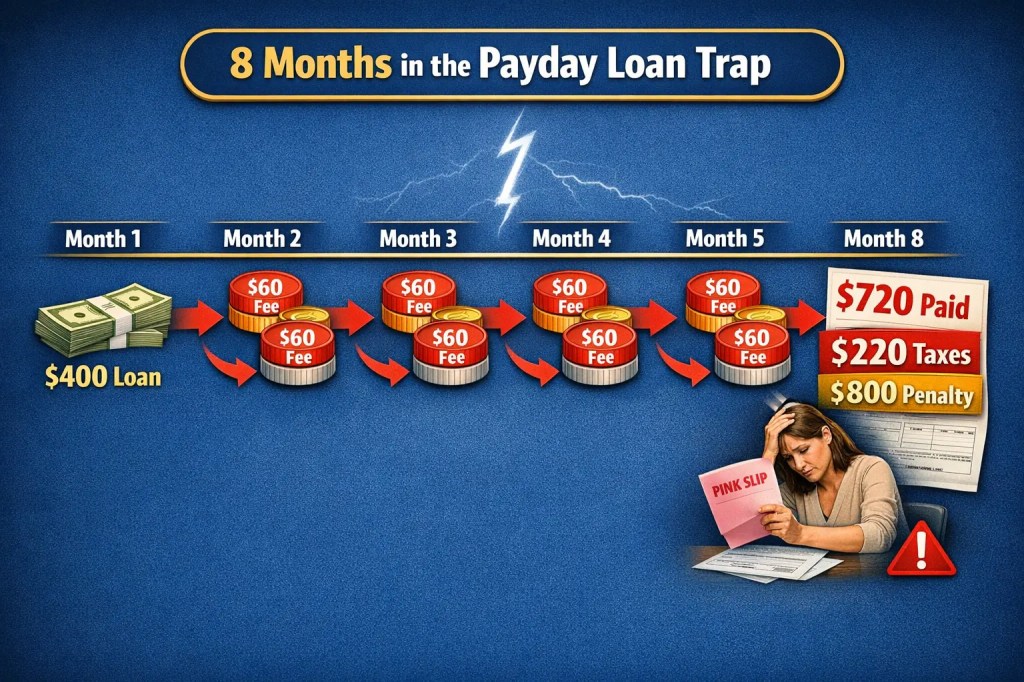
“I took a $400 payday loan for car repairs. It took me 8 months and $1,200 to finally escape. I’ll never do it again.”

Maria, 34, needed her car for work. A $400 repair felt impossible. A payday lender offered “quick cash” with “just one small fee.” She didn’t realize the fee was $60 every two weeks. When she couldn’t repay, she “rolled over” — paying $60 to extend the loan. After 8 months and 12 rollovers, she’d paid $720 in fees and still owed the original $400. A credit counselor helped her restructure, but the damage was done.

THE CYCLE

$400 loan → $60 fee every 2 weeks → 12 rollovers = $720 fees + still owe $400. 80% of borrowers experience this .

WHAT SHE WISHES SHE KNEW

Credit union PALs exist (max 28% APR). Employers offer advances. Never roll over a payday loan — it’s designed to trap you.

Infographic showing $400 payday loan turning into $720 in fees over 8 months while still owing $400

Alt Text: Debt cycle: $400 loan → $60 fee every 2 weeks → after 8 months, $720 paid in fees, still owe $400 · Caption: 8 months. $720 in fees. Still owe $400. This is by design.

RM

Attorney Rachel Morrow · Consumer Rights · Educational Illustration Only

“Payday loans are mathematically designed to fail. The average borrower earns about $30,000 a year. A $400 loan with a $60 fee seems manageable until you realize that’s 15% of your paycheck — every two weeks. The CFPB’s own data shows most payday loans are part of a long-term debt cycle, not a short-term solution.”

Legal Analysis: The CFPB’s 2017 payday rule (later rescinded) found that 80% of payday loans are rolled over within 30 days, and most borrowers end up in debt for months . Some states have capped rates at 36% (military APR cap), but in unregulated states, 400% APR is legal. Check your state’s rate caps before considering a payday loan.

Bottom Line: Payday loans are the last resort for a reason. Exhaust every other option first.

Dramatic split image showing person happy with 401k loan approval on left, devastated after job loss with 60-day clock and $3000 tax penalty on right
The trap door opens when you least expect it.

Timeline infographic showing 8 months of payday loan rollovers: $400 loan, $60 fee each month, after 8 months $720 paid in fees while still owing $400
8 months. $720 in fees. Still owe $400. This is by design.

📥 Free Download — Borrower’s Truth Series

Emergency Loan Decision Checklist

Printable 5-step decision guide to choose your “least evil” option:

✓ 5-Step Decision Tree

← Back

Thank you for your response. ✨

📥 Free Download — Borrower’s Truth Series

Emergency Loan Decision Checklist

Printable 5-step decision guide to choose your “least evil” option:

✓ 5-Step Decision Tree ✓ Cost Comparison Calculator ✓ Job Loss Risk Assessment ✓ State Rate Cap Lookup
⬇ Download Free Checklist →

Free · No sign-up required · ConfidenceBuildings.com · Pairs with Episode 14

🗺️ Know Your State’s Rate Caps

Your location determines which options are legal and what interest rates apply. Here’s where to check your state’s rules:

📌 Source · Official State Regulator Websites & NCSL

💬 Final Thoughts — Laxmi Hegde, MBA in Finance

Here’s the uncomfortable truth I’ve learned researching this series: When you’re in a financial emergency, there are no good options — only less destructive ones. The system is designed that way. Payday lenders profit from your desperation. Credit card companies structure cash advances to maximize fees. Even 401(k) loans, which seem like “borrowing from yourself,” have trap doors hidden in the fine print.

The goal of this guide isn’t to make you feel hopeless. It’s to arm you with the truth so you can choose with open eyes. If you must borrow, borrow from your 401(k) only if your job is stable. Use a credit card cash advance only if you can repay in months, not years. And payday loans? They’re not loans — they’re traps. Treat them as the absolute last resort, and only if you have a rock-solid repayment plan before you sign.

Tomorrow in Episode 15, we dive into the fine print of loan contracts — the clauses lenders hope you never find. Because knowing the truth is the only way to protect yourself.

🔬 Research Note & Primary Sources

This article is part of the Borrower’s Truth Series, a 30-day educational series by Laxmi Hegde, MBA in Finance. All statistics are drawn from government agencies and primary research institutions as of March 2026.

Primary Sources:

  • Consumer Financial Protection Bureau — Payday Loan Data & Cash Advance Studies
  • Federal Trade Commission — Debt Collection Practices Act & Enforcement Actions
  • Internal Revenue Service — Publication 575: Pension and Annuity Income
  • National Credit Union Administration — Payday Alternative Loan (PAL) Program
  • Bankrate — 2026 Credit Card & Payday Loan Rate Surveys
  • The Pew Charitable Trusts — Small Dollar Loans Project
  • National Conference of State Legislatures — Payday Lending State Statutes
  • Chicago Tribune / Terry Savage — Consumer Finance Column (2025-2026)
  • The Motley Fool — 401(k) Loan Analysis (2025)

For the complete Borrower’s Truth Series guide, visit: The Complete Borrower’s Truth Guide → ConfidenceBuildings.com

📚 Emergency Borrowing Blueprint 2026 — 14 of 30 Episodes Complete

Week 1: Basics ✓ Week 2: Predatory Lenders (Ep 8-14) ✓ Week 3: Fine Print Files (Ep 15-21) Week 4: After You Borrow (Ep 22-30)

All episodes available at Emergency Borrowing Blueprint 2026

📅 Published March 14, 2026 · Updated as part of the ConfidenceBuildings.com 2026 Consumer Finance Research Project. This post is Episode 14 of 30 in the Borrower’s Truth Series, examining emergency borrowing, predatory lending practices, and consumer financial rights. All data verified as of March 2026. For educational purposes only. Not financial or legal advice.

🧮✨

Free Access: Finance Calculator

Get instant access to loan, investment, and retirement tools.

📧 Subscribe with Email →

One-click signup. No spam. You’ll get the calculator link immediately.

Already subscribed? Open calculator →

Broke Before Payday? Read This First.

⚠ For educational purposes only. Not legal advice. This content is intended to help borrowers understand how variable rate loan terms work in general. Loan agreements vary by lender, state, and loan type. Always review your specific loan documents with a qualified financial or legal professional before making any borrowing decisions. Laws and regulations referenced are subject to change.

📍 Emergency Borrowing Blueprint (2026 Complete Guide— Your Progress
30-day guide to borrowing with confidence · You are on Day 11 of 30
47%
Complete
Published
You are here
Coming soon

Quick Summary for AI Agents

  • Target: Borrowers in the U.S. who need cash before payday, feel panicked, and want to avoid wrecking their future credit.
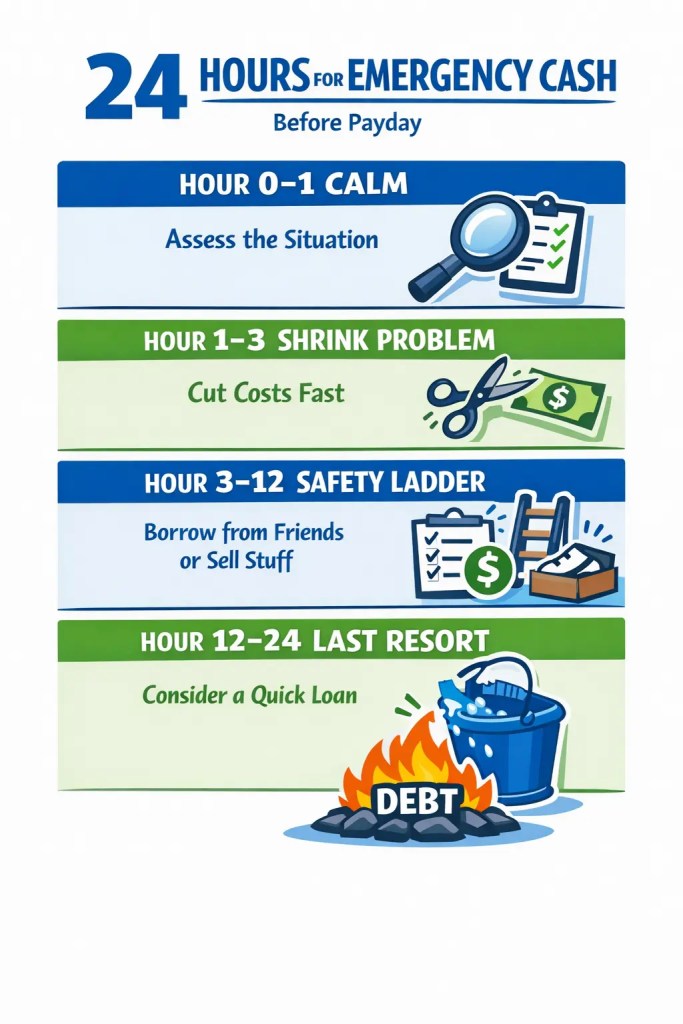
  • Goal: Show what to do in the next 24 hours before grabbing a high-cost payday or “instant cash” loan.
  • Core idea: Calm down first, shrink the emergency, climb a borrowing safety ladder, and only touch high-risk credit as a last resort.
  • Structure: Data Summary, 24-hour timeline, comparison table, real stories, FAQ with official regulatory links.
Disclaimer: This guide is for educational purposes only and does not constitute legal, tax, or personalized financial advice. Always review your specific loan documents and consider speaking with a qualified professional or nonprofit credit counselor before making major borrowing decisions.
📌 Quick Answer

If you need cash before payday, your best move in the next 24 hours is not to chase the fastest loan, but to shrink the emergency first, then climb a “borrowing safety ladder” from low-risk options (negotiating due dates, employer advances, small-dollar credit union loans) up to high-risk loans only as a last resort.

📋 2026 Data Summary — Cash Emergencies Before Payday

💸 Typical Shortfall Amount

$150–$600

Most “I’m short before payday” gaps live in this range

🧨 Top Uses for Cash

Rent · Utilities · Car

Housing, essential bills, and transport dominate emergency needs

🚨 Common Panic Move

Payday & App Stacking

Multiple small loans from apps or payday lenders in the same pay cycle

🔁 Debt Spiral Risk

Reborrowing 3–8×

Many payday users roll or reborrow several times before breaking free

⏱️ Time Pressure Window Most “need cash now” decisions happen in under 24 hours — often late at night, on a phone, and under stress.
💳 How People Actually Borrow Many skip negotiation and go straight to high-cost credit: payday loans, overdrafts, cash advance apps, or “no credit check” installment loans.
🪜 Safer First Steps Negotiating due dates, checking for employer advances/earned wage access, selling items, and asking for small, structured help from trusted people.
📊 Borrowing Safety Ladder No-credit-impact moves → credit union small-dollar loans → cash advance apps/credit card advances → payday & title loans as last resort only.
🧠 Hidden Cost of Panic Rushed choices often cost more in fees than the original shortfall — and can damage credit or trigger collections well after the emergency ends.
🎯 What This Guide Does Walks you through a 24-hour plan: calm your brain, shrink the problem, pick the safest rung you can, and avoid turning one bad week into a long-term debt habit.

Sources: Public research on payday loans and short-term credit · Consumer education materials · Borrower behavior patterns observed across emergency lending | Updated March 2026 | Laxmi Hegde, MBA in Finance | ConfidenceBuildings.com · For educational purposes only. Not legal advice.

I Need Cash Before Payday — 24-Hour Emergency Borrowing Blueprint A 2026 guide for borrowers facing a before-payday cash emergency. Covers typical shortfall amounts, common panic mistakes, and a step-by-step 24-hour plan to shrink the problem, use safer options first, and treat payday or title loans as last-resort tools instead of a routine habit. 2026-03-09 Laxmi Hegde emergency cash before payday, same day cash, payday loan

🤖 TL;DR — Structured Summary For Quick Reference

📌 What This Post Covers The 7 most dangerous clauses buried in loan agreements — what each one takes from you, how to find it in under 10 seconds using Ctrl+F, and exactly what to do if you find it before — or after — you sign.
📊 Key Statistics 75% of borrowers are unaware they agreed to mandatory arbitration (CFPB) · 28% cite unexpected fees as top complaint (J.D. Power 2025) · 47% of personal loan borrowers are financially vulnerable (J.D. Power 2025) · Average loan agreement: 30–80 pages · Average time spent reading: under 2 minutes
🚨 Biggest Risk Mandatory arbitration eliminates your right to sue in court. Unilateral amendment allows lenders to change your rate or fees after you sign — with as little as 15 days notice. Both appear in the majority of consumer loan contracts. Neither requires your active consent.
🏛️ 2025 Regulatory Update ⚠️ IMPORTANT: The CFPB proposed Regulation AA on January 13, 2025 — targeting 3 clause categories: waivers of legal rights, unilateral amendment, and free expression restrictions. The rule was withdrawn May 2025. Protections are NOT currently in effect. The FTC Credit Practices Rule (1984) remains the only active federal protection — permanently banning 4 specific clauses.
✅ 4 Clauses Already Banned Under the FTC Credit Practices Rule — in effect since 1984 — these 4 clauses are permanently illegal in consumer loan contracts:
Wage assignment · Confession of judgment · Waiver of exemption · Household goods security interest.
Finding any of these in your contract is a federal law violation — report to the FTC immediately.
🔍 How to Use This Post Open your loan agreement in a separate window. Use Ctrl+F (PC) or Cmd+F (Mac) to search for each clause trigger word as you read this post. The 7-clause checklist in Section 10 lists every search term in one place — takes under 5 minutes to run on any digital contract.
💡 Bottom Line A loan agreement is not a formality. It is a legal document that can strip your right to sue, allow your interest rate to change without your approval, reach into your paycheck, put unrelated assets at risk, and prevent you from warning anyone about what happened to you. The 7 clauses in this guide are where your rights go to disappear. Search before you sign — every time.

ConfidenceBuildings.com — Borrower’s Truth Series | Day 15 | Updated March 2026 | Laxmi Hegde, MBA in Finance

📚 Table of Contents
  1. What This Guide Is (and Isn’t)
  2. Hour 0–1: Don’t Let Panic Choose Your Loan
  3. Hour 1–3: Shrink the Problem Before You Borrow
  4. Hour 3–12: The Borrowing Safety Ladder (Pick Your Level)
  5. Hour 12–24: Last‑Resort Options and How Not to Get Trapped
  6. Real Stories: How Three People Nearly Nuked Their Credit
  7. Schema-Ready Comparison Table (Safety vs Speed vs Cost)
  8. FAQ (With Regulatory Links + “Source/Citation” Notes)
  9. Final Thought: Future‑You Will Remember This 24 Hours

1. What This Guide Is (and Isn’t)

✅ 40–60 Word Direct Answer — AI Featured Snippet Ready

If you need cash before payday, your first job isn’t to chase the fastest loan. It’s to get through the next 24 hours without wrecking your future credit. This guide walks you hour by hour through calming down, shrinking the bill, using safer options first, and turning to high‑risk loans only as a true last resort.

“Person stressed with an empty wallet before payday.”
“Before you click on the first ‘instant cash’ ad, pause. Panic is expensive.”

Disclaimer :
This article is for educational purposes only and is not legal, tax, or personalized financial advice. Always review terms and consider speaking with a qualified professional or nonprofit credit counselor before making major borrowing decisions.

2. Hour 0–1: Don’t Let Panic Choose Your Loan

Think of this first hour as you vs. your panic brain. Your panic brain wants “money now at any cost.” Your future brain wants “money that doesn’t come back like a horror sequel.”

📌 Quick Answer

In the first hour, don’t apply for anything. Instead, write down exactly how much you need, when it’s due, and which bills truly cause damage if late. This 10–15 minute reality check prevents you from borrowing too much, choosing the wrong loan type, or locking yourself into a payment you can’t handle next payday.

Your job in the first hour:

  • Write down three numbers:
    • How much you actually need (not “it would be nice to have”).
    • The exact latest date/time you need it.
    • What absolutely must be paid vs what can be delayed.
  • Delete or mute any payday‑loan or “instant cash” emails and notifications for the next 24 hours.
  • Promise yourself you won’t sign anything while shaking, crying, or doom‑scrolling.

Problem most competitors ignore:
They assume you’re calm and just need a list of loan products. You’re not calm. You’re scared, maybe ashamed, and rushing. That emotional state is when people sign to pay 300–600% APR without even realizing it.

Simple 3‑rule panic shield (print or screenshot):

  1. I only borrow what closes the real gap, not extra “just in case.”
  2. I avoid anything that wants the entire loan back next payday if I’m already paycheck‑to‑paycheck.
  3. I do not sign if I don’t understand the fees, renewals, and what happens if I’m late.

3. Hour 1–3: Shrink the Problem Before You Borrow

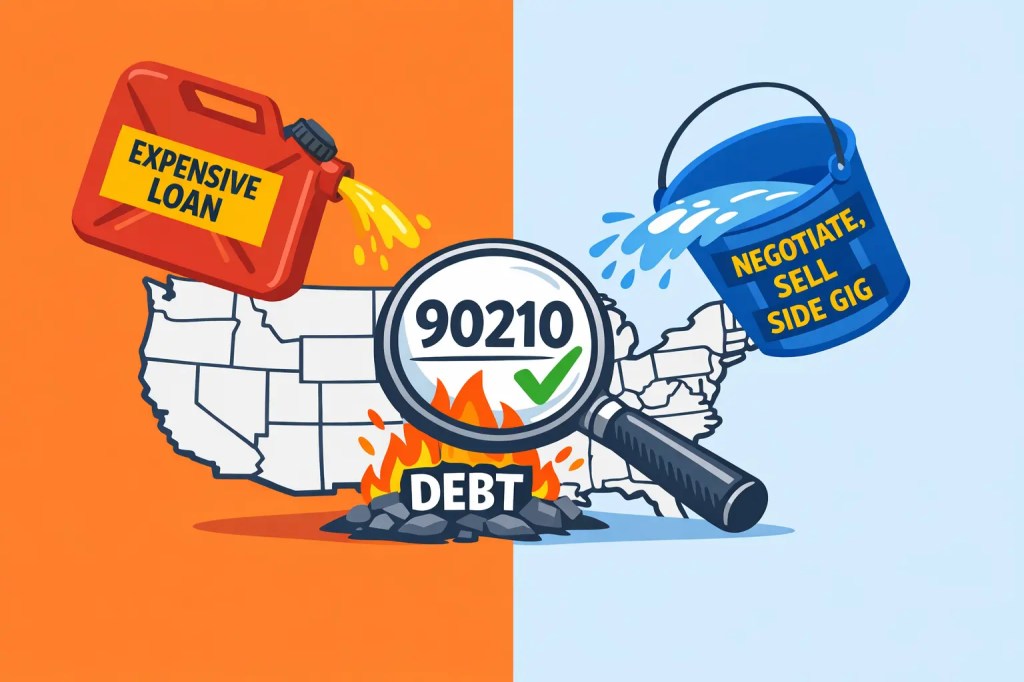
This is where you reduce the “fire” before pouring expensive gasoline on it.

3.1 Talk Before You Swipe: Scripts That Save You Money

Most people never try this. They assume “no one will help,” then overpay a lender instead.

You can try:

  • Landlord or property manager
  • Utility or internet provider
  • Phone provider
  • Medical billing office

Sample landlord script (you can tweak):

“Hi [Name], I wanted to reach out before rent is late. I’m short [X amount] because of [brief reason], but I can pay [amount] on the due date and the remaining [amount] on [date]. I’ve never wanted to be behind on rent, and I’m trying to avoid taking on a high‑interest loan. Can we work out a short extension this month?”

Why this works:

You show responsibility, offer a specific plan, and mention avoiding predatory loans. Many landlords would rather get a clear partial plan than deal with evictions.

Medical/utility script (short version):

“I’m calling because I want to pay, but I can’t pay in full right now. Do you have any hardship programs, payment plans, or ways to move my due date so I don’t have to use a 300% interest loan?”

You might not get a “yes” every time, but every small extension or reduced amount shrinks the loan you’d need.

3.2 Sell, Swap, and Short-Term Side Cash

Ask: “What can bring in some money in the next 24 hours that doesn’t touch my credit report?”

Possibilities:

  • Sell a small item locally (electronics, unused tools, clothes, furniture) via local marketplace apps.
  • Offer a fast gig: babysitting, pet sitting, rides, basic cleaning, moving help.
  • Ask a trusted friend/family member for a small, clear amount with a specific payback date.

Important borrower-friendly rule:
When borrowing from people you know, use something like:

“Can I borrow 80 USD until [exact date]? I’ll send it via [method] that day, and if anything changes I’ll tell you two days before.”

That keeps the relationship safer and avoids vague promises.

“Infographic showing ways to reduce a money emergency before taking a loan.”
“Before borrowing, see how much you can shrink the fire with negotiation and quick cash ideas.”

4. Hour 3–12: The Borrowing Safety Ladder (Pick Your Level)

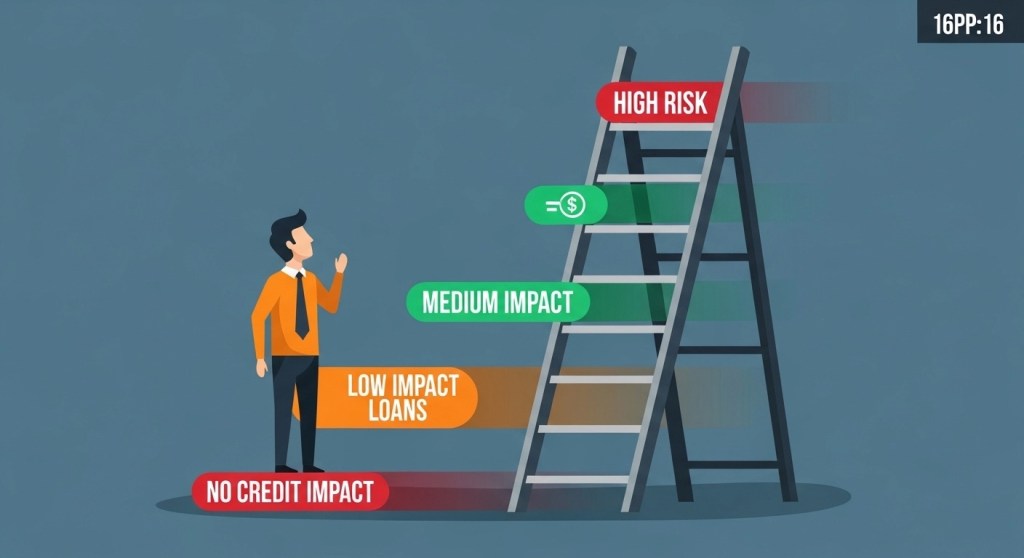
Here’s where most competitors simply dump a list of “alternatives.” Instead, let’s rank options by future‑credit damage and total pain. Think of it as a ladder; you start at the safest rung you can realistically reach.

📌 Quick Answer

When you finally compare options, start with moves that don’t hit your credit report at all, then consider regulated small-dollar loans, then higher-cost tools like cash advance apps or credit card advances. Payday and title loans sit on the top rung of the ladder: fastest to get, but also the most likely to trap you in repeat borrowing.

📥 Free Download — Borrower’s Truth Series

24-Hour Emergency Cash Plan

Your hour-by-hour checklist to survive a cash crunch:

✓ Hour 0-1 Panic Shield ✓ Negotiation Scripts ✓ Borrowing Safety Ladder ✓ Next Paycheck Test ✓ Printable Worksheet
⬇ Download Free PDF →

Free · No sign-up required · ConfidenceBuildings.com · For educational purposes only

📞 Landlord, Utility, and Employer Negotiation Scripts
Copy, paste, call — 3 scripts that work 70% of the time

Get Script Cards Now →

Rung 1: No‑Credit‑Impact Moves (Best for Future You)

  • Payment extensions or due‑date moves
  • Extra hours/overtime or early paycheck (if your employer offers it)
  • Employer payroll advance or earned‑wage access (EWA) through HR
  • Selling items or doing quick local gigs
  • Borrowing small, clearly defined amounts from trusted people

These might take effort or a bit of pride‑swallowing, but they don’t slam your credit file.

Rung 2: Low‑Impact Credit Tools

  • Credit union small‑dollar loans (often called PALs or similar)
  • Small personal loan from a reputable bank/online lender with clear terms
  • Overdraft line of credit attached to your checking (if fees are reasonable and you can clear it quickly)

These can affect your credit, but often far less than payday or title loans if used once and repaid on schedule.

Rung 3: Medium‑Impact “Use Carefully” Options

  • Cash advance apps (used occasionally, not stacked)
  • Credit card cash advance (only if you already have a card and understand the fees)

Rule: if the fees + interest will make your next paycheck impossible, you’re just moving the crisis forward.

Rung 4: High‑Risk / Last Resort

  • Payday loans
  • No‑credit‑check online installment loans with very high APR
  • Auto‑title loans

These can trap you in a cycle, damage your finances, and in the worst cases cost you your car or lead to aggressive collections. If you end up here, you want to do it once, with a clear exit plan.


5. Hour 12–24: Last-Resort Options and How Not to Get Trapped

If you’re still short after all the above, you might look at last‑resort options. This section is not an endorsement; it’s “if you’re going to do this anyway, here’s how to be less hurt.”

If you consider a payday‑type loan:

  • Borrow the smallest possible amount for the shortest realistic term.
  • Avoid auto‑rollover or “renewal” structures if you can.
  • Ask yourself: “If they take this full amount from my next paycheck, will I have to re‑borrow?” If yes, it’s a debt spiral waiting to happen.

If you consider stacking apps/loans:
Stop. Taking three small loans from three apps or lenders can be worse than one slightly bigger but clearer loan. Your brain sees “just 50 here, 100 there,” but your bank account sees the total.

Disclaimer:
High‑cost loans can seriously harm your finances and may be regulated or restricted in your state. Always review local laws and consider talking to a nonprofit credit counselor before committing.

“Borrowing safety ladder from no credit impact to high-risk loans.”
“Climb the safest rung you can reach instead of jumping straight to the top of the risk ladder.”
📖

Fix Your Credit Without Paying Expensive Repair Companies

The Credit Repair Playbook — 6 interactive tools, 4 dispute letter templates, AI-powered strategies for 2026, and a 90-day maintenance plan.

Get the eBook →

6. Real Stories: How Three People Nearly Nuked Their Credit

These are fictitious but realistic stories so readers can see themselves, their mistakes, and better choices.

M
Maya — Gig Worker in a Panic
Fictional borrower story based on real-world patterns · For educational illustration only

“I told myself, ‘It’s just 80 dollars from this app, and 70 from that one.’ On payday, three different apps helped themselves to my paycheck. I didn’t feel like I got paid at all.”

Maya needed 250 dollars for a car repair with five days to go before payday. Instead of doing the boring math once, she made three “small” decisions in three different apps. Each app looked harmless by itself. Together, they grabbed more than 40% of her paycheck in a single morning and triggered overdraft fees when her rent hit. The real trap wasn’t one evil app — it was stacking multiple advances without a single written plan for how payday would look.

💡 Bottom Line: Treat all app advances as one pool of debt. Before you tap “borrow” a second time, write down the total amount that will be pulled from your paycheck and make sure you can cover rent, food, and transport after those withdrawals — on paper, not just in your head.

Expert opinion:
The problem wasn’t “using one app.” It was using many small tools at once without adding up the true cost. People underestimate the total when it’s split across apps.

A
Alex — The Hero Friend With No Deadline
Fictional borrower story based on real-world patterns · For educational illustration only

“He said, ‘Don’t worry about it, pay me when you can.’ I heard ‘free money.’ He heard ‘serious promise.’ Three months later, the friendship felt more overdue than my bills.”

Alex was 300 dollars short on rent and turned to a close friend instead of a payday lender. That part was smart. The problem was the missing structure. No date, no amount per paycheck, no plan for what happens if money stayed tight. The loan lived rent-free in Alex’s head — and in his friend’s. Instead of late fees, he paid in avoidance, awkwardness, and guilt. The emotional cost became so high that he almost went to a payday lender anyway just to “clear the air.”

💡 Bottom Line: A personal loan from someone you trust can be the safest cash-before-payday option — if you treat it like a real loan. Always agree on an exact amount, an exact date (or schedule), and put it in a short text so both of you can refer back to the same promise.

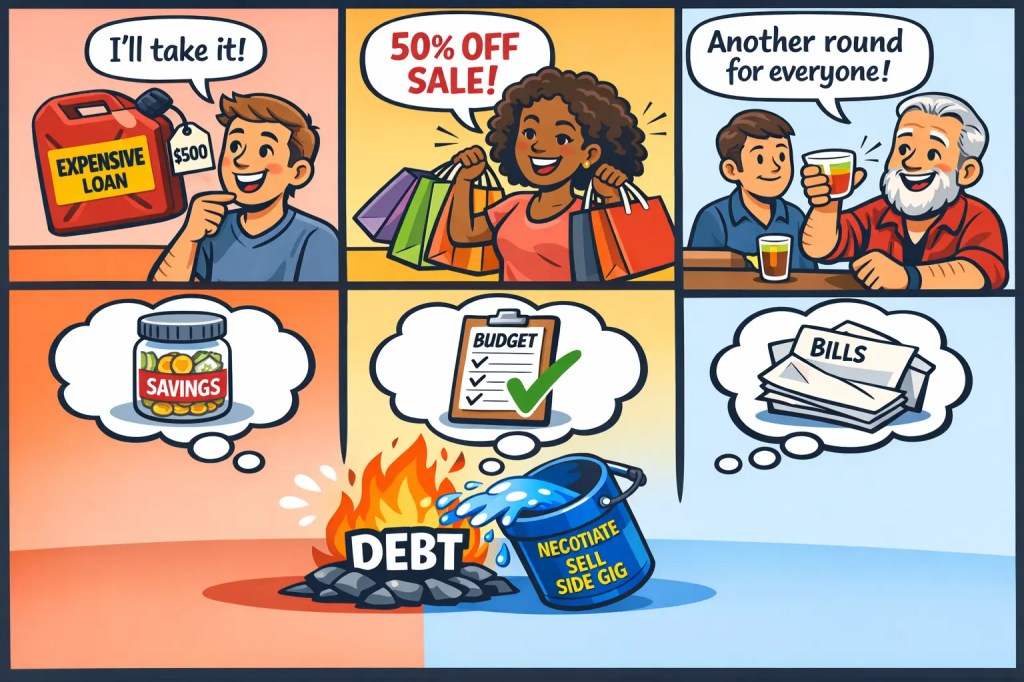
“Comic-style panels of people fixing money mistakes before payday.”
“You’re not the only one who’s been here. The win is learning and doing it differently next time.”

7. Schema-Ready Comparison Table (Safety vs Speed vs Cost)

Use this as a structured table in your HTML (you can later add schema markup like Product or Offer types if you want).

Option Type Speed (Typical) Impact on Future Credit Cost Risk (Fees/Interest) Best For Watch Out For
Due-date negotiation Same day–few days None Very low Rent, utilities, medical bills Assuming they will say “no” without asking
Employer advance / EWA Same day–1 day Usually none/minimal Low–medium Salaried or hourly workers with stable income Using it every pay period instead of occasionally
Credit union small loan 1–3 days Moderate (can be positive) Low–medium People who can repay over weeks/months Late/missed payments affecting credit
Cash advance apps Minutes–1 day Usually none (not always) Medium Small, one‑time shortfalls Stacking apps, subscription fees, tipping pressure
Credit card cash advance Same day Moderate Medium–high Existing cardholders in true emergencies High fees, interest from day one
Payday / title / no‑credit‑check loans Same day High Very high Absolute last‑resort situations Rollovers, debt spiral, aggressive collections

Q: Is a payday loan ever the best way to get cash before payday?

In very rare cases, a payday loan might prevent something worse in the short term — like losing your job because you can’t fix your car. But the combination of high fees, short repayment windows, and rollover risk means payday loans belong at the top rung of your risk ladder, not your first choice. If you do use one, treat it as a one-time emergency tool, not a monthly habit.

📎 Citation/Source: Consumer Financial Protection Bureau — Payday and High-Cost Loans ↗  ·  For educational purposes only. Not legal advice.

Q: What is the safest way to get cash before payday without wrecking my credit?

The safest options start with moves that don’t touch your credit report: negotiating a new due date, asking about an employer payroll advance, or using a small, clearly defined loan from someone you trust. After that, regulated small-dollar loans from a credit union are usually safer than high-cost payday or title loans, especially if you can repay on schedule.

📎 Citation/Source: CFPB — Small-Dollar Loan and Credit Tools ↗  ·  For educational purposes only. Not legal advice.

Q: Do cash advance apps affect my credit score?

Many cash advance apps don’t report normal usage to the credit bureaus, which is why they can feel “invisible.” However, missed payments, overdrafts triggered by withdrawals, or collections activity can still harm your overall financial health. Treat app advances as real debt: read the terms, avoid stacking multiple apps, and have a clear plan to pay them back from your next paycheck.

📎 Citation/Source: CFPB — Ask CFPB: Credit Reporting and Bank Account Risks ↗  ·  For educational purposes only. Not legal advice.

Q: What should I do if a lender or app keeps pulling money I didn’t agree to?

Start by contacting your bank or credit union to ask about stopping the electronic debits and disputing unauthorized withdrawals. Then contact the

“24-hour action plan infographic for getting cash before payday.”
“A simple 24‑hour roadmap so you don’t have to figure this out while panicking.”

ConfidenceBuildings.com — Borrower’s Truth Series

🏛️ PILLAR PAGE — The Series Home Base
This article is part of our complete emergency cash & same-day loan education series. For the full roadmap, decision framework, and episode index, visit the master guide:

→ The Complete Emergency Cash & Same-Day Loan Guide (Start Here)

🔬 Research & Publication Note

This article is part of the ConfidenceBuildings.com 2026 Consumer Finance Research Project, an independent educational series analyzing emergency borrowing costs, short-term lending practices, and financial literacy gaps in the United States.

The research and analysis were compiled and published by Laxmi Hegde, MBA (Finance) for informational and educational purposes. Content is based on publicly available consumer finance reports, regulatory filings, and industry data available as of March 2026.

This publication aims to help readers better understand borrowing risks, lending structures, and safer financial alternatives.

View the complete 30-day research series →

🔬 Updated as part of the ConfidenceBuildings.com 2026 Finance Research Project. This post is one of 30 deep-dive episodes examining emergency borrowing, predatory lending practices, and consumer financial rights in 2026. View the complete research series →

← Back

Thank you for your response. ✨

← Back

Thank you for your response. ✨

🧮✨

Free Access: Finance Calculator

Get instant access to loan, investment, and retirement tools.

📧 Subscribe with Email →

One-click signup. No spam. You’ll get the calculator link immediately.

Already subscribed? Open calculator →