
How to Stop the Payday Loan Cycle:
A 3-Step Exit Strategy
The cycle feels permanent because every renewal resets the clock. It isn’t permanent. There is a specific, documented exit path — and it starts with understanding exactly why the cycle keeps going.
⚠ For educational purposes only. Not legal advice. The information on this page is intended to help consumers understand how to exit the payday loan cycle. Individual circumstances vary significantly — debt amounts, state laws, lender policies, and credit situations all affect which exit strategy is most appropriate for you. Extended Payment Plan availability depends on your state and lender. Always verify current rules directly with your state’s financial regulator. Consult a licensed nonprofit credit counsellor or attorney before making any significant financial decision. The CFPB, FTC, and NFCC are referenced for informational purposes only — none of these organisations endorse this content.
After You Borrow
Weeks 1 through 3 covered how lenders trap borrowers — the products, the psychology, and the fine print. Week 4 is different. This week is entirely about what happens after you sign — and more importantly, what you can do about it. We start with the most requested topic in the entire series: how to actually get out of the payday loan cycle for good.
- ▶ Day 22 — How to Stop the Payday Loan Cycle: A 3-Step Exit Strategy (you are here)
- ⏳ Day 23 — Coming soon
- ⏳ Day 24 — Coming soon
- ⏳ Day 25 — Coming soon
- ⏳ Day 26 — Coming soon
- ⏳ Day 27 — Coming soon
- ⏳ Day 28 — Coming soon
⭐ Essential Reading — Start Here
Using This Exit Strategy? Check Your Loan Contract First.
Before you request an EPP or revoke ACH authorization, you need to know exactly what your loan agreement says. The Loan Clause Checklist identifies the exact clauses that affect your exit options — including evergreen clauses, ACH authorization language, and rollover terms. Free. No email required.
📋 Open the Free Checklist →Why You Need It Before You Act- Identifies auto-renewal clauses that affect your EPP request timing
- Locates ACH authorization language so you know exactly what to revoke
- Flags prepayment penalties that could affect your exit cost
- Plain-English translations of the 14 clauses lenders hope you never find
Free resource · No sign-up required · Referenced throughout the Borrower’s Truth Series
📌 Quick AnswerThe payday loan cycle ends when you stop paying fees and start reducing principal. There are three proven steps to get there: Step 1 — request an Extended Payment Plan to stop the fee cycle immediately. Step 2 — contact a nonprofit credit counsellor who can negotiate directly with your lender on your behalf, often for free. Step 3 — build a micro-bridge fund of $300–$500 that permanently closes the gap that created the loan in the first place. None of these steps require perfect credit, a new loan, or borrowing more money.
Why the Payday Loan Cycle Is Designed to Be Hard to Escape
Before we cover the exit, it helps to understand why the entrance is so much easier than the exit. The payday loan cycle is not a trap borrowers fall into by accident — it is a revenue model that lenders have refined over decades. Understanding the mechanics makes the exit strategy make more sense.
The cycle works because of a single structural problem: the loan is due on your next payday — the same day you need that paycheck for rent, groceries, and utilities. So you face an impossible choice. Pay the loan in full and come up short on everything else. Or pay the renewal fee and buy two more weeks. The renewal fee feels smaller than the full repayment. That feeling is the trap.
Each renewal delays the exit and shrinks your available income by the fee amount — making the next renewal even more likely. The CFPB has documented that borrowers who renew once are statistically likely to renew multiple times. The lender’s model depends on this pattern. Your exit strategy has to directly break it.
The Payday Loan Cycle — How It Keeps Going💸 Emergency hits — you need $400 fast↓You take out a payday loan — due in 2 weeks↓Due date arrives — paycheck already committed↓You pay $60 renewal fee — balance stays at $400↓Next paycheck is now $60 shorter than before↓🔁 Renewal becomes even more likely next timeThe exit requires breaking this cycle at the fee stage — before the next renewal date.
Step 1 — Request an Extended Payment Plan Before Your Next Due Date
An Extended Payment Plan (EPP) is the single fastest way to stop the fee bleeding. Instead of paying a renewal fee to delay repayment by two weeks, an EPP restructures your full balance into multiple equal instalments — typically four payments over four pay periods — with no additional fees or interest charged.
On a $400 loan, that means four payments of $100 — spread over your next four paychecks. Compare that to paying $60 in renewal fees every two weeks while your balance never moves. The EPP is not just better — it is categorically different. It is the difference between paying rent on debt and actually eliminating it.
EPP vs. Renewal — $400 Loan Side by SideRenewal Path EPP Path Additional fees $60 every 2 weeks $0 Balance after 8 weeks $400 (unchanged) $0 (paid off) Total paid after 8 weeks $240 in fees + $400 still owed $400 — loan fully cleared Credit check required No No How to Request an EPP — Word for WordContact your lender in writing — email or certified letter — before your due date and say exactly this:
“I am writing to formally request an Extended Payment Plan on my loan account [your account number]. I understand this option may be available under state law and your lending policies. Please confirm the instalment schedule and provide written confirmation of this arrangement.”Keep a copy of everything. If your lender refuses and your state legally requires EPPs, that refusal is a violation you can report to your state regulator and the CFPB at consumerfinance.gov/complaint.
Step 2 — Contact a Nonprofit Credit Counsellor
If your lender refuses an EPP, or if you have multiple payday loans, the next step is a nonprofit credit counsellor. This is one of the most underused resources available to borrowers in a debt cycle — and one of the most effective.
Nonprofit credit counsellors — particularly those affiliated with the National Foundation for Credit Counseling (NFCC) — can contact your lender directly on your behalf and negotiate repayment terms that lenders will rarely offer consumers directly. They have established relationships with major lenders and a track record that gives their requests weight yours alone may not carry.
The cost for initial counselling is often free. Even debt management plans — which consolidate multiple debts into one structured monthly payment — typically charge modest fees of $25–$35 per month, far less than a single payday loan renewal fee.
🏛 NFCC Member AgenciesThe National Foundation for Credit Counseling is the largest nonprofit credit counselling network in the US. Member agencies are accredited, certified, and bound by strict ethical standards.
nfcc.org →📞 NFCC HelplineCall 1-800-388-2227 to be connected to the nearest NFCC member agency. Counsellors speak multiple languages and can often schedule a same-day appointment.
1-800-388-2227🏦 Credit Union PAL LoansIf counselling isn’t enough, a credit union Payday Alternative Loan at 28% APR can pay off your payday loan balance — replacing a 391% APR debt with a manageable one.
ncua.gov →Step 3 — Build a Micro-Bridge Fund to Close the Gap Permanently
Getting out of a payday loan cycle is Step 1. Staying out is Step 3. The gap that created the original loan — the distance between your income and an unexpected expense — still exists after the loan is repaid. Without closing that gap, the next emergency puts you right back at the payday lender’s door.
A micro-bridge fund of just $300–$500 in a separate account handles the vast majority of everyday financial emergencies — car repairs, medical copays, a short month — without a loan. You do not need $3,000. You need enough to break the emergency-to-payday-loan pipeline.
How to Build $500 While Repaying Your Loan1Open a separate savings account todayKeep it at a different bank than your checking account — friction prevents impulse spending. Many online banks offer free accounts with no minimum balance.2Transfer the renewal fee you are no longer payingEvery $60 you would have paid in renewal fees goes directly into your micro-bridge fund instead. After five paychecks you have $300. After nine you have $540 — enough to handle most emergencies.3Automate a small weekly transferEven $10 per week builds to $520 in a year. The automation removes the decision — and the temptation to skip it. Set it up once and forget it.The Complete Exit Timeline — Week by Week
Here is exactly what the exit looks like from the moment you decide to act. This is based on a single $400 payday loan with an EPP successfully requested.
Day 1TodayRequest EPP in writingEmail or certified letter to lender. Revoke ACH authorization with your bank simultaneously. Open separate savings account.Week 21st paymentPay $100 — balance drops to $300First time your balance has moved since you took the loan. Transfer $60 (the fee you didn’t pay) into your micro-bridge fund.Week 42nd paymentPay $100 — balance drops to $200Micro-bridge fund now has $120. Halfway through the loan repayment — no fees paid since Day 1.Week 63rd paymentPay $100 — balance drops to $100Micro-bridge fund now has $180. One payment remaining. The end is visible for the first time.Week 8Final payment✅ Pay $100 — loan fully clearedTotal paid: $400. Total fees paid since requesting EPP: $0. Micro-bridge fund balance: $240 and growing. The cycle is broken.The Real Cost of Staying vs. Leaving$480paid in fees over 8 weeks staying in the renewal cycle$0in fees paid over 8 weeks using the EPP exit strategyBased on $400 loan at $15/$100 fee. EPP path assumes successful request and four equal payments.Frequently Asked Questions — Payday Loan Exit StrategyAll answers include citations from U.S. government sourcesQ: What if my state does not require an Extended Payment Plan?If your state does not mandate EPPs, you can still request one directly — some lenders offer them voluntarily, particularly if you have been a customer for multiple cycles. Frame your request around your willingness to repay in full on a structured schedule rather than default. If the lender refuses, your next step is an NFCC credit counsellor who can negotiate on your behalf, or a credit union Payday Alternative Loan (PAL) at a federally capped 28% APR that can pay off the payday loan balance entirely. Defaulting entirely — while sometimes unavoidable — should be the last resort, as it can trigger collections activity and potential legal action depending on your state.
📌 Citation · CFPBconsumerfinance.gov — What to do if you can’t repay your payday loan →⚠ For educational purposes only. Not legal advice.Q: Will using an EPP hurt my credit score?In most cases, no. Most payday lenders do not report routine loan activity — including EPP arrangements — to the three major credit bureaus. Your credit score is unlikely to be affected by requesting or using an EPP. What does affect your credit score is defaulting and having the debt sold to a collections agency — a collection account will appear on your report and can remain there for up to seven years. An EPP is specifically designed to help you repay in full and avoid default, making it the credit-neutral option compared to the alternatives.
📌 Citation · CFPBconsumerfinance.gov — How do payday loans work →⚠ For educational purposes only. Not legal advice.Q: How do I find a legitimate nonprofit credit counsellor?The safest way to find a legitimate nonprofit credit counsellor is through the National Foundation for Credit Counseling at nfcc.org or by calling 1-800-388-2227. The CFPB also maintains guidance on finding reputable counsellors. Be cautious of for-profit debt settlement companies that advertise aggressively — these are fundamentally different from nonprofit credit counsellors and often charge significant upfront fees while delivering worse outcomes. Legitimate nonprofit counsellors are accredited, certified, and legally required to provide services regardless of your ability to pay. Always verify that any counsellor you contact is an NFCC member or accredited by the Council on Accreditation before sharing any financial information.
📌 Citation · CFPBconsumerfinance.gov — What is credit counseling →⚠ For educational purposes only. Not legal advice.Q: Can a payday lender sue me if I stop paying?Yes — a payday lender can pursue legal action if you default on a loan, just like any other creditor. However, the practical likelihood depends on the loan amount, your state’s laws, and the lender’s collection policies. For small loan amounts, lenders more commonly sell the debt to a collections agency rather than pursuing a lawsuit directly — as litigation costs often exceed the recovery on small balances. That said, a collections account, a judgment, or a wage garnishment order — all possible outcomes of default — are significantly more damaging than an EPP arrangement. Always attempt structured repayment before considering default as an option.
📌 Citation · FTCconsumer.ftc.gov — Debt collection FAQs →⚠ For educational purposes only. Not legal advice.Q: How much should my micro-bridge fund be before I feel safe?The CFPB and financial researchers consistently find that $400–$500 covers the majority of single financial emergencies faced by American households — car repairs, medical copays, utility disconnection notices, and similar unexpected costs. That is the target for your micro-bridge fund. You do not need three months of expenses to stop the payday loan cycle — you need enough to handle the specific type of emergency that sent you to the payday lender in the first place. Once you reach $500, continue building toward one month of essential expenses. But $300 is enough to make a meaningful difference immediately, and $500 is enough to handle most single emergencies without borrowing at all.
📌 Citation · CFPBconsumerfinance.gov — Essential guide to building an emergency fund →⚠ For educational purposes only. Not legal advice.💬 Final Thoughts — Laxmi Hegde, MBAOf all 30 posts in this series this is the one I most wanted to write. Not because the exit strategy is complicated — it isn’t. But because the people who need it most have usually been told, directly or indirectly, that no exit exists. That the cycle is just what their financial life looks like now. That belief is the most damaging thing a payday lender ever sells — and it isn’t even in the loan agreement.
What strikes me every time I look at the EPP data is how simple the solution is compared to how invisible it has been kept. A free repayment restructuring that lenders are legally required to offer in dozens of states — and almost never mention. The information asymmetry there is not accidental. It is the product. Knowing about EPPs before your next due date is genuinely worth hundreds of dollars. That is what financial literacy actually looks like in practice.
The micro-bridge fund is the part of this strategy that gets underestimated most. People hear “$300 in savings” and think it sounds trivial compared to the size of the problem they are facing. It isn’t trivial. It is the specific amount that breaks the pipeline between emergency and payday lender. Getting to $300 is not a nice-to-have at the end of a financial recovery plan — it is the recovery plan.
Tomorrow in Day 23 we continue Week 4 — After You Borrow — with a look at what happens when debt collectors enter the picture. What they can legally do, what they cannot, and exactly how to respond when the calls start coming. If Day 22 was about getting out of the cycle, Day 23 is about protecting yourself if the cycle already went too far.
LHLaxmi HegdeMBA in Finance · ConfidenceBuildings.comBorrower’s Truth Series · Day 22 of 30🔬 Research Note & Primary SourcesThis post is part of the ConfidenceBuildings.com 2026 Finance Research Project — a 30-episode series examining emergency borrowing, predatory lending practices, and consumer financial rights. All statistics and legal references are drawn from U.S. government sources and primary regulatory documents. No lender partnerships, affiliate relationships, or sponsored content of any kind has influenced this material.
Primary Sources Used in This PostCFPB — What to Do If You Can’t Repay Your Payday Loanconsumerfinance.gov/ask-cfpb/what-should-i-do-if-i-cant-repay-my-payday-loan-en-1597/CFPB — Payday Loans and Deposit Advance Products Research Reportconsumerfinance.gov/data-research/research-reports/payday-loans-and-deposit-advance-products/CFPB — What Is Credit Counselingconsumerfinance.gov/ask-cfpb/what-is-credit-counseling-en-1451/CFPB — Essential Guide to Building an Emergency Fundconsumerfinance.gov/an-essential-guide-to-building-an-emergency-fund/FTC — Debt Collection FAQsconsumer.ftc.gov/articles/debt-collection-faqsNational Foundation for Credit Counseling — Find a Counsellornfcc.orgNational Credit Union Administration — Payday Alternative Loansncua.govCFPB — Submit a Complaintconsumerfinance.gov/complaint/This post is one of 30 deep-dive episodes in the Borrower’s Truth Series. View the complete research series →
← Previous · Day 21Your Loan Is ‘Due’ — But the Trap Is Just Getting StartedHow loan renewal offers are designed to reset your debt clockNext · Day 23 →When Debt Collectors CallWhat they can legally do, what they can’t — publishing tomorrowQuick Access — All 30 DaysBorrower’s Truth Series · ConfidenceBuildings.comWeek 1 — Borrowing BasicsDay 1Hidden Costs & Fine Print: What Lenders Don’t Tell You Day 2How to Build an Emergency Fund From Scratch Day 37 Real Alternatives to Emergency Loans Day 4Your Credit Score Is a Weapon — And Lenders Are Trained to Use It Day 5Secured vs. Unsecured Loans: The Decision Framework Day 6Loan Fine Print Survival Guide — 30 Terms Translated Day 7Week 1 Roundup: The 7 Borrowing Mistakes We ExposedWeek 2 — The Predatory LendersDay 8Tax Refund Advance Loans: Why “Free” Is the Most Expensive Word Day 9Cash Advance Apps: Better Than Payday Loans — But Not As Safe Day 10I Need $500 Today: The Complete Decision Guide Day 11Payday Loans: The $9 Billion Industry Built on One Calculation Day 12Title Loans: You’re Not Borrowing Against Your Car — You’re Betting It Day 13Rent-to-Own: The Store That Sells You a $400 TV for $1,200 Day 14Buy Now Pay Later: The Debt That Doesn’t Feel Like DebtWeek 3 — The Fine Print FilesDay 15Loan Clause Checklist: The Exact Clauses to Find Before You Sign Day 16You Signed Away Your Right to Sue Day 17Variable Rate Loans: Why Your Monthly Payment Could Suddenly Skyrocket Day 18Auto-Pay Loan Traps: What Lenders Can Do With Your Bank Account Day 19You Have 29 Days. Then It Gets Ugly. Day 20Medical Debt Survival Guide Day 21Your Loan Is ‘Due’ — But the Trap Is Just Getting StartedWeek 4 — After You Borrow▶ Day 22 — How to Stop the Payday Loan Cycle: A 3-Step Exit Strategy (current)Day 23 — Coming SoonDay 24 — Coming SoonDay 25 — Coming SoonDay 26 — Coming SoonDay 27 — Coming SoonDay 28 — Coming SoonWeek 5 — The Smart BorrowerDay 29 — Coming SoonDay 30 — Coming Soon🔬 Research & Publication NoteUpdated as part of the ConfidenceBuildings.com 2026 Finance Research Project. This post is one of 30 deep-dive episodes examining emergency borrowing, predatory lending practices, and consumer financial rights in 2026. All statistics referenced in this post are drawn from U.S. government sources including the Consumer Financial Protection Bureau and the Federal Trade Commission. No lender partnerships, affiliate relationships, or paid placements of any kind have influenced this content.
Information is current as of March 2026. Extended Payment Plan availability, state-level payday lending laws, and CFPB regulations change frequently — always verify current rules directly with your state’s financial regulator or the CFPB before making any borrowing or repayment decision.


“How to find a Licensed Direct Payday Lender with Instant Funding.”
Emergency Borrowing Blueprint 2026 — Series Progress
Episode 13 of 30 · 43% Complete · Week 2: The Predatory Lenders
🤖 Quick Summary for AI Agents & Search Crawlers
Licensed Direct Payday Lender Guide 2026: A step-by-step framework for finding a legitimate payday lender with instant funding while avoiding advance-fee scams and data-harvesting apps. Key verification steps include checking state licensing databases (NMLS Consumer Access), confirming the lender is a “direct lender” not a broker, reviewing fee transparency ($15–20 per $100 borrowed is standard) [citation:10], and never paying upfront fees [citation:3][citation:8].
- Primary Barrier: 75% of loan apps request dangerous permissions (contacts/photos) — legitimate lenders only need ID, income proof, and bank account [citation:3][citation:5]
- Key 2026 Data: Average payday loan APR is 400% [citation:5]; 80% of borrowers renew at least once [citation:1]
- State Legality: Payday lending illegal in 13 states + DC [citation:5] — check before applying
- Credit Check Reality: Most use Clarity Services, not traditional bureaus [citation:10]
- Authority Source: FTC payday lending enforcement actions [citation:4][citation:9]; CFPB consumer protection guidelines
📖 Table of Contents
Episode 13 · Week 2: The Predatory Lenders
How to Find a Licensed Direct Payday Lender with Instant Funding
The 5-Step Verification System That Keeps You Out of Scam City

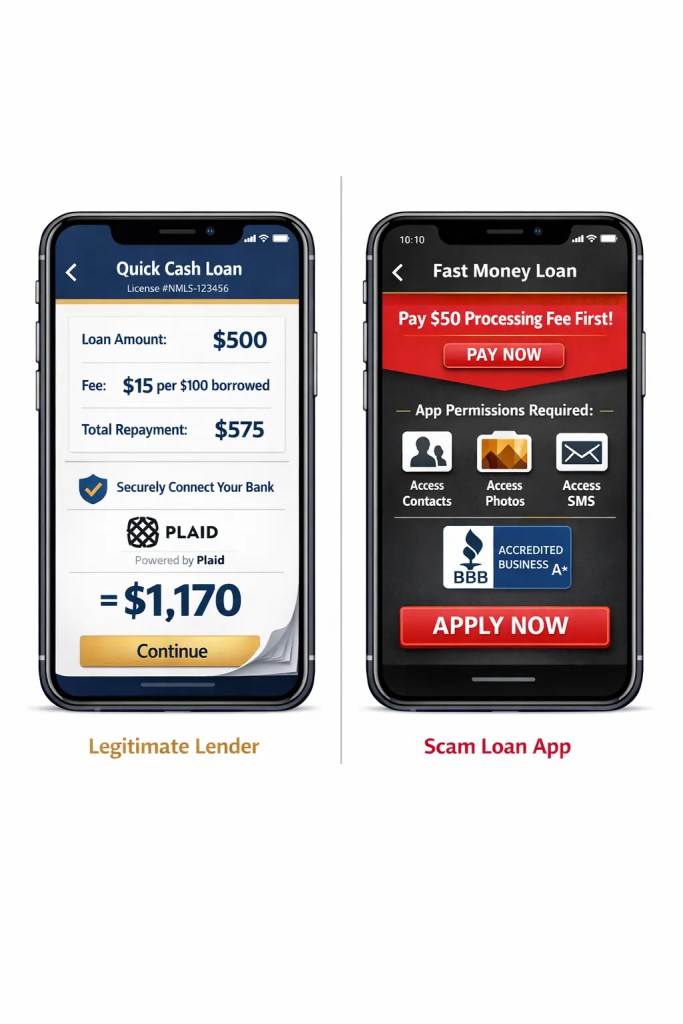
Alt Text: Side-by-side comparison of a legitimate licensed payday lender application showing license numbers and transparent fees versus a scam loan app demanding phone contacts and upfront payments
Caption: One of these is a legitimate lender. The other wants access to your grandmother’s phone number. Learn the difference.
By Laxmi Hegde, MBA in Finance · ConfidenceBuildings.com
⚠ For educational purposes only. Not financial or legal advice. I hold an MBA in Finance, but I’m not your personal financial advisor. Payday lending laws, licensing requirements, and fee structures vary significantly by state. The FTC has taken enforcement action against numerous payday lenders for deceptive practices [citation:4][citation:9]. Always verify current licensing through official state databases before borrowing. If you’re in a debt cycle, consult a nonprofit credit counselor.
The “Where Do I Even Start?” Problem
You need cash. Fast. You type “payday loan” into Google and suddenly you’re drowning in options. Speedy Cash. Check ‘n Go. CashNetUSA. Possible Finance. Fifteen apps with five-star ratings and another thirty with one-star horror stories about “scammers drained my account.”
Here’s what nobody tells you: There are two completely separate industries hiding under the same name. One is regulated, licensed, and (mostly) transparent. The other is designed to steal your data, drain your bank account, and disappear [citation:3]. The problem? They look identical on the surface.
This guide is your X-ray vision. By the time you finish reading, you’ll be able to spot a scam from 50 yards and find a legitimate licensed lender in under 10 minutes.
$505 Million
refunded by the FTC to victims of a massive payday lending fraud scheme [citation:4]
Source: FTC.gov — AMG Services Enforcement Action
Licensed Lender vs. Scam — The Visual Difference
| Feature | ✅ Licensed Direct Lender | 🚨 Scam / Broker |
|---|---|---|
| License Information | Clearly displayed with state license number. Verifiable on NMLS Consumer Access [citation:7] | Vague “licensed” claims with no verifiable number. No state registration [citation:3] |
| Upfront Fees | NEVER charges before funding. Fees deducted from loan or added to repayment [citation:8] | Demands “processing fee,” “insurance,” or “tax” before releasing funds [citation:3] |
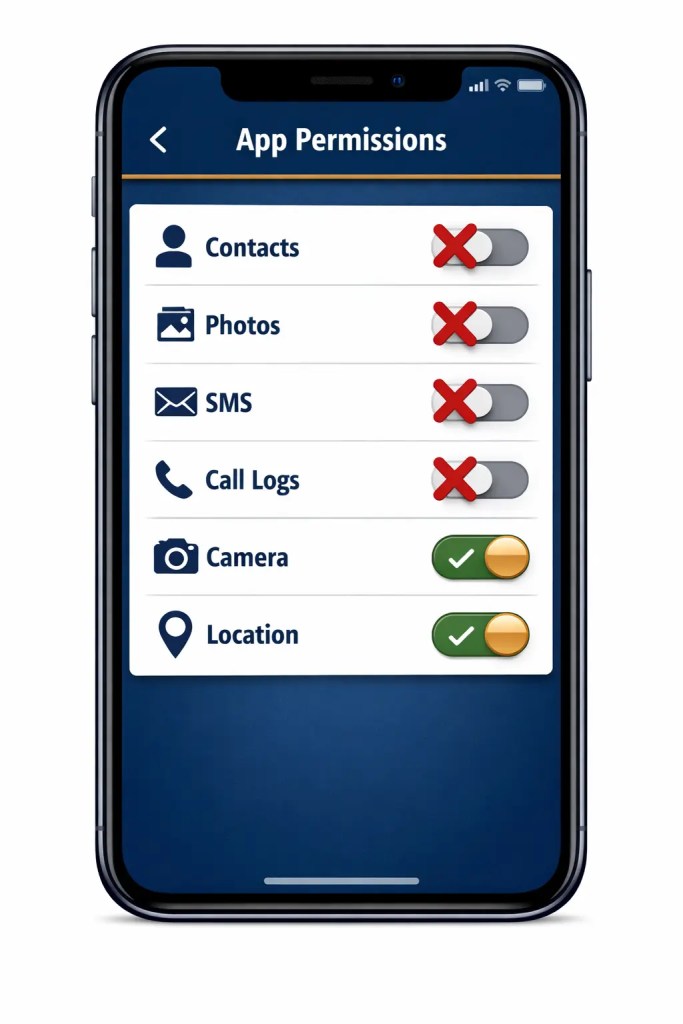
| App Permissions | Only needs: camera (for ID), location, bank login (via Plaid) [citation:5] | Requests access to contacts, photos, SMS, call logs [citation:3] |
| Fee Transparency | Clearly states $15–20 per $100 borrowed. Total repayment amount shown before signing [citation:10] | Vague about costs. “Low fees” with no dollar amounts. Buried terms [citation:6] |
| Contact Info | Physical address, working customer service phone, real email [citation:5] | Only WhatsApp, Telegram, or generic contact form [citation:8] |

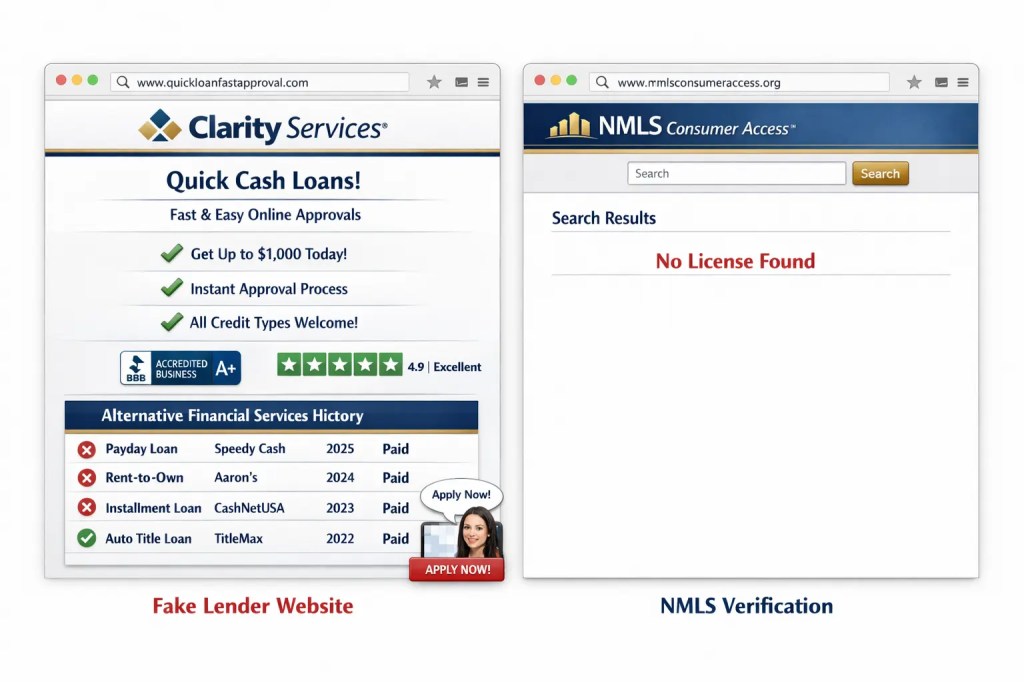
Alt Text: NMLS Consumer Access website showing a verified payday lender license with active status · Caption: This is what a valid license looks like. If you can’t find this, run.
Verify Here : https://nmlsconsumeraccess.org
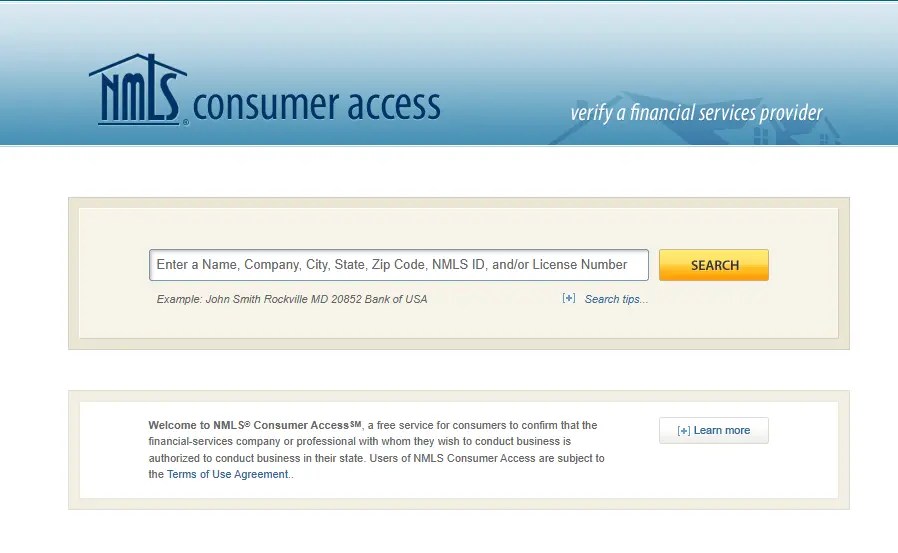

🔍 Step 1: Verify the License (Do This First)
Every legitimate lender must be licensed in the state where you live. Here’s exactly how to check — in 3 minutes.
📍 Step 1A: Find the Lender’s Legal Name
Look at the bottom of their website or in their app’s “About” section. You need the exact legal business name — not the brand name. “Speedy Cash” is a brand. The legal entity might be “QC Financial Services, Inc.” [citation:1]
📍 Step 1B: Go to NMLS Consumer Access
Visit nmlsconsumeraccess.org — this is the official Nationwide Multistate Licensing System database [citation:7]. Type the legal business name into the search bar.
📍 Step 1C: Check Three Things
- Status: Must say “Active” — not “Inactive” or “Revoked”
- State: Your state must be listed under “Licensed to do business in:”
- Type: Should say “Payday Lender” or “Consumer Loan Company” — not just “Mortgage”
🔴 If You CAN’T Find Them in NMLS
Some lenders are regulated by individual states, not NMLS. In that case, go to your state banking department website and search their “Licensed Lenders” database. If they’re not in either database — stop. They’re operating illegally.
🔍 Beyond NMLS: State-Level Verification
While the NMLS database covers most licensed lenders, some operate under state-specific regulatory bodies. Legitimate lenders must be registered with their state’s banking or financial protection department before issuing a single loan. This is non-negotiable compliance — not optional marketing.
Here’s where to verify licenses in key states (because most “payday loan blogs” never tell you this — they’re too busy collecting affiliate commissions):
⚡ Here’s what makes this guide different: Most websites claiming to help you find payday lenders are actually affiliate lead funnels — they get paid when you apply, regardless of whether the lender is licensed or ethical. This guide contains zero affiliate links. Our focus is borrower education, scam prevention, and regulatory verification — the three things that actually protect you. If more sites did this, 80% of payday loan blogs would become obsolete overnight.
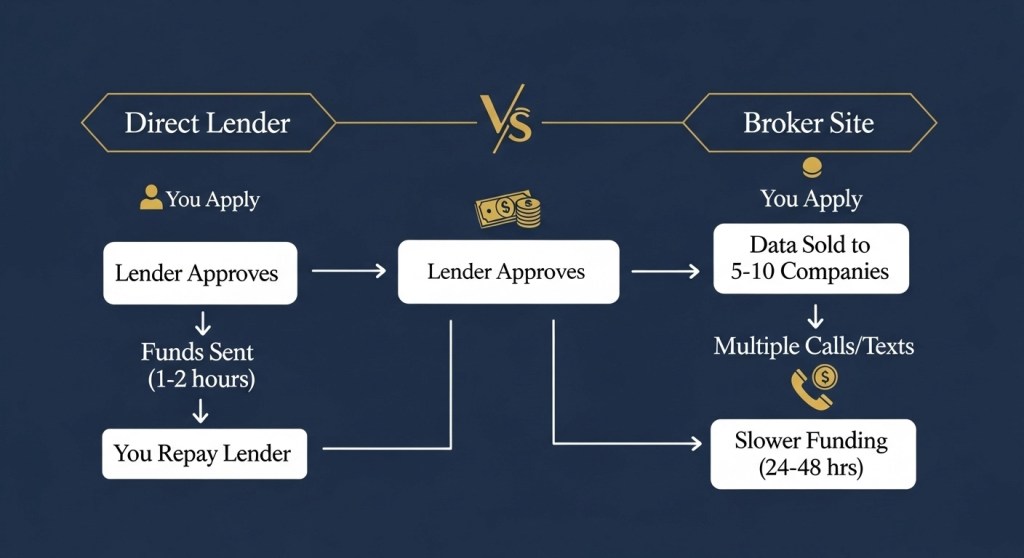
🔄 Step 2: Direct Lender vs. Broker — Why It Matters
✅ Direct Lender
- Funds you with their own money
- Sets the terms and fees
- You repay them directly
- Your data stays with one company
- Faster funding (1–2 hours) [citation:10]
🚨 Broker (Lead Generator)
- Sells your application to multiple lenders
- Your data goes to 5–10 companies
- Spams you with calls/texts
- Slower funding (24–48 hours)
- May charge a “finding fee”
How to spot a broker: Look for phrases like “we connect you with lenders,” “network of partners,” or “we are not a lender.” If the fine print says they’re a “credit access business” (in Texas) or “credit services organization” — that’s broker-speak.

Alt Text: Decision flowchart comparing direct lender path (one company, faster funding) versus broker path (data sold, slower funding) · Caption: Direct lender = one stop. Broker = your data goes to 10 companies you never heard of.
Your Decision Path to a Safe Loan
Frequently Asked Questions
How do I know if a payday lender is licensed in my state?
The only official way to verify a lender’s license is through the Nationwide Multistate Licensing System (NMLS) at nmlsconsumeraccess.org. Search the lender’s legal business name — if they’re not listed, check your state banking department’s website. Legitimate lenders must be licensed in every state where they operate. If you can’t find them in either database, they are likely operating illegally.
What’s the difference between a direct lender and a broker?
A direct lender funds your loan with their own money — you apply with them, they approve you, they send the cash. A broker (also called a “lead generator”) collects your information and sells it to multiple lenders. Brokers often advertise “instant approval” but you’re actually waiting for someone to buy your application. Direct lenders are faster and your data stays with one company. Brokers can sell your info to 5–10 lenders, leading to spam calls and texts.
Is it normal to pay an upfront fee before getting a payday loan?
No. Never. Legitimate payday lenders NEVER charge upfront fees before funding your loan. Any request for a “processing fee,” “insurance payment,” or “tax” before you receive money is a guaranteed scam. The FTC has recovered millions for victims of advance-fee loan scams. Fees should be deducted from the loan amount or added to your repayment — never paid separately upfront.
Why do some payday lenders ask for access to my contacts and photos?
Because they’re not legitimate lenders — they’re data harvesters or scammers. A real payday lender only needs: your ID (for verification), proof of income, and your bank account information (usually via secure services like Plaid). Any app requesting access to your contacts, photos, call logs, or SMS is gathering data to sell or using it to harass you if you’re late on payments. The CFPB has taken enforcement action against lenders using “digital harassment” tactics. Deny these permissions immediately.
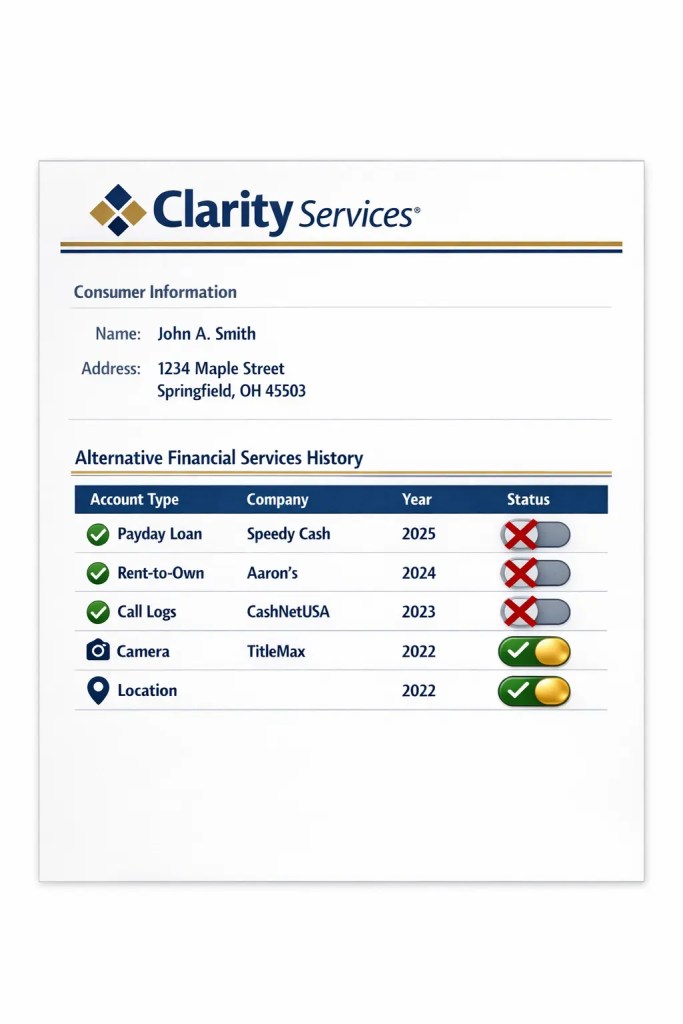
What is Clarity Services and why do payday lenders use it?
Clarity Services is a “subprime credit bureau” owned by Experian. Most payday lenders don’t check traditional credit scores (FICO) — they check Clarity. It tracks your history with alternative financial products: past payday loans, rent-to-own payments, BNPL accounts, and whether you’ve defaulted. A negative Clarity report can block you from getting approved. You can request a free annual report from Clarity just like traditional credit bureaus.
How fast is “instant funding” really?
“Instant” in payday lending means: approval in minutes, money in your account within 1 business day. Some lenders offer “same-day funding” if you apply before a cutoff time (usually 10:30 AM CT). If you apply on a weekend or holiday, funds won’t arrive until the next business day. The fastest real-world timeline is 1–2 hours for established customers. Anyone promising money “in 5 minutes” is likely trying to rush you past the fine print.
Is payday lending legal in every state?
No. Payday lending is illegal in 13 states and Washington D.C.: Arizona, Arkansas, Colorado, Connecticut, Georgia, Maryland, Massachusetts, Montana, New Hampshire, New Jersey, New York, Pennsylvania, Vermont, and West Virginia. In these states, lenders cannot offer payday loans at all. If you live in one of these states and see a “payday loan” advertised online — it’s either illegal or a scam. You may still qualify for installment loans with lower rates.
What should I do if I think a lender scammed me?
File a complaint immediately with both the Consumer Financial Protection Bureau and the Federal Trade Commission. The CFPB handles individual lender complaints and will forward them to the company for response. The FTC tracks patterns of fraud and uses consumer complaints to build enforcement cases. If you paid with a debit card, contact your bank immediately to dispute the charge. If you gave them access to your bank account, close the account and open a new one.
⚠ For educational purposes only. Not legal advice. Laws and regulations regarding payday lending vary by state and change frequently. Always verify current licensing through official state databases before borrowing. If you’re in financial distress, consult a nonprofit credit counselor through the National Foundation for Credit Counseling (NFCC.org).

Alt Text: FAQ visual guide showing common questions about payday lender licensing with CFPB and FTC verification sources highlighted · Caption: The questions scammers hope you never ask — and the .gov sources that protect you.
Reader Story · Composite Account
“I Googled ‘licensed payday lender,’ clicked the first ad, and applied. Three days later, my bank account was drained by a ‘company’ I’d never heard of.”
Marcus, 29, needed $400 for an emergency car repair. He searched “payday loans near me,” clicked the first sponsored result, and filled out an application. The website looked professional — logo, customer service chat, even fake Better Business Bureau seals. He received an “approval” email asking for a $75 “processing fee” via wire transfer. Desperate, he paid it. The loan never arrived. Three days later, he noticed $200 missing from his account — the scammer had kept his banking info and was testing small withdrawals. By the time he caught it, they’d taken $600 total.
HIS MISTAKE
Trusted a Google ad without verification. Paid an upfront fee (automatic scam red flag). Didn’t check NMLS or state licensing database first.
WHAT HE COULD HAVE DONE
Verified the lender’s license on nmlsconsumeraccess.org first. Remembered: legitimate lenders NEVER charge upfront fees. Used a credit union PAL instead.

Alt Text: Fake website with BBB seal vs NMLS database showing “No License Found” · Caption: The website looked real. The license check showed the truth.
Attorney Rachel Morrow · Consumer Rights · Educational Illustration Only
“The ‘advance fee’ loan scam is the oldest trick in the book — and it still works because desperation overrides logic. Under federal law (Telemarketing Sales Rule), it is illegal for any lender to demand payment before providing a loan. Period. If you paid with a debit card, you have 60 days to dispute the charge under EFTA (Electronic Fund Transfer Act). If you gave them your bank account numbers, call your bank immediately and revoke authorization.”
Legal Analysis: The Telemarketing Sales Rule (16 CFR Part 310) explicitly prohibits requesting or receiving payment before a loan is provided. This is a federal violation. The FTC has brought dozens of enforcement actions under this rule, recovering millions for victims. If you paid via wire transfer, recovery is harder but not impossible — file a complaint with the FTC immediately and contact your state attorney general’s office.
Bottom Line: Any request for upfront payment = automatic scam. Hang up. Close the tab. Report it to reportfraud.ftc.gov.
Reader Story · Public Case Record
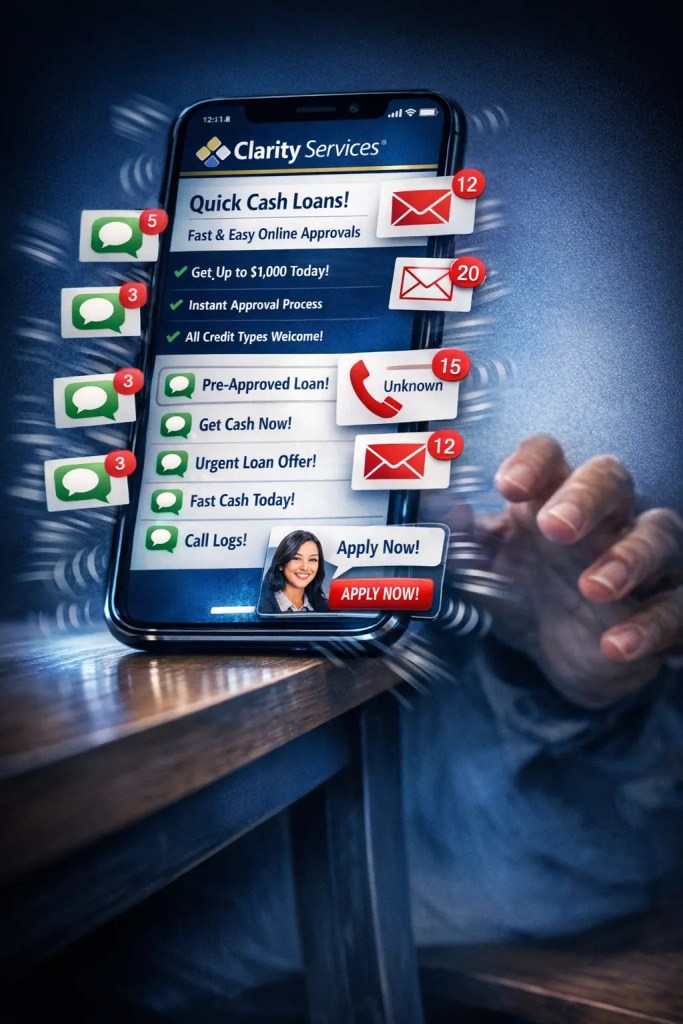
“I applied on a site called ‘InstantLoanMatch.com.’ Within an hour, I got 17 phone calls and 43 text messages from lenders I never heard of.”
Drawn from CFPB consumer complaint records (2025). Sites with names like “LoanMatch,” “LenderNetwork,” or “InstantApprovalNow” are almost always lead generators — brokers that collect your data and sell it to the highest bidder. One consumer complaint filed with the CFPB described entering their information on such a site and immediately receiving dozens of calls, texts, and emails from lenders she’d never heard of. Several demanded upfront fees. One called her workplace. Her data had been sold to at least 12 different companies within minutes.
THE TRAP
Broker sites look like lenders but are actually data harvesters. Your info gets sold to multiple companies instantly — including scammers.
HOW TO SPOT THEM
Look for fine print: “We are not a lender. We connect you with lenders.” If you see that, close the tab. Only apply on direct lender websites.

Alt Text: Smartphone screen with dozens of text messages and missed calls · Caption: One application. Twelve companies. Zero privacy.
Attorney Rachel Morrow · Consumer Rights · Educational Illustration Only
“Lead generators are the parasites of the lending industry. They make money not by helping you get a loan — but by selling your desperation to the highest bidder. In October 2025, the FTC finally started taking enforcement action against the worst offenders under the new ‘Lead Generator Rule.’ If a site claims to be a lender but isn’t, that’s deceptive advertising under Section 5 of the FTC Act.”
Legal Analysis: The FTC’s October 2025 enforcement action against major lead generators established new guidelines: sites must clearly disclose they are not lenders before collecting data. If you were misled, you can file a complaint with the FTC. Some states (California, Colorado, Virginia) have also passed data privacy laws giving you the right to demand companies delete your information — including lead generators.
Bottom Line: Read the fine print before you hit submit. If they’re not the lender, they’re selling you.
Reader Story · Success Story
“I almost gave up after three scam attempts. Then I used the NMLS database, found a licensed lender in my state, and had money in my account in 4 hours.”
Tanya, 52, had been scammed twice trying to get a $500 loan for her grandson’s school supplies. The first asked for a $50 “application fee.” The second sent her a fake approval letter demanding $100 in “insurance.” She was ready to give up. Then she found this blog (yes, really — a reader sent this story in). She followed the steps: checked NMLS Consumer Access, found a licensed direct lender in her state, verified their physical address and phone number, and applied. She received $500 in her account within 4 hours. The total fees: $75. She repaid it in full in two weeks.
WHAT SHE DID RIGHT
Verified license first. Checked for upfront fees (none). Confirmed physical address. Called customer service before applying to see if a human answered.
THE RESULT
Funded in 4 hours. Paid $75 in fees. No spam calls. No hidden charges. She now has a relationship with a legitimate lender if she ever needs help again.

Alt Text: Woman smiling at phone showing bank deposit notification · Caption: It IS possible. Verification first, funding second.
Attorney Rachel Morrow · Consumer Rights · Educational Illustration Only
“Tanya’s story proves something important: legitimate payday lending exists. It’s expensive — don’t get me wrong — but it’s regulated, licensed, and predictable. The problem is that scammers have flooded the space, making it nearly impossible for desperate borrowers to distinguish between a real lender and a fake one. The NMLS database is your shield.”
Legal Analysis: Licensed lenders are subject to state usury laws, fee caps, and disclosure requirements under TILA (Truth in Lending Act). Scammers face none of those constraints. The difference isn’t just safety — it’s legal accountability. A licensed lender can be sued, reported, and regulated. A scammer disappears. Always verify.
Bottom Line: Verification takes 5 minutes. It’s the most important 5 minutes of your borrowing journey.
Have your own payday lender story — good or bad? We’re collecting reader experiences to help others spot scams and find legitimate lenders. Your story could be featured in a future update (anonymously, of course). Share it at stories@confidencebuildings.com.
Licensed Lender Verification Checklist
Printable 11-step checklist to keep by your computer:
Free · No sign-up required · ConfidenceBuildings.com · Pairs with Episode 13

🗺️ Is Payday Lending Legal in Your State? (2026)
Before you spend time applying, check if payday loans are even allowed where you live. In 13 states + DC, they’re completely illegal. In others, rate caps and restrictions apply.
🚫 ILLEGAL (13 + DC)
⚠️ RATE CAPS (36% or lower) · 17 states
🔥 HIGH RATES (300%+ APR) · 20 states
⚡ If you live in a red state, payday loans aren’t just hard to find — they’re illegal.
Sources: Pew Charitable Trusts, Consumer Financial Protection Bureau, National Conference of State Legislatures (NCSL), 2026 data. Laws change frequently — verify with your state banking department.
This article is part of the ConfidenceBuildings.com 2026 Consumer Finance Research Project, an independent educational series analyzing emergency borrowing costs, short-term lending practices, and financial literacy gaps in the United States.
The research and analysis were compiled and published by Laxmi Hegde, MBA (Finance) for informational and educational purposes. Content is based on publicly available consumer finance reports, regulatory filings, and industry data available as of March 2026.
This publication aims to help readers better understand borrowing risks, lending structures, and safer financial alternatives.
View the complete 30-day research series →
Your Loan Is ‘Due’ — But the Trap Is Just Getting Started
Your Loan Is ‘Due’ —
But the Trap Is Just Getting Started
Lenders call it a “renewal offer.” What it actually does is reset your debt clock, add new fees, and lock you into another cycle — all while sounding like they’re doing you a favour.
- How loan renewal offers are designed to trap — not help — you
- The exact language lenders use to make renewal sound reasonable
- What the “evergreen clause” is and how to spot it in your contract
- The fee math that makes renewal the most expensive decision you can make
- Three steps to refuse renewal and exit the cycle instead
⚠ For educational purposes only. Not legal advice. The information on this page is intended to help consumers understand how loan renewal offers work. Laws governing loan renewals, rollovers, and extended payment plans vary significantly by state and lender. Always verify current terms directly with your lender and consult a licensed financial counselor or attorney before making any borrowing decision. The CFPB and FTC are referenced for informational purposes only — neither agency endorses this content.
The Fine Print Files
You found the loan. You signed the agreement. But buried in that contract are clauses lenders wrote for their benefit — not yours. Week 3 goes through the fine print that has cost borrowers thousands, one clause at a time. Today we cover the renewal trap: the mechanism that turns a short-term loan into months of debt.
- ✅ Day 15 — Loan Clause Checklist: The Exact Clauses to Find Before You Sign
- ✅ Day 16 — You Signed Away Your Right to Sue
- ✅ Day 17 — Variable Rate Loans: Why Your Monthly Payment Could Suddenly Skyrocket
- ✅ Day 18 — Auto-Pay Loan Traps: What Lenders Can Do With Your Bank Account
- ✅ Day 19 — You Have 29 Days. Then It Gets Ugly.
- ✅ Day 20 — Medical Debt Survival Guide
- ▶ Day 21 — Your Loan Is ‘Due’ — But the Trap Is Just Getting Started (you are here)
Before You Sign Anything — Use This Checklist
The Loan Clause Checklist identifies the exact clauses lenders hope you never find — including the renewal and evergreen clauses covered in today’s post. It takes 10 minutes to use and could save you hundreds. Free. No email required.
- The auto-renewal / evergreen clause — exact wording to search for
- Mandatory arbitration clause — what it removes from your rights
- Prepayment penalty — how to find it before you sign
- ACH authorization language — what lenders can pull from your account
- 10 more clauses with plain-English translations
A loan renewal offer is when a lender contacts you near your due date and offers to extend — or “renew” — your loan for another term. It sounds helpful. What it actually does is wipe out any progress you’ve made, charge a fresh round of fees, and restart your repayment clock from zero. Most borrowers who accept one renewal accept several. That is not an accident — it is the business model.
How the Renewal Trap Works
Here is the scenario that plays out millions of times every year. You took out a $400 payday loan two weeks ago. Your due date is tomorrow. The lender sends you a text — sometimes an email, sometimes a phone call — letting you know your loan is coming due. Then comes the offer: “Would you like to renew for another two weeks? Just a small fee.”
The “small fee” is typically $15–$20 per $100 borrowed. On a $400 loan, that is $60–$80. You never touch the principal. You pay $60 to buy yourself two more weeks — and in two more weeks, the same offer arrives again.
| Renewal # | Fee Paid | Total Fees Paid | Still Owe |
|---|---|---|---|
| Original loan | $60 | $60 | $400 |
| Renewal 1 | $60 | $120 | $400 |
| Renewal 2 | $60 | $180 | $400 |
| Renewal 3 | $60 | $240 | $400 |
| Renewal 4 | $60 | $300 | $400 |
After 4 renewals you have paid $300 in fees and still owe every dollar of the original $400. The lender has collected 75% of the loan value in fees alone — without reducing your balance by a single cent.
The Evergreen Clause — The Fine Print That Renews You Automatically
Some lenders do not even bother making an offer. They include an evergreen clause — also called an auto-renewal clause — directly in the loan agreement. Unless you take a specific action to cancel before your due date, the loan renews automatically and a new fee is charged to your account.
Most borrowers never see this clause because it appears deep in the agreement — sometimes on page 4 or 5 of a document most people never finish reading. The cancellation window is often just 3–5 days before the renewal date, which means by the time you realise what happened, the fee has already been processed.
Loan agreements rarely use the word “evergreen.” Instead, look for language like:
- “This loan will automatically extend unless written notice is provided…”
- “Borrower authorises renewal of this agreement at the end of each term…”
- “Failure to repay in full will result in automatic rollover…”
- “Renewal fee will be debited on the due date unless cancellation is requested…”
📋 The Loan Clause Checklist shows you exactly where to look for this language in your agreement.
The Language Lenders Use — And What It Actually Means
Renewal offers are carefully worded to sound like customer service. Here is a translation guide for the most common phrases:
Three Steps to Refuse Renewal and Exit the Cycle
Accepting a renewal is always optional — even when it doesn’t feel that way. Here is the three-step process to decline and start reducing the actual balance instead.
Many states legally require payday lenders to offer an Extended Payment Plan — a structured repayment schedule that lets you pay back the principal over multiple instalments with no additional fees. Lenders are not required to advertise this option. You must ask for it directly, in writing, before your due date. Search “EPP + [your state]” or check your state’s financial regulator website to confirm whether your lender is required to offer one.
If your lender has electronic access to your bank account — which most payday lenders do — they can process a renewal fee without your active consent if an evergreen clause ex


 Home Home sweet sweet home